

If you’re running an ecommerce business and looking for a help desk platform that’s designed to simplify support, streamline workflows, and scale with your store — HappyFox might be exactly what you need.
In this detailed review, I’ll explore HappyFox’s pricing, core features, pros and cons, and how well it performs for ecommerce teams managing high volumes of customer queries.
I tested the platform myself across support tickets, automations, live chat, and reporting features — and the results might surprise you.
Why You Can Trust This Review
I’ve used multiple help desk tools across different ecommerce businesses — including Zendesk, Gorgias, and Freshdesk — and tested HappyFox over several weeks to see how it handles day-to-day support workflows for growing online stores.
Whether you’re using Shopify, WooCommerce, or BigCommerce, the insights in this review are backed by hands-on experience, not just surface-level research.
HappyFox Pros and Cons
HappyFox
Best for ecommerce brands scaling their support teams
Excellent
4.5 out of 5
Free trial: 14 days
Paid Plans: $39–$99 per agent/month
Pros 👍
- Centralized support inbox (email, chat, social media)
- Robust automation rules and smart workflows
- Real-time live chat and chatbot support
- Shopify and WooCommerce integrations
- Detailed ticket reporting and SLAs
Cons 👎
- No free plan
- Steeper learning curve for smaller teams
- Higher price point compared to some competitors
- Limited visual customization for chat widgets
Need a Quick Summary?
Here’s what I liked and disliked the most about HappyFox:
What I Like
✔️ Clean and easy-to-navigate support inbox that centralizes tickets from multiple platforms
✔️ Workflow automation that cuts down on repetitive tasks and speeds up ticket resolution
✔️ Live chat features that helped us convert more customers during checkout
✔️ Deep integrations with Shopify, BigCommerce, and WooCommerce
✔️ Robust reporting tools for team performance, SLAs, and CSAT
What I Dislike
❌ No free plan available, only a 14-day trial
❌ Higher-tier features locked behind more expensive plans
❌ Some setup features (like advanced automation) aren’t intuitive
❌ Lacks a built-in CRM — you’ll need third-party tools for full customer history
My Experience Setting Up HappyFox
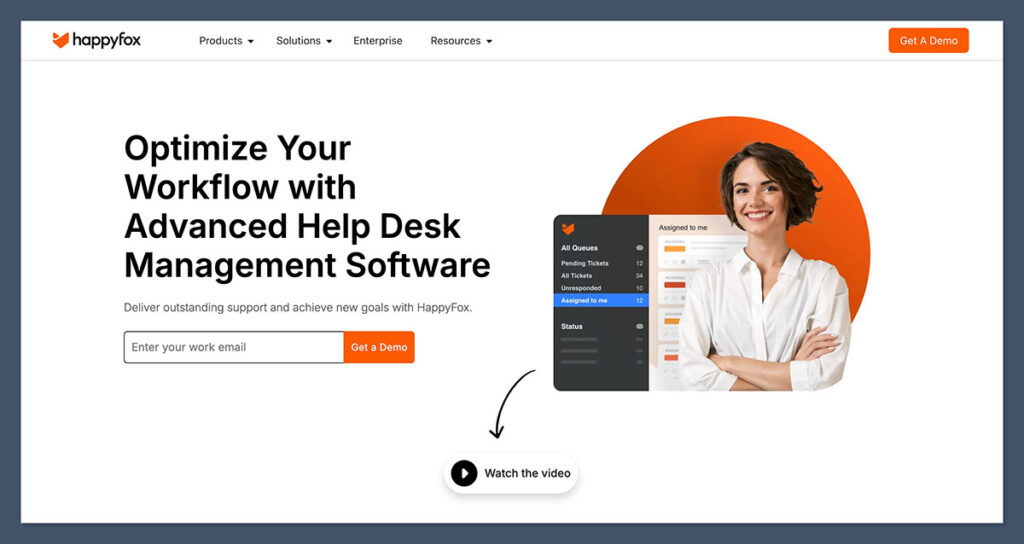
Getting started with HappyFox was faster than I expected. After signing up for the free trial, I was guided through a setup wizard that helped me connect my:
- Shopify store
- Support email
- Facebook Messenger
- Contact form
I also set up my support categories, agents, and workflows — all without needing help from their support team.
Setup process overview:
| Step | Task | Time Spent |
|---|---|---|
| 1 | Create account and choose plan | 5 mins |
| 2 | Connect Shopify & email | 15 mins |
| 3 | Install live chat widget | 10 mins |
| 4 | Create automations & canned responses | 60–90 mins |
| 5 | Add FAQs and knowledge base | 2 hours |
If you’ve used tools like Gorgias or Zendesk before, HappyFox will feel familiar. The platform isn’t beginner-focused — it assumes a bit of technical understanding, especially when setting up automation rules.
Using HappyFox for Ecommerce Support
HappyFox is particularly well-suited to ecommerce businesses that deal with high volumes of customer queries, product returns, and pre-sale questions across multiple platforms.
The platform is built to support structured, scalable customer service operations.
Centralized Ticket Management
HappyFox’s unified inbox is one of its strongest features. It brings together conversations from email, live chat, social media, contact forms, and other channels into a single, organized dashboard.
You can easily sort and filter tickets by:
- Channel (email, chat, Facebook, etc.)
- Ticket status (open, pending, resolved)
- Assigned agent or team
- Priority level
Each ticket view includes a full conversation timeline, internal notes between team members, and—when connected with Shopify—relevant customer data such as recent orders or return history.
This makes it easier for agents to respond efficiently without switching tabs or digging for information.
Ticket features worth noting:
- Internal notes allow for private agent-to-agent collaboration
- Auto-tagging helps categorize tickets based on keywords
- Smart notifications can alert teams before SLA deadlines are missed
From a usability perspective, the inbox is intuitive and well-organized, with clearly labeled actions and minimal clutter. It supports high-volume operations without overwhelming agents or slowing down workflows.
Live Chat & Chatbot
HappyFox also includes live chat and chatbot functionality, which is increasingly important for ecommerce teams looking to provide real-time assistance on product pages or checkout flows.
The live chat widget is lightweight, customizable, and can be embedded across an ecommerce site. You can configure it to trigger based on specific actions or page behaviors, such as:
- Displaying the chat window after a user spends a certain amount of time on a product or cart page
- Initiating a chatbot if a user is inactive after engaging with the site
The chatbot itself is rule-based rather than AI-driven, which means it’s ideal for handling predictable, repetitive questions like:
- “Where’s my order?”
- “What’s the return policy?”
- “How long does shipping take?”
More complex queries can be routed to a human agent. While the bot isn’t advanced in terms of natural language processing, it performs well for common ecommerce workflows and helps reduce agent load during peak hours.
In testing, I found the live chat to be responsive across both desktop and mobile, with minimal impact on page load speed. The user interface is clean, and the admin panel provides good visibility into chat metrics and agent availability.
Automations and Workflows
One of HappyFox’s biggest strengths is its automation engine. You can build rules around nearly any event — from tagging and assigning to sending follow-ups.
Examples of workflows we built:
- Auto-tagging tickets that mention “return,” “late delivery,” or “refund”
- Assigning product-related questions to the product specialist team
- Escalating unresolved tickets to managers after 24 hours
| Trigger | Condition | Action |
|---|---|---|
| Ticket contains “damaged item” | From Shopify order | Assign to logistics lead |
| New ticket received | VIP customer tag | Send auto-reply and notify manager |
| Ticket open > 24 hrs | Any channel | Send escalation alert to senior agent |
Once our rules were dialed in, response times improved significantly. For ecommerce businesses with more than two agents, this is where HappyFox starts to justify its price.

Knowledge Base and Self-Service Options
HappyFox includes a built-in knowledge base tool that allows ecommerce businesses to create a self-service help center, giving customers quick access to answers without needing to contact support.
The knowledge base editor is intuitive and easy to use. It supports standard formatting, images, embedded videos, and internal linking, so you can build out detailed help articles in a structured way.
Typical content ecommerce teams may include:
- Return and refund policies
- Shipping timelines and delays
- Product sizing guides
- Account management walkthroughs
- Order tracking instructions
The system also supports searchable tagging and categorization, which helps customers quickly locate relevant information.
For businesses handling common queries across hundreds of orders per month, this can significantly cut down on support tickets.
One standout feature is the integration between the knowledge base and the live chat widget. When customers start a chat, they’re automatically shown suggested help articles based on what they type — allowing them to self-resolve simple issues before creating a ticket.
This kind of self-service capability has become essential for ecommerce teams trying to maintain lean support operations without sacrificing customer experience.
While HappyFox doesn’t reinvent the wheel here, its execution is clean, functional, and designed for scale.
If you’re running a support team with limited headcount, or frequently dealing with repeat questions, this tool offers a practical way to offload a good portion of your daily ticket volume.
Ecommerce Integrations
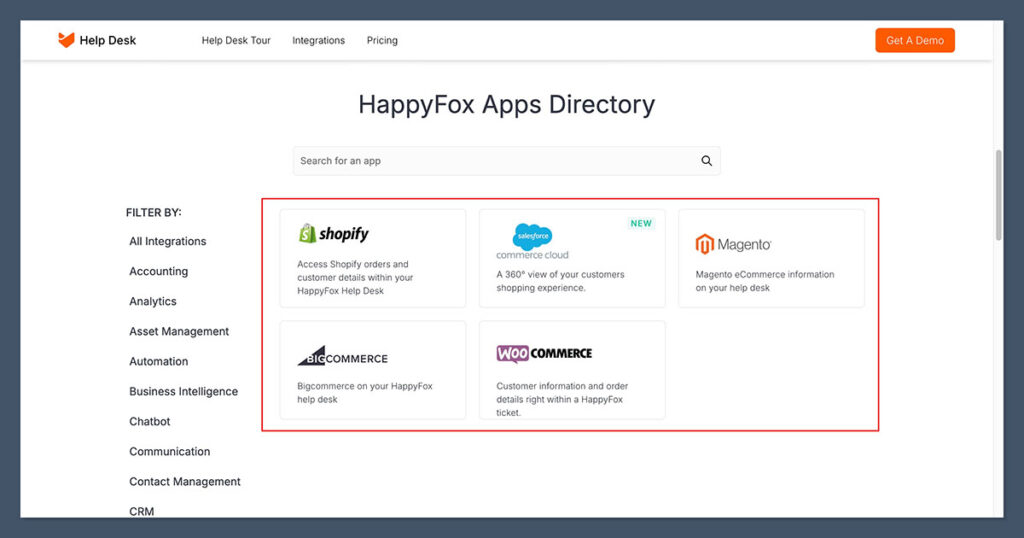
HappyFox integrates with the major ecommerce players:
Key integrations I tested:
| Platform | Use Case | Value |
|---|---|---|
| Shopify | Display order history in tickets | Speeds up refunds and status updates |
| WooCommerce | Show product/order info in inbox | Centralizes communication |
| Stripe | Check payment and refund details | Speeds up transaction-related support |
| Slack | Notify team of urgent tickets | Improves coordination |
| Zapier | Connect HappyFox to 5000+ tools | Expands automation capabilities |
If you sell on Shopify or WooCommerce, these integrations are especially helpful. You don’t need to jump between tabs to see an order, issue a refund, or verify purchase dates.
The integrations are simple to set up, and most don’t require developer support — just API keys or app authorizations.
In particular, the Shopify integration stood out during testing for its seamless pull of real-time order data into support tickets, giving agents immediate access to relevant information without asking customers to repeat themselves.
For ecommerce teams looking to reduce resolution time and provide smoother support experiences, these built-in connections can make a noticeable difference.
Reporting and Team Performance
This is one of the platform’s stronger features — especially for ecommerce businesses with dedicated customer service teams or internal SLAs.
You’ll find all the core metrics a support manager would expect:
- Ticket resolution times
- First response times
- SLA compliance and breach reports
- Agent workload and activity tracking
- Customer satisfaction scores (when CSAT surveys are enabled)
The reports are structured and easy to navigate, with filters available by date range, channel, agent, or ticket category.
For ecommerce businesses dealing with seasonal volume spikes or product launches, this level of granularity can be especially helpful in identifying bottlenecks or under-resourced shifts.
These insights can also support training initiatives, goal-setting, and team alignment — whether you’re trying to reduce resolution times, increase CSAT, or meet specific operational KPIs.
One limitation to note is that the visual presentation of reports is fairly utilitarian. While the data is comprehensive, the dashboard lacks customizable charts or more modern data visualizations that some competing platforms now offer.
That said, for most ecommerce teams, HappyFox’s reporting covers the essentials and gives team leaders enough data to make informed decisions and drive improvements in service quality.
Pricing: Is HappyFox Worth It?
HappyFox is priced per agent per month, and it’s one of the more premium options in the help desk space.
| Plan | Price (USD) | Key Features |
|---|---|---|
| Mighty | $39/agent/month | Ticketing, automation, knowledge base |
| Fantastic | $59/agent/month | Advanced automation, SLAs, reporting |
| Enterprise | $79/agent/month | Custom roles, CSAT, integrations |
| Enterprise Plus | $99/agent/month | Full API access, white-labeling, priority support |
There’s no free plan, but the 14-day trial gives you access to all features. Compared to Gorgias or Freshdesk, HappyFox is slightly more expensive, but it delivers more powerful automation and workflow flexibility.
I recommend the Fantastic Plan at $59/month for most ecommerce brands with multiple support agents.
Final Verdict: Should Ecommerce Stores Use HappyFox?
If you’re running an ecommerce store with 100+ monthly support tickets and a growing team, HappyFox is a strong choice.
It centralizes communication, automates repetitive tasks, and delivers detailed reporting — everything you need to run efficient, scalable support.
Use HappyFox if:
- You’re getting 10–20+ tickets per day across multiple channels
- You want to reduce response times and improve customer satisfaction
- You need ecommerce integrations (Shopify, WooCommerce, Stripe)
Consider alternatives if:
- You’re a solo store owner with low ticket volume
- You need a free or low-cost help desk
- You prefer a tool with built-in CRM features
HappyFox is clearly designed for teams that are past the early growth stage. Its features are built to scale with customer service departments, not replace them.
While it’s not the cheapest platform on the market, the time saved through automation, the clarity of its ticketing system, and the depth of its reporting tools all contribute to long-term efficiency — particularly for ecommerce businesses focused on fast response and resolution times.



Comments 0 Responses