

Best for Content-Led Stores

WooCommerce
View Pricing Read Review →Free plugin (hosting extra)
Free to install; most hosts offer a 30-day money-back guarantee
- 0% platform transaction fee on any gateway
- No product or sales caps
- Flexible WordPress URLs and blogging
Best for Design Freedom

Wix
View Pricing Read Review →$29/month (Core, billed yearly)
Free plan to build; 14-day money-back guarantee
- Free-form drag-and-drop editor
- 0% platform fee, up to 50,000 products
- Free domain for 1 year on yearly plans
Best for Products, Services and Memberships

Squarespace
View Pricing Read Review →From $19/month (billed yearly)
14-day free trial; 0% transaction fee from Core ($29)
- About 200 templates, all included
- Unlimited products on every plan
- Sell products, services and memberships
Shopify is still the best ecommerce platform we rank, thanks to its sales tools, 24/7 chat support, and over 16,000 apps. But its strongest features may not justify your bill.
If Shopify’s pricing, paid apps, third-party payment fees, or section-based editor frustrate you, these Shopify alternatives solve different problems. Basic costs $29/month billed yearly or $39 monthly, before extras. Which competitor fixes your biggest frustration without taking away tools you need?
Key Takeaways 🔍
- Shopify remains the strongest all-round option, but its 2% fee on third-party gateways on Basic can make payment flexibility expensive.
- WooCommerce is my best Shopify alternative overall: its free plugin charges no platform fee, whichever payment gateway you choose.
- Wix and Squarespace offer straightforward hosted swaps, with 0% physical-product platform fees on their main selling plans from $29/month billed yearly.
- You can sell for $0 a month with Square Online Free or Big Cartel Gold. Big Cartel limits you to five products.
- BigCommerce is no longer universally fee-free: its June 2026 changes lowered sales caps and added fees on non-embedded payment providers.
📢 Read about the recent updates I’ve made to this page
I updated this page on November 17, 2026, expanding six picks to nine, adding Ecwid, Square Online, Big Cartel, and GoDaddy, and moving Shift4Shop, whose free plan depends on Shift4 Payments, to the FAQs. Prices reflect Squarespace’s July rise, Ecwid’s March increase, and BigCommerce’s June changes. I also added migration guidance and product updates, and refreshed Shopify’s details: Starter is closed to new stores; its trial is three days free, then $1/month for three months.
🧪 How we test for the best Shopify alternatives
I rank these platforms using published pricing, plan limits, help documentation, Ecommerce-Platforms’ reviews, and user feedback on Trustpilot, G2, and Capterra. Cost and fees carry the most weight, reflecting the problems this comparison addresses. The How We Test Ecommerce Platforms section below explains the criteria in full.
Comparing Shopify Alternatives
Compare nine Shopify alternatives by cost and fit. Prices billed yearly unless noted, in USD as of November 2026.
| Platform | Rating | Starting price | Transaction fees | Better than Shopify for | Free custom domain | AI builder | Recommended for |
|---|---|---|---|---|---|---|---|
| WooCommerce | 4.5 | Free plugin (plus hosting) | 0% platform fee | No platform fee on any gateway, flexible URLs | Depends on your host | No native builder | WordPress users and content-led brands |
| Wix | 4.4 | $29/mo (Core) | 0% platform fee | Free-form drag-and-drop design | Yes, 1 year on most yearly plans | Yes (Wix Harmony) | Beginners who want design freedom |
| Squarespace | 4.3 | $19/mo (Basic) | 2% on Basic, 0% from Core | Included templates, services and memberships | Yes, 1 year on annual plans | Yes (Blueprint AI) | Creatives selling products and services |
| Sellfy | 4.3 | $22/mo (Starter) | 0% (yearly sales caps apply) | Selling digital files and print-on-demand | Not listed on plans | No | Digital creators and POD sellers |
| Ecwid | 4.2 | $5/mo (Starter, 10 products) | 0% | Adding a store to a site you already run | No (custom domain from Venture) | No | Owners of an existing website |
| Square Online | 4.1 | $0 (Free plan) | 0% platform fee; 3.3% + $0.30 online on Free | One inventory for in-person and online sales | First year on paid plans | AI copy tools and Squaremates agent | Shops and pop-ups using Square POS |
| BigCommerce | 4.0 | $29/mo (Core) | 0% on 21 embedded providers; 2% / 1% / 0.6% on others | Big option sets, B2B, fee-free Stripe and PayPal | Not listed on plans | No (Companion AI assistant) | B2B sellers and complex catalogs |
| Big Cartel | 3.5 | $0 (Gold, 5 products) | 0% | Selling a few products for $0 | No (custom domain on paid plans) | No | Musicians, makers and merch sellers |
| GoDaddy | 3.2 | $24.99/mo (Airo Professional) | 0% platform fee; 2.7% + $0.30 with GoDaddy Payments | Free domain and 24/7 phone support | Yes, with any paid Airo plan | Yes (Airo) | Sole traders and local businesses |
Which Shopify Alternative Is Best for My Specific Business Needs?
📝 WooCommerce suits WordPress users whose content brings in customers. You get no platform fee on any gateway and control over URLs, but hosting becomes your responsibility.
🎨 Wix is my recommendation when Shopify’s sections constrain your layout. Its free-form drag-and-drop editing starts at $29/month for selling, without the maintenance of a self-hosted store.
🗓️ Squarespace brings products, services, and memberships together, with every template included. Start on Core for 0% physical-product platform fees, but budget separately for scheduling where needed.
💾 Sellfy suits downloadable files and print-on-demand merchandise. Its 0% Sellfy fee applies within plan allowances, with Starter covering up to $10,000 in yearly sales.
🔌 Ecwid offers a small store from $5 a month, without requiring a replacement website. Keep your WordPress, Wix, or Squarespace site and add its store widget.
🏪 Square Online suits shops and market stalls using Square POS. Its one inventory connects counter and website sales, and the $0 plan can accept orders.
📦 BigCommerce fits wholesale and complicated product options, with no platform fee on Stripe or PayPal. Check the June 2026 sales caps before assuming it costs less.
🎸 Big Cartel lets a band or maker sell 5 products for $0 on Gold. Paid plans add importing and merch tools, but the catalog ceiling stays low.
🌐 GoDaddy keeps your domain, website and store in one account, with 24/7 phone support. I recommend it when a small catalog needs only basic selling tools.
1. WooCommerce: For Content-Led Stores on WordPress
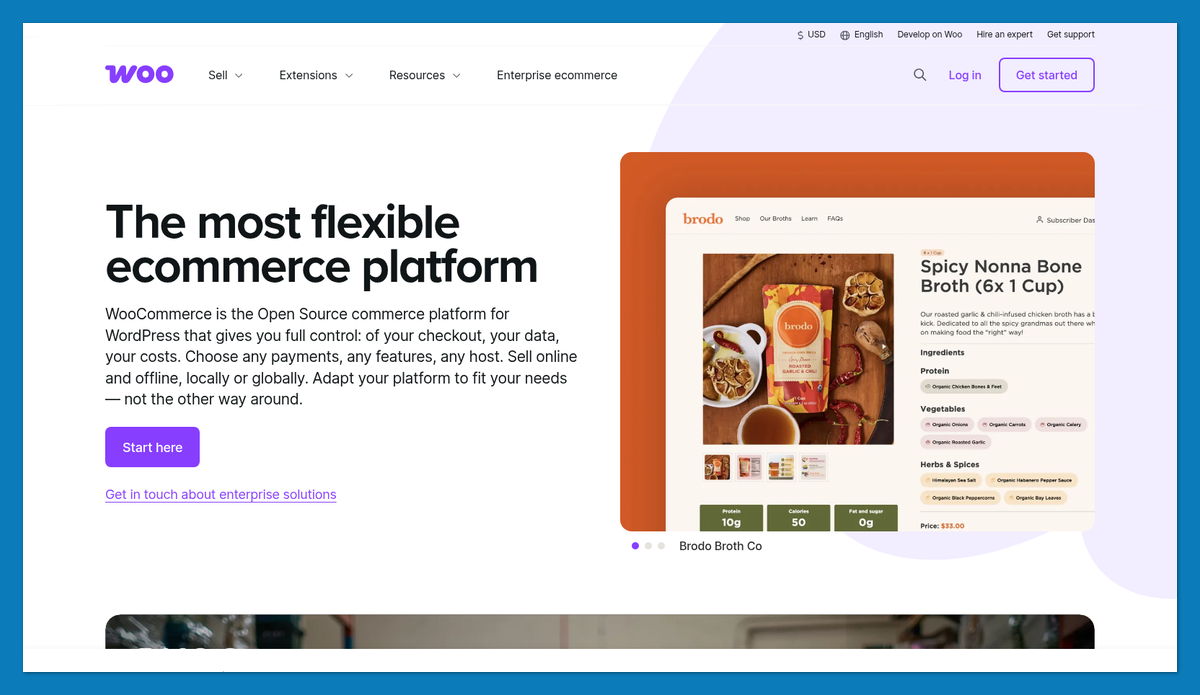
WooCommerce is my highest-rated Shopify alternative for ownership and content-led selling. I rate it 4.5 out of 5. The plugin is free, with no platform fee on any payment gateway.
It turns WordPress into a store, leaving you in control of the code and hosting. That’s also the trade-off: Shopify bundles hosting, SSL, and checkout management, while WooCommerce makes you responsible for arranging them. WooCommerce’s hosted Woo Express service is discontinued.
What I Like
- ✔️ No gateway penalty: WooCommerce takes 0%, while US WooPayments charges 2.9% + $0.30 per domestic card with no monthly fee. Shopify adds 2%, 1%, or 0.6% on Basic, Grow, or Advanced when Shopify Payments isn’t your processor.
- ✔️ Control over URLs and content: WordPress lets you set permalinks rather than keep Shopify’s fixed /products/, /collections/, and /pages/ prefixes. Its deeper blogging tools make WooCommerce particularly appealing when articles bring customers to your products.
- ✔️ No product or sales caps: Capacity depends on your hosting rather than a subscription threshold. Your open-source store can move to another host, so growing sales don’t automatically push you into a more expensive platform plan.
- ✔️ Thousands of theme choices: WordPress offers thousands of store-ready themes, generally costing $0 to $149. Shopify includes 24 free themes, with paid designs costing $100 to $500, giving WooCommerce more budget-friendly starting points.
🆕 Since My Previous Update…
In September 2026, WooCommerce 11.1 added variation image galleries, right-to-withdraw order support, and faster Store API and REST requests. Security releases followed on September 18 and 22, reinforcing the need to keep your installation updated.
What I Dislike
- ❌ Maintenance falls to you: WordPress 6.9 caused WooCommerce checkout problems in December 2025 until WooCommerce 10.4.2 shipped. Shopify handles infrastructure and checkout maintenance for you; WooCommerce requires an update and recovery plan.
- ❌ Extensions can recreate your app bill: Subscriptions costs $279/year and Bookings $249/year. Premium extensions commonly run $79 to $279 annually each, so a free plugin doesn’t guarantee a cheaper store.
- ❌ Support is split: Your host, WordPress, and individual plugin developers handle different problems. I prefer Shopify’s centralized support if you don’t want to work out which provider owns an issue.
How Much Does WooCommerce Cost?
WooCommerce’s pricing starts at $0 for the plugin, but 2026 cost estimates put basic to professional small stores at about $480 to $2,800 a year, before processing. Hosting ranges from about $48 to $120 yearly for budget shared plans to $360 to $1,380 or more for managed hosting; compare the best WooCommerce hosting options and their typically 30-day guarantees. Shopify Basic’s $348 yearly subscription means WooCommerce isn’t automatically cheaper.
How Does WooCommerce Compare to Shopify?
- ⚖️ Our Shopify vs WooCommerce comparison shows matching starting US domestic card rates, but only Shopify adds a third-party gateway fee.
- ⚖️ Shopify packages hosting, SSL, security, and POS together. WooCommerce requires you to assemble and maintain the equivalent setup.
- ⚖️ WooCommerce offers flexible URLs and ownership; Shopify counters with over 16,000 apps and no server upkeep.
Should you use WooCommerce instead of Shopify?
I recommend WooCommerce if WordPress already supports your business or search-led content drives sales. It removes platform gateway fees without imposing sales caps. Skip it if maintaining hosting and plugins sounds like another job; Wix and Squarespace are easier hosted swaps.
2. Wix: For Drag-and-Drop Design Freedom
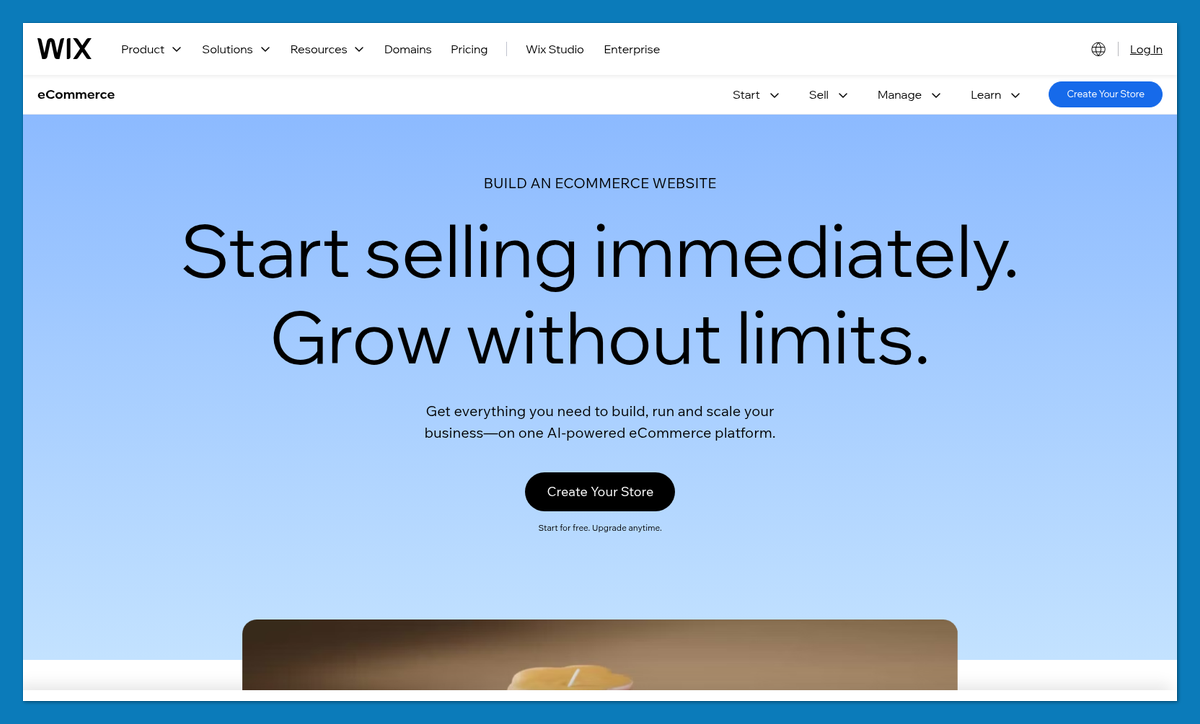
Wix is my preferred hosted alternative when Shopify’s section editor limits your design. I rate it 4.4 out of 5. Its free-form editor lets you position elements anywhere, rather than build every page around stacked sections.
The Business plan, at $39/month billed yearly, combines your store with bookings and marketing features. Unlike WooCommerce, Wix doesn’t make you manage a separate hosting setup.
What I Like
- ✔️ Free-form drag-and-drop editing: Wix lets you arrange page elements freely instead of working within Shopify’s section-and-block structure. I recommend it when your store needs to sit alongside a distinctive portfolio or service website.
- ✔️ 0% platform fee on product sales: Wix supports up to 50,000 products and six options per product, compared with Shopify’s three options. US Wix Payments costs 2.9% + $0.30 for standard cards and 3.7% + $0.30 for Amex.
- ✔️ First-year domain included: Most yearly plans provide a voucher for a new domain purchased through Wix. Redeem it within 60 days; it doesn’t cover renewals. Shopify doesn’t include a domain with its subscription.
- ✔️ Build before paying: Wix’s free plan lets you prepare your website without a deadline. It carries Wix ads and a wixsite address and cannot accept payments, but gives you more preparation time than Shopify’s three-day free trial.
🆕 Since My Previous Update…
Wix launched Harmony on January 21, 2026, combining natural-language AI prompts with drag-and-drop editing. Its Aria agent can redesign pages and add commerce features, with voice mode following in February. Harmony is included in existing plans.
What I Dislike
- ❌ Checkout isn’t equally flexible: You can’t restyle checkout through the editor. Settings cover details such as form fields and policy checkboxes; February 2026’s redesign added a customizable header, not unrestricted checkout design.
- ❌ Moving platforms takes work: Shopify imports require CSV mapping or Cart2Cart. Later, you can export products in batches of up to 5,000, plus contacts and orders, but not the full Wix website.
- ❌ Membership fees and billing complaints: Pricing Plans membership sales carry an extra 4% on Core or 2% on Business. Trustpilot reviewers also report billing and cancellation problems, with scores around 3.4 to 3.5 out of five.
How Much Does Wix Cost?
Wix’s pricing for ecommerce spans $29 to $159 per month, billed yearly: Core costs $29, Business $39, and Business Elite $159; Light costs $17 but cannot take online payments. Paid plans have no free trial, although there’s a 14-day money-back guarantee and the free building plan. Core matches Shopify Basic’s yearly-billed price, so I recommend switching for design freedom rather than subscription savings.
How Does Wix Compare to Shopify?
- ⚖️ In Wix vs Shopify, Wix wins on free-form layouts and the first-year domain; Shopify offers 24 free themes and structured editing.
- ⚖️ Wix caps stores at 50,000 products. Shopify has no product cap and supports up to 2,048 variants per product.
- ⚖️ Both offer AI builders, but Shopify’s over 16,000 apps provide more specialist expansion options than Wix’s built-in toolkit.
Should you use Wix instead of Shopify?
I recommend Wix when layout freedom matters more than advanced catalog management. You keep hosted convenience without accepting Shopify’s page structure. If you prefer an included template library and sell services alongside products, compare Squarespace next.
3. Squarespace: For Selling Products, Services and Memberships
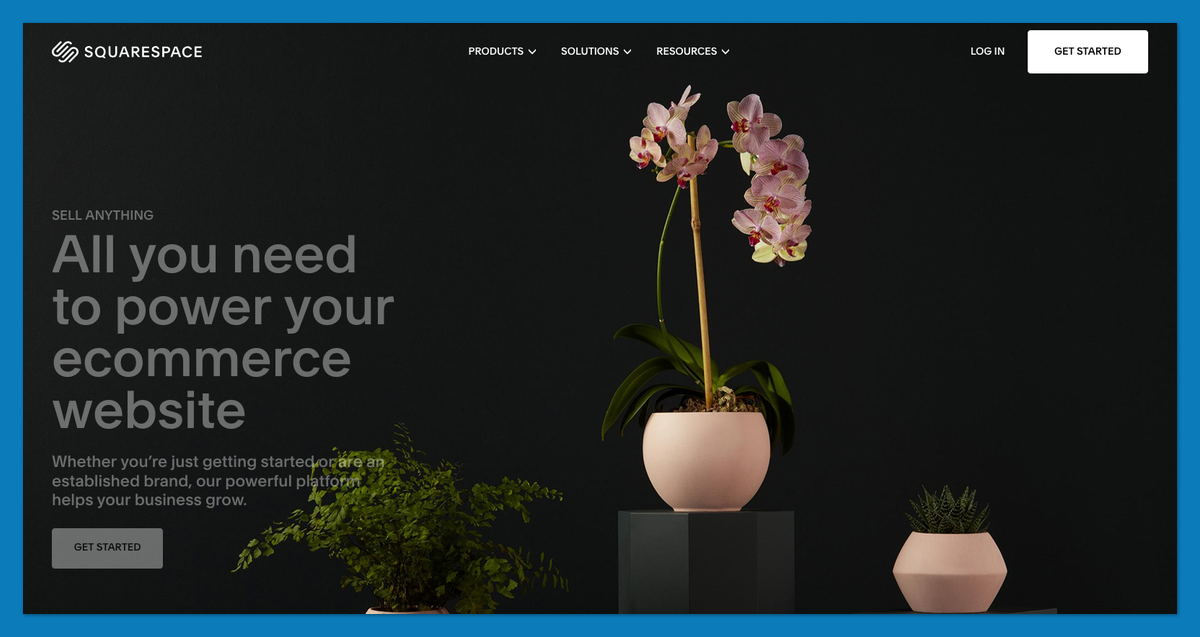
Squarespace is my choice for creatives combining products, services, and memberships. I rate it 4.3 out of 5. Its commerce tools cover physical goods and digital or video products, while Acuity Scheduling supports appointments.
You can manage these alongside your website rather than build your business entirely around a product catalog. Unlimited products on every plan make Squarespace a broader replacement than Sellfy, which ties its plans to annual sales.
What I Like
- ✔️ Every template is included: Squarespace’s library contains about 200 templates, all available within your plan. Shopify offers 24 free themes, with most others costing $100 to $500, so changing your starting design needn’t mean another purchase.
- ✔️ 0% store fee from Core: Core costs $29/month billed yearly and removes the physical-product platform fee. Card processing remains: 2.9% + $0.30 on Basic and Core, 2.7% + $0.30 on Plus, and 2.5% + $0.30 on Advanced.
- ✔️ Services alongside products: Scheduling and memberships sit alongside your store. Acuity may cost extra, but I like having a defined appointment-booking option rather than choosing among Shopify booking apps.
- ✔️ Two weeks to evaluate it: Squarespace’s 14-day free trial gives you longer to assess your website than Shopify’s three free days. Shopify follows that with $1/month for three months, rather than an extended free trial.
🆕 Since My Previous Update…
On July 14, 2026, Squarespace released limited-release and product-drop tools for announcing launches and availability dates. July also brought automatic Express Checkout worldwide, placing Apple Pay, Google Pay, and Link by Stripe at the top of checkout.
What I Dislike
- ❌ July 2026 brought price rises: On July 13, yearly-billed Basic rose from $16 to $19, Core from $23 to $29, and Plus from $39 to $49. Users quoted by TechRadar complained about “paying for things I sincerely did not ask for.”
- ❌ Digital fees remain on Core: Basic charges a 2% physical-product store fee. Digital content and memberships have separate fees of 7% on Basic and 5% on Core, falling to 0% on Advanced.
- ❌ Fewer integrations and no phone support: Squarespace’s integration library is small beside Shopify’s over 16,000 apps. Support runs through email and live chat, with no phone option.
How Much Does Squarespace Cost?
Squarespace’s pricing ranges from $19 to $99 per month billed annually, or $25 to $139 monthly. I recommend Core at $29 yearly-billed, or $39 monthly, to avoid Basic’s 2% store fee; Plus costs $49 yearly-billed or $65 monthly. There’s no free plan, but a 14-day trial, and annual plans include an eligible domain for one year.
How Does Squarespace Compare to Shopify?
- ⚖️ Our Shopify vs Squarespace comparison favors Squarespace for included templates; most Shopify themes require a separate purchase.
- ⚖️ Both support unlimited products, but Shopify offers deeper POS, multichannel selling, and app options.
- ⚖️ Shopify migration requires CSV mapping: Squarespace imports up to 10,000 products with 250 variants each, but not customers or digital downloads.
Should you use Squarespace instead of Shopify?
I recommend starting with Core if your business combines products with services or classes. Calculate membership fees and any Acuity subscription separately before committing. Stay with Shopify if specialist apps or in-store selling are central to your operation.
4. Sellfy: For Digital Downloads and Print-on-Demand
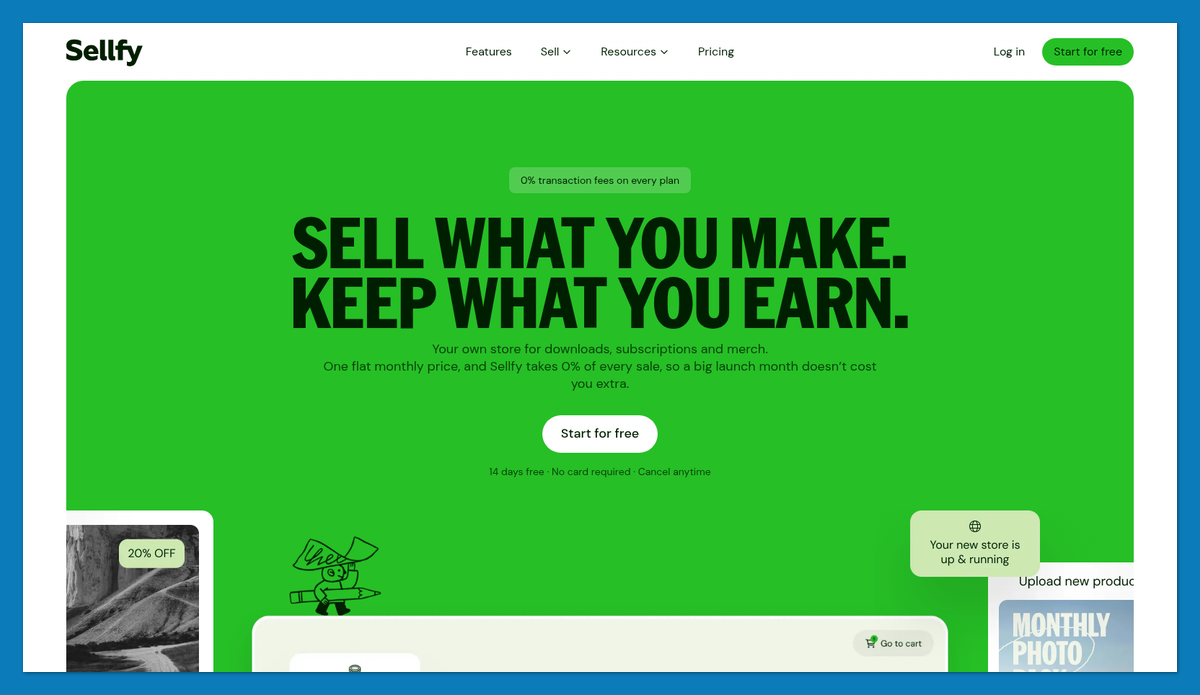
Sellfy is my simplest Shopify replacement for a mainly digital catalog. I rate it 4.3 out of 5. It supports downloads and subscriptions alongside print-on-demand and physical products, without limiting how many products you list.
Payments go directly to your Stripe or PayPal account without a Sellfy holding period. I like its narrower focus for creators who need file delivery and merchandise rather than Shopify’s broader retail toolkit.
What I Like
- ✔️ 0% Sellfy fee within your sales allowance: You pay Stripe or PayPal processing, not an additional platform percentage. Shopify Basic adds 2% when Shopify Payments isn’t your processor, making Sellfy attractive if you want to keep either gateway.
- ✔️ Room for large downloads: Each product can contain up to 50 files, with maximum individual file sizes of 10, 15, or 20 GB depending on your plan. Check your largest download before choosing Starter.
- ✔️ Email and print-on-demand built in: Starter includes 2,000 email credits, Business 10,000, and Premium 50,000. Print-on-demand is available on every plan, reducing the separate services you need around your store.
- ✔️ Trial and refund window: You get a 14-day free trial and a 30-day refund window after upgrading. Use the trial to confirm your files and product presentation fit.
What I Dislike
- ❌ Annual sales caps: Starter allows $10,000, Business $50,000, and Premium $200,000 yearly. Sellfy may charge 2% on excess sales until you upgrade, although your store stays live. Shopify has no equivalent sales threshold.
- ❌ Limited design depth: Sellfy has a theme-based customizer and about 10 themes, with custom code available. I don’t recommend it when free-form design is your main reason for leaving Shopify.
- ❌ Starter leaves out growth tools: Sellfy branding remains, and you don’t get upselling, abandoned-cart tools, the affiliate program, or product migration. Compare Business against your Shopify app bill, not just Starter’s headline price.
How Much Does Sellfy Cost?
Sellfy costs $22 to $119 per month billed annually, or $29 to $159 monthly: Starter is $22, Business $59, and Premium $119 on yearly billing. Starter saves $7/month against Shopify Basic, but its $264 annual subscription represents about 2.6% of sales even at the full $10,000 allowance. Business covers $50,000 in yearly sales and Premium $200,000.
How Does Sellfy Compare to Shopify?
- ⚖️ Our Shopify vs Sellfy comparison separates creator-focused selling from Shopify’s general-purpose retail platform.
- ⚖️ Sellfy ties plan eligibility to revenue. Shopify doesn’t require a subscription upgrade just because sales increase.
- ⚖️ Product migration needs Business or Premium, and Sellfy’s integration options are much smaller than Shopify’s app ecosystem.
Should you use Sellfy instead of Shopify?
I recommend Sellfy for downloadable presets, course-style files, and print-on-demand merchandise. Match your projected sales to its annual allowances before paying. Skip it for a physical-stock-heavy catalog or growth that will quickly push you past the caps.
5. Ecwid: For a Low-Cost, Plug-In Store
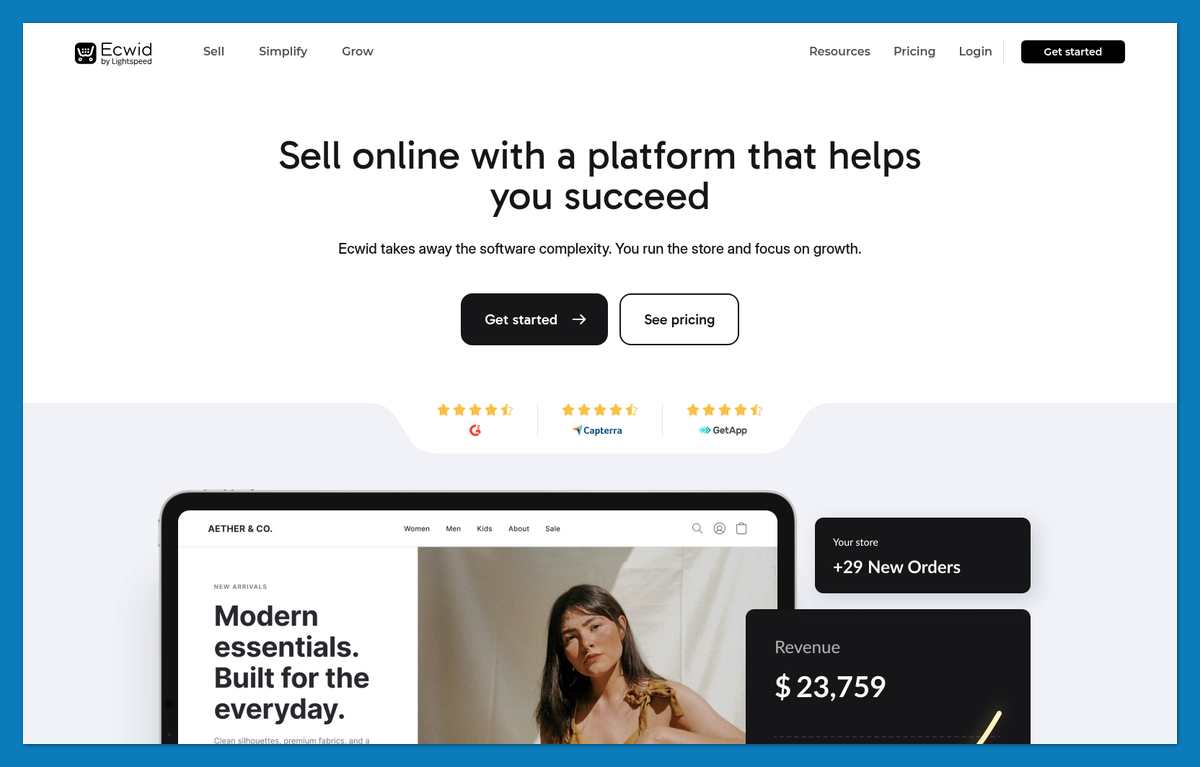
Ecwid is the cheapest paid option here with 0% platform fees, starting at $5/month for 10 products. I rate it 4.2 out of 5. Consider it before committing to another $29 subscription.
Now owned by Lightspeed, Ecwid can run as a one-page Instant Site or sit inside your existing website. Its WordPress plugin, Wix app, and Squarespace code-block integration let you keep a website you like instead of rebuilding everything around a new store.
What I Like
- ✔️ Keep your current website: Ecwid embeds a hosted store in WordPress, Wix, or Squarespace. I recommend this route when your main site already does its job and replacing Shopify shouldn’t mean redesigning your whole online presence.
- ✔️ No platform fee across 58 gateways: PayPal works out of the box, and Ecwid doesn’t add a transaction percentage. Shopify’s 2%, 1%, or 0.6% third-party gateway fee can make the same processor choice more expensive.
- ✔️ Low entry price with a practical upgrade: Starter costs $5/month. Venture adds custom-domain support, live chat, Facebook and Instagram selling, and automated tax for $29/month billed yearly. Eligible nonprofits can receive six months of Venture free.
🆕 Since My Previous Update…
In July 2026, Ecwid added the Forme apparel theme to Instant Site. Product pages gained compact and full views, drag-and-drop block ordering, and a product picker for the Products section, giving small stores more layout options.

What I Dislike
- ❌ The free plan is gone: It became the $5 Starter plan around December 2025, followed by paid-plan increases on March 2, 2026. Trustpilot users criticize both changes; Ecwid’s score is 2.7 out of five.
- ❌ Cheap plans lack variants: Product allowances are 10, 100, 2,500, and unlimited across the four plans. Neither Starter nor Venture includes variants, and multi-currency selling requires an additional $4.49/month app.
- ❌ SEO controls are restrictive: You can’t edit image alt text, redirects aren’t available inside the widget, and changing URLs requires Business. About 450 apps provide less expansion scope than Shopify’s over 16,000.
How Much Does Ecwid Cost?
Ecwid’s pricing spans $5 to $119 per month billed annually: Starter $5, Venture $29, Business $49, and Unlimited $119; monthly billing costs $35, $65, and $149 for the upper three plans. There’s no free plan or free trial, and prices outside the US run about 35% higher in the UK and 15% higher in the eurozone. Venture matches Shopify Basic’s yearly-billed price but caps you at 100 products.
How Does Ecwid Compare to Shopify?
- ⚖️ In Shopify vs Ecwid, Ecwid’s advantage is adding commerce to your current website rather than replacing it with a store-led platform.
- ⚖️ Ecwid takes no platform fee on any of its 58 gateways. Shopify charges extra unless Shopify Payments is your processor.
- ⚖️ Shopify has unlimited products and more apps. Moving to Ecwid uses CSV import or a third-party migration tool, subject to your catalog cap.
Should you use Ecwid instead of Shopify?
I recommend Venture if you like your existing website and sell up to 100 products without variants. Check that restriction before paying, particularly for clothing. For thousands of products or stronger SEO control, I favor Shopify or WooCommerce over Ecwid.
6. Square Online: For Local Shops and Pop-Up Sellers
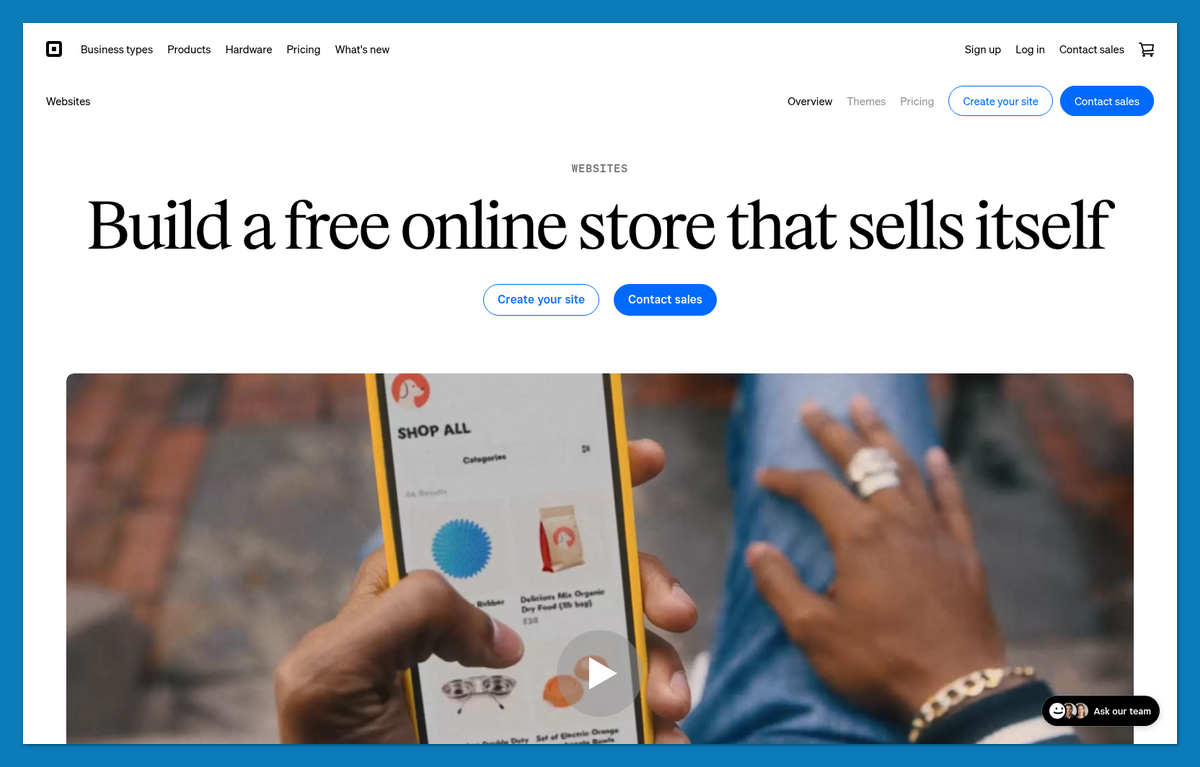
Square Online is my best fit for businesses already selling in person with Square. I rate it 4.1 out of 5. Your online store shares inventory and a customer directory with Square POS.
Square renamed Square Online to Websites in 2026 to put more emphasis on website-building tools, without changing its features. Its strongest reason to switch remains the connection between your counter and website, not a bigger app library or more design freedom.
What I Like
- ✔️ A free plan that accepts orders: Square Free sells physical goods, digital products, and services without a subscription. Online processing costs 3.3% + $0.30; unlike Shopify’s trial, this isn’t a temporary introductory arrangement.
- ✔️ One inventory for counter and web: Square POS and online orders share your catalog. Tap to Pay works on iPhone and Android, with Afterpay and Cash App Pay also supported. Shopify’s POS Pro adds $89/month per location.
- ✔️ No extra platform transaction fee: You pay processing, which drops to 2.9% + $0.30 online on paid plans. Plus also adds subscriptions and bundles, giving you a reason to upgrade beyond removing Square branding.
🆕 Since My Previous Update…
On July 1, 2026, Square launched a ChatGPT app and Claude plugin to help sellers appear in AI-assisted discovery and shopping. Eligible sellers can sell through these integrations without an additional marketplace commission.
What I Dislike
- ❌ Free carries a higher card rate: Online processing rose from 2.9% to 3.3% + $0.30 on January 13, 2026. Free sites also display Square ads and use a square.site address rather than your own domain.
- ❌ Less room for distinctive layouts: Square Online offers about 15 store themes. G2 and GetApp users describe customization limits, so I recommend Wix instead if your main complaint about Shopify is design freedom.
- ❌ Locations and payout risk need attention: Paid plans are priced per location, which can multiply your subscription. Square’s Trustpilot reviews include account holds and delayed funds; its score is 3.6 out of five from about 7,500 reviews.
How Much Does Square Online Cost?
Square Online pricing runs $0 to $149 per month per location: Free costs $0, Plus $49, and Premium $149, with custom Square Pro pricing above about $250,000 in annual sales. Plus adds a custom domain and abandoned-cart emails; Premium adds real-time shipping rates, advanced reporting, and 24/7 phone support; paid plans include a first-year domain, renewing from $19.95/year. At $2,000 in monthly US online card sales, Free’s 0.4-percentage-point premium over Shopify Payments on Basic costs about $8, below Shopify’s $29 subscription before other costs.
How Does Square Online Compare to Shopify?
- ⚖️ Our Shopify vs Square Online comparison highlights Square’s POS-first approach; Shopify starts with ecommerce and adds POS.
- ⚖️ Shopify gives you more themes and over 16,000 apps. Square Online favors a simpler connected setup.
- ⚖️ Square Free charges no subscription and 3.3% + $0.30 online; Shopify Basic costs $29 yearly-billed with US processing of 2.9% + $0.30.
Should you use Square Online instead of Shopify?
I recommend Free if your business already runs through a Square counter, stall, or pop-up. Sharing stock matters more here than having the largest app library. If ecommerce is your main sales channel, Shopify or Wix offers more design and marketing scope.
7. BigCommerce: For Complex Catalogs and B2B Selling
BigCommerce remains the closest Shopify replacement for complex catalogs and wholesale, but don’t choose it on the old promise of universally fee-free payments. I rate it 4.0 out of 5.
On June 1, 2026, Standard became Core, Plus became Growth, Pro became Scale, and Enterprise became Performance. Lower sales caps and a new outside-gateway fee accompanied the names. I recommend it for specific catalog needs, not as an automatic cost-saving move.
What I Like
- ✔️ 21 fee-free embedded providers: BigCommerce exempts providers including Stripe, PayPal/Braintree, and Adyen from its platform fee. Shopify waives its third-party fee when Shopify Payments is the processor, so BigCommerce gives you more fee-free choices.
- ✔️ Deeper options and wholesale tools: Products support 600 SKUs and 250 values per option. Customer groups and tiered pricing don’t require apps, while extra storefronts cost $30 to $100/month each. Shopify supports three options and 2,048 variants.
- ✔️ A free Shopify migration app: The Data Migration App transfers up to 500,000 product, customer, and order records. It includes SEO URLs, 301 redirects, and meta titles, making it a stronger native migration route than most alternatives here.
- ✔️ 15-day trial without a card: You get five times Shopify’s free trial period to assess whether the catalog and B2B tools justify the cost.
🆕 Since My Previous Update…
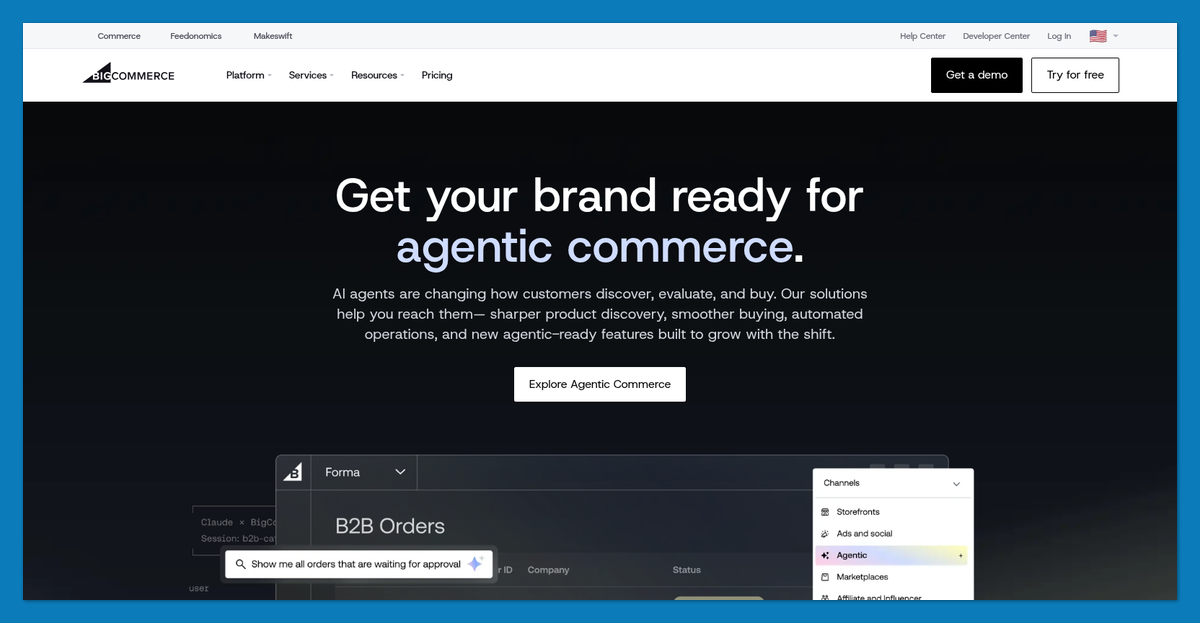
At Commerce Live on April 30, 2026, BigCommerce introduced promotion enhancements, including coupon stacking and shipping-method discounts. It also added AI purchase-order automation, the BigCommerce Companion assistant, and PayPal Store Sync.
What I Dislike
- ❌ Sales caps trigger upgrades: Core allows $30,000 trailing-12-month GMV and Growth $100,000; Scale allows $33,333 monthly with 0.9% overage. GMV means gross order value minus 10%. A $200,000-gross-sales store reaches Scale at $3,588 yearly, versus $948 to $1,068 on Shopify Grow, before processing and extras.
- ❌ 2.0% / 1.0% / 0.6% outside-gateway fees: The Open Payment Provider fee applies on Core, Growth, and Scale. One four-store merchant wrote on Trustpilot in May 2026: “they now want 1% of gross sales for processing our cards.”
- ❌ Core phone support costs extra: Phone support adds $29/month on Core and is included from Growth. About 1,200 apps also leave fewer specialist choices than Shopify’s over 16,000.
How Much Does BigCommerce Cost?
BigCommerce pricing for self-serve plans runs $29 to $299 per month billed annually, or $39 to $399 monthly: Core is $29, Growth $79, and Scale $299 yearly-billed. Performance is custom-priced, from $1,499/month billed annually, and the free trial lasts 15 days without a card. Core matches Shopify Basic’s entry price, but GMV caps decide the longer-term bill; Shopify Grow costs $79 or $89/month billed yearly without a sales cap.
How Does BigCommerce Compare to Shopify?
- ⚖️ Shopify vs BigCommerce shows matching outside-gateway fee ladders, but BigCommerce exempts 21 providers.
- ⚖️ BigCommerce automatically upgrades qualifying stores as sales grow; Shopify has no revenue-based plan threshold.
- ⚖️ Shopify added B2B to Basic through Advanced on April 2, 2026. BigCommerce still leads on multiple storefronts and Performance-level price lists.
Should you use BigCommerce instead of Shopify?
I recommend it for wholesale, large option sets, or several brands using an embedded payment provider. Model your next sales threshold before moving. For ordinary retail approaching the $30,000 or $100,000 GMV caps, Shopify is likely the cheaper subscription.
8. Big Cartel: For Merch Drops and Tiny Catalogs
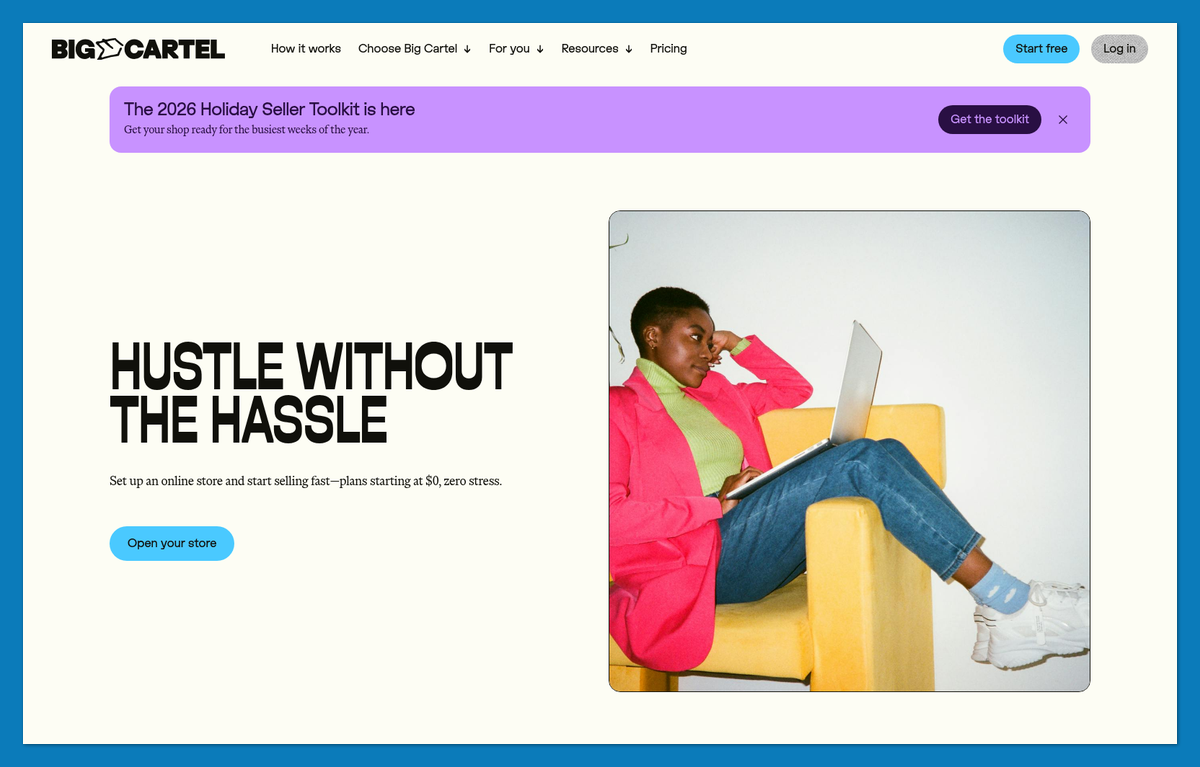
Big Cartel is my easiest recommendation for selling a handful of products without a monthly subscription. I rate it 3.5 out of 5. It serves bands, artists, and makers rather than complex retail operations.
I recommend it when Shopify’s monthly bill feels disproportionate to a small merchandise catalog. You give up catalog capacity and SEO controls, so this is a simpler store, not an upgrade in selling depth.
What I Like
- ✔️ Gold really is free: Sell five products with one image each for $0/month. That covers a tightly edited merch range, whereas Shopify requires a paid store subscription after its introductory offer.
- ✔️ No platform percentage: Big Cartel charges 0%; Stripe or PayPal still takes its processing fee. US Stripe card processing is about 2.9% + $0.30, so a free store doesn’t mean free payment acceptance.
- ✔️ Direct Shopify product imports: Platinum and Diamond include product imports from Shopify, Etsy, and Squarespace. That saves CSV reformatting, although your new catalog must fit the plan’s limits.
- ✔️ Useful merchandise tools: Diamond adds scheduled drops, password-protected products, and abandoned-cart recovery. Paid plans include digital products, sales tax autopilot, and shipping labels discounted by up to 90%; the December 2025 Printify integration adds print-on-demand.
🆕 Since My Previous Update…
On May 28, 2026, Big Cartel added direct editing of prices, stock, and status from the product table on paid plans. June 16 brought category assignment within the product form, reducing the steps needed to organize listings.
What I Dislike
- ❌ Firm catalog ceilings: You get 5 products on Gold, 50 on Platinum and 500 on Diamond. Shopify doesn’t cap products, so inventory size can eliminate Big Cartel before you compare anything else.
- ❌ Weak controls for search-led stores: Meta descriptions aren’t editable, there’s no built-in blog, and changed product URLs redirect to the homepage. I don’t recommend that trade-off when existing product pages bring valuable search traffic.
- ❌ Limited payment and recovery options: Stripe and PayPal are the supported processors, with Venmo through PayPal for US shoppers. You can use only one currency at a time, and abandoned-cart emails require Diamond.
How Much Does Big Cartel Cost?
Big Cartel pricing runs $0 to $30 per month on monthly plans: Gold is free, Platinum costs $15 with a seven-day trial, and Diamond costs $30. Platinum is roughly half Shopify Basic’s $29 yearly-billed price. Diamond costs about the same as Basic but stops at 500 products, so its value rests on merch tools and simplicity.
How Does Big Cartel Compare to Shopify?
- ⚖️ In Big Cartel vs Shopify, Big Cartel offers fewer moving parts; Shopify provides deeper selling tools and apps.
- ⚖️ Shopify Payments also avoids Shopify’s platform fee, so your saving may be the subscription rather than transaction fees.
- ⚖️ Stay with Shopify above 500 products or when existing product URLs and search traffic are important.
Should you use Big Cartel instead of Shopify?
I recommend Gold or Platinum for a band, illustrator, or maker selling up to 50 items. Diamond makes sense for scheduled drops, not unlimited growth. Choose Shopify, Squarespace, or WooCommerce when catalog size or SEO becomes the priority.
9. GoDaddy: For Keeping Your Domain, Site and Store Together
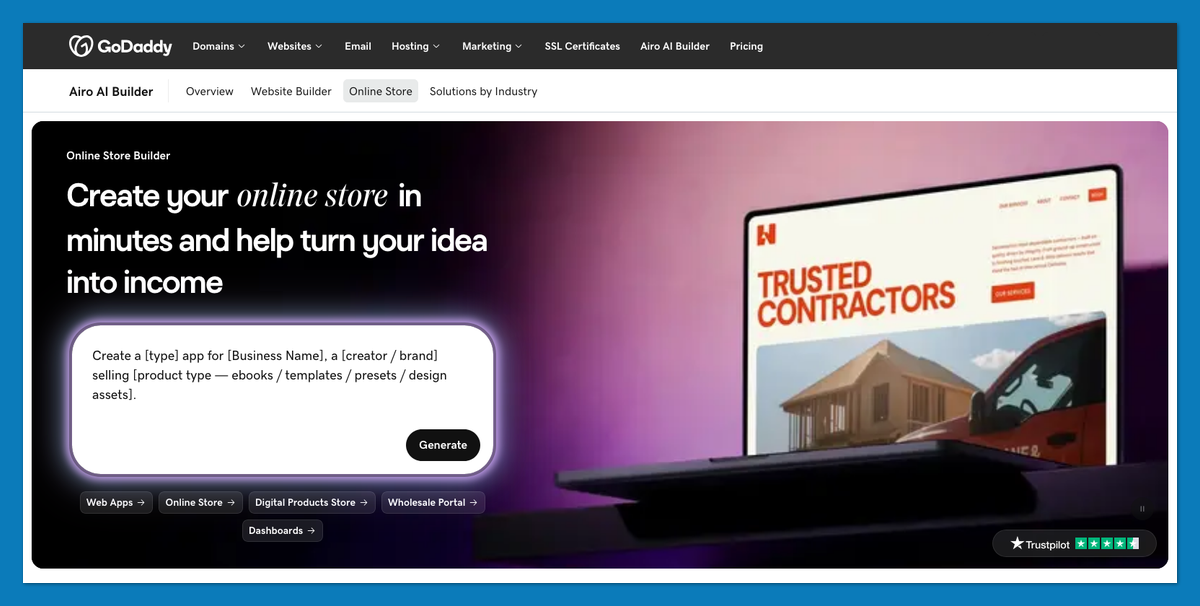
GoDaddy suits a small business that wants its domain, website and a simple store under one account. I rate it 3.2 out of 5. Its 24/7 phone support is an advantage over standard Shopify plans.
The current builder is Airo AI Builder, marketed in the US as GoDaddy Website Builder. You need Professional to sell a product catalog; don’t confuse its features with those of the older Websites + Marketing Commerce plan.
What I Like
- ✔️ Domain included with paid Airo plans: GoDaddy bundles a custom domain with any paid Airo plan, while Shopify requires a separate purchase. That’s useful if you already manage other business services through GoDaddy.
- ✔️ Around-the-clock phone access: Phone, live chat, and an AI assistant provide several ways to get help. Shopify reserves phone support for Plus, so GoDaddy offers a contact option that standard Shopify plans don’t.
- ✔️ Build with AI before subscribing: Airo generates sites from prompts, and its free tier provides 50 monthly AI credits without a card. Text and image edits don’t consume credits; paid plans include code view and a zip download.
🆕 Since My Previous Update…
In May 2026, GoDaddy embedded Airo into WordPress with automatic WooCommerce storefront generation. That’s a separate route to consider if you prefer the ownership of WooCommerce, my first pick, rather than an Airo-hosted store.
What I Dislike
- ❌ Shipping is basic: Airo offers free, flat-rate, and weight-based shipping, with no real-time carrier rates, label printing, local pickup, or local delivery yet. GoDaddy suggests Stripe where GoDaddy Payments lacks a required store feature.
- ❌ Credits expire and renewals need confirmation: Monthly AI allowances of 50, 150, 300, or 750 credits don’t roll over. Confirm renewal charges and payment terms before subscribing; GoDaddy Payments’ online rate is 2.7% + $0.30.
- ❌ Builder changes complicate the choice: GoDaddy retired the AI builder inside classic Websites + Marketing on July 31, 2026. Removing Airo branding remains “coming soon,” and there’s no app store comparable to Shopify’s ecosystem.
How Much Does GoDaddy Cost?
Professional costs $24.99 per month billed annually, or $49.99 monthly, and is Airo’s entry plan for a product catalog; Starter costs $9.99 yearly-billed for payment links and QR codes, while Ultimate costs $99.99 yearly-billed. Free lets you build but not publish, and GoDaddy states a 30-day money-back guarantee on annual website builder plans; confirm Airo’s conditions before using paid credits. Professional is about $4/month below Shopify Basic, with a domain included.
How Does GoDaddy Compare to Shopify?
- ⚖️ Our Shopify vs GoDaddy comparison shows a modest entry-price saving, while Shopify supplies 24 free themes and deeper commerce tools.
- ⚖️ Shopify Shipping offers real-time rates and discounted labels. Airo doesn’t yet provide those capabilities.
- ⚖️ GoDaddy fits a small catalog; Shopify is better equipped for a business expanding across sales channels.
Should you use GoDaddy instead of Shopify?
I recommend GoDaddy when account consolidation and phone support outweigh advanced store features. It can suit a small business already using GoDaddy for its domain and email, but don’t assume local pickup is supported. For nationwide shipping or app-dependent workflows, choose Shopify or Wix.
How Do I Choose the Right Shopify Alternative for My Business?
Pick the platform that fixes your biggest Shopify frustration, not the one with the longest feature list. A cheaper subscription doesn’t help if you lose an essential integration or immediately exceed a sales cap. When comparing Shopify alternatives for small business, start with your current costs and your next stage of growth.
- What is Shopify really costing you each month? Add Basic’s $29 yearly-billed subscription, paid apps, and any 2% third-party fee; Wix or Squarespace may replace some app subscriptions.
- Which payment processor do you want to use? WooCommerce and Ecwid add no platform fee on supported gateways; BigCommerce exempts 21 embedded providers.
- How many products and variants do you sell? Big Cartel stops at 500 products, Ecwid Business at 2,500, and Wix at 50,000; Ecwid’s cheaper plans lack variants.
- Will your sales outgrow a cap? BigCommerce Core and Growth allow $30,000 and $100,000 trailing-year GMV; Sellfy’s yearly allowances are $10,000, $50,000, and $200,000.
- Do you sell in person, digital files or services? Start with Square Online for Square POS, Sellfy for downloads, or Squarespace for a mixed product-and-service business.
- Can you take your store with you later? Wix cannot export an entire site, while WooCommerce’s open-source code can move with you to another host.
How Do I Migrate My Store From Shopify to an Alternative?
Move your store using three options: export a CSV, use a migration app, or hire a professional. Choose by the records you need to transfer, not just your product count.
- CSV file: Open Shopify’s Products > Export for products, variants, and image URLs, not image files, so keep your Shopify store live until images finish importing. SEO title and description fields are blank unless manually edited. WooCommerce needs matching global attributes for option names; Squarespace accepts 10,000 products with 250 variants each, but no customers or downloads. Wix’s template accepts 15 MB and 10,000 rows, with images imported by URL.
- Migration app: BigCommerce’s free app moves up to 500,000 records with redirects; Big Cartel imports products on paid plans, and Sellfy offers migration on Business and Premium. WooCommerce’s paid Shopify Migration extension also moves customers, orders, coupons, pages, and blog posts. Wix’s Cart2Cart app has a 1,000-product and 1,000-order limit. Automated tools such as Cart2Cart and LitExtension start at about $19 to $79 and scale with records; run a free demo before paying.
- Professional help: LitExtension’s expert-run service starts at $129, while agency estimates for larger managed migrations run about $5,000 to $15,000. Hire help when you must preserve URL structure, map custom fields, or closely match your current design. Request a scope covering design and integrations as well as data, and confirm which records transfer. Assign responsibility for redirects and checkout checks before work starts.
How each alternative imports a Shopify store:
| Platform | Native Shopify import | Best route |
|---|---|---|
| WooCommerce | CSV importer for products; paid Shopify Migration extension | Extension or LitExtension/Cart2Cart for customers and orders |
| Wix | No | Cart2Cart app or Wix CSV template |
| Squarespace | No | Map Shopify’s CSV to Squarespace’s template |
| Sellfy | Product migration on Business and Premium | Built-in migration |
| Ecwid | Not documented | CSV import or LitExtension/Cart2Cart |
| Square Online | Not documented | CSV item import |
| BigCommerce | Yes, free Data Migration App | Data Migration App |
| Big Cartel | Yes, on Platinum and Diamond | Built-in product import |
| GoDaddy | Not documented for Airo | Rebuild in Airo and re-add products |
These parts won’t move automatically with your product import:
- Your theme and page designs, which need rebuilding.
- Installed apps and the workflows or data tied to them.
- Customer passwords, requiring a reset-email or invitation plan.
- Saved payment methods, which need separate handling.
- Shopify metafields as native attributes, requiring mapping or recreation.
Map every traffic-bearing Shopify URL to its matching destination with a 301 redirect, never a blanket homepage redirect. Pay particular attention to /products/, /collections/, and /blogs/news/ paths, and restore missing metadata and image alt text.
Follow our Shopify to WooCommerce migration or Shopify to BigCommerce migration guide. Test checkout, taxes, shipping, and redirects before switching your domain.
How We Test Ecommerce Platforms
A lower subscription price earns little credit here if a sales cap immediately forces an upgrade. This ranking draws on Ecommerce-Platforms’ full platform reviews, published pricing and documentation, plus user feedback on Trustpilot, G2, and Capterra as of November 2026. It evaluates the trade-offs of leaving Shopify, not new hands-on store builds.
The ranking uses seven criteria:
- Pricing and fees: 25% covers subscriptions, processing, platform fees, renewals, and cap-driven upgrades.
- Sales features: 20% considers payments, shipping, tax, POS, marketing, and wholesale capabilities.
- Design and ease of use: 15% considers templates, editor structure, and AI building tools.
- Scalability: 15% measures product, variant, and sales limits alongside integration options.
- Moving from Shopify: 10% considers import methods, redirects, and data left behind.
- Help and support: 10% considers available contact channels and their operating hours.
- Reputation: 5% includes user ratings, development pace, and changes in store adoption.
Volusion still sells plans from $35/month, but StoreLeads counts about 3,150 live stores and a 21% yearly decline, so I left it out of the recommendations. Conditional-free offers belong in the FAQs rather than alongside platforms with broadly available free selling plans.
Final Verdict: Which Shopify Alternative Should You Pick?
Shopify is still our top choice for online stores, as explained in our Shopify review. I recommend switching only when an alternative solves a specific cost or workflow problem without removing essential features.
- WooCommerce leads for ownership and WordPress content, with no platform gateway fees but maintenance responsibilities.
- Wix offers greater hosted design freedom, plus a first-year domain on most annual plans.
- Squarespace fits products, services, and memberships together, with every template included.
- Sellfy simplifies downloads and print-on-demand, provided your sales fit its annual allowances.
- Ecwid is the lowest-cost plug-in store, starting at $5/month for 10 products.
- Square Online suits existing Square sellers, connecting online orders with in-person inventory.
- BigCommerce serves complex catalogs and wholesale, but sales caps require careful cost projections.
- Big Cartel keeps tiny merch catalogs affordable, including five products on its free plan.
- GoDaddy consolidates your domain, site, and store, with phone support but basic shipping.
Eight of these nine let you start without paying, through free software, a free building or selling plan, or a trial; that doesn’t mean eight free live stores, and Ecwid starts at $5/month. Compare your top two with your current bill before moving products; if neither fixes your main frustration, Shopify remains my recommendation.
FAQs
Will switching from Shopify hurt my SEO?
Switching can affect SEO, but correct redirects reduce the risk. Map each traffic-bearing product, collection, and blog URL to its true match with a 301 redirect, restore metadata, and check indexing in Google Search Console. Keep a record of your existing URLs before changing platforms, and test their destinations before launch. Avoid Big Cartel for SEO-dependent migrations: changed product URLs redirect to its homepage.
Is there a free or cheaper alternative to Shopify?
Yes: Square Online and Big Cartel let you sell with no subscription; see our best free ecommerce platforms. Square charges processing; Big Cartel limits Gold to five products, while Ecwid is a cheaper alternative to Shopify at $5/month. Our Shift4Shop review covers a conditional free Shopify alternative: its End-to-End plan requires US eligibility and Shift4 Payments. Confirm the reported minimum of about $500/month in processing before signing up.
What is the best open-source Shopify alternative?
WooCommerce is my best open source Shopify alternative because its free plugin combines WordPress content tools with no platform transaction fee. You still pay for hosting and any premium extensions or maintenance. Other open source ecommerce platforms include Magento Open Source, the free edition behind Adobe Commerce, plus PrestaShop and Shopware Community Edition. All require a hosting and upkeep budget, so free software doesn’t mean a free-running store.
Which Shopify alternative is best for selling digital products?
Sellfy is my recommendation for digital products, with 0% platform fees within plan allowances, built-in email marketing, and up to 50 files per product. Individual files can be 10 to 20 GB depending on the plan, while annual sales allowances range from $10,000 to $200,000. Squarespace also sells digital content, but charges 7% on Basic and 5% on Core, falling to 0% on Advanced.
Which Shopify alternative is best for large inventories?
BigCommerce is my pick for complex inventories, supporting 600 SKUs per product, 250 values per option, and migration of up to 500,000 records, although GMV caps raise costs. WooCommerce has no platform caps but depends on hosting; Wix stops at 50,000 products. Enterprise Adobe Commerce is quote-only, with partner estimates of about $22,000 to $40,000 or more yearly. Shopify remains strong with unlimited products and 2,048 variants.
Which Shopify alternatives have no transaction fees?
WooCommerce, Wix product sales, Ecwid, Big Cartel, Sellfy within its sales allowance, and Square Online charge no platform fee, although payment processing still applies. Squarespace removes its physical-product fee from Core, but digital-content fees differ. BigCommerce exempts 21 embedded providers and charges 2%, 1%, or 0.6% on others. Shopify uses the same headline ladder on Basic, Grow, and Advanced unless Shopify Payments is your processor.



Shopify is at least one of the top eCommerce platforms for creating and managing online stores today. Of all the alternatives in this article, Wix, Weebly, WooCommerce are the best. Thanks for sharing this nice article.
👍👍👍
Thanks for sharing shopify alternatives, however i am using shopify for last 3 years and i have a great experience in shopify but i also love wix platform, its an easy and good platform! Thank you.
Awesome, thanks for sharing! 🙂
I’m looking at starting an online boutique for women and children. I like the idea of invoicing through a website, accepting multiple payment options, lowest transaction fees, cheapest fees per month, extensions for rewards for customers, etc. What are your top choices for me and why? Thanks!
Hello Christina, Shopify would be the best option for starting an online boutique, but Square Online and Wix could be some great options as well.
Hi Catalin,
we have a company in South Africa and like to sell up to 20 different non-alcoholic beverages (amount of beverages is growing) via an online shop. Which platform would you recommend?
Thanks for your support,
Palle
Hello Palle, in your case, I would go with Wix. Good luck with your business!
Hi i want to start a business selling T shirts and other thing with PrintFull, what of these is the best options that works with PrintFull, consider that i want PayPal like my Main payment method.
Hello John, I’m not sure I understand your question.
Which platform is best that accepts Paypal payments but is for small startups – about 7 items only
Hello, you can use PayPal with any of the platforms listed here. In your case I would go with Weebly or Big Cartel.
Hi!
I would like to start my eShop in Hungary. Which is the Top3 you would suggest from the known platforms and what are their pros/cons? Goal is to buy goods in other country (member of EU) cheap and sell it in Hungary (also EU member) on a real price. I do have contact to shipping company too and I would like to offer online payment too.
Thanks in advance!
Z
Hello,
Hello Soltan,
My top three would be Shopify, BigCommerce and Squarespace.
Good luck with your business!
–
Bogdan – Editor at ecommerce-platforms.com
Hi Catalin!
What would you recommend for selling coffee online?
Thank you!
Hello Jimmy,
If you’re on a bugdget you may start with Big Cartel (see our review here). They have a free plan if you sell 5 products or less.
–
Bogdan – Editor at ecommerce-platforms.com
Hi and thank you, Bogdan! I have been searching for this type of info for some time now. Greatly appreciated!
Glad you liked it Candy 😉
Hey I can’t use my Shopify payment Gateway because of some reasons Could you give me the best payment gateway I could use There’s too many Gateway’s to choose from and most of them I seen have bad complaints and bad review thanks.. (Located in the US)
Hi Jaques, You might consider using 2Checkout or PayPal. See our full 2Checkout review here and our PayPal review here.
Best,
–
Bogdan – Editor at ecommerce-platforms.com
Hello! I am in the beginning stages of starting a business selling early years (0 to 6) nature based, Waldorf inspired curriculum/resource packages. The target audience is both families and educators. These packages include original recorded songs, poems and stories along with lyrics, activities related to the five senses and craft suggestions. They will be available to purchase monthly, seasonally or yearly. I was curious if you could suggest the best online distributor to use! Thank you in advance!
Hi Mikel, I am trying to set up a website for a supplement product line with 5 products only. I will need a payment system, several tabs to house the text and youtube video, rather than many space for new products. In my case, which e-commerce site would you recommend? Thanks for your feedback.
In your case, LemonStand might be a good option. You can read our full review here.
Best,
I have a problem with shopify in that, apparently, it cannot calculate my VAT or give me a current stock holding valuation meaning I will have to do manual stock takes, whats the point of doing all the work to switch to a new system when it doesn’t offer this vital but very basic feature ! Does anybody know of another platform that does offer this feature ?
Hi Oliver, have you tried contacting their support?
–
Bogdan – Editor at ecommerce-platforms.com
my friend has it and she said it works perfectly with the stock count and billing info
Hello Catalin,
Which one would you choose or recommend to start a drop shipping store?
Thank you,
Hi Oscar,
I would go with Shopify 🙂
Check out this post for more info.
Cheers!
–
Bogdan – Editor at ecommerce-platforms.com
Hi Catalin! Thank you very much for all the useful info. I was planning to use the Shopify Buy Button on e-commerce site that has been already created, but payments are not supported in my country. Do you if any of the mentioned platforms offers a similar solution? Thank you very much again!
Hi Mikel, where is your business based?
Hi Bogdan! Is based in Spain. I’ll really appreciate any advice. Thank you very much!
Only Shopify Payments are not accepted in Spain but you are free to use an external payment gateway (you’ll pay a 2% transaction fee). Most of the major payment gateways are supported in Spain. Check out the complete list here
Cheers!