

“An ecommerce website builder? Why do I need one?” Well, they are simply all the rage these days for anyone who wants to launch their own online shop and do so all by themselves!
But this brings up many questions and potential problems in terms of selecting the right ecommerce website builder for your specific needs.
Today, we discuss them all to help you decide!
In this guide, we teach you how to avoid this and similar issues.
Therefore, a good way to look at your ecommerce website builder shopping experience is consider it twofold: (a) what you want to accomplish, and (b) what your own personal needs are:
- With the personal needs, it all comes down to how experienced you are and how quickly you plan on scaling up. A builder with hundreds of templates is great for a beginner, but what if you’d like to get into customizing the CSS and that’s not available?
- The second area to evaluate is what you want to accomplish. This ties into the tools, settings and features that are offered through the various platforms. With that, we want to take a look at the current state of ecommerce and the major trends to plan for the functionality you’ll require.
In the following sections, we’ll show you everything there is to know about the best ecommerce website builders on the market and how to pick the ideal one for you.
In a hurry and don’t have time to consume the entire guide? Here’s a quick comparison of the top ecommerce website builders:
The best ecommerce website builder tools in 2026
Here’s the final lineup of the best website builder tools for ecommerce that we’re comparing today:
1. Wix 👈 The Best Ecommerce Website Builder
We’ve picked these tools based on our knowledge and experience with ecommerce websites. These are the top solutions out there for both newbie and advanced business owners who want to join the world of selling online.
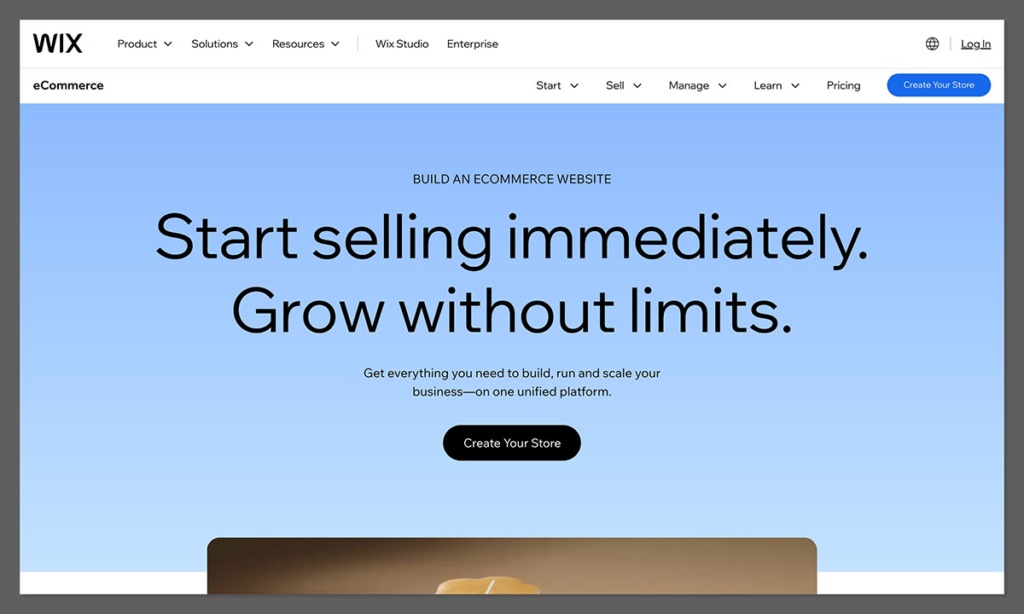
Wix has seriously upgraded its appeal for ecommerce companies in the last couple of years. It started off as a general website builder, and you can still tell in how easy it is to use, and how it gives you more room to shape crucial pages than you get with most alternatives.
Before, that used to mean Wix was great for design, but Shopify was the better choice for more advanced shop functionality. Now, Wix is a world apart. Wix Harmony, for instance, is the brand-new hybrid website editor, complete with an AI assistant (Aria) that can create pages, changes layouts, add store features, plus rewrite sections with a prompt.
Wix isn’t just for small shops anymore either. With Wix Enterprise, larger brands get dedicated account management, enterprise-grade security and compliance (SOC 2, ISO 27001), and the infrastructure to handle high-traffic catalogs. The catalog V3 API and multi-currency payouts mean bigger teams can run complex, international operations without outgrowing the platform.
Wix has really improved its selling tools too, the updated catalog V3 developer API supports more complicated product catalogs, with better variant tracking and customization. There’s multi-currency payouts alongside Buy Now, Pay Later options. You can experiment with 3D and AR previews.
Plus, you can manage physical products, downloads, subscriptions, services, and appointments in one place, and mix in discounts, emails, loyalty features, abandoned cart emails, or product recommendations.
Prices start at $17 per month for Light when you pay yearly, but you can’t take payments on that plan. You’ll need to upgrade to at least Core at $29 per month for ecommerce.
What are the features and offerings that make Wix special?
- The editor is still incredibly simple with drag-and-drop control, and Wix Harmony can build or edits part of your site with AI.
- Core now includes payments, ecommerce features, bookings, 5 collaborator accounts, plus 50GB of storage for a reasonably low price.
- You can create complicated catalogs, and sell physical items with memberships, appointments, tickets, or digital files in one place.
- Tools are included for email, customer management, automation, plus loyalty programs, and there are tons of integrations.
- Users can tweak mobile versions of their site separately when the automatic layout isn’t ideal on desktop.
What may turn you off Wix?
- You need to rebuild your site if you switch to a totally different template.
- Shopify is still better for complicated international stores, or companies with a lot of apps.
- The jump from $39 for Business to $159 for Business Elite is big.
Who should use this ecommerce builder?
Wix is a brilliant option for creators, smaller retailers, or service businesses that want an amazing website, and a fantastic checkout experience. It’s also ideal if you want content, bookings, or memberships next to a standard store.
Check out the full Wix review if you’d like to learn more.
2. Shopify 👈 the ecommerce heavyweight
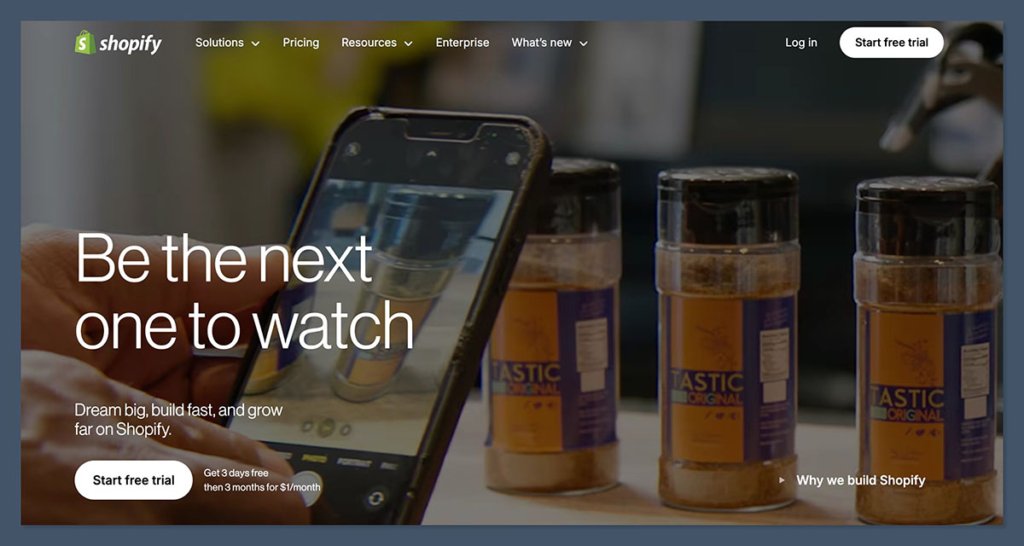
Shopify has always been towards the front of the ecommerce pack, but that doesn’t stop the company from moving further and upgrading features year after year. It’s one of the biggest pioneers on this list, especially when you take the 2026 releases into account.
In Spring 2026, Shopify introduced 150 new updates, many of which help prepare stores to sell through AI assistants, as well as a core website, social channels, or marketplaces. The Shopify Catalog, for instance, organizes product information automatically so your AI tools can read prices or check variants properly.
There’s also Agentic Storefronts, which let merchants manage how products appear on things like ChatGPT, or Gemini. Some channels even let customers buy without leaving the LLM conversation.
Sidekick is even better than ever too. It can check store data, help out with editing themes, work alongside apps like Loop or Klaviyo, and handle some tasks for you in the background. Plus, Shopify’s added B2B tools to its Basic, Grow, and Advanced plans, including company profiles, payment terms, volume pricing and up to three catalogs.
We’d still recommend Shopify for stores that want to grow fast, and expect to see some complications. Beginners can launch without worrying about code, while advanced users have access to custom CSS or Liquid.
Currently, Basic costs $39 per month, or $29 when you pay annually, Grow is $105 monthly or $79 annually and Advanced is $399 monthly or $299 annually. Shopify Plus starts at $2,300 per month.
What are the features and offerings that make Shopify special?
- Shopify Starter costs $5 per month and lets you sell through links, messages and social posts. It’s not a full store builder, but it’s a good starting point.
- The themes are some of the better ones on the market, and they’re already mobile optimized, and ready to tweak with AI.
- You can sell through social media channels, AI assistants, or marketplaces, as well as your own store, giving you lots of ways to build revenue.
- Shopify has its own point of sale system for in-person selling.
- The app market is huge, covering everything from email marketing, to subscriptions, accounting, returns, plus shipping.
- Hosting, SSL, and 24/7 support come as part of the package.
What may turn you off Shopify?
- You don’t get FTP access, so you can’t edit server files directly.
- Basic doesn’t include extra staff accounts.
- App fees pile up quickly once you need subscriptions, better search, reviews or advanced reporting.
Who should use this ecommerce site builder?
Shopify is still the better fit when ecommerce is the whole business. It’s brilliant for larger catalogs, wholesale, international selling, or retailers that combine online and physical stores.
Check out the full Shopify review if you’d like to learn more.
How to get Shopify for $1 per month for the first 3 months?
Shopify has begun offering a special deal for sellers who sign up for a new Shopify plan. That deal?
Pay Shopify $1/month for the first 3 months of full access to the platform!
This offer is is now available on all standard plans: Starter, Basic, Shopify, and Advanced.
3. BigCommerce
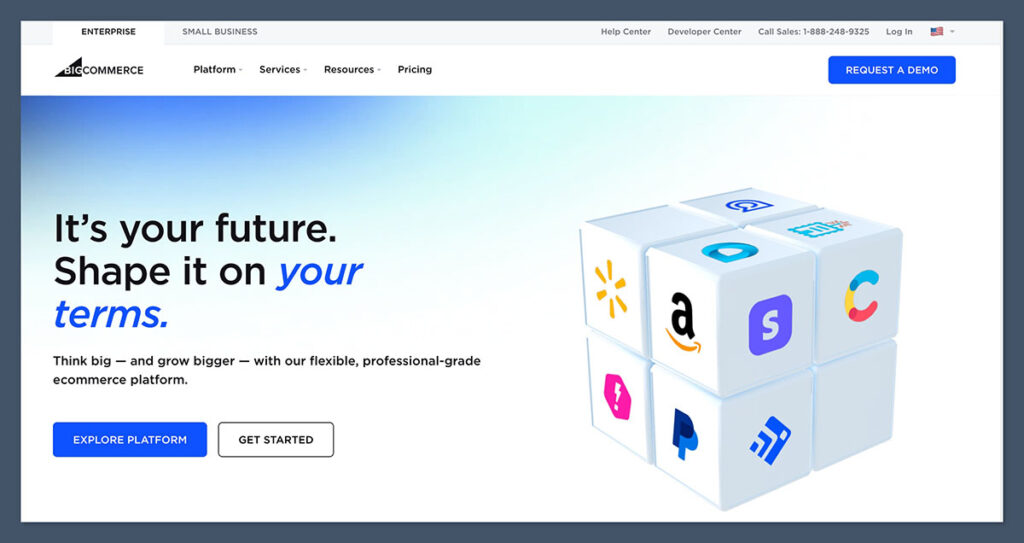
BigCommerce used to play second fiddle to Shopify, but things have changed and, nowadays, it’s a fully fledged alternative. It offers much of the same features and it’s not limited in any way.
The themes are also solid, with many modern options, divided into multiple categories, plus they are mobile-friendly and accessible.
There are also free and paid ones available, which should help you make your store truly yours and fitting your brand.
👍 What are the features and offerings that make BigCommerce special?
- Good-looking themes that cover all of the most common store categories and niches.
- You get to set up unlimited staff accounts, which is great if there are more people working in your store.
- The easy-to-use backend has features for coupons, discounts, social media and more.
- Lets you sell via Facebook, Pinterest, eBay, Amazon and Square POS.
- The support with this ecommerce website builder is 24/7.
- The app store is filled with options.
👎 What may turn you off of BigCommerce?
- Buying premium themes for BigCommerce can get really expensive. Even $200+ a piece.
- Translations are complex and often impossible.
⭐ Who should use this ecommerce site builder?
BigCommerce is the tool that’s the most similar to Shopify in the way it delivers its features, the way it lets you build an ecommerce website and then handle your ongoing work with it. Use it if you don’t like the Shopify interface.
Check out the full BigCommerce review if you’d like to learn more.
4. Squarespace
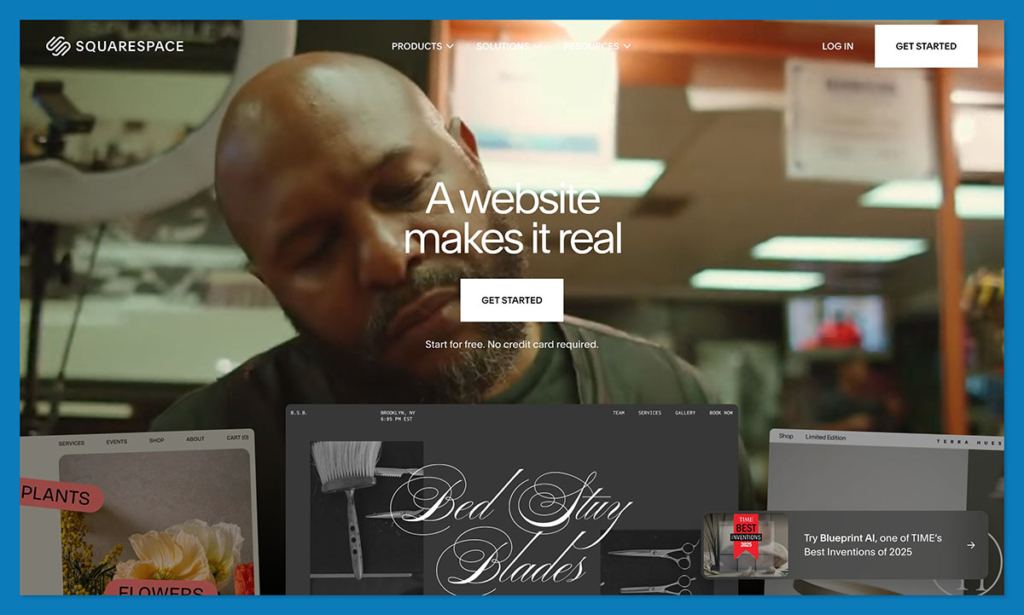
Squarespace delivers a stunning web design interface, with some of the more remarkable and modern templates out there.
It’s important to remember that Squarespace is primarily for building regular websites, but it does have a nice Commerce plan starting at $26 per month.
All you have to do is hook up your payment processor, choose a theme and get selling.
We recommend this ecommerce website builder for companies that are interested in a more modern, media-based look, while also focusing on minimalism.
The features are there for social media, design, inventory and marketing, literally anything that a new ecommerce store might need.
However, at the same time, you shouldn’t expect to build a huge store with Squarespace since that’s not what it’s meant to do.
👍 What are the features and offerings that make Squarespace special?
- The themes are even better than Shopify’s (and you can get third-party themes if you want to).
- The sites run smoothly, and they always seem to load pages quickly.
- The 24/7 support is helpful, and we really like the live chat support.
- Connect with customers through full social media integration, sell on Facebook and Instagram.
- SEO features are solid.
- There are great tracking tools for your overall website traffic as well as sales.
👎 What may turn you off of Squarespace?
- The only payment options are Stripe, PayPal and Apple Pay.
- Abandoned cart recovery is available only on the $40 / month plan.
- Some of the themes aren’t necessarily built for ecommerce websites so you need to be careful when picking your design.
⭐ Who should use this ecommerce site builder?
Squarespace is a great “website building tool” all around. It gives you the full package of tools that you might need on your way to DIY a website – and these tools include ecommerce features as well.
That said, we recommend you check out Squarespace only if you don’t like Shopify for some reason.
Check out the full Squarespace review if you’d like to learn more.
5. Simvoly
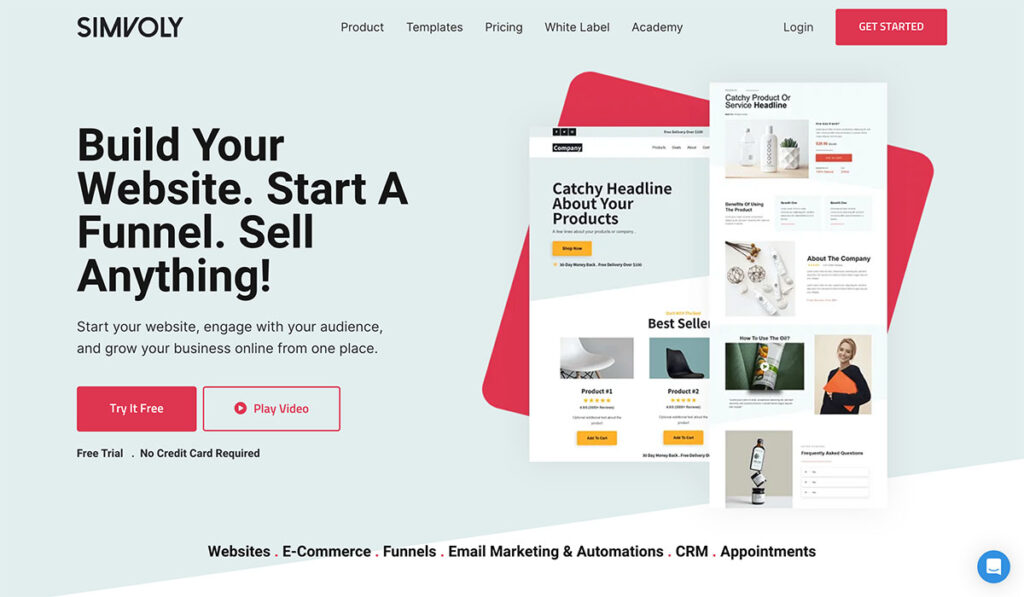
- Price from (per month) Starting from $12/month paid annually
- Mobile optimized: ✓
- Ease of use: 8/10
- Designs: 9/10
- Ecommerce features: 10/10
Simvoly is a website builder that’s been on the market since 2016. It offers full website-building capabilities via a drag-and-drop page builder and access to 200+ customizable and mobile-friendly templates in a range of categories, including ones specifically designed for eCommerce stores, sales funnels, and websites offering services (e.g., restaurants) and memberships.
In addition, white labeling is available. Simvoly offers a “100% White Label DIY Platform” with your branding, domain, and custom CSS/JS.
Simvoly has quite an extensive pricing structure, with four plans aimed at solopreneurs and eCommerce businesses. Prices are $12/mo paid annually for the Personal plan, $29/mo paid annually for the Business plan, $59/mo for the Growth plan and $149/mo for the Pro plan.

Each package includes full eCommerce features, funnel analytics, A/B testing, an AI Assistant to help you write SEO titles, descriptions, product descriptions, SSL, quizzes, and surveys, and 0% transaction fees.
Each plan, however, comes with a bandwidth, subscriber, and email marketing limit.
In addition, the Personal plan restricts the number of website pages you can create (20). In contrast, the other plans allow you to build unlimited pages.
Also, only the two most expensive plans allow you to sell unlimited products. Meanwhile, with the Personal plan, it’s just five, and with the Business plan, it’s 100.
Suppose you hit your monthly email marketing limit on your subscription plan. In that case, you can increase your allowance by purchasing Simvoly’s email marketing and automation add-ons, which start at $9/mo for an additional 500+ subscribers.
Lastly, there’s a separate White Label pricing structure aimed more at agencies, developers, SaaS, etc. Prices here start at $59/mo, paid annually, for the WL Basic Plan to build 2 websites and 10 funnels.
What are the features and offerings that make Simvoly special?
- An intuitive drag-and-drop editor accessible via the Simvoly dashboard
- Access to a complete eCommerce solution, including sales funnels, custom checkouts, analytics, upsells, downsells, bump offers, and subscriptions
- Built-in email marketing, including a drag-and-drop email editor
- A free 14-day trial with no credit card needed.
- Access to 200+ attractive, mobile-responsive, SEO-optimized templates
- A white-label website builder ideal for agencies, SaaS, and web developers building websites for multiple clients.
What may turn you off Simvoly?
There’s no free plan, and there’s more of a learning curve than other contenders, such as Wix. It also offers fewer native integrations, although you can access more via Zapier, Make, Pabbly, and Integrately.
Who should use this ecommerce builder?
eCommerce businesses looking to sell an array of product types (physical, digital, subscription, services, etc.).
Simvoly is also a good choice if you want access to drag-and-drop editing tools, 200+ customization templates, a website builder that combines sales funnels in the same platform, and white labeling options.
Check out the full Simvoly review if you’d like to learn more.
6. Square Online

Square Online is an interesting solution if you’re looking for an ecommerce website builder.
Actually, the Square company began as a provider of storefront hardware for businesses that wanted to start accepting credit cards. This wasn’t such a straightforward thing a mere couple of years ago.
Even to this day, businesses can get Square’s easy-to-use credit card readers, cash registers, and other equipment that makes their day-to-day easier.
And now, on top of all that, you can also build a fully-fledged ecommerce store using Square Online. The tool is very easy to use, and the onboarding sequence gets you through the most key stages smoothly.
Lastly, Square Online has a quite attractive pricing. Actually, that would be an understatement. Square Online comes with an entirely free plan.
What’s even more interesting (and uncommon compared to the competition) is that Square doesn’t limit the number of products you can have in your store on that free plan.
In case you need more features and want to be able to brand your store website better – with a custom domain name and without Square’s own branding – you can upgrade to one of the paid plans, which start from $12 a month.
👍 What are the features and offerings that make Square Online special?
- There’s an entirely free plan that doesn’t limit the number of products and sales you can get. Plus, you also get unlimited file storage and bandwidth.
- The paid plans are very affordable, starting at $12 a month.
- Square Online lets you set up unique types of ecommerce offerings such as restaurant table bookings, event ticket selling, appointment bookings, donations, and more.
- Whatever you sell can be set up with standard shipping, but also pickup or delivery.
- Square’s famous POS equipment will make it easy for you to open up a storefront and have it integrated with your online operation seamlessly if you ever want to.
- There’s 24/7 customer support via live chat and phone.
👎 What may turn you off from Square Online?
- Not all features seem to be available internationally, which makes Square Online a viable solution mostly for US-based businesses.
⭐ Who should use this ecommerce site builder?
Square Online is a great solution for two kinds of businesses. First, if you are a US-based business, you already have a storefront, and you want to make sure that whatever you’re going to be doing online will integrate well with what you’re doing in the storefront already.
You can get Square equipment to seamlessly link your offline and online activities.
Second, Square Online is also a good solution for new businesses that want to launch an online store as soon as possible and not deal with any technical aspects of the task.
At the same time, such businesses can later join Square’s suite of offline tools as well. This means that Square can fit the current needs of your business, whatever they might be.
Thus, you will probably not have to change your ecommerce platform as you grow.
Check out our full Square Online review if you’d like to learn more.
7. WordPress with WooCommerce
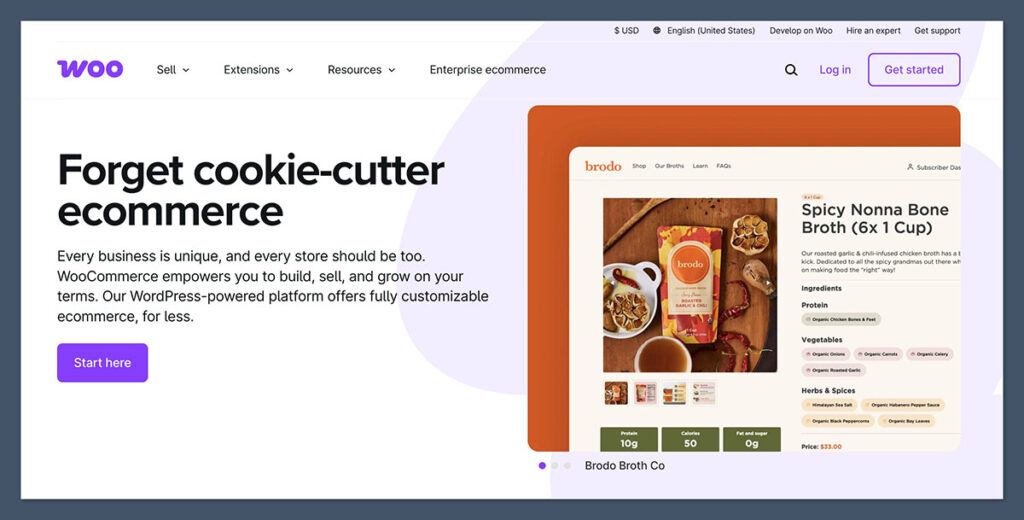
Every ecommerce website builder listed above is considered “hosted.” This means that you pay for a monthly ecommerce solution and the hosting is packaged in with it.
However, you have a few solutions that are considered “self-hosted,” meaning that apart from getting the ecommerce software itself, you must also find your own web hosting and pay for it as a separate investment. In this model, the ecommerce software often comes for free and is open source.
A self-hosted system requires a beginner to intermediate level of website knowledge, while the hosted options are usually out-of-the-box products.
That being said, installing WordPress and WooCommerce is not difficult, and some hosting companies offer to take care of that installation for you as soon as you sign up (SiteGround does this, for instance).
Currently, the best such self-hosted ecommerce option in the market is the pairing we’re looking into here – WordPress and WooCommerce.
WordPress is a website engine – a piece of web software that allows you to build and run a website in a user-friendly way. WooCommerce is a plugin that you install on top of WordPress to turn it into a fully fledged ecommerce store.
👍 What are the features and offerings that make WooCommerce special?
- The software itself is free and has a quick installation process.
- If you know how to use WordPress, this is a great choice to ensure that you can scale up properly.
- You maintain full control of your ecommerce website.
- You have access to powerfull blogging tools
- WooCommerce gives out an excellent ecommerce theme called Storefront, along with a handful of child themes that all look great.
- Since the WooCommerce is open-source, thousands of other themes are sold all over the internet.
- If a feature isn’t packaged into WooCommerce, you can go out and find a WordPress plugin to help out. Basically the options are endless with this.
- Great SEO tools available.
👎 What may turn you off of WooCommerce?
- You have to go out and get your own hosting and your own domain name.
- Coding knowledge is often preferable to really get in there and customize things.
- You may have to hire someone who knows what they are doing.
- There’s no customer support with WordPress per se. All you get is the support provided by your web host.
⭐ Who should use this ecommerce builder?
WooCommerce is the best 100% DIY ecommerce website builder in the market. It lets retain full control of your website and also modify every little detail of it. WooCommerce and WordPress are both open source. The only downside is that you do need to be comfortable around things like servers and things related.
Check out how to build a store with WooCommerce here.
Found your ecommerce website builder?
If you have any questions about finding the perfect ecommerce website builder, leave a comment in the section below.
Still don’t know which platform to choose?
👉 Maybe our ecommerce comparison chart will help you out.
👉 Also, check out this article if you’re looking for the best payment gateways.
Further reading
The current state of ecommerce
Let’s look at the state of ecommerce; and right away, the first things that pop up are: more and more consumers browse on mobile before making a decision to buy [1], ecommerce sales keep increasing every year [2], and a quality SEO ranking is more crucial than ever, with more than 40% of people starting their shopping journeys on Google [3].
What does this mean for you specifically? A couple of things:
(1) Your store – or more accurately your ecommerce website builder – has to enable you to create a mobile-friendly store website. Without that, you won’t attract mobile shoppers and thus reduce your revenue significantly.
(2) You need to take the first step as soon as possible. Yes, the sales are increasing, but what that also means is that competition is increasing as well, so you must act quickly if you want to have an impact. Don’t wait, choose your ecommerce website builder today!
(3) Your builder has to have good SEO structure in place and allow your store website to take full advantage of it. If your store is not SEO-friendly from day one, it’s going to be hard to retrofit SEO on top of it later on.
What else is going on that could affect your decision with a website builder?
Well, it turns out, Americans are more likely to buy from a company if they follow said company on any form of social media [4].
That certainly gets merchants thinking about building a social platform. Going back to your builder of choice, it should allow you to integrate your store with social media easily – the possibility to share and advertise your products on social is a must-have feature.
Also, the past few years have been the era of the consumer expecting more because of an onslaught of information.
When someone comes to your site, regardless of the ecommerce website builder you use, they have the internet on their side. Because of that, people are more likely to turn away if they see that your site runs slowly. Shoppers expect to see options for free shipping, free returns and expedited shipping.
Oh yeah, and if your products fail to offer ratings and reviews, it makes it look like you’re far less credible. Trust issues are peaking, particularly because online fraud and identity theft is still booming. But these trust issues also tie into buying.
If a customer feels like they aren’t getting proper support, all the blame falls on that company. The same goes for slow shipping, product problems and a lack of transparency with items and payments. A good ecommerce website builder will help you solve at least a couple of these problems.
At the very least, you want to be able to set up shipping zones (different rates and options depending on the delivery location), and enable customer reviews/ratings on your products. All of the top ecommerce website builders out there have these features available.
Major trends to expect for 2022 and beyond
Quite a few trends may occur as the ecommerce market lunges forward. For example, according to data, 79% of smartphone users have made a purchase via their mobile device in the last six months [5].
Okay, this isn’t the most mind-blowing news, but it’s important to remember that the trend of mobile commerce is most likely going to continue.
Another trend to look at is the lessening reliance on Google. The search engine has made it more difficult for small to mid-size brands to move up the ranks over the past few years, and many merchants are finding that it’s more plausible to find customers through different outlets like Amazon (considering most Google results show Amazon anyways), social media and email marketing.
What this means for your ecommerce website builder of choice is that you need features that allow for some integration with those third-party tools, marketplaces and social media platforms.
Fair enough…the trends may change. Some will stick, while others we’ll never hear about again. However, looking at these things provides good indication of the types of actions you should take with your store.
Now that you’ve had a chance to think about your own needs and the needs of the market, feel free to come back to the comparison up top ☝️☝️☝️ and pick your ideal ecommerce website builder with confidence!


Hola ¿podrías comentar algo sobre Godaddy? Estoy comparando todas las plataformas posibles y me llama la atención que no la mencionas. Muchas gracias.
Hello Deborah, you can check out our GoDaddy Website Builder review here.
Thanks for sharing the great information on the best eCommerce platforms and comparison about all major platforms.
You’re welcome!
muchas gracias a la información de la pagina y algunos comentarios pude resolverlo. Esto me ayudo mucho , por que se me hizo mas facil para proyectos que tenia pendiente y no me salia.
You’re welcome Gian!
very nice post thanks bro
We’re glad you liked it!
Thanks for sharing useful information.
You’re welcome!
This review do justice to all the ecommerce platforms discussed here.
I had used two of the platforms discussed in this article for my online store ikkibana.com
I had used the community edition of Magento for developing this site. I had to hire the service of an ecommerce website development company, Global Media Insight, for developing a basic ecommerce website. Because, it is very complex platform and requires someone with really good programming knowledge to help you create an ecommerce website. So, If you think Magento’s community edition as a free ecommerce development platform, think again. You might need to hire an ecommerce website developer to do the job.
Later when I had to include more features in to the website, like tracking orders and integrating online payment gateway etc.. it became a lot harder with Magento. I know community edition of magento is a free platform, but every body should know that if you are looking to develop a full fledged ecommerce website with a whole lot of features and if you take your business seriously, you should go for Shopify.
I had to re-built the entire store using shopify to integrate those additional features which I needed.
Shopify is a paid platform, but it has its benefits. I was able to re-built the entire website and additional features I needed in half the time it took with Magento.
Really interesting thing about shopify is that you dont need the continuous support of a developer to help you with day to day tasks. It is easy for someone with limited or no programming language to handle a shopify website’s back end.
Here is my point,
If you are serious about your ecommerce business, go for a paid ecommerce development platform that have good support and is easy to manage.
Thank you for taking the time to make and share the comparisons! It looks like I’ll be using shopify for future e-commerce websites! Thank you again! Cheers!
Good luck with your project Lulu!
Great comparison. We were challenged by Shopify when it can to product implementation. Specifically, we sell greeting cards and need advanced pricing intelligence based on many price points/quantity discounts, etc. it seems we need a third party tool to create a mature shopping cart interface that accommodates our needs. We built a crude system with Virtuemart on Joomla, but would like a platform more user friendly. Any advice on integrating a robust shopping cart with pricing intelligence?