

After comparing eight independent 3PLs on verified pricing, real merchant reviews, and what their SLAs actually pay out, ShipBob is the best all-around fulfillment service for fast-scaling DTC brands, thanks to the category's strongest software and a true national 2-day network. But there is no universal winner here: the right 3PL depends on your order volume and what you sell.
In this guide, I'll walk you through the pricing, strengths, and drawbacks of each provider, so you can match one to your store. We take no vendor money, and no warehouse on this list ranked itself.
Key Takeaways 🔍
- ShipBob is the top all-rounder for growing DTC brands, but you must audit its invoices, because postage markups and surprise fees are the recurring complaint
- eFulfillment Service is the only pick with no monthly minimum, no setup fee, and no contract, making it the natural first step for small sellers
- ShipMonk wins on lower storage and setup cost, plus purpose-built kitting for subscription boxes
- Red Stag is the only provider that pays cash, a flat $50 per error, and specializes in heavy, fragile, and high-value goods
- Real invoices run 20% to 50% above the quoted per-order rate, so budget above the headline number
- Ship under roughly 100 to 300 orders a month and you probably don't need a 3PL yet
How we compare fulfillment services
At Ecommerce Platforms, we rank 3PLs on four things that actually predict buyer's remorse, not marketing claims:
- Real warehouses: genuine ecommerce fulfillment, not software or a partner marketplace
- Verifiable pricing: published fee data, not “contact us for a quote” and nothing else
- SMB and DTC fit: serves growing merchants, not enterprise-only accounts
- A documented track record: real merchant reviews, good and bad
Most popular “best 3PL” lists mix software like Linnworks and ShipStation in with real warehouses, fold in marketplace networks that don't fulfill anything themselves, and at least one lists the same company twice. That's not a ranking. That's a directory with a headline.
Fulfillment Services Comparison Table
Here's how the eight compare side by side before we get into each one:
| Provider | Best for | Monthly minimum | Setup fee | Order minimum | Typical storage | Key strength | Watch-out |
|---|---|---|---|---|---|---|---|
| ShipBob | Fast-scaling DTC | $275/mo | $975 | ~400/mo for good rates | $40-80/pallet | Best software + national 2-day | 15-30% postage markup |
| ShipMonk | Subscriptions, kitting | $250/mo | $0 | Batches ~50 orders | $25/pallet | Owned facilities + kitting | Billing errors, slow exit |
| eFulfillment Service | New, very small sellers | None | $0 | None | Quote | No minimum, no contract | Single MI location, 50 lb cap |
| Red Stag | Heavy, oversized, high-value | Quote | Quote | ~200/mo | Quote | $50-per-error guarantee | Only 2 locations |
| Amazon FBA | Marketplace-first | Per-unit | None | None | $0.57/cu ft (AWD West) | Prime badge | Fee stack + payout delay |
| ShipHero | WMS software + fulfillment | WMS $1,995+ | ~$975 | 500+/mo (3PL) | $40/pallet | Published fee card | 500-order floor |
| Flexport | Enterprise + freight | $5,000/mo | Quote | Quote | Quote | Freight + fulfillment bundled | $5k minimum |
| Portless | Cross-border, China-origin | Quote | Quote | Quote | N/A (origin) | No domestic holding cost | Tariffs erode edge, no public pricing |
1. ShipBob: Best for Fast-Scaling DTC Brands
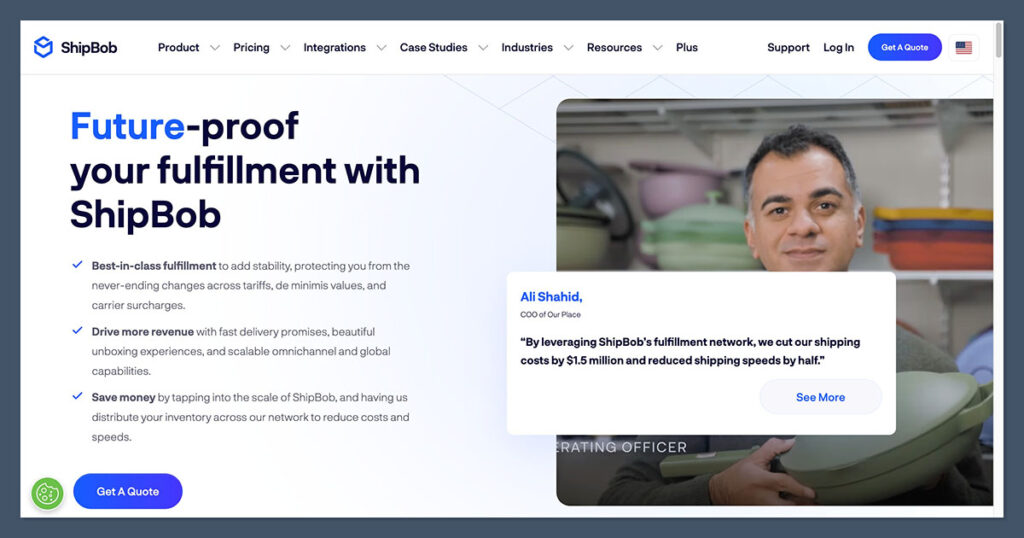
ShipBob pricing: $275 per month minimum (fulfillment only)
Public rate card: No
ShipBob doesn't publish a rate card anymore, which tells you how 3PL pricing works now: the market leader would rather quote you privately than let you comparison shop. Once you get a quote, the real entry cost is a $275 monthly minimum on fulfillment alone, a $975 setup fee, $0.30 per pick, and a 15-30% markup layered on top of carrier postage. Rates only start to look competitive once you're moving roughly 400 orders a month.
What that buys is the most complete package in the category. ShipBob runs 60+ US fulfillment centers plus 10+ international ones, and its zone-skipping network pre-positions your inventory closer to buyers so coast-to-coast 2-day delivery is realistic rather than aspirational. The dashboard, analytics, and inventory tools are the best I've seen among 3PLs, and every major cart connects out of the box, which is why fast-scaling DTC brands keep landing here.
The catch is billing, and it's a real one. Merchant reviews are genuinely polarized: some brands call ShipBob flawless while others describe surprise labeling charges, disputed overcharges, and inventory that went missing between warehouses. None of that is a dealbreaker if your margins can absorb the postage markup and you audit every invoice line by line, but it does mean ShipBob rewards operators who watch their statements closely and punishes those who don't.
✔️ Pros
- Software: the dashboard, analytics, and inventory tools are the best in the category
- National reach: the 60+ center footprint makes coast-to-coast 2-day realistic
- Integrations: covers every major cart (Shopify, Amazon, WooCommerce, BigCommerce) out of the box
- Amazon prep: auto-generates FBA orders for Amazon-native sellers adding a DTC channel
❌ Cons
- Surprise fees: merchants report labeling charges billed without notification
- Billing disputes: repeated overcharges that forced line-by-line audits
- Support: complaints about overseas support and 48+ hour response times, with no phone line
- Postage markup: a 15-30% markup added on top of carrier rates
Why use ShipBob? ⬇️
- 60+ US and 10+ international fulfillment centers reaching 200+ countries
- A zone-skipping network that pre-positions inventory closer to customers to cut last-mile time and cost
- The best-in-class dashboard among 3PLs, consistently rated so in head-to-head reviews
- Best for fast-scaling DTC brands that want top software and true national 2-day
How Much Does ShipBob Cost?
ShipBob's headline numbers understate the real bill. The $275 minimum and $0.30 pick fee look reasonable on their own, but the 15-30% postage markup is where costs quietly compound, because it applies to every shipment rather than showing up as one flat monthly line. Add the $975 setup and storage that jumps to $40-80 per pallet after the 30-day grace period, and the effective per-order cost only makes sense once you clear roughly 400 orders a month. Below that, the minimum eats your margin.
| Monthly minimum | $275/month (fulfillment only) |
| Setup fee | $975 |
| Pick fee | $0.30 per pick |
| Storage | $40-80/pallet/month (after 30-day free grace period) |
| Postage markup | 15% to 30% on carrier rates |
| Order volume for good rates | ~400 orders/month |
2. ShipMonk: Best for Subscription Boxes and Kitting
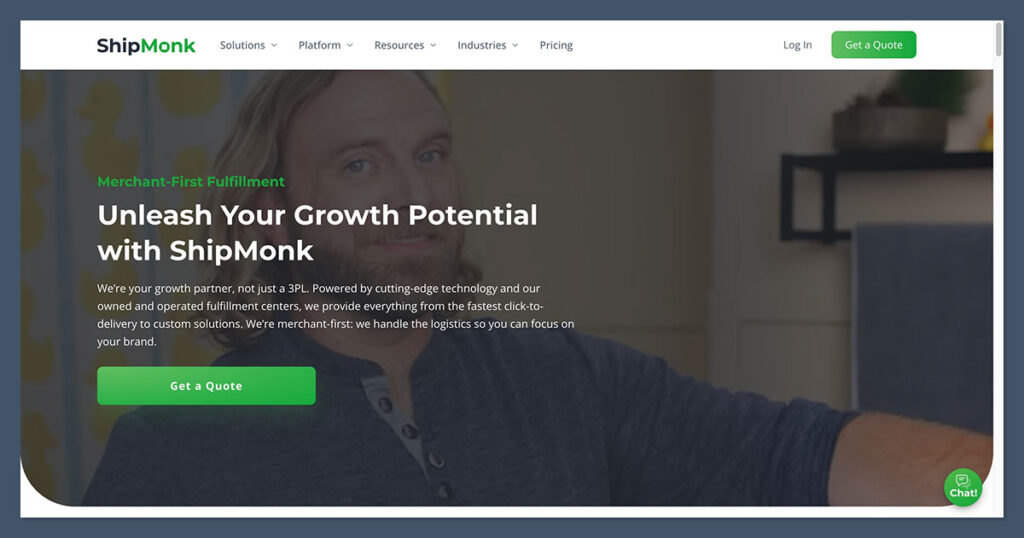
ShipMonk pricing: $250 per month minimum
Setup fee: $0
ShipMonk cuts your entry cost fast: no setup fee, free inbound receiving, and storage priced roughly 1.4x lower than ShipBob. The monthly minimum sits at $250, and picks start at $2.50 for the first item plus $0.50 for each additional one. For many mid-size brands, that structure works out cheaper on total cost than ShipBob once you actually run the numbers against your own order mix.
The operational story is control. ShipMonk owns all 11 of its fulfillment centers outright, spread across the US, Canada, Mexico, the UK, and the Czech Republic, roughly 3 million square feet including the new 406,000 sq ft KY2 apparel and returns facility in Louisville. Everything runs on one platform stitching together order management, warehouse management, inventory, and transportation, and the kitting and batch workflows are purpose-built for subscription boxes and crowdfunding.
That kitting focus is the real reason to pick ShipMonk over a generalist. Its Chief Revenue Officer, Aras Kolya, frames the pitch bluntly: “Fulfillment IS marketing,” and the unboxing experience is the argument. The trade-off shows up in billing: merchants report charges for other clients' packages and pallets they never used, and at least one described a drawn-out, six-month exit. Trustpilot reflects the split, running about 70% five-star against roughly 20% one-star.
✔️ Pros
- Cost structure: lower setup and storage than ShipBob for many mid-size brands
- Owned facilities: all 11 warehouses are its own, so more direct operational control
- Kitting: the standard recommendation for subscription boxes and assembly work
- Support: the “Happiness Engineer” team generally reviews as more responsive than ShipBob's
❌ Cons
- Billing errors: merchants report charges for other clients' packages and for pallets never used
- Slow exit: one account described a 6+ month exit with continued billing
- Operational slips: misshipped orders and lost stock with “no credit issued”
- Polarized reviews: Trustpilot runs about 70% 5-star against roughly 20% 1-star
Why use ShipMonk? ⬇️
- Owns all 11 fulfillment centers across the US, Canada, Mexico, UK, and Czech Republic, about 3 million square feet total
- Added KY2, a 406,000 sq ft Louisville apparel and returns facility, in April 2026
- A unified OMS, WMS, inventory, and TMS platform
- Purpose-built kitting and batch workflows (batches need ~50 orders)
ShipBob vs ShipMonk: which is cheaper? ⬇️
ShipMonk usually wins on storage and setup, ShipBob on software and national 2-day. Ship-heavy, low-storage brands often come out ahead with ShipMonk once you weigh ShipBob's 15-30% postage markup against your shipping mix. Model both against your real order mix.
How Much Does ShipMonk Cost?
ShipMonk's advantage is what's missing from the bill. There's no setup fee, inbound receiving is free, and storage at $25 per pallet is roughly 1.4x cheaper than ShipBob's, so the fixed costs that pile up elsewhere largely disappear here. The variable side is a $2.50 first-item pick plus $0.50 for each additional item, which favors brands shipping single-item or small-basket orders. For ship-heavy, low-storage catalogs, that combination usually lands below ShipBob on total cost.
| Monthly minimum | $250/month |
| Setup fee | $0 |
| Inbound receiving | Free |
| Storage | $25/pallet/month |
| Pick and pack | From $2.50 first item, $0.50 each additional (some sources cite ~$2.75 per order) |
3. eFulfillment Service: Best for New and Very Small Sellers
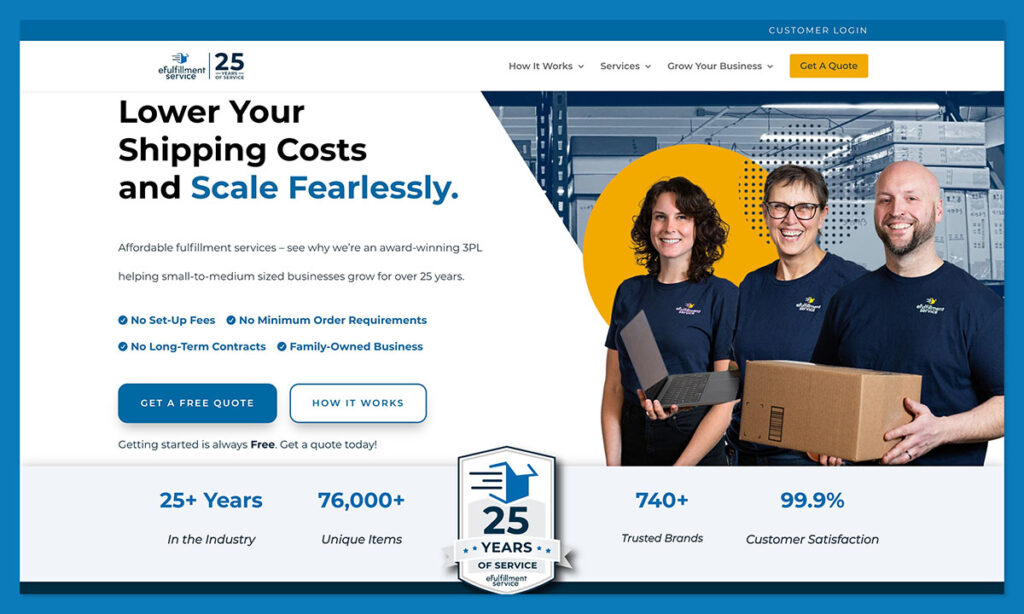
eFulfillment Service pricing: Pay-as-you-go, no minimum
Contract required: No
If a $250 monthly minimum is the one thing standing between you and outsourcing, this is your pick. eFulfillment Service is the only 3PL on this shortlist with no order minimums, no contracts, and no setup fees. It runs on a pure pay-as-you-go model, which means you can hand off fulfillment the month you're ready and walk away just as cleanly if it doesn't fit.
Behind the low barrier is a surprisingly durable operation. The company has run out of Traverse City, Michigan for more than 25 years, a long tenure in a business where plenty of 3PLs quietly fold, and it connects to 40+ carts and marketplaces despite its small-seller focus. It reports a 99.7% client satisfaction rating, and its systems are built around standard parcels up to 36 inches and 50 pounds.
The limits are the flip side of that simplicity. A single Michigan footprint can't do the zone-skipping that multi-node networks use to hit national 2-day, and the size cap rules out anything heavy or oversized. Below roughly 200 orders a month, self-fulfillment may still be cheaper. Treat eFulfillment Service as the natural first step, then reassess once you cross 300 to 500 orders and a bigger network starts to earn its keep.
✔️ Pros
- Zero barrier: the only shortlist 3PL that removes the monthly minimum
- No lock-in: pay-as-you-go with no contract to escape later
- Integrations: 40+ carts and marketplaces for such a small-focused provider
- Track record: a quarter century in a business where plenty of 3PLs fold
❌ Cons
- Single region: one Michigan footprint weakens zone-skipping and 2-day reach
- Size cap: 36 inches and 50 lbs rules out oversized or heavy goods
- Below breakeven: under ~200 orders a month, self-fulfillment may still be cheaper
Why use eFulfillment Service? ⬇️
- 25+ years in operation, run out of Traverse City, Michigan
- 40+ cart and marketplace integrations
- A reported 99.7% client satisfaction rating
- Best for sellers shipping under about 300 orders a month who want to outsource without a monthly minimum. Reassess once you cross 300 to 500 orders, where a multi-node network starts earning its keep
How Much Does eFulfillment Service Cost?
There's almost nothing fixed to budget here, which is the entire point. No monthly minimum, no setup fee, and no contract means your cost scales directly with what you actually ship, so a slow month simply costs less rather than triggering a shortfall charge. Per-order rates are quote-based and tied to your parcel profile, and the 36-inch, 50-pound cap keeps pricing predictable by design. Just remember that below about 200 orders a month, doing it yourself may still beat any outsourced rate.
| Monthly minimum | None |
| Setup fee | $0 |
| Contract | None (pay-as-you-go) |
| Per-order pricing | Quote-based |
| Package cap | 36 inches, 50 lbs |
4. Red Stag Fulfillment: Best for Heavy, Oversized, and High-Value Goods
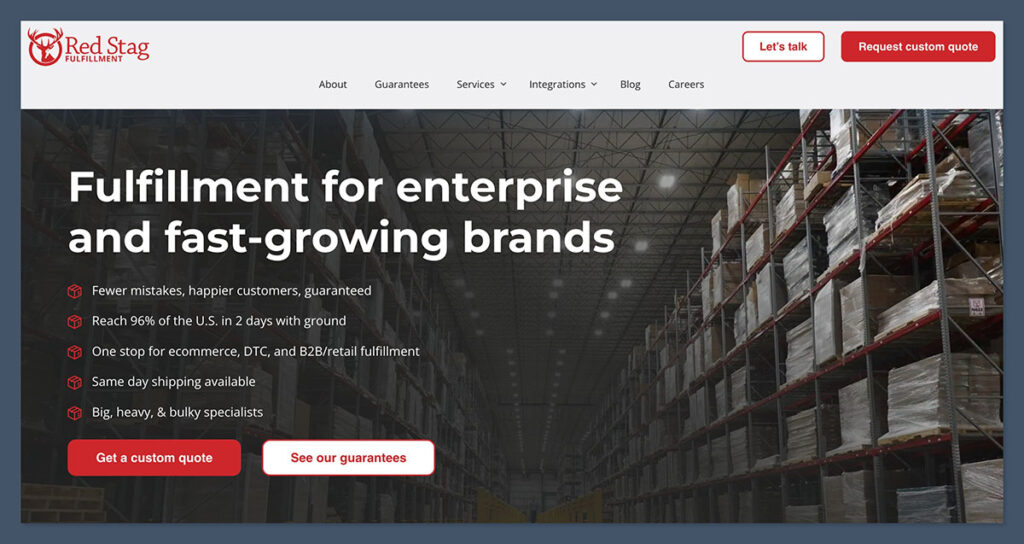
Red Stag pricing: Quote-based
Order minimum: ~200/month
Red Stag makes about one mispick per 16,000 orders, and when it does slip, it pays you $50 for the mistake. That's a real number, not the vague “we'll make it right” language most 3PLs hide behind. Its published error rate sits between 0.006% and 0.02%, with 99.96% on-time shipping, and the guarantee goes further than the payout: Red Stag fixes the error at its own cost and reimburses inventory lost or damaged in its care at full value.
That accuracy is the whole point, because Red Stag specializes in the SKUs most 3PLs would rather not touch. Heavy, fragile, oversized, and high-value items like furniture and equipment are its home turf, and for those products a single mispick can wipe out the profit on a dozen clean orders. Measurable accuracy backed by cash is exactly what justifies its premium for that kind of catalog.
The constraint is reach. Red Stag operates just two warehouses, in Tennessee and Utah, which cover the eastern and western US reasonably well but can't match ShipBob's national footprint for guaranteed 2-day everywhere. It also carries a roughly 200-order-per-month floor, so it's not built for the earliest-stage sellers. Confirm transit times to your densest customer regions before you commit.
✔️ Pros
- Real guarantee: a cash-backed financial backstop, not marketing language
- Accuracy: top-tier error and on-time rates in the industry
- Hard goods: handles the SKUs general 3PLs won't touch
❌ Cons
- Two locations: limits national 2-day coverage versus ShipBob's larger network
- 200-order floor: excludes the earliest-stage sellers
Why use Red Stag? ⬇️
- A 0.006% to 0.02% error rate and 99.96% on-time shipping
- A 100% service guarantee: a flat $50 credit per mispick, misship, or late shipment, plus fixing the error at its own cost, plus full-value reimbursement for inventory lost or damaged in its care
- Two warehouses, in Tennessee and Utah, covering the eastern and western US reasonably well
- Best for heavy, fragile, oversized, or high-value SKUs where a single mispick is expensive. Confirm transit times to your densest customer regions before you sign
How Much Does Red Stag Cost?
Red Stag doesn't publish a per-order rate, so pricing comes down to a custom quote built around your product weight, dimensions, and volume. That opacity is the trade-off for a specialist that handles heavy and high-value goods most 3PLs won't. The number that actually matters here isn't the pick fee, it's the $50-per-error credit plus full-value reimbursement, which works like insurance on exactly the kind of expensive SKU where a single mistake would otherwise erase your margin. Expect the roughly 200-order monthly floor to gate entry.
| Pricing model | Quote-based, no public rate card |
| Order minimum | ~200/month |
| Accuracy guarantee | $50 credit per error, plus full-value reimbursement |
5. Amazon FBA: Best for Marketplace-First Sellers

Amazon FBA pricing: Per-unit fulfillment fee
Prime eligibility: Yes
This is the most expensive year FBA has ever had, and the real damage isn't the +$0.08 per unit Amazon put on the marquee. It's the stacking underneath it. A 3.5% fuel surcharge landed in April, tiered increases push some higher-value items up to about $0.51 per unit, and AWD West storage climbed 19% to $0.57 per cubic foot. Individually, each change looks modest; together they reset the math on thin-margin catalogs.
Two shifts hurt more than the fees themselves. Free US FBA prep and labeling ended at the start of the year, and payouts now arrive seven days after delivery rather than on Amazon's older schedule, which quietly squeezes cash flow independent of any per-unit increase. The low-inventory fee is now assessed at the FNSKU level too, so thin stock on individual variants gets penalized even when your overall inventory looks healthy.
None of that erases FBA's core advantage. The Prime badge is still the single biggest conversion driver on Amazon, and Amazon handles storage, pick and pack, shipping, returns, and customer service end to end. That's why so many Amazon-first brands now run a hybrid setup, keeping FBA for Prime orders while a dedicated 3PL handles their own storefront, rather than routing own-site orders through the pricier Multi-Channel Fulfillment.
✔️ Pros
- Prime badge: still the single biggest conversion driver on Amazon
- Hands-off: Amazon runs storage, pick and pack, shipping, returns, and customer service
- Reach: marketplace-native traffic no standalone site matches
❌ Cons
- Free prep ends: US FBA prep and labeling services stop January 1, 2026
- Payout delay: payouts move to 7 days after delivery starting March 12, 2026, squeezing cash flow
- Low-inventory fee: now assessed at the FNSKU level, penalizing thin stock on individual variants
- No brand control: no custom packaging or inserts
The 2026 FBA fee changes, explained ⬇️
- A new 3.5% fuel surcharge took effect April 17, 2026
- Tiered increases run up to ~$0.51/unit on higher-value items
- Buy with Prime adds +$0.24/unit; Multi-Channel Fulfillment adds +$0.30/unit
- AWD West storage rose 19% to $0.57/cubic ft/month; most other changes took effect January 15, 2026
- The verdict: keep FBA for Prime-driven Amazon sales, but pair it with a dedicated DTC 3PL for off-Amazon orders. Tools like ShipBob's automated FBA prep let you feed both channels without running two operations
How Much Does Amazon FBA Cost?
FBA pricing is deceptively layered. The per-unit fulfillment fee is only the base; the 3.5% fuel surcharge, tiered increases up to about $0.51 per unit, and separate add-ons for Buy with Prime and Multi-Channel Fulfillment all stack on top. Storage is billed by cubic foot and climbs sharply in peak months. The line that hurts cash flow most doesn't even appear as a fee: the seven-day-post-delivery payout delay, which ties up revenue you've already earned. Model the all-in per-unit cost, not the headline fee.

| Fulfillment fee | Per-unit, plus 3.5% fuel surcharge |
| Higher-value tiers | Up to ~$0.51/unit |
| Buy with Prime | +$0.24/unit |
| Multi-Channel Fulfillment | +$0.30/unit |
| AWD West storage | $0.57/cubic ft/month |
6. ShipHero: Best for Brands That Want WMS Software Plus Fulfillment
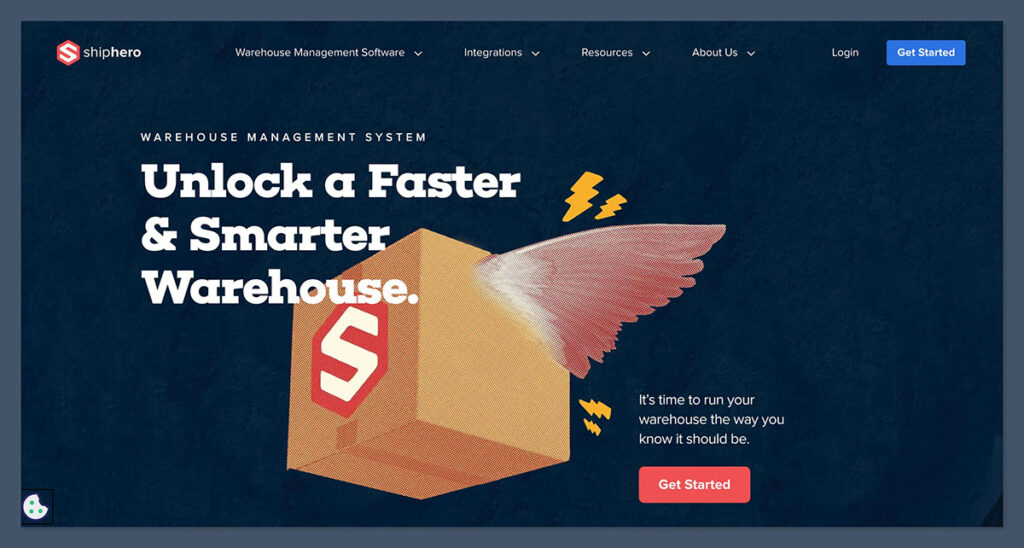
ShipHero pricing: WMS from $1,995/month
3PL order minimum: 500+/month
When someone tells you “ShipHero costs $X,” your first question should be: which ShipHero? It's two products under one name, standalone warehouse management software you run yourself and an outsourced 3PL network that fulfills on your behalf, and merchants mix them up constantly. The software alone starts near $2,000 a month; the 3PL network is a separate, usage-based bill layered on top.
Its rare selling point is transparency. In a category built on “contact us for a quote,” ShipHero publishes an actual reference-fee card, listing $40-per-pallet storage, tiered receiving rates, picks around $0.33, and roughly $975 onboarding. Those are reference figures rather than guaranteed prices, but they still let you model costs before you ever talk to a salesperson, which is more than most competitors allow.
The dual model is the appeal and the filter. If you want to operate your own warehouse, or have the ambition to, ShipHero's WMS is a genuine option; if you'd rather outsource, its network handles that instead. Either way, the 3PL side carries a 500-order-per-month floor, so it's aimed at brands already at scale rather than sellers who want hands-off fulfillment at low volume.
✔️ Pros
- Transparency: actual published figures versus ShipBob's quote-only model
- Run your own: the option to operate its warehouse software in-house
- Or outsource: the option to hand fulfillment to its network instead
❌ Cons
- 500-order floor: the 3PL account excludes early-stage sellers
- Pricey software: the WMS alone runs close to $2k a month
- Reference, not quote: the published fees are figures, not guaranteed prices
Why use ShipHero? ⬇️
- Publishes a transparent reference-fee card, which is rare among 3PLs
- A dual model: run the WMS yourself, or use the fulfillment network
- Best for brands that run or want to run their own warehouse software, or need 3PL at 500+ orders a month with published fees. Skip it if you want fully hands-off fulfillment under 500 orders a month
How Much Does ShipHero Cost?
ShipHero splits into two very different bills, so price it as two products. The standalone WMS is a flat software subscription of roughly $1,995 to $2,295+ a month, sensible only if you run your own warehouse. The 3PL network is usage-based, with $40-per-pallet storage, receiving at $35 to $45 an hour, picks around $0.33, and about $975 to onboard. Because these are published reference figures rather than a locked quote, treat them as a planning baseline and confirm your actual rates against your SKU mix and volume.
| WMS software | $1,995 to $2,295+/month |
| 3PL order minimum | 500+ DTC orders/month |
| Storage | $40/pallet ($10/shelf, $5/bin, ~$0.70/cu ft/day) |
| Receiving | $35/hr first 2 hours, then $45/hr |
| Pick fee / onboarding | ~$0.33 per pick / ~$975 onboarding |
7. Flexport: Best for Enterprise Brands With Freight Needs
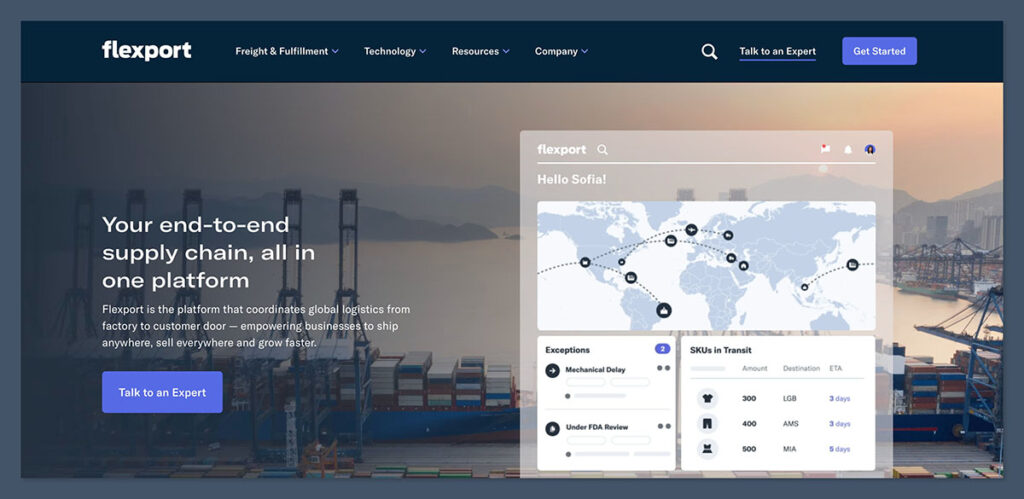
Flexport pricing: $5,000 per month minimum spend
Best fit: Enterprise + import freight
If you saw Flexport on another “best 3PL” list, that list is out of date. On January 1, 2026, Flexport raised its fulfillment minimum from $500 to $5,000 a month. That's a 10x jump, and a company spokesperson confirmed the move was a deliberate shift upmarket, aimed squarely over the head of any first- or second-3PL SMB.
For the brands it does target, the pitch is integration. Flexport bundles ocean and air freight with fulfillment under a single contract, which suits diversified, high-volume sellers who manage their own imports and would rather not stitch together a separate freight forwarder and 3PL. Owning the supply chain from origin to doorstep is a real advantage at that scale.
The pricing structure is where it gets treacherous. The $5,000 minimum is calculated across eight separate categories, from fulfillment and storage to freight, prep, and even credit card processing, and any shortfall gets billed on the next month's invoice. Unless you already spend $5,000+ a month and want freight and fulfillment together, Flexport has priced itself out of reach. I'm keeping it on the list only so you know exactly why to cross it off.
✔️ Pros
- One vendor: freight and fulfillment bundled under one roof
- Steady volume: strong for diversified, high-volume brands
- Import control: owns the supply chain from origin to doorstep
❌ Cons
- $5k floor: excludes this article's reader almost entirely
- 8-category math: easy to trip the minimum and eat a shortfall charge
- Deliberate move upmarket: a company spokesperson confirmed the enterprise focus
How Flexport's $5,000 minimum works ⬇️
The $5,000/month minimum spend is calculated across 8 categories: fulfillment, reserve storage, parcel, FTL/LTL freight, pallet and case handling, label services, prep, and credit card processing. Shortfalls get billed on the next month's invoice. Skip it unless you already spend $5,000+ a month and want freight and fulfillment together.
How Much Does Flexport Cost?
Flexport's pricing is defined by one number: a $5,000 monthly minimum spend. What makes it tricky is that the minimum is measured across eight separate categories, from fulfillment and storage to freight, prep, and card processing, so you can hit it in some areas and still fall short overall, at which point the gap lands on next month's invoice. For genuine enterprise shippers already spending at that level, the bundled freight-plus-fulfillment contract can be efficient. For everyone else, the floor alone is the answer.
| Monthly minimum | $5,000 minimum spend |
| Billing basis | Across 8 categories (fulfillment, freight, storage, prep, and more) |
| Shortfall | Billed on the next month's invoice |
8. Portless: Best for Cross-Border and China-Origin Fulfillment
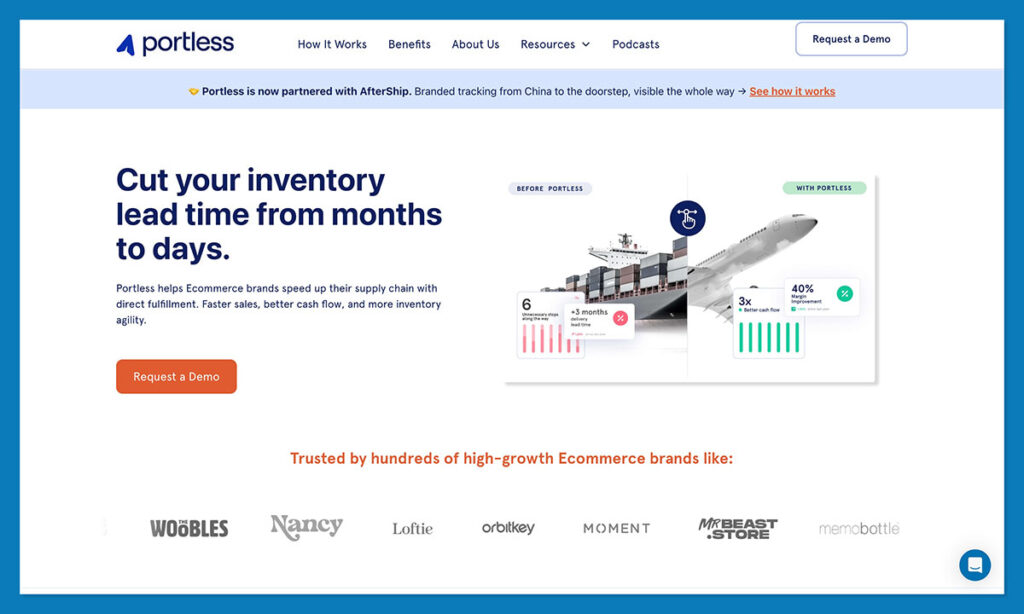
Portless pricing: Quote-based
Model: Ships direct from origin (China)
What if you never held US inventory at all, and shipped every order straight from China? That's Portless, and its origin-fulfillment model was genuinely clever until the tariff rules changed underneath it. The appeal was concrete: no US warehouse lease, no capital locked in forward-stocked inventory, and no domestic storage fees, because each order ships direct from your manufacturer to the buyer.
The model lived or died on the $800 de minimis exemption, and that exemption is gone. It ended for China and Hong Kong on May 2, 2025, and for everyone else on August 29, 2025, and parcels that once cleared customs duty-free now face tariffs as high as 145%. Under the new rules, per-parcel duties can add $12 to $15 to a $10 item, which erases most of the holding-cost savings that made origin fulfillment attractive in the first place.
There's a transparency issue on top of the tariff one. Portless publishes no rate card and tends to place itself at the top of its own comparison lists, so you're negotiating blind. If most of your inbound is small cross-border parcels, model the new landed cost carefully before committing. For many US brands, bulk-importing into a domestic 3PL and forward-stocking now beats shipping from origin outright.
✔️ Pros
- No domestic warehousing: skip the holding cost entirely
- Fast origin dispatch: ships straight from the source
- Was a bargain: highly attractive before the tariff shift
❌ Cons
- Duty-free edge is gone: US de minimis ended and parcels now face tariffs as high as 145%
- Self-ranks #1: the vendor puts itself atop its own comparison lists
- No transparent pricing: quote-only, with nothing published
Why the tariff shift broke this model ⬇️
US de minimis ended for China and Hong Kong on May 2, 2025, and for all other countries on August 29, 2025. Under the new tariffs, per-parcel duties can add $12 to $15 to a $10 item, erasing most of the holding-cost edge. If most of your inbound is small cross-border parcels, model the new duties before you commit. For many US brands, domestic forward-stocking now beats origin fulfillment outright.
How Much Does Portless Cost?
Portless quotes privately, so the sticker price isn't the number that decides this. Because it ships direct from origin, your true cost is landed cost: the per-order fulfillment fee plus the tariffs that used to be zero. With de minimis gone, duties of $12 to $15 on a $10 item can dwarf whatever fulfillment saving the model offers. Before you sign, build a full landed-cost model on your real SKUs and compare it against forward-stocking into a domestic 3PL.
| Pricing model | Quote-based, no public rate card |
| Fulfillment origin | China (direct-to-buyer) |
| Tariff exposure | Up to 145% since de minimis ended |
How Do I Choose the Right Fulfillment Service?
Order volume is the single biggest variable, so start there. Under about 100 to 300 orders a month, self-fulfillment is usually cheaper than any 3PL's minimum. From there you graduate: a no-minimum 3PL, then a $250 to $275/month-minimum 3PL, then “partnership grade” at 500+ orders, then $5,000+/month enterprise.
Match your own numbers to this table:
| Merchant profile (volume + product + channel) | Shortlist | Why |
|---|---|---|
| Under ~300 orders/mo, standard parcel | eFulfillment Service, or self-fulfill | Minimums aren't worth it at this volume |
| 300-2,000 orders/mo, DTC apparel or general goods | ShipBob or ShipMonk | Full-service networks built for mid-size scale |
| Subscription or kitting-heavy | ShipMonk | Purpose-built batch and assembly workflows |
| Heavy, fragile, or high-value | Red Stag | Specialty warehousing plus the $50 guarantee |
| Amazon-first | Amazon FBA, plus a DTC 3PL | Prime badge, paired for off-Amazon sales |
| Own-warehouse ambition, or 500+ orders/mo | ShipHero | WMS software or 3PL at scale, with published fees |
| Enterprise with import freight | Flexport | Freight and fulfillment under one contract |
Once you have a shortlist, vet each candidate on the things that cause buyer's remorse, not just the rate card:
- Warehouse locations versus your customers: proximity drives both shipping speed and cost through zone skipping
- Ecommerce-specific experience: favor it over generic warehousing, since ecommerce-savvy partners can advise on tariffs and product classification
- Billing transparency and exit friction: ask directly and get it in writing, because these are the top two sources of regret
- Total cost, not the headline rate: don't optimize on the per-order price alone
- A real needs conversation: talk through returns volume, kitting, and peak-season spikes instead of trusting the published rate card
The True Cost of a 3PL: Hidden Fees to Budget For
Real 3PL invoices land 20% to 50% above the quoted per-order rate. And storage has quietly become a profit center: 48.6% of 3PLs now charge a long-term storage penalty of 1.5x to 3x the standard rate, up from just 23.3% a year earlier. Here's the fee stack to budget for.
| Fee | Typical range | How it's billed / when it hits |
|---|---|---|
| Receiving | Varies widely | Per pallet, carton, SKU, hour, or container; billed inconsistently |
| Monthly minimum | $250 to $1,000+ | Charged whether or not you hit the volume |
| Setup / onboarding | $0 to $975 | One-time, upfront |
| Pick and pack | $0.30 to $2.75 | Per order, often plus a per-additional-item fee |
| Storage | $25 to $80/pallet/mo | Monthly, sometimes after a 30-day grace period |
| Long-term storage penalty | 1.5x to 3x standard | Once inventory sits 30 to 90+ days |
| Peak-season surcharge | +10% to 30% | On fulfillment fees during Q4 |
| Split-shipment surcharge | Duplicate pick and pack | When one order ships from multiple nodes |
| Postage markup | 15% to 30% | Added to carrier rates (for example, ShipBob) |
| Returns processing | Per return | When a customer sends an item back |
Use these benchmarks to sanity-check any quote:
- All-in cost per order runs about $10 to $17 depending on vertical, with apparel averaging ~$6.20 and fragile homewares ~$18.40
- Keep fulfillment inside 8% to 12% of revenue; anything above 15% signals inefficiency you should fix
- Factor in carrier increases: FedEx and UPS posted a 5.9% headline general rate increase for January 2026, an effective 8% to 12% for typical DTC merchants once dim-weight and zones are counted
How Tariffs and the End of De Minimis Change Your Strategy
The $800 US de minimis exemption is gone. Parcels that used to clear customs duty-free now face tariffs as high as 145%. On many consumer goods the blended rate lands around 35% once Section 122 and Section 301 duties stack.
The dates matter for planning. The exemption ended for China and Hong Kong on May 2, 2025, and for all other countries on August 29, 2025. The EU follows on July 1, 2026, replacing its 150-euro duty-free threshold with a flat 3-euro customs duty per parcel regardless of value.
The strategic consequence is a shift from shipping individual duty-free parcels from origin to bulk-importing inventory into a domestic or regional 3PL once and absorbing tariffs at scale. That's called forward stocking, and the math is stark: duties can add $12 to $15 to a $10 item shipped individually. Prices on Shein, Temu, and AliExpress have already risen 20% to 40% since the exemption ended.
- If you import from China, price forward-stocking against per-parcel duties before you choose a model
- Domestic 3PLs gain an edge: ShipBob, ShipMonk, Red Stag, and eFulfillment Service all benefit
- Origin models need new math: run the duty numbers on Portless-style fulfillment before committing
Can I Switch 3PL Providers? A 90-Day Migration Playbook
Switching 3PLs sounds terrifying: stockouts, lost inventory, and paying two providers at once. That fear is exactly what keeps merchants stuck with a bad partner. Here's the 60 to 90 day plan that de-risks all three.
- Days 1-30, Audit & Select: document your current provider's costs and performance, evaluate 3 to 5 candidates, and sign with the winner. Check the outgoing contract for its notice period (typically 30 to 60 days) and any termination fees first.
- Days 31-60, Setup & Integration: complete system integrations, build the SKU catalog and packaging specs, and start moving slow-moving, non-critical inventory to the new facility first.
- Days 61-75, Parallel Testing: route a subset of live orders through the new 3PL while the old one handles the rest, verifying pick accuracy, SLA compliance, and integrations before full cutover.
- Days 76-90, Go-Live: execute the full cutover, transfer remaining inventory, and send official termination notice to the old provider.
- Add a 2-week buffer beyond the 90 days, because every timeline slips
- FBA has a wrinkle: phase inventory out of Amazon in stages to avoid stockouts, and plan to replace the Prime badge and Amazon's customer service in your own channel strategy
How We Rank Fulfillment Services
Our rankings come from comparing each provider on verified pricing, real merchant reviews, and what their service guarantees actually pay out, weighed against four inclusion rules: real warehouses, verifiable pricing, SMB and DTC fit, and a documented track record. We take no vendor money, and we rank on merit.
ShipBob remains the strongest all-rounder because it's difficult for another provider to match its software and national 2-day reach, but it's the one you most need to audit on billing. eFulfillment Service is the honest first step for small sellers, ShipMonk the value pick for mid-size brands that need kitting, and Red Stag the specialist for heavy or high-value goods that a single mispick would sink. The right choice depends on your volume, your product weight, and your customer map, which is exactly why it's worth testing a shortlist against your own numbers rather than trusting any single headline.
Final Verdict: Which Fulfillment Service Should You Pick?
The 15-second version, by merchant profile:
- Brand new, or under ~300 orders/month: eFulfillment Service
- Growing DTC that wants the best software: ShipBob
- Mid-size wanting lower storage plus kitting or subscriptions: ShipMonk
- Heavy, fragile, or high-value goods: Red Stag
- Amazon-first: Amazon FBA, paired with a DTC 3PL
- Run your own WMS, or 500+ orders/month: ShipHero
- Enterprise with import freight needs: Flexport
- Cross-border importer: run the tariff math first, then decide between origin and domestic
The “best” 3PL isn't the one with the biggest network or the slickest dashboard. It's the one whose fee structure and warehouse locations fit your volume, your product weight, and your customer map, and whose invoice actually matches its quote. Whichever you pick, budget for invoices running 20% to 50% above the quoted per-order rate, get references, and ask about billing and exit terms directly before you're desperate to leave your current provider.
Ecommerce Fulfillment FAQ
How many orders per month before a 3PL beats self-fulfillment?
Around 100 to 300 orders a month. Below that, in-house fulfillment is usually cheaper because 3PL monthly minimums run $250 to $1,000+ regardless of how little you ship. Clear that volume consistently and the labor you save typically outweighs the minimum.
Is ShipBob or ShipMonk cheaper?
ShipMonk usually wins on total cost for mid-size brands: no setup fee, free inbound receiving, and roughly 1.4x lower storage. But ShipBob's 15-30% postage markup can flip the result, depending on your shipping-to-storage ratio. Model both against your real order mix.
What does a 3PL's accuracy guarantee actually pay out?
It varies widely. Red Stag pays a flat $50 per error, fixes the mistake at its own cost, and reimburses lost or damaged inventory at full value. ShipBob credits up to $100 of manufacturer value per order ($500 on freight claims) within a 90-day window, with exclusions for holidays, out-of-stock goods, mislabeled inventory, and late forecasts.
How long does switching 3PLs take?
Plan for 60 to 90 days across four phases: audit and select, setup and integration, parallel testing, and go-live. Add a 2-week buffer because timelines routinely slip. Contracts usually require 30 to 60 days' notice to exit, so confirm that before you sign anywhere new.
Are Amazon's FBA fee changes really as modest as Amazon says?
No. The headline +$0.08 per unit undersells the impact. The 3.5% fuel surcharge, the 7-day-post-delivery payout delay, and the end of free US prep compound well beyond it. The payout delay in particular squeezes cash flow independent of any fee increase.
Did the end of de minimis change how I should fulfill?
Yes. With the $800 duty-free threshold gone, individually shipped low-cost parcels from abroad now face steep tariffs. That tilts the math toward bulk-importing inventory into a domestic 3PL (forward stocking) over per-parcel origin shipping. Run your own landed-cost numbers before committing.


The best I’ve ever used in the UK is Selazar, their prices are good and their service is amazing. They pick and pack my orders less than 30 minutes after I receive them on my website. Plus they offer Next day shipping for all order before 8.30pm.
Shippo is actually not a fulfillment provider, just a provider and price comparison tool for shipping *labels*. You still have to store and ship your items yourself.
Thanks for letting us know Balu!
Cheers!
—
Bogdan – Editor at ecommerce-platforms.com
As a follow-up, the same actually holds true for ShipStation. They, as well, are not a fulfillment provider. No offense, but you might want to spend a little more time on the research next time. Doesn’t really make me trust the descriptions you provided for the remaining fulfillment providers…