


ShipBob is one of the most popular fulfillment partners for ecommerce businesses, especially for DTC brands focused on scaling fast. The company supports businesses with global shipping, inventory management, and fast delivery — but what does ShipBob actually cost?
In this comprehensive guide, we’ll explore the different costs involved when using ShipBob, including receiving, storage, picking and packing, shipping, returns, and implementation.
We’ll also cover hidden fees to watch out for, and which plans make sense for your stage of business.
Key Takeaways 🔍
- ShipBob offers modular pricing based on services used, not a fixed monthly fee
- Most ecommerce businesses pay between $5–$10 per order for fulfillment and shipping
- Storage fees vary by inventory volume and warehouse location
- ShipBob’s software and analytics tools are free, but there is a one-time setup fee
- Returns processing and kitting services come with additional charges
- Startup businesses with under 400 orders/month may qualify for free self-service onboarding
How Much Does ShipBob Cost?
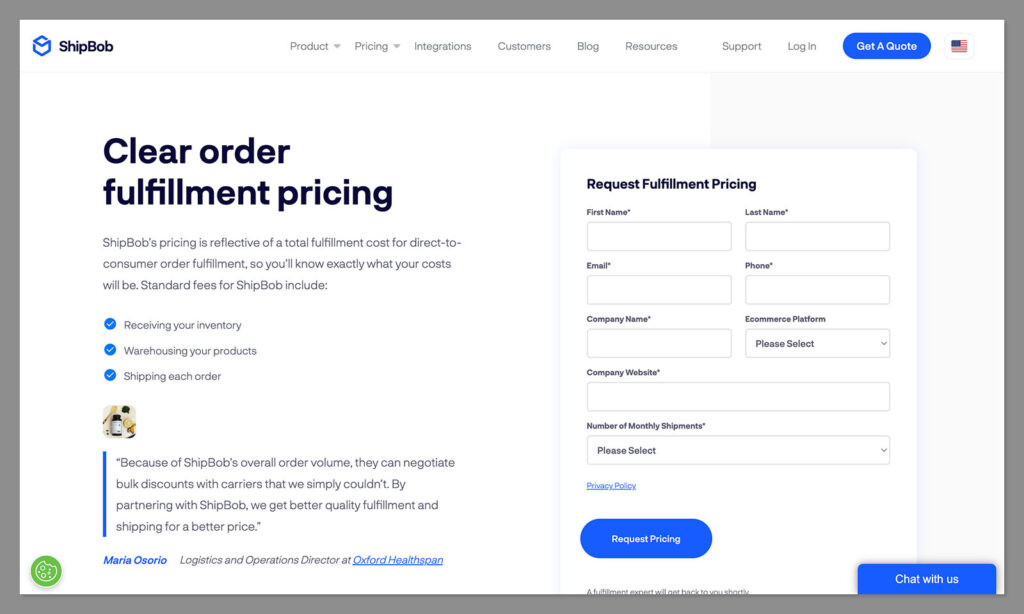
Unlike other ecommerce platforms, ShipBob doesn’t list clear-cut pricing tiers on its site. Instead, your monthly cost depends entirely on the size of your business, number of orders, SKUs, and storage needs.
To get exact pricing, you’ll need to request a quote from ShipBob’s sales team. That said, we can break down the key cost categories so you know what to expect.
ShipBob Pricing Summary
| Service | Price |
|---|---|
| Receiving | $25/hr (first 2 hrs), then $40/hr |
| Storage | $5/bin, $10/shelf, $40/pallet per month |
| Pick and Pack | First 4 picks free, $0.20–$0.25 per extra |
| Standard Packaging | Free |
| Custom Packaging Handling | $0.20–$0.50 per package |
| Returns | Starts at $3 per return |
| Software | Free |
| Setup Fee | Varies (Free for <400 orders/month) |
| Kitting/Assembly | $0.02–$0.56 per task |
Receiving and Storage Fees
ShipBob’s receiving and storage fees are calculated based on labor and space used.
Receiving Fees
When your inventory arrives at one of ShipBob’s fulfillment centers, it must be verified, sorted, and stored properly. The costs here are hourly.
- First 2 hours of receiving: $25/hour
- After that: $40/hour
- Products must be barcoded and palletized; if not, extra fees apply
- Businesses sending unprepared inventory may face delays or additional charges
Storage Fees
Storage pricing is based on how much space your products take up and where they’re stored. You’ll be billed monthly.
- $5 per bin (0.77 cubic feet)
- $10 per shelf (7.1 cubic feet)
- $40 per pallet (60 cubic feet)
These costs add up for businesses with high-SKU counts or large, bulky items. If you plan to store slow-moving products, be prepared for higher bills over time.
Picking and Packing Costs
ShipBob includes pick and pack fees as part of its modular pricing structure. This cost is tied to how many products you ship in each order.
Picking Fees
- First 4 picks per order are free
- Each additional pick is $0.20–$0.25 per item
Example: If a customer orders 6 items, you’ll be charged $0.40–$0.50 extra for the two items over the 4-pick threshold.
Packaging Costs
Standard packaging — including boxes, poly mailers, and tape — is free when you use ShipBob’s materials.
But if you want to provide custom mailers, inserts, or branded packaging, you’ll pay for:
- Storage of your custom materials
- Handling fees, typically $0.20–$0.50 per package
Adding custom marketing materials like vouchers or thank-you cards? You’ll also incur additional handling charges.
Kitting and Assembly Fees
ShipBob offers kitting services for businesses that need custom order assembly. This is useful for subscription boxes, curated bundles, or gift sets.
Prices vary by task. Here are some sample kitting fees:
- Picking SKU: $0.07
- Convert SKU to Kit SKU: $0.02
- Construct packaging: $0.56
- Seal item: $0.08
- Wrap item: $0.28
- Apply label/barcode: $0.21
- Insert paper dunnage: $0.11
Because these tasks are billed individually, kitting can get expensive. Make sure to request a quote before committing if this is part of your business model.
Shipping Costs
Shipping fees are the most variable part of ShipBob’s pricing, since they depend on product size, weight, destination, and shipping method.
Most ShipBob clients pay:
- $5–$8 per domestic order
- Custom international rates based on destination and carrier
ShipBob has bulk shipping discounts from major carriers, including:
- USPS
- UPS
- FedEx
- DHL
- Royal Mail (UK)
- DPD
You can also split inventory across multiple fulfillment centers to reduce shipping zones and costs. According to ShipBob, this can lead to a 13% reduction in shipping expenses and 25% faster delivery times.

Returns Processing Fees
Returns are part of ecommerce — and ShipBob charges for handling them.
Returns Pricing
- Returns start at $3 per order
- Fees vary based on complexity and number of items returned
- You can buy discounted return labels via ShipBob
- Only charged when a product arrives back at a fulfillment center
ShipBob does not offer returns support by default on all plans. You must opt in during onboarding or request it later through your account manager.
Software and Support Costs
One of the most attractive parts of ShipBob’s service is its free software.
You get access to:
- Order management dashboard
- Inventory tracking tools
- Real-time analytics and reporting
- Integrations with Shopify, WooCommerce, BigCommerce, Amazon, Walmart, and more
Setup Fees
- Free for Startup Plan users (under 400 orders/month)
- One-time fee applies for larger businesses; cost varies based on complexity
If you’re using API integrations, advanced automation, or multi-channel syncing, expect to pay more for onboarding support.
Additional and Hidden Fees
While ShipBob aims for transparency, there are a few extra costs that aren’t obvious upfront.
Potential Extra Charges
- FBA Prep: For sellers who want to use Amazon FBA, ShipBob can prep inventory for an additional charge
- B2B Orders: Wholesale and pallet-based orders come with labeling and freight coordination costs
- Custom Developer Support: For businesses building custom integrations with ShipBob’s API
You won’t be charged unless you use these services — but it’s important to factor them in as your business grows.
Who Should Use ShipBob?
ShipBob’s pricing model works best for:
- DTC brands with 300+ orders per month
- Businesses shipping lightweight products
- Ecommerce stores that want to offer 2-day delivery in the US or UK
- International sellers looking for a US/UK fulfillment partner
Not Ideal For:
- Small stores under 100 orders/month
- Products with high returns or large dimensions
- Brands that need complete control over unboxing and custom packaging
Example Cost Breakdown for a Small Ecommerce Store
Here’s what a typical small-to-mid-size ecommerce brand might pay for 500 orders per month.
| Category | Monthly Cost Estimate |
|---|---|
| Receiving (4 hours) | $130 |
| Storage (10 bins) | $50 |
| Picking and packing | Included (extra picks: $60) |
| Packaging materials | Free (standard) |
| Shipping (avg. $6/order) | $3,000 |
| Returns (15 per month) | $45 |
| Total Estimated Cost | $3,285/month |
Is ShipBob Worth It?
For many ecommerce businesses, ShipBob provides a competitive advantage by removing the burden of in-house fulfillment. You get faster shipping, access to global markets, and full visibility of your supply chain — all through a single platform.
However, the cost structure makes it most suitable for:
- Brands with solid monthly order volume
- Merchants with small, shippable SKUs
- Sellers focused on customer experience and speed
If you’re just starting out, ShipBob’s Startup Plan is a great entry point with no setup fees. But for serious sellers, the real ROI comes from efficiency gains and faster shipping that drives customer retention.
Final Verdict: Should You Use ShipBob?
ShipBob is a premium fulfillment solution with modular pricing that scales with your business. There’s no flat-rate plan, but once you understand the cost breakdown, it becomes easier to predict your monthly spend.
It’s best suited for brands ready to scale and optimize logistics — especially if you’re shipping across the US, Canada, UK, EU, or Australia.
Before committing, speak to a ShipBob sales rep, calculate your average order weight and dimensions, and review your monthly order volume. That will help you understand exactly how much ShipBob will cost — and whether it fits your profit margins.



Comments 0 Responses