


Thinkific is our top-rated course platform for selling digital products, offering powerful tools to create, market, and monetize your online courses.
With flexible pricing, zero transaction fees, and a drag-and-drop course builder, Thinkific makes it easy to launch and scale your education business.
In this review, I’ll break down Thinkific’s features, pricing, templates, and selling tools, so you can decide if it’s the right fit for your ecommerce brand.
Need a quick summary of Thinkific?
| Thinkific | Features |
|---|---|
| Best For | Selling digital courses and memberships |
| Overall Rating | Excellent – 4.6 out of 5 |
| Recommended For | – Creators – Coaches – Ecommerce brands selling knowledge |
| Free Plan Available | Yes |
| Paid Plans | $0 – $149/month |
Quick Verdict:
Thinkific is a robust course platform that’s built for creators, coaches, and ecommerce sellers who want to turn their knowledge into a digital product.
With zero transaction fees and a free plan that’s actually usable, it’s a strong option for anyone looking to launch or scale an online course business.
Thinkific overview

- Free plan available
- Pricing from $39/month
- Website builder
- 0% transaction fee
- Course quizzes and surveys
Key Takeaways
- Thinkific is best for selling online courses and digital products
- Great option for beginners and growing creators
- No transaction fees on any plan
- The free plan includes core features like quizzes and student enrollments
- Easy to use, but lacks deep design flexibility
- Email marketing and automation tools require third-party integrations
Thinkific Pros & Cons
| Pros | Cons |
|---|---|
| No transaction fees | Limited design flexibility |
| Free plan with real features | Built-in marketing tools are basic |
| Drag-and-drop course builder | Requires Zapier for advanced workflows |
| Clean interface and fast setup | Limited template variety |
Need a quick summary of Thinkific? I’ve listed its best and worst features below:
What I Like
- The drag-and-drop course builder is intuitive and powerful
- You can start selling with the free plan—no forced upgrades
- Built-in support for subscriptions, bundles, and memberships
- The Thinkific Academy provides solid onboarding and templates
- Payments work globally with Stripe and PayPal out of the box
What I Dislike
- Design options feel restrictive compared to platforms like Kajabi
- No built-in email automation—requires third-party tools
- Upsells are basic and lack funnel-building logic
- Support isn’t 24/7, which can be limiting during a launch window
Thinkific’s user experience is solid, the course builder is one of the best I’ve tested, and it comes with built-in tools for selling digital products.
Where it falls short is design flexibility and automation. If you need heavy email marketing or a high-converting sales funnel out of the box, you’ll need to bolt on other tools.
Let me break down exactly what I found while using Thinkific across every key area that matters for ecommerce sellers.
Why You Can Trust This Review
I’ve spent the last 8 years building ecommerce brands – everything from dropshipping stores to full-blown course businesses. I’ve launched digital products on Teachable, Kajabi, Podia, LearnWorlds – you name it.
I’ve sold coaching programs, recorded masterclasses, built membership sites, and tested more learning management systems than I can count.
This review is based on hours of hands-on use of Thinkific. I didn’t just skim the sales page – I built a live course, connected payment processors, ran a test checkout, and explored how this platform fits into an actual ecommerce funnel.
If you’re thinking about selling education products – whether as your main business or a new revenue stream – here’s what I found using Thinkific in 2025.
Thinkific Pros & Cons
| Pros | Cons |
|---|---|
| No transaction fees on any plan | Limited design freedom |
| Free plan with real features | Built-in email is weak |
| User-friendly course builder | Zapier needed for key automations |
| Drip scheduling, upsells, coupons included | No mobile app builder for students |
Getting Started With Thinkific
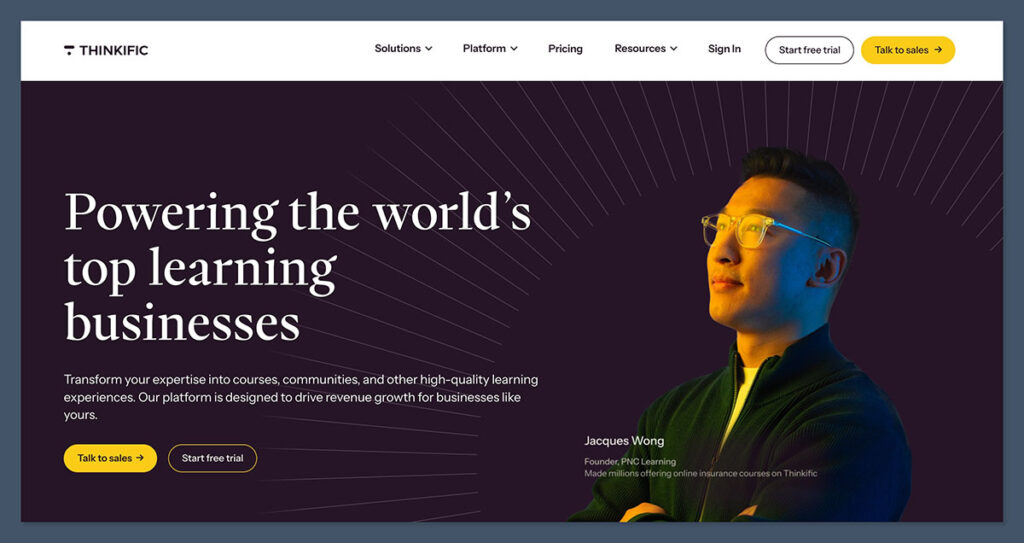
Creating a Thinkific account took less than two minutes. No credit card needed, just a name, email, and basic details about the type of product I planned to sell.
The onboarding wizard walked me through each step and gave me a checklist right on the dashboard, which was helpful.
What stood out to me immediately was the clarity of the interface. It’s built for course creators first, and it shows. The platform isn’t bloated with features I don’t need, and everything was easy to find.
I didn’t need to watch tutorials just to figure out where to start, which isn’t always the case with platforms like Kajabi or WordPress-based builders.
Thinkific’s dashboard is clean and to the point. At the top, there’s a progress bar for launching your first course.
This serves as both a checklist and a visual guide. As someone who’s launched multiple products over the years, I appreciated the focus—it keeps you from getting distracted by features that don’t matter early on.
Here’s what the first setup steps looked like:
- Step 1: Add your first course
- Step 2: Set your pricing and connect Stripe or PayPal
- Step 3: Customize your site’s look and feel
- Step 4: Publish and start enrolling students
Each step includes tooltips, quick links to video tutorials, and suggestions for best practices.
For example, when I added a course, it suggested naming conventions and curriculum structures based on popular models. These small touches helped me move faster.
To give you an idea of what the onboarding process covers, here’s a snapshot:
| Task | Time to Complete | Ease of Use Rating (1-5) |
|---|---|---|
| Create an account | Under 2 minutes | 5 |
| Add a course title and lesson | 5–10 minutes | 4.5 |
| Set pricing and connect Stripe | 3–5 minutes | 5 |
| Choose a theme and logo | 10 minutes | 4 |
| Preview and publish | Instant | 5 |
You won’t find any flashy AI site-building here like what Wix and Shopify are rolling out. Thinkific takes a more manual but focused approach.
There’s no magic “build my brand” button. But because the system is so streamlined, it’s ideal if you want to get something live fast without wrestling with too many settings or technical steps.
Thinkific gets out of your way so you can do what matters: launch. And for ecommerce sellers with limited time, that simplicity can be a real advantage.
Building and Launching My First Course
This is where Thinkific shines. The course builder is drag-and-drop, and it feels like it was built by someone who’s actually created digital products before.
I could structure lessons, add videos, upload worksheets, and build quizzes – all without touching code.
The layout is intuitive. Each course is built as a series of modules and lessons, with support for multiple types of content.
I liked how easy it was to reorder sections, duplicate lessons, and preview the student experience with just one click. I didn’t have to guess what things would look like or constantly switch between editor and preview mode.
Here’s what I liked:
- Uploading video files and PDFs was seamless
- Bulk upload saved me tons of time
- I could drip content by schedule or enrollment date
- Upsells and pricing models (free, one-time, payment plan) were easy to toggle
Thinkific supports multimedia content (audio, video, text, downloadable files), and lets you split your course into sections. There’s also a feature for pre-selling courses which I tested with a checkout page and it worked flawlessly with Stripe.
For instructors managing multiple product types, the ability to mix formats was useful.
I included video walkthroughs, PDF worksheets, and even a few quizzes inside a single course. Each lesson type had its own settings, like completion requirements and video autoplay.
That kind of control lets you build structured learning paths without a ton of complexity.
Here’s a quick look at what types of content you can add per lesson:
| Content Type | Supported | Notes |
|---|---|---|
| Video | Yes | MP4 upload or Wistia embed |
| Text | Yes | Rich text editor with HTML support |
| PDF/Docs | Yes | Drag and drop or upload directly |
| Quiz | Yes | Multiple choice, pass/fail logic |
| Survey | Yes | Great for feedback or onboarding |
| Downloadables | Yes | Useful for worksheets and templates |
| SCORM/HTML5 | No | Not natively supported |
On the downside, there’s no built-in webinar or live event integration. You’ll need Zoom or a separate tool for that – but they do make the process pretty straightforward.
I connected Zoom with a few clicks and embedded a registration link inside the course.
If you’re selling live cohorts or want a hybrid model, you’ll need to patch this together with external tools. But for evergreen courses, Thinkific offers all the fundamentals you need to build, test, and launch fast – with no friction.
Customizing the Look of My Site
Design is where Thinkific plays it safe.
While the theme editor lets you change fonts, colours, and logos, there’s a lack of deep customization. This won’t be a dealbreaker for some, but for those who care about pixel-perfect branding, it’s limiting.
Each site is based on one of a few preset templates. They work well for educational products, but don’t expect anything bold or highly creative.
The themes are clean and mobile-friendly, but they’re not particularly unique or visually rich. For me, the designs were good enough for getting started, but I wouldn’t use them for a high-end coaching brand without tweaking.
Some design features I used:
- Drag-and-drop page builder for homepage, about page, etc.
- Custom domain setup (via CNAME record, took 10 mins)
- Logo and favicon upload
- Mobile-responsive preview
The page builder is simple to use, but the block system can feel a bit rigid. You get pre-built sections like testimonials, pricing tables, and calls to action—but you can’t move everything around freely.
Certain components are locked into place, which limits your ability to create a layout that’s completely original. That said, I was still able to get a professional-looking site up and running in under an hour.
Here’s how the customization options stack up:
| Customization Feature | Available | Notes |
|---|---|---|
| Fonts and colours | Yes | Choose from preset palettes or add custom hex codes |
| Page builder | Yes | Block-based, limited to Thinkific layouts |
| Custom domain | Yes | Free SSL included, domain via CNAME setup |
| HTML/CSS access | Limited | Only on paid plans with Site Builder access |
| Language localization | Yes | Translate key areas of your site and content |
| Templates | 5+ | Clean designs, but little variety |
One thing I didn’t love was the way certain content blocks are fixed.
You can’t rearrange everything, and certain elements like pricing tables are locked in their position. This became more noticeable when I tried to create a branded landing page—spacing, image placement, and CTAs felt constrained.
Still, for someone just starting, it’ll get the job done.
The templates are built with course businesses in mind, so you’re not starting from scratch. As long as your brand doesn’t require something highly visual or interactive, Thinkific offers enough tools to build a clean and functional storefront without needing a designer.
Pricing – Is Thinkific Worth the Money?
Thinkific’s pricing is fair, especially for what you get.
There’s a genuinely free plan, which includes the full course builder, student enrollments, and 0 percent transaction fees. You’re not hit with surprise charges, and you’re not stuck with a watermark on your site or forced branding.
For small ecommerce brands or creators just starting with digital products, that alone makes Thinkific stand out.
Here’s how the plans break down:
| Plan | Monthly Price | Key Features | Best For |
|---|---|---|---|
| Free | $0 | 1 course, quizzes, basic site builder | Beginners testing ideas |
| Start | $74 | Unlimited courses, live lessons, coupons | Coaches and small teams |
| Grow | $149 | Communities, white label, affiliate tools | Established course sellers |
Each step up in price gives you access to new features that support growth. On the Free plan, you’re limited to a single course, but the tools included are real—no trial versions or time limits.
The Start plan opens up multiple courses and live lessons, while the Grow plan adds white labeling, advanced marketing options, and the ability to build affiliate programs.
What impressed me most was that even the free plan doesn’t limit you with forced branding or transaction cuts. That’s rare. And the jump from Start to Grow isn’t just cosmetic – it adds serious power if you’re scaling.
I didn’t feel penalized for starting small, which is a problem I’ve had on other platforms.

Where I saw value:
- You can start earning without spending a dollar
- You don’t need to upgrade until you’re ready to grow
- There’s no pressure to upgrade just for basic ecommerce tools
- Stripe/PayPal integrations are available on all plans
One area where Thinkific clearly outperforms Teachable is in transaction fees.
Teachable takes a 5 percent cut on its $59/month plan unless you move up to the $159/month tier. Kajabi starts at $149/month, but includes built-in automation and funnels.
Podia starts lower at $39/month, but has weaker course structuring features compared to Thinkific.
Here’s a quick side-by-side:
| Platform | Starting Price | Transaction Fees | Notable Limits |
|---|---|---|---|
| Thinkific | $0 | None | 1 course on free plan |
| Teachable | $59 | 5% on basic plan | Fees unless on Pro tier |
| Kajabi | $149 | None | Higher price, steeper learning curve |
| Podia | $39 | None | Simpler builder, limited course logic |
Overall, Thinkific hits a strong balance. You’re not sacrificing core tools to save money, and upgrades actually feel worthwhile.
If you’re testing a digital product in an ecommerce business, this lets you validate your idea before locking into a paid commitment. And once you’re ready to scale, the paid tiers give you room to grow without adding platform fees to your margins.
Selling Courses and Digital Products
Thinkific lets you monetize in several flexible ways, and it’s more ecommerce-friendly than you’d expect from a course platform.
Whether you’re running a one-product business or building a full education catalog, the core sales tools are built-in and easy to use.
Here’s what I tested:
- One-time pricing for standalone courses
- Subscriptions for monthly access or memberships
- Course bundles for higher-ticket offers
- Free + paid tiers for freemium lead generation
Each pricing model can be set per course, and you can assign multiple pricing options to a single product. For example, I set up a free preview tier, a one-time price, and a payment plan all under one course—something that’s hard to do without workarounds on other platforms.
These options help ecommerce sellers experiment with low-barrier offers, premium packages, and upsells without needing a developer.
You can also create private courses, set enrollment deadlines, and offer free previews. Upsells are supported via thank you page prompts or directly from the course player.
While the upsell settings are basic, they are effective if you know your funnel strategy.
Here’s a snapshot of what’s possible within Thinkific’s pricing and sales logic:
| Feature | Supported | Notes |
|---|---|---|
| One-time purchase | Yes | Works with Stripe or PayPal |
| Payment plans | Yes | Custom billing cycles supported |
| Subscriptions | Yes | Monthly or annual billing |
| Course bundles | Yes | Combine multiple products into one offer |
| Free preview | Yes | Allow users to test content before buying |
| Private course access | Yes | Manual enrollment or invite-only |
| Upsells and cross-sells | Limited | Basic thank you page option only |
On the backend, orders are tracked clearly, with filters for student activity, revenue by product, and payment status. I could easily export sales reports and see which offers were converting best. The only thing missing was deeper sales attribution.
If you want source tracking (i.e. knowing if sales came from email, ads, or affiliates), you’ll need to pair Thinkific with analytics tools or a custom checkout platform.
One thing I’d like to see: better built-in cross-sell flows. Right now, to build a full ecommerce funnel, you’ll likely want ConvertKit, ActiveCampaign, or a custom checkout flow using ThriveCart or a similar tool.
These external tools help you link products, trigger automations, and improve lifetime value—but they add setup time and cost.
Marketing and Automation
Marketing tools are where Thinkific is functional, but not exceptional. It gives you the basics, but if you rely on funnels, segmentation, or advanced lead nurturing, you’ll need third-party tools.
Still, I was able to set up a working system that drove sales without custom development.
Here’s the breakdown of what Thinkific offers:
- You can collect emails and segment students
- Offer discount codes for promos
- Create custom checkout questions for segmentation
- Run simple email campaigns (but limited in design and logic)
Thinkific’s built-in email tool works for basic announcements. I sent a few one-off campaigns to enrolled students, like updates and bonus lesson alerts. But there’s no automation engine inside Thinkific.
You can’t build timed email sequences, tag contacts, or trigger behavior-based flows out of the box.
For more advanced funnels, I ended up integrating ConvertKit via Zapier. This let me:
- Add students to email automations
- Trigger welcome sequences
- Tag buyers by product purchased
- Run cart abandonment follow-ups externally
The integration process was straightforward. Thinkific supports native connections with ConvertKit, Mailchimp, and ActiveCampaign, or you can build custom automations with Zapier.
Still, it’s another cost and another dashboard to manage—something to keep in mind if you want an all-in-one experience.
If Thinkific ever adds built-in automation tools like Kajabi or Podia have, it would be a game changer. Right now, it’s flexible but fragmented.
You get control, but at the cost of simplicity. For ecommerce sellers who already use marketing platforms or CRMs, that might not be an issue. But for new creators, it’s one more learning curve to climb.
Integrations and App Marketplace
Thinkific doesn’t have a massive app store like Shopify, but it does integrate with most tools you’d expect. It’s more of a plug-and-play ecosystem than a full-blown platform marketplace.
That said, if you already have systems in place for email, CRM, or analytics, you’ll find that Thinkific connects to them with minimal effort.
Top integrations include:
- Payment: Stripe, PayPal
- Email: ConvertKit, Mailchimp, ActiveCampaign
- CRM/Automation: Zapier, HubSpot
- Analytics: Google Analytics, Facebook Pixel
- Live Sessions: Zoom
You can also embed third-party widgets like Calendly or Typeform using HTML blocks. I used this to embed a coaching application form directly into a landing page, which worked well without needing extra software.
Here’s how Thinkific’s integration support stacks up:
| Category | Native Integration | Notes |
|---|---|---|
| Payments | Yes (Stripe, PayPal) | Instant setup, supports global sales |
| Email Marketing | Yes (via API) | ConvertKit, Mailchimp, ActiveCampaign |
| CRM + Automation | Zapier, HubSpot | Zapier enables deeper multi-step logic |
| Analytics + Pixels | Yes | GA, Facebook Pixel, custom scripts |
| Live Video | Zoom | Manual link embedding; no webinar hosting |
| Scheduling Tools | Embed only | Calendly, Typeform supported via HTML |
The biggest advantage here is flexibility. You’re not locked into one tech stack, which is ideal if you’re already using specific tools in your ecommerce workflows.
The downside is that many of these connections rely on Zapier. While Zapier is powerful, it adds another cost layer and introduces more moving parts—especially if you’re trying to automate customer journeys or manage affiliate flows.
For ecommerce sellers used to Shopify’s native integrations or Podia’s built-in features, this approach feels more modular. It gives you control, but at the cost of convenience.
If your funnel includes multiple touchpoints (email nurture, upsells, retargeting), expect to invest some time into stitching things together.
Analytics and Reporting
Thinkific includes built-in analytics dashboards, and I found them accurate and easy to navigate.
The metrics are geared toward course performance and student behavior, which is exactly what you’d want from a learning platform. I could track who enrolled, who paid, and who actually completed the material.
You’ll see metrics for:
- Revenue
- Student progress
- Enrollments by course
- Completion rates
Each dashboard is broken down by product and student, with export options in CSV for further analysis. I used this data to pinpoint where students were dropping off in longer courses, and where upsells were converting most effectively.
That helped me refine both my curriculum and my pricing strategy.
Here’s a breakdown of what’s included by default:
| Report Type | Available | Exportable | Notes |
|---|---|---|---|
| Revenue | Yes | Yes | Tracks by product, date range, and payment method |
| Enrollment | Yes | Yes | Filtered by course or bundle |
| Completion Rates | Yes | Yes | Helpful for content optimization |
| Student Activity Log | No | N/A | Limited visibility on individual behavior |
| Sales Attribution | No | N/A | Requires external tools (e.g., GA4, UTM tracking) |
Still, don’t expect the deep funnel data you’d get from tools like Segment, GA4, or paid analytics suites.
If you’re running ads or building attribution models, you’ll need to supplement Thinkific with outside reporting tools. It tracks what happens inside the course environment well—but not what happens before the sale or across channels.
For a course-first platform, though, it covers the core numbers that matter.
Revenue, engagement, and completion insights are all easy to find, even for non-technical users. If your ecommerce play is centered on selling knowledge products, this is often all you need to make informed decisions and iterate quickly.
Customer Support and Resources
Thinkific offers strong support across channels, and they’ve clearly invested in helping creators succeed. Whether you’re troubleshooting an integration, building your first product, or exploring advanced features, there’s a support option available.
Here’s what I used:
- Live chat support (available weekdays, very responsive)
- Email support with 24–48 hour turnaround
- Thinkific Academy – full of tutorials, templates, and checklists
- Weekly webinars and live Q&A sessions
- Active Facebook community with real user feedback and peer help
The live chat team was helpful and knowledgeable, especially when I had questions about connecting third-party apps. On one occasion, I asked about custom domain DNS propagation, and support pointed me to their own guides and walked me through verifying the setup.
Thinkific Academy deserves special mention. It’s not just fluff content.
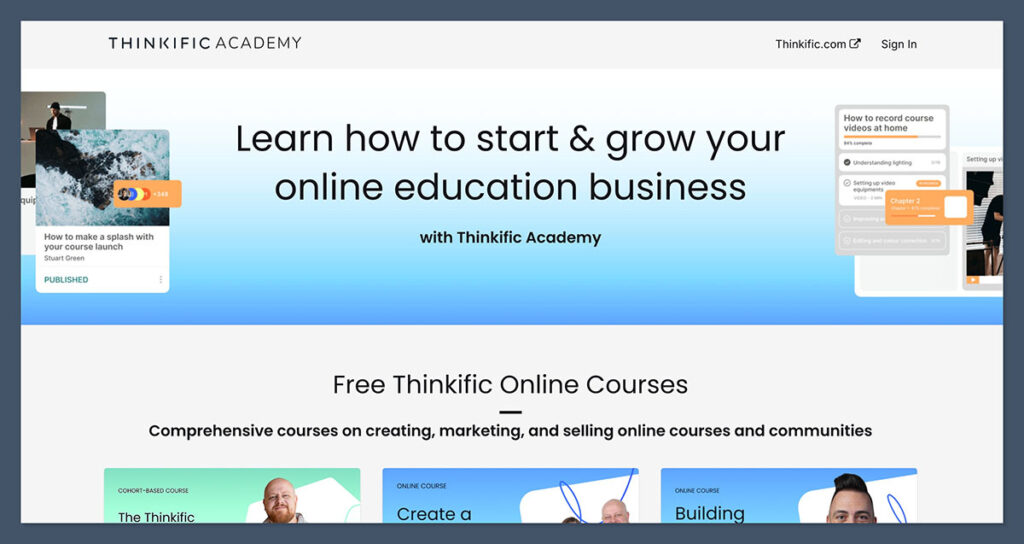
The platform provides structured training for both beginners and advanced sellers. I used their templates to speed up course layout, and the onboarding lessons gave me clarity around how to launch faster.
Here’s a quick look at the available support options:
| Support Channel | Available | Notes |
|---|---|---|
| Live chat | Weekdays | Fast and helpful, but not 24/7 |
| Yes | Replies within 1–2 business days | |
| Video tutorials | Yes | Well-organized inside the Academy |
| Webinars & workshops | Weekly | Live Q&A and walkthroughs |
| Community support | Yes | Active Facebook group + Thinkific community |
| Phone support | No | Not offered on any tier |
One area they could improve: 24/7 live support for paid users. While not essential, it would be helpful for global users launching in different time zones.
It’s especially relevant if you’re pushing a launch on a weekend and run into a technical snag. A lot of competing platforms, like Kajabi or Teachable, offer extended or round-the-clock support for higher plans.
Still, Thinkific’s resource hub makes up for the lack of live coverage. If you’re comfortable learning through self-serve content and asking questions inside a peer group, you’ll find more than enough to stay unstuck and make progress.
Thinkific vs Other Course Platforms
Here’s how Thinkific stacks up against top alternatives:
| Platform | Best For | Starting Price | Transaction Fees | Standout Feature |
|---|---|---|---|---|
| Thinkific | Digital products, courses | Free | 0% | User-friendly builder |
| Teachable | Coaching and digital sales | $59 | 5% on lower plans | Better sales page design |
| Kajabi | Funnels, high-end offers | $149 | 0% | All-in-one platform |
| Podia | Creators and indie brands | $9 | 0% | Built-in email marketing |
If you’re focused on simplicity and keeping costs low, Thinkific is hard to beat. It covers the core needs of course creators without locking features behind expensive paywalls or forcing upgrades.
But if you’re building a complex funnel or want deep marketing automation baked in from day one, Kajabi or Podia might offer more out of the box.
They come with native email tools and more robust page-building capabilities, but you’ll pay for that convenience upfront.
Final Verdict: Is Thinkific Worth It?
If you’re looking to sell courses or digital products online, Thinkific is one of the best platforms available right now.
It’s perfect for ecommerce sellers who want to add an education stream, build authority, or generate passive income without overcomplicating their tech stack.
You won’t find deep sales funnels or flashy templates, but the essentials are here – and they’re done well. It’s scalable, doesn’t punish you with hidden fees, and gives you full control over your pricing and products.
I’d recommend Thinkific if:
- You want to sell courses without upfront costs
- You care more about content than design
- You’re okay using external tools for marketing
It’s not perfect, but for most ecommerce brands, Thinkific is more than good enough to build, launch, and grow an online course business in 2025.
For me, it offered the right balance of flexibility and simplicity—and it let me focus on what matters most: delivering value through my content.


Hi there!
One question: how about uploading videos onto my course site?Any experience with that?
Is it easy and quick or is it maybe not even an option?
Easy! You can upload any video faster than to youtube 🙂 – no restrictions at all. I have it in my course.
Hi
I have a big problem: sometimes my web site home page on Thinkific disappeared and on screen appeared: error 500. The SSL certification is active.
Someone have my same problem?
Can I help me?
Hey Anna, have you tried contacting their support team?
Hola, puedo recibir pagos en mi cuenta personal de mi país (Venezuela) y añadir estos usuarios al curso en thinkific?
Great informative review!
Glad you found it useful!
–
Bogdan – Editor at ecommerce-platforms.com