

Best Overall BigCommerce Alternative

Shopify
View Pricing Read Review →$29/month Basic, billed yearly
3-day free trial, then $1/month for 3 months
- No sales caps or automatic plan upgrades
- 16,000+ apps
- B2B tools on every paid plan
Best for No Platform Fees

WooCommerce
View Pricing Read Review →Free open-source plugin
Hosting and extensions from about $480/year (estimate)
- 0% platform transaction fees
- Full ownership of code and data
- Wholesale tools through plugins
Best for Simple Stores

Wix
View Pricing Read Review →$29/month Core, billed yearly
14-day money-back guarantee
- Free-form drag-and-drop editor
- No commission on store sales
- Up to 50,000 products
Shopify is the best BigCommerce alternative for 2027, with no sales cap, 16,000+ apps and B2B on every paid plan.
The case for comparing BigCommerce alternatives changed on June 1, 2026. One BigCommerce development agency highlighted that a store with $150,000 in annual GMV could move from $79 to $299/month on annual billing without its revenue changing.
BigCommerce’s new pricing introduced four changes:
- Renamed plans: Core costs $39/month or $29 billed yearly; Growth $105 or $79; Scale $399 or $299. Performance is custom, from $1,499/month billed yearly.
- Lower caps: Core allows $30K, Growth $100K in trailing-year GMV, calculated as gross order value minus 10%. Crossing caps triggers automatic upgrades. Scale includes $33,333 monthly GMV, then 0.9% overage.
- Gateway fees: The Open Payment Provider fee is 2% / 1% / 0.6% on Core / Growth / Scale for orders outside 21 embedded providers.
- Phone support: Core now charges $29/month extra.
One Trustpilot reviewer wrote: “Only reason we went with BigCommerce was they bragged about ‘zero transaction fees’ for using gateways.” The merchant said they were moving four stores.
Still, stay if your orders use embedded providers, such as Stripe or PayPal, and the subscription remains competitive. BigCommerce also earns its place for B2B price lists, quotes and independent storefronts, or large product-option sets, with 600 SKUs per product and 250 values per option.
For simpler B2C stores approaching those caps, these are my top alternatives to BigCommerce.
Key Takeaways 🔍
- Shopify leads for uncapped growth, apps and built-in B2B.
- Prices range from $0 to quote-only enterprise contracts.
- Square Online and Big Cartel have free plans; WooCommerce, PrestaShop, Shopware Community and Magento Open Source have free editions.
- WooCommerce, Wix, Ecwid, Square Online, Adobe Commerce, Shopware, PrestaShop and Big Cartel add no platform transaction fee.
- Consider Adobe Commerce or Shopware for demanding B2B workflows, but keep BigCommerce if its trade tools already fit.
BigCommerce Alternatives Comparison Table
Take a look at the 10 picks side by side.
| Platform | Best for | Rating | Starting price | Free plan or trial | Platform transaction fee | Sales cap | B2B tools |
|---|---|---|---|---|---|---|---|
| Shopify | Overall | 4.8 | $29/mo billed yearly ($39 monthly) | 3-day trial, then $1/mo for 3 months | 0% with Shopify Payments; 0.2%-2% otherwise | None | All paid plans (3 catalogs; unlimited on Plus) |
| WooCommerce | No platform fees | 4.5 | Free plugin + hosting | Free core | 0% | None | Via plugins |
| Wix | Simple stores | 4.4 | $29/mo billed yearly (Core) | No trial; 14-day money-back | 0% | None | No |
| Squarespace | Design-led brands | 4.3 | $19/mo billed yearly | 14-day trial | 2% on Basic; 0% from Core | None | No |
| Ecwid | Existing websites | 4.2 | $5/mo (Starter) | No free plan | 0% | None | Limited |
| Square Online | In person + online | 4.1 | $0 | Free plan | None (processing 2.9%-3.3% + $0.30) | None | No |
| Adobe Commerce | Enterprise custom builds | 4.0 | Quote only (est. $22K+/yr) | Free Open Source edition | 0% | None; license scales with GMV | Native |
| Shopware | B2B and wholesale | 3.9 | Free CE; Rise from EUR 600/mo | Rise: first 30 days free | 0% | None listed | Evolve (EUR 2,400+/mo) |
| PrestaShop | European merchants | 3.8 | Free (self-hosted) | Free | 0% | None | Via modules |
| Big Cartel | Small catalogs | 3.5 | $0 | Free plan; 7-day trial on Platinum | 0% | 5 / 50 / 500 products | No |
| BigCommerce (for reference) | B2B and complex catalogs | – | $29/mo billed yearly ($39 monthly) | 15-day trial | 0% on 21 embedded providers; 2% / 1% / 0.6% otherwise | $30K / $100K trailing GMV, auto-upgrade | Native (price lists on Performance) |
Card processing fees apply on every platform, and Shopify’s yearly Grow and Advanced prices vary ($79 or $89, $299 or $359), so check each pricing page before you buy.
1. Shopify: Best Overall BigCommerce Alternative
- Pricing: $39 to $399/month billed monthly; Basic $29/month billed yearly
- Sales cap: None on any plan
- Platform transaction fee: 0% with Shopify Payments; otherwise 2% / 1% / 0.6%, or 0.2% on Plus
- Overall Rating: 4.8/5
Shopify is my best overall replacement for BigCommerce. At $200,000 yearly sales, annual-billed subscriptions cost $3,588 on BigCommerce Scale versus $948 to $1,068 on Shopify Grow, before payment fees and add-ons.

Shopify gives you a hosted replacement for BigCommerce with room for a retail brand to expand its marketing, not just its catalog. Its June 2026 Spring Edition introduced Rollouts for scheduled publishing and A/B tests, making it especially appealing if you want to plan storefront changes and compare different versions without moving to a developer-led platform.
Moving from BigCommerce means budgeting for the apps behind your preferred workflows, not just choosing a subscription. One agency estimates that scaling Shopify stores spend $200 to $800/month on apps, which can eat into the savings from switching. I recommend pricing your essential integrations before treating the lower platform bill as your final operating cost.
Key Features:
- No GMV thresholds or automatic upgrades
- 16,000+ apps and about 1,300 theme listings
- Standard-plan B2B: company profiles, three catalogs, quantity rules and net terms
- Agentic Storefronts for AI shopping; Sidekick assistant
- POS, international Markets and unlimited B2B catalogs on Plus
Pros:
- No sales cap
- Roughly 13 times BigCommerce’s app count
- Advanced: 15 staff accounts, 10 inventory locations
- Three-day trial, then $1/month for three months
Cons:
- Outside-gateway fees; only Shopify Payments exempt
- Phone support restricted to Plus
- Three options per product, 2,048 variants and fixed URL prefixes
I rank Shopify first because removing sales caps makes growth easier to budget for. But the Shopify vs BigCommerce decision still turns on payments and product structure: Shopify Payments removes its gateway surcharge, while products requiring more than three options need restructuring. BigCommerce’s larger option sets can matter more than Shopify’s higher variant allowance.
How Much Does Shopify Cost?
| Plan | Monthly price (billed annually) | Monthly price (billed monthly) | Key limit |
|---|---|---|---|
| Basic | $29 | $39 | No extra staff accounts; 3 B2B catalogs |
| Grow | $79 or $89 | $105 | 5 staff accounts; 3 B2B catalogs |
| Advanced | $299 or $359 | $399 | 15 staff accounts; 3 B2B catalogs |
Shopify’s plans show yearly Grow at $79 or $89 and Advanced at $299 or $359. Confirm your offer; Plus starts at $2,300/month on a three-year term.
One Trustpilot reviewer who ran a BigCommerce store for 15 years moved after a reported 169% increase: “The Australia Post integration worked correctly from day one.”
2. WooCommerce: Best Open-Source Option With No Platform Fees
- Pricing: Free plugin; $480 to $560/year estimated for a basic DIY store
- Sales cap: None
- Platform transaction fee: 0%; US WooPayments processing is 2.9% + $0.30
- Overall Rating: 4.5/5
WooCommerce is my pick for ownership without platform fees. Its free WordPress plugin removes the platform subscription and sales-cap problem, although hosting providers and extension developers still set their own prices.
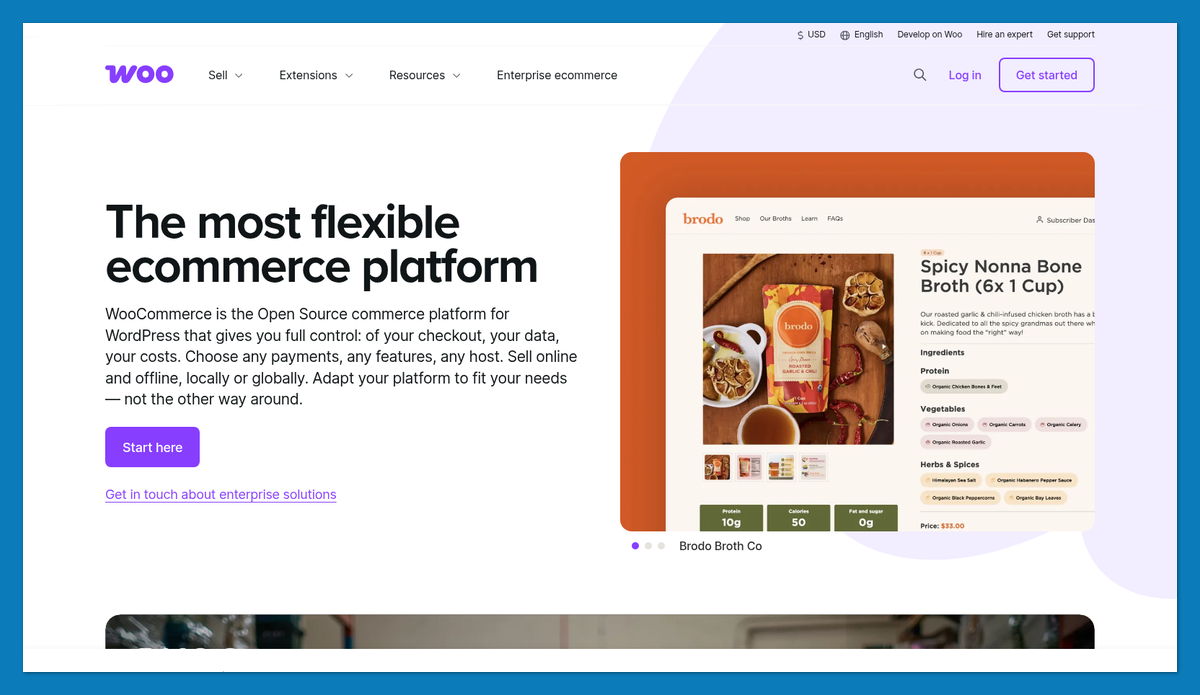
WooCommerce gives you a WordPress-based route away from BigCommerce, including multisite support if your plans extend beyond one website. It suits a business that wants its developer to shape the store around existing content and workflows. The June 2026 release brought AI agent abilities into core, adding another reason to consider it beyond license savings.
Unlike BigCommerce’s hosted setup, WooCommerce leaves store performance dependent on the hosting you choose. Estimated premium managed hosting costs $360 to $1,380 or more per year, before extensions or developer help, so the cheapest server is not necessarily the best value. I favor this route when you can fund reliable infrastructure rather than simply remove a subscription.
Key Features:
- Full ownership of code and data
- Subscriptions and Bookings extensions
- Wholesale tools through paid plugins
- REST API for headless storefronts
- Seven AI agent abilities added in WooCommerce 10.9
Pros:
- 0% platform fees, with no sales cap
- Freedom to change hosting providers
- G2 4.4 and Capterra 4.5 ratings
- Built-in product CSV importer
Cons:
- You manage security, updates and backups
- Extensions typically cost $79 to $279/year each
- Woo Express discontinued; no Woo phone support
I recommend WooCommerce only when someone owns the maintenance routine. The December 2025 WordPress update that broke affected WooCommerce checkouts for roughly ten days shows why staging and backups matter. For B2B sellers, plugins can cost less than enterprise software, but developer support belongs in the budget. Our Shopify vs BigCommerce vs WooCommerce comparison explores that trade-off.
The operating budgets below are estimates from Swell, a competing platform, not WooCommerce packages. They exclude card fees; request separate hosting and maintenance quotes before treating a free plugin as a cheaper operating model.
How Much Does WooCommerce Cost?
| Option | Price | What you get |
|---|---|---|
| Core plugin | Free | Self-hosted WordPress commerce software |
| Basic DIY store | $480 to $560/year, est. | Basic hosting, theme and extension budget |
| Professional small store | $2,350 to $2,800/year, est. | Larger operating and extension budget |
| Established store | $11,700 to $15,500/year, est. | More substantial hosting and maintenance budget |
If you already run WordPress or have a developer on call, start here; if you want someone else handling hosting, choose Shopify.
3. Wix: Best Drag-and-Drop Builder for Simple Stores
- Pricing: $17 to $159/month billed yearly; selling starts at $29/month
- Sales cap: None
- Platform transaction fee: 0%; US Wix Payments processing is 2.9% + $0.30
- Overall Rating: 4.4/5
Wix is my recommendation for simple stores that want design freedom. Core includes online selling without platform commission, but Light cannot take payments.
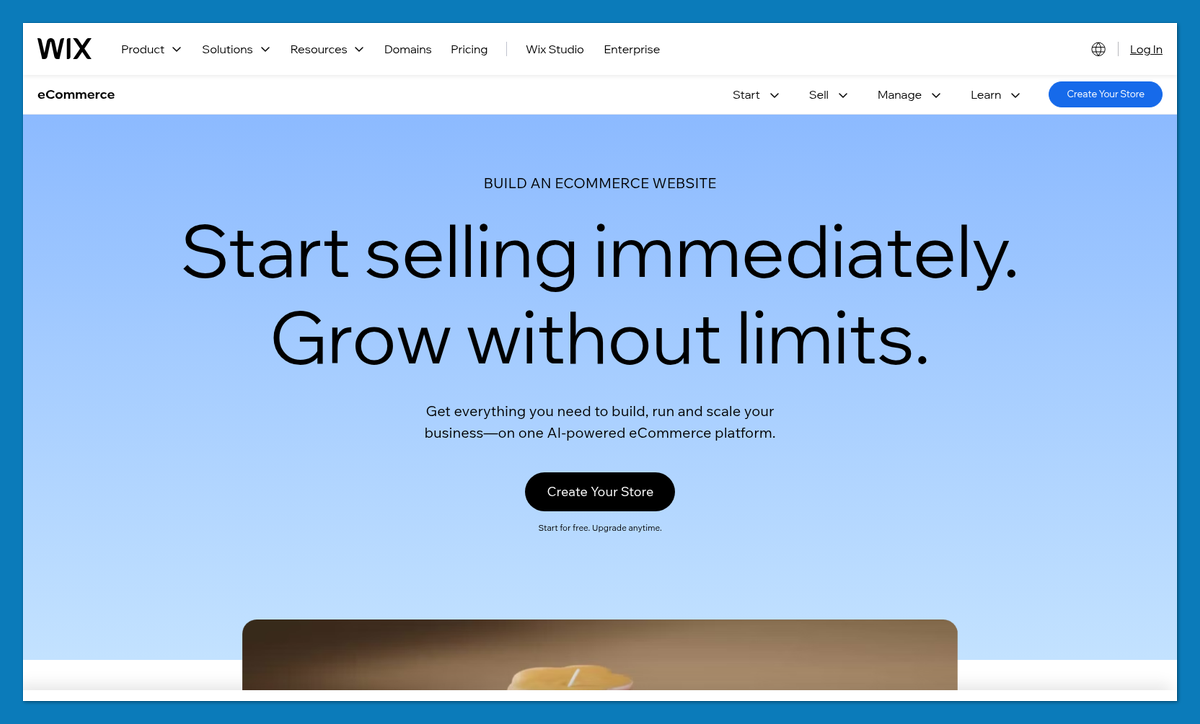
Wix gives you a website-first alternative to BigCommerce when selling products is only part of what your site needs to do. Its Harmony builder launched in January 2026, and Harmony is also embedded in Gemini. That makes Wix worth considering if you want AI-assisted site creation rather than a commerce platform built around complex retail operations.
Wix’s lack of store commission does not mean every type of payment is free of additional charges. If you sell memberships through Wix Pricing Plans, Core carries an extra 4% fee, separate from ordinary store sales. I recommend checking that distinction before leaving BigCommerce if recurring membership income is central to your business rather than a small sideline.
Key Features:
- Free-form drag-and-drop editor
- Harmony AI builder with the Aria agent
- Up to 50,000 products
- Built-in Wix Payments
Pros:
- Page design without coding
- No commission on store sales
- Capterra 4.4 from about 10,740 reviews
- Straightforward route to launching a small catalog
Cons:
- Fixed checkout design; six options per product
- CSV or Cart2Cart migration; no full-site export
- No B2B price lists or multi-storefront
I put Wix ahead of heavier platforms when your catalog is straightforward, but portability is the compromise. Its import template takes 15 MB or 10,000 rows, so plan a CSV move rather than an automatic transfer. If you leave again, products, contacts and orders can come out, but the site itself cannot; product exports allow up to 5,000 per CSV.
How Much Does Wix Cost?
| Plan | Monthly price (billed annually) | Monthly price (billed monthly) | Ecommerce |
|---|---|---|---|
| Light | $17 | About $24 | No |
| Core | $29 | About $36 | Yes |
| Business | $39 | About $46 | Yes |
| Business Elite | $159 | About $172 | Yes |
Best for simple catalogs and design-first small brands. Skip Wix if you sell wholesale or need more than six options per product; compare Shopify vs Wix vs Squarespace before settling on a builder. Wix has no paid-plan trial, but offers a 14-day money-back guarantee.
4. Squarespace: Best for Design-Led Brands
- Pricing: $19 to $99/month billed yearly; $25 to $139 monthly
- Sales cap: None; unlimited products
- Platform transaction fee: 2% on Basic; 0% from Core
- Overall Rating: 4.3/5
Squarespace is my favorite for brands whose presentation sells the product. Despite July 2026 increases of up to 26%, its $29/month Core plan, billed yearly, matches BigCommerce Core without the $30K GMV cap.

Squarespace gives you a hosted alternative to BigCommerce when your product pages need to support a distinctive visual brand rather than complicated account rules. Its July 2026 repricing also makes older budget comparisons unreliable: the former entry price was $16/month billed yearly. It suits you best when presentation, rather than the lowest possible subscription, drives the decision.
Moving from BigCommerce to Squarespace requires extra planning if you sell downloadable goods: its CSV importer excludes digital products, not just customer accounts. Check how you will recreate those listings before committing to a design-led rebuild. I see it as a stronger fit for physical-product brands than for merchants expecting a straightforward transfer of a mixed digital catalog.
Key Features:
- Design-led storefront templates
- Unlimited products on every plan
- Card processing: 2.9% + $0.30 on Basic/Core; 2.7% + $0.30 on Plus
- CSV imports up to 10,000 products and 250 variants
Pros:
- My strongest design pick among hosted builders
- No platform fee from Core
- No product-count upgrade pressure
- Capterra 4.6 from about 3,417 reviews
Cons:
- Recent subscription price increases
- No substantial B2B or multi-storefront tools
- Email and chat support only
I recommend Core over Basic when avoiding platform fees is your reason for leaving BigCommerce. The migration catch is customer data: Squarespace’s CSV import brings products across, not customer accounts. Plan a customer re-invitation campaign rather than assuming your existing account database transfers. Our Shopify vs Squarespace vs BigCommerce comparison separates design priorities from selling requirements.
How Much Does Squarespace Cost?
| Plan | Monthly price (billed annually) | Monthly price (billed monthly) | Key limit |
|---|---|---|---|
| Basic | $19 | $25 | 2% platform transaction fee |
| Core | $29 | $39 | No platform transaction fee |
| Plus | $49 | $65 | Card rate: 2.7% + $0.30 |
| Advanced | $99 | $139 | Lower card rate than Plus |
Choose Squarespace when your catalog is straightforward and visual presentation matters more than wholesale workflows. Use the 14-day trial to evaluate a template and product layout before paying; this is not a replacement for BigCommerce’s trade-account tools.
5. Ecwid by Lightspeed: Best for Adding a Store to an Existing Website
- Pricing: $5 to $149/month; annual-billed tiers above Starter cost $29 to $119/month
- Sales cap: None; Starter allows about 10 products
- Platform transaction fee: 0% on every plan
- Overall Rating: 4.2/5
Ecwid is best when you want to keep your existing website. Add its store to your current pages instead of replacing the whole site with another BigCommerce competitor.
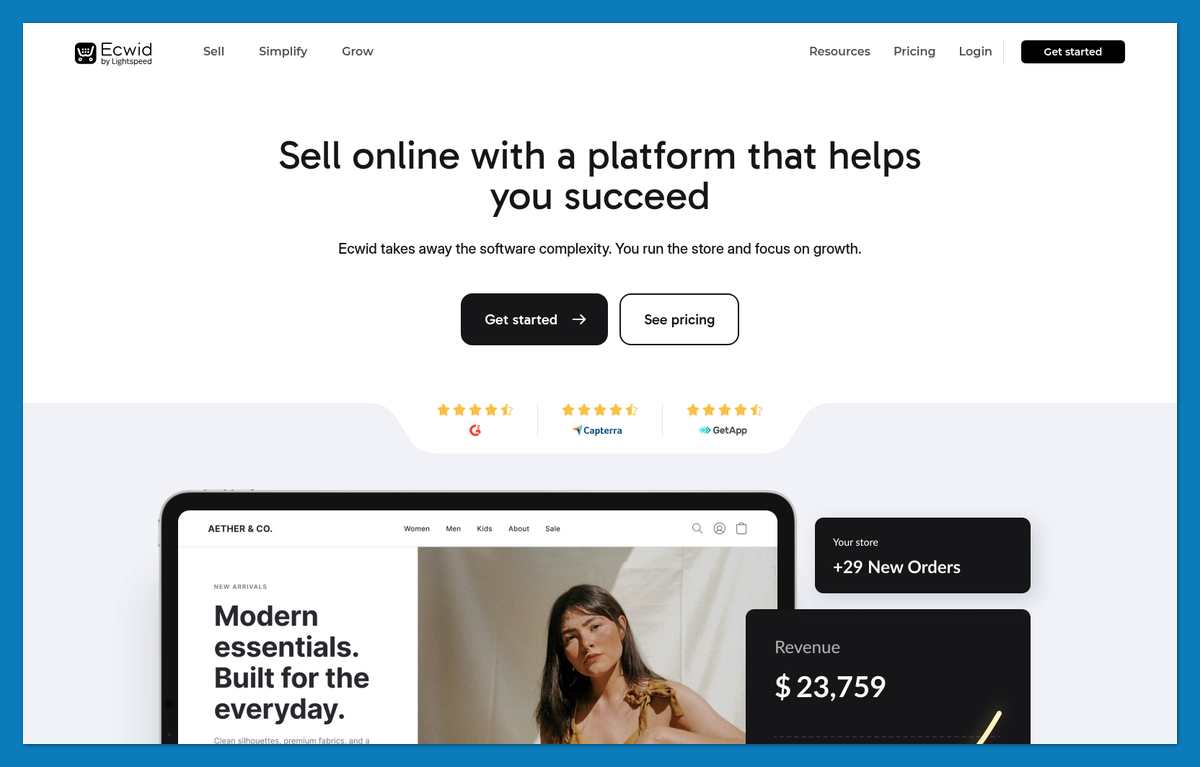
Ecwid gives a content-led business a way to separate its website choice from its selling software, rather than making BigCommerce the center of both. There are no setup fees, but the March 2, 2026 increase raised the Venture, Business and Unlimited prices. That makes it a convenience choice for you, not an automatic budget winner.
Leaving BigCommerce for an embedded store does not remove the work of transferring your trading history. For Ecwid, LitExtension or Cart2Cart can handle customer and order transfers, so price that work separately from adding the store to your pages. I favor Ecwid when preserving your website saves enough effort to justify a separate commerce migration.
Key Features:
- Embeds in WordPress, Wix, Squarespace or HTML websites
- 58 payment gateways
- Lightspeed Retail POS connection
- Around 450 apps
- WooCommerce product/category imports through its WordPress plugin
Pros:
- Keeps your existing website
- No Ecwid transaction fees
- Low $5 starting price
- G2 4.7 from about 405 reviews
Cons:
- Free plan removed; prices increased in March 2026
- Variants require Business or above
- Basic SEO and limited B2B tools
I recommend checking variants before choosing a tier: Business costs $49/month billed yearly, not Venture’s $29. That matters if you sell sizes or colors. Since Venture matches Shopify Basic’s annual-billed price, Ecwid wins mainly when keeping your existing site matters more than getting a full storefront builder, the key distinction in my BigCommerce vs Ecwid recommendation.
How Much Does Ecwid Cost?
| Plan | Monthly price (billed annually) | Monthly price (billed monthly) | Key limit |
|---|---|---|---|
| Starter | Not listed | $5 | About 10 products; no variants |
| Venture | $29 | $35 | No product variants |
| Business | $49 | $65 | Product variants available |
| Unlimited | $119 | $149 | Top published tier |
At $29/month billed yearly, Ecwid Venture fits inside your current site, while Shopify Basic is the stronger choice for replacing your storefront. Read our Ecwid review if preserving a content-led website is your priority.

6. Square Online: Best for Selling In Person and Online
- Pricing: $0 to $149/month per location
- Sales cap: None; custom Pro pricing above about $250K/year
- Platform transaction fee: None; processing is 3.3% + $0.30 on Free, 2.9% + $0.30 on paid plans
- Overall Rating: 4.1/5
Square Online is my pick for bringing counter and web sales together. Its free plan combines an online store with Square’s payment and POS ecosystem.
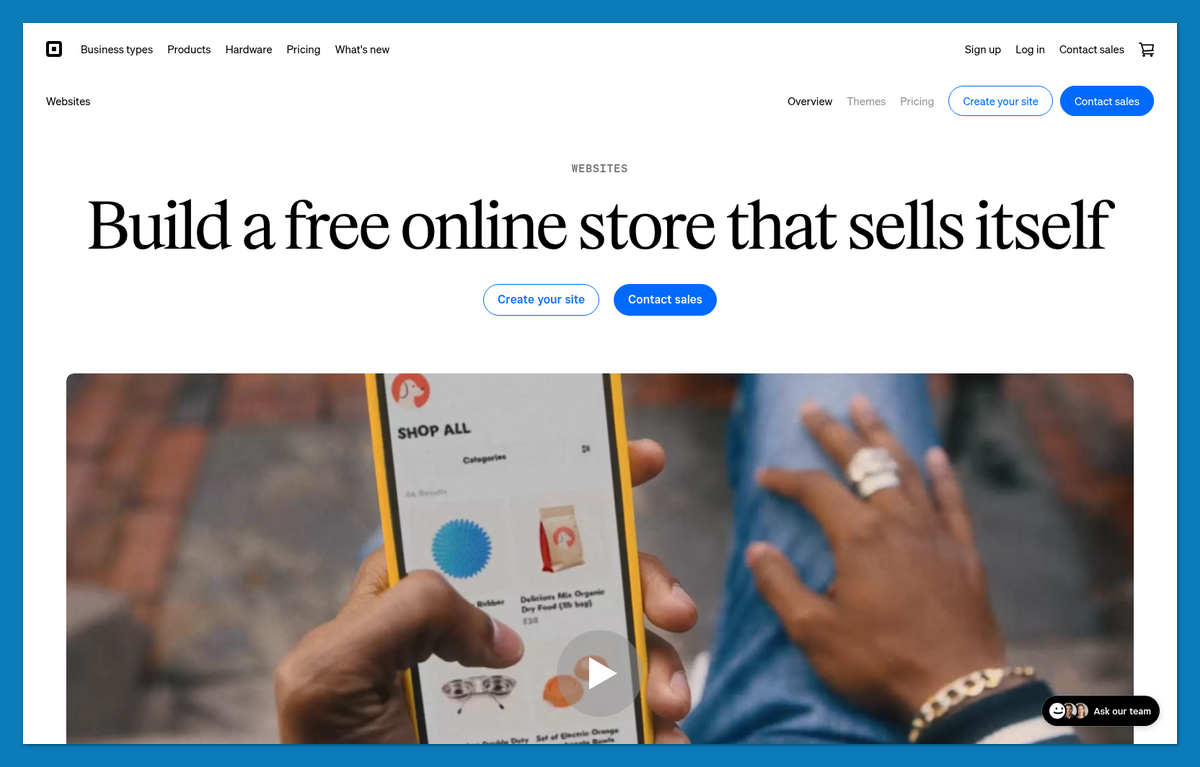
Square Online gives you a retail-focused alternative to BigCommerce, especially if your physical shop matters more than a highly customized website. It is also Square’s destination for new websites as Weebly winds down in 67 countries outside the US during 2026. If you are considering either builder, Square Online is the clearer choice for a fresh start.
Running Square Online shifts your budgeting toward physical locations: paid subscriptions apply per location, while BigCommerce charges separately for additional online storefronts. Locations and storefronts are different cost drivers, so map your actual shop setup before comparing the monthly headlines. I recommend Square when coordinating physical retail matters more to you than operating several distinct online brands.
Key Features:
- Free plan with unlimited products
- Online store, POS and payments from one vendor
- Per-location plans for multiple shops
- Destination for Square’s migrating Weebly users
Pros:
- Genuine $0 subscription
- One dashboard for online and in-person selling
- No platform surcharge above processing
- Capterra 4.6 from about 328 reviews
Cons:
- Free plan: Square ads, square.site domain, higher processing
- Limited design control and no B2B tools
- Trustpilot sellers report account holds and delayed funds
I recommend comparing processing costs before choosing Free. By my math, the 0.4-percentage-point saving on Plus covers its $49 monthly fee at $12,250 in monthly online card sales, assuming the same transaction mix. Above that, Free can cost more than Plus. Our breakdown of Square Online’s fees explains the subscription and processing distinction.
How Much Does Square Online Cost?
| Plan | Monthly price | Key limit |
|---|---|---|
| Free | $0 | Square ads and a square.site domain; 3.3% + $0.30 processing |
| Plus | $49 per location | 2.9% + $0.30 processing |
| Premium | $149 per location | 2.9% + $0.30 processing |
Best for local retailers and food sellers who want one system for counter and web. Skip it for wholesale or a highly customized storefront; our Shopify vs Square Online comparison covers the stronger growth-focused alternative.
7. Adobe Commerce: Best for Enterprise Stores That Need Custom Builds
- Pricing: No published price; partner estimates start around $22,000/year
- Sales cap: None; estimated license pricing scales with GMV
- Platform transaction fee: 0%
- Overall Rating: 4.0/5
Adobe Commerce is best for enterprise customization, not cutting costs. Consider it when custom business logic or regional storefronts exceed what BigCommerce can accommodate.

Adobe Commerce gives you a development-led alternative when BigCommerce’s packaged approach no longer matches your business, but release planning becomes part of the commitment. Magento 2.4.9 arrived on May 12, 2026, while support for 2.4.6 ended that August. It suits you if your technical team can choose and maintain a supported foundation, not merely commission a launch.
A custom Adobe storefront also changes the scale of the build budget compared with BigCommerce. IWD Agency estimates $150,000 to $450,000 for an Adobe PWA Studio headless build, versus $100,000 to $300,000 for BigCommerce Catalyst. I only favor that extra investment when you can name the business requirements the less expensive route cannot meet.
Key Features:
- Native B2B tools
- Multi-region store views
- PWA Studio for headless storefronts
- Extensive code customization
- Version 2.4.9 support through May 2029
Pros:
- Highest customization ceiling on this list
- Native trade-account functionality
- Strong fit for one brand across five-plus countries
- Free Magento Open Source edition
Cons:
- Estimated TCO: $122,000 to $450,000+/year; estimated builds: 4 to 12 months
- Ongoing patches; September 2026 security advisory affected supported versions
- Magento storefront count down 23.3% year over year
I give Adobe a narrower recommendation because IWD Agency estimates annual TCO for a $5M-GMV B2B store at $177K versus BigCommerce’s $145K. For standard B2B needs between $5M and $25M, I favor staying. Adobe earns consideration when customization justifies the expense; our Shopify vs Adobe Commerce comparison covers another enterprise route.
How Much Does Adobe Commerce Cost?
| Option | Price | What you get |
|---|---|---|
| Magento Open Source | Free license | Self-hosted, self-maintained software |
| Adobe Commerce on-premise | About $22,000/year, est. | License estimate below $1M GMV |
| Adobe Commerce Cloud | About $40,000/year, est. | Cloud license benchmark |
| Adobe Commerce at $25M+ GMV | $100,000 to $190,000+/year, est. | Enterprise license benchmark |
Choose Adobe only with a development team and an enterprise budget. Request a quote covering implementation and ongoing support, not just licensing; most smaller stores get better value from Shopify Plus or staying on BigCommerce. Magento Open Source removes the license charge, not hosting or maintenance.
8. Shopware: Best for B2B and Wholesale Sellers
- Pricing: Free Community Edition; paid plans from EUR 600/month, excluding VAT
- Sales cap: None listed; confirm volume terms in your quote
- Platform transaction fee: 0%
- Overall Rating: 3.9/5
Shopware is my strongest EU-focused wholesale alternative. Evolve starts at EUR 2,400/month for quotes and purchasing approvals, making initial budgeting easier than with quote-only competitors.

Shopware gives you a Germany-rooted commerce platform to consider when BigCommerce’s hosted model feels too restrictive for your wholesale business. Alongside its open-source route, Shopware Payments is available, giving you a payment option within the broader platform offering. It suits teams that want flexibility over their commerce setup rather than simply a cheaper monthly subscription.
Support needs can change which Shopware plan makes sense, even after you have matched the selling features. 24/7 priority support sits on Beyond, whereas BigCommerce keeps round-the-clock chat and email across its plans. I recommend putting response expectations into your Shopware quote before switching, especially if your team depends on help outside normal business hours.
Key Features:
- Evolve B2B quotes and approval workflows
- Multiple sales channels under one admin
- API-first architecture
- AI content tools from Rise
- Beyond Digital Sales Rooms and multi-location inventory
Pros:
- Published B2B starting prices
- Free, MIT-licensed Community Edition
- Built-in multi-shop sales channels
- Strong German-speaking European presence; G2 4.2
Cons:
- Rise alone starts at EUR 600/month
- Small review base; storefront count down 19.8% year over year
- Reported update incompatibilities in multi-tenant setups
I see Evolve as a workflow choice rather than a budget escape. At EUR 2,400 a month, it costs far more than BigCommerce’s self-serve plans. Customer-specific pricing is Beyond-only, so confirm that requirement before comparing quotes. Our Shopware review explains the broader platform fit.
How Much Does Shopware Cost?
| Option | Price | What you get |
|---|---|---|
| Community Edition | Free | MIT-licensed, self-hosted software |
| Rise | From EUR 600/month, ex-VAT | AI content tools, direct support; first 30 days free |
| Evolve | From EUR 2,400/month, ex-VAT | B2B components and phone support |
| Beyond | Custom quote | Customer-specific pricing and Digital Sales Rooms |
Choose Shopware for EU-focused trade workflows and open-source flexibility; stay on BigCommerce if its price lists and three to five independent brand storefronts already meet your needs.
9. PrestaShop: Best Free Platform for European Merchants
- Pricing: Free to download; hosting, modules and themes cost extra
- Sales cap: None
- Platform transaction fee: 0%
- Overall Rating: 3.8/5
PrestaShop is my pick for European merchants with developer support. You own the software rather than paying for a hosted platform tier, but that shifts operating responsibility onto your team.

PrestaShop gives you a commerce-focused open-source route away from BigCommerce, without making WordPress part of your store’s foundation. That distinction matters if your technical team prefers working directly on commerce software rather than adding selling tools to a content platform. I see your team’s existing skills as a better reason to shortlist it than the download price alone.
With BigCommerce, you choose a hosted tier; with PrestaShop, you need to define which responsibilities belong to your host, developer and module suppliers. Ask for a written maintenance scope covering the extensions your checkout relies on, rather than accepting a hosting quote as the full budget. I favor PrestaShop when those responsibilities are clear before migration starts.
Key Features:
- Free open-source code
- Thousands of modules and themes
- More than 250,000 merchants, according to PrestaShop
- Strong European presence
- Control over hosting and code
Pros:
- No license or platform fee
- Full code ownership
- Large module marketplace
- Capterra 4.3 from about 332 reviews
Cons:
- Paid modules often needed for basics, including SEO
- Users report difficult version 8-to-9 upgrades
- Live storefront count down 20.4% year over year
I see the choice between PrestaShop and WooCommerce as a skills decision: WordPress experience favors WooCommerce, while PHP-commerce expertise can favor PrestaShop. Both move costs into hosting and add-ons. Given the reported upgrade difficulties, confirm version 9 support for every essential extension before committing. Our PrestaShop review covers the ownership trade-off.
How Much Does PrestaShop Cost?
| Option | Price | What you get |
|---|---|---|
| Open-source software | Free | Downloadable, self-hosted commerce software |
| Hosted offer | Not published | Separately sold hosted service; request pricing |
| Hosting, modules and themes | Not published | Additional services and add-ons priced separately |
I recommend PrestaShop when you sell mainly in Europe and have a developer responsible for upkeep. Without that support, choose a hosted platform rather than treating a free license as a free operating budget. Request the separate hosted-offer price if you want PrestaShop without arranging your own hosting.
10. Big Cartel: Best Cheap Option for Small Catalogs
- Pricing: $0 to $30/month
- Sales cap: None; product caps of 5 / 50 / 500
- Platform transaction fee: 0%; Stripe and PayPal only
- Overall Rating: 3.5/5
Big Cartel is best for artists and makers with a small catalog. A five-product store can replace BigCommerce Core with a free subscription, while Platinum supports 50 products for $15/month.
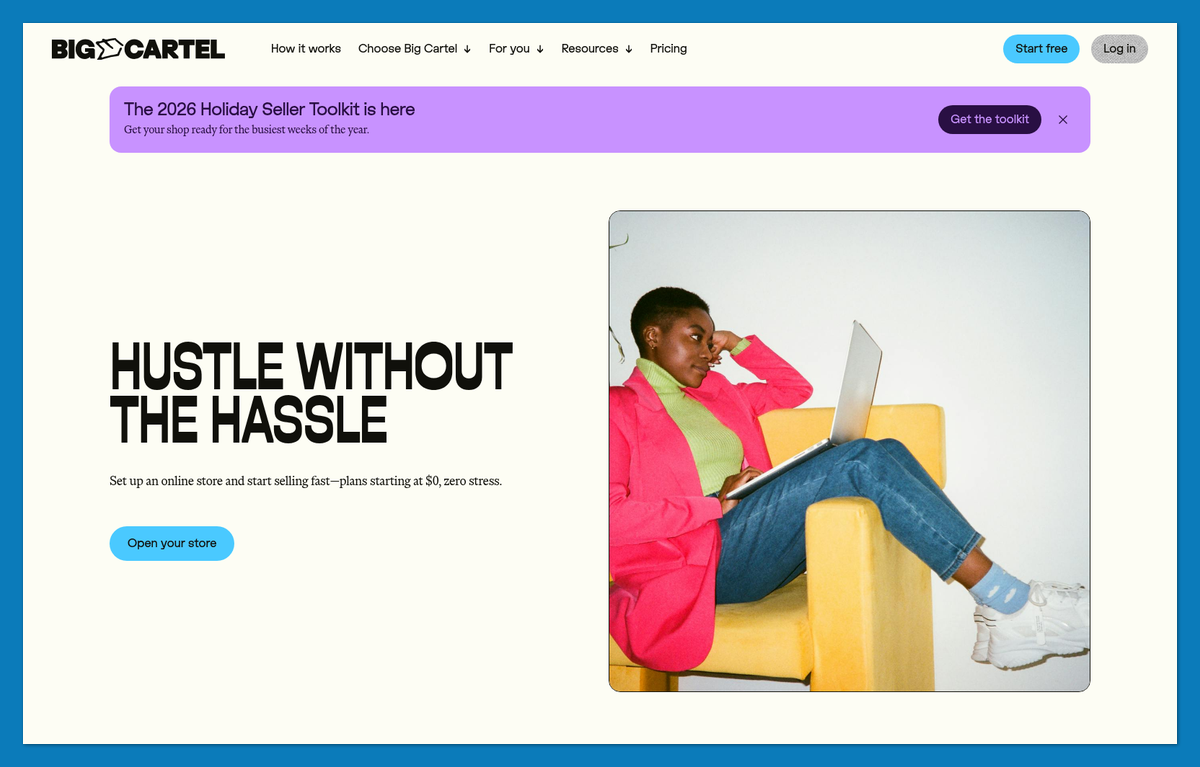
Big Cartel gives you a way to downsize from BigCommerce without tying your subscription to sales revenue. Its plans are organized around catalog size rather than turnover, which suits a maker selling a narrow range successfully rather than constantly adding new lines. You can judge the fit by what you intend to stock, not just last year’s sales.
Running Big Cartel also means accepting a much narrower payment choice than BigCommerce: Stripe and PayPal are the only options. Both are already embedded providers on BigCommerce, so keeping either does not itself create a platform-fee saving. I recommend switching for the smaller subscription and simpler scope, not because those gateways become newly exempt from surcharges.
Key Features:
- Simple setup aimed at independent makers
- Diamond abandoned-cart recovery and scheduled drops
- Diamond Zapier integration
- Imports from Etsy, Squarespace and Shopify
Pros:
- Free Gold plan
- Low-priced $15 and $30 paid tiers
- No Big Cartel transaction fees
- Straightforward small-store setup
Cons:
- 500-product ceiling
- Uneditable meta descriptions, weak redirects and no blog
- No B2B, independent storefronts or deep app ecosystem
I recommend Big Cartel for deliberately small stores, not as a cheaper route to BigCommerce-scale selling. There is no direct BigCommerce import, so budget time to recreate products. Changed product URLs redirect to the homepage rather than the replacement product. That SEO limitation rules it out for search-dependent stores, as our Big Cartel review explains.
How Much Does Big Cartel Cost?
| Plan | Monthly price | Key limit |
|---|---|---|
| Gold | $0 | 5 products |
| Platinum | $15 | 50 products; 7-day free trial |
| Diamond | $30 | 500 products; abandoned-cart recovery and scheduled drops |
Best for artists and makers with fewer than 500 products who need a modest storefront. Skip it if organic search, wholesale or a growing catalog drives your business; Square Online’s free unlimited-product plan is a better starting point for catalog size.
How to Choose the Right BigCommerce Alternative
Your last 12 months of orders and your payment gateway settle much of this decision. Use this checklist alongside our wider ranking of ecommerce platforms to rule out poor fits before migrating.
- Sales versus caps: Take trailing-year gross sales and multiply by 0.9. Above $30K on Core or $100K on Growth means an automatic BigCommerce upgrade.
- Payment gateway: Stripe, PayPal, Adyen and BigCommerce Payments avoid BigCommerce’s platform fee. Outside providers cost 2% / 1% / 0.6%; Shopify uses that ladder unless you use Shopify Payments. WooCommerce and most other picks add no platform fee.
- Catalog complexity: Compare BigCommerce’s 600 SKUs per product and 250 values per option with Shopify’s three options and 2,048 variants. Wix allows six options; Big Cartel stops at 500 products total.
- B2B needs: Compare your quote and account workflows with Shopify’s three standard-plan catalogs, Shopware Evolve, Adobe Commerce or WooCommerce plugins.
- Hosted or self-hosted: WooCommerce, PrestaShop, Magento Open Source and Shopware Community put security and updates on you. Compare those responsibilities across open-source platforms.
- In-person selling: Shortlist Square Online, Shopify POS or Ecwid with Lightspeed.
- Add-on budget: Allow for apps and extensions. One agency estimates $200 to $800/month for scaling Shopify stores; WooCommerce extensions typically cost $79 to $279/year each.
These subscription and overage calculations use published annual-billing prices. They exclude apps, themes, processing and outside-gateway fees; the $500,000 example assumes sales spread evenly across months.
| Yearly gross sales | BigCommerce plan | BigCommerce cost/year | Shopify Grow/year | Shopify Advanced/year |
|---|---|---|---|---|
| $200,000 | Scale, automatically upgraded | $3,588 | $948 to $1,068 | $3,588 to $4,308 |
| $500,000 | Scale plus 0.9% overage | About $4,038 | $948 to $1,068 | $3,588 to $4,308 |
Shopify’s plan choice depends on features, not sales volume. But if your savings are small and you already use a BigCommerce embedded provider, migration can cost more than it saves.
How to Switch From BigCommerce Without Losing Sales or SEO
Broken URLs and missing customer records can make a cheaper subscription expensive. There is no one-click exit: BigCommerce’s free Data Migration App brings stores in, not out.
- Export and inventory: Export products, customers, orders and blog posts as CSV. List every URL that brings in traffic.
- Test a migration tool: LitExtension starts at $79; Cart2Cart costs $69 to $600+; Matrixify costs $20 to $200/month. Run an available demo on 10 to 20 records. Shopify’s free Store Importer does not natively support BigCommerce.
- Rebuild the theme: Stencil themes do not convert into Shopify Liquid. Allow one to three weeks, an agency estimate.
- Import in waves: Move products, then customers, then orders, with notifications off. Passwords never migrate; arrange resets. Imported orders become archived records.
- Map redirects: Give every traffic-bearing URL a 301 redirect, such as
/blog/post/to/blogs/news/post. Test 50 to 100. An agency-cited estimate puts traffic retention with complete maps at 95% to 97%, not a guarantee. - Launch and monitor: Test checkout, shipping and taxes before switching DNS. Submit the new sitemap and monitor Search Console for broken URLs for 30 days.
Agency timeline estimates are four to five weeks below 1,000 SKUs, six to ten weeks mid-market and ten to fourteen weeks for B2B or ERP-connected stores. Estimated costs are $79 to $200 for tool-only DIY or $5,000 to $15,000 managed.
For other destinations:
- WooCommerce: Use its built-in CSV importer after column mapping.
- Wix: Use its CSV template or Cart2Cart app.
- Squarespace: Import up to 10,000 products and 250 variants by CSV, but no customers.
- Ecwid: Use LitExtension or Cart2Cart for customer/order transfers.
- Big Cartel: Recreate BigCommerce products; direct imports support only Etsy, Squarespace and Shopify.
Follow our step-by-step BigCommerce to Shopify migration for the full transfer plan.
How I Rated These BigCommerce Alternatives
My ratings out of five prioritize what you gain or lose by leaving BigCommerce, with cost and selling capabilities carrying half the weight.
- Total cost and fees (25%): Monthly/yearly prices, transaction fees, caps and add-on budgets.
- Selling features and scalability (25%): Catalog limits, B2B, POS, multichannel and headless options.
- Ease of use (15%): Setup, administration and editor capabilities.
- Migration and data portability (10%): Import routes and export restrictions.
- Apps, themes and integrations (10%): Ecosystem size and depth.
- Help and support (10%): Channels and plan restrictions, particularly phone support.
- Reputation and momentum (5%): G2/Capterra feedback, storefront trends and updates.
These are comparative editorial ratings based on published pricing, documentation and user reviews, not hands-on store builds. Prices reflect November 2026 in USD unless shown in EUR; enterprise figures are partner estimates where stated.
Final Verdict: Which BigCommerce Alternative Do I Recommend?
Shopify is the best BigCommerce alternative for most stores. No sales cap removes forced subscription upgrades, its app store offers the broadest choice here, and paid-plan B2B tools cover more wholesale needs than before. Check product options and payment fees before committing.
Choose WooCommerce for ownership without platform fees, Wix for a simple store, or Adobe Commerce or Shopware for demanding B2B requirements. Stay on BigCommerce if embedded gateways and price lists already make the numbers work, especially with independent brand storefronts. Start with your shortlist’s free trials or free plans, and confirm your hardest product and checkout requirements before paying.
FAQs
Does BigCommerce still have no transaction fees?
Not on self-serve plans using outside gateways. Orders through its 21 embedded providers avoid platform fees; others trigger 2% on Core, 1% on Growth or 0.6% on Scale. Contracted Performance has none. BigCommerce bills the fee monthly and includes manual payment methods. Embedded providers such as Stripe and PayPal/Braintree still charge payment-processing fees.
Is Shopify cheaper than BigCommerce?
Shopify can be cheaper after a BigCommerce cap-driven upgrade. Both start at $39 monthly or $29/month yearly. At $200,000 annual sales, Grow costs $948 to $1,068/year versus Scale’s $3,588, before payment fees and add-ons. Both use a 2% / 1% / 0.6% outside-gateway fee ladder; Shopify waives it with Shopify Payments.
What is the cheapest BigCommerce alternative?
Square Online and Big Cartel offer free hosted plans. Square charges 3.3% + $0.30 processing; Big Cartel allows five products.
- Ecwid Starter: $5/month.
- Squarespace Basic: $19/month yearly, plus 2%.
- Wix Core or Shopify Basic: $29/month yearly.
WooCommerce and PrestaShop need paid hosting. Compare free ecommerce platforms by operating cost, not license price alone.
Which BigCommerce alternative is best for B2B?
Shopify suits straightforward wholesale; Shopware and Adobe Commerce suit deeper requirements. Shopify includes three catalogs on standard paid plans and unlimited catalogs on Plus. Shopware Evolve starts at EUR 2,400/month; WooCommerce offers plugin-based B2B. BigCommerce remains strong for price lists and independent brand storefronts, so compare your exact workflows before leaving.
Why aren’t Volusion, Shift4Shop, Weebly or AmeriCommerce on this list?
Their restrictions or direction make them weaker recommendations.
- Weebly is closing in 67 countries outside the US; logins end December 26, 2026.
- Volusion has limited development and roughly 3,570 stores.
- Shift4Shop’s conditional $0 plan requires US merchants processing $500+/month through Shift4 Payments; otherwise expect about $41/month. Confirm eligibility.
- Cart.com no longer markets the AmeriCommerce storefront on its homepage.
Square Online is the clearer replacement for Weebly.
Can I try these platforms before paying?
Most offer a trial, introductory offer or free plan.
- Shopify’s free trial: three days, then $1/month for three months.
- Squarespace: 14 days.
- Big Cartel Platinum: seven days.
- Shopware Rise: first 30 days free.
- Square Online and Big Cartel: ongoing free plans.
Wix instead offers a 14-day money-back guarantee, not a paid-plan trial. BigCommerce’s own trial lasts 15 days.



Does bigcartel let you use your own domain with the free plan?
No, Custom domains is a premium feature and is not available on their free Gold plan. Cheers!
Used Volusion for 2 years. Worst two years of the business. I would stay away from it. Also avoid Authorize.net if you can. You have been warned. I am looking for an alternate for Bigcommerce as it seems like there is a big price hike for current customers upwards of 20% increase for me specifically. No new features simply a 20% increase. Bigcommerce was good but just getting too expensive.
I’ll take a look at some of these.
What do you think of GoDaddys GoCentral?
Hi Terry,
Check out this link for more info: https://ecommerce-platforms.com/ecommerce-reviews/godaddys-online-store-and-email-marketing-tools
–
Bogdan – Editor at ecommerce-platforms.com
Great article I am thinking of switching my clients from Big Commerce to Shopify…