

Every page ranking for DropMagic vs PagePilot was written by one of the two companies being compared. PagePilot's page scores DropMagic “Limited” or “Basic” down nine self-graded rows. DropMagic's page is a takedown dressed as a review. They disagree on PagePilot's price, plan names, currency and AI image counts, so someone is wrong.
They also miss the basic point: these products do not compete head to head. PagePilot is an AI product page generator. DropMagic is an AI store builder. The useful question is not which one wins, it is which job you are hiring for.
I pulled both live pricing pages, both App Store listings, both vendors' docs and the independent reviews, then reconciled the contradictions. I did not build or publish a store with either tool, and nothing below pretends I did.
Key Takeaways
- PagePilot is cheaper to start at $39/month against DropMagic's single $79/month plan, verified on both pricing pages
- Neither free tier can publish to Shopify, so “free” means generate and preview only
- DropMagic's comparison page is wrong about PagePilot's AI images: the live pricing page lists 50, 200 and unlimited by tier, not 5
- PagePilot's “true drag and drop” claim is overstated: independent reviews describe a constrained block editor with no free positioning
- They solve different problems: DropMagic builds the store, PagePilot builds the page you send ads to
- Both sit at 4.8 to 4.9 stars on the Shopify App Store, and both have documented support complaints
How DropMagic and PagePilot Compare at a Glance
DropMagic generates a five-page store from a single product link. PagePilot generates one page at a time. Both vendor comparisons score them against each other row by row, which is like scoring a house builder against a window fitter and declaring a winner.
| Feature | DropMagic | PagePilot |
|---|---|---|
| What it generates | Full Shopify store, fixed 5-page structure | Single product and landing pages |
| Entry price to publish | $79/mo (Pro) | $39/mo (Lite) |
| Number of paid tiers | 1 | 3 ($39 / $59 / $99) |
| Free plan | Unlimited generation, cannot publish | Free trial, generate and preview, cannot publish |
| AI images included | 30 credits/mo on Pro | 50 / 200 / unlimited by tier |
| Stores per plan | Unlimited on Pro | 1 / 3 / 5 by tier |
| Editor | Drag and drop bounded by a 57-section library | Block editor, no free positioning, no code access |
| Built-in ad tools | None found | AI ad copy plus creatives, 10+ variations |
| Product research | None found | 10 AI-curated winning products daily |
| Shopify App Store rating | 4.9/5 (~53 reviews) | 4.8 to 4.9/5 (72 to 150 reviews depending on the pull) |
| Trustpilot | No rating found | 4.7 to 4.8/5 (170 to 194 reviews, search-snippet sourced) |
| Best for | Getting a first store live fast | Building pages you can run ads to |
Four claims in this fight are contested. Here is where each landed.
| Contested claim | Who says it | What I found |
|---|---|---|
| “PagePilot caps AI images at 5/month on every plan” | DropMagic's comparison page | False. The live pricing page lists 50, 200 and unlimited by tier (sections 2 and 5) |
| “A true drag and drop editor” | PagePilot's marketing | Overstated. Independent reviews describe block editing with fixed positions (section 4) |
| “DropMagic is free” | DropMagic's marketing | Generation is free, publishing is not. $79/month is the real entry price (sections 2 and 3) |
| “DropMagic creates theme conflicts” | PagePilot's comparison page | Unverified. DropMagic generates a design rather than modifying an existing theme, and no documented case was found (section 6) |
How I checked these numbers
I worked from live sources: pagepilot.ai/pricing, dropmagic.ai, both Shopify App Store listings, PagePilot's docs and affiliate pages, and six independent reviews and listings.
Three limits are worth naming. Trustpilot blocked direct access with an HTTP 403, so those figures come from search snippets. No Trustpilot rating exists for DropMagic at all. No video transcripts were retrievable, and no documented case of a merchant running both tools together was found.
The nine criteria below settle those four contested claims in order.
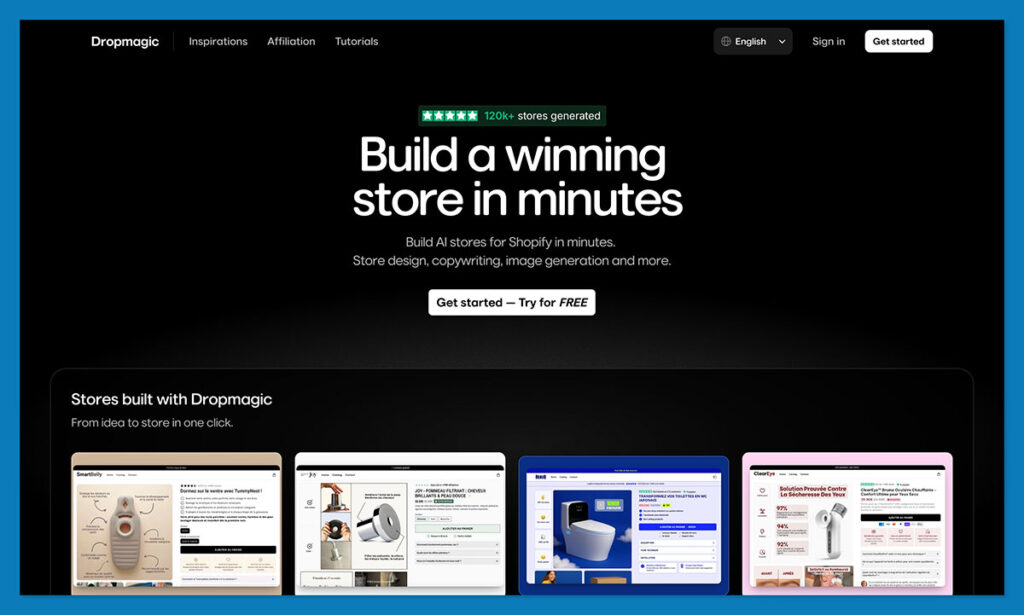
1. What Each Tool Actually Builds: Product Pages vs Full Stores
If you do not have a store yet, DropMagic is the only one of these two that can give you one. If you already have a store and need pages that convert cold ad traffic, PagePilot is the only one built for that.
Buy PagePilot expecting a store and you get a single product page. No homepage. No navigation, no collections, no branding a visitor can browse.
It may be an excellent page. It is still one page.
DropMagic works from a product link pasted in from AliExpress, Amazon, Shopify or Alibaba, and returns:
- A homepage with branded sections
- Product pages
- AI-written copy across the whole store
- AI-generated images
- All of it assembled from a 57-section library inside a fixed five-page structure
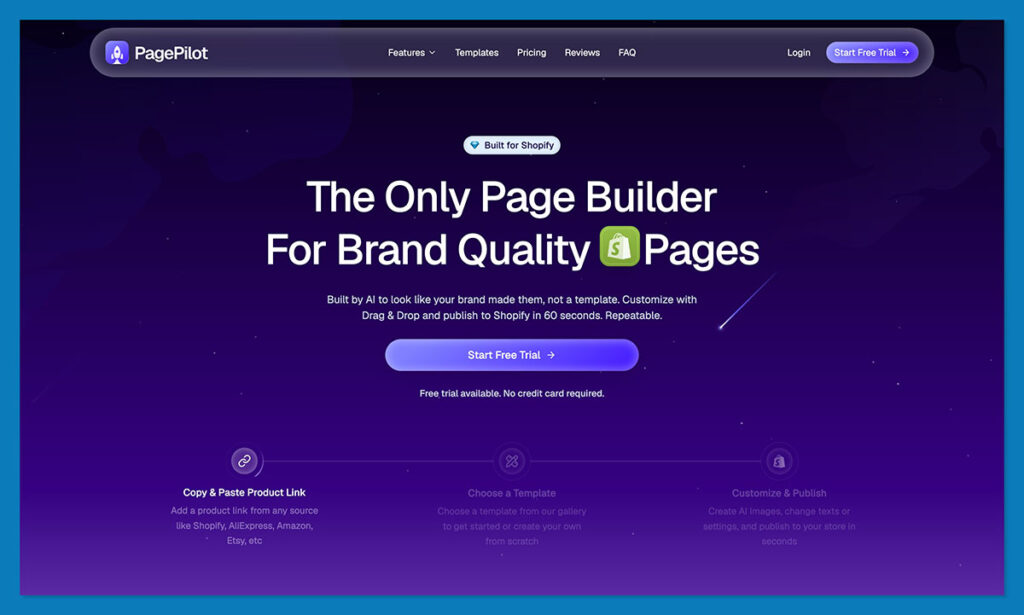
PagePilot takes the same kind of product URL and returns a full landing page with layout, images and copy. One independent review timed that generation at 45 to 75 seconds, which is their number and not mine. Import to a connected Shopify store takes two clicks, per PagePilot's own workflow. Every paid tier shares the same base kit per PagePilot's pricing page: 8+ templates, 35+ sections and blocks, 30+ languages, SEO fields and cart upsells.
Neither tool does the rest of the job. Specifically, neither handles:
- Supplier fulfillment
- Checkout configuration
- Customer service
- Any post-launch optimization
That is not my framing, it is DropMagic's. Its own launch tutorial places store generation at step 2 of 5, handing fulfillment to DSers and customer service to a separate tool. A vendor telling you where its product stops is worth more than a competitor telling you.
Best for: DropMagic if the store itself does not exist yet. PagePilot if the store exists and the pages are the weak link.
Skip if: you want DropMagic to run the business after launch, or you want PagePilot to give you a storefront.
2. Pricing: What DropMagic and PagePilot Really Cost to Launch
PagePilot is roughly half the price to start at $39/month, and DropMagic's effective entry price is $79/month rather than $0, because its free tier cannot publish.
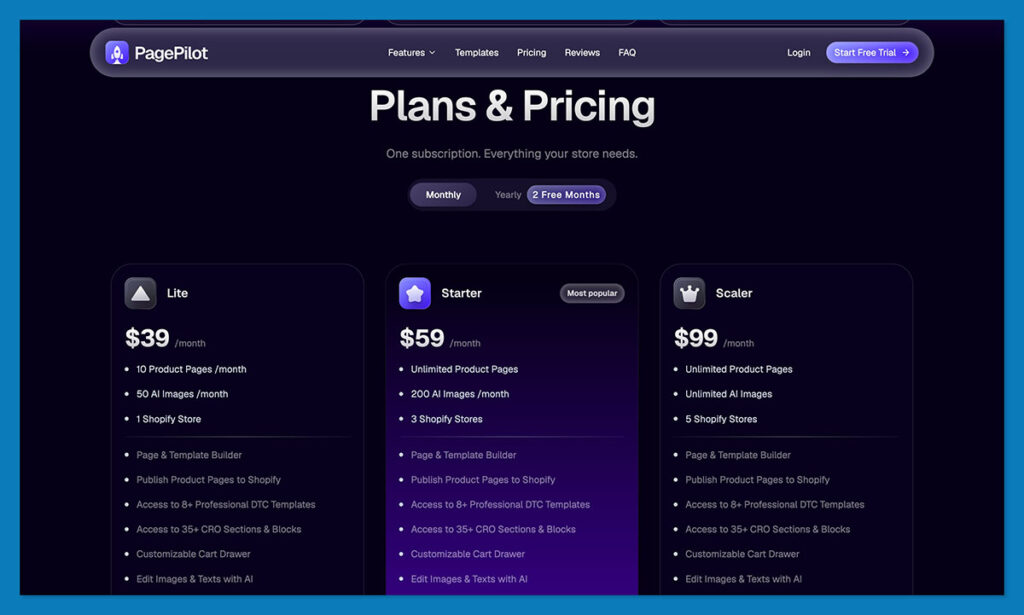
Four sources publish four different price sheets for PagePilot, and no two match. Two independent reviews put the top tier at 79, one in dollars and one in euros. DropMagic's comparison page prices that tier at €79 and renames it “Expert”. PagePilot's own live page says $99 and calls it Scaler, and that is the only authoritative sheet in the set:
- Lite, $39/month: 10 product pages per month, 50 AI images per month, 1 Shopify store
- Starter, $59/month: marked Most Popular, unlimited pages, 200 AI images per month, 3 stores
- Scaler, $99/month: unlimited pages, unlimited AI images, 5 stores
- Annual billing gives 2 free months on every tier
DropMagic's structure is far simpler, and simpler is not the same as cheaper:
- Free, $0: unlimited store and product generation, no Shopify publishing
- Pro, $79/month: unlimited stores and products, unlimited AI copywriting, 30 AI image credits per month, one-click product import, one free .store domain per store
- No mid-tier and no enterprise tier exist
Sticker price is not the number that matters. This is:
| What you are paying for | DropMagic | PagePilot |
|---|---|---|
| Cheapest plan that can publish | $79/mo | $39/mo |
| One year, billed annually | $948 (no annual discount published) | $390 on Lite (2 months free) |
| Stores included at entry price | Unlimited | 1 |
| AI images at entry price | 30 credits/mo | 50/mo |
| Cheapest way to run 3 stores | $79/mo | $59/mo (Starter) |
The tier figures above come from both vendors' live pages. The €39/€59/€79 variant and the $79 Scaler figure come from third-party reviews and are out of sync with the vendor. That euro sheet also lists page caps of 50, 150 and 250 a month, which do not match the unlimited-above-Lite structure PagePilot publishes itself.
Check pagepilot.ai/pricing on the day you buy, because even honest third parties go stale here. And DropMagic's claim that PagePilot allows 5 AI images a month at every tier is contradicted by PagePilot's own pricing page, which makes it a vendor claim that failed verification.
On raw price, PagePilot wins on every axis except one: the number of stores you get for the money.
3. Free Plans and Trials: What You Get Before You Pay
Both free tiers are demos. You can generate as much as you like on either one, and you can publish on neither.
The worst moment in either product is the same moment: you finish a store or a page you are happy with, click to go live, and hit a paywall. As one independent write-up puts it, DropMagic “lets you generate unlimited stores forever for free, you just can't publish them to Shopify.” A second source calls that free tier essentially a demonstration-only version.
DropMagic's free plan gives you unlimited generation and preview, and no publishing. Its free-tier AI image allowance is unclear: dropmagic.ai does not state a number, and one third-party listing says 2 credits. I would not budget around either figure until the vendor publishes one.
PagePilot's free entry is worded as “Try PagePilot.ai 100% FREE! No credit card required.” You can create pages and connect a Shopify store during that period. Publishing still requires a paid plan, which makes it structurally identical to DropMagic's free tier.
One Shopify App Store reviewer pushes back on the marketing directly, complaining the “preview is extremely limited.”
What free genuinely buys you on both tools:
- The visual quality and layout style of the output
- The tone of the AI copy before you commit to rewriting it
- Whether the section library suits your niche
- How long a generation actually takes on your product
Run the same product URL through both free tiers before you spend anything. It costs nothing, and it is the only hands-on signal available to you pre-purchase.
4. The Editors: How Much Design Control You Actually Get
Both editors are more constrained than their marketing suggests. DropMagic gives you more surface area to rearrange, PagePilot gives you more control over a single page, and neither gives you free-form design.
PagePilot markets a “true drag and drop editor”. DropMagic's comparison calls the same product a text editor that pushes you into Shopify's theme editor for real design changes. Both cannot be true.
The independent read sits between them. A reviewer at ecomm.design describes a block-based editor closer to Notion: you edit text, swap images, change button colors and add or remove pre-set sections. That is the ceiling, and their line is blunt:
“It's not drag-and-drop, and you can't place elements wherever you want.”
A second independent account leans toward DropMagic's version, calling it close to a text editor. They disagree on how limited it is, and agree it is nothing like Wix or Webflow.
DropMagic's editor is technically drag and drop, but bounded. An independent reviewer calls it limited to filling a 57-section library across a fixed five-page structure, and lands the sharpest line here:
“The 5-minute build time is the product, and the 5 minutes is also the depth ceiling.”
| Can you… | DropMagic | PagePilot |
|---|---|---|
| Move elements freely | No | No |
| Add or remove sections | Yes, from a 57-section library | Yes, from 35+ preset blocks |
| Rewrite copy with AI | Yes, unlimited on Pro | Yes |
| Change colors and images | Yes | Yes |
| Access code | Not documented | No |
| Change page structure | Within a fixed 5-page structure | Within the block order |
| Language support | Not documented | 30+ per the pricing page |
Who said what: “true drag and drop” is PagePilot's, “text-only editor” is DropMagic's, and the block-editor description is independent. That is the version I stand behind.
Best for: DropMagic to rearrange a whole store fast. PagePilot for tighter control over one page.
Skip both if: you have a specific layout in your head. Buy a theme and a real page builder instead. Neither of these will build it.
5. AI Copy and AI Images: Credits, Limits, and Who Writes Better
PagePilot includes far more AI images at every price point. DropMagic's copy engine is the more interesting one, because it writes differently depending on who you say you are selling to.

Here is the number you came for. At $39/month PagePilot includes 50 AI images; at $79/month DropMagic includes 30 credits. DropMagic's comparison page claims PagePilot allows 5 a month at every tier, and PagePilot's live pricing page disproves it outright.
The verified image allowances, side by side:
- PagePilot: 50/month on Lite, 200/month on Starter, unlimited on Scaler
- DropMagic: 30 credits/month on Pro; free-tier count not stated by the vendor, listed as 2 by one third-party source
- Neither vendor documents a credit rollover policy, which is a real gap if you generate in bursts
The copy comparison is less lopsided. DropMagic's persona-based copywriting takes age, interests, lifestyle and tone as inputs, so two stores selling the same product to different audiences get different headlines and marketing angles. That is genuinely useful for multi-market testing.
DropMagic also claims its copywriter is “trained on 8-figure brand copy,” which is an unverifiable marketing line and should be read as one. PagePilot's copy arrives as part of a conversion-structured page, backed by a separate ad copy generator covered in section 7.
One caveat on output quality, with its source labeled: buildyourstore.ai, itself a competing store builder, describes DropMagic's product pages as “sectioned and content-heavy” and likely to need manual refinement before launch. Directionally useful, commercially self-interested, worth exactly that much.
If all you want is copy and images, neither subscription is the cheapest route. Shopify Magic writes product descriptions free on your current Shopify plan, and a standalone AI image generator covers the rest without a page-builder subscription attached.
6. Publishing to Shopify: Theme Compatibility and What Customers Actually See
PagePilot's preview-versus-live mismatch is real and independently reported. PagePilot's accusation that DropMagic causes theme conflicts is not backed by any evidence I could find.
You approve the page in the editor, publish it, and the storefront version does not match. An independent review states the risk plainly: “Imported pages may display differently in Shopify than in preview due to theme variations.”
PagePilot's marketing claims compatibility with any Shopify theme. The same independent review confirms rendering can vary and recommends the free Sense or Dawn themes for best results. DropMagic's stronger claim, that PagePilot only builds on Dawn or Sense, overstates what the evidence supports. Practical rule: if you run a heavily customized premium theme, generate and test one page on the free tier before you pay for a plan.
DropMagic sits differently. It does not build on top of an existing theme, it generates the design from scratch, which reframes PagePilot's theme-conflict accusation entirely. If that risk exists at all, it applies to dropping a generated store into an already-themed store, not to a fresh build. I found no primary evidence of theme-breaking behavior for either tool, so this stays an open question.
One footnote worth knowing. A PagePilot user reported leftover app code after uninstalling that they believed caused payment problems. That is a single report, not a pattern, and I am presenting it as such.
Attribution, since all three versions are in circulation: “works with any Shopify theme” is PagePilot's claim, “Dawn or Sense only” is DropMagic's claim, and the theme-variation caveat is the independent one.
Publishing risk is real but modest on both sides. The mitigation is identical either way: test on a free theme first, then move to your production theme once you know how the output behaves.
7. Beyond the Page: Ad Creatives, Product Research, and Cart Upsells
PagePilot wins this outright. It bundles ad creative generation, a daily product research feed and a cart drawer with upsells, and I found no DropMagic equivalent for any of the three.
If you already pay for PagePilot, you can drop two subscriptions: a separate ad copy tool and a separate upsell app. That is the practical win, and it is a tool-count saving rather than a dollar figure I can verify.
- AI ad generator: paste a product URL or a short description and get 10+ Facebook and Google ad variations with matching AI creatives, covering hooks, headlines and primary text, in a three-step workflow
- Daily winning products: 10 AI-curated products a day, scored on rising demand, profit margin, social virality and low competition, included on all paid plans
- Native cart drawer with upsells: an average order value lever that most page builders send you to a separate, page-slowing app for
Now the counterweight. Every one of those three is documented by PagePilot itself, on its own site, docs and help center. I found no independent evaluation of the ad creative quality or the product feed's hit rate. A daily list of “winning products” is a feature whose entire value rests on output quality, and that quality is unverified here.
DropMagic offers nothing in this category, which is a scope decision rather than an oversight. Its counterweight is the one from section 1: a whole store instead of a page, unlimited stores on the single plan, and a free .store domain with each one.
Best for: merchants running paid traffic who currently pay separately for ad creative or upsells.
Skip if: your traffic is organic or existing. None of these three change your economics.
8. Ratings, Support, and Company Track Record
Both tools rate 4.8 to 4.9 stars on the Shopify App Store, and both have support complaints serious enough to matter. PagePilot has the longer track record and the larger review base.
Not one page ranking for this comparison cites a user review, rating or complaint. Every score in both vendors' matrices was assigned by the vendor writing the page.
| Signal | DropMagic | PagePilot |
|---|---|---|
| Shopify App Store rating | 4.9/5 | 4.8 to 4.9/5 |
| App Store review count | ~53 | 72 to 150 depending on the pull |
| Trustpilot | No rating found | 4.7 to 4.8/5, 170 to 194 reviews (search-snippet sourced) |
| Support complaint on record | 16-day wait for a first vague response, refund requested | “Team will be back in less than 1 hour” banner, user still waiting hours later, software unusable |
| Company signals | Newer, smaller review base | Founded 2023 by Robert Pop and Alex Minecan |
| Side products | None found | StorePilot, a free store builder run as an affiliate funnel |
Read those ratings correctly. Both are high, both sit on small young samples, and neither is decision-grade. Fifty-three reviews tells you a tool works for the people who reviewed it, not how it holds up across a thousand stores.
Two gaps, stated not filled. No Trustpilot rating for DropMagic could be confirmed through any route, and the PagePilot figures come from search snippets because direct access returned HTTP 403. Scamadviser flags dropmagic.ai as legit and safe, a safety signal rather than a satisfaction rating.
StorePilot needs explaining, since DropMagic raises it as an accusation. Store.pagepilot.ai generates a free store on the Dawn theme with pre-selected products, then pushes a Shopify referral link paying up to 30% recurring commission plus a flat per-signup fee on a 60-day cookie. It is a lead generation funnel, not a second product. DropMagic's claim checks out.
Budget for slower support than either vendor's marketing implies, and keep your product data exportable.
9. Alternatives and Stacking: When Neither Tool Is Worth Paying For
If all you need is product descriptions, Shopify Magic already does that free on your current plan. Neither subscription is worth it until you need generated structure, not generated words.
There is an option neither vendor page mentions, because neither vendor gets paid when you choose it.
| Alternative | What it costs | When it beats DropMagic or PagePilot |
|---|---|---|
| Shopify Magic | Free on every Shopify plan | You only need product descriptions, email and blog content, background image editing and Sidekick |
| Free Shopify theme built manually (Dawn or Sense) | $0 plus your time | You have more time than budget and want full layout control |
| StorePilot | Free | You want to see a generated store before paying anything, accepting it is an affiliate funnel on the Dawn theme |
| Hiring a designer or buying a premium theme | One-off cost | You need a store that does not look generated |
Shopify Magic stops at content. It fills an existing store rather than generating structure, and its store-setup feature produces a basic starter template that needs manual refinement. That limitation framing comes from DropMagic's own comparison page, so treat it as vendor-framed.
Can you run both tools together, DropMagic for the store shell and PagePilot for ad landing pages? Probably, and nobody has written it up. I found no tutorial, case study or vendor documentation of the combined workflow.
It is a reasonable inference given the scopes, since PagePilot pages import into a theme, but an inference is all it is. It also costs $118/month before either tool has made you a sale.
Against a single-tool path at $39 or $79, that stack is hard to justify on a first store. Start with one, and only add the second when you can name the specific job it does.
The Bottom Line: Which One Should You Buy?
There is no winner here, because these are not the same product. Every page that declared one was published by a company selling one of them. What you should buy depends on which half of the job you cannot do yourself, and that routes cleanly.
- No store yet, one product, want to launch this week: DropMagic at $79/month, accepting the fixed five-page structure and the 57-section ceiling
- Store already live, running paid ads, testing products: PagePilot at $39/month on Lite, or $59 on Starter if you need unlimited pages
- Testing whether AI generation is good enough at all: generate on both free tiers with the same product URL, publish on neither, and decide from the output
- You only need better product copy: neither. Shopify Magic is already included in what you pay Shopify
DropMagic: what works
- Full store from one product link, not a single page
- Unlimited stores and a free .store domain on the one plan
- Persona-based copy for testing the same product against different audiences
DropMagic: what does not
- $79/month with no cheaper tier to ramp into
- Free tier cannot publish, so the “free” framing is marketing
- No post-launch optimization. It ships once and does not learn from buyer behavior
PagePilot: what works
- $39 entry price and three tiers to grow into
- Ad creatives, product research and cart upsells bundled into the same subscription
- Larger review base and a longer track record, operating since 2023
PagePilot: what does not
- Editor is far more constrained than “true drag and drop” implies
- Pages can render differently live than they do in preview
- Generates pages only, not a store
Three things I could not verify, which you should weigh before you subscribe. No Trustpilot rating exists for DropMagic anywhere I could reach. No documented case of anyone running both tools together was found. Neither vendor publishes what happens to your generated pages or stores if you cancel.
Ask their support that last question in writing before you hand over a card, and keep the reply.
Frequently Asked Questions
Is DropMagic or PagePilot better for beginners?
It depends on what you are missing, not on skill level. No store at all means DropMagic, since it is the only one of the two that produces a homepage, navigation and branding. An existing store that needs converting pages means PagePilot. Section 1 breaks the scope difference down in full.
How much does DropMagic cost?
DropMagic has one paid tier: Pro at $79/month, confirmed on the vendor's own site and across multiple independent sources. There is no mid-tier and no enterprise plan. Pro includes unlimited stores, unlimited AI copywriting and 30 AI image credits a month. The free plan cannot publish to Shopify, so $79/month is the real entry price to get anything live.
Is PagePilot's editor really drag and drop?
Not in the way the marketing implies. PagePilot claims “a true drag and drop editor,” but independent reviews describe block-based editing: you change text, images, colors and preset sections without repositioning elements or touching code. One reviewer puts it directly: “you can't place elements wherever you want.” See section 4.
Can I use DropMagic and PagePilot together?
Probably, though nobody has documented it. I found no tutorial, case study or vendor documentation of a combined workflow using DropMagic for the store shell and PagePilot for ad landing pages. It is plausible given their different scopes, but treat it as an inference. Running both costs $118/month.
Does PagePilot work with any Shopify theme?
PagePilot claims yes. An independent review notes imported pages may display differently in Shopify than in preview due to theme variations, and recommends the free Sense or Dawn themes for best results. DropMagic's claim that PagePilot only builds on Dawn or Sense overstates the actual restriction. Test one page free before committing if your theme is heavily customized.
Do DropMagic or PagePilot handle fulfillment, checkout, or SEO?
Neither handles fulfillment or checkout. PagePilot includes basic SEO fields for meta titles and descriptions. DropMagic's own launch playbook places store generation at step 2 of 5, handing fulfillment to DSers and customer service to separate tools, so both are one component of a larger stack.


Comments 0 Responses