

The Shopify Agentic plan is sold as a free plan, and the subscription genuinely is $0 a month. Shopify’s Agentic Storefronts Supplemental Terms of Service also disclose a second charge, an “Agentic Storefronts Fee,” assessed per channel on top of payment processing at a rate published nowhere public.
The distance between the marketing page and the legal page is the story here.
The plan itself is easy to describe: a Shopify subscription with no storefront attached, built to push your catalog into ChatGPT, Google AI Mode and Gemini, Microsoft Copilot, Perplexity and the Shop app while your real store stays on WooCommerce, BigCommerce or Magento.
Published guides disagree on three questions that decide whether it’s worth your time. Is it free? Does checkout happen in the chat or on your site? Can you sign up today?
I checked all three against Shopify’s own documentation and legal terms. Shopify reports AI-driven traffic to its merchants grew 8x year over year in Q1 2026, with AI-powered search orders up nearly 13x, though those are its own unaudited figures. Start with the cost.
What the Shopify Agentic Plan Actually Is (and What It Isn’t)
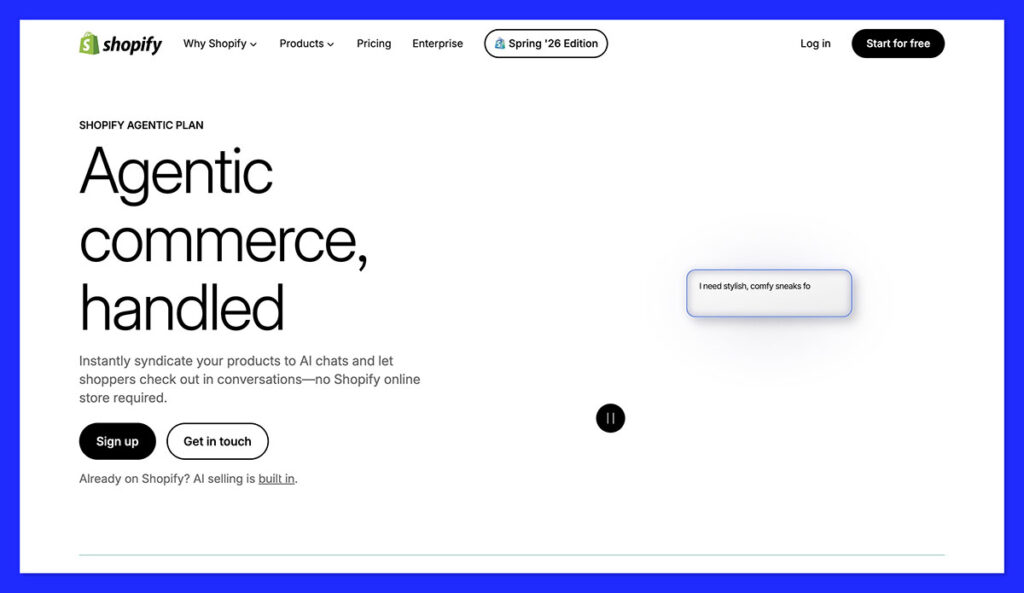
The Shopify Agentic plan hands you a Shopify admin, a Shopify checkout and Shopify order records. It does not hand you a Shopify store. Online Store is not on the plan at all.
Your products live in Shopify Catalog, the inventory AI channels query when a shopper asks for a running shoe under $120. Because you have no Shopify storefront for those listings to link to, every product carries an “external URL” standard metafield pointing back to its real page on your own site. That one field explains the whole design. Shopify treats your existing store as the product’s home and itself as the distribution layer.
Think sidecar, not replacement. Your PIM keeps managing product data, your OMS keeps managing fulfillment, your tax rules keep filing, and the Shopify account exists only to feed AI channels.
Underneath sits the Universal Commerce Protocol, an open standard covering cart creation, checkout, payment and post-purchase that Shopify co-developed with Google and shipped around January 11, 2026. Amazon, American Express, Etsy, Mastercard, Meta, Microsoft, Salesforce, Stripe, Target, Walmart and Visa have signed on. “It’s open by default,” Tobi Lütke wrote when it went live. The channels are converging on one standard, which makes this infrastructure rather than a Shopify side project.
What you get
- A Shopify Catalog listing that participating AI channels read from
- Shopify checkout on the channels that support buying in-channel
- Orders in your Shopify admin with channel attribution showing which AI surface sent them
- Merchant-of-record status, so the sale is legally yours
What you don’t get
- No Online Store, no theme, no Shopify-hosted product pages
- No Shopify Messaging, gift card sales or manual order creation
- No Shop post-purchase offers
It’s a distribution channel with a Shopify login attached, not a store.
What the Agentic Plan Really Costs, Including the Fee in the Fine Print
The “~4% agentic commerce fee” merchants keep warning each other about is a real number attached to the wrong company. Perplexity markets its merchant program explicitly against the roughly 4% transaction fee OpenAI’s Agentic Commerce Protocol reportedly charged, and that figure got copied across to Shopify along the way. Shopify has never published a 4% agentic fee.
Shopify charges in three layers. Only two are visible before you sign up.
Layer one is the subscription, and it really is $0 a month.
Layer two is payment processing, quoted as “from 2.9% + 30¢” for US merchants. That number moves: the same Shopify plan page served in a Romanian locale shows 1.9% + 1.25 RON online. Competing guides quote different rates and all can be right, because yours depends on region, currency and payment provider.
Layer three is the one no guide covers. Shopify’s Agentic Storefronts Supplemental Terms of Service define “Agentic Storefronts Fees” as transaction-based charges on sales through Participating Channels, on top of standard processing. The rate is “set out in your Shopify Admin,” per channel, and appears nowhere public. Price in the asymmetry too: refund or cancel an order and you get a proportional refund of the Agentic Storefronts Fee and its sales tax, but not of the underlying Shopify Payments transaction fee.
| Cost layer | What it covers | Published rate | Where it’s disclosed |
|---|---|---|---|
| Monthly subscription | Access to the plan and admin | $0 | Shopify plan page |
| Payment processing | Card processing on completed sales | From 2.9% + 30¢ (US); varies by region | Agentic plan page |
| Agentic Storefronts Fee | Transactions through Participating Channels, per channel | Not published | Supplemental ToS; rate shown in your admin |
| Third-party gateway fees | Processing if you don’t use Shopify Payments | Varies by provider | Your provider’s contract |
The marketing says free plan. The Shopify Agentic plan is a free subscription with three variable fee layers, one of which you cannot see until you’re inside the admin. Open Sales channels > Agentic and read the per-channel rate before you commit inventory, not after.
Where Checkout Actually Happens on Each AI Channel
Two of the most-read guides on the Shopify Agentic plan contradict each other on where your buyer pays. One says the shopper redirects to your checkout; the other says the purchase completes inside the chat. Both are right, and the difference decides whether your analytics, consent capture and upsells fire.
On ChatGPT, it’s a redirect. Shopify’s documentation is specific: customers complete their purchase on your online store checkout inside a ChatGPT in-app browser or in a new tab, with no extra OpenAI platform fee beyond standard processing. Your site loads, so everything you built there still fires.
On Google AI Mode and Gemini, Microsoft Copilot and Meta, you can activate direct in-channel checkout instead.
Legally the sale stays yours either way. Shopify’s terms make you the seller of record, “responsible for all aspects of the transactions between you and your customer(s),” and you keep the customer relationship, the data and the post-purchase experience. Owning that data on paper is not the same as your tools receiving it.
| AI channel | Where checkout happens | In-channel checkout? | What this means for your stack |
|---|---|---|---|
| ChatGPT | Your checkout, in an in-app browser or new tab | No | Your site loads; tracking, consent and upsells fire |
| Google AI Mode / Gemini | In-channel, if you activate it | Yes | Buyer never reaches your site |
| Microsoft Copilot | In-channel, if you activate it | Yes | Buyer never reaches your site |
| Meta | In-channel, if you activate it | Yes | Buyer never reaches your site |
| Shop app | Inside the Shop app | Yes | Buyer never reaches your site |
Two things land on your side regardless:
- Order records land in your Shopify admin with channel and referrer attribution, so a ChatGPT sale is labeled
- Webhooks for
orders/create,orders/updatedandfulfillments/createpush agentic orders into your OMS
Which channels you switch on decides how much of your customer experience survives the sale.
Who Can Join the Agentic Plan Today
There is no waitlist. Guides still describing the Shopify Agentic plan as “in waitlist mode” are out of date. Current Shopify sources describe it as publicly available with self-serve signup, and any brand can sign up today.
Whether you can use it is a different question from whether you can sign up for it. Agentic Storefronts has hard eligibility rules:
- US-based store. Your Shopify store must be based in the United States.
- US-based customers. You have to be selling to buyers in the US.
- USD transactions. Sales must process in US dollars.
- Catalog-eligible products. Products must meet Shopify Catalog’s eligibility rules.
- Supplemental Terms accepted. You agree to the Agentic Storefronts Supplemental Terms of Service.
- Published store policies. Terms of service and related policies need to be live.
- No forced account login. You cannot require a customer account before checkout.
Two channels break that pattern in your favor. For ChatGPT and Microsoft Copilot, any merchant in Shopify Catalog selling to US buyers can use them regardless of where the store is based. Google AI Mode and Gemini sit at the other extreme: early access, select US-based brands only. Broader international rollout is tied to regional AI regulation and Shopify Payments availability, so it moves market by market.
One thing you don’t choose. Agentic Storefronts is available from the Starter plan up and is active by default for eligible stores rather than opt-in.
If you’re outside the US, don’t sit and wait for a signup button. Get your products into Shopify Catalog and treat ChatGPT and Copilot as your reachable surface, because the full plan won’t clear its eligibility gate in your market until Shopify Payments and local AI rules line up.
How to Get a WooCommerce, BigCommerce or Magento Catalog Into Shopify Catalog
You are not missing a hidden connector. Shopify’s setup documentation contains no WooCommerce, BigCommerce or Magento path. It assumes your products arrive in the Shopify admin and takes no interest in how they got there.
Shopify sanctions three sync methods, and picking the wrong one is how stores oversell. Its guidance: sync dynamic data in real time through the GraphQL Admin API or webhooks, not batch imports.
| Method | Best for | Setup effort | Inventory freshness |
|---|---|---|---|
| CSV import | Initial load, small or static catalogs | Low, no developer needed | Stale between manual re-uploads |
GraphQL Admin API (productSet) | Fast-moving price and inventory | High, a developer project | Near real-time |
| PIM connector app | Large catalogs already in a PIM | Medium, app config plus field mapping | Set by the connector’s schedule |
One field trips everyone up. Every product needs an “external URL” standard metafield pointing at its live listing on your storefront. On the redirect channels that URL is the purchase path, so a stale one turns a ChatGPT sale into a 404. Whatever syncs your catalog has to maintain it, not set it once.
Everything after the import is configuration you already have elsewhere, now maintained twice:
- Sign up for the free Shopify Agentic plan and accept the Supplemental Terms.
- Import your catalog by CSV, GraphQL Admin API or PIM connector.
- Add the external URL metafield to every product.
- Configure payment, shipping zones and rates, populating product weights if you charge by weight.
- Set up tax collection through Shopify Tax, manual rates or a third-party app.
- Manage the channel from Sales channels > Agentic and push orders to your OMS by webhook.
General-purpose connectors exist (Webkul’s Magento 2 and WooCommerce integrations, iMan, Erply), but none are Shopify-published or part of documented Agentic onboarding, so each needs its own review.
CSV gets 20 SKUs live over a weekend and tells you whether AI channels send you anything. API sync becomes mandatory once inventory moves fast enough to sell what you don’t have.
What Breaks on the Agentic Plan: Limits, Lost Data and No Opt-Out
One merchant put it better than the documentation: “post-purchase upsell apps (eg AfterSell) never fire, personalization tools have zero browsing data on this customer, no consent to marketing emails.” On the Shopify Agentic plan’s in-channel checkout the buyer never lands on your site, so anything depending on a site visit is dead.
Workarounds exist. Detect agentic orders through channelInformation metadata and route those customers differently. Draft-order links in confirmation emails pull them home; the sturdiest fix is a branded packing insert with a QR code.
No opt-out. Merchants report no self-service way to switch Agentic Storefronts off. The only workaround, marking products “Unlisted,” also strips them from your own search visibility. One forum user reads it as “if you don’t like it, leave.” Independent makers push harder: their photos and descriptions get ingested with no consent mechanism.
| Operation | How it works on the Agentic plan | What you have to change |
|---|---|---|
| Refunds | In Shopify admin, whatever provider took the money | A second refund workflow |
| Taxes | Configured in Shopify, which may collect and remit tax itself | Duplicate setup, second filing |
| Shipping rates | Set in Shopify; weight-based rates need product weights | Sync rate tables manually |
| Support | No Shopify Messaging on this plan | Your existing helpdesk |
Each gap has a consequence:
- No Online Store, which is why the external URL metafield matters
- No Shopify Messaging, so pre-sale questions have no native inbox
- No gift card sales
- No manual order creation, so phone orders stay in your main system
- No Shop post-purchase offers, the one native upsell surface
The quieter cost is informational. Pulling non-Shopify catalogs into Shopify Catalog gives Shopify cross-merchant benchmarks and conversion data at network scale, while you barely see how AI channels rank your products. Merchants report Shopify “doesn’t yet categorize traffic as ‘came from ChatGPT’.”
Best for merchants whose retention runs on email and packaging. Skip if your margin depends on post-purchase upsells or you object to AI ingestion of your product content.
What Merchants Are Actually Reporting So Far
OpenAI’s Instant Checkout launched on the biggest consumer AI surface in the world and had about a dozen Shopify merchants live on it when OpenAI killed it five months later. Shopify President Harley Finkelstein confirmed the number and blamed limitations at the AI platforms rather than merchant reluctance.
Hold that next to Shopify’s Q1 2026 numbers: AI-driven traffic to merchant stores up 8x year over year, AI-powered search orders up nearly 13x, and new AI-referred buyers ordering at nearly twice the rate of other channels. Those are Shopify’s own unaudited figures, measuring the entire Shopify AI-channel surface rather than Shopify Agentic plan merchants.
What merchants can see is thinner. Testers in the Shopify Community report they cannot isolate AI-driven traffic in standard analytics at all, with one watching instead for “spikes in specific products, more long-tail variants.” The threads read as speculation rather than results, which is itself the finding.
Analysts split. Forrester’s Sucharita Kodali doubts horizontal AI agents become real shopping destinations, citing research that consumers still default to Amazon for the actual purchase. Monos CEO Victor Tam takes the other side: agentic shopping lets a brand show up “at the exact moment someone is asking real questions with real intent.” Monos, Gymshark and Everlane are Shopify-native brands on Agentic Storefronts, not Agentic plan users, a distinction guides blur.
Measure these in your first 90 days:
- Channel and referrer attribution on every order in Shopify admin
- Long-tail SKU spikes, the indirect signal for AI-driven discovery
- External URL click-through on the redirect channels
- AOV on agentic orders against your site average
The traffic is real and growing, the per-merchant results are unpublished, and anyone quoting agentic conversion benchmarks in mid-2026 is extrapolating.
Agentic Plan vs Direct Channel Programs vs Waiting
The Shopify Agentic plan is not the only door into AI shopping. One alternative takes five minutes to apply for.
| Route | Cost to you | Channels reached | Effort | Best for |
|---|---|---|---|---|
| Shopify Agentic plan | $0/mo + processing + undisclosed channel fee | ChatGPT, Google AI Mode/Gemini, Copilot, Meta, Shop app | Days by CSV, weeks by API | US merchants wanting widest reach |
| Perplexity Merchant Program | Free, no transaction fee | Perplexity | ~5-minute application | Zero-risk first test |
| OpenAI direct (ACP) | Free, discovery only | ChatGPT discovery | Low | Stores already surfacing in ChatGPT |
| Direct UCP build | Engineering time | Any UCP-compatible agent | Months | Custom stacks with dev capacity |
| Wait and watch | $0 | None | None | Merchants blocked on eligibility |
Perplexity is the outlier on effort: free, a five-minute application, in-chat PayPal checkout, no merchant transaction fee. It had 45 million monthly active users in early 2026; its Buy Now agent hit 2 million monthly shoppers and a $2 billion GMV run rate by July 2026. Reach is narrower than ChatGPT or Google, and checkout is PayPal-only.
OpenAI directly is the cautionary tale. Instant Checkout ran September 29, 2025 to March 5, 2026, with 8% of US adult ChatGPT users trying it in month one. Forbes’s Jason Goldberg calls the retreat resource allocation, not a verdict on agentic commerce. ChatGPT’s US daily AI app share fell from 57% to 42% between August 2025 and February 2026 while Gemini doubled to 25%.
Direct UCP is open by default and implementable without Shopify, but merchant-facing tooling is barely documented and costs real engineering time.
- Not mutually exclusive. Perplexity and the Shopify Agentic plan run in parallel.
- The cheap ones stack. Joining Perplexity doesn’t affect Shopify Catalog eligibility.
Apply to Perplexity first. Run the Shopify Agentic plan alongside it if you clear the US eligibility gate. Leave direct UCP until order volume justifies the engineering time.
Should You Add the Agentic Plan? The Bottom Line
The decision is cheaper than it looks, and price isn’t the reason. Signing up for the Shopify Agentic plan costs $0. What it actually costs is catalog sync, external URLs maintained forever, shipping and tax configured a second time, and a second reconciliation surface for your finance stack.
Adopt if
- You’re US-based, selling to US buyers in USD
- Your catalog is stable enough for CSV, or you already have API or PIM capacity
- Your retention runs on email and packaging, not on-site upsells and personalization
- You want distribution without replatforming, with your WooCommerce or Magento store untouched
Skip or wait if
- You’re outside the US eligibility window, though ChatGPT and Copilot stay reachable through Shopify Catalog
- Your margin depends on post-purchase upsell apps that will not fire on in-chat orders
- You object to AI ingestion of your product content, because there is no opt-out
- Your inventory moves fast and you have no engineering capacity for real-time API sync
One footnote for bigger merchants. An enterprise tier of the Agentic plan exists, adding unlimited staff accounts, Combined Listings, carrier-calculated shipping, payment capture per fulfillment, extra inventory locations, API rate limits consistent with Shopify Plus, protected customer data level 2 and Shopify Functions API access. Pricing isn’t published, so you contact Shopify sales.
My call: worth a controlled test if you clear eligibility, not worth a replatforming conversation. Import 20 SKUs by CSV, then check the per-channel Agentic Storefronts Fee in Sales channels > Agentic before you push the rest of the catalog.
Shopify Agentic Plan FAQs
Do I have to migrate my store to Shopify to use the Agentic plan?
No. The Shopify Agentic plan is a sidecar to your existing stack: WooCommerce, BigCommerce or Magento stays your primary platform, and your PIM, tax setup and OMS keep running. You add a Shopify account that exists only to feed AI channels, with each product linking back to your storefront through the external URL metafield.
Can I use the Shopify Agentic plan if my business isn’t based in the US?
Not the full plan. Agentic Storefronts requires a US-based store selling to US-based customers in USD, and international rollout depends on regional AI regulation and Shopify Payments availability. ChatGPT and Microsoft Copilot are the exception: any merchant in Shopify Catalog selling to US buyers can reach them regardless of store location.
Is there an enterprise version of the Agentic plan?
Yes. An enterprise tier adds unlimited staff accounts, Combined Listings, carrier-calculated shipping, payment capture per fulfillment, extra inventory locations, API rate limits consistent with Shopify Plus, protected customer data level 2 and Shopify Functions API access. Shopify does not publish its pricing, so you contact sales directly.
Did OpenAI really discontinue Instant Checkout?
Yes. OpenAI launched Instant Checkout on September 29, 2025 and discontinued it March 5, 2026, with about a dozen Shopify merchants integrated and 8% of US adult ChatGPT users trying it in month one. ChatGPT now runs a “discover in chat, transact on the merchant site” model, which is why the Agentic plan’s ChatGPT flow is a redirect.
Who owns the customer relationship on an agentic order?
You do, on paper. Shopify’s Supplemental Terms of Service make you the seller of record, responsible for all aspects of the transaction and retaining the customer relationship and data. On in-channel checkout the buyer never visits your site, so marketing consent and browsing data aren’t captured. See “What Breaks on the Agentic Plan” above.
How long does it take to go live on the Shopify Agentic plan?
Signup is self-serve and immediate. A CSV import of a small, static catalog plus basic shipping and tax configuration is a day’s work. Real-time GraphQL Admin API sync, external URL metafields maintained across thousands of SKUs, and shipping logic that matches your main store is an engineering project measured in weeks.


Comments 0 Responses