

Shopify and ThriveCart both promise to help you sell online, but they are not really the same kind of product, and that is the single most important thing to understand before you spend money on either one.
Shopify is a full ecommerce platform that gives you a storefront, a product catalog, inventory, shipping, and a checkout. ThriveCart is a checkout and funnel tool that you bolt onto something you already have.
We compared both platforms across eight areas that matter to online sellers, verifying every pricing figure against each vendor's current public rates rather than relying on older published reviews.
For most people building a real online store, Shopify is the better choice. For a narrower group of sellers, mostly digital product creators, course sellers, and coaches, ThriveCart's one-time payment model is genuinely hard to beat.
Shopify vs ThriveCart: Quick Verdict
- Shopify: best overall. The right pick if you sell physical products, need a real storefront, want inventory and shipping handled natively, or plan to grow a brand with SEO and multichannel selling.
- ThriveCart: best for digital sellers who hate subscriptions. The right pick if you sell courses, coaching, memberships, or digital downloads, already have a website or landing pages, and want to pay once instead of every month.
The honest answer: a lot of sellers end up using both. ThriveCart handles the cart and the affiliate program, Shopify handles the store.
Below, we break down where each platform wins and, more usefully, where each one quietly falls apart if you pick the wrong tool for your business model.
Quick Comparison: Shopify vs ThriveCart
| Category | Shopify | ThriveCart |
|---|---|---|
| What it actually is | Full hosted ecommerce platform | Checkout, cart, and funnel tool |
| Entry price | $39/month ($29/month billed annually) | $495 one-time, no recurring fee |
| Higher tiers | Grow $105/month, Advanced $399/month, Plus from $2,300/month | Pro+ at $295/year, Ultimate Bundle $985 one-time |
| Platform transaction fees | None with Shopify Payments; 0.6% to 2% with third-party gateways | None on any plan |
| Card processing | 2.9% + 30c (Basic), down to 2.5% + 30c (Advanced) | Your processor's own rate (Stripe, PayPal, Authorize.net) |
| Storefront and themes | Yes, free and paid themes, full site builder | No storefront, checkout pages only |
| Inventory management | Yes, multi-location, native | Minimal, not built for it |
| Order bumps and one-click upsells | Via apps | Native, unlimited |
| Affiliate program | Via third-party apps | Native affiliate center (Pro+) |
| Course selling | Via apps | Built in (Learn / Learn+) |
| SEO and blogging | Yes, native | No |
| Free trial | Yes, plus a $1/month promo for the first three months | No free trial, money-back guarantee only |
| Best for | Physical products, growing brands, multichannel sellers | Digital products, courses, coaching, one-product funnels |
Key Takeaways
- Shopify is a store. ThriveCart is a cart. If you need customers to browse a catalog, Shopify is the only real option here.
- ThriveCart's $495 one-time Standard licence has no recurring fee, which is unusual and genuinely valuable if you sell digital products.
- The “lifetime” label is not the full story. ThriveCart's Pro+ tier now renews at $295 per year from year two, so the affiliate and advanced features are a subscription in practice.
- ThriveCart's checkout beats Shopify's out of the box, with native order bumps, one-click upsells, downsells, and A/B testing that Shopify pushes into paid apps.
- Shopify has no free-trial equivalent problem. ThriveCart has no trial at all, so testing it means buying it first and relying on the refund window.
- Total cost flips depending on your timeline. Shopify Basic runs $348 per year on annual billing. ThriveCart Standard is $495 once. Past roughly 18 months, ThriveCart is cheaper on paper, but only if you do not need what Shopify actually gives you.
1. Best for Pricing: ThriveCart (With a Serious Caveat)
This is the comparison ThriveCart's marketing wants you to make, and on the surface it looks lopsided. Pay once, own it forever, versus pay every month for the rest of your business's life. But the real numbers are more interesting than the pitch.
Shopify's Pricing
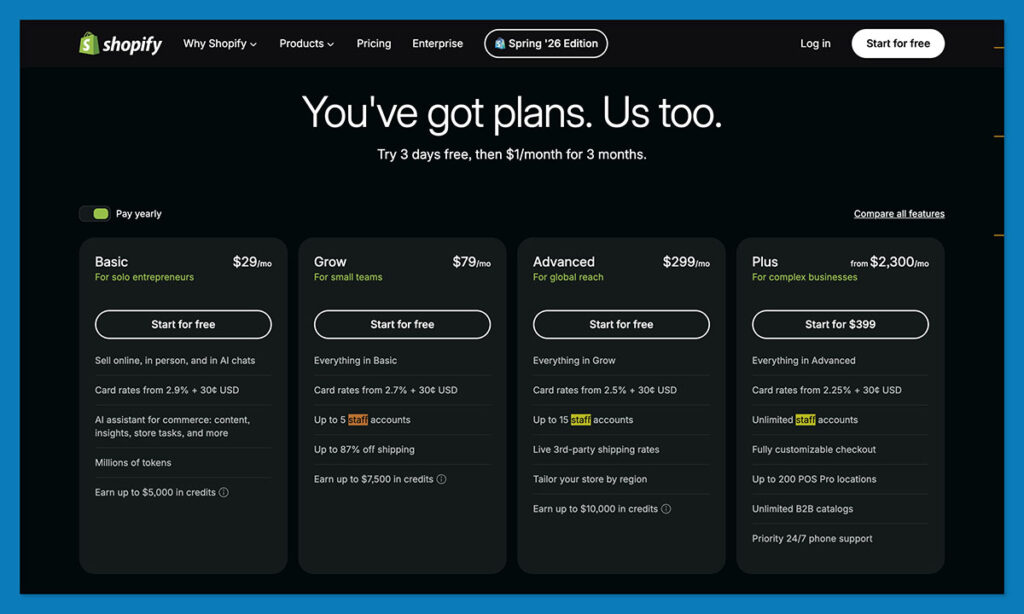
Shopify's core plans, with a 25% discount for annual billing:
- Starter: $5/month. Not a real store, just checkout links you can share on social. Worth knowing about, rarely worth choosing.
- Basic: $39/month ($29/month billed annually). A complete storefront, unlimited products, abandoned cart recovery. Card rate of 2.9% + 30c on Shopify Payments.
- Grow: $105/month ($79/month billed annually). Adds staff accounts, better reporting, and a lower 2.7% + 30c card rate.
- Advanced: $399/month ($299/month billed annually). Custom reports, carrier-calculated shipping, 15 staff accounts, and the lowest standard card rate at 2.5% + 30c.
- Plus: from $2,300/month. Enterprise territory. Ignore it unless you are doing serious volume.
Shopify offers a short free trial with no credit card required, followed by a promotional rate of $1 per month for your first three months. That is a meaningful de-risking of the decision, and ThriveCart has nothing comparable.
The fee that catches people out: if you use a third-party payment gateway instead of Shopify Payments, Shopify adds its own surcharge on top, ranging from 2% on Basic down to 0.6% on Advanced. Use Shopify Payments and that fee disappears entirely.
ThriveCart's Pricing
ThriveCart's structure is unusual, and it has changed:
- Standard: $495 one-time. This is the real deal. No monthly fee, no annual fee, no transaction fee from ThriveCart. You get the checkout builder, order bumps, upsells, downsells, A/B testing, and subscription billing.
- Pro+: $295 per year. This is the part most reviews get wrong. ThriveCart replaced its old one-time Pro upgrade with an annual subscription. Pro+ unlocks the affiliate center, advanced analytics, subscription dunning, multiple order bumps, and custom domains. It is not lifetime.
- Ultimate Bundle: $985 one-time, which packages Standard, the Learn+ course add-on, and your first year of Pro+. From year two, the $295 annual Pro+ renewal still applies.
ThriveCart charges zero transaction fees. You connect your own Stripe, PayPal, or Authorize.net account and pay only your processor's standard rate. Because the payment relationship is directly between you and your processor, you keep control of that revenue stream, which matters if you ever switch platforms.
Worth flagging: ThriveCart has no free trial. It relies on a money-back guarantee instead, but the stated window is reported inconsistently across sources. Confirm the current refund terms on ThriveCart's own checkout page before you buy, not from a review site.
The Actual Math
Shopify Basic on annual billing costs $348 per year. ThriveCart Standard is $495 once. So ThriveCart breaks even at around 17 months and is pure profit after that, which sounds decisive.
It is not, and here is why. If you need an affiliate program (and most digital sellers eventually do), you are on Pro+ at $295 per year. Now you are paying $495 up front plus $295 every year, which over three years is $1,085 versus Shopify Basic's $1,044. The gap closes almost entirely. The one-time story only holds if you stay on Standard forever.
The Winner: ThriveCart, if you can live on the Standard plan
ThriveCart Standard at $495 with no recurring fee is the best pure-cost story in this comparison, and there is no transaction fee on any plan.
But once you add Pro+ at $295 per year, the “pay once” advantage largely evaporates, and Shopify gives you a free trial plus a $1 promo period that ThriveCart cannot match.
2. Best for Selling Online: Shopify
This is where the two platforms stop being comparable, and it is the section that should decide the matter for most readers.
What Shopify Gives You

Shopify is a complete commerce operating system.
You get a browsable storefront with collections and product pages, native inventory management across multiple locations, real shipping tools with carrier-calculated rates on higher plans, a point-of-sale system for physical retail, and multichannel selling into Amazon, Etsy, Instagram, TikTok, and Google.
Every plan includes unlimited products, unlimited bandwidth, and abandoned cart recovery. Shopify also handles fraud analysis, tax calculation, gift cards, discount codes, and customer accounts natively. If you sell physical goods, this is not a nice-to-have list. It is the job.
The app ecosystem is the other half of the story. Shopify's App Store runs into the thousands of apps, which means almost any gap you find has a fix. The downside is that “there's an app for it” often means “you'll pay monthly for it.” Reviews, loyalty, advanced upsells, and subscriptions frequently become line items on your bill rather than included features.
What ThriveCart Gives You
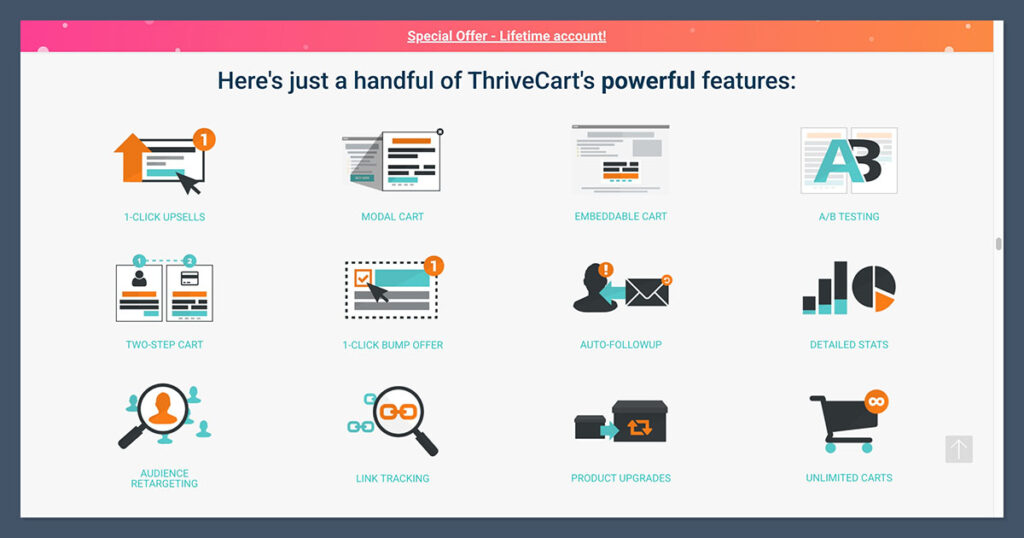
ThriveCart does not give you a store. There is no product catalog to browse, no collections, no storefront, no site builder. What you get is a checkout page (one-page, two-page, or embedded) that you point traffic at from a sales page, an email, or an ad.
Within that scope, it is excellent. ThriveCart handles one-time payments, subscriptions, split-pay, and pay-what-you-want pricing on the same product. It supports physical products with shipping weights and dimensions, and it integrates with fulfilment providers, but this is a bolt-on rather than a real fulfilment system. Nobody should run a 200-SKU apparel store on ThriveCart.
Its integration layer is where it earns its place: direct connections to Kajabi, Teachable, Thinkific, MemberPress, ActiveCampaign, ConvertKit, Mailchimp, and Drip, plus Zapier for everything else.
The Winner: Shopify, and it is not close for ecommerce
If you sell products that need a catalog, inventory, and shipping, ThriveCart is not competing. Shopify handles the entire commerce stack natively. ThriveCart is a specialist tool that assumes you already have a website and a traffic source.
3. Best Checkout and Conversion Tools: ThriveCart
Here the tables turn hard. ThriveCart was built for exactly one job, and it does that job better than Shopify does out of the box.
What ThriveCart Includes Natively
- Order bumps: the small “add this for $27” offer on the checkout page. Unlimited on Standard, with multiple bumps per checkout on Pro+.
- One-click upsells and downsells: post-purchase offers that do not require re-entering card details. This is the single highest-leverage revenue feature in the platform.
- A/B split testing on checkout pages: built in, not an app.
- Cart abandonment recovery: included.
- Flexible billing: subscriptions, split payments, buy-now-pay-later, and pay-what-you-want, all configurable on one product.
- Sales tax and VAT handling: automatic compliance and tax-inclusive pricing.
How Shopify Compares
Shopify's native checkout is fast, trusted, and converts well, and Shop Pay's one-tap checkout is a real advantage with returning customers. Shopify also markets its checkout as converting better on average than competing platforms.
But order bumps and one-click post-purchase upsells are app territory on Shopify, and those apps typically cost between $10 and $100 per month. Checkout page customisation is limited unless you are on Plus, where checkout extensibility unlocks. For a digital seller optimising a single funnel, that is a real friction cost.
The Winner: ThriveCart owns the checkout
Order bumps, one-click upsells, downsells, and split testing come standard with ThriveCart and cost extra on Shopify. If your business model is “drive traffic to one high-margin offer and maximise average order value,” ThriveCart is purpose-built for it.
4. Best for Marketing and Growth: Shopify
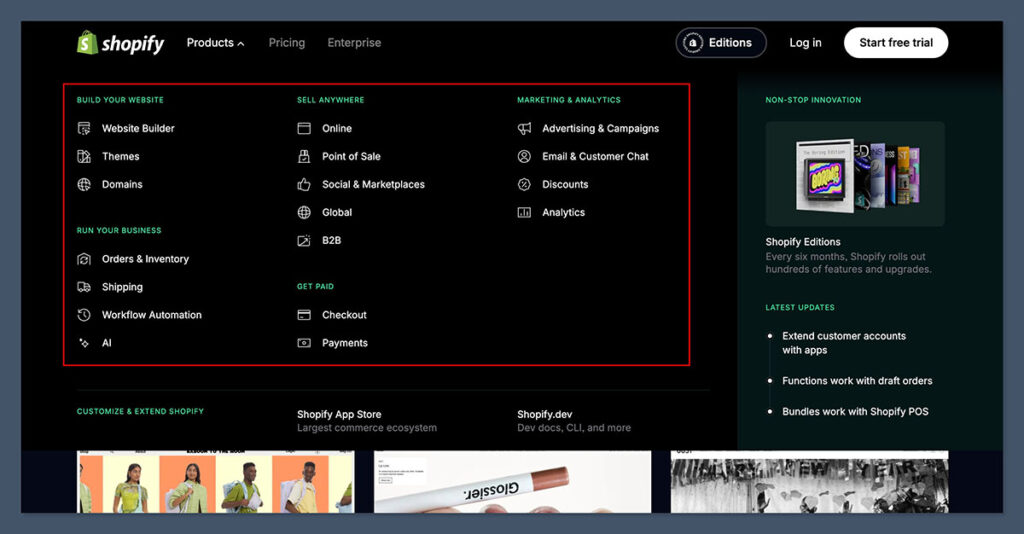
A checkout page only works if people find it. This is where Shopify's breadth pays off and ThriveCart's narrowness starts to hurt.
SEO and Content
Shopify has a native blog, editable meta titles and descriptions, image alt text, automatic sitemaps, and clean URL structures. You can build organic traffic on Shopify. Its product catalog also now syndicates into AI-driven shopping surfaces, which is quickly becoming a real acquisition channel.

ThriveCart has no SEO story at all, because it has no site. Your checkout pages are not content you rank. If organic search is part of your acquisition plan, ThriveCart cannot be your only tool, and that is by design rather than a flaw.
Sales Channels
Shopify connects to Instagram, TikTok, Facebook, Google, Amazon, Etsy, and eBay, syncing inventory across all of them. ThriveCart does not do multichannel selling, because it does not hold a catalog to sync.
Email and Automation
Shopify includes Shopify Email for basic campaigns and automations. ThriveCart does not send marketing email itself, but its behaviour rules are genuinely powerful: you can tag customers and trigger automations in your email platform based on which payment option they chose, whether they took the bump, or whether their subscription failed.
The Winner: Shopify has the acquisition engine
Shopify can bring you customers through SEO, social commerce, and marketplaces. ThriveCart can only convert traffic you already have. That is a fundamental difference in what each platform is for.
5. Easiest to Use: It Depends on the Job
Neither platform is difficult, but they demand different things from you.
Shopify
Shopify's onboarding asks a handful of questions about your business and drops you into a dashboard with a guided setup checklist. Adding products, picking a theme, and configuring payments are all straightforward. The site editor is section-based rather than free drag-and-drop, which keeps designs from breaking but also limits how far you can push a layout without touching code.
The complexity in Shopify is not the interface. It is the sprawl. Once you have a dozen apps installed, each with its own settings panel and billing, the admin gets noisy fast.
ThriveCart
ThriveCart's interface is narrower, which makes it faster to learn. Building a checkout is genuinely quick: pick a template, drag elements around, attach a bump and an upsell, connect Stripe, publish. You can have a live, converting checkout in under an hour.
The catch is everything around it. ThriveCart assumes you already have a sales page, a website, an email platform, and a delivery mechanism. Setup is easy; assembling the stack around it is not. Most ThriveCart users are running three to five other tools alongside it, and when a Zapier connection breaks, troubleshooting is on you.
The Winner: ThriveCart for building one checkout, Shopify for running a business
ThriveCart gets you live faster because it does less. Shopify has a steeper setup but replaces several tools at once. Judge this on how many moving parts you want to own.
6. Best Design and Templates: Shopify
Shopify offers a large theme library covering most retail categories, including free themes that are genuinely good enough to launch with. Premium themes are typically a one-time purchase in the $100 to $400 range, not a subscription, and every theme is responsive and customisable through the section editor.
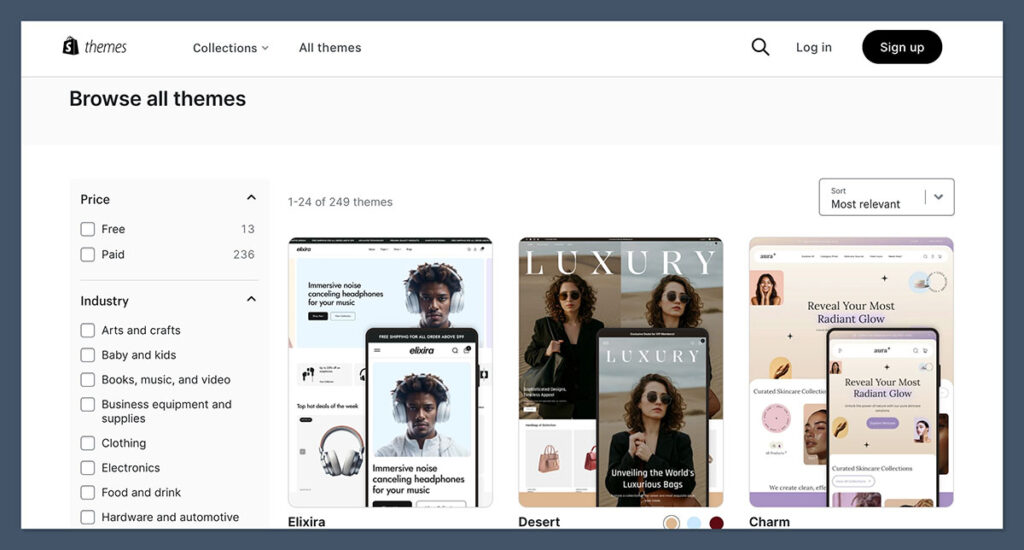
ThriveCart's templates are conversion-optimised checkout templates, not site designs. They are clean, tested, and mobile-friendly, and you can edit them without code. But they are checkout pages. Your brand's actual look and feel lives on whatever platform hosts your sales page, which ThriveCart does not provide.
The Winner: Shopify, because ThriveCart is not in this race
Shopify gives you a full storefront design system. ThriveCart gives you a well-designed checkout box. Both do their job, but only one of them is designing your brand.
7. Best for Affiliate Programs: ThriveCart
This is ThriveCart's other genuine advantage, and it is the reason a lot of Shopify merchants buy ThriveCart anyway.
ThriveCart's Pro+ tier includes a native affiliate center: affiliates get their own portal, links are tracked automatically, commissions calculate on the sale (including on upsells and bumps), and payouts run automatically through PayPal. There is also a joint-venture platform for splitting revenue with partners. For creators launching a product with an affiliate push, this is a serious tool.
On Shopify, affiliate management is a third-party app. The good ones work well but add $50 to $200 per month to your bill, and they sit outside your core checkout rather than inside it.
The trade-off is honest: ThriveCart's affiliate center sits behind Pro+, which is $295 per year. That is still cheaper than most Shopify affiliate apps, but it is not the “one-time payment” the headline promises.
The Winner: ThriveCart, comfortably
A native affiliate center with automated payouts, built into the checkout, at $295 per year is better value than any equivalent Shopify app. For creators who launch with affiliates, this alone can justify ThriveCart.
8. Best for Support and Stability: Shopify
Shopify offers 24/7 support through live chat, with escalation to human advisors, plus an extensive Help Center, a large community forum, and a huge ecosystem of agencies and freelancers who know the platform. Priority support is reserved for Plus merchants. Shopify has also removed email support, which frustrates some merchants who prefer a paper trail.
ThriveCart's support runs through a helpdesk and ticket system with documentation and a user community. It is adequate, but it is not a 24/7 operation at Shopify's scale.
The bigger consideration is stability. ThriveCart has changed ownership more than once, and long-time users describe a difficult period with downtime, unreliable Stripe connectivity, and thin support before the platform stabilised under new ownership. It has since recovered, and the product is actively developed again. But it is worth knowing, because a lifetime licence is only as good as the company behind it. That is the structural risk of any one-time-payment model, and it deserves weight in your decision.
The Winner: Shopify, on both support and platform risk
Shopify offers round-the-clock support and the deepest partner ecosystem in ecommerce. ThriveCart's support is reasonable, but its ownership history is a fair reason for caution when you are prepaying for lifetime access.
How We Compared Shopify and ThriveCart
We assessed both platforms across eight weighted categories, pulling feature and pricing data from each vendor's current public documentation and cross-checking figures against multiple independent sources.
Every price in this comparison was verified against live pricing pages rather than carried over from older reviews, which matters here because ThriveCart changed its Pro tier from a one-time upgrade to an annual subscription and many published reviews still quote the old numbers.
| Criterion | Weighting | What we assessed |
|---|---|---|
| Sales and checkout features | 30% | Checkout capability, upsells, bumps, subscriptions, split testing, cart recovery |
| Store and catalog features | 20% | Storefront, product catalog, inventory, shipping, multichannel selling |
| Value for money | 15% | Total cost of ownership over one, three, and five years, including add-ons and transaction fees |
| Marketing and SEO | 12% | Organic search capability, email tools, sales channels, affiliate management |
| Ease of use | 10% | Onboarding, editor usability, time to a live, sellable page |
| Design and templates | 5% | Template quality, customisation depth, mobile responsiveness |
| Support | 5% | Channels, availability, documentation, partner ecosystem |
| Platform stability | 3% | Ownership history, uptime record, development activity |
Shopify vs ThriveCart: Our Verdict
For anyone building an ecommerce business, Shopify is the winner. It gives you a storefront, a catalog, inventory, shipping, SEO, and multichannel selling in one place, backed by 24/7 support and the largest partner ecosystem in the industry. ThriveCart cannot do those things, and it does not try to.
But if you sell digital products, courses, or coaching, ThriveCart deserves a serious look. Its checkout is better than Shopify's out of the box, its affiliate center is excellent, and the $495 Standard licence with no recurring fee is a real cost advantage for a business that does not need a storefront.
Two things should temper the ThriveCart pitch.
First, the “lifetime” framing is only fully true on the Standard plan, because Pro+ renews at $295 per year and that is where the affiliate and advanced features live. Second, there is no free trial, so evaluating ThriveCart means paying first and relying on the refund window.
The most practical recommendation: if you are unsure which side you fall on, start with Shopify's trial and its $1 promotional period. You can validate whether you actually need a storefront for almost nothing.
If you build it out and realise your entire business is one offer, one funnel, and an affiliate program, ThriveCart will still be there, and you will know exactly why you are buying it.
Frequently Asked Questions
Can ThriveCart replace Shopify entirely?
Only if you sell a small number of digital products and do not need a browsable storefront. ThriveCart has no product catalog, no site builder, no inventory system, and no SEO capability. It is a checkout tool, not an ecommerce platform. If customers need to browse, filter, and add multiple items to a cart, you need Shopify.
Can I use Shopify and ThriveCart together?
Yes, and plenty of sellers do. A common setup is to run the main store on Shopify while using ThriveCart to sell a high-margin digital product, a course, or an affiliate-driven offer through a dedicated funnel. The two do not integrate deeply, so you will be reconciling data across both, but there is nothing stopping you running them in parallel.
Is ThriveCart's lifetime deal actually lifetime?
The Standard plan at $495 is a genuine one-time payment with no recurring fee. The Pro+ tier is not: it renews at $295 per year from year two, and it is where the affiliate center, advanced analytics, and several other features live. ThriveCart replaced its previous one-time Pro upgrade with this annual model, so older reviews quoting a one-time Pro price are out of date.
Does ThriveCart charge transaction fees?
No. ThriveCart takes no cut of your sales on any plan. You connect your own Stripe, PayPal, or Authorize.net account and pay only that processor's standard rate. Shopify also charges no platform transaction fee if you use Shopify Payments, but it adds a surcharge of between 0.6% and 2% if you use a third-party gateway instead.
Which is cheaper over three years?
On Shopify Basic with annual billing, three years costs roughly $1,044. ThriveCart Standard alone costs $495 once, so it is dramatically cheaper. But if you need Pro+ for the affiliate center, three years costs around $1,085, which is slightly more than Shopify Basic. The answer depends entirely on whether you can stay on ThriveCart's Standard plan.
Does ThriveCart have a free trial?
No. ThriveCart offers no free trial or free tier. The only way to evaluate it is to buy a plan and request a refund within the guarantee period if it does not work out. The stated refund window is reported inconsistently by third-party sites, so check the terms on ThriveCart's own checkout before purchasing. Shopify, by contrast, offers a free trial with no credit card required, followed by a $1 per month promotional rate for three months.
Can I sell physical products with ThriveCart?
Technically yes. ThriveCart lets you add shipping weight, price, and dimensions to a product, and it integrates with some fulfilment providers. But it has no real inventory management, no catalog, and no shipping rate calculation. It works for a single physical product sold through a funnel. It does not work for a store with a real product range.
Which one is better for selling online courses?
ThriveCart, in most cases. It includes a built-in course builder and handles the checkout, upsells, and affiliate program in one tool. Shopify can sell courses through third-party apps, but you are stacking subscriptions to get there. That said, if course hosting is your core business rather than a side offer, a dedicated course platform will beat both of them on the teaching experience.


Comments 0 Responses