

Quick answer: OpenCart is a free, open-source ecommerce platform with solid SEO tools, full ownership of your store, and zero monthly fees.
But it’s not for beginners — setup takes work, and you’ll likely need to buy extensions and find your own hosting. If you’re technical or have a developer, it’s an underrated powerhouse. If you’re just starting out, it’ll frustrate you.
Why I Tried OpenCart — and What You Should Know
After running ecommerce sites for more than a decade, I’ve seen platforms come and go. I’ve built stores on Shopify, WooCommerce, Magento, BigCommerce — the works.
I gave OpenCart a serious look because I wanted something lightweight, flexible, and with good SEO bones — without paying hundreds per month on apps and fees.
I didn’t need flashy drag-and-drop editors. I didn’t want to be locked into a monthly SaaS plan with limited control. What I was looking for was a no-nonsense platform that gave me raw access to the backend, clean SEO out of the gate, and room to scale without getting hammered by app fatigue or bloated code.
Why OpenCart Stood Out
Here’s what pushed me to try OpenCart:
- Free to use — completely open-source with no licensing costs
- Server-level control — I pick the host, configure the stack, and own the data
- Low overhead — perfect for cutting costs in Q4 when margins matter
- Lean SEO architecture — great structure for long-tail traffic with minimal tuning
- Active developer ecosystem — thousands of modules, themes, and integrations
Even with all that potential, I went in cautious. I knew from past experience that “free” platforms often make up for it in hidden costs or complexity.
What I Found Using It
What I found is a platform that’s extremely customisable, dirt cheap, and solid under the hood — but only if you’ve got technical skills or dev support. It’s not plug-and-play. You’ve been warned.
To paint a clearer picture, here’s how OpenCart stacks up on the things that matter right away:
| Feature | My Rating (1–10) | Notes |
|---|---|---|
| Ease of Use | 4 | Basic UI, but setup is manual |
| SEO Capability | 8 | Strong foundation, needs some extras |
| Cost to Launch | 3 | Super cheap if self-managed |
| Developer Friendliness | 9 | Clean codebase, MVC structure |
| Beginner Friendly | 2 | Not ideal unless you follow tutorials |
| Extension Ecosystem | 7 | Big library, but quality varies |
If you’re the kind of store owner who likes to fine-tune every part of your stack, OpenCart gives you the framework to build exactly what you want. But if you want your store up by lunch? You’re better off with Shopify.
The short version: OpenCart gives you power and freedom — if you’re willing to earn it.
What Is OpenCart?
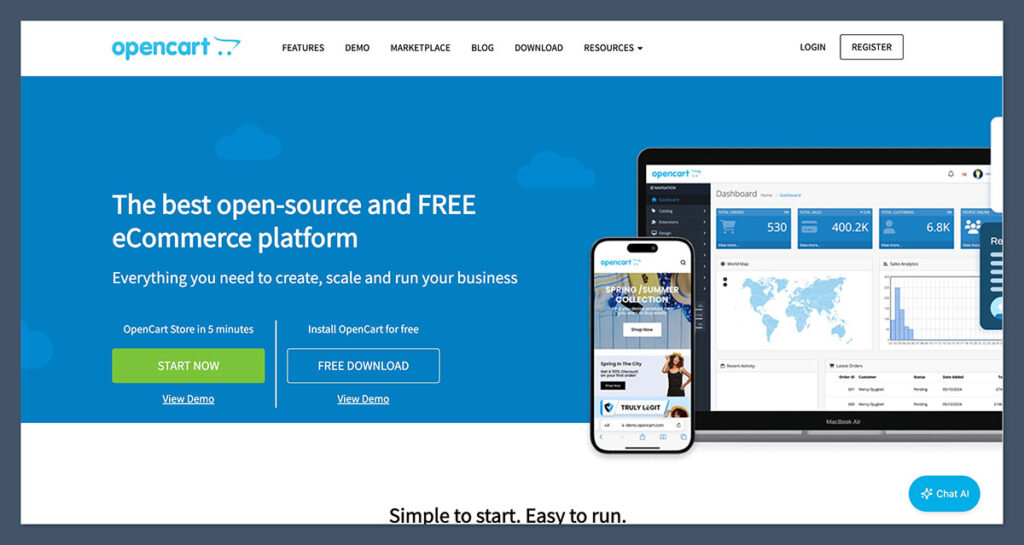
OpenCart is a free, open-source ecommerce platform written in PHP. That means you download the software, install it on your own server, and get full control.
It’s similar to WooCommerce in that sense — but with one big difference: OpenCart isn’t tied to WordPress. It’s a standalone platform built purely for ecommerce, with no CMS baggage and no bloated plugins trying to do 12 things at once.
That makes it faster, more focused, and arguably leaner than a lot of “do-it-all” platforms.
How It Works in Plain English
You’re basically downloading the engine of your online store — not the full car. You’ll need to pick your tires (hosting), steering wheel (theme), and upgrades (extensions). Once you’ve got it installed, you’re in the driver’s seat.
Here’s what that really means for your store:
- No monthly subscription
You’re not paying $30–$400/month like you would with Shopify or BigCommerce. Just cover:- Hosting ($5–$30/month)
- Domain ($10–$15/year)
- Optional extensions (like SEO tools, payment methods)
- You’re in charge
No platform lock-in, no forced updates, no limits on how many products or staff accounts you have. - Flexible hosting
You can run OpenCart on almost anything:- Shared hosting (like SiteGround or Namecheap)
- VPS (DigitalOcean, Cloudways)
- Dedicated servers or even locally while testing
- Decent SEO out of the box
Comes with:- Clean URL structure
- Editable meta titles and descriptions
- Auto-generated sitemaps
- Canonical tags to avoid duplicate content
Pros and Cons at a Glance
| Pros | Cons |
|---|---|
| 100% free and open-source | No official support (unless paid) |
| Great foundation for SEO | Manual setup + server knowledge |
| Full store ownership and control | Limited modern templates by default |
| Huge extension marketplace | Quality varies across developers |
The catch? You’ve got to do everything yourself or pay someone to do it. There’s no hand-holding. No AI builder. No step-by-step wizard that magically makes things look polished. It’s old school — but that’s not always a bad thing.
If you want raw power and control over your ecommerce stack without recurring fees, OpenCart gives you that — but it’s not plug-and-play.
What I Like About OpenCart
OpenCart has a lot going for it if you’re after flexibility, control, and SEO-friendliness. It’s the kind of platform that rewards you the more you’re willing to dig into it.
1. Zero Monthly Fees
This is the biggest reason I gave it a go. You can realistically run a fully functioning ecommerce store for $10–$30/month. That’s not even one week of Shopify Basic, and you’re not paying recurring app fees on top.
Here’s a breakdown of typical OpenCart costs:
| Item | Monthly Cost (USD) |
|---|---|
| Hosting | $5–$20 (shared or VPS) |
| Domain | $10–$15/year |
| SSL Certificate | Often free (Let’s Encrypt) |
| Optional Extensions | Varies, mostly one-time |
This is where OpenCart shines — low cost, high control. You pay once for what you need, and there’s no surprise billing next month.
2. Decent SEO Tools Built In
OpenCart’s out-of-the-box SEO is better than most people give it credit for. It’s not perfect — but it gives you a clean foundation to work with.
You can easily:
- Set custom meta titles and descriptions
- Use SEO-friendly URLs (via
.htaccess) - Add rel=canonical tags to prevent duplicate content
- Generate Google XML sitemaps
- Install SEO extensions to expand into schema, breadcrumbs, and OpenGraph
Here’s what I normally add right away:
- SEO Mega Pack (covers rich snippets, social cards)
- Canonical Fix module (to avoid duplicate URLs)
One-time cost for decent SEO coverage? Around $30–$50 — not bad for what it delivers long-term.
3. You Own the Store
No SaaS platform means no lock-in. With OpenCart, you own everything — code, content, data, and performance.
That also means you can:
- Run daily or weekly backups (and restore fast if anything breaks)
- Move your store to any host without restrictions
- Boost performance using server-level caching, CDNs, and lightweight themes
If you’re thinking long term — or you’ve had to migrate from a platform that closed down or jacked up pricing — this kind of control is a major win.
4. Extension Marketplace
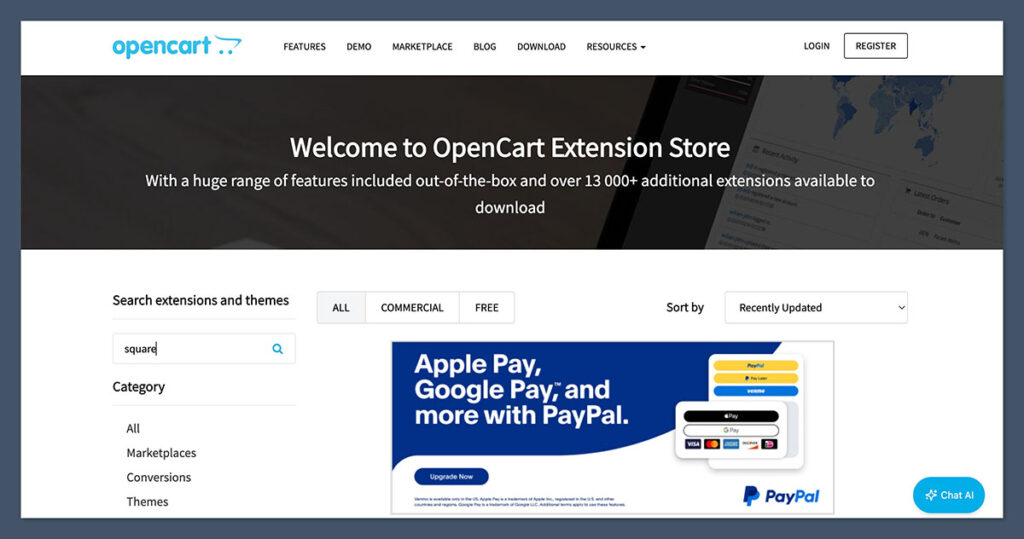
There are over 13,000 extensions in the OpenCart marketplace. To be fair, not all of them are good. But once you learn which developers are solid, you’ll find reliable tools for everything from shipping to UX tweaks.
Here are a few extensions I always look for:
- Journal Theme – a premium all-in-one theme with drag-and-drop layouts, built-in modules, and performance optimisation
- SEO Mega Pack – handles structured data, Twitter cards, Facebook OpenGraph
- Advanced Shipping Pro – custom shipping rates by zone, weight, or product
- Quick Checkout Solutions – one-page, mobile-optimised checkout plugins
I treat OpenCart like Lego — it’s up to you to choose the right blocks. But once you do, it’s surprisingly capable.
What I Don’t Like About OpenCart
This platform isn’t for the faint of heart. It’s got serious limitations if you’re not a dev — or at least comfortable working with server files, FTP, and debugging errors.
1. Tough Setup for Non-Technical Users
Unlike Shopify or Wix, OpenCart doesn’t walk you through anything. You’ll need to:
- Upload the files via FTP or a control panel
- Set up a MySQL database manually
- Tweak
.htaccessfor URL rewrites - Adjust
config.phpfiles for your environment - Secure your admin directory
It’s not rocket science — but it’s also not beginner-friendly. If you’ve never touched cPanel or edited PHP, you’ll struggle.
2. Support Is Bare-Bones
OpenCart’s support options are minimal unless you’re willing to pay. Here’s what you get:
- A community forum — active but hit or miss for real answers
- Paid support directly from OpenCart — starting at $99 per incident
- Some extension developers offer support for their modules (quality varies)
There’s no live chat, no dedicated ticket system, and definitely no onboarding team. If something breaks, you’re either:
- Googling for hours
- Posting on Stack Overflow
- Hiring a freelance dev to fix it
3. Extensions Can Get Pricey
Yes, OpenCart is free — but many of the best extensions aren’t. The free ones often lack updates or documentation, so most serious stores end up buying the premium versions.
Here’s a quick price snapshot:
| Extension Type | Price Range (USD) |
|---|---|
| SEO extensions | $30–$70 |
| Shipping/payment modules | $20–$50 |
| Themes (e.g. Journal) | $60–$100+ |
| Multi-store, language packs | $50–$150 |
You’re still paying way less than Shopify long term — but don’t assume OpenCart is zero-cost. It’s more of a “build-your-own-stack” cost model.
OpenCart vs Shopify vs WooCommerce: How It Really Compares
Here’s the real deal — if you’re choosing between OpenCart, Shopify, or WooCommerce, you need to ask yourself what matters more: control or convenience?

Each of these platforms serves a different type of store owner. I’ve used all three over the past decade, and the differences come down to cost, technical ability, and how much you want to customise your store vs just getting sales rolling fast.
Here’s how they stack up:
| Feature | OpenCart | Shopify | WooCommerce |
|---|---|---|---|
| Cost (12 months) | ~$120–$400 | $348–$3,588 | ~$150–$600 |
| SEO control | High (manual) | Medium (app-based) | High (with plugins) |
| Ease of use | Low | Very High | Medium |
| Hosting included | No | Yes | No |
| App/plugin quality | Hit or miss | Very high | High |
| Performance | Depends on host | Optimised out of box | Depends on host |
| Ideal for | Dev teams / pros | Anyone | WordPress users |
When OpenCart Wins
- You want low overhead: No recurring SaaS fees. You only pay for what you use.
- You’re technical (or have someone who is): Full backend control, freedom to customise.
- You care about SEO: Built-in flexibility for URLs, meta data, and page structure.
When Shopify Wins
- You want to move fast: Store setup takes minutes. No hosting headaches.
- You don’t want to mess with code: Everything is visual and streamlined.
- You’ve got budget: You’ll pay more, but you get polish and premium support.
When WooCommerce Wins
- You’re already using WordPress: WooCommerce plugs right in and feels native.
- You want to blog + sell: Great for content-first stores (courses, digital products).
- You want a balance of control and usability: You still need hosting and plugins, but it’s easier than OpenCart.
Key Considerations
- Hosting matters for both OpenCart and WooCommerce. Go cheap, and your site will crawl. Shopify handles that side for you — and it shows in performance.
- OpenCart’s extensions take more vetting. Shopify apps are curated and consistent. WooCommerce plugins fall somewhere in the middle.
- All three can scale, but OpenCart and WooCommerce require server tuning once traffic picks up. Shopify handles that behind the scenes — with a price tag.
My take?
If you value SEO and control, and don’t mind getting your hands dirty — OpenCart punches above its weight. It’s the best budget platform for people who know what they’re doing.
For ease, speed, and support? Shopify still wins — especially if your goal is to sell fast without worrying about the backend.
SEO with OpenCart: Real Talk
I’ve tested OpenCart stores head-to-head against WooCommerce and Shopify for SEO performance — and surprisingly, OpenCart held its own in key areas.
It’s got a clean structure, it’s fast when properly configured, and it doesn’t shove everything behind a paywall or require bloated apps to manage core SEO settings.
That said, it’s not foolproof out of the box. You still need to know what to tweak and which modules to install.
The Good: Where OpenCart Delivers on SEO
OpenCart has some strong fundamentals. It’s not a flashy all-in-one SEO suite, but it gives you the flexibility to build one with the right tools.
Here’s what’s built in or easy to enable:
- Canonical URLs baked in
Helps avoid duplicate content issues across product variants and filtered pages. - Sitemap generator included
XML sitemaps are easy to configure and submit to Google Search Console. - SEO fields on every product, category, and CMS page
Meta titles, descriptions, and keywords can be edited directly in the admin panel. - Fast load times if you optimise caching
When paired with LiteSpeed, Redis, or Cloudflare, OpenCart can run faster than most WordPress setups — especially on mobile.
This kind of flexibility is what makes OpenCart stand out for SEO — you’re not boxed in by app limitations like you are on Shopify.
The Gotchas: Where You’ll Hit a Wall
OpenCart is strong, but there are weak spots that need attention — especially if you care about technical SEO and structured data.
Some of the common issues I’ve seen include:
- Duplicate content
OpenCart doesn’t automatically handle URL rewrites or canonical logic for filters, categories, or pagination. You’ll need a module to sort that out. - No rich snippets or schema without paid modules
You won’t get structured data for products, reviews, FAQs, or breadcrumbs without third-party tools. These are essential for CTR in search results. - Some themes (especially free ones) are poorly coded for SEO
Many free themes lack semantic markup, have bloated JavaScript, or miss basic accessibility standards. That can hurt rankings long-term.
If you’re using OpenCart for SEO, it’s not a plug-and-play setup. But with a few tools, you can get it humming.
My SEO Stack for OpenCart
To make OpenCart SEO-ready for serious rankings, here’s the stack I use on every store:
| Tool/Module | Purpose | Cost |
|---|---|---|
| Journal Theme | Clean, fast, responsive theme with SEO markup | ~$89 |
| SEO Mega Pack | Adds schema, OpenGraph, structured data | ~$49 |
| LiteSpeed Cache + CDN | Speeds up load time (LiteSpeed or Cloudflare) | Free–$20/mo |
| SEOPack | Central control panel for on-page SEO settings | $49 one-time |
This combo gives me everything I need — from canonical URL control to fast page loads and rich results in search. The total cost is still lower than a single month on Shopify Advanced.
Bottom line?
If you put in the effort, OpenCart is a strong SEO contender — especially for technical users or stores with a long-term content strategy. You just have to bring your own stack.
Can OpenCart Scale?
Yes — but only if your server can handle it.
OpenCart isn’t a hosted solution like Shopify. That means scaling isn’t just a matter of upgrading your plan — it depends entirely on your hosting stack, how well you optimise the site, and what extensions you’re running.
I’ve scaled OpenCart stores to over 5,000 products on a mid-tier VPS with no major issues. Load times stayed sharp, admin functions were stable, and customer-side performance held up under moderate traffic. But that didn’t happen by accident — it took some proper setup and tuning.
What You’ll Need to Scale OpenCart
If you want to run a large store, you’ll need to build a solid foundation. Here’s what I recommend:
- VPS Hosting (or better)
Shared hosting won’t cut it at scale. Use DigitalOcean, Cloudways, Vultr, or a managed VPS from a provider like KnownHost. Aim for 2–4GB RAM minimum and SSD storage. - Redis or Memcached
Helps reduce database calls and keeps your store responsive under load. Redis is easy to integrate with OpenCart using a module. - Cloudflare or BunnyCDN
A CDN speeds up content delivery worldwide and cuts server load. Cloudflare’s free plan is fine for most stores; BunnyCDN is faster and very affordable. - Extension Audit
Some OpenCart extensions are bloated or poorly coded. Too many active modules can slow down your store dramatically — especially on the admin side.
Here’s a basic setup you should aim for once your product count goes above 1,000:
| Component | Recommended Tool/Service | Notes |
|---|---|---|
| Hosting | Cloudways (Vultr HF) | Scalable, good performance |
| Caching Layer | Redis + LiteSpeed/OpenLiteSpeed | Reduces server-side bottlenecks |
| CDN | Cloudflare or BunnyCDN | Speeds up global delivery |
| Theme | Journal or custom lightweight | Avoid heavy, unoptimised themes |
| Product Limit Tested | 5,000+ | Stable with proper configuration |
What Happens If You Don’t Optimise?
If you try to scale OpenCart with cheap shared hosting, poor extensions, or no caching, here’s what’ll happen:
- Slow page loads (especially on category and search pages)
- Admin panel lag — sometimes 5–10 seconds per action
- Increased risk of site crashes during traffic spikes
- Poor Google Core Web Vitals scores (which hurt rankings)
OpenCart doesn’t babysit you. It gives you the freedom to scale — but you’re responsible for the horsepower.
My verdict?
OpenCart can absolutely scale to thousands of products and high-traffic conditions. But you need to treat it like a self-hosted platform, not a plug-and-play website builder. Build your stack properly, and it’ll hold its own with the big platforms.
Final Verdict: Should You Use OpenCart?
Here’s the truth: OpenCart isn’t for everyone. It’s not trying to be. It’s a flexible, open-source ecommerce platform that gives you full control, low overhead, and solid SEO potential — but it doesn’t come with training wheels.
If you’re looking for a clean UI, instant themes, and drag-and-drop editing, OpenCart will frustrate you. But if you’re looking to build a customised ecommerce setup without bleeding cash on monthly subscriptions, it’s one of the most underrated platforms out there.
Use OpenCart If You:
You’ll thrive with OpenCart if you’re technical — or if you’ve got a developer on standby. It’s designed for users who want to build their store their way, even if it takes more setup time.
- Know your way around hosting and PHP
You don’t need to be a full-stack dev, but you should know how to install scripts, configure servers, and fix errors. - Want full control without monthly fees
No platform commissions, app subscriptions, or sales limits. You only pay for what you choose to use. - Plan to invest in solid extensions
Good themes, SEO modules, and shipping tools aren’t free. But they’re usually one-time purchases — not recurring. - Prioritise SEO and custom workflows
If you want total control over how your store ranks and how your funnel works, OpenCart gives you the tools to shape that experience.
Avoid OpenCart If You:
OpenCart isn’t for everyone — and knowing when not to use it can save you time and money.
- Want plug-and-play simplicity
Platforms like Shopify, Wix, or Squarespace let you start selling fast with minimal setup. OpenCart won’t. - Don’t have dev support
If you don’t know how to fix things when they break (or don’t want to learn), you’ll hit walls quickly. - Prefer all-in-one solutions
OpenCart isn’t an ecosystem. There’s no “built-in everything” experience — you’ll source extensions, payment gateways, themes, and hosting separately. - Care more about design than flexibility
OpenCart’s out-of-the-box themes are underwhelming. Without a good template or custom build, your store will look generic.
Summary Table
| Scenario | Is OpenCart a Good Fit? |
|---|---|
| You want full backend control | Yes |
| You need to launch in 1 day | No |
| You’re building on a budget | Yes |
| You rely on design templates | No (without a premium theme) |
| You prioritise technical SEO | Yes |
Bottom line?
OpenCart won’t hold your hand — but if you know what you’re doing, it’s a lean, mean ecommerce machine.
It’s not as polished as Shopify or WooCommerce, but it’s a platform built for flexibility and freedom. Just be ready to roll up your sleeves.


Did a survey of all e-commerce packages to meet our specific needs, eg custom fields to collect buyers Bank account details. Open cart was the only one flexible enough to deliver. I’m not a developer although I can hack a bit of VBA. Two years ago I set up the website myself fairly quickly and easily (with just needing a $20 plug in) although some of the reports were very fiddly, eg getting an email of each purchase sent to us in addition to the user. It did fall over a month ago. Apparently and paid a developer in Indian a couple of hundred dollars to fix and tidy up my efforts. Totally recommend even to those without extensive IT knowledge but who need more unusual e-commerce sites.
Thank you Opencart
Thanks for sharing Gary!
opencart is new platform for ecommerce solutions . your article gives helpful info. Thanks for sharing
You’re welcome Ashwini!
Does not work as a shopping cart “out of the box.” Basic default processes do not work. This is even if you do not want to make design changes. The default options do not always work and the “community forum” does not like it when asking about how to get the default program working. I don’t want a fancy site, just something that works and OC is not one of them.
I would advise you to give OpenCart another try in a demo shop, probably on your PC with MAMP, XAMP. I am using the latest version (3.0.3.2) and I have little to no issues, , it’s very flexible and I have gotten plenty of support from the Forum. As the post suggests, you may need little PHP knowledge and if you intend to redesign stuff, most definitely need CSS.
I have made so many advanced changes to my store with the help of the Forum, Personal Troubleshooting and reading up on the topic.
Honestly, since I have made this install, I have only seen a few bugs and with a single Google Search I found a solution on Github or the forum. Most times, certain errors are caused by installing Extensions that are not coded properly, therefore, I always test on my localhost server, check for errors then take a snapshot of my live server, then install the extension and check for errors. I also completely utilize the support of any extension I purchase until I am satisfied that things are OK, and I have no errors.
With regards to what Ernie said, he sticks with the older version as it is more stable therefore when using a new version of any solution you can expect little glitches, etc.
Regards,
Sean
I agree. I got a demoversion of Opencart v3 installed on my PC using XAMPP and I use it for webdesign work and bug checking. It works like a dream!
Looking for an Onlineshop Solution, I started up, using OpenCart (v.1.5.6.4+) 5+ Years ago, mainly because of the giant amount of free Knowledge and Extensions. Many new OpenCart Versions have been released since, but I decided to stay with the Version chosen, because it offers most free Extensions, and it’s still the most secure, simple, powerful, and easy to handle OC Software, compared with everything else, released by Opencart since.
But not only the OC Code, but also the ‘global OC Climate’ changed very much, during all those Years, and as a grave consequence of that, many of the former Contributors are no longer part of the OC Scene. This Drain of Knowledge and Goodwill seems to have slowed down OC Development in general, and OC Newcomers today find themselfs confronted with outdated and misleading Install + Upgrade Information, leading to many problems and broken Shops.
In addition, the OC User Forum is no longer a place, to find real help and free Support, it’s now more a Place to exchange arguments, since most everybody is now more a natural enemy of everybody else, and most are just waiting, to hopefully generate some income out of Newbies, unable to make their new OC Software Versions work as planned.
Lucky me, to stay with OpenCart v.1.5.6.5(_rc), because for that Version, no Forum Support will be required, since everything on Code and Knowledge already exists. It enabled me, to create my own Solution, without requiring assistance, and I’m sure, that it will be working and secure, until OpenCart one day possibly find the way back to it’s root again, instead of trying, to redesign the Wheel, with every new Release again. Or then, it will eventually fail, like so many Projects before, in the history of the Internet.
Sucks. Very difficult to customize, Bugs almost in every extension and module. Vague, confusing and not clear solutions for all those bugs in forums and docs.