

Tapstitch and Printify are two print-on-demand platforms with very different approaches to helping you build a product business. We’ve spent considerable time testing both to give you a clear, honest recommendation.
As a result of our testing, Printify is the stronger choice for most sellers who want scale and flexibility. But Tapstitch earns its place for a specific kind of brand builder.
Tapstitch vs Printify: Quick Verdict
- Printify – Best overall for volume, variety, and multi-channel selling
- Tapstitch – Best for fashion-first clothing brands that want curated blanks and consistent branding
In this review, I’ll break down exactly why Printify takes the overall win while explaining the real cases where Tapstitch is the smarter pick. I’ll compare both platforms on pricing, product quality, integrations, fulfillment, and more.
Quick Comparison: Tapstitch vs Printify
| Category | Tapstitch | Printify | Winner |
|---|---|---|---|
| Pricing & Plans | No subscription; higher per-item costs | Free plan + Premium from $24.99/mo | Printify |
| Product Range | Curated apparel only | Thousands of SKUs across all categories | Printify |
| Print Quality | Consistent; in-house production | Variable; provider-dependent | Tie |
| Integrations | Shopify, Etsy, Wix | Shopify, Etsy, WooCommerce, Wix, TikTok Shop, eBay, and more | Printify |
| Branding Options | Neck labels, multi-zone print, branded packaging | Varies by print provider | Tapstitch |
| Fulfillment | In-house; 2–4 business days | 90+ global providers; localized routing | Printify |
| Ease of Use | Streamlined, focused interface | More complex; more options to manage | Tapstitch |
| Scalability | Small–mid brands; curated drops | Built for high-volume, multi-channel scale | Printify |
1. Best for Pricing: Printify
Tapstitch keeps things simple on the subscription side: there are no monthly fees at all. You pay only for production and shipping per order. That’s an appealing model if you’re early-stage and want to avoid fixed costs, but it comes with a trade-off – base product and shipping costs run higher than Printify’s network average.
Printify offers three tiers. The free plan covers up to five stores and costs nothing, which is a generous starting point.
The Premium plan costs $24.99 per month on an annual basis ($299/year) or $39 per month month-to-month, and unlocks up to 10 stores plus product discounts of up to 20–33% depending on the product.
Enterprise pricing is available for high-volume operations and comes with additional discounts negotiated directly.

Note: Printify updated its Premium pricing in February 2026. If you’ve seen older pricing cited elsewhere, the figures above reflect the current rates.
The real-world margin picture favors Printify at scale. Once you’re doing meaningful monthly volume, the Premium discount more than offsets the subscription cost, and Printify’s lower base prices across its supplier network generally produce better margins than Tapstitch’s per-item costs – particularly on shipping.
Tapstitch makes more sense if you’re selling at a premium price point where the higher base cost is absorbed by your retail margin strategy.
The Winner
Printify wins on pricing for most sellers. Its free plan removes the barrier to entry, and Premium pays for itself quickly at moderate volumes. Tapstitch’s no-subscription model is a fair alternative for smaller, premium-priced brands.
2. Best for Products: Printify (with a caveat for apparel brands)
This is where the two platforms diverge most sharply, and it’s worth being precise about what “best” means depending on what you sell.
Printify’s catalog spans thousands of SKUs: apparel, mugs, wall art, home and living items, accessories, and far more. If you want to test products across multiple niches without switching platforms, Printify is the only choice here. You pick from 90+ print providers globally, filtering by print method, region, price, and performance ratings.

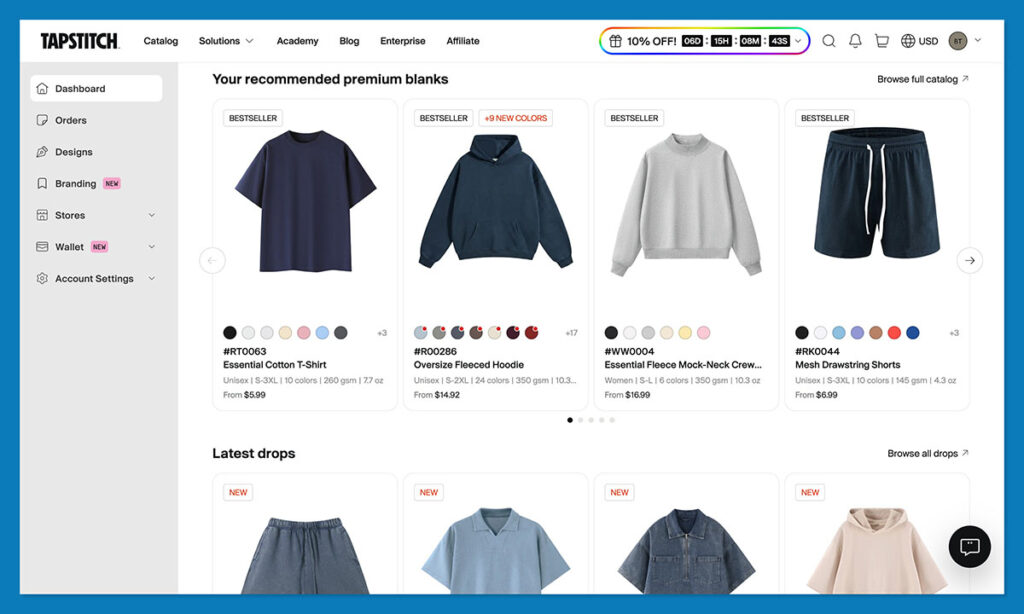
Tapstitch takes the opposite approach. Its catalog is deliberately narrow – tees, hoodies, sweatshirts, joggers, and similar apparel – but the garments are curated for quality.
The pitch is fashion-first blanks: better cuts, eco-conscious materials, multi-zone print capability, and a consistent production standard from a single in-house facility. If you’re building a clothing brand rather than a general merch store, that curation matters.
On quality consistency, Tapstitch has a structural advantage. Because it produces everything in-house, you know what you’re getting across every order.
With Printify, quality is genuinely variable – excellent providers exist on the network, but so do weaker ones. The platform pushes provider rankings and sampling as tools to manage this, and that works, but it requires more active management on your part.
Trustpilot scores reflect this nuance: Printify sits around 4.6 and Tapstitch around 4.3. Both are positive, but community feedback suggests Tapstitch delivers consistent results for what it specializes in, while Printify’s experience depends heavily on provider selection.
The Winner
Printify wins on breadth. For sellers who want variety, testing, or products beyond clothing, there’s no contest. Tapstitch earns the win within apparel specifically – if a focused, fashion-quality catalog is what you need, it’s the stronger option there.
3. Best for Integrations: Printify
Tapstitch connects natively with Shopify, Etsy, and Wix. For a focused clothing brand operating on one or two of those platforms, that’s workable. The Shopify app functions reliably and covers the basics of syncing products and routing orders. What Tapstitch doesn’t offer is depth beyond that – no native WooCommerce, no eBay, no TikTok Shop integration, and no open API for custom workflows.
Printify’s integration list is substantially longer: Shopify, Etsy, WooCommerce, Wix, Squarespace, PrestaShop, eBay, TikTok Shop, and others, plus API access for custom setups.

If you want to sell across multiple marketplaces simultaneously, push products to different stores in different regions, or automate publishing at scale, Printify is built for that and Tapstitch is not.
The Winner
Printify wins outright. Its multi-channel integration list covers every major selling surface, and the API opens up custom scalability. Tapstitch’s three integrations cover most new brands’ needs, but limit you as you grow.
4. Best for Branding: Tapstitch
Branding is the one area where Tapstitch makes a clear, consistent case. The platform markets branded packaging, neck labels, and multi-zone print placement as standard features, not add-ons.
If you want every garment to feel like it came from a real clothing label, not a generic POD drop, Tapstitch’s in-house model makes that easier to deliver consistently.
Printify offers branding options too, but the experience is uneven. Neck labels, custom inserts, and branded packaging are available on select products through select providers – you need to search for providers that support the specific branding features you want, and not all SKUs will qualify. It’s achievable, but requires more research and setup than Tapstitch’s more uniform offering.
The Winner
Tapstitch wins on branding. For sellers building a clothing brand identity, the consistent branded packaging and label options are a meaningful differentiator. Printify can get you there, but it takes more work to configure.
5. Best for Fulfillment and Shipping: Printify
Tapstitch fulfills everything in-house, with a standard production window of 2–4 business days. That’s a solid baseline, and having a single production facility means fewer surprises in terms of print quality or packaging. Community feedback describes shipping speed as reasonable, though not a standout advantage.
Printify’s global network of 90+ providers is its main fulfillment strength. Because you can select providers based on proximity to your customer base, US-only providers for domestic orders, EU-based providers for European customers, you can reduce both shipping time and cost by routing orders intelligently.
Every order includes tracking, and the provider selection tools give you meaningful control over how fulfillment performs in practice.
The Winner
Printify wins on fulfillment flexibility. The ability to route orders to geographically appropriate providers gives it a structural shipping advantage, particularly for sellers with an international customer base.
6. Best for Ease of Use: Tapstitch
Tapstitch’s narrow focus makes it genuinely easier to navigate. There are fewer decisions to make: the catalog is curated, the production process is standardized, and the setup path from product creation to store sync is straightforward. For a brand owner who wants to spend time on design and marketing rather than managing supplier relationships, that simplicity has real value.
Printify is more powerful but more complex. Choosing from 90+ print providers, comparing specs and pricing, sampling products before scaling, and managing multiple store connections all add friction. None of it is unusable, but the learning curve is steeper – especially for sellers new to POD who don’t yet know what to look for in a print provider.
The Winner
Tapstitch wins on ease of use. Its focused scope means less to learn and less to manage, which is a genuine advantage for clothing-focused brands that don’t need the full complexity Printify offers.
How We Tested Tapstitch and Printify
Our Testing Methodology
Our comparison is based on hands-on platform testing, product sampling, and review of community feedback from active POD sellers. We evaluated both platforms across six weighted criteria:
- Pricing and margins – base costs, subscription value, real-world profitability
- Product range and quality – catalog breadth, blank quality, print consistency
- Integrations – channel coverage, multi-store support, API access
- Branding options – neck labels, custom packaging, print zones
- Fulfillment and shipping – production times, global routing, tracking
- Ease of use – onboarding, product creation, order management
We also reviewed Trustpilot ratings, Reddit community threads, and both platforms’ own documentation to cross-reference claims and surface any gaps between marketing and reality.
Tapstitch vs Printify: Our Overall Winner
For most print-on-demand sellers, Printify is the stronger platform. Its catalog breadth, multi-channel integrations, global fulfillment network, and margin-friendly pricing at scale make it the more versatile and scalable choice. Whether you’re testing new product niches, selling across multiple marketplaces, or building toward high-volume operations, Printify is built for that kind of growth.
Tapstitch is the right call for a specific type of seller: someone building a fashion-forward clothing brand who wants consistent quality from a single production partner, built-in branding features, and a simpler operational model. It’s not trying to compete with Printify on catalog or scale, and it doesn’t need to – its positioning is narrower and more deliberate.
If you’re not sure which fits your business, both platforms allow you to sign up and test without a significant upfront commitment. Tapstitch has no subscription to start, and Printify’s free plan covers up to five stores. Test with samples before you scale on either.
Tapstitch vs Printify: FAQs
Is Tapstitch better than Printify for clothing brands?
For fashion-focused clothing brands that want premium blanks, consistent branding, and in-house production quality, Tapstitch is the stronger fit. It’s built specifically for apparel and prioritizes garment quality over catalog breadth. Printify is the better choice if you want flexibility, lower base costs, or products beyond clothing.
Does Tapstitch have a monthly fee?
No. Tapstitch charges no subscription fee. You pay only for production and shipping on each order. Printify offers a free plan and a Premium tier starting at $24.99 per month on an annual basis, which unlocks product discounts of up to 20–33%.
Can I use Printify with TikTok Shop?
Yes. Printify has a native integration with TikTok Shop, alongside Shopify, Etsy, WooCommerce, eBay, Wix, Squarespace, and others. Tapstitch does not have a direct TikTok Shop integration.
How does print quality compare between Tapstitch and Printify?
Tapstitch produces everything in-house, which means print quality is standardized across all orders. Printify’s quality varies depending on which print provider you select for each product. Printify provides provider ratings and encourages sampling as a way to manage quality, but it requires more active oversight than Tapstitch’s single-facility model.
Which platform is better for beginners?
Tapstitch is easier to start with thanks to its focused catalog and simpler setup. Printify has more options, which means more decisions to make upfront, but its free plan and wide provider network make it a strong choice for beginners who want to test multiple product types without committing to a subscription.


Comments 0 Responses