

Overall, I’d definitely pick Shopify if you’re looking for a comprehensive ecommerce platform. While Hostinger has some basic ecommerce features, Shopify is a far more comprehensive solution, with more advanced inventory management tools, an integrated payment processor, and stronger reporting features.
Hostinger definitely shines in terms of simplicity if you’re looking for a basic website builder, however, with a variety of templates to choose from, and a drag-and-drop editor.
Quick Verdict
- I recommend Shopify for: Anyone in search of a flexible, scalable, and easy-to-use platform for omnichannel commerce.
- I recommend Hostinger for: Smaller businesses with fewer products to sell, and a need for simple website creation tools.
Shopify vs Hostinger: Pros and Cons
While Hostinger and Shopify have some similar features (as I’ll cover below), they appeal to different potential customers.
Shopify is designed to be a comprehensive ecommerce solution, which means it has more advanced sales tools. Hostinger is primarily a website builder, with some basic ecommerce features, and an easy-to-use interface.
Shopify Pros and Cons
Pros 👍
- Comprehensive omnichannel sales tools
- Powerful fulfillment and shipping solutions
- Built-in tools for abandoned cart recovery and gift cards
- Integrated point of sale capabilities
- User friendly interface with great responsive themes
- In-depth reporting and analytical tools
Cons 👎
- Slightly higher cost
- Transaction fees for third-party payment processors
Hostinger Pros and Cons
Pros 👍
- Affordable web hosting solutions
- Easy-to-use drag-and-drop website builder
- Excellent server performance with uptime guarantee
- Robust security features
- Supports a range of payment processing options
- Some SEO capabilities
Cons 👎
- Limited ecommerce features
- Fewer theme customization options
- Minimal integrations and apps
What the Two Platforms Do Best
As I mentioned above, Hostinger and Shopify are ultimately very different tools. Where Shopify is specially designed for ecommerce, Hostinger started life as a website hosting provider, and expanded to include some ecommerce capabilities.
Although you can sell products with Hostinger, you won’t have as many comprehensive tools as you get with Shopify.
What Shopify Does Best:
- Omnichannel selling: As well as allowing users to sell through their own websites, Shopify supports marketplaces and social media platforms, as well as in-store selling with its own POS solution. It even offers warehousing and fulfillment services.
- Advanced ecommerce: Shopify offers a range of ecommerce tools you won’t get from Hostinger, from gift cards and discount codes to a fulfillment network, and support for email marketing and abandoned cart recovery.
- Customization: Although there are some parts of your Shopify website you won’t be able to customize extensively (such as the checkout page), the themes are a lot more flexible, and you get more control over page design than you would with Hostinger.
What Hostinger Does Best:
- Simplicity: Hostinger ensures anyone has the tools they need to build a website or store, regardless of their design knowledge. The drag-and-drop website builder and simple themes are excellent for beginners with no coding experience.
- Affordability: Hostinger’s plans are more affordable than those available from Shopify, and you can access a range of flexible resources, such as bandwidth and storage, based on your specific needs.
- Excellent security and reliability: Hostinger offers dedicated SLAs for uptime, as well as access to fantastic resources to ensure pages load consistently. You also get a built-in SSL certificate for your website, and a proprietary firewall.
Shopify vs Hostinger: Pricing and Fees
If you’re worried about budgetary constraints, Hostinger is likely to be the better option for you, with prices that are a lot cheaper than the plans available from Shopify. However, it’s worth noting these low prices do come with fewer features.
Hostinger Pricing and Fees
Hostinger offers a range of different pricing plans intended to accommodate different customer needs. You can access basic hosting plans for just a few dollars, or experiment with the comprehensive plans intended for ecommerce needs.
Prices start at from $2.99 per month for the basic plan, although you will pay a higher price when you renew your plan.
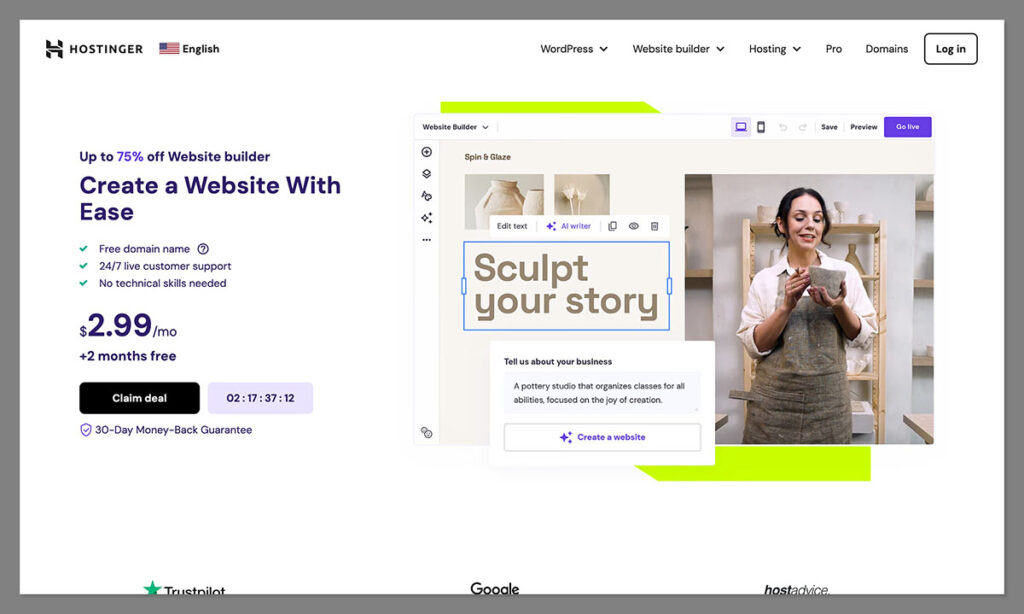
Notably, unlike Shopify, Hostinger doesn’t have its own built-in payment gateway. Instead, you’ll need to use an integrated solution, like PayPal. There are no extra transaction fees to pay, but you will be charged payment processing fees by the gateway you choose.

Shopify Pricing and Fees
Shopify is definitely more expensive than Hostinger, but in my opinion you still get great value for money. You can get started for $5 per month on the Shopify Starter plan if you just want to sell through social media channels and messaging apps.
If you want the full website building solution, you’ll need to spend at least $39 per month (or $29 per month paid annually) for Shopify’s Basic plan.
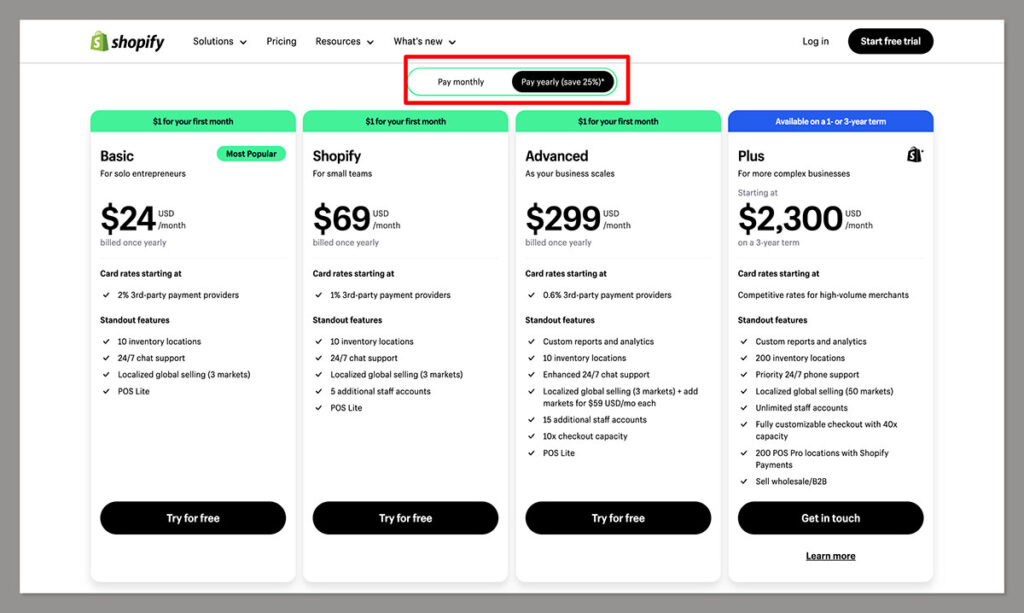
Prices range all the way up to $2,300 per month (Shopify Plus), for the other plans, and users can change their plan whenever they like.
Notably, Shopify does charge extra transaction fees on top of payment processing fees if you use a third-party payment processor (other than Shopify Payments). These fees range from 0.15% on Shopify Plus, to 2% on the Shopify Basic plan.
Shopify vs Hostinger: The Core Features
As I mentioned previously, although Shopify and Hostinger have different “target audiences”, they do share some overlapping features. Both platforms are extremely easy to use, and give you various customizable themes for your store (although I think Shopify offers more options).
Both tools also have exceptional security features, and support for processing transactions. Plus, they both offer access to:
- Shipping solutions (though Shopify has more options)
- Dropshipping capabilities via integrations
- Inventory management tools
- Support for various payment gateways
- SEO features (such as automated sitemaps)
- Reporting and analytical tools
- Drag and drop theme customization tools
- Free SSL certificates
The Unique Features of Hostinger
Overall, I found Hostinger to be lacking a lot of advanced ecommerce tools, but it still gives companies a wide range of useful features, ideal for beginners in the online selling space. Some of the top features of Hostinger include:
- Extensive payment gateway support: Although Hostinger doesn’t have a native payment gateway, it does support various payment methods for global customers. It also offers access to a range of payment methods, including cryptocurrency.
- Search Engine Optimization: Because it’s a website builder first, Hostinger’s SEO features are slightly more advanced than those on Shopify. You can optimize your SEO settings on a granular level, and create sitemaps automatically.
- Website traffic reporting: Hostinger’s reporting and analytical tools focus heavily on insights into website traffic. You can see which devices your customers use, where they visit your website (location), and even create page speed reports.
- Simple interface: Although Shopify is user-friendly, Hostinger is a lot more accessible for absolute beginners. You can navigate everything with minimal effort, and don’t have to dive into code to customize your website’s appearance.
- Security: Hostinger’s in-house built firewall gives you extra protection for your website, ensuring you can focus on building and managing your online store, without having to worry about security breaches or compliance issues.
The Unique Features of Shopify
Ultimately, Shopify gives users virtually all of the features offered by Hostinger, as well as some bonus extras, including advanced sales tools. The most impressive features of Shopify include:
- Warehousing and fulfillment: Shopify offers access to a comprehensive fulfillment network and warehousing services, two things you can’t get with Hostinger. You also get your own shipping label printing solution.
- Advanced inventory management: Shopify has far more advanced inventory management features, with the option to manage SKUs, track stock counts, automate restock notifications and more. You can even create inventory reports.
- Ecommerce analytics: With Shopify, users get a robust range of reporting and analytical features, focused mainly on sales. You can access data on sales, customer behavior, traffic sources, and even marketing performance.
- Omnichannel selling: Shopify has it’s own dedicated point of sale solution for in-store selling (Shopify POS Lite is included on most plans) You also get the option to sell on social media sites, and through marketplaces like Amazon and Ebay.
- Sales tools: Alongside having its own payment processor and world-leading checkout, Shopify offers access to a wider range of sales tools, including gift cards and discount codes, and the option to upsell and cross-sell with integrations.
- Marketing tools: Shopify also has some great SEO features, as well as extra marketing solutions, such as abandoned cart recovery, and Shopify email. You’ll also be able to communicate with customers directly through chat.
- Apps and integrations: Although Hostinger does support some integrations, Shopify has a far more extensive app market. There are countless integrations available for web design, sales, marketing, customer service, accounting and more.
Read more:
Shopify vs Hostinger: Ease of Use and Customer Support
Shopify is one of the most user-friendly ecommerce platforms I’ve used. It makes it simple to build and manage your online store, and automate various processes. You can set up various payment and shipping methods with minimal technical knowledge.
Plus, Shopify provides access to a range of self-help resources, video tutorials, and 24/7 customer support via chat, phone, and email.
Shopify is also a far more scalable solution for ecommerce, giving you access to a range of subscription levels, and a flexible infrastructure that can adapt to suit your needs.
Hostinger is easy to use for beginners too. It’s designed for people with limited technical knowledge, and is very easy to navigate and use. Hostinger is also relatively scalable, but it’s intended to scale to match traffic needs, rather than ecommerce requirements.
In terms of customer support, Hostinger primarily offers live chat and email support, although staff members are available around the clock.
Shopify vs Hostinger: The Verdict
Overall, Shopify is definitely the better choice if you’re looking for a user-friendly and scalable ecommerce platform. It offers far more advanced tools to business leaders, as well as the opportunity to sell across multiple channels.
Although Hostinger is more affordable, and very easy to use, it lacks some of the key features businesses need to sell a wider range of products in different ways. I’d recommend it more for beginners in the ecommerce market, with only a few products to sell.



Comments 0 Responses