

The rules just changed, and most sellers found out the hard way. According to seller reports and POD analysts, that standard $19.99 t-shirt that used to pay roughly $4.88 in royalties now pays about $2.44 at the default tier, if you rely on Amazon’s own traffic to sell it.
So this Amazon Merch on Demand review lands at an awkward moment. If you’re an aspiring print-on-demand seller wondering whether it’s still worth starting, you deserve a straight answer rather than a recycled hype reel.
Short version: it’s still one of the lowest-risk ways to test print on demand and reach a massive audience, but it’s now a side hustle that rewards active marketing, not the passive-income machine it gets sold as. The default royalties are now genuinely low.
I’ve reviewed POD platforms for years, and this review leans on real seller income reports, documented quality complaints, and the reported royalty restructure rather than marketing copy.
Accuracy note before we start: the new tier numbers come from seller reports and POD trackers, not a confirmed Amazon announcement. Every figure is flagged with a “~”, and you should verify current rates on Amazon’s official Merch royalty page before you commit.
Here’s what I’ll cover: how it works, the approval reality, the upload tier system, the new royalties, what you can actually earn, print quality, the full pros and cons, and how it stacks up against the alternatives.
1. What Amazon Merch on Demand Is and How It Works
The genuine appeal fits in one breath: you upload a design, Amazon prints it, ships it, and handles customer service and returns, while you pay nothing and hold zero inventory. You collect a royalty every time one sells. That zero-upfront-cost model is the real draw, and it’s why beginners flock to it.
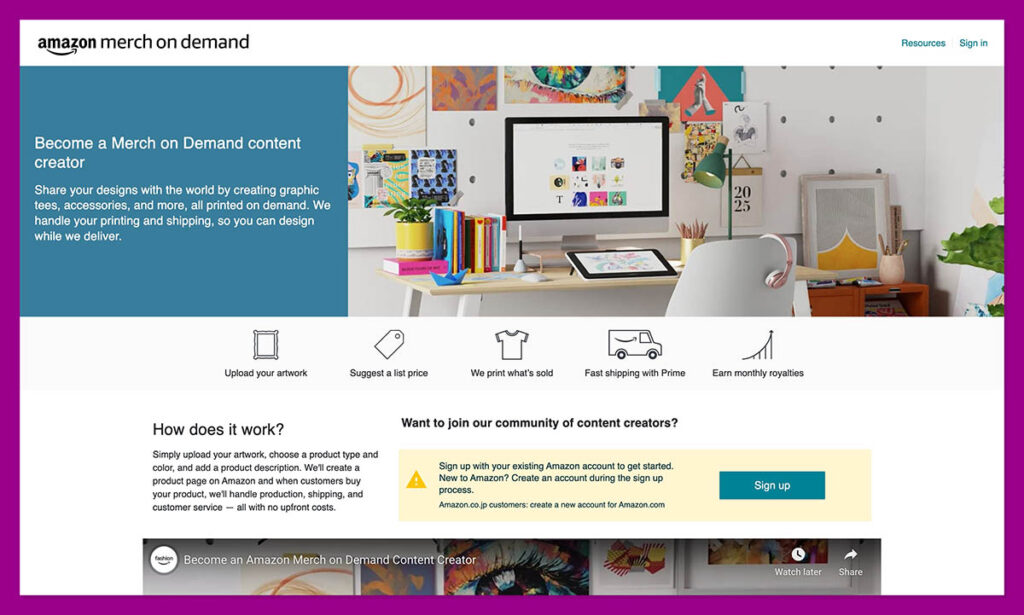
Amazon Merch on Demand (formerly Merch by Amazon) is an invitation-only print-on-demand marketplace built inside Amazon itself. Instead of running your own store, you’re publishing designs directly onto the world’s largest ecommerce platform.
Here’s the actual mechanics, start to finish:
- Apply or get invited through merch.amazon.com (it’s gated, more on that next)
- Upload your artwork as a 4500 x 5400 pixel PNG at 300 DPI, which Amazon prints using direct-to-garment (DTG) printing
- Set your list price within Amazon’s allowed range for each product
- Amazon prints, ships, and handles all customer service and returns
- You collect a royalty per sale, paid out roughly 60 days after month-end once you clear the ~100-in-local-currency payout threshold
- Your listings are Prime-eligible from day one, with that trust badge built in
The scale is the headline benefit. You’re tapping Amazon’s hundreds of millions of active buyers and the Prime shipping badge without building an audience yourself. It sells globally too, across the US, UK, Germany, France, Italy, Spain, and Japan marketplaces.
The dashboard does the rest. Once a listing is live, you write a keyword-rich title and bullets, pick your colors, and Amazon handles fulfillment end to end. One reported wrinkle worth knowing: several trackers (storesautomation, amzprep) claim 15-30 second lifestyle video mockups convert roughly 22% better than static images under an alleged “Motion Rank” boost, though no Amazon source confirms that figure, so treat it as an unverified optimization tip rather than a guarantee.
Get this straight early, because a lot of guides get it wrong: your royalty is the list price minus Amazon’s fixed production cost, not a flat 15% fee. Conceptually, you’re paid whatever’s left after Amazon’s non-negotiable print cost.
In plain terms, you’re a contract designer for Amazon’s storefront. That’s the upside, and as we’ll see, it’s also the catch.
2. Getting Started: Application and Approval Reality
You can’t just sign up. Amazon Merch is invitation-only, and most applicants reportedly get rejected. Industry estimates from several POD trackers put the approval rate around 30-40%, though that figure comes from analysts, not an Amazon-published number.
Why did it get harder? A surge of AI-generated spam accounts pushed Amazon to tighten its standards. Expect a 2-8 week wait after applying, with no status updates along the way, and a 60-day lockout before you can reapply if you’re denied. Some applicants reportedly wait months.
Why Applications Get Rejected
Most rejections trace back to a short list of avoidable mistakes:
- AI-looking portfolio art with obvious low-effort artifacts, which Amazon’s review team specifically screens for
- Trademark or IP red flags, since the upgraded filters now flag designs “substantially similar” to existing works, even when your AI prompt was original
- Generic motivation, like writing “I want passive income” instead of a real plan
- A non-business email such as Gmail or Yahoo
- Any mention of reselling or copying other people’s designs
How to Improve Your Odds
The application itself does most of the heavy lifting:
- Write a specific, niche-focused pitch in 3-4 sentences, naming the audience you’ll design for
- Name your design tools (Adobe Illustrator, Canva, or AI with clear creative direction)
- Acknowledge the content and IP policy so Amazon knows you’ve read it
- Include a portfolio link to Behance, Dribbble, Instagram, or Etsy
- Use a business email rather than a free consumer address
Have your tax details ready too, since the form asks for an EIN (preferred over your SSN) or a W-8BEN if you’re applying from outside the US, plus a bank account for royalty deposits. Getting flagged for a sloppy or incomplete application wastes the full 60-day reapply window, so it pays to submit clean the first time.
The opacity is the frustrating part. There’s no real-time tracking, no expedite option, and no guaranteed acceptance, which several reviewers flag as a genuine weakness. Clear the door first, because that gate is now the toughest it has ever been.
3. The Amazon Merch Tier System Explained
You don’t get unlimited uploads. Every new seller starts at Tier 10, which is exactly 10 design slots, and you have to make sales to unlock more. This surprises almost every beginner, and it shapes the entire early grind.
The system works like a ladder. Each tier unlocks more upload slots, but only after you hit a sales threshold at your current level. The numbers below are reported consistently by POD analysts (amzprep, storesautomation, thesellingguys), though the thresholds and timelines aren’t confirmed on an official Amazon page.
| Tier (design slots) | Sales required to reach it | Reported typical timeline |
|---|---|---|
| Tier 10 (start) | None (default) | Day one |
| Tier 25 | 10 sales | 2-6 months |
| Tier 100 | 25 sales | 4-12 months |
| Tier 500 | 100 sales | 8-18 months |
| Tier 1,000 | 500 sales | 12-24 months |
Higher tiers exist beyond this (2,000, 4,000, 8,000 and up), but most sellers spend their first year or two on the lower rungs. One source (storesautomation) adds that you reportedly need to fill about 80% of your current slots before Amazon considers you for the next tier, so leaving slots empty can stall your climb on top of the sales gate.
The implication is brutal for a volume strategy. At 10 slots, you can barely test two or three niches before you’re capped, so the “upload hundreds of designs and let the winners surface” approach simply isn’t available early on. You earn your way into volume.
One wrinkle worth flagging, though it comes from a single source (amzprep): tier status is reportedly now tied to a trailing performance window rather than lifetime sales, and an account with zero sales for around 12 months may get downgraded. Pair that with the 18-month auto-deletion policy covered later, and the old “upload and forget” approach looks dead.
Compare that to open platforms like Redbubble or TeePublic, where you can upload freely from day one with no slot cap. That trade-off, gated quality versus open volume, runs through this whole comparison.
4. Royalties and the Three-Tier Restructure
The same sale can now pay you wildly different amounts. According to seller reports, a Creator-tier seller earns ~$2.44 on a $19.99 tee, while a Premium seller earns ~$5.27 on the exact same shirt. The difference is entirely how much traffic you personally drive to Amazon.
Critical accuracy note. The tier figures are corroborated across multiple POD analysts (Merch Titans, Side Hustle Playbook, amzprep, storesautomation) but are not confirmed on an official Amazon page, and the sources conflict on the prior rate. Treat every figure here as reported, put a “~” on it, and confirm the live numbers on Amazon’s official Merch royalty page before you make any decision, since rates vary by product, price point, and marketplace.
How Royalties Actually Work
This part is verified across Printful, Merch Titans, and ecommerceceo: your royalty is the list price minus Amazon’s fixed production cost. It is not a flat percentage fee. A standard tee costs Amazon roughly $8-12 to produce (storesautomation cites about $8.21), a hoodie roughly $17-28, a PopSocket about $5.14, and your royalty is whatever’s left. The marginal rate works out to about $0.73 per extra $1 you add to the list price. Ignore any guide claiming a flat “15% fee” or “$11.25 on a $25 shirt” math, it’s simply wrong.
The Three Traffic Tiers
The restructure layered a three-tier system on top of that formula, based on external traffic:
- Creator is the base, default rate for sellers driving under ~15% external traffic
- Plus pays ~2x base, reportedly requiring 15-34% of monthly US unit sales from non-organic sources plus a ~10 monthly-sales minimum
- Premium pays ~2.16x base, reportedly requiring 35%+ external traffic plus the same ~10-sale minimum
It applies to the US store only (international marketplaces are reportedly unaffected), and your tier recalculates monthly on a trailing window.
| Product (list price) | Creator (~) | Plus (~) | Premium (~) |
|---|---|---|---|
| Standard t-shirt ($19.99) | ~$2.44 | ~$4.88 | ~$5.27 |
| Pullover hoodie ($29.99) | ~$1.78 | ~$3.56 | ~$3.84 |
Figures reported by POD analysts, not confirmed on an official Amazon page. The hoodie row is single-source (Side Hustle Playbook) and highly price-point dependent. Confirm current rates on Amazon’s royalty page.
The Plus-tier figures also climb fast with list price, per Merch Titans’ calculator: a standard tee reportedly runs from ~$0.50 at $13.99 up to ~$9.26 at $25.99, a long-sleeve tee from ~$1.04 to ~$9.80, and a PopSocket from ~$3.01 to ~$5.93. The same source’s “Creator = Plus x 0.50, Premium = Plus x 1.08” formula lines up with the 2x/2.16x multipliers other trackers report, which is part of why the structure looks real even without Amazon’s confirmation.
Here’s what it means for a beginner. If you rely purely on Amazon’s organic traffic, the Creator rate is roughly a 50% cut versus the prior ~$4.88 flat rate, per Merch Titans’ analysis. The Plus tier only matches what you used to earn automatically, so you now have to market just to stand still. Amazon’s intent, per Side Hustle Playbook and Merch Titans, is clear: reward the sellers who bring their own traffic and quietly filter out the casual uploaders.
What Counts as External Traffic
These are the sources that lift you into Plus or Premium:
- Amazon Sponsored Products ads
- Social media (Instagram, TikTok, Pinterest, Facebook)
- Off-platform advertising (Google, Facebook, Pinterest ads)
- Email marketing to your own list
- Blog and YouTube links tracked with free Amazon Attribution tags
My direct take: if you won’t drive outside traffic, budget your expectations around the Creator rate, not the headline Premium number. And double-check the live figures on Amazon’s royalty page before you commit a single weekend to this.
5. Realistic Earnings: Is Amazon Merch Actually Passive Income?
One seller who ran an account from 2021 to 2023, hit Tier 4,000, then burned out, summed it up in a Reddit-sourced paraphrase:
“It’s a great side hustle, terrible business. You’re a contract designer for Amazon, not an entrepreneur.”
That’s the reality the hype reels skip.

Documented Income Reports
- Adam (MerchArts case study) earned a documented $82,895.44 in 2022 royalties from 22,807 sales, on roughly $20,000 of ad spend, with 83% of sales being standard tees. That works out to about $227 a day, net roughly $63,000 after ads. That’s a high performer, not a typical beginner.
- Merch Pursuits documented a from-scratch ramp: $61 in month one to $1,063 in month eight, from 206 sales at Tier 500 with 292 live designs, all organic. But royalties then ran ~$5.17 per shirt. At today’s ~$2.44 Creator rate, that same volume nets roughly half, around ~$497/month.
- Ryan Hogue charts the long decline directly: $7.19 per sale pre-2018, then $5.38, then $5.23, and now ~$2.44 at Creator. He still earned $21,970 in 2018, so the platform can pay, but the trend line points down.
The Honest Math
It’s sobering. At the Creator rate of ~$2.44, clearing $500/month takes about 205 tee sales every month. Ten designs at Tier 10 might net you ~$24/month. A realistic first-year ramp looks like $0-100/month in months one to three, maybe $200-1,000 by months six to twelve with consistent uploads, with year two and beyond reserved for serious operators. Most sellers are lucky to make a few hundred dollars a month early on.
Timing matters as much as volume. Merch Pursuits’ own jump to $832 came in December, a holiday spike, and the standard playbook is to upload seasonal designs 6-8 weeks ahead of Christmas, Halloween, or Valentine’s Day to catch the early search traffic.
Saturation is real, too. As one analyst at mydesigns.io put it, “T-shirts are the most saturated category on the internet,” with the worst crowding in generic lanes like coffee lovers, wine enthusiasts, and dog mums. Yet tight-niche operators running deep research and 200-plus listings still clear $3,000-$30,000/month, so it cuts both ways.
So is it passive? Honestly, it’s semi-passive at best. The work is front-loaded design plus ongoing catalog management (the 18-month deletion, the downgrade risk), and the real money now rewards active marketing. It’s a great fit for patient design-volume builders, and a poor fit if you want money fast or truly hands-off.
6. Product Range and Print Quality
Here’s the question competitors dodge entirely: are these shirts any good? The honest answer is “it depends,” because the real-world reports genuinely swing both ways.
The catalog is broader than just tees:
- T-shirts (standard, premium, long-sleeve)
- Pullover and zip hoodies
- Sweatshirts
- PopSockets, phone cases, and tote bags
Notably, Amazon has no sticker product, which matters when we compare it to Redbubble later. The higher-priced items are also where the better money hides: a hoodie listed around $39.99 reportedly pays roughly $8.40-$13.20 even at the Creator tier (storesautomation), versus $2.44 on a $19.99 tee, so leaning into hoodies and zip-ups is one way to blunt the Creator-tier cut.
On the production side, the specs are verified: Amazon uses DTG (direct-to-garment) printing on lightweight 100% cotton (white) or cotton/poly blends (heather colors), from your 4500 x 5400 PNG at 300 DPI. One honest caveat: Amazon does not publicly disclose which blank or shirt brand it prints on, so you can’t vet the garment in advance.
What Buyers Actually Report
On the negative side, a 2023 Amazon Seller Central poster reported that the shirts were “SO thin,” with a visible heat-press square on the front and rectangle on the back that “completely changed the color of the shirt.” Their verdict: “the quality was absolutely terrible. Can’t even promote your products.”
On the positive side, a 2025 reviewed.com buyer who tested a Dolly Parton design called it “the highest quality printing I’ve seen in an on-demand print,” with ink that showed no peeling or fading after multiple wash cycles. That reviewer had walked in wary of prints that “rub or peel off with little effort,” so the durable result genuinely surprised them. The one knock: the shirt shrank after the first wash, so an XL became “rather snug.”
My read is that quality appears to have improved but stays inconsistent and blank-dependent. Test-buy your own design before you market it. The quality is good enough to sell, just not guaranteed enough to trust blind.
7. Amazon Merch on Demand Pros and Cons
Before the verdict, here’s a scannable balance sheet so you can weigh it at a glance.
What I Like
- ✔️ Zero upfront cost and no inventory, since Amazon handles production, shipping, returns, and customer service, so you risk only your time
- ✔️ Built-in Amazon audience and Prime badge from day one, with no store to build or traffic to buy
- ✔️ Higher per-unit apparel royalties than Redbubble or TeePublic, with one real 6-month test showing ~$13.18 vs ~$6.53 average per sale
- ✔️ Global marketplaces across the US, UK, Germany, France, Italy, Spain, and Japan
- ✔️ Higher-margin products like hoodies (reportedly ~$8-13/sale at some price points, caveat applies) soften the Creator-tier cut
What I Dislike
- ❌ The Creator-tier royalty drop, a reported ~50% cut to ~$2.44 per tee for organic-only sellers (reported figure, confirm on Amazon)
- ❌ Invitation-only with a reported ~30-40% approval rate and a 2-8 week opaque wait
- ❌ No branding, packaging, or customer relationship, which makes it a cash-flow-only play with no public artist profile
- ❌ Upload throttling, since you start capped at just 10 design slots
- ❌ The 18-month auto-deletion of non-selling listings, which kills any set-and-forget plan
- ❌ Account-suspension risk with opaque appeals, which has hit even compliant sellers like Ryan Hogue
- ❌ Heavy platform dependence, since Amazon controls base costs and can change royalties unilaterally
The pattern is clear: Amazon Merch is unbeatable on risk and reach, and weak on control and margins. That tension is exactly what the verdict has to resolve.
8. Amazon Merch vs Printful, Redbubble, TeePublic and Seller Central
If Amazon Merch’s trade-offs don’t fit you, here’s where to look instead, and what you gain or give up with each.
| Platform | Approval / entry | Per-sale royalty or margin | Built-in traffic | Brand & customer control |
|---|---|---|---|---|
| Amazon Merch | Invite-only (~30-40%, reported) | Highest apparel royalty among marketplaces, but ~$2.44 Creator default | Huge (Amazon + Prime) | None |
| Printful (+ Shopify) | Open | You set price/margin (~$8 on a $20 tee) | None, you drive it | Full brand + customer list |
| Redbubble | Open | Lower (~$6.53 avg/sale in a 6-mo test) | Strong standalone marketplace | Partial (artist profile) |
| TeePublic | Open | Fixed ~$4/shirt, ~$2 on sale days | Strong (2nd to Redbubble) | Partial |
| Spreadshirt | Open | Fixed (e.g. ~$3/shirt), platform absorbs discounts | Moderate | Partial |
| Seller Central + POD | Amazon seller account | Higher margin (~$3.24-$9.24 on a $24.99 tee), no tier cap | Amazon traffic | Full brand control |
A few takeaways worth pulling out of that grid. Amazon Merch still wins on zero-risk entry and reach, and it genuinely tops Redbubble and TeePublic on per-apparel-sale earnings. Printful plus Shopify wins on brand and margin, but you have to bring every visitor yourself. Watch the fixed-royalty platforms, though: TeePublic discounts to ~$2 a shirt on its near-daily sale days, and Michael Essek notes Threadless can pay as little as $1 on a $22 shirt, the lowest of the field.
The interesting middle option is Seller Central plus a POD provider like Printful or Gelato. You get Amazon’s traffic and full brand control, with margins of roughly $3.24-$9.24 per shirt and no tier cap. That’s why one analyst at mydesigns.io argues a beginner starting fresh might skip Merch first:
“If I were starting from zero today with no existing Amazon account, I would not even apply to Merch on Demand first.”
That’s their opinion, not gospel, and the royalty figures above come from third-party tests that change over time.
Quick verdict on the field: Amazon Merch is the easiest on-ramp and the best passive apparel royalty. Pick an alternative if you want margin, brand, or a customer list. That sets up the bottom line.
The Bottom Line: Who Should Use Amazon Merch on Demand
Amazon Merch on Demand is still the lowest-risk way to test print on demand and reach Amazon’s enormous audience. But the Creator-tier reality means it’s a side hustle that rewards active marketing, not the passive income it’s marketed as. Whether it’s right for you comes down to one question: will you drive your own traffic?
It’s a strong fit if you’re one of these people
- ✔️ A beginner who wants to test designs at literally zero financial risk
- ✔️ A designer monetizing an existing portfolio for supplemental cash flow
- ✔️ A brand or seller validating designs before committing to FBA or a DTC store
- ✔️ A patient marketer willing to drive your own traffic to reach Plus or Premium rates
Skip it, or look elsewhere first, if any of these describe you
- ❌ You want high margins or to set your own prices (go Printful/Shopify or Seller Central + POD)
- ❌ You want brand control, custom packaging, or a customer and email list
- ❌ You expect fast or truly hands-off income, because this is semi-passive at best
- ❌ You won’t market externally and would lean only on Amazon’s organic traffic at ~$2.44/tee
Factor in the current reality before deciding. The Creator-tier rate makes organic-only economics tough, and the 18-month deletion policy means “upload and forget” is over. As always with these reported figures, verify the current royalties on Amazon’s official Merch royalty page first, since that page is the source of truth and these numbers come from analysts, not Amazon.
My recommendation: if you treat it as a zero-risk testing ground and bring your own traffic, Amazon Merch still earns its spot in a side-hustle stack. If you want a business you actually own, start elsewhere.
Amazon Merch on Demand FAQ
Is Amazon Merch on Demand worth it?
It depends on whether you’ll market your designs. Organic-only beginners face the low ~$2.44 Creator rate and a slow first year, so it’s underwhelming as a standalone business. Active sellers driving external traffic reach the Plus rate (~$4.88, matching old earnings), making it worthwhile. It’s best treated as a low-risk testing ground or secondary channel. Confirm current rates on Amazon’s official page.
How much can a beginner realistically make?
Usually little at first: around $0-100/month in months one to three, potentially $200-1,000 by months six to twelve with consistent uploads. At the reported ~$2.44 Creator rate, hitting $500/month takes roughly 205 sales monthly. For context, Merch Pursuits documented $1,063 in month eight, but that was at older ~$5.17 rates, so expect roughly half that today.
Is Amazon Merch free?
Yes, it’s free to join and use once you’re approved, with no inventory costs and no monthly fees. You earn a royalty on each sale, calculated as the list price minus Amazon’s fixed production cost, and Amazon handles printing, shipping, and all customer service. Your only real investment is the time spent creating designs and applying.
How hard is it to get approved?
Hard. POD analysts report only about 30-40% of applicants get approved, with a 2-8 week wait and no status updates (that figure is reported, not Amazon-published). Improve your odds with a specific, niche-focused pitch, a portfolio link, and a business email. Avoid AI-looking portfolio art and generic “passive income” statements, which are common rejection triggers.
How do Amazon Merch royalties work now? Is it a 15% fee?
No, it’s not a percentage fee. Your royalty is the list price minus Amazon’s fixed production cost (roughly $8-12 for a standard tee). Under the reported tiers, a $19.99 tee pays ~$2.44 (Creator), ~$4.88 (Plus), or ~$5.27 (Premium) depending on how much external traffic you drive. Ignore any “15% fee” math, and confirm current rates on Amazon’s royalty page.
Is it really passive income?
Not really. It’s front-loaded design work plus ongoing catalog management, including the 18-month auto-deletion of non-selling listings and possible tier downgrades for inactivity. The better royalty rates specifically reward active marketing rather than passive uploads. Call it semi-passive at best, since you can earn while you sleep, but only after significant upfront effort and continued maintenance.
Amazon Merch vs Redbubble or Printful, which is better?
Amazon Merch pays more per apparel sale (~$13.18 vs ~$6.53 against Redbubble in a 6-month test) and brings its own traffic, but it’s invite-only with no brand control. Redbubble and TeePublic offer open signup but lower per-sale earnings. Printful or Seller Central + POD give you margin, branding, and a customer list, but you must drive all your own traffic. Choose by goal.



Comments 0 Responses