

Best for Earnings and Reach

Etsy
View Pricing Visit Etsy →$0.20 per listing
6.5% transaction fee + 3% + $0.25 processing
- About 88 million active buyers
- You set the retail price and choose your POD partner
- Keeps $6.89 on a $25 Printify T-shirt
Best for Hands-Off Selling

Redbubble
View Pricing Visit Redbubble →Free to join
Platform fee of 0% to 50% of monthly earnings
- Over 70 products from one upload
- Prints, ships and handles customer service
- Monthly payouts by the 15th ($10 minimum)
Among print-on-demand sites for artists, Etsy vs Redbubble comes down to how you get paid: both let you sell artwork without inventory, but Etsy lets you set prices and pay fees, while Redbubble pays an artist margin minus its cut.
After comparing both, I recommend Etsy paired with a print-on-demand app like Printify for most artists, because you keep more of each sale. But Redbubble wins for zero-upfront-cost selling, without handling orders yourself.
At Ecommerce-Platforms.com, we’ve been testing and reviewing ecommerce platforms since 2012. I lined up both marketplaces’ fees, selling rules and investor results as of November 2026, comparing earnings and setup through to audience, fulfillment, branding and product range.
Key Takeaways
- Etsy pays more per sale: a $25 Printify tee keeps $6.89 after fees and fulfillment, versus $2.00 to $4.00 on a $24 Redbubble tee.
- Redbubble is free to start: no setup fees, listing fees or monthly subscription, with over 70 products available from one upload.
- Etsy has the bigger audience: about 88 million active buyers in Q3 2026, against Redbubble’s 3.1 million customers in FY26.
- Redbubble handles everything after the sale: it prints, ships and answers customers, while Etsy buyers message you.
- Etsy gives you more control: you set the retail price, pick the blank and build your own shop brand.
A Quick Comparison of Etsy vs Redbubble
Etsy wins overall for earnings and audience size, while Redbubble stands out for free, hands-off selling. Choose between stronger margins and less shop management.
| Etsy (with a POD app) | Redbubble | |
|---|---|---|
| Overall rating | 4.1/5 | 3.8/5 |
| Cost to start | Setup fee may apply; amount shown at signup; $0.20 per listing; free POD integration | Free; no setup fees, listing fees or monthly subscription |
| Selling fees | 6.5% transaction; 3% + $0.25 processing (US); 15% or 12% on Offsite Ads orders | Monthly platform fee: Standard 50%, Premium 20%, Pro 0%; capped at $150 per payment period |
| Who sets the price | You set retail prices | Redbubble sets base prices; you set markup, defaulting to 10% |
| Who prints and ships | Printify, Printful or Gelato | Redbubble’s manufacturers |
| Audience | About 88 million active buyers; Q3 2026 | 3.1 million customers; FY26, year to June 30, 2026 |
| Product range | POD partner’s catalog; your own qualifying work | Over 70 products per upload |
| Branding | Shop name, branding, reviews and buyer messages | Artist page within Redbubble |
| Customer service | You answer buyers; partner handles production | Redbubble handles customer service |
| Payouts | Etsy Payments deposits; weekly by default for new sellers | Monthly, paid by the 15th; $10 minimum |
| Best for | Earnings and brand-building | Hands-off selling and testing designs |
| Pros | Higher example earnings; bigger audience; retail price control | Free to start; no order handling; broad product range |
| Cons | Listing and selling fees; shop management; POD disclosure rules | Standard’s 50% fee; assigned tiers; shrinking customer base |
What Kinds of Sellers Are Etsy or Redbubble Best For?
Choose based on how much of the selling you want to do yourself.
Etsy Is Best for…
- Artists building a brand: set your prices, choose blanks and retain more from each sale.
- Sellers ready to run a shop: write listings, answer buyers and choose a POD partner.
Redbubble Is Best for…
- Beginners testing designs: discover what sells without paying upfront.
- Hands-off artists: upload artwork and leave production, delivery and customer service to Redbubble.
1. Best for Fees and Earnings: Etsy
Etsy costs more to sell on, but you keep more of each sale.
Redbubble charges nothing upfront, while Etsy bills per listing and order. Yet the T-shirt example favors Etsy, because Redbubble’s tier fee reduces an already small artist margin.
Etsy wins because the Printify example leaves $6.89 after fees and production, compared with $2.00 to $4.00 on Redbubble.
How Much Does Selling on Etsy Cost?
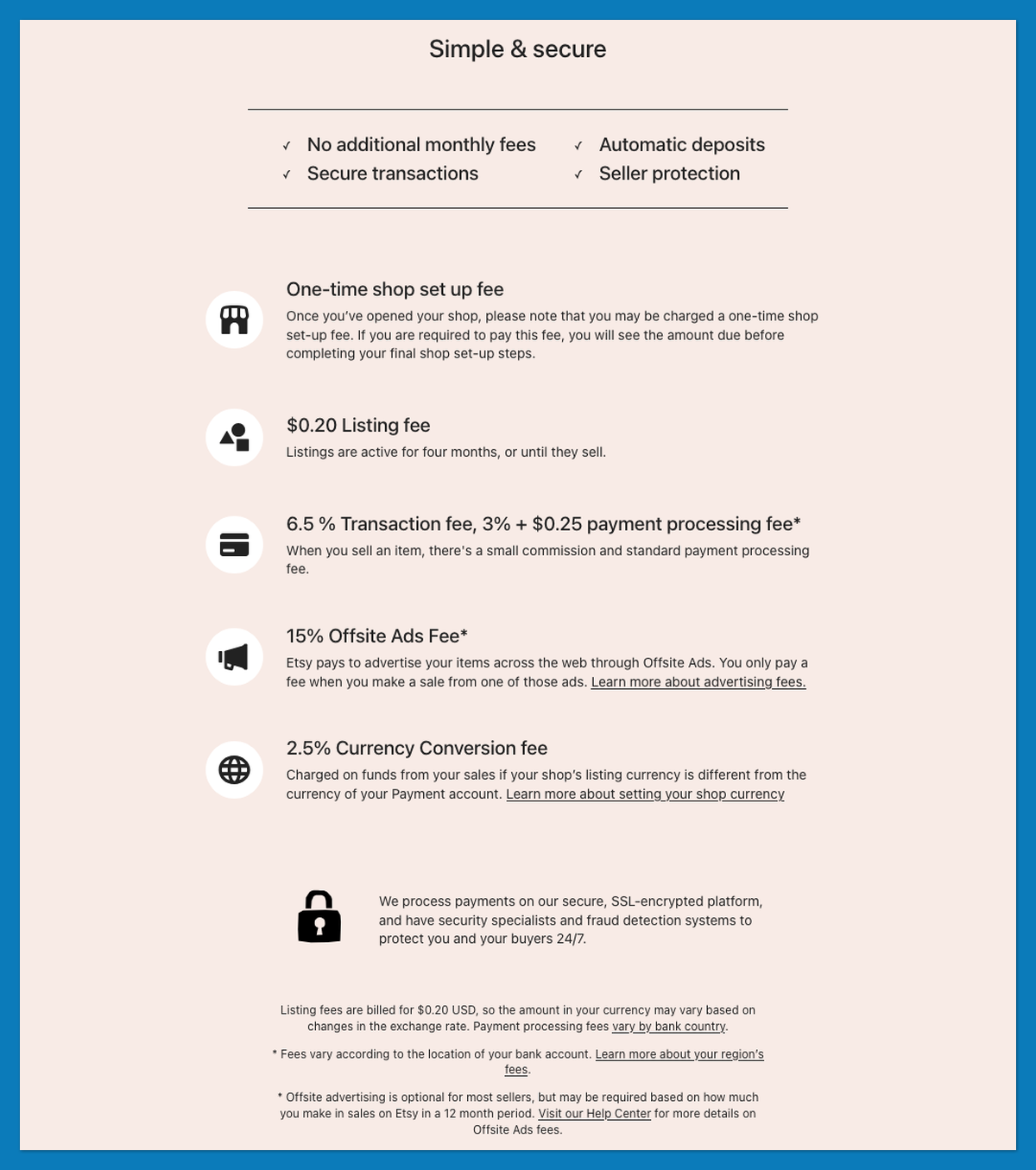
These Etsy fees apply to US sellers under Etsy’s Fees & Payments Policy.
| Etsy fee (US) | Amount | When it applies |
|---|---|---|
| Shop setup fee | May apply; shown during setup | Once; non-refundable |
| Listing fee | $0.20 | Listing lasts 4 months or until sold; renews after each multi-quantity sale |
| Transaction fee | 6.5% | Item, shipping and gift wrap; excludes US sales tax |
| Payment processing | 3% + $0.25 | Order total, including tax and shipping |
| Offsite Ads | 15% below $10,000 annual sales; 12% at $10,000+ | Attributed orders; optional below threshold, mandatory at or above it; $100 cap per order |
| Currency conversion | 2.5% | Listing and payment-account currencies differ |
| Etsy Plus (optional) | $10/month | Includes 15 listing credits and $5 Etsy Ads credit |
Etsy’s transaction fee covers shipping as well as the item price. At the annual sales threshold, Offsite Ads becomes mandatory.
POD apps connect for free; paid plans are optional. Printify’s pricing includes Premium at $39 monthly, or $24.99 a month billed yearly, for lower product costs.
How Much Does Selling on Redbubble Cost?
Redbubble has no listing or monthly subscription fees. Its base price covers its service fee and manufacturing; you add a markup that defaults to 10%.
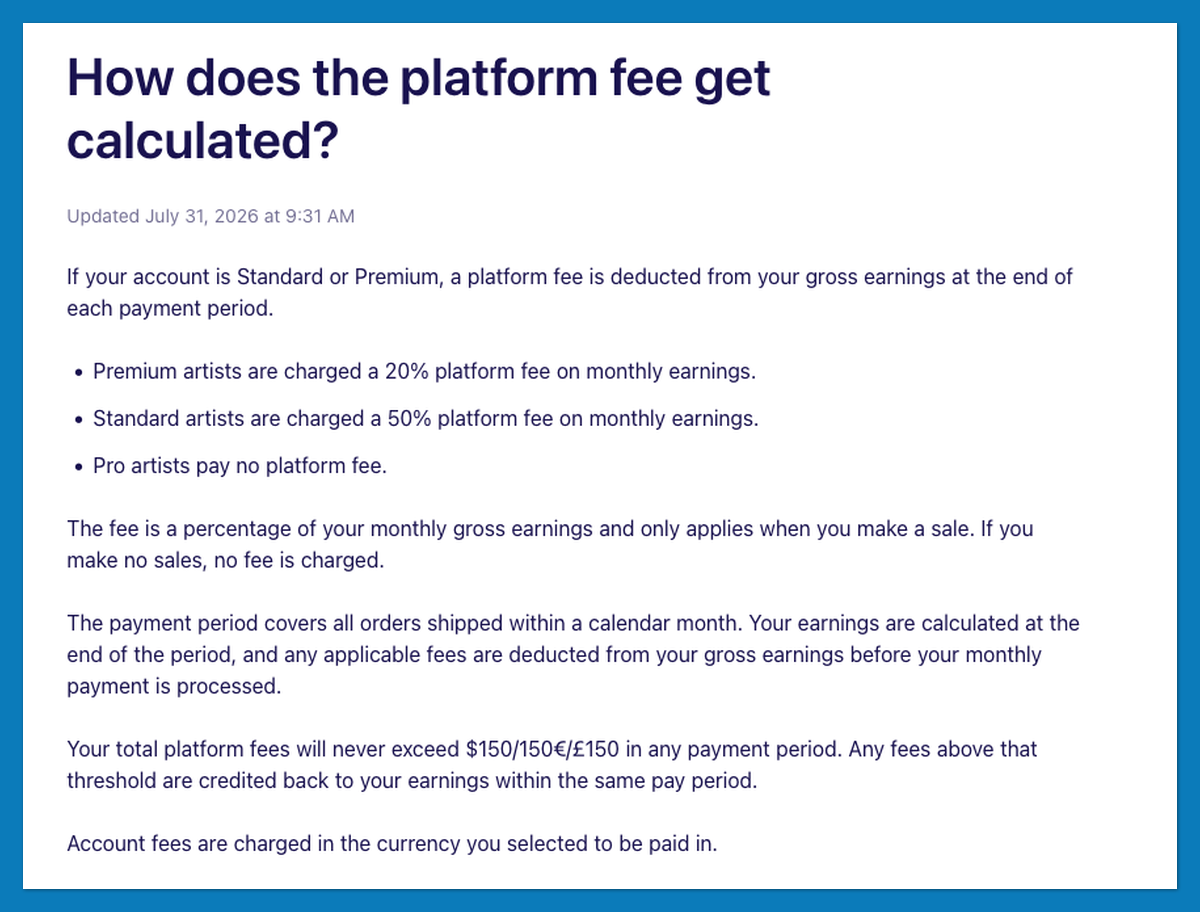
Since September 1, 2025, Redbubble account tiers determine the platform fee deducted from monthly gross earnings.
| Redbubble tier | Platform fee (share of monthly earnings) | Excess markup fee (on markup above 20%) | How you get it |
|---|---|---|---|
| Standard | 50% | 50% | Assigned; default for new artists |
| Premium | 20% | 50% | Assigned; established brand or following |
| Pro | 0% | 0% | Invite-only; top-seller or Artist Ambassador programs, reviewed yearly |
Platform fees never exceed $150 per payment period, covering orders shipped that calendar month; no sales means no platform fee. Premium paid no platform fee before the change.
What You Earn on One T-Shirt
I worked out this US example as of November 2026, excluding sales tax. It compares Etsy’s Bella+Canvas 3001 using Printify Free and Choice shipping with Redbubble’s Classic T-shirt at 20% markup.
| Per T-shirt | Etsy + Printify (Free plan) | Redbubble Standard | Redbubble Premium | Redbubble Pro |
|---|---|---|---|---|
| Retail price | $25.00, free shipping | $24.00 | $24.00 | $24.00 |
| Production and shipping | From $11.29 + $3.99 = $15.28 | $20.00 base price | $20.00 base price | $20.00 base price |
| Your margin before fees | $9.72 | $4.00 | $4.00 | $4.00 |
| Platform fees | $0.20 listing + $1.63 transaction + $1.00 processing = $2.83 | 50% = $2.00 | 20% = $0.80 | 0% = $0.00 |
| You keep | $6.89 | $2.00 | $3.20 | $4.00 |
| If the order came from Offsite Ads | $3.14 at 15%; $3.89 at 12% | No separate ad fee | No separate ad fee | No separate ad fee |
Redbubble’s platform fee applies to monthly earnings, not individual sales; this illustrates its share before the cap. Use how to price print-on-demand products to adapt the example.
- The 10% default costs you: Standard keeps $1.00 on the default-markup tee.
- Markups above 20% attract another fee: at 30%, the excess fee applies at sale; Standard keeps $2.50.
- Offsite Ads squeezes Etsy profit: the 15% fee leaves $3.14; eligible smaller shops can opt out.
- Your POD plan changes the math: Printify Premium’s tee starts at $9.04, leaving $9.14 before its $39 subscription, covered from the 18th tee monthly. Printful‘s $11.92 tee plus $4.95 shipping leaves $5.30.
Redbubble’s sitewide discounts also lower your artist margin: reducing the base price cuts the percentage-based margin proportionally.
- Etsy pays out faster: new sellers receive weekly deposits by default, on Mondays; reserves can hold funds for refunds and chargebacks.
- Redbubble pays monthly: payments arrive by the 15th, through PayPal or bank transfer, after reaching $10; smaller balances roll over. Add payment details to avoid an Unpayable Artist Account Fee.
Redbubble still costs nothing to start. Choose Etsy for stronger example margins, or Redbubble to avoid upfront spending.
2. Best for Getting Started: Redbubble
Redbubble gets your designs on sale with no upfront cost and no store to run.
Redbubble needs an account, artwork and payment details. Etsy plus a POD app adds shop setup, priced listings and a production-partner disclosure.
Redbubble wins because opening costs $0 and you don’t create a separate listing for every product, whereas Etsy can charge setup and listing fees.
Opening a Redbubble Shop
- Sign up as an artist: create your account and verify your details.
- Upload at least 5 public designs: enable at least 1 product for each.
- Complete your profile: add a profile picture, cover image, social links and bio.
- Add payment details: use verified PayPal or a bank account, and verify your phone number.
- Wait for classification: your shop stays private until Redbubble finishes assigning your account.
- Set your markup: open Product Pricing to change the 10% default per product.
Redbubble offers a free start for independent artists, but your assigned tier determines the fee. Most newcomers start on Standard, the 50% tier covered in round 1.
Opening an Etsy Shop With a Print-on-Demand App
For Etsy print on demand, connect your fulfillment partner before publishing:
- Open your Etsy shop: a setup fee may apply; the amount appears during setup.
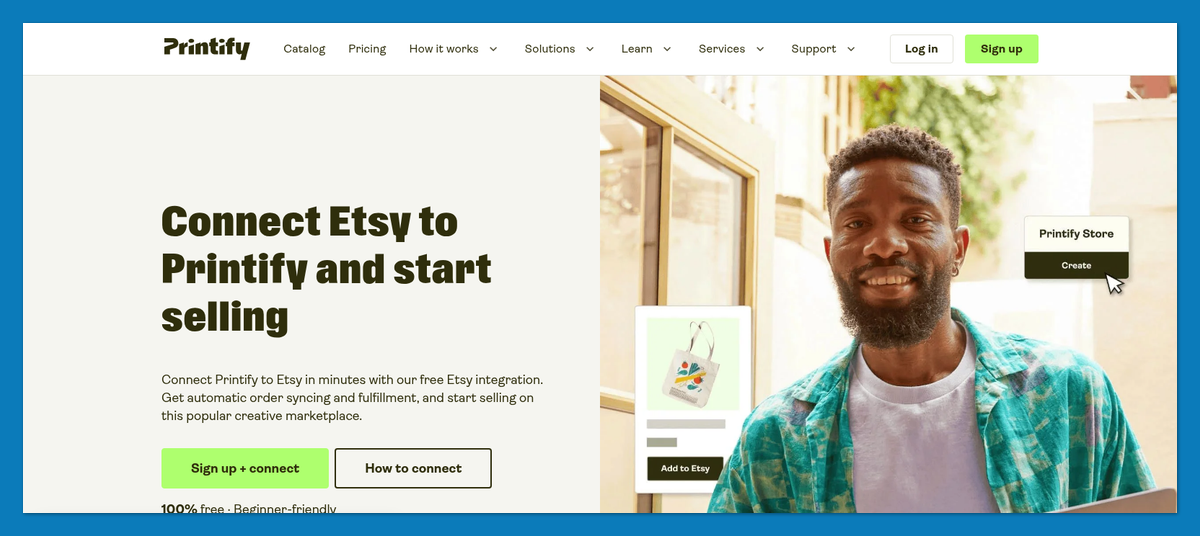
- Connect a POD app: Printify, Printful and Gelato are free to connect.
- Create your product: add mockups in the app and set your retail price.
- Disclose your production partner: in Shop Manager, select “Who made it?” then “Another company or person,” and add the POD company.
- Publish your listing: pay $0.20; unsold listings expire after 4 months and incur another fee when renewed.
Printify’s integration is free to connect, not free to fulfill orders. Our guides explain how to connect Printify to Etsy or begin selling on Etsy with Gelato.

Skipping the production-partner disclosure can get your shop suspended, a risk both Printify and Printful warn about. Etsy’s October 22, 2026 listing rules also require at least 1 unaltered photo of the real item, so order samples rather than relying entirely on mockups.
The extra Etsy steps buy you control over titles, tags and photos. Choose Redbubble for a no-spend start; skip it if choosing the blank and setting the retail price matter more.
3. Best for Reaching Buyers: Etsy
Etsy puts your designs in front of a far bigger, growing crowd.
Etsy reported about 88 million active buyers in Q3 2026, compared with 3.1 million Redbubble customers in Articore Group’s FY26 results, the year to June 30, 2026.
Etsy wins because its reported buyer base is about 28 times larger and growing again, while Redbubble’s customer count fell about 11%. The measures and reporting periods differ, so treat this as a rough comparison.
Etsy’s Buyer Base
- About 88 million active buyers: up 1% year over year in Q3 2026, its first increase in 2 years.
- About 5.8 million active sellers: up 6.5%, meaning more competing shops too.
- $2.65 billion in gross merchandise sales: up 8.8% in the quarter ended September 30, 2026.
A larger marketplace doesn’t guarantee visibility: your titles and tags still need to help shoppers find your designs. Orders attributed to Offsite Ads also carry the extra fee covered in round 1.
Etsy’s CFO said on its Q3 2026 earnings call that earlier search tuning favored cheaper digital items. Etsy is rebalancing how physical products appear, a relevant distinction if you’re selling printed artwork rather than downloads.
Redbubble’s Buyer Base
- 3.1 million customers: down from 3.5 million the previous year.
- 468,000 selling artists: down from 542,000.
- A$20.9 million in net artist earnings: down from A$30.2 million, averaging about A$45 per selling artist annually.
- 54% repeat customers: more than half of customers return.
Redbubble markets the marketplace for you: it says its September 2025 fee change funds paid and organic marketing alongside improved discovery and tagging. The annual artist-earnings average is not a forecast of your income.
Articore also operates TeePublic, with 2.5 million customers and 165,000 artists. Our TeePublic vs Redbubble comparison covers that separate marketplace.
For deciding where to sell art online, Etsy also leads on the rough audience-to-seller ratio: about 15 active buyers per active seller, versus about 7 customers per selling artist on Redbubble. I recommend Etsy for reach, not guaranteed sales.
4. Best for Fulfillment and Customer Service: Redbubble
Redbubble handles everything after the sale, from printing to customer emails.
On Etsy, “Where’s my order?” lands in your inbox. On Redbubble, the buyer deals with Redbubble instead.
Redbubble wins because it manages production and customer support, while Etsy sellers coordinate fixes with their POD partner.
How Redbubble Handles Orders
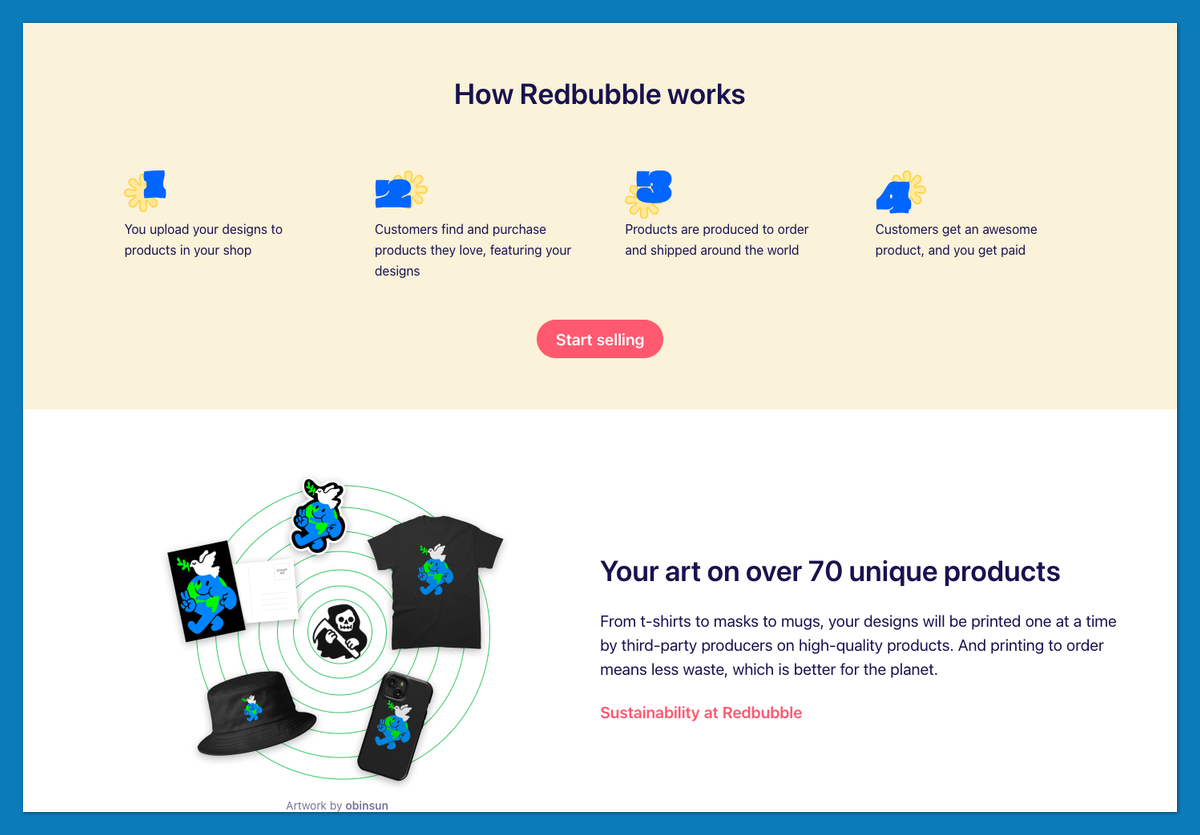
Once your design is live, Redbubble manages manufacturing, shipping and customer service, including returns. Its “How Redbubble works” section presents the arrangement in 4 steps, without putting you between the buyer and manufacturer.
As of November 23, 2026, Trustpilot ratings were 4.4/5 for Redbubble, compared with 1.4/5 for Etsy. Most reviews came from shoppers, so they reflect buying experiences rather than artist earnings.
The ratings covered 65,112 Redbubble reviews and 21,784 Etsy reviews. Read that feedback as buyer sentiment, not a comparison of seller support.
The trade-off is that you can’t choose the printer or blank for a Redbubble product. Our guide to whether Redbubble is legit explores the service, but handing over fulfillment also means handing over those production decisions.
How Etsy and Your POD Partner Split the Work
- Your POD partner prints and ships: orders sync from Etsy to Printify, Printful or Gelato for production and dispatch.
- You answer buyers: delivery questions and complaints reach your shop; you manage reviews and set your returns policy within applicable rules.
- Misprints go through your partner: its policy determines reprint eligibility, so compare Printful vs Printify before choosing who makes your products.
Etsy sellers on Trustpilot describe suspensions, payment holds and difficult support experiences. A November 2026 reviewer wrote, “Etsy has no phone numbers and your emails go nowhere”; that’s one seller’s account, not a complete description of Etsy’s support options.
Etsy’s consolation is direct contact with buyers, which lets you address problems personally and build relationships around your shop. To spend your time illustrating rather than answering customer emails, pick Redbubble.
5. Best for Branding and Control: Etsy
Etsy lets you set your prices, pick your products and build your own shop brand.
Etsy gives you the choice of retail price, blank and printer. Redbubble leaves you with your markup and artist page.
Etsy wins because product presentation and pricing are your decisions, though its upcoming terms change deserves attention before you upload.
What You Control on Etsy
- Your price: set the retail amount, then subtract POD costs and Etsy fees to work out your margin.
- Your product and printer: choose a specific blank, such as the Bella+Canvas 3001, and an available print provider through your POD app.
- Your shop identity: customize your shop name and branding, write listing titles and tags, choose photos, and communicate directly with buyers.
Etsy’s updated Terms of Use, effective December 16, 2026, expand Etsy’s and its partners’ rights to use seller content to develop and train AI, with no general opt-out for US sellers as of November 23, 2026. Etsy says it doesn’t use your content to train AI models designed to copy your original work.
For control over your own store and domain, compare Shopify vs Etsy. Etsy offers more shop-level freedom than Redbubble, but you still operate within Etsy’s marketplace rules.
What You Control on Redbubble
- Your markup, not the base price: adjust the percentage per product; Standard and Premium incur the excess markup fee above 20%.
- Your artist page, not production: present your profile and artwork, but Redbubble chooses the available blanks and manufacturers.
- Your tier isn’t your choice: Redbubble assigns Standard, Premium or Pro; you cannot buy or request an upgrade.
Redbubble’s simpler model means fewer product and production decisions, which suits artists who don’t want to manage a storefront. You still need to choose artwork and review your markup; hands-off fulfillment doesn’t remove pricing decisions.
For building a recognizable shop brand, I recommend Etsy. Its extra work gives you control over the products customers associate with your art.
6. Best for Product Range: It’s a Tie!
Redbubble covers more products per upload, while Etsy lets you choose every product.
“More products” can mean what one upload reaches or how freely you choose your range. Those are different advantages for an illustrator.
Etsy and Redbubble are evenly matched because Redbubble offers easy breadth, while Etsy gives you product choice and flexibility.
Redbubble’s Product Range
Redbubble offers over 70 products from one upload. You can place artwork on everyday merchandise without building each product through a separate POD app.
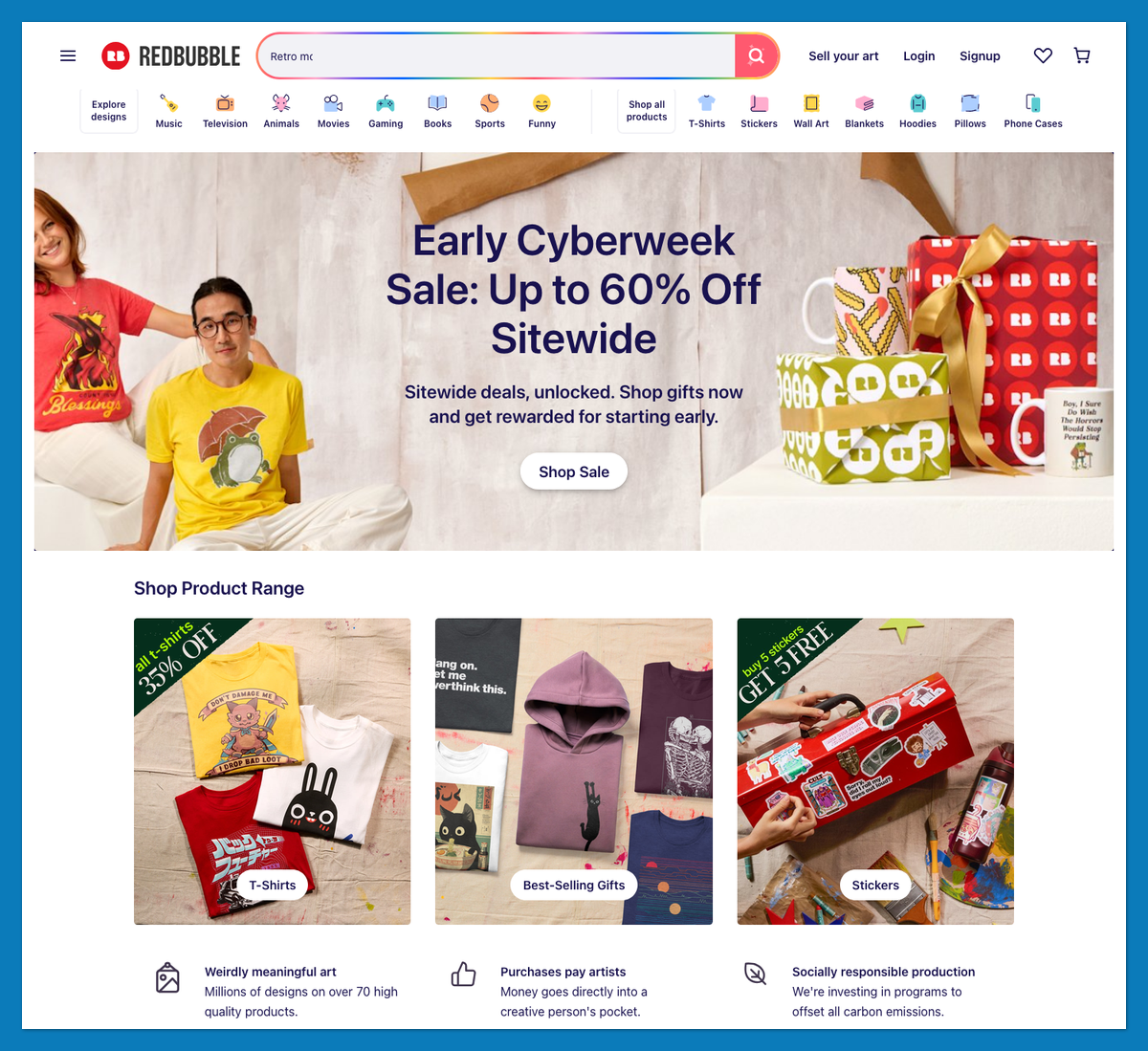
- Clothing: T-shirts and hoodies.
- Home and art: wall art, blankets and pillows.
- Small items: stickers and phone cases.
The Redbubble Partner Program lets approved artists sell officially licensed fan art, with Pro artists fast-tracked. Approvals can take weeks depending on the franchise, and the license covers Redbubble only.
As our Redbubble review explains, the limitation is Redbubble’s fixed catalog. You can’t add an unsupported product or substitute your preferred blank.
Etsy’s Product Range
Etsy’s POD range comes from your chosen partner’s catalog, rather than Etsy manufacturing products itself. Compare the best Etsy print-on-demand companies to choose suitable blanks and providers.
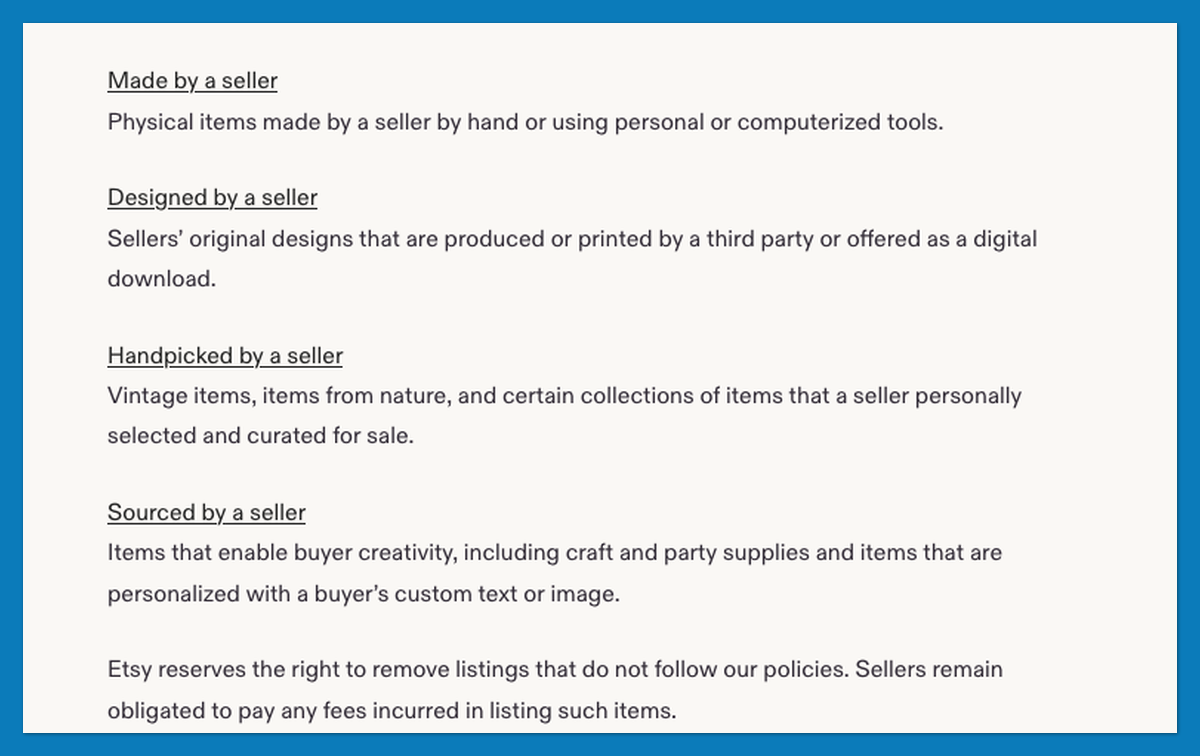
Etsy’s Creativity Standards, updated June 10, 2025, recognize 4 seller categories: “Made by,” “Designed by,” “Handpicked by” and “Sourced by.” Original POD designs qualify as “Designed by a seller”, and you can sell your handmade originals alongside them.
- Original designs only: reselling blank T-shirts doesn’t qualify as seller-designed POD.
- AI-made designs need disclosure: state in the description when you prompted an AI tool.
- No bundles of others’ work: collections of someone else’s designs and AI prompt bundles don’t qualify.
Choose Redbubble for broad product coverage per upload, or Etsy to hand-pick what carries your artwork. Etsy isn’t handmade-only, but your production partner must be disclosed.
How We Compare Marketplaces for Artists
We’ve been testing and reviewing ecommerce platforms since 2012, and we use weighted criteria to explain our recommendations. I compared marketplace policies, investor results and POD prices as of November 2026, then worked through the T-shirt earnings example.
Our weighting prioritizes what artists keep and the audience they can reach:
- Fees and earnings (25%): costs, selling fees and money retained per sale.
- Reaching buyers (20%): audience size, growth and discovery.
- Getting started (15%): costs, setup steps and selling rules.
- Fulfillment and customer service (15%): who prints, ships and answers buyers.
- Branding and control (15%): pricing freedom, product choices, shop identity and terms.
- Product range (10%): eligible products and flexibility for original artwork.
Etsy won rounds worth 60%, versus Redbubble’s 30%, with 10% tied.
Our editorial ratings are 4.1/5 for Etsy and 3.8/5 for Redbubble; the weighted round results support Etsy as the winner. The examples use published prices and fees, so repeat the calculation for your chosen product rather than treating this T-shirt margin as universal.
Etsy vs Redbubble: Our Winner
Etsy is the better choice for most artists. Its larger audience and shop-level control accompany stronger example earnings: $6.89 per tee versus $2.00 to $4.00 on Redbubble, although you manage listings and customer messages. To start, open an Etsy shop and connect Printify.
That said, Redbubble is the better pick for hands-off, zero-upfront-cost selling, particularly for testing which designs sell before paying Etsy listing fees. Most newcomers start on the 50% Standard tier, so convenience takes a substantial share of earnings. If avoiding order management matters more than maximizing each sale, join Redbubble as an artist.
For original artwork, you can run both because Redbubble’s license is non-exclusive; licensed Partner Program fan art stays on Redbubble. Use Redbubble purchases to guide which original designs you list on Etsy, without assuming the audiences will buy identically. If neither fits, compare our Redbubble alternatives or Etsy alternatives before committing your product range to a marketplace.
Etsy vs Redbubble FAQs
Is Etsy or Redbubble Better for Selling Art?
Etsy is better for most artists seeking higher earnings and a shop brand; Redbubble is better for free, hands-off selling. Our T-shirt example leaves $6.89 through Etsy and Printify, compared with $2.00 to $4.00 through Redbubble, depending on tier.
Etsy also has the larger reported audience, but you manage listings and buyer questions yourself. If you’re weighing Redbubble vs Etsy before your first launch, our guide to how to start a print-on-demand business explains how to plan around those responsibilities.
How Much Does Redbubble Take From Artists?
Redbubble charges nothing upfront, then takes 50% on Standard, 20% on Premium or 0% on Pro from monthly earnings. Those percentages apply to the artist margin, not the full retail price, because the base price already covers manufacturing and Redbubble’s service fee.
Standard and Premium also pay an excess markup fee of 50% on earnings from markup above 20%, deducted at sale. Platform fees are capped at $150 per payment period and apply only in months with sales; see round 1 for the example.
How Much Does Etsy Take Per Sale?
Etsy charges 6.5% of the item price plus shipping and gift wrap, alongside US payment processing of 3% + $0.25 and the $0.20 listing fee. On our $25 tee with free shipping and no sales tax, that’s $2.83 before POD costs, or about 11% of the sale.
Offsite Ads adds 15% on attributed orders, dropping to a mandatory 12% at $10,000 in yearly sales, with a $100 cap per order. A separate one-time shop setup fee may apply; its amount appears during setup.
Can You Sell the Same Design on Etsy and Redbubble?
Yes, you can sell your own original work on both platforms. Redbubble’s license is non-exclusive, and Etsy accepts original designs manufactured by a disclosed production partner under “Designed by a seller.”
The exception is officially licensed fan art approved through the Redbubble Partner Program: that permission covers Redbubble only, not an Etsy listing. Use Redbubble to identify which designs sell, then select those designs for Etsy, while remembering that different audiences won’t necessarily buy the same artwork.
How Does Redbubble Decide Your Account Tier?
Redbubble assigns your tier using design quality and artistic skill, alongside design volume, account activity, commercial success and compliance with community guidelines. You cannot buy a tier or request an upgrade.
Standard generally covers new artists, while Premium targets artists with a personal brand or established following. Pro is invite-only, through the top-seller and Artist Ambassador programs reviewed at the start of each year. Redbubble upgraded some accounts before its September 1, 2025 fee change, but don’t budget on receiving a higher tier.
When Does Redbubble Pay Artists?
Redbubble pays once a month, by the 15th, for eligible orders shipped during the previous month. Your balance after fees must reach the $10 minimum payout threshold; smaller balances roll over until you qualify.
Payments use verified PayPal or bank transfer, with US ACH transfers taking 1 to 3 business days to arrive after release. Add your payment details early because missing information can trigger Redbubble’s Unpayable Artist Account Fee. By comparison, new Etsy sellers receive weekly deposits by default, although payment reserves can delay access to funds.


Comments 0 Responses