

Artisan Furniture is my first recommendation for a focused furniture store, while BrandsGateway is my pick for luxury fashion. The best high-ticket dropshipping suppliers give you more than expensive products: you need suitable regional stock, workable shipping costs, and returns you can afford to handle.
For this guide, I’m treating products selling for roughly US$200 or more, or the local equivalent, as high-ticket. There is no universal cutoff, and these suppliers also carry less expensive items.
International fit matters, too. A supplier serving Germany might offer very different terms for Australia. If you’re new to the model, start with this explanation of how dropshipping works.
Key Takeaways
- Choose Artisan Furniture for a specialist furniture store, but distinguish locally stocked pieces from on-demand products.
- Choose BrandsGateway for luxury fashion, provided your budget covers subscriptions and condition-sensitive returns.
- Choose AppScenic to compare regional suppliers, rather than committing immediately to a single manufacturer.
- Choose BigBuy for selling across European channels, provided you can handle unwanted customer returns yourself.
- Choose GigaCloud for bulky-product sourcing, especially through its documented US Shopify setup.
| Supplier | Best for | Supplier model | Geographic fit | Starting access cost | Main caution |
|---|---|---|---|---|---|
| Artisan Furniture | Solid-wood furniture | Manufacturer and supplier | Regional UK, US, EU, Canadian and Australian programs | No UK setup fee; optional paid syncing | Stocked and on-demand lead times differ |
| BrandsGateway | Luxury fashion | Fashion supplier | International, destination-dependent | Grow: $209/month | Returns and split shipments add complexity |
| AppScenic | Comparing regional suppliers | Supplier marketplace | US, UK, EU, Canada, Australia and other supported routes | Free browsing; ordering from $39/month | Supplier-specific terms and wallet fees |
| BigBuy | European multichannel selling | Stockholding wholesaler | Europe-first | Quote for selected package | Perfect-condition customer returns not accepted |
| GigaCloud | Bulky goods | B2B supplier marketplace | US app route; other markets need confirmation | Free signup and US Shopify app | Seller-specific returns and warranties |
1. Artisan Furniture: Best for Solid-Wood Furniture Stores
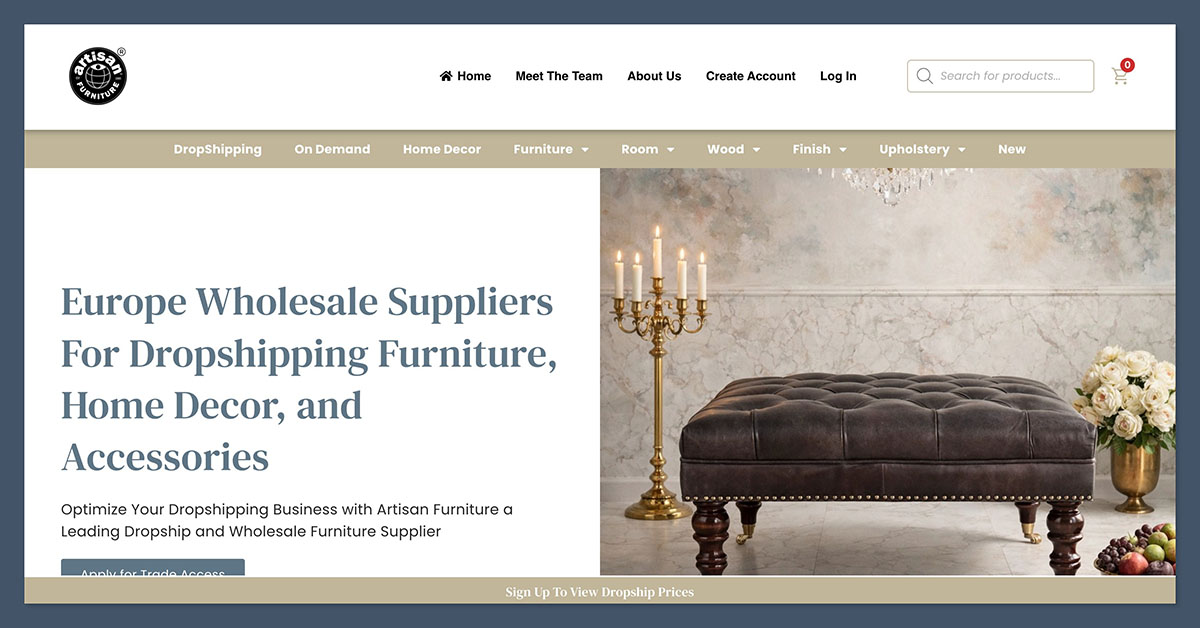
I recommend Artisan Furniture if you want a coherent furniture range rather than a general catalog. Its specialist approach makes more sense for a store built around materials and room styles, although AppScenic offers more scope to compare unrelated categories.
Quick facts
- Business model: Furniture manufacturer with regional dropshipping programs.
- Product focus: Solid-wood furniture and storage furniture.
- Integration approach: Free manual CSV uploads or optional paid data syncing.
Why I Recommend Artisan Furniture
Artisan manufactures furniture in Jaipur, India, but operates regional fulfillment centers. That distinction matters: manufacturing origin does not mean every customer order ships from India.
Its delivery arrangements are geographically specific. Mainland UK and contiguous US delivery are free within the relevant programs. EU delivery is free within Spain and Germany, with surcharges elsewhere in the EU. Canada’s program advertises coverage across 10 provinces. In Australia, metro delivery is free, with surcharges for regional and remote addresses.
I would build your opening assortment around stock in the hub serving your customers. Most hubs serve their own territories, so choose the regional program before building your catalog.
Pros
- A focused catalog supports a specialist store. The US range centers on solid-wood furniture and storage furniture. I would use that focus to create consistent collections rather than importing everything available.
- You can start without bulk purchasing. The UK dropshipping program has no setup fee or minimum order quantity. It requires a registered business, but VAT registration is not a prerequisite.
- Catalog maintenance has a low-cost starting route. Free CSV uploads let you manage a small range manually before paying for synchronization. That separates the sourcing decision from the automation decision.
Cons
- On-demand products need a different sales promise. The Country Style Sideboard is fully assembled solid mango wood, but its listed on-demand lead time is a minimum of 12 to 16 weeks. A customer who needs furniture next week will need a stocked alternative.
- Damage reporting leaves little room for delay. The global returns policy generally gives you 2 working days to report damage, defects, or missing parts, with supporting images or video.
Limitations to Plan Around
Standard dropshipping does not include the change-of-mind return benefit offered through Artisan’s separate Fulfilment Program. Before listing a piece, decide how you would handle a customer who simply dislikes it.
You should also explain normal artisanal variation on product pages and ask customers to retain packaging. For expensive furniture, clear expectations about finish and delivery can be as important as attractive photography.
My recommendation is to launch with a manageable stocked collection. Add on-demand pieces only when your product pages and customer service can support the longer wait.
Artisan Furniture Pricing
Automated syncing covers product information, images, inventory, and pricing. It does not, by itself, establish automatic order forwarding. Paid syncing is nonrefundable, and your store-side integration remains your responsibility.
| Access or service | Cost | Scope |
|---|---|---|
| UK dropshipping setup | No setup fee | Goods and applicable delivery charges separate |
| Manual CSV uploads | Free | Merchant-managed uploads |
| UK automated syncing | £119/year plus VAT | Per region |
| US automated syncing | US$119/year plus applicable sales taxes | Per region |
| EU automated syncing | €119/year plus VAT | Per region |
| Canadian automated syncing | C$119/year plus applicable taxes | Per region |
| Australian automated syncing | A$119/year plus GST | Launch-phase offer |
2. BrandsGateway: Best for Luxury Fashion

BrandsGateway is my recommendation for a fashion-led business comparing luxury dropshipping suppliers. It suits a curated boutique better than a general store, but its subscription overhead makes casual catalog experimentation expensive.
Quick facts
- Product focus: Branded fashion, including clothing, bags, and accessories.
- Access: Free catalog browsing; paid dropshipping integration.
- Store platforms: Integration options include Shopify, WooCommerce, Wix, Shift4Shop, and BigCommerce.
Why I Recommend BrandsGateway
BrandsGateway separates dropshipping from wholesale purchasing, and dropshipping has no minimum order requirement. You should not apply its separate wholesale minimum to individual customer orders.
I would shortlist specific products before subscribing. Start with the sizes and styles your audience wants, then calculate shipping to their location. A recognizable brand name will not rescue a product that is too expensive to deliver.
The useful regional control is warehouse filtering. You can narrow the catalog by European or US warehouse availability rather than assuming every product ships from the closest location.
Pros
- The assortment fits a premium fashion proposition. You can build around a particular category or customer instead of combining unrelated expensive items. I would favor a narrow opening collection with clear sizing information.
- Plugins reduce repetitive store administration. Inventory synchronization and order forwarding help keep your storefront aligned with supplier availability. However, forwarded orders still require you to finalize shipping and payment and pay for fulfillment.
- You can examine wholesale prices before committing. Free browsing makes it possible to check candidate products against realistic selling prices before adding a recurring integration bill.
Cons
- One basket can generate several shipping charges. Orders containing products from different warehouses are split into separate shipments. That makes mixed-warehouse merchandising a cost decision, not just a styling decision.
- Returns require prompt action and the correct courier. The dropshipping return window is 14 days from customer receipt, with items sent back within that period. Returns must use UPS, FedEx, or DHL rather than ordinary postal services.
Limitations to Plan Around
Worldwide shipping is destination-dependent, not a promise of universal coverage or a guaranteed arrival date. Check the actual route before publishing delivery estimates.
Returned items also need their original condition and packaging, including relevant tags and accessories. Commercial terms put return customs charges on the buyer, so international reverse shipping deserves its own budget.
I would avoid building campaigns around a single irreplaceable item. A compelling product page is less useful if replenishment cannot support the campaign.
BrandsGateway Pricing
The displayed USD monthly plans below cover 1 connected store per subscription. Confirm the selected platform and currency before checkout. Subscriptions are nonrefundable, so I would finish the catalog and shipping checks first.
| Plan | Monthly billing | Product imports |
|---|---|---|
| Grow | $209/month | Up to 1,000 |
| Scale | $289/month | Up to 5,000 |
| Enterprise | $799/month | Unlimited |
| Separate REST API/CSV package | $459/month | Confirm package scope |
For a focused boutique, the entry plan’s import allowance may be sufficient. Paying for more products only makes sense if you have a merchandising reason to list them.
3. AppScenic: Best for Finding Suppliers Across Multiple Regions
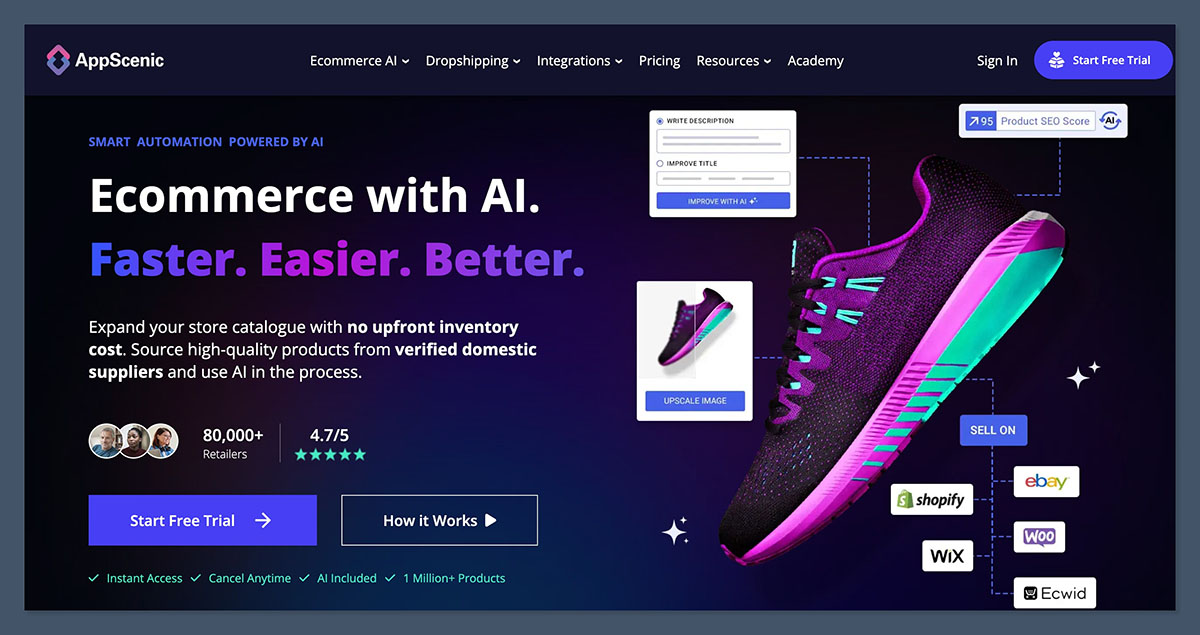
I recommend AppScenic when your first task is finding suitable regional supply, not choosing a single manufacturer. It gives you more suppliers to compare than Artisan Furniture, but each comes with its own shipping and return terms.
Quick facts
- Business model: Supplier marketplace and automation service.
- Regional scope: Suppliers in the US, UK, EU, Canada, Australia, and elsewhere.
- Starting approach: Browse products first, then choose an ordering plan.
Why I Recommend AppScenic
AppScenic’s higher-value categories include kitchen islands, espresso machines, massage chairs, and high-end bikes. I like that range for merchants still choosing a niche: you can compare several higher-value categories before committing to one.
Its furniture marketplace is also useful if you want to compare furniture dropshipping suppliers across regions rather than adopt one supplier’s entire aesthetic.
The most useful starting point is the distinction between Ship From and Ship To. A product located in your preferred country is not necessarily available for every destination you serve.
Pros
- You can narrow products around a real delivery route. The catalog filters cover origin, destination, price, and stock status. I would apply those before comparing product photos or recommended retail prices.
- Product cards expose practical buying information. Processing time and location-specific delivery costs help you reject unsuitable listings early. That is more useful than comparing supplier prices without freight.
- Payment automation has configurable timing. The wallet can pay orders after a selected hold period of 6, 12, 24, or 36 hours. Choose the delay around your order-review process.
Cons
- Wallet funding adds another cost layer. Deposits incur payment processing fees, with estimated and actual charges shown in the account. Include these separately from your storefront’s payment fees.
- Return terms vary by supplier. Each product’s Return Policy tab sets out the accepted conditions and timeframe. You cannot safely write one generous store policy and assume every supplier will absorb it.
Limitations to Plan Around
Read the separate Supplier Policy tab before listing an item, too. Two similar-looking products can come with different terms, even when their prices are close.
AppScenic labels selected products Premium. That badge affects which subscription you need, but it does not mean a product meets a particular high-ticket price threshold.
Automation also needs funding. Auto-funding replenishes the wallet from a saved payment method when your threshold is reached. I would set that threshold deliberately, especially before selling products with a large supplier payment.
There is no single delivery promise you can apply across this marketplace. Build your customer estimates around the specific supplier, product, and destination.
AppScenic Pricing
AppScenic’s monthly pricing lets you browse for free, but you need a paid plan to place orders. Paid plans include automatic ordering, price and stock synchronization, and tracking imports.

| Plan | USD monthly price | Stores | Pushed products | Premium access |
|---|---|---|---|---|
| Standard | $39 | 1 | 100 | No |
| Pro | $79 | 3 | 5,000 | Yes |
| Elite | $99 | 10 | 20,000 | Yes |
I would choose Pro only when your selected products need Premium access or you exceed Standard’s limits. An expensive product does not automatically require a higher subscription.
4. BigBuy: Best for Selling Across European Channels

BigBuy is my pick for European multichannel selling. I would review its return terms before deciding whether its integrations suit your store.
Quick facts
- Business model: Wholesaler holding stock in its own European warehouse.
- Order model: Single-unit wholesale purchases with direct customer dispatch.
- Best fit: Europe-focused merchants with established customer-service processes.
Why I Recommend BigBuy
BigBuy’s dropshipping program combines stockholding with neutral shipping. Delivery notes can carry your retailer identity without BigBuy advertising or product prices.
That is a different proposition from AppScenic’s multi-supplier discovery model. I would consider BigBuy when coordinating your store and external sales channels matters more than comparing several suppliers for each product.
Pros
- European stock provides a defined sourcing base. You can evaluate products against a European fulfillment route rather than start with an unrestricted global catalog. Destination-specific checks remain necessary.
- Integration covers more than product imports. Synchronization options extend to stock, orders, carriers, shipping, and tracking. Ask which functions are included for each channel you intend to use.
- Shopify has a dedicated integration route. BigBuy’s Shopify offering gives merchants a platform-specific starting point, although connector scope and cost should be confirmed with the package.
Cons
- Change-of-mind returns can become your inventory. BigBuy’s aftersales policy does not accept perfect-condition products returned by your customers. You need somewhere to receive, inspect, and potentially resell them.
- Preparation time is not delivery time. The advertised 24 to 48 hours applies to preparation for most products. Arrival estimates depend on the courier and destination, with product-specific preparation details and cart estimates.
Limitations to Plan Around
You remain responsible for end-customer aftersales. BigBuy asks customers to report incidents within 48 hours and gives merchants 5 calendar days to raise an incident. Visible packaging damage should be recorded on delivery documentation.
That creates a workflow requirement: your support inbox cannot sit unattended while a reporting deadline expires. I would prepare a damage-report form and photo instructions before launching furniture listings.
For destinations outside the EU, additional customs procedures can apply. Destination duties and import expenses are not included in the shipping charge and are charged to the recipient.
BigBuy Pricing
Request a current quote for the selected wholesaler pack, including setup, recurring charges, and your intended connectors. Compare the complete configuration, not an isolated subscription figure.
| Package | Scope to discuss | Pricing approach |
|---|---|---|
| B2B | Purchasing access and applicable services | Current quote |
| Ecommerce | Multi-Channel Integration Platform, API, CSV/XML catalog, and bulk orders | Current quote with store connector |
| Marketplaces | Intended marketplace connections and included services | Current quote by channel configuration |
Wholesale and recommended retail prices are displayed without VAT. Keep your tax treatment separate from the apparent product-price spread when assessing costs.
5. GigaCloud: Best for Bulky Products and US Fulfillment
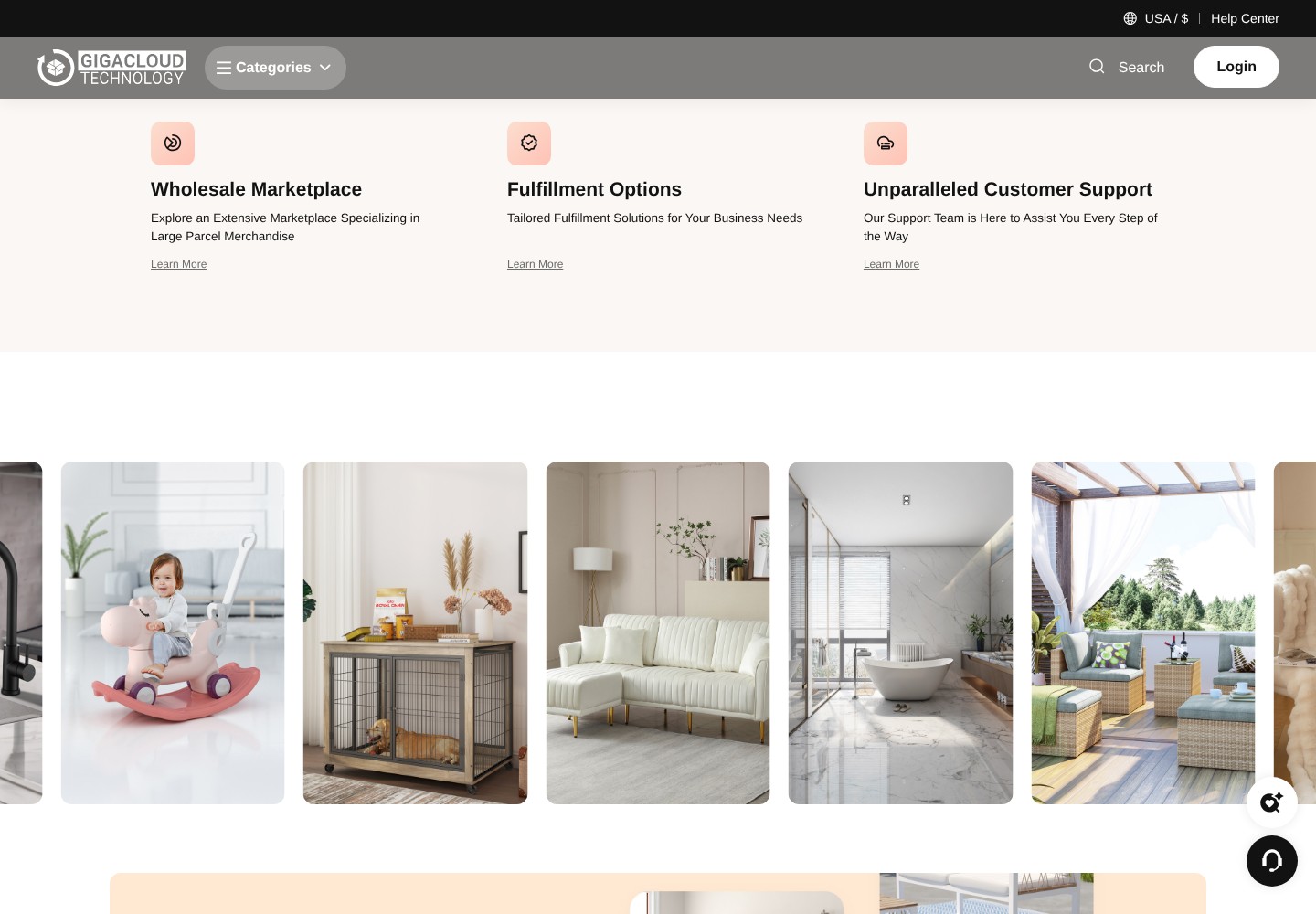
GigaCloud is my recommendation for bulky-product sourcing when logistics are central to the decision. Its clearest app-based route is for US Shopify merchants, not every international store that happens to sell to US customers.
Quick facts
- Business model: B2B marketplace connecting individual suppliers and resellers.
- Product focus: Large goods, including home furnishings, appliances, and fitness equipment.
- Shopify restriction: The GIGA-US app is available only to US Shopify users.
Why I Recommend GigaCloud
GigaCloud’s marketplace model brings sourcing, payments, and fulfillment together. Supplier Fulfilled Retailing allows products to go directly to your customers.
For large goods, I find that combination more relevant than catalog size alone. The delivery service matters as much as the product listing when your customer is ordering something they cannot easily move alone.
Its international fulfillment footprint includes the US, Canada, UK, Germany, and Japan. However, warehouse presence does not establish consumer delivery coverage or app eligibility in every one of those markets.
Pros
- The logistics offering addresses bulky-goods requirements. Services include warehousing, pick-and-pack, less-than-truckload freight, and last-mile delivery. I would ask for a route-specific service quote rather than assume standard parcel handling.
- Eligible Shopify users have a dedicated automation option. The free GIGA-US app advertises inventory and price updates, automatic purchasing, and order synchronization. Its US-only restriction is the important boundary.
- You can source without a bulk minimum. Marketplace signup is advertised as free, with individual or bulk purchasing and no minimum order quantity. That avoids committing to a container simply to investigate a range.
Cons
- Marketplace access does not standardize seller obligations. Returns and warranties depend on the seller and applicable order terms. Evaluate the actual vendor behind a promising product, not only the platform hosting it.
- Delivery service levels require clarification. Do not assume upstairs placement, assembly, or white-glove delivery. Ask what the quoted service includes and whether access restrictions trigger additional charges.
Limitations to Plan Around
The Shopify integration allows product details and images to be transferred and edited, while supplier communication takes place in the marketplace. I would use that communication channel to settle damage procedures before listing bulky items.
GigaCloud also advertises EDI/API automation, but merchants outside the US app route should confirm integration access through reseller onboarding. Do not infer eligibility from the broader logistics network.
For a refund or replacement, you submit a return merchandise authorization request to the seller. Its marketplace agreement sets out that process, but you still need the individual seller’s return terms.
I would shortlist a few sellers and compare their return addresses, warranty handling, and delivery quotes side by side. A cheaper product is not necessarily the better choice if a damage claim becomes harder to resolve.
GigaCloud Pricing
Free access does not mean free fulfillment. Goods, logistics, and applicable service charges still determine your operating cost.
| Cost component | Charging basis |
|---|---|
| Marketplace signup | Advertised as free |
| GIGA-US Shopify app | Free for eligible US Shopify users |
| Products and logistics | Charged with the order |
| Additional services | Applicable fee schedules |
| Taxes and duties | Separate unless specified |
How To Choose a High-Ticket Dropshipping Supplier
Start with a destination and a specific product, not the supplier’s headline price. I would compare 3 candidate SKUs using the same customer postcode and the same delivery requirements.
That turns a vague supplier comparison into a usable commercial decision.
- Confirm regional stock. Ask whether the exact SKU is available in the intended warehouse. A regional website or warehouse network does not guarantee that your chosen item is held locally.
- Specify the delivery service. For furniture, distinguish curbside delivery from threshold or room-of-choice service. Ask about appointments, stairs, restricted access, and remote-area charges before writing your shipping policy.
- Price the return journey. Establish the return address, authorization process, packaging requirements, and who pays. Also decide where an unwanted product goes when the supplier refuses change-of-mind returns.
- Trace the automation. Product imports, stock updates, order forwarding, payment, and tracking are separate functions. Ask which steps run automatically and which still need your approval or funding.
- Calculate landed cost. Include product cost, freight, payment charges, applicable duties, software allocation, and a returns allowance. A supplier’s recommended retail price is not evidence that customers will pay it.
Supplier B2B terms do not define all your obligations to customers. Check the requirements in your selling markets separately rather than copying a supplier policy into your storefront.
An Illustrative Cost Calculation
The example below is deliberately hypothetical. It is not a typical margin, supplier quote, or earnings forecast.
| Illustrative item | Amount |
|---|---|
| Selling price, excluding sales tax | $1,000 |
| Supplier product cost | $580 |
| Outbound freight | $120 |
| Payment costs | $30 |
| Allocated software cost | $15 |
| Assumed returns and damage reserve | $55 |
| Remaining contribution before advertising and other overhead | $200 |
The $200 is not net profit. It still needs to cover advertising and business overhead, and the reserve is only an assumption. A costly return could exceed it.
Use the dropshipping profit calculator to explore your own figures, then run a less favorable scenario. Increase freight, lower the selling price, and add a return charge. If the product only works under optimistic assumptions, I would not launch it.
Finally, consider cash timing. You may need to fund a supplier order before your payment provider releases the customer’s money. A few expensive orders can create a substantial funding gap, even when sales are going well.
How I Chose These Suppliers
I prioritized documented dropshipping programs with relevant higher-value categories, clear geographic scope, and usable information about costs and aftersales.
This comparison is based on desk research of official program pages, pricing, integration documentation, and commercial policies. I did not place test orders, inspect products, or measure delivery performance.
My recommendations reflect product specialization, regional fit, automation scope, and the risks you retain as the retailer. I have not assigned numerical scores because these businesses solve different sourcing problems, and documentation alone cannot establish fulfillment reliability.
Prices are current as of October 2026. Confirm the selected currency, billing term, taxes, and destination charges before paying.
Which High-Ticket Dropshipping Supplier Do I Recommend?
I would start with Artisan Furniture for a specialist furniture business or BrandsGateway for premium fashion. Their focused ranges give you a clearer merchandising direction than a broad catalog.
Choose AppScenic when you still need to compare regional suppliers. BigBuy makes more sense for European multichannel operations with an aftersales plan, while GigaCloud deserves attention for bulky goods through its supported US setup.
Your next step should be product-specific: request a shipping quote for your customer’s location, get written return and warranty terms, and arrange a sample where practical. Commit to the supplier only after the chosen product’s full operating cost makes sense.
FAQs
Can I use these suppliers to sell internationally?
Yes, where the supplier, product, and delivery route support your destination. International dropshipping suppliers do not necessarily offer the same stock, rates, or returns across countries.
Start with one customer market and verify its fulfillment route. GigaCloud’s international infrastructure, for example, does not remove the GIGA-US app’s restriction to US Shopify users.
Does selling expensive products mean higher profits?
No. A higher order value can leave more money after product costs, but freight, acquisition costs, returns, and payment fees may absorb it.
Compare contribution after variable costs rather than the difference between wholesale and recommended retail prices. You also need enough working capital to fund supplier payments and customer refunds.
Can I start without paying for supplier membership?
Some routes allow it. Artisan’s UK dropshipping setup has no setup fee, and GigaCloud advertises free marketplace signup and a free eligible US Shopify app.
BrandsGateway and AppScenic let you browse before paying, but their dropshipping integration or ordering access requires a paid plan. None of these arrangements eliminates product, delivery, or store operating costs.



Comments 0 Responses