

Best Overall

Fourthwall
View Pricing Read Review →No monthly fees on the standard plan
Organic t-shirts from $14.52
- 40+ sustainable products, GOTS or PETA certified
- Free storefront included
- Merchant of Record tax handling
Largest eco catalog

Printful
View Pricing Read Review →Free account, no monthly fee
Pay the base price per order
- 300+ eco products, 70% organic or recycled minimum
- GOTS, OCS, GRS and RCS verified
- Published yearly sustainability reports
Best plastic-free

TPOP
View Pricing Visit TPOP →Free account, no monthly fee
Pay the base price per order
- 100% plastic-free packaging
- GOTS 5.0 and OEKO-TEX ECO PASSPORT inks
- Fair Wear textile supply chain
According to OEKO-TEX, terms like “eco-friendly,” “natural,” and “non-toxic” aren’t regulated and can be used by any brand without proof. That’s why a sustainability-focused POD search has to start with what the platform is actually certified for, not what it calls itself. The motivation is real: 78% of consumers say sustainability matters when they buy, and that share skews even higher among Gen Z and millennial customers.
After evaluating 8 platforms against stacked third-party certifications (GOTS, OEKO-TEX, GRS, RCS, FSC, Fair Wear, PETA Vegan), named carbon offset programmes, and published year-on-year sustainability data, Fourthwall is our top pick because it handles more of the work around building a sustainable brand: 40+ eco products, a free storefront, and tax handling as your Merchant of Record. Printful remains the pick for the broadest verified eco catalog backed by the strongest published progress data in the industry.
Key Takeaways
- Fourthwall is our top pick overall: 40+ eco products (organic tees from $14.52) plus a free storefront and Merchant of Record tax handling, though it publishes no sustainability report.
- Only 2 of 8 platforms are genuinely plastic-free in packaging: TPOP and Inkthreadable. Printful’s mailers are recycled plastic (PCR), not plastic-free.
- Only 2 of 8 run on 100% renewable energy at the production facility: Teemill (Isle of Wight) and Shirtigo (Germany).
- Only 1 platform operates a true circular return loop: Teemill, with QR-code garment returns and £5 credit.
- Gelato has the lowest shipping carbon of any global POD: 99.6% same-region fulfillment across 130+ partners in 32+ countries.
- None of the 8 platforms is B-Corp certified at the time of writing (April 2026). Stacked third-party certifications are the credible workaround.
- Printful has the largest verified eco catalog: 300+ products meeting a 70% organic or recycled minimum, certified by GOTS, OCS, GRS, or RCS.
The 8 Eco-Friendly POD Platforms at a Glance
Quick-reference table comparing all 8 platforms across the dimensions that actually matter when you’re picking a supplier. Full profiles follow.
| # | Platform | HQ / Fulfillment | Packaging | Key Certifications | Trustpilot | Best For |
|---|---|---|---|---|---|---|
| 1 | Fourthwall | Venice, CA, US | No plastic-free promise | GOTS or PETA (organic and vegan lines) | 4.2/5 (387) | Building a sustainable brand with storefront and tax handled |
| 2 | Printful | US + EU + global | PCR plastic (70-100%) | GOTS, OCS, GRS, RCS, OEKO-TEX | 4.6/5 (thousands) | Largest verified eco catalog at scale |
| 3 | TPOP | France / EU | 100% plastic-free | GOTS 5.0, OEKO-TEX ECO PASSPORT, OCS, Fair Wear | 4.8/5 | Plastic-free EU shipping |
| 4 | Teemill | Isle of Wight, UK | 100% plastic-free | GOTS, Good On You “Great” | “Excellent” (4,066+) | Circular economy return loop |
| 5 | Inkthreadable | UK | 100% plastic-free (since 2019) | OEKO-TEX, GOTS (Stanley/Stella), PETA Vegan, Fair Wear | 4.6/5 (900+) | 100% vegan catalog |
| 6 | Apliiq | Los Angeles, US | Standard | GOTS (organic cotton line) | 3.2/5 (low volume) | US streetwear with hemp + private label |
| 7 | Shirtigo | Germany | 100% recycled paper boxes | GOTS, OEKO-TEX (Stanley/Stella), PETA Vegan, Fair Wear | Mixed (107 reviews) | EU renewable-energy production |
| 8 | Gelato | Global (32+ countries) | Partner-dependent | FSC, EcoVadis supplier audit | 4.7/5 (800+) | Lowest global shipping carbon |
Here’s the certification glossary worth memorizing before you start comparing the best eco-friendly print on demand companies:
| Certification | What it covers |
|---|---|
| GOTS (Global Organic Textile Standard) | Entire supply chain: organic farming, chemical inputs, water treatment, AND fair labor |
| OEKO-TEX Standard 100 | Tests finished product for 100+ harmful chemicals (heavy metals, formaldehyde, pesticides, phthalates). Does NOT certify organic farming or fair wages |
| GRS and RCS | Verify recycled content and chain of custody |
| FSC | Covers paper and wood sourcing |
| PETA-approved Vegan | Confirms no animal materials |
| Fair Wear Foundation | Audits labor practices |
They’re complementary, not interchangeable.
Now the greenwashing red flags to watch for:
- “Recyclable packaging” usually still means plastic, just plastic that can be recycled (assuming the customer’s local facility accepts it).
- “We love the planet” without a single named certification body is a marketing line, not a credential.
- “Water-based inks” alone is a low bar that almost every modern POD platform hits.
- “Carbon-neutral shipping” without naming the offset programme (Ecologi, DHL GoGreen, Verra) is unverifiable.
- No published annual sustainability report with year-on-year data is a signal that nobody’s keeping score.
The 8 platforms below each stack credentials you can actually point to. They’re not all perfect (Fourthwall publishes no sustainability report, Printful’s mailers are still plastic, Apliiq’s review base is tiny, Shirtigo has print-durability complaints), but each one stacks credentials you can actually point to. The lineup covers the full geographic and use-case range, alongside the wider best print-on-demand companies landscape.
Let’s start with our top pick.
1. Fourthwall: Best Overall

I realize that Fourthwall might seem like an odd first choice, since it doesn’t really advertise sustainability as much as most of the other brands on this list. Still, it does offer more than 40 eco products, and it’s adding new options all the time. Some choices are already pretty unique, like waterproof bags or the Econscious tote that can carry as much as 30 pounds.
Although the range you get from Fourthwall is a bit smaller than you might see on something like Printful, you still get plenty of variety, and you get the added bonus of knowing that not only are the
Also, Fourthwall gives you things that other print-on-demand providers overlook. First of all, you can print on more parts of certain garments, like the sleeves and inside labels. More importantly, you also get a free storefront alongside the print-on-demand catalog, so you’re not paying separately for something like Shopify.
Beyond that, Fourthwall gives companies ways to add to their product collections with digital downloads and memberships that don’t cause any waste whatsoever. It even acts as your Merchant of Record for Tax to help you out with the tricky parts of growing your business.
The useful facts:
- Over 40 sustainable products
- Organic t-shirts starting from $14.52
- 100% organic cotton options and GOTS or PETA certification
- No monthly fees on the standard plan
- Included storefront
- Custom sourcing for more unusual products
Despite not having the same “annual sustainability reports” some other companies promote, Fourthwall comes out on top because it handles more of the stuff around building a sustainable brand than simply giving you a good range of products.
The honest weaknesses:
- Fourthwall doesn’t really publish any sustainability reports
- It doesn’t give you a lot of information about product transportation
- Other companies have larger catalogs with more eco-friendly options
- No verified plastic-free packaging promise
Best for: Fourthwall is great if you want help building a sustainable brand, rather than just a great selection of products. It helps you handle the challenging parts of launching and running a store far better than most POD providers.
Skip if: You need a much larger collection of products, or you genuinely want to see published emissions data or sustainability reports.
2. Printful: 300+ Eco Products, the Largest Verified Catalog (and the Honest PCR Plastic Caveat)
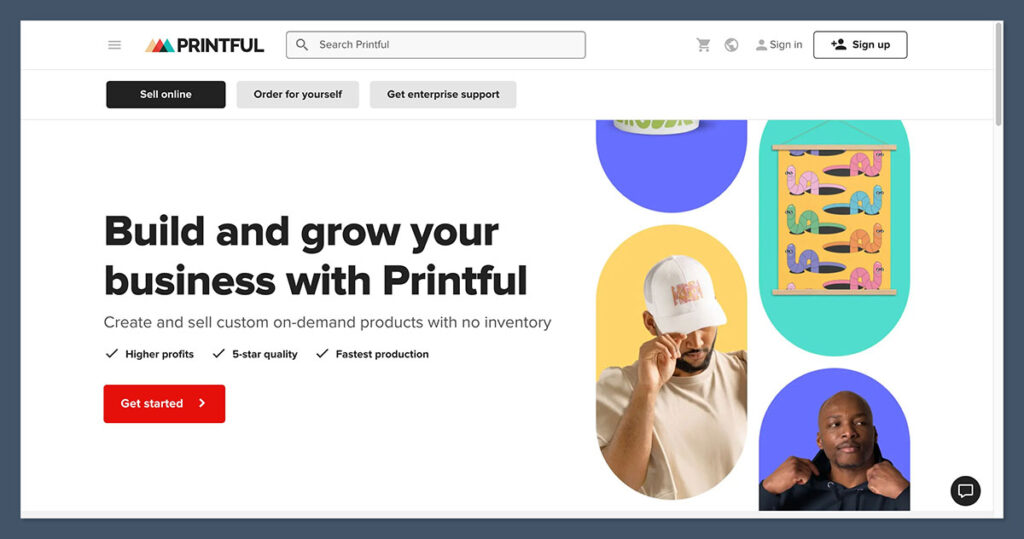
Printful review coverage gets the broad picture, but on the eco angle specifically: Printful has the largest verified eco catalog of any platform in this guide, with 300+ products requiring a minimum 70% organic or recycled materials, certified by GOTS, OCS, GRS, or RCS. But Printful’s mailers are still plastic. They’re recycled plastic, but not plastic-free.
The verified eco catalog is the strength worth taking seriously. Across organic cotton, recycled polyester, and certified blends, Printful’s 70% threshold is a stated bar that excludes most of its own conventional catalog. Verification runs through GOTS or OCS for organic content and GRS or RCS for recycled content. All inks are OEKO-TEX certified, vegan, and biodegradable. For a brand that needs scale plus verified credentials in one place, the breadth is a real differentiator over the niche EU and UK platforms.
The honest plastic caveat needs naming clearly. Printful’s apparel packaging in North America is 90-100% post-consumer recycled (PCR) plastic, made from used shopping bags and wrapping film. Globally, PCR content is at least 70% for apparel mailers. PCR plastic is still plastic, it doesn’t biodegrade, it can shed microplastics, and it creates plastic waste at end-of-life. TPOP and Inkthreadable use cardboard or recycled-material soft sleeves with no plastic component at all. If your audience cares about plastic-free shipping as a marketing claim, Printful is not the pick.
The published progress data is genuinely useful:
- Printful’s CY2024 Sustainability Report (the first joint report covering the merged Printful + Printify entity, post the Fyul transaction) shows eco products drove 7% of total revenue in 2024, with a 10% target for 2025
- Operational emissions are down 24% since 2021
- Sedex partnership covers ethical labor compliance
- In 2022, Printful recycled nearly 800,000 lbs of excess fabric
- Trustpilot sits at 4.6/5 from thousands of reviews, the strongest sample size of any platform in this guide
The honest weaknesses round it out:
- Eco products are only 7% of Printful’s revenue, so the vast majority of the catalog is conventional product
- PCR plastic is still plastic
- Base prices run higher than Printify or Gelato
- No confirmed B-Corp certification
- No named carbon offset programme for shipping emissions
Best for: high-volume brands with US + EU customers who want the broadest eco SKU selection backed by GOTS/GRS verification and published sustainability reports. Skip if: plastic-free packaging is a core green claim for your brand (PCR is still plastic), or if eco products are your entire focus (only 7% of Printful’s catalog hits the eco bar).
3. TPOP: Zero-Plastic Packaging and GOTS 5.0 Certified Inks (France)
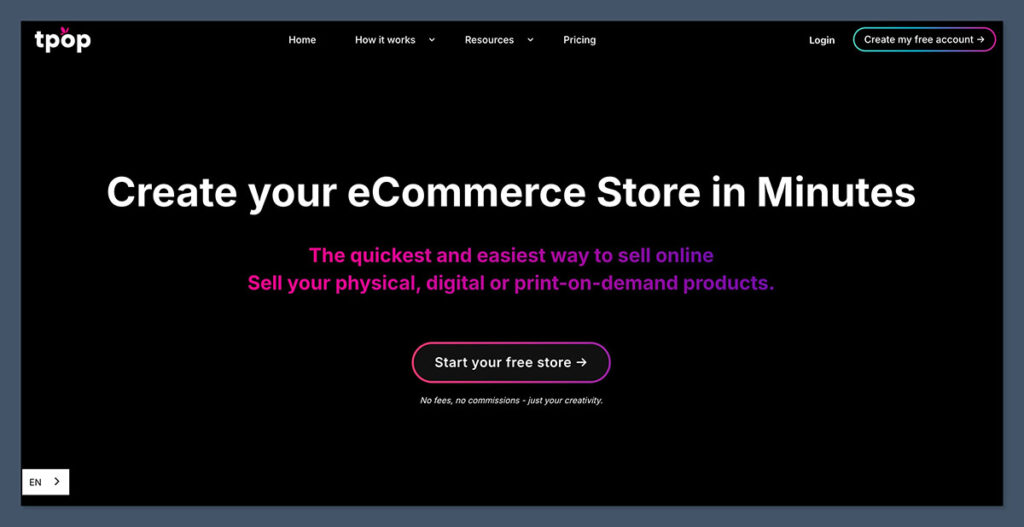
TPOP doesn’t use plastic anywhere in its packaging. Not in the mailer, not as a polybag, not as tape. Every order ships in cardboard sleeves or recycled-material soft sleeves. Of the 8 platforms in this guide, only TPOP and Inkthreadable can make that claim.
The certification stack is the headline. That’s five third-party credentials layered on a single platform, while most competitors stop at one or two:
- Inks: GOTS 5.0 certified AND OEKO-TEX ECO PASSPORT certified, water-based, and vegan
- Textiles: STANDARD 100 by OEKO-TEX, OCS certification, and Fair Wear Foundation affiliation
Two 2025 facts make TPOP unusual:
- It transitioned its entire textile catalog to DTF printing in 2025 and developed its own eco-friendly DTF film substrate, the only one of its kind in Europe. Standard DTF films are PET plastic-based, and TPOP built a proprietary alternative to keep the eco story intact while moving to a softer hand-feel print.
- It sits at 4.8/5 on Trustpilot (“Excellent”), the highest of any platform in this guide. Roughly 51.3% of TPOP’s Shopify users are based in France, which tells you exactly where the platform’s gravity is.
The Fair Wear Foundation affiliation deserves its own note because it’s the labor-audit credential most POD platforms skip. Fair Wear is an independent multi-stakeholder organization that audits garment factories on living wages, working hours, and freedom of association. Pairing a Fair Wear textile supply chain with GOTS 5.0 organic ink certification gives you both the environmental and the social half of “sustainable production” with one supplier. Branded packing slips and white-label fulfillment round out the seller toolkit, with integrations for Shopify, WooCommerce, Etsy, and direct ordering.
Now the honest weaknesses:
- EU-focused fulfillment, so shipping times and costs go up sharply for US or non-EU customers (think 5 to 14 days outside the EU)
- Smaller product catalog than Printful or Gelato
- No confirmed B-Corp certification
- The 2025 DTF transition is genuinely new, so long-term performance of the proprietary eco film at scale is something I’d want to validate with a sample order before committing a full launch
Best for: EU-focused brands selling to customers who care about plastic-free shipping and full-supply-chain organic certification. Skip if: you ship primarily to the US, where delivery and costs become a problem fast.
4. Teemill: The Only POD Platform With a True Circular Economy Return Loop (UK)
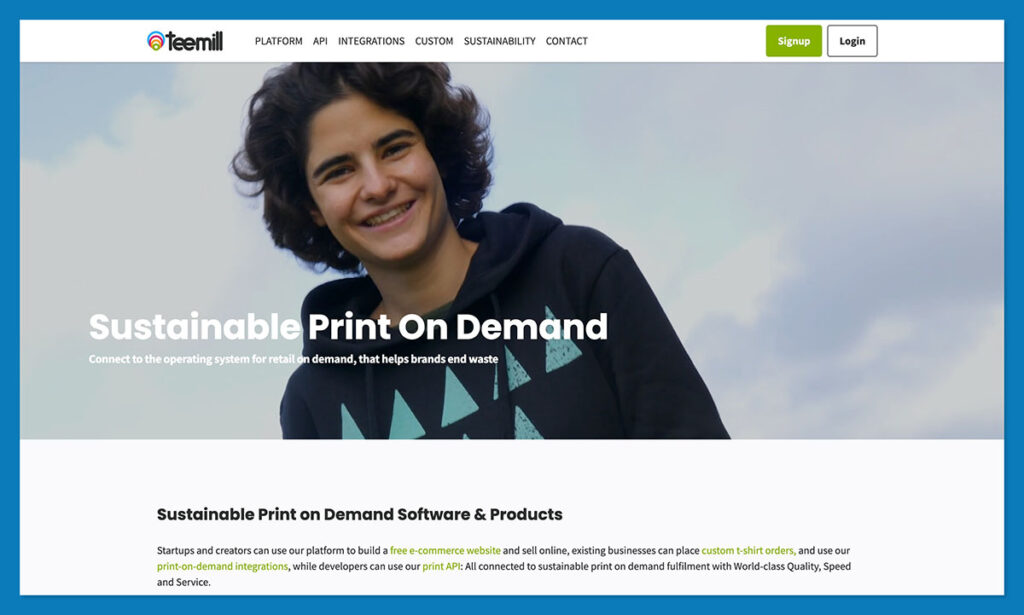
Teemill is the only POD platform on this list (and one of the very few apparel companies anywhere) with a true closed-loop garment return scheme. Every Teemill garment ships with a QR code in the wash-care label. When a customer wears it out, they scan the code, get a free post label, send the worn garment back, get £5 credit on their next order, and Teemill remakes the fabric into a new product.
The mechanics matter because they’re third-party validated. Teemill’s circular supply chain is featured as a case study by:
- The Ellen MacArthur Foundation
- The Exeter Centre for Circular Economy
- The European Circular Economy Stakeholder Platform
That’s institutional validation, not brand self-reporting. Good On You separately rates Teemill “Great” (their highest tier, December 2023), citing the lower-impact organic cotton, the closed-loop water savings, the plastic-free packaging, and the renewable-energy production.
The materials story is equally clean:

- 100% GOTS-certified organic cotton across the entire product range
- Production on the Isle of Wight, UK, on 100% renewable energy (solar plus wind)
- Plastic-free packaging
- Trustpilot “Excellent” with 4,066+ reviews now, up from earlier 2023 data showing 4.4/5 from 3,600 reviews — rating volume has grown without slipping
Here’s the underrated point: a circular organic cotton T-shirt from Teemill retails at around £20 ($25), comparable to non-circular conventional garments. The “eco costs more” assumption doesn’t hold here, because Teemill has built the technology efficiencies to keep pricing competitive. That alone makes it a credible choice for brands that want to compete on storefront price, not just sustainability story.
The honest gaps:
- UK-only fulfillment, so US-first or non-UK ship-to brands should look elsewhere
- Around 52 GOTS SKUs (apparel-focused, no broad lifestyle range)
- No confirmed B-Corp certification
For brands selling explicitly circular fashion (the kind where the return-and-remake story matters as much as the design), Teemill is the only POD platform built around the loop. For everything else, the UK-only fulfillment is a structural limit you have to accept upfront.
5. Inkthreadable: 100% Vegan, 8 Tonnes of Plastic Saved Annually (UK)
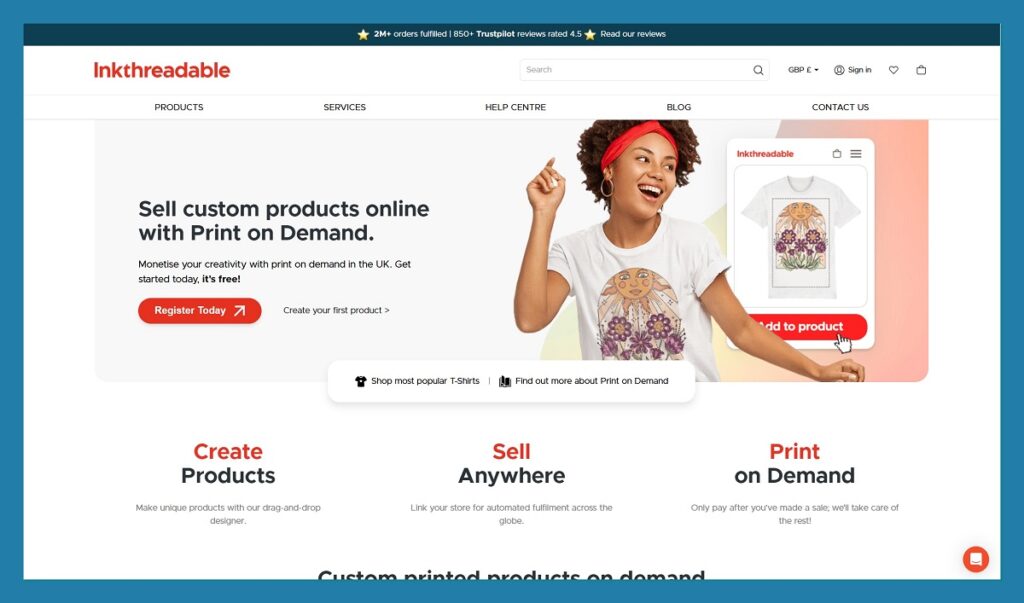
Inkthreadable’s switch to 100% plastic-free packaging in April 2019 saves 8 tonnes of single-use plastic every year. That’s not a vague “sustainable packaging” claim. That’s a verified per-year number from one POD facility.
The vegan-and-plastic-free stack is built from inherited certifications:
- Kornit printers with OEKO-TEX-approved, vegan, water-based inks
- Blanks from Stanley/Stella, which holds GOTS certification, is PETA-approved Vegan, and is audited by Fair Wear Foundation for labor standards
- 100% vegan products across the catalog (no animal materials in either manufacturing or printing)
That’s four stacked third-party certifications inheriting through the supply chain.
The carbon-offset story is named, not generic. Inkthreadable partners with Ecologi to plant trees and support carbon offset projects. You can point a buyer at Ecologi’s project portfolio and have them self-verify, which is exactly what eco-savvy customers want. Textile waste is repurposed into products like carpet underlay, so the model is effectively zero-landfill at the production stage.
The integrations cover Shopify and Etsy directly, which lines up with the platforms most UK eco brands actually run on. Trustpilot sits at 4.6/5 (“Excellent”) with 900+ reviews, up from 4.7/800+ in earlier 2023 data, so the rating volume has grown without compromising the quality signal.
For context on what “100% vegan” actually means here, Inkthreadable’s commitment runs through the whole production chain. The Kornit inks contain no animal-derived ingredients. The Stanley/Stella blanks are PETA-approved Vegan. There are no leather labels, no wool blends, no silk linings. For a vegan brand selling to customers who actively check fabric composition, that’s a credibility layer most POD platforms can’t deliver because they buy blanks across multiple suppliers without vegan vetting.
The honest weaknesses are real:
- UK-only fulfillment, which rules it out for US or global brands
- Reported reliability issues during peak periods. One Trustpilot reviewer wrote that they “had to cancel my Etsy listings for their products, which is a shame because they are the only good ethical option in the UK.” That’s a useful quote because it captures both the trade-off and the genuine respect for the platform’s eco credentials
- No confirmed B-Corp certification
- Smaller brand recognition than Printful’s
Best for: vegan brands, UK-based sellers, and anyone whose customers will scrutinize the carbon offset programme by name. Skip if: you ship primarily to the US (delivery times stretch) or you cannot tolerate occasional fulfillment delays during peak periods.
6. Apliiq: Organic Cotton, Hemp, and Recycled Polyester in One Streetwear Catalog (Los Angeles)
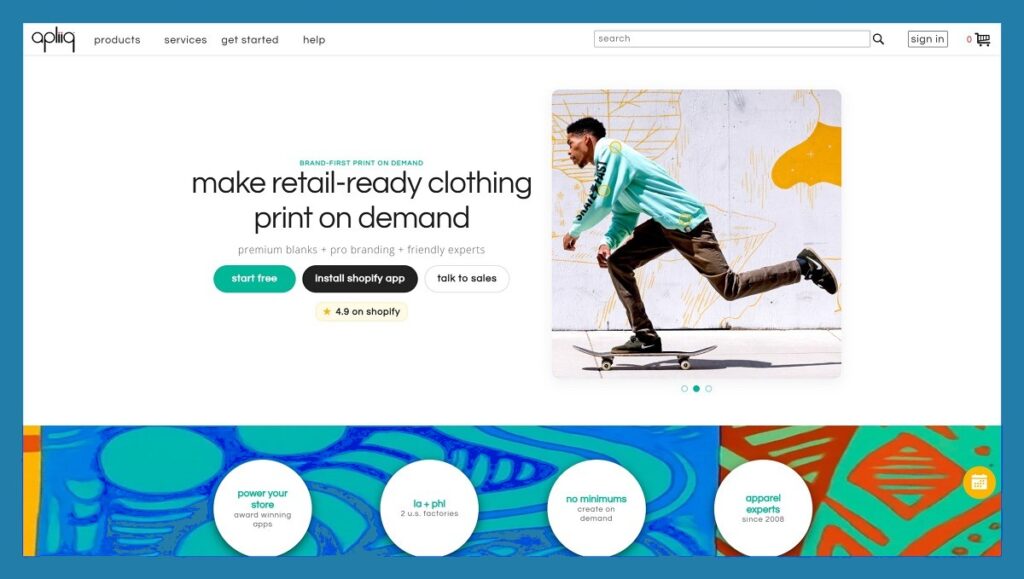
Apliiq is the only POD platform on this list that lets you ship organic cotton tees, hemp-cotton button-downs, and recycled-polyester hoodies from the same Los Angeles facility, with a private-label woven neck tag on every garment.
The multi-material catalog is the structural advantage:
| Product | Material composition |
|---|---|
| eConscious tees | 100% GOTS-certified organic cotton (4.4 oz, medium weight) |
| Hemp range | 55% hemp / 45% cotton |
| Hoodies | 80% organic cotton / 20% recycled polyester |
| Eco Trucker hats | 100% organic cotton crown + 100% recycled polyester peak |
Hemp is the under-the-radar standout: it requires roughly 50% less water than conventional cotton and is naturally pest-resistant, so it doesn’t need the heavy pesticide load that conventional cotton does. No other platform in this guide offers hemp at all.
The streetwear positioning is intentional. Apliiq is built for real fashion brands, not generic merch shops. Made-to-order production, water-based inks, custom woven labels, custom patches, and full private-label branding (not available at most POD platforms) mean you can launch what looks like an independent fashion label rather than a Shopify dropship store. LA-based US production also means shorter domestic shipping emissions for US customers, which is a meaningful gap versus EU-shipped alternatives.
Now the honest weaknesses, and they need flagging:
- Trustpilot is 3.2/5 “Average” with very few reviews (just one at the time of search), so the score is statistically unreliable as a quality signal but worth knowing
- The single existing review reported disappointing embroidery quality, neck tags, and rib collar attachment, plus unresponsive customer service
- Pricing runs higher than commodity POD platforms
- Not suited for EU-focused brands
- No named carbon offset programme, which is a real gap versus Inkthreadable’s Ecologi partnership
- No confirmed B-Corp certification
Compared to Teemill, Apliiq trades the closed-loop circular scheme for material variety (hemp, organic, recycled poly all in one catalog) and US production. Compared to Printful, Apliiq is fashion-focused with private-label branding Printful doesn’t match. Best for US streetwear brands building a real label rather than a generic merch line.
7. Shirtigo: 100% Renewable Energy Production With Stanley/Stella GOTS Blanks (Germany)
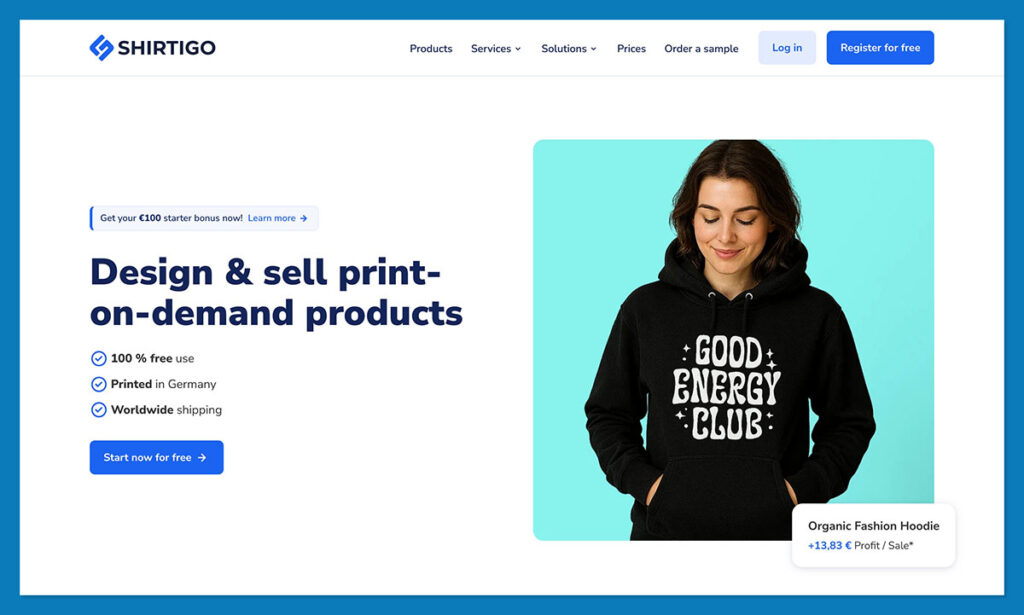
Shirtigo’s production runs on 100% renewable energy, sourced from a certified supplier called MONTANA. That avoids CO₂ emissions at the facility level, which is structurally stronger than offsetting emissions after the fact. Of the 8 platforms here, only Shirtigo and Teemill make that claim with a named energy source.
The verified-supply-chain stack is solid:
- Inks: Kornit NeoPigment — water-based, biodegradable, contain no toxins, and safe for children and babies
- Blanks: Stanley/Stella (GOTS certified, OEKO-TEX certified, PETA-approved Vegan, Fair Wear audited), inherited credentials shared with Inkthreadable
- Packaging: Shipping boxes are 100% recycled paper and 100% recyclable
- Shipping: Carbon-offset through DHL GoGreen, a named offset programme rather than a generic claim
The German production model brings practical advantages too:
- Short EU shipping distances
- No upfront costs
- 2-5 business day production
- Around 50+ products with 4,000+ variants per Merchize coverage
- Custom branding at $0.34 to $1.17 per order
For an EU brand looking to launch fast on a verified-renewable backbone, the platform mechanics work.
The honest weakness is around print durability, and you should plan for it. One Trustpilot reviewer reported that “every print deteriorated within one to two washes, they could literally peel the print off the shirt, even when following the washing instructions.” That’s one review out of a 107-review base, so the sample is small, but the failure mode is severe enough that I’d order samples and stress-test on your specific designs before committing a full product launch. The platform is also primarily German/EU market, no confirmed B-Corp, and no named carbon offset programme beyond DHL GoGreen for shipping.
Best for: EU brand owners who want renewable-energy production credentials, verified blank sustainability (Stanley/Stella), and named offset shipping (DHL GoGreen). Skip if: your customers will publicly compare print durability. Order samples first to validate Kornit NeoPigment quality on your specific designs before committing.
8. Gelato: 99.6% Local Production, Lowest Shipping Carbon Footprint of Any Global POD
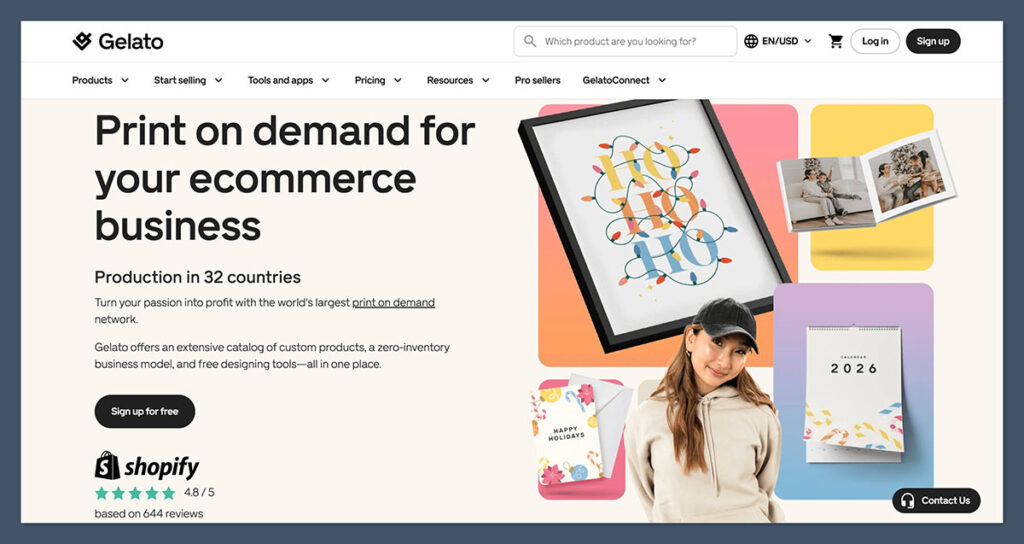
According to Gelato’s 2023 Sustainability Report, 99.6% of packages were fulfilled in the same region as the end customer, and 87% in the same country. No other global POD platform comes close on that shipping-carbon math.
The local-production model is the entire bet. Gelato operates with 130+ production partners across 32+ countries, routing every order to the facility nearest the customer. The Gelato VP put it directly in a Sustainability Magazine interview: producing items in the same region as the buyer avoids the majority of international freight emissions baked into centralised POD models. For a global brand selling across multiple continents, that math is genuinely hard to argue with.
The supply-chain transparency layer matters too:
- All wood and paper products are FSC-certified
- 100% of partners and suppliers are risk-assessed via Gelato’s Supplier Compliance Program, with a documented Supplier Code of Conduct enforced at onboarding
- In 2023, Gelato partnered with EcoVadis (a global business sustainability ratings platform used by major enterprises like Salesforce and Heineken) to add a third-party accountability layer on supplier performance
- Annual sustainability reports published every year from 2020 through 2023, giving real year-on-year progress data rather than a single marketing-page snapshot
- The 2023 report alone documents the 99.6% same-region shipping figure with methodology notes attached
- Trustpilot sits at 4.7/5 with 800+ reviews, the highest score among global-scale POD platforms
- Integration with Shopify, Etsy, WooCommerce, BigCommerce, Squarespace, Wix, TikTok Shop, and Amazon is broad and well-maintained
The honest gap is materials, and it’s a real one. Gelato’s sustainability story is logistics-led, not materials-led. There’s no platform-wide GOTS or organic cotton catalog like Teemill or TPOP have. Product material sustainability depends on which local print partner ends up making your order, so a question like “is this organic cotton GOTS-certified?” answers as “depends on the partner.” There’s also no named carbon offset programme for residual emissions, no plastic-free packaging mandate at platform level, and no confirmed B-Corp certification.
Compared to Teemill or TPOP, Gelato wins outright on global shipping carbon and platform-wide transparency reporting. Compared to Printful, Gelato’s local model beats Printful’s centralised fulfillment for shipping carbon by a wide margin. Best for global brands with multi-continent customer bases who want shipping carbon as the primary green claim.
How to Choose the Right Eco POD for Your Brand
No single platform wins on every dimension. The right pick depends on which customer cohort you’re serving and which green claim matters most to your brand. Use these filters to narrow down.
By primary geography:
- US customers → Fourthwall (storefront and tax handled), Printful (broadest verified catalog), Apliiq (LA streetwear with hemp), or Gelato (local production in-country)
- UK customers → Teemill (circular loop) or Inkthreadable (vegan, plastic-free)
- EU (non-UK) customers → TPOP (France, plastic-free) or Shirtigo (Germany, renewable energy)
- Global multi-continent customers → Gelato (99.6% same-region fulfillment) or Printful (US + EU dual-hub model)
By primary green claim:
| Your lead claim | Best platform |
|---|---|
| Plastic-free packaging | TPOP or Inkthreadable |
| Circular / closed-loop | Teemill (only option) |
| 100% vegan | Inkthreadable |
| Renewable energy production | Teemill or Shirtigo |
| Lowest shipping carbon | Gelato |
| Sustainable brand with storefront and tax handled | Fourthwall |
| Verified eco catalog at scale | Printful |
| Hemp and multi-material streetwear | Apliiq |
By product focus:
- Apparel-only with a clean eco story → Teemill, TPOP, or Inkthreadable
- Apparel + accessories + home + print products → Printful or Gelato
- Streetwear with private label → Apliiq
- Merch plus digital downloads and memberships in one store → Fourthwall
- Fast EU launch on a renewable backbone → Shirtigo
By catalog size:
- Need 300+ eco SKUs under one roof → Printful
- Can work with a curated 50-SKU range → Teemill, Shirtigo, or TPOP
If you’re still deciding between two or three platforms after this filter, order samples from each and run a wash-and-wear test on your actual designs. Print durability and fabric hand-feel vary enough between platforms that a $30 sample order is the cheapest insurance against a full product launch on the wrong supplier.
Our Methodology: How We Evaluated These Platforms
The 8 platforms in this guide were selected from an initial pool of 20+ POD providers that market themselves as sustainable or eco-friendly. We then filtered against verifiable criteria to separate real credentials from greenwashing language.
Inclusion criteria — a platform had to meet at least 3 of these to make the list:
- At least one named third-party certification (GOTS, OEKO-TEX, GRS, RCS, FSC, Fair Wear, PETA Vegan) with current validity
- Published sustainability data with year-on-year figures, not a one-off marketing page
- Named carbon offset programme (Ecologi, DHL GoGreen, Verra, EcoVadis) or renewable energy source — not generic “carbon-neutral” claims
- Plastic-free or verified recycled-content packaging with a stated percentage
- Publicly available supplier code of conduct or labor audit programme
- Minimum 100 verified customer reviews across Trustpilot or equivalent
Fourthwall is the one exception to these criteria. It publishes no sustainability report and names no offset programme, so it ranks first on brand-building support (included storefront, Merchant of Record tax handling, zero-waste digital products) rather than on credentials alone.
How each platform was scored:
| Evaluation dimension | Weight |
|---|---|
| Verified certifications (stacked third-party credentials) | 25% |
| Packaging transparency (plastic-free vs. PCR vs. conventional) | 20% |
| Energy source and shipping carbon | 20% |
| Published sustainability reporting with year-on-year data | 15% |
| Customer reviews and fulfillment reliability | 10% |
| Catalog breadth and brand fit | 10% |
What we excluded: Platforms with only “water-based inks” as a single credential, platforms without any published sustainability data, and platforms whose eco claims couldn’t be traced to a named certification body. That removed Redbubble, SPOD, Gooten, CustomCat, and several others from consideration. Printify was excluded because, while its parent entity (now merged with Printful) has sustainability reporting, the Printify marketplace itself doesn’t enforce eco standards across its supplier network.
Research approach: Platform self-reporting was cross-checked against third-party validators (Good On You ratings, Ellen MacArthur Foundation case studies, EcoVadis scorecards, Trustpilot review patterns) wherever available. Where a platform’s claim couldn’t be independently verified, we either flagged it in the weaknesses section or excluded the claim entirely.
Final Verdict
Our top pick: Fourthwall. It offers 40+ eco products, organic t-shirts from $14.52, and GOTS or PETA certified options, and it handles more of the work around building a sustainable brand than any other platform here: an included storefront, no monthly fees on the standard plan, zero-waste digital products and memberships, and tax handling as your Merchant of Record. The trade-off is transparency, since Fourthwall publishes no sustainability reports or emissions data.
Runner-up: Printful. For brands with US + EU customer bases that need the largest verified eco catalog (300+ products), published year-on-year sustainability data, and fulfillment reliability at scale, Printful is the most credible choice. The PCR plastic packaging is a real caveat, but its certification verification, emission reduction tracking, and labor compliance via Sedex are the strongest in the guide.
Best alternatives by use case:
- Best for plastic-free packaging: TPOP (EU) or Inkthreadable (UK) — the only two platforms with zero plastic across the full packaging stack
- Best for circular fashion: Teemill — the only genuine closed-loop return scheme with institutional validation from the Ellen MacArthur Foundation
- Best for global shipping carbon: Gelato — 99.6% same-region fulfillment is unmatched
- Best for US streetwear brands: Apliiq — hemp, organic cotton, and recycled polyester in one LA facility with full private-label branding
- Best for EU launches on renewable energy: Shirtigo — German production on 100% renewable backbone with DHL GoGreen offset shipping
- Best for vegan brands: Inkthreadable — 100% vegan catalog verified through Stanley/Stella PETA-approved blanks
If plastic-free packaging is non-negotiable for your brand positioning, neither Fourthwall nor Printful is the right pick, regardless of their other strengths. Choose TPOP or Inkthreadable instead and accept the geographic trade-off.
Eco-Friendly Print on Demand FAQ
Is print on demand actually better for the environment than conventional apparel manufacturing?
Yes, primarily because of the made-to-order model: no overproduction, no unsold inventory, no deadstock waste. The average apparel brand overproduces by 30-40%, and POD eliminates that entirely because every item is produced only after a customer places an order. The remaining environmental impact comes from inks, materials, energy source, and shipping, all of which vary significantly by platform. That’s why the 8-platform comparison above matters more than a generic “POD is greener” claim.
What’s the difference between GOTS and OEKO-TEX certification?
GOTS (Global Organic Textile Standard) covers the entire supply chain: organic fiber farming, chemical inputs, water treatment, and fair labor. It’s the gold standard for organic textiles. OEKO-TEX Standard 100 only tests the finished product for 100+ harmful chemicals (heavy metals, formaldehyde, pesticides, phthalates) and does not certify organic farming, environmentally friendly processes, or fair wages. Both are valuable, but they test different things and should not be treated as equivalent in marketing copy.
Which eco POD platforms are best for US-based sellers?
For US sellers, four platforms stand out:
- Fourthwall — the pick if you want 40+ eco products plus a free storefront and Merchant of Record tax handling in one place
- Apliiq (Los Angeles) — best fit for streetwear with hemp, organic cotton, and recycled polyester all in one catalog, plus private-label branding
- Printful — gives you the broadest eco catalog with US-based in-house fulfillment and the largest verified SKU count
- Gelato — suits US sellers with global customer bases who want local production happening in each customer’s country, not centralised shipping from one US facility
Which eco POD platforms are best for UK or EU sellers?
For UK and EU sellers, four platforms dominate:
- TPOP (France) — the pick for plastic-free packaging and EU-fulfilled speed with stacked GOTS and OEKO-TEX credentials
- Teemill (Isle of Wight, UK) — leads on circular economy and 100% renewable-energy production
- Inkthreadable (UK) — wins for 100% vegan products and plastic-free packaging since 2019
- Shirtigo (Germany) — covers German renewable-energy production with DHL GoGreen offset shipping
Gelato also works for EU brands wanting global reach with strong local network coverage.
Are any of these POD platforms B-Corp certified?
None of the 8 platforms in this guide carries confirmed B-Corp certification at the time of writing (April 2026). B-Corp is the highest single sustainability credential for businesses overall, covering social and environmental performance together, but it’s still rare in the POD industry. The practical workaround is to use stacked third-party material and process certifications (GOTS + OEKO-TEX + GRS + Fair Wear + PETA Vegan) as your credibility layer. Teemill holds carbon-neutral and organic organisation certifications and Good On You rates it “Great,” which is the closest equivalent on the list.
What greenwashing red flags should I watch for when evaluating an eco POD supplier?
Six red flags worth screening for:
- Generic “eco-friendly” or “natural” language without naming a certification body
- “Recyclable packaging” that’s still plastic (versus cardboard or recycled-material soft sleeves)
- “Carbon-neutral shipping” without naming the offset programme (Ecologi, DHL GoGreen, Verra)
- Citing only OEKO-TEX without GOTS, since OEKO-TEX is product safety only and not supply-chain sustainability
- “Water-based inks” cited as the only credential, which is now a low industry bar
- No published annual sustainability report with year-on-year data showing real progress


Comments 0 Responses