

Since the arrival of the first digital point of sale, it seems as though the transaction management market has never stopped growing.
Small business owners have continued to increase, driving demand for solutions that allow them to make sales in virtually any environment.
The Clover POS system is just one of the complete out-of-the-box solutions for electronic point of sale management on the market today.
This high-performance offering combines customizable software and hardware machines to suit a range of business needs – whether you’re running a small company, or just setting up shop as a pop-up brand.
Clover is now a Fiserv brand, sold mostly through payment processors and resellers, which is why two merchants can pay very different prices for the same terminal.
This review covers what it costs in 2026, what the contract commits you to, and who should look elsewhere.
What is Clover POS?
Clover POS is a point of sale platform that adapts to counter service, quick service, retail and full service dining. It pairs its own hardware with a large app market, so you can bolt on the features your business actually needs.
Clover is owned by Fiserv, which acquired its previous parent First Data in 2019. It sells into six business categories: retail, quick service dining, full service dining, professional services, personal services, and home and field services. Each category gets its own plan ladder, and the features and the rates shift with it.
The part that catches people out is how you buy it. Clover is sold directly, but it is also sold through a large network of independent sales organizations, agents and banks, and every one of them sets its own processing rate, monthly fee and contract length on top of Clover’s own pricing. The quote you end up with depends as much on who is selling as on Clover itself, and that single fact explains most of what follows.
The App Market runs to hundreds of apps covering loyalty, accounting, scheduling and more, so you can shape the system around your workflow.
👉 Let’s start simple. Any POS solution needs to be affordable if you want to make the most of it.
Clover POS Pricing: The Basics
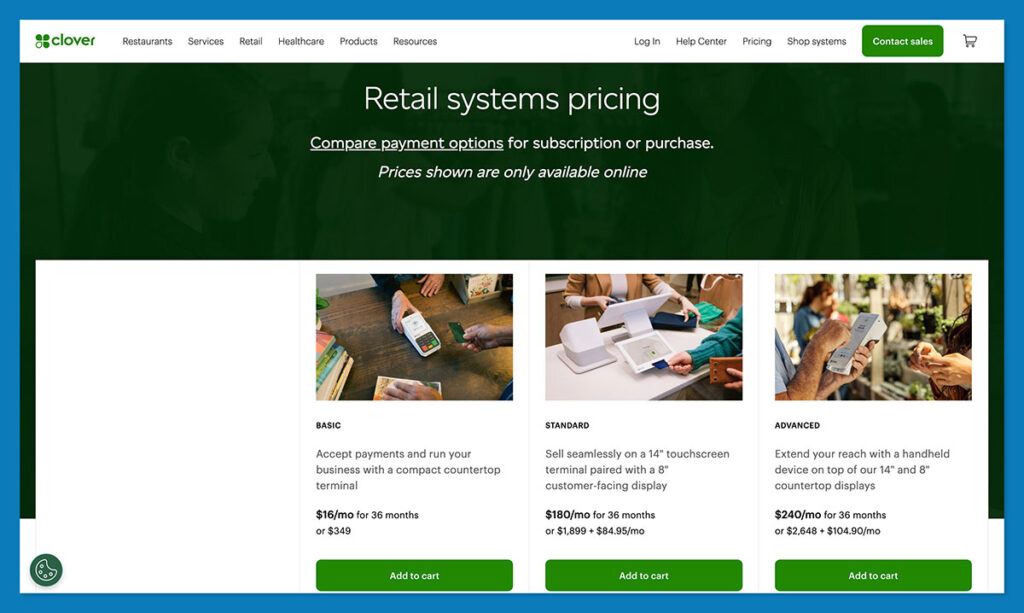
The Clover POS system is a bit complicated pricing-wise, as you need to sign up for it through a credit card processor. Some processors publish their Clover pricing, others make you call a sales team for a quote, and each one layers its own rate and monthly fee on top of Clover’s list figures.
You now have two ways to buy. Pay for the hardware upfront, at the sticker price on each terminal, and add a monthly software fee that varies by plan. Or take a 36 month bundle that folds the hardware and the software into a single lower monthly payment, so you walk out with a working counter for a predictable charge and a three year commitment.
Either route still needs a merchant processing agreement with whoever sells you the account, and the app layer adds cost again on top.
So treat every published figure as a list price. Before you sign anything, get the rate, the monthly software fee, the term and the termination fee in writing from your processor. That one step will save you more money than any amount of comparison shopping.
👉 Here is a run-down of the software pricing by business type, followed by a look at what the hardware costs.
Clover POS Software Pricing
Clover no longer sells one plan ladder to everyone. It prices by what your business does, so find your own row rather than reading the whole table.
| Business type | Plan | Monthly software fee | 36 month bundle | Card present rate |
|---|---|---|---|---|
| Retail | Basic | $0 to $16.95 | about $16/mo | 2.6% + 10c |
| Retail | Standard | $84.95 | about $180/mo | 2.3% to 2.6% + 10c |
| Retail | Advanced | $104.90 | about $240/mo | 2.3% + 10c |
| Quick service | Starter | $89.95 | about $135/mo | 2.3% to 2.6% + 10c |
| Quick service | Standard | $89.95 | about $185/mo | 2.3% to 2.6% + 10c |
| Quick service | Advanced | $109.90 | about $245/mo | 2.3% + 10c |
| Full service | Starter | $89.95 | about $179/mo | 2.3% to 2.6% + 10c |
| Full service | Standard | $109.90 | about $239/mo | 2.3% to 2.6% + 10c |
| Full service | Advanced | $129.85 | about $354/mo | 2.3% to 2.6% + 10c |
| Personal services | Basic | $0 to $16 | varies | 2.6% + 10c |
| Personal services | Standard | $84.95 | about $130/mo | 2.5% + 10c |
| Personal services | Advanced | $84.95 | about $180/mo | 2.5% + 10c |
| Professional services | Entry to top tier | $0 to $84.95 | varies | 2.3% to 2.6% + 10c |
| Home and field services | Entry to top tier | $29.95 to $84.95 | varies | 2.3% to 2.6% + 10c |
Clover does not publish a separate rate for every tier, and the rate written into your own agreement is set by the reseller who sells you the account.
Keyed and card not present transactions run at 3.5% plus 10 cents on every plan, so entering a card number by hand always costs more than dipping or tapping.
Tier names change, so match on price, not on the label. One reseller’s “Basic” is another’s “Payments” or “Essentials.” The three tier ladder is broadly stable, but the words on the brochure are not, so compare the monthly fee, the processing rate and the feature list instead of the name.
The software fee is per device. That $84.95 covers one register. Run a Mini at the counter and a Flex in the dining room and you pay for both, with each extra register adding roughly $9.95 to $19.95 a month. It is the line merchants most often forget to budget for.
The Virtual Terminal is a separate plan. It runs about $14.95 to $29.95 a month for a browser based dashboard you can key transactions into, which is useful for phone orders, mail orders and invoice links, but every payment on it runs at the keyed rate of 3.5% plus 10 cents. It does not include a physical terminal.
Most small retailers land on Retail Basic or Retail Standard, and the jump between them is the one that hurts. Basic starts at $0 a month, so a new shop can take cards for little more than the 2.6% plus 10 cents. Standard is $84.95 a month, which is a real line item on a lean P&L. Restaurants get no such on ramp: the cheapest quick service and full service plans open at $89.95, so the cheap Clover story really only applies to retail, personal services and professional categories.
What Clover Really Costs Over Three Years
Work one example end to end. A small retail shop doing $30,000 a month in card sales, on the Retail Standard tier, with a Station Duo on the counter:
- Hardware: a Station Duo bought outright lists at $1,899.
- Software: Retail Standard is $84.95 a month, so 36 months comes to $3,058.20.
- Processing: at 2.3% plus 10 cents, 2.3% of $30,000 is $690 a month, and 300 card transactions add another $30. Call it $720 a month, or $25,920 over 36 months.
That is roughly $30,877 over three years, and more than 80 percent of it is processing. The rate you negotiate matters far more than whether the terminal cost $1,799 or $1,899.
Then there is everything sitting outside that sum. App Market subscriptions run from $0 to $99 or more per app per month, billed per merchant account on top of the software fee. PCI non compliance fees of $20 to $100 a month land on your statement if you never return the compliance questionnaire, and they keep landing until you do. Each extra register adds roughly $9.95 to $19.95 a month.
And 2.3% is the good end of the range. Because each reseller sets its own markup, two shops on the same plan with the same hardware can pay processing bills that differ by hundreds of dollars a month. Negotiate the rate, not the terminal price.
Clover POS Hardware Pricing
The hardware is the part of Clover most people picture, and it is sold as a family designed to work together.
| Device | Price | What it is | Best for |
|---|---|---|---|
| Clover Go | $199 | Bluetooth card reader that pairs with your own phone or tablet | Mobile sellers who need chip, magstripe and contactless |
| Clover Compact Terminal | $349 | Small countertop or handheld terminal with a 3.6 inch touchscreen | Small counter service or a secondary station |
| Clover Flex Pocket | $699 | Handheld, no built in printer | Line busting where a printer is not needed |
| Clover Flex | $749 | Handheld all in one with built in printer, scanner and signature capture | Tableside and mobile checkout |
| Clover Mini | $849 | 8 inch countertop touchscreen, no cash drawer or printer included | Fixed counter with a small footprint |
| Clover Station Solo | $1,799 | 14 inch merchant facing touchscreen, camera, barcode scanner, receipt printer, cash drawer | Full counter setup without a customer display |
| Clover Station Duo | $1,899 | Adds an 8 inch customer facing screen to the Solo’s kit | Full counter with customer facing display |
| Kitchen Display System | $799 (14 inch) / $899 (24 inch) plus $25/mo per device | Wall mounted display for kitchen orders | Restaurants replacing printed tickets |
| Clover Kiosk | $3,499 plus $34.95/mo per device | 24 inch ordering touchscreen with an integrated 8 inch payment screen and built in thermal receipt printer | Self service ordering in quick service |
Since the last version of this review the line has been reworked. The single “Clover Station” SKU, $1,149 back in 2019, is now two models: the Station Solo without a customer display, and the Station Duo with one. “Clover Mobile” has been retired, and the Flex and the smaller Flex Pocket carry the handheld duties instead. Older reviews and reseller brochures still list the retired names and the 2019 prices, so ignore them.
Devices can be financed over 36 months rather than bought outright: roughly $40 a month for a Flex, $45 for a Mini and $180 for a Station Duo on a bundle that folds in the software. That low monthly figure is the point of the bundle, but the finance is written through the reseller and tied to the processing term, so leaving early means paying off the remaining hardware as well as the termination fee.
Paying cash for the terminal does not buy you out of anything either. Every Clover device is locked to Fiserv processing and cannot be reprogrammed for another processor, so moving POS provider later means buying new terminals from scratch. The section below sets out what that commitment involves.
👉 So which device fits your counter? The Go at $199 suits a solo operator or a pop up running the Clover app on their own phone, and the Compact Terminal at $349 is the cheapest fixed countertop. The Mini at $849 is the sweet spot for most small retail counters, though you supply the cash drawer and receipt printer yourself. The Flex at $749 is the one to get if you check people out at tables, because it prints the receipt where you stand. For a full counter the Station Duo at $1,899 is the flagship, and the Solo at $1,799 saves $100 if you can live without the second screen. Kitchens should budget a $799 or $899 display plus $25 a month per screen, and quick service sites testing self service can price the Kiosk at $3,499 plus $34.95 a month. Current prices are on Clover’s official hardware page.
The Contract, the Early Termination Fee and the Lock-In
This is the part of a Clover purchase that costs people money later, so read it before you sign anything.
Term. Buying direct from Clover can avoid a mandatory long term contract, but most merchants buy through a reseller, and those agreements commonly run 36 months, sometimes 48. The reseller sets the actual length, so ask outright whether the term is three years or four, and get the answer on the written quote.
Leaving early. Early termination fees commonly run $295 to $595, with roughly $500 the figure cited most often. Some agreements skip the flat fee altogether and calculate liquidated damages against the processing volume you would have run over the rest of the term, which can come to considerably more. Make the sales rep put a dollar amount in the quote, not a formula. If you financed the hardware, the remaining device payments sit on top of it.
The hardware does not travel. Clover terminals are locked to Fiserv processing and cannot be reprogrammed for a different processor, whether you financed them or paid cash for them. Leaving means buying a whole new set of terminals as well as paying any termination fee, and that is the biggest structural cost of choosing Clover. Get your data out first: Clover’s own guidance is to export sales and customer data as CSV or Excel from the Settings and Administration panel, and access goes when the account closes.
The fees that arrive later. The underlying merchant agreement typically allows rate changes on 30 days notice, delivered by statement insert or email. Merchants also report PCI non compliance fees of $20 to $100 a month when the compliance questionnaire is never completed, and rolling reserve holds of 5 to 10 percent of sales on some reseller accounts, which can tie up working capital with no warning.
Before you sign, get these in writing on the actual quote from your reseller:
- The card present rate
- The monthly software fee per device
- The contract length
- The early termination fee in dollars
- Whether there is a rolling reserve
- Who to call when the terminal fails
Inventory Management and Orders
As any modern merchant will know, a great POS system doesn’t just handle transactions from a range of cards and devices. You’ll also need to be able to manage your orders and inventory too. The good news is that the Clover POS is excellent when it comes to tracking your company’s performance.
Entry level plans cover basic item tracking and categories, while the higher tiers add modifiers, variants and item level controls.
Clover no longer publishes a single item ceiling, so high SKU retailers should confirm the limits on their tier before committing.
If you need even more options for inventory management, then you can also access the apps on the Clover POS marketplace.
Additionally, for people running food companies and restaurants, there’s also plenty of order management options too.
You can add items to orders through the Register or Clover dining app, and you can search through your interface with ease. When necessary, employees can also create custom items on orders for clients too.
Virtual Terminal
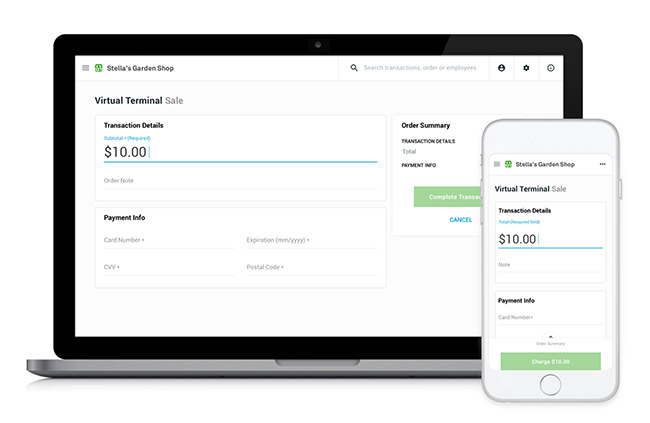
If you’re away from your Clover POS system device, but you want to make sure that you never miss out on a potential sale, then you can always accept payments with the Virtual Terminal instead. The Clover Virtual Terminal gives users the option to process payments, refunds, and other expenses wherever they are. All you need to do is log into your Clover dashboard from a smartphone, computer, or tablet to get started.
The Virtual Terminal is a quick and easy way to manage payments on the go – for instance, if you’re working at a local market, or you’re hosting a pop-up store. The application is PCI compliant and secure so that you can access better peace of mind too.
The Clover POS virtual terminal is now sold as its own plan, at roughly $14.95 to $29.95 a month. Your transactions run at the keyed rate of 3.5% plus 10 cents on top of that. Additionally, you can accept credit and debit card payments from virtually anywhere.
If you need to send receipts for compliance purposes, then you can do so by email or text, and you’ll have the option to collect contact data so that you can continue to engage with them in the future too.
Clover POS Review: Employee Management
The Clover POS system makes it easier to manage your business wherever you are. It doesn’t just take payments on your behalf but also helps when it comes to managing your employees too. There’s the option to set user permissions, add employees to your system, and even track shifts whenever you need also. What’s more, with access to the Clover App Market, you can unlock tools like Gusto for payroll services, or Time clock for managing shifts and time off.
For those who work in restaurants and café, there’s Tip pooling apps and even applications that can help with calculating commissions for individual employees. The options are endless. Administrators using the Clover app can log into their employee management services at any time of the day to change roles, login permissions, and contact information. You can also run reports to check which of your employees are driving the most sales.
Clover POS Review: Reporting and Analytics
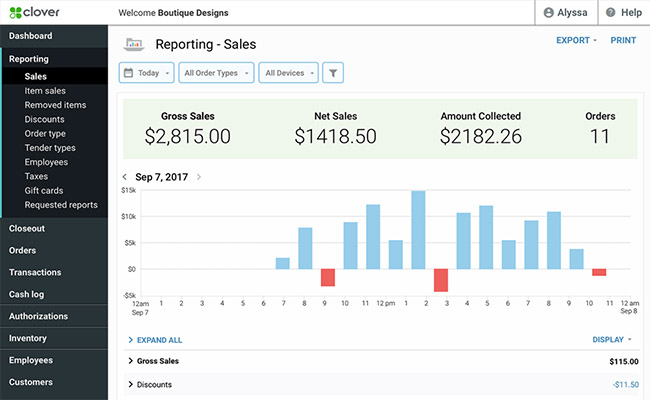
Want to keep track of what’s going on with your sales?
No problem! The Clover POS system has you covered. The apps available with your Clover POS software include some decent reporting tools.
For instance, you can access a “By Payments” report on your Clover Station, which shows you a summary of all the transactions made within a specific period. There are also reports available for cash reports, payments by card type, and payment statistics.
All of the reports available from the Clover POS can be sorted according to time and date and filtered for specific requirements too.
Once those reports are created, they can also be exported and printed for additional analysis.
Just some of the things you can do with the Clover POS system reporting include:
- Track revenue with at-a-glance sales reports
- Filter your POS reports to see your best-selling items and monthly trends
- Get access anywhere, including from mobile dashboard apps
- Track sales in real-time with aggregated data across multiple locations
- View end-of-day reports with gross sales and refunds
- Track tips and server totals per employee
- See the volume of your credit card transactions according to card type
Customer Management
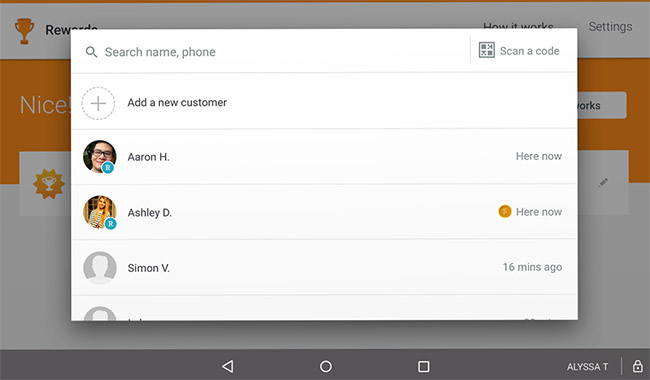

Any great merchant knows that if they want to ramp up their profits in the long-term, they can’t just focus on one-off sales. These days, the best results come from your repeat customers – those are the people who stick to your customer list and keep coming back for more. With the Clover POS system, you can transform any client into a loyal consumer.
The Clover POS system software allows users to build customer lists and accept feedback from clients using digital receipts.
You can set up an immersive loyalty program, send vouchers and gift cards to your best customers, and run a range of marketing campaigns on social media, all using apps.
One of the most impressive features available from the Clover POS for customer and loyalty management is the option to use “Gift Cards.”
Both physical and digital cards are available, and they can be branded to suit your company’s style too. Customers can access and use gift cards on mobile devices, and you can track their usage digitally also. This means that there’s no need for messy receipts.
Loyalty is now generally bought as an App Market subscription rather than bundled with your hardware. It still lets you build a points or rewards program, store customer detail and target your best spenders. Check whether loyalty is included in the quote you are given, or billed separately.
Once you’ve set your loyalty solution up, you can store customer information and easily find details on your most valuable customers. It’s even possible to track the spending habits of individual people and send out real-time promotions through email and text campaigns.
Apps and Integrations
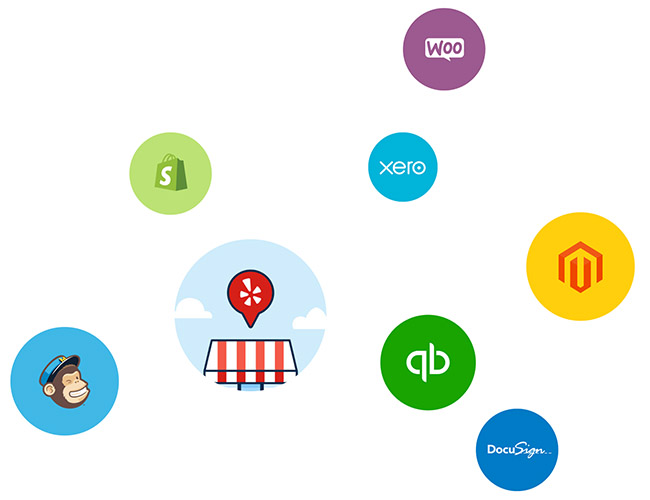
Probably the most exciting aspect of the Clover POS system is just how customizable it can be.
No matter what you need from your point of sale system, there’s sure to be a handful of apps and tools in the Clover Station marketplace that will help you to transform your sales strategy.
Ultimately, with the Clover app market, you can choose the features or tools that your business needs to strengthen sales, from coupon processing and virtual Pin pads, to gift card management.
Clover’s POS marketplace also comes with options for employee management and advanced reporting too.
Many apps are free, but the ones merchants actually rely on are paid subscriptions, and app costs stack on top of your software fee.
Here are some real App Market costs to budget for:
- Accounting sync apps that push Clover sales into QuickBooks or Xero: from about $40 per month
- Digital Loyalty by Loyalzoo: about $0.15 per active customer per month, or an unlimited plan from about $127 per month
- Homebase time clock and scheduling: has a free tier for basic time clock use
- Most other app prices are not published in one place and vary by app, so check the cost of any third-party tool before you commit
Apps are billed per merchant account per month, on top of your Clover software fee.
You can see a complete list of the Clover POS integrations here.
However, if you can dream up something that you need to make your transactions more effective, then you can pretty much rest assured that you’re going to get it from the Clover marketplace. Additionally, there’s a range of available “apps” that come from Clover directly, such as:
- Register for processing payments
- Promos to keep customers coming back for more
- Feedback to help you hear from fans directly
- Happy hour to offer discounts according to time slots
- Rewards to support and encourage customer loyalty
- Clover dining to seat guests and manage waitstaff
- Shifts to schedule your employee working hours
What’s more, if you have any particular needs (and a little bit of developer knowledge), then the Clover API is available for developers to use too.
Clover POS Ease of Use
Now that you know the basics of what you can expect from a tool like the Clover POS system let’s take a look at how easy it is to use a service like this one.
The Clover POS prides itself on offering a highly user-friendly solution for businesses. This is a massive factor in what makes Clover so popular for companies in a range of sizes. The whole experience arrives set up and ready to go – provided that you’ve bought both a hardware solution and something that you can use to manage your software.
Ideal for small to mid-sized companies, the Clover POS system comes with a very small learning curve. Business leaders and employees alike shouldn’t have much trouble picking up everything that they need to know about the solution within a few minutes of basic training.
Most of the available apps on Clover are clearly labeled and self-explanatory, so it takes about 5 minutes of training to get started. Additionally, one of the best things about using an all-in-one POS solution like Clover is that all of the hardware is designed to work together seamlessly.
Clover POS takes much of the guesswork out of running your business as a leader in your company. The intuitive and innovative design is easy enough for anyone to understand.
Additionally, depending on the kind of functionality you’re looking for, there are plenty of apps on the screen that you can access with just a touch of your finger.
Clover Review: Customer Service and Support
Clover is a Fiserv product. First Data, Clover’s previous owner, was absorbed into Fiserv back in July 2019, so any old complaints aimed at First Data are now aimed at Fiserv. That merger did not simplify the support setup, because Clover reaches you through two layers.
Responsibility is split. Clover and Fiserv support the hardware and the software itself. The reseller or bank that sold you the account handles your rates, your monthly statements and any account-level problem. So the quality of your support depends heavily on who sold you the system: a direct Clover sale puts you in front of one team, while a reseller sale can leave you bounced between two organizations the moment a billing question turns into a hardware fault.
On the plus side, phone support runs 24/7, generally through your processor or bank partner, with Clover’s own team also reachable. A live person at 10 p.m. means a down terminal is not automatically a dead register until morning, and plenty of competing systems cannot say that.
Merchants do report real frustrations, though. Complaints cluster on per transaction and equipment fees that were never in the sales pitch, being billed for services on hardware that should not have been active, and being bounced between Clover and the reseller when something breaks. Long hold times come up, so do cancellations that were never actually processed and charges that continue after a business has closed and the equipment has gone back. PCI non compliance fees of $20 to $100 a month, rolling reserve holds of 5 to 10 percent of sales on some reseller accounts, and aggressive sales tactics add to the unhappiness.
Clover does run a self-serve help center with troubleshooting guides, FAQs and video tutorials, and it is reachable on social channels. Those resources are worth knowing about before you need them.
Clover POS System Alternatives
If you’re still on the fence about investing in a Clover POS, or you just want to do some shopping around before you invest, there are always alternatives to consider.
Here are just a handful of different options you can try out if you think that Clover might not be the right point of sale for you.
Here is how the four strongest alternatives line up against Clover on price, rate and commitment.
| System | Starting price | Card present rate | Contract | Best for | The catch |
|---|---|---|---|---|---|
| Clover | from about $16/mo bundled | 2.3 to 2.6% + 10c | 36 to 48 months via reseller | Merchants who want one hardware family | Reseller contracts, termination fees, rates vary by seller |
| Square | $0/mo | 2.6% + 15c | No contract | Small shops, mobile sellers, appointment businesses | Fixed rate gets costly at volume, no other processor ever |
| Shopify POS | $39/mo, POS Pro $89 per location | 2.6% + 10c | Month to month | Retailers already selling online through Shopify | POS Pro stacks per location on top of the ecommerce plan |
| Lightspeed Retail | $89/mo annual, $109 month to month | 2.6% + $0.10 | No mandatory lock in | High SKU and multi location retailers | No free tier, monthly billing costs materially more |
| Toast | $0/mo Starter, $69/mo Point of Sale | 2.49% + 15c | Two to three years, auto renewal | Restaurants, bars and cafes | Restaurants only, Toast processing is locked in |
Shopify POS

Shopify POS is the obvious answer if you already sell online through Shopify or plan to, because stock, orders and customer records live in one place across your website and your shop floor. The reporting ties the two channels together cleanly. If you have no ecommerce ambitions and just want a till, it is the wrong answer next to Clover, which does not need a web store subscription to get started.
👍 Pros:
- Plans start at $39 a month with POS Lite included, which covers the core register functions at no extra charge.
- POS Pro adds advanced retail tools at $89 per location per month on top of your Shopify subscription.
- Card present transactions run at 2.6% plus 10 cents on the Basic plan.
- Standard plans are month to month, so there is no multi year contract of the kind most Clover reseller deals carry.
- One stock and order pool across online and in store kills double entry and keeps inventory accurate.
👎 Cons:
- POS Pro stacks per location on top of the ecommerce subscription, so costs climb fast if you run more than one shop.
- Shopify is an ecommerce platform first, and the POS reads as an add on rather than a system built for physical retail.
- Using a third party payment gateway is penalized with extra fees, which limits your ability to shop for processing rates.
- You are paying for an ecommerce subscription you may not need if the shop has no online side.
Square POS
Square is the direct answer to Clover‘s biggest weakness: there is nothing to sign and nothing to cancel, so no 36 month lock in and no termination fee if things do not work out. The trade off is a fixed processing rate that does not move with volume, and no way to ever bring your own processor.
👍 Pros:
- A free plan at $0 a month gives you a full POS with the basics covered, with paid tiers above it.
- Card present transactions cost 2.6% plus 15 cents on the free plan, improving to about 2.4% plus 15 cents at the top tier.
- No contract and no early termination fee, so you stay month to month and can walk away.
- Hardware starts from a $59 reader, so the upfront cost for a new or mobile business is tiny.
- Fast setup and strong mobile and appointment tools suit service providers and pop up sellers.
👎 Cons:
- The fixed rate gets expensive as volume climbs, because there is no lower percentage to negotiate.
- You can never bring your own processor, so you are on Square’s processing for the life of the account.
- Account stability complaints surface regularly, with merchants reporting unexpected holds and sudden terminations.
- Advanced features sit behind paid add ons, and the deep inventory tools are thinner than a dedicated retail system’s.
Lightspeed Retail
ShopKeep, which this review used to recommend here, was bought by Lightspeed in 2020 and its merchants were migrated onto Lightspeed Retail, so that is the product to look at now. It is the pick for a retailer with thousands of SKUs or several sites who needs real inventory depth rather than an app for everything, and it competes with Clover at the higher end, where purchase ordering and supplier management matter more than a broad app marketplace.
👍 Pros:
- Plans start at $89 a month billed annually, or $109 a month month to month, with no mandatory lock in.
- Card present processing runs at 2.6% plus 10 cents, in line with Clover’s mid tier rates.
- Inventory handling is built for high SKU catalogs, with matrix items and variants handled natively.
- Multi location and multi store management is built in, so several shops run from one back office.
- Purchase ordering and supplier management are included, so stock replenishment needs no separate add on.
👎 Cons:
- There is no free tier, so you pay a monthly fee from day one even for a single register.
- Monthly billing costs 18 to 22 percent more than annual, which adds up across several locations.
- The learning curve is steeper than Clover’s, particularly for staff new to advanced inventory systems.
- It is priced above Clover’s entry tiers, so a small shop may pay for capability it never uses.
Toast
If you run a restaurant, bar or cafe, Toast is the specialist and Clover is the generalist that can do it. Toast’s hardware is built for kitchen environments, online ordering and delivery are native to the workflow, and the kitchen display and handheld ordering tools are made for service. The catch is that Toast is restaurants only, its payment processing is not optional, and the real cost often runs well above the advertised monthly figure.
👍 Pros:
- A Starter Kit at $0 a month and a Point of Sale plan at $69 a month give you a clear on ramp.
- Card present transactions run at 2.49% plus 15 cents on the paid plan.
- Hardware is built for kitchen environments and holds up in a busy back of house.
- Online ordering and delivery handling are built in, so web orders flow straight into the kitchen workflow.
- Kitchen display and handheld ordering are designed for table service, cutting paper and speeding up order taking.
👎 Cons:
- Toast is for restaurants only, so a retail or service business cannot use it whatever the price looks like.
- Toast payment processing is not optional, which removes any ability to shop for rates.
- Contracts run two to three years with auto renewal.
- Reported early termination exposure varies widely between accounts, so get the exit terms in the written quote.
Is the Clover POS System Right for You?
Clover is genuinely good, adaptable hardware. The app market lets you shape the system around your business, and the interface is easy enough that staff pick it up in minutes. The trade-off is that you are buying into a commitment, and the quality of your support depends heavily on who sold you the system. Let’s boil it down.
Buy Clover if you want one hardware family covering counter, handheld, kitchen displays and kiosks, you are happy to stay with Fiserv processing for three years or more, and you have a written quote with the rate and the termination fee spelled out on it. The multi-vertical plans work well for a business that does not fit neatly into one category, and the App Market lets you build the feature set you need without paying for a bloated all-in-one suite.
Think hard if you are a high-SKU or multi-site retailer. Lightspeed Retail does inventory depth, purchase ordering and multi-location management far better, and its reporting is built for that job. If you run a restaurant, especially a full-service or fine-dining one, Toast is the specialist. Clover can serve restaurants perfectly well, but Toast was built from the ground up for kitchens.
Skip it if you want to keep your current processor, if you are not prepared to sign a 36-month agreement, or if you are small enough that Square’s free plan does the same job with nothing to cancel and no termination fee hanging over you.
Get the rate, the monthly fee, the term and the termination fee in writing from whoever quotes you, then measure that against the table above. Get a Clover quote here once you have your numbers ready.
Clover POS Review: Frequently Asked Questions
How much does Clover POS cost per month?
Monthly software fees run from $0 to about $129.85, depending on your business category and tier. A retail shop on the Basic plan pays $0 to $16.95; a full service restaurant on the Advanced tier pays $129.85. Bundles that fold in the hardware over 36 months run from about $16 a month to roughly $354. Processing then adds 2.3% to 2.6% plus 10 cents on card present sales, and 3.5% plus 10 cents on keyed or online ones.
Can you use Clover with your own payment processor?
No. Clover hardware is locked to Fiserv processing and cannot be reprogrammed for a different processor. If you leave Clover, the terminal stops working for payments and you have to buy new equipment, so you cannot keep the kit and move to a cheaper processor later. Merchants regularly report being surprised by this when they try to move, which makes it worth understanding before you sign.
Does Clover require a contract?
Buying direct from Clover can avoid a long term contract, but most merchants buy through a reseller, and those agreements commonly run 36 months, sometimes 48. Early termination fees typically sit between $295 and $595, with roughly $500 cited most often, though some agreements use liquidated damages tied to projected processing volume instead, which can run considerably higher. The merchant agreement also usually permits rate changes on 30 days notice.
Is Clover better than Square?
It depends on which trade you prefer. Clover gives you more hardware choice and the chance to shop for a processing rate between resellers, at the cost of a contract and a single processor family. Square has no contract and no termination fee, but its fixed rate gets expensive as volume climbs and you can never use another processor. For zero commitment, Square is simpler. For hardware variety and a negotiable rate, Clover wins.
What happens to your Clover hardware if you cancel?
It stops working for payments. Clover terminals are locked to Fiserv and cannot be moved to another processor, so the device becomes useless as a payment tool. Before the account closes, export your sales and customer data to CSV or Excel from the Settings and Administration panel, because access goes with the account. Merchants regularly report charges continuing after equipment is returned, so keep return tracking and any correspondence with your reseller.



Comments 0 Responses