

Our research team and I spent over 200 hours testing 12 of the top ecommerce platforms in 2026 – but we only have time to give you the top five.
After a deep dive into ease of use, pricing, features, SEO capabilities, and scalability, we’ve narrowed down our picks to the top ecommerce platforms we think will suit any type of online business.
Whether you’re just starting out with a side hustle or you have a DTC brand with a small product catalog, or you’re building out a large product range, we’re pretty sure there’s a platform on this list that’ll be a great fit for you.
Our Top 6 Ecommerce Platforms
- Shopify – Our pick for the best ecommerce platform – full stop
- Wix eCommerce – Perfect for anyone who wants a simple, easy to use ecommerce solution
- Payhip – Perfect for selling digital products with no monthly fees or upfront costs
- BigCommerce – Great for stores that need to scale quickly and handle B2B sales
- Squarespace Commerce – If you’re a creative business looking for a beautiful store that’s easy to use, then this is the one for you
- WooCommerce – Ideal for businesses that need top class SEO and complete control over content
Why You Can Trust This Guide
Ecommerce Platforms has been doing one thing for more than 15 years: helping people find the right software to build and run an online store. That focus is the whole point of the site, and it shapes how we approach a guide like this one.
200+ hours of hands-on testing across 12 platforms for this guide alone.
Real test stores. We build, configure, and sell on each platform rather than rewriting marketing pages.
Independent rankings. Our picks are not for sale. We may earn a commission if you sign up through some links, but that never decides where a platform lands or what we say about it.
Kept current. Pricing, plans, and features change often, so we revisit and update our recommendations as they do.
The scores and rankings here come from our editorial team of ecommerce specialists, not a single anonymous reviewer or a vendor brief. Where a platform falls short, we say so, because the goal is to help you pick the right tool, not to talk you into the most expensive one.
How We Tested
Every platform in this guide was evaluated against the same six criteria, weighted to reflect what actually matters when you are running a store day to day. We sign up, build a working storefront, add products, run test checkouts, and push each platform on the things its marketing tends to gloss over.
| Criterion | What we evaluated | Weight |
|---|---|---|
| Ease of use | Setup time, editor and dashboard clarity, how quickly a non-technical user can launch and manage a store | 20% |
| Features and functionality | Core selling tools, product and inventory management, multichannel selling, app ecosystem, built-in versus add-on capabilities | 20% |
| Pricing and value | Plan costs, transaction fees, what you actually get for the money, and the true cost as a store grows | 20% |
| SEO and marketing | Control over URLs, metadata and schema, page speed, blogging, and built-in marketing tools such as email and discounts | 15% |
| Scalability | Performance at higher volumes, catalog and order limits, B2B and wholesale support, and upgrade paths | 15% |
| Support and resources | Channels available, response times, and the quality of documentation and learning material | 10% |
Each platform earns a score out of five against these criteria, and that score informs both the comparison table above and where a platform ranks. We retest when a provider changes pricing or ships a major feature, so the verdict reflects the current product rather than an older version of it.
Quick Comparison Table
| Platform | Rating | Starting Price | Best For | Free Trial | AI Features |
| Shopify | 4.8 | $29/month | Selling online at any scale | Yes (3 days) | AI Sidekick |
| Wix eCommerce | 4.6 | $27/month | Beginners and quick launches | Yes | AI Site Builder |
| Payhip | 4.5 | Free | Selling digital products | Yes (Permanently) | None native |
| BigCommerce | 4.4 | $39/month | High-volume and B2B stores | Yes (15 days) | Built-in tools |
| WooCommerce | 4.3 | Free plugin | SEO and total flexibility | No | None native |
| Squarespace | 4.1 | $27/month | Design-focused businesses | Yes (14 days) | Blueprint AI |
1. Shopify – The Ecommerce Platform That Does It All

Best overall

Shopify is packed with many useful features, and its developers consistently gather feedback from users to release updates and new products that cater to their needs.
It’s a popular choice for businesses around the world looking to create an online store, and in our view, it’s the top ecommerce platform available.
Shopify is still the king of ecommerce platforms, and it’s easy to see why.
Whether you’re a side hustler or an 8 figure brand, Shopify has the tools you need to sell across multiple channels, manage your inventory and scale your business fast.
I found setting up a Shopify store to be a breeze. Their new AI assistant, Shopify Sidekick, does a great job with product descriptions, marketing prompts and inventory setup – making it easier than ever to get online and selling.
Pros
- Supports unlimited products and SKUs
- Excellent mobile-optimized templates
- A huge app marketplace with over 8,000 apps to install
- A secure and scalable checkout process
- You can sell across Amazon, TikTok and Facebook
Cons
- There are transaction fees if you don’t use Shopify Payments
- Unless you’re on Shopify Plus, checkout customization is limited
- While the free templates are fine, the premium ones cost a pretty penny
How Much Does Shopify Cost?
| Plan | Monthly Price (USD) | Best For |
| Basic | $29 | Small or new businesses |
| Grow | $79 | Growing stores |
| Advanced | $299 | Scaling stores with analytics |
| Shopify Plus | From $2,300 | Enterprise-level brands |
The Basic plan is perfect for new or small businesses that just getting started. It includes all the basics, like unlimited products, 24/7 support, and access to Shopify’s POS app – a great place to start if you’re just testing the waters.
The Grow plan is geared towards growing brands that need a bit more oomph to scale. The extra features, like better shipping discounts and professional reports, will save you money and give you a better insight into how your store is performing.
The Advanced plan is for stores that are looking to optimise their operations with detailed analytics and automation – this is the one for businesses that are running at high volumes and need to make the most of their data.
Shopify Plus is for the big players – enterprise level businesses that need total control and custom workflows – it includes advanced API access, exclusive apps, and dedicated support.
The Bottom Line: Shopify is still our top pick for the best ecommerce platform out there. If you’re serious about selling online, then it’s the most reliable and scalable solution on the market today.
Shopify offers a free trial for 3 days without a credit card. It regularly has promotions (like the current one to enjoy your first 3 months of Shopify for $1 ).
We recommend seeking out one of these promotions, and combining that with a yearly plan for the best value. Learn more about the trial here.
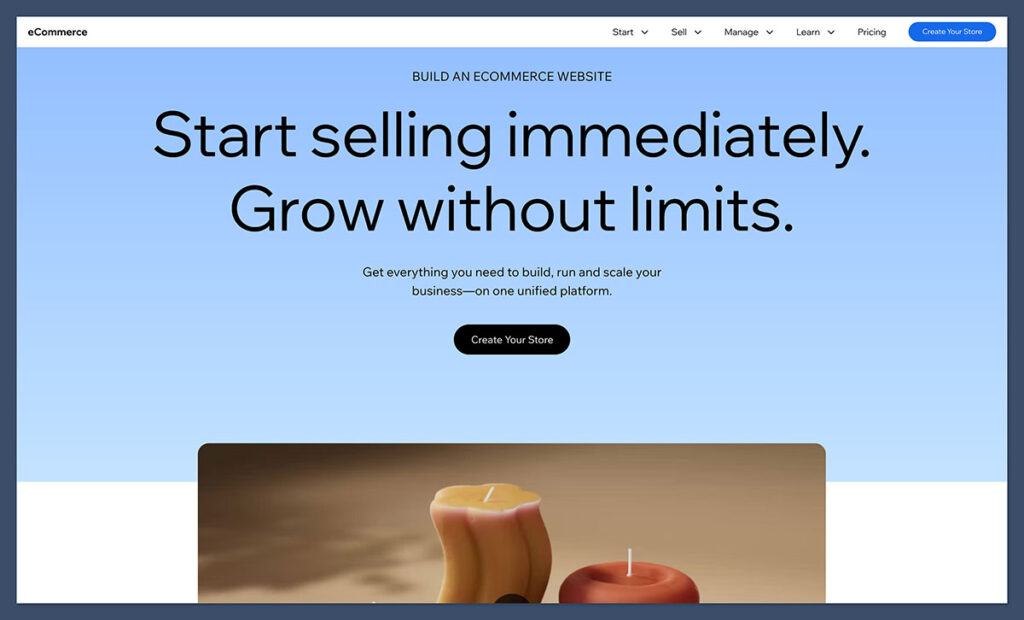
2. Wix eCommerce – Perfect for Those Who Don’t Want to Code
Best for Beginners

Saying Wix is for beginners is an understatement, and that’s not a bad thing.
Wix has come the closest to perfecting the drag-and-drop editor; even a complete newcomer to the web design and ecommerce game can figure out how to make a beautiful, functional ecommerce store.
Wix is a website builder first, ecommerce platform second.
But, to be honest, it’s come on a long way since then and I found its drag and drop builder to be super easy to use. Perfect for anyone who wants to start selling without hiring a developer or getting bogged down in code.
Their ecommerce site builder – powered by AI – can whip up a fully functional online store in no time, with just a few quick questions. It’s not exactly the best option for huge inventories – but it’s perfect for lean stores and solo entrepreneurs who are just getting started.
Pros
- The editor is ridiculously easy to use, with a vast library of over 2000 templates at your fingertips
- Built-in product galleries, bookings, and subscriptions make it easy to add variety to your site
- The AI tools are a game-changer when it comes to building, writing and managing content – and they’re all included
- You can take payments from multiple different sources – and get 24/7 support and a ton of learning resources on top
Cons
- Unfortunately, there are some pretty big limitations on product filters and variants
- And while the site loads quickly on desktop, its a bit of a slug on mobile
- And worst of all – there’s no way to customize the checkout process
Wix Pricing (Ecommerce Plans)
| Plan | Monthly Price (USD) | Features Included |
| Business Basic | $27 | Accepts payments, basic features |
| Business Unlimited | $32 | Subscriptions, 100GB storage |
| Business VIP | $59 | Priority support, unlimited bandwidth |
The Business Basic plan at $27/month gives you all the core features needed to launch a store and start accepting payments. It includes a free domain for a year, secure online payments, unlimited products, and basic marketing tools—ideal if you’re just getting started and want a clean, simple setup.
The Business Unlimited plan at $32/month is a better fit for sellers who want more flexibility and scale. It adds support for subscriptions, 100GB of storage, advanced shipping rules, and access to Wix’s logo maker and analytics apps, making it a good next step for stores with growing traffic or more complex product offerings.
The Business VIP plan at $59/month is designed for sellers who want full priority support and the most resources Wix offers. This includes unlimited bandwidth, VIP customer service, faster response times, and advanced marketing tools, making it best for established brands that rely on uptime and customer experience.
Bottom Line:
If you’re on a deadline to build a beautiful online store and don’t need all the bells and whistles, Wix is probably your best bet.
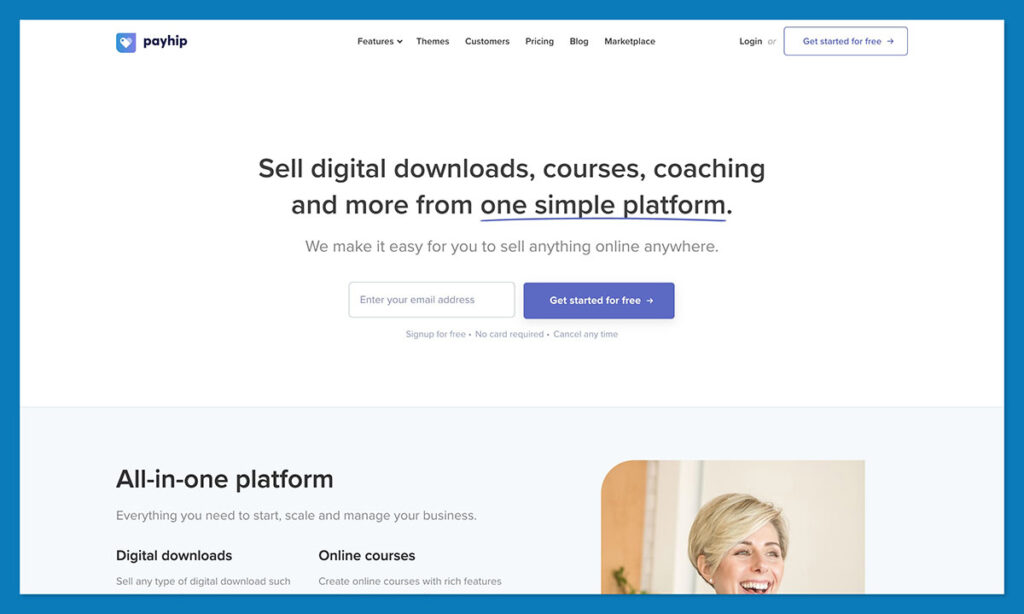
3. Payhip – Ecommerce Platform for Digital Products
Best for Digital Products

Payhip has quietly become one of the best all-in-one ecommerce platforms for digital product creators. They are one of the only platforms where you can build a fully branded eCommerce store with zero upfront fees and zero monthly fees. While it’s especially popular for selling digital downloads, courses, memberships, and coaching, you can also use it to sell physical products on a smaller scale.
In our view, it’s one of the strongest ecommerce platforms available for creators and small businesses looking to sell digital products directly to their audience.
Payhip has become a go-to platform for independent creators who want a simple way to sell online without dealing with the complexity or high costs of traditional ecommerce platforms. It’s especially popular for digital product businesses selling ebooks, templates, music, online courses, coaching sessions, memberships, and other downloadable products, but it also supports physical product sales for smaller stores.
A big reason creators are drawn to Payhip is that you can launch a fully branded online store without paying anything upfront. There’s no monthly subscription required to get started. Instead, Payhip only takes a small 5% fee when you actually make a sale, which makes it a much lower-risk option for beginners who are still growing their audience or testing new products.

What also makes Payhip really appealing is that almost everything you need is already built into the platform. You don’t have to spend hours installing plugins or connecting a bunch of third-party tools just to start selling. Things like customizable checkout pages, automatic digital product delivery, marketing tools like affiliate programs, discount codes, analytics, customer management, and email capture tools are all ready to use from the start.
Pros
- Generous forever-free plan
- Fully customizable storefronts with free hosting and domain
- Built-in marketing tools and analytics
- Integrations with 10+ payment gateways so it’s available globally
- Supports both digital and physical product types
Cons
- Limited third party app integrations
- No multi-account logins
How Much Does Payhip Cost?
Payhip’s pricing is one of the main reasons it’s become so popular with creators and small online businesses. Unlike many ecommerce platforms that require expensive monthly subscriptions from day one, Payhip lets you start selling for free and only charges a fee when you make a sale.
The platform offers three pricing plans:
- Forever Free – $0 per month (+5% transaction fee)
- Plus – $29 per month (+2% transaction fee)
- Pro – $99 per month (0% transaction fee)
What’s amazing is that you’re not forced into upgrading just to unlock important features. Every plan includes the same unlimited access to all of Payhip’s features, unlimited products, and unlimited revenue. As your store grows, you can switch plans to lower your transaction fees and keep more profit.
For a lot of creators, that flexibility makes Payhip far more affordable than platforms that lock you into expensive monthly subscriptions from day one.
Bottom Line: Payhip is one of the best platforms for creators who want an affordable, beginner-friendly way to sell digital products, build a branded storefront, and grow an online business without high upfront costs or monthly fees.
4. BigCommerce – Best for Scaling and B2B

Best for mid to large businesses

Scaling your business should be priority #1 for you as an entrepreneur. So, why not choose a platform that pushes you to grow?
BigCommerce has long been the fiercest competitor to Shopify, but it has shifted its strategy as a platform that fosters rapidly growing online stores. Even its pricing is set up to raise as you increase your sales.
BigCommerce is designed to help you grow. Unlike Shopify, it comes with heaps of ecommerce features built-in, so you don’t have to mess around with apps to get the job done.
While testing, I was really impressed with how well it integrates with Amazon, Google Shopping, and eBay – and it’s got some seriously useful B2B features like customer groups, price lists, and quote management – which are only available on Shopify’s enterprise plan
Pros
- Good news: no transaction fees on any plan!
- Strong SEO tools and it loads fast – which is a big plus
- Advanced inventory and order management – which is super useful for big or complex stores
- Built-in multi-currency and cross-channel selling – which is a game-changer for some sellers
- And it’s a good option for B2B functionality too
Cons
- One major downside is that design customization is a real challenge – unless you’re a coder
- And some people report a bit of a learning curve
- And finally, the revenue caps can bump you up into a higher plan if you’re not careful
BigCommerce Pricing
| Plan | Monthly Price (USD) | Annual Revenue Limit |
| Standard | $39 | Up to $50,000/year |
| Plus | $105 | Up to $180,000/year |
| Pro | $399 | Up to $400,000/year |
| Enterprise | Custom | Unlimited |
The Standard plan at $39/month is a great place to start if you’re a new store making up to $50,000 per year. It’s got multi-channel selling (eBay, Amazon, Facebook), coupons and discounts, real-time shipping quotes, and a heap of other useful features that’ll get you up and running in no time.
The Plus plan at $105/month is a good place to be if you’re looking to build some more marketing and conversion tools. You get customer segmentation, abandoned cart saver, stored credit cards for quicker checkouts, and lower credit card fees – which is perfect for building loyalty and improving the customer journey.
The Pro plan at $399/month is built for higher-volume stores making up to $400,000 per year. It’s got advanced search filtering (faceted search), Google customer reviews integration, and custom SSL, along with a higher API limit – which is perfect for big product catalogs or complex customer experiences.
The Enterprise plan is custom pricing – with no revenue cap. It’s perfect for fast-scaling or established businesses that need a heap of resources and support.
Bottom Line:
If you’re building a big or complex store and want everything built-in, BigCommerce is probably your best bet.
5. Squarespace Commerce – Best for Creatives

Best for Creatives

With photo-centric themes and a true drag-and-drop builder, Squarespace is the place for creatives to show off their work.
On the other hand, it’s not a bad platform for any ecommerce business that plans to use high-resolution imagery on their website.
Squarespace stands out for its stunning templates and visual design. I found it a great fit for creative businesses, photographers, designers and artists selling physical or digital products.
Their new Blueprint AI tool can create a starter layout based on your brand style. It’s not the most advanced ecommerce engine, but for small catologues and visual storytelling, it’s great.
Pros
- Squarespace’s templates are a real showstopper
- They come with built-in booking, services and product pages
- Strong blogging and content tools
- No transaction fees on Commerce plans
- Easy to use and maintain
Cons
- Limited product filtering and inventory options
- No advanced shipping or B2B features
- Less scalable for big stores
Squarespace Commerce Pricing
| Plan | Monthly Price (USD) | Features |
| Commerce Basic | $27 | Sell online, no transaction fees |
| Commerce Advanced | $49 | Subscriptions, advanced shipping |
The Commerce Basic plan at $27 a month gives you everything you need to run a modern online store with no transaction fees. That means unlimited products, mobile-optimised checkout, integrated accounting tools, customer accounts and access to powerful marketing features like email campaigns and promotional pop-ups – making it a solid pick for smaller stores or creative businesses.
The Commerce Advanced plan at $49 a month adds more control for growing businesses that need advanced tools. This tier unlocks subscriptions, abandoned cart recovery, advanced shipping and discounts, and access to API-based integrations – ideal for sellers who want to automate more of their business and drive repeat revenue through subscriptions.
The Bottom Line
If your store is small, visually led or brand-focused, Squarespace is a fantastic option – but you’ll eventually hit limitations as you grow.
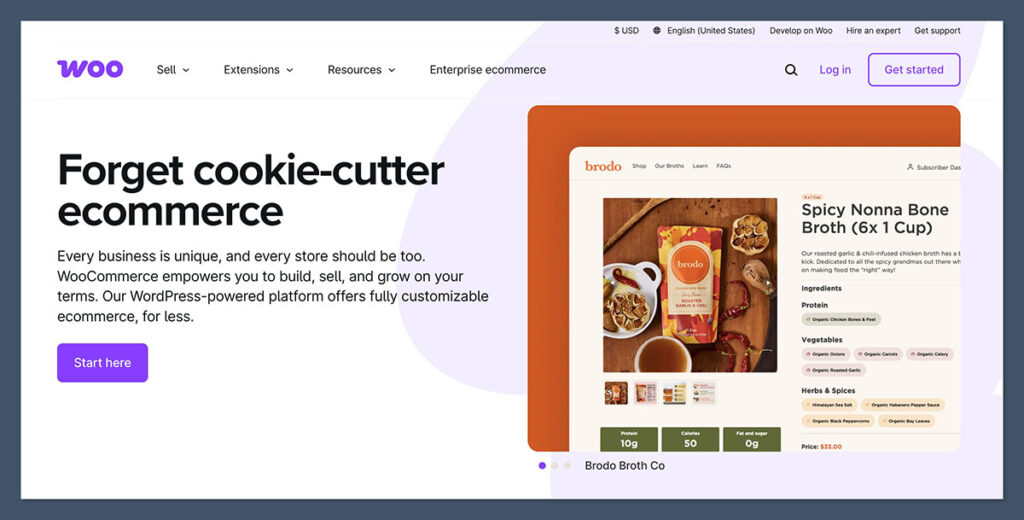
6. WooCommerce – Best for SEO and Customization
Rating: 4.3 / 5
Starting at free (just the plugin)
No trial needed
WooCommerce is the WordPress plugin that can turn your website into a fully functional store. Being open source gives you complete control over your design, code and even the functionality.
If SEO and content are key to your growth strategy, WooCommerce is the way to go. I found that during testing, I had complete control over URLs, schema, product page layout and even blog integration.
Pros
- WooCommerce really shines with excellent SEO and content marketing tools
- You can customise the design and structure to your heart’s content
- No pesky platform fees – just hosting and extensions costs
- There’s a huge community of developers and plugins to call on
- You can easily manage your products and categories
Cons
- Don’t get me wrong, there’s some technical setup needed (hosting, SSL, backups)…
- And maintenance? That can be time consuming
- And sometimes plugin conflicts can break your site
Typical WooCommerce Costs
| Feature/Service | Estimated Monthly Cost |
| Hosting (SiteGround, Cloudways) | $15–$50 |
| Premium Plugins & Themes | $0–$100+ |
| Developer Help (optional) | Varies |
While WooCommerce itself is free, the real costs come down to how you build and run your store.
Hosting is essential, and usually costs between $15 and $50 a month (SiteGround and Cloudways are popular options).
Many store owners also splash out on premium plugins or themes to get more features – this can be anywhere from $0 to over $100 a month, depending on what you need (like advanced SEO, custom checkout or shipping rules).
If you’re not doing the technical work yourself, then hiring a developer to sort out the setup, maintenance or custom tweaks is an optional – but often necessary – expense that can vary widely.
The Bottom Line
If you or your team are confident handling the technical side, WooCommerce offers complete freedom and control – especially if you’re big on SEO.
How to Choose the Right Ecommerce Platform
Not sure where to start? Here’s a quick guide based on what you need:
| Your Business Goal | Best Platform |
| Launching fast without tech skills | Wix or Shopify |
| Building a scalable ecommerce operation | Shopify or BigCommerce |
| Focusing on SEO and blogging | WooCommerce |
| Selling services or digital downloads | Squarespace or Wix |
| Needing B2B tools or wholesale pricing | BigCommerce |
Every platform has trade-offs, so your decision should match how you plan to grow.
Think about what features matter most to your business – whether that’s speed, flexibility, content or advanced sales tools – and choose the one that supports your long-term strategy.
Final Verdict
There may not be a single ecommerce platform that fits everyones needs perfectly but if i had to pick one that generally meets the needs of most users, it would be Shopify.
The thing is, its fast, works reliably, can scale to meet your growing needs and its literally built to sell online.
But if you’re on a tight budget or want a bit more freedom to customise things, Wix and WooCommerce are well worth checking out as alternatives.
Have a poke around the free trials and demos, and go with the one that best fits what you’re looking for and your businesss current stage of growth.
Frequently Asked Questions
What is the best ecommerce platform overall?
Shopify is our top pick for most sellers. It balances ease of use, a deep feature set, and the ability to scale from a side hustle to an eight-figure brand, all in one place. It is not the cheapest option, but it is the most reliable all-rounder we tested.
What is the best ecommerce platform for beginners?
Wix is the easiest starting point if you want to launch quickly without touching code. Its drag-and-drop editor and AI site builder can produce a working store in an afternoon. Shopify is the better long-term choice if you expect to grow into a larger catalog.
What is the cheapest way to start selling online?
Payhip lets you open a branded store for free and only charges a 5% fee when you make a sale, which makes it the lowest-risk way to begin. WooCommerce is also free as a plugin, though you will pay separately for hosting, typically around $15 to $50 per month.
Which ecommerce platform is best for SEO?
WooCommerce gives you the most control. Because it runs on WordPress and is open source, you can fine-tune URLs, schema, page structure, and blog content without the limits other hosted platforms impose. The trade-off is that you handle the technical setup and maintenance yourself.
Which platform is best for B2B or high-volume stores?
BigCommerce. It includes B2B tools such as customer groups, price lists, and quote management as standard, along with strong inventory and multichannel features, where rival platforms often reserve these for enterprise tiers.
What is the best platform for selling digital products?
Payhip is built for it, with automatic delivery of downloads, courses, and memberships and no monthly fee to start. Squarespace is a good alternative if design and presentation matter as much as the sale.
Do I need coding skills to build an online store?
No. Shopify, Wix, Squarespace, BigCommerce, and Payhip are all built so that non-technical users can launch and manage a store. WooCommerce is the exception, since it expects you to be comfortable with hosting, plugins, and occasional maintenance.
Can I move my store to another platform later?
Yes, though the effort varies. Products, customers, and orders can usually be exported and imported between platforms, but themes, custom code, and some app data rarely transfer cleanly. It is worth choosing a platform you can grow into to avoid migrating sooner than you need to.


Thanks for this honest comparisons! I think that WIX might be a better fit for me to create an ecommerce store. This was very helpful 🙂
Thanks for sharing!
Interesting post karol
Rhanks Rakesh!
Wow, impressive post! Really appreciate the effort spent on comparing all these platforms. Sometimes it’s really hard to decide which one would fit your expectations and needs. Therefore, I often use Cart2Cart’s migration preview service and migrate some of the data to their test store without even installing the platform. It’s really convenient, especially for those who are still at a crossroads. I did migrate my store to Shopify and the platform is awesome!
👍👍👍
I am running an eCommerce business. This post really helps me a lot.
Happy to hear that!
Intersting post Karol ! Thanks from France !
You’re welcome!
So many details about custom PHP web development are well-covered! I’d also add WooCommerce to the list, though, however, that’s just my personal opinion.
Good comparison. However, I’d like to say the “best eCommerce platform” is something that fits your business model. Best to sell products on facebook is Ecwid, best to embed products is abantecart, best for startups and newbies is Shopify or bigcommerce of course.
Hey there!
Thanks so much for this article! Very informative, and a ton of great comparison data on these products. I think it’s worth noting that Ecwid actually recently released a variety of simple themes for their Instant Site tool that are pretty cool and simple to use. Just my two cents!
Nice article, I like this comparison guide.
Thanks Katarina!
Correct pretty detailed info for sure. Nice read from my end. Keep up the good work
thanks for sharing such a helpful article.
You’re welcome!
very nice and helpful article.thank you so much.
You’re welcome 😉
This is an informative article! I have an e-store on bigcommerce and considering to move to Shopify and Magento, one friend recommended me to use an automated migration tool called Litextension. I tried its free demo to transfer limited entities from my bigcommerce store to shopify and magento test store, furthermore, I can preview how the data is arranged and managed in the platform backend. Honestly, I agree that choosing which one is better platform between shopify and magento is tough because these both ecommerce platforms really gave me great experience. After reading this article, I will try the demo migration on each those platforms to see what are the differences by this tool.
Awesome, let us know what you decide.
Such an informative article! This article can show the best feature of each platform because there are too many platforms in the marketplace which confuse me a lot. I’m considering to transfer data from my old Woocommerce store and can’t make a final decision yet. I found that there is an automated migration tool called LitExtension which provides free demo for customers to use its test store features to preview how each platform works. Does anybody use full migration of this service? Because my friends recommend me this tool for me so who are in the same case should try its free demo because it’s free.
Nice article! I think AmeriCommerce has all of them beat. I have experience with Shopify, and I think it’s a nightmare for users with minimal experience. Also, AmeriCommerce doesn’t charge based on sales volume. So you are getting “punished” for having a successful business. You pick your plan, and that is it.
Hey Catalin, First of all, thanks for the great post, which is extremely useful and knowledgeable.i have really enjoyed to read this article. keep sharing.
Thanks Sara, glad you liked it!
Bigcommerce and shopify both are good place to start the online business but as compare to pricing. I suggest to go with bigcommerce. I have been working with small business owner’s and they are very happy the way are earning. By using paid and organic methods, they are achieving good in bigcommerce.
Excelente Articulo.
Thank you!
Good one article. I got good information about Magento big cart.
Glad you liked it!
Amazing..! It’s quite lengthy but enjoyed..!
Glad you liked it!
Can you tell me; where I can find data about how many people make a purchase online?, which are the most purchased items? and so on.
Hello Andres,
Here’s a recent article from BigCommerce that might answer some of your questions.
nice article, keep it up.
Thank you Nilesh, glad you liked it!
I think something is wrong with this Shopify Pricing: $9 dollars. For me the Basic Plan is $29 or Do you have some promotion code? Thank you!
Hello Leonardo,
The $9/month is the Lite Plan. Check out this post for more info.
–
Bogdan – Editor at ecommerce-platforms.com
Hello,
I am an owner of the Vrinsoft in Melbourne Australia, and I have been developing e-commerce website, so my question is my client asking me a platform that has good speed to build an eommrce website, so please give me advice which will best in the comparison of speed.
Hi Jay,
We haven’t got the chance to do a comparative speed test on the platforms listed here, so I can’t say which one is the absolute best. What I can say is that speed shouldn’t be a problem for any of them.
–
Bogdan – Editor at ecommerce-platforms.com
Hi,
Loved your review. We are trying to setup an online shop for customised goods. What will happen is our customer needs to upload a photo, then through a software (which we haven’t developed yet) the photo will be edited (resized, color changed, etc.) and be displayed to the customer within seconds, then we they approve, the order will be finalised. My question is, do you know if any of these platforms will support such a customized-external plug-in? Thanks.
Hello Soroush,
Glad you liked our article! Custom features can be implemented for all platforms listed here.
Hi,
I am going to launch a single product business. Which platform is the best?
I am thinking of a wix website with buy button from shopify. Is it weird?
For a single product Wix would be the cheapest option. You can read our full Wix review here.
–
Bogdan – Editor at ecommerce-platforms.com
I think shopify is better than others. I want to learn magento also. How can I learn magento ? Can anyone help me ?
Hello Hemant,
There are tons of Magento courses and tutorials available. You can start by browsing their developer documentation.
We always prefer shopify. Aslo we direct our customers to use shopify for their e-commerce projects.
Always a good choice, Boğaziçi!
Thanks for all the work. We are an independent wholesale auto parts store that would like to get back into e-commerce. We hired someone to set up our site and they used woocommerce on wordpress. This site has generated 0 yeas ZERO sales in 18 months. We are looking at Shopify, Bigcommerce and volution. We have approx. 1200 different parts, and are novices with CSS and HTML, but we don’t want that to keep us from picking the best site for our needs. We are trying supplement our current business and grow. Any suggestions?
Hi Geoff,
Starting with the cheapest plan, both Shopify and BigCommerce have no limits when it comes to number of products, file storage and bandwidth. Volusion is a bit behind, limiting the number of products and your bandwith depending on the plan you choose.
I would recommend choosing between Shopify and BigCommerce, here are our full reviews:
https://ecommerce-platforms.com/articles/shopify-review
https://ecommerce-platforms.com/articles/bigcommerce-review
https://ecommerce-platforms.com/compare/bigcommerce-vs-shopify
Best,
–
Bogdan – Editor at ecommerce-platforms.com
How long has it been since you evaluated these eCommerce platforms?
It just seems that more recently I have noticed sites who use Shopify seem to have a lot more problems.. error messages that never seem to be resolved, etc.
I am trying to select a new platform for my website and have pretty much crossed Shopify off my list due to all the troublesome sites I have encountered.
I was using 3dCart.. but they do not treat their customers well at all. Considering BigCommerce if I can find a template that suits me.
Hi Sherry,
We review our posts regularly. For most ecommerce entrepreneurs, Shopify is one of be the best choices. You can find here more than 500 examples of stores using Shopify. BigCommerce comes close, but it’s main problem are the templates. Here you can find around 50 exapmples of stores built using BigCommerce.
Hope you’ll find this useful!
–
Bogdan – Editor at ecommerce-platforms.com
Hi Catalin
This post is so helpful especially for people who know nothing about programming, and making website like me. I have fashion biz company, and joined alibaba for 2 years, but since they increase their price, I can’t afford it any longer. I am looking for e-commerce platform that suitable for my biz. Yea I also thinking about my shopify, but is it possible to join myshopify if I am going to sell as wholesaler – OEM service?
this is really nice post! Thank you for sharing!
Hi Ericka, you can do this using Shopify and an app like Wholesaler: https://apps.shopify.com/wholesaler
Best,
–
Bogdan – Editor at ecommerce-platforms.com
Hey,
Thanks for the post!! We are using Tictail for long time. It is working good till. Any suggestions for us.
Thanks,
Mya
Hey Mya,
Shopify and Big Cartel might be some great alternatives.
Hi,
I was wondering if you could elaborate on some industry standards that us “newbies” are not familiar with. such as:
1. Is there companies that have stock, and drop ship the product for us , so all we have to do is get the “click” sales, and the other distributor, or whatever send s the product. (much like amazon fulfillment, but using there own stock) – if these types of products do exist, what are they called? what is the terminology? I dont know how to look for options of businesses with that type of structure (vs having my own inventory, and no drop ship). – can you elaborate on this terminology, and what its commonly refereed to? is there a site that lists these types of vendors/distributors/ suppliers?
2. If I choose to own all of my inventory, and warehouse the stock, and ship it out on my own, what software can help take the clicked order, and print out an invoice automatically, so I can ship it out with ease, much like amazon would i suppose.
3. What other common knowledge basic differences are there? can you throw up a basic education in eCommerce options, and the step=>step process entailed? I think this would help immensely!
Thank you,
B
Hello Ben,
You should definitely find the guides below useful:
Choosing Between Self-fulfillment, 3rd-party Logistics and Dropshipping
Dropshipping Definition: The Best Way to Setup a Drop shipping Business Quickly
Guys, good review overall. However, I noticed a bit of a “bias” toward Shopify and was wondering whether that bias is purely driven by the advantages of that platform as you see it, or by other factors. No, I am not saying some of the information was incorrect, but at times the features were not fully highlighted to be compared fairly.
For example: looking at the quick comparison table above, I would assume that Shopify is offering much better pricing plans compared to let’s say BigCommerce (starting from $9 for Shopify, and $29 for BigCommerce). In reality though, both Shopify and BigCommerce offer the store hosting plans starting from $29 (Shopify’s basic plan of $9 does not give you a storefront, only the “Buy” button, that you can integrate on your own site).
Also, I found little info about important store functionality such as multi-channel support, price tiering etc. At least when it comes to these two features, I can see BigCommerce winning over Shopify:
Tiered pricing allows you to set different price points / discounts to specific user groups (say regular customers vs distributors), or offer volume or event driven pricing changes. BigCommerce has this feature integrated with their plans, whereas Shopify relies on 3rd party plugins for that functionality, and at additional monthly fees.
Multi-channel support (cross-sell the items from your storefront on ebay, Amazon, Facebook, etc) – comes integrated with BigCommerce at no additional cost, and is missing from the Shopify feature list. I talked to Shopify support and was told that while Amazon integration is coming soon, ebay has not been even announced yet.
Disclaimer: I do not represent any of the above e-commerce companies, I am merely comparing the platforms to identify the one that is most optimal for my future store. At this moment, I am on the fence between Shopify and BigCommerce. Just thought a more fair overview of features would benefit us all.
I am on the fence as well…I tried shopifys trial but not bigcommerce yet. I agree that the review seems a little one sided toward shopify
Thanks for this incredibly useful and insightful resource for those of us interested in entering the world of e-commerce.
I just wanted to note that at time of writing there appears to be an error in the URL linking to your Bigcommerce review; the link in the text: Bigcommerce (full review here) is to https://ecommerce-platforms.com/go/TryBigcommerce
I believe the correct link is:
https://ecommerce-platforms.com/articles/bigcommerce-review
Thanks for the heads up, will update the post as soon as possible.
I think Shopify is the number one ecommerce software in the world.
I totally agree Golam.
Great article but do you have an updated version? I have a 3dcart store and they now offer an updated admin panel which looks similar to shopify and bigcommerce. Additionally their theme store has many new themes and I don’t believe they offer those old designs mentioned in the article. I would suggest doing a more recent article or updating the information if you have reviewed the platforms since the time you published this. Great job with the comparisons none the less.
Hi Johnson,
Thanks for letting us know, will make the modifications as soon as possible!
Bogdan – Editor at ecommerce-platforms.com
Great article, I recommend to all mys clients the Shopify Platform, due to your flexibility, with the API you can extend and add new features.
Maikel, glad you liked it — thanks for the feedback.
Bigcommerce and Shopify are great options for ecommerce website development. As a developer I worked on 4 of the above mentioned platforms I feel using Bigcommerce is very easy and reliable for ecommerce development.
Sarah, thanks for the feedback!
Hi,
I got a problem in defining/finding keywords for the platform I’m looking for, can you help me?
I once had a ‘micropayment’ platform selling one-time private accesses to specific urls, and I’m looking for something like that again.
Meaning I built a page containing php/sql stuff, and the product on platform was selling the access to that page, securing it by generating a unique random code, verified then “burnt” upon arrival at said page (through a back-script from platform I had to include in the page’s code).
This way, it ensured, well, one-time access to a private url, that I could use for various purposes after that.
Is there still a platform doing that kind of stuff (potentially with paypal linkage). With generated codes or not, I don’t mind, I just need to sell secured access to private page somehow, even complicated ? What would be the keywords to look for such platforms ?
Thanks a lot
Hi Mattan,
This article covers some of the best options for easily selling digital goods online:
Top 10 Best Ways to Sell Digital Goods Online
You might find it helpful, cheers!
Bogdan – Editor at ecommerce-platforms.com
Hi Bogdan, 3DCart has updated the pricing and the cheapest plan is $19 http://www.3dcart.com/pricing.htm
Hi Denis,
Thanks for the heads up, we have made the necessary changes.
Cheers!
Hi, how does Shopify compare with Wix? Is there any particular reason as to why you did not include Wix for comparison in this article? Thanks.
Hi Yoshi,
You can check out our in-depth comparison of Shopify and WIX. We have also separate reviews for Shopify and Wix.
Hope this helps!
I Found interesting to read comparison of different ecommerce store,when it comes to ecommerce store fees, we have to renew monthly or annually,Please solve my doubts,
Hi there, most of the services have a monthly fee but most of them offer a discount if you pay for a whole year in advance. Cheers!
Hi,
And thanks for your post. It was a very interesting comparison. I live in Japan and we don’t have very good platforms like the west for online sales. I’m pretty new to all the options that everyone is talking about. My big question if it sounds foolish, sorry, but which one do customers tend to gravitate to online the most? Who gets the most activity when it comes to customers finding what they are looking for? That is the big question I have with these platforms that I can’t seem to get answered. Yes, each site is its own and seo’s etc… But what do customers seem to be tapping into?
Hi Ben, Shopify and BigCommerce are among the most used. You should have no problem setting up an online store in Japan with any of these services. Cheers!
Hi Catalin,
So between Godaddy and shopify, which one would you say to go for. (sorry, I know Godaddy is not mentioned on here but i just wanted to know your thoughts)
Thank you.
Hi Angleica, Shopify and GoDaddy are two completely different products: Shopify is a complete ecommerce solution that allows you to set up an online store and GoDaddy is an Internet domain registrar and web hosting company. Hope this helps!
Hi Bogdan,
Thank you for this. Yes, i do know. Got my domain from Godaddy and was looking to start an online store. Noticed Godaddy have a product similar to ecommerce if not the same (called online store) and since I’m not entirely sure, I was looking to weigh it against that of shopify to see which one is better in terms of features and what it offers.
Do you know of this product at all?
Attached the link: https://uk.godaddy.com/websites/online-store#features
Thanks a lot.
Hi Angelica, I did a research and I would definitely recommend choosing Shopify. The templates available are more appealing, customization is much easier, there are more pricing plans, not to mention all the apps and extentions available in the Shopify App Store. You can check out our Shopify review for more info. Best.
Hi Bogdan,
thank you, for taking the time to answer. You’ve been very helpful 🙂
I am leaning towards Shopify now, most of their themes are pretty clean looking at the demos.
Is there any any SEO or traffic benefit for using any of the above stores as compared to own ecommerce store? I Know the SEO. I have my self-hosted store http://gladiatorsguild.com/
Opening another store on any of the above mentioned can benefit me further? I always wondered, if I should head to shopify and create a store over there. But then I think of how it draws traffic. Is it like Amazon, eBay etc or like own store that requires SEO?
Enjoyed the overview of top platforms. Have had good success at Go Daddy. But I now want to develop different content new stores but not use Godaddy.
It seems we should learn Word Press and Shopify. ecommerce-platforms.com is excellent source of information.
Good afternoon,
First, thanks for the post, which is extremely useful and interesting.
Second, I wanted to ask for help, because I want to create an online store and have some questions.
I would like to have my own domain and I know that it is possible to buy it through the many e-commerce platforms that exist (eg. Shopiffy or big cartel). But I have heard that it is best to buy through platforms such as godaddy. What is your opinion and what is the difference?
These sites to create online stores (eg Shopify) function as hosting right? In this case no need to buy the hosting, in another right site?
I apologize for the issues, but would like to know a little more about domains and hosting and understand what the best alternative for me.
Thank you
Marisa
Hi Marisa,
You can purchase a domain name within Shopify, this will make administration and renewal easier since you have access to all settings from a single admin account. With BigCartel you’ll have to purchase your domain from a third-party service like GoDaddy or Domain.com.
Hope this helps,
Great post Catalin,
But I should agree with some of the commenters above – Magento should probably be added to the list. Especially now, when there are plenty of tools that allow even non-techies to fully experience the platform. For example, Zoey is based on Magento and can be run/ managed by someone, who’s not a developer or a certified specialist.
Hi there, we did list Magento but had to remove it when they decided to close their “consumer” product, see this post: https://ecommerce-platforms.com/ecommerce-news/magento-closes-prostores-go-partners-bigcommerce
I used to sell through both Big Cartel and Magento and find BC more user friendly. It only lacks good reporting. I’m not very good with Google Analytics, would appreciate something easier where I could also control over my other channels, i.e. Facebook and Twitter. Is there anything like Compass but more complex?
Anyone heard about DuckSell? I’m done with those crazy platforms, I want to sell directly on my website.
for those who only need a simple business with limited options the Prestashop is indeed ok within its limits. Personally i think woocommerce, and shopify are perhaps the second choice to ecwid, but having been testing all the above platforms for some years now, i can say that for me at least, Ecwid is the only Option with the Power i need to run my online businesses. Shopify comes second but is much more expensive, and less mobile ready. It is also not yet ready for mobile and semantic seo, but Ecwid is at the forefront of new cutting edge web technologies, and constantly expanding its scope and ability to absorb all future technologies, api’s and so on..
Prestashop is however not even 10% of the power-tool Ecwid is when it comes to seo, marketing, adding products to other marketplaces (Ebay, Amazon, wix, weebly, Faceboook, Blogger, WordPress)
Prestashop is easy for beginners as well (IMHO) – not much of a learning curve for novices. There are plenty of online learning resources available and it has an active online community (for helping novices and experts alike). Other major pluses are that, it’s free (open source), facilitates the use of many modern looking templates and is supported by many hosting companies like Godaddy, Hostgator, etc.
I currently use Ecwid and am considering switching to Shopify. The one thing I find hard, mostly because I am limited in my computer knowledge, is getting my products indexed on Google. Hoping that maybe the SEO with Shopify is better or at least easier! Any thoughts?
Hi Emily,
Yup Shopify is most certainly the easiest to use platform of the ones I’ve reviewed over the years. That includes managing the on-site aspects of SEO.
Best of luck!
Hello Emily!
Wendy from Ecwid is here. We are sorry to learn that you faced difficulties with SEO in your Ecwid store.
In general, Google can index Ecwid stores and you do not need programming skills to get your store indexed. For more details, refer to this post on our forums: https://www.ecwid.com/forums/showthread.php?t=35739
Please, post here the link to your Ecwid store and I will inspect it. I will reach out to you via email shortly. Thank you!
To Emily Elllingwood
i have tried all the choices mentiuoned in this blog, and Ecwid is the only one that gets my products listed in google
I use various methods because i own 5 Ecwid stores, and i can tell you, Shopify does not have half the power, and will end up twice as expensive.
Ecwid is like a youtube embed code, and i have my store inserted into well over 30 websites
The SEO is fantastic and much better than Shopify
Most of my competitors use shopify and zen cart and magento, and they all dont come anywhere near me on first page.
I would seriously reconsider changing from Ecwid to Shopify, or any other platform.
If the SEo isnt working for you in Ecwid, then it is not Ecwid that is doing the wrong thing, its You (no offence intended). If you do the wrong thing with Ecwid, then Shopify won’t be any different
The best way to seo anything is to make a single blog post or page about it and insert the product into the post
but the store itself does get indexed, if it is inserted into an seo friendly page
Really good article! I would add in that on Bigcommerce, the pro plan ($199.95) scales up to 1 million in revenue – so it’s entirely viable to put off a bump to a higher pricing plan. Phone support on Bigcommerce is also 24/7 save for the few times when they need to do a company meeting.
Thanks for sharing you thoughts Brian, we’re really glad you enjoyed our article!
I have read that WooCommerce is perfect for beginners. WordPress is so easy to use and WooCommerce is simply an extension of that. Customizing your site through WordPress is really simple due to the number of plugins available. Plus, WooCommerce has tutorial videos to help with the set up. But Magento’s interface is also really easy to use and it comes with tutorial videos and documentation. It has a full installation wizard too. However, Magento’s difficulty is increased when you want to start adding extensions to your site. In this instance, you might want to think about hiring a Magento-specialist developer.
Please advise if you are familiar with both what to choose for small business – Magento or Woo-Commerce platform and why???
If you are already familiar with WP, yeah it’s quite easy to use, but if you’re just starting out using a CMS, jumping straight to WooCommerce, the learning curve is a lot higher than using a native ecommerce solution like Shopify.
Between WP and Magento, in terms of how easy it is to work with in the long term, I would go with WP + WooCommerce.
Best of luck John!
Any thoughts on Soldsie or Spreesy which treats social media accounts as a sales channel? It seems risky to have a third-party take email address comments to send an invoice, though it’s convenient.
Shopify has a lot of ongoing charges that are NOT obvious at first glance. For starters they charge 1.4% + 30c on all credit cards and this is in addition to the usual bank credit card charges. If your store trades $500,000 per year which is not that high you will pay $7000 per year and that’s not including the 30c per transaction fee.
To make matter worse they offer no way to charge extra for certain payment methods like amex or paypal and if you put shopify as a POS system instore you will be charged a fee on EVERY transaction even if your customers pay cash. Shopify does mention their fees clearly but they don’t mention that these credit card fee’s DO NOT replace the bank charges. So you need to pay credit card fees twice, once to your bank and once to shopify.
Im not saying shopify is a bad product, they offer a very good product which is fine for small businesses with low turn over or people with no computer skills but for me these costs are not sustainable in a very competitive market. My suggestion is go with a platform like Prestashop. Its more expensive upfront but has no ongoing costs.
Great post, thanks for sharing!
You’re welcome William!
I am glad you mentioned the dramatic increase in cost for higher revenue stores on BigCommerce. I am one of the long-time BigCommerce customers who is now leaving for Shopify because of the pricing increase. As far as I can tell, BigCommerce has nothing over Shopify in terms of service that would justify spending four times as much per month. There are some annoying switching costs in terms of time, effort, and template purchase, but it seems well worth it to me. And Shopify has some features (buy now on Pinterest, etc) that people have been asking for at BigCommerce for months and months to no avail. Anyway, we’ll see how it goes, but so far I’m pleased with what Shopify has to offer me in comparison to BigCommerce.
Glad I ran across this article. Familiar with a couple of them, although we use woocommerce for WordPress was thinking about trying Shopify or BigCommerce for a potential new client. All the comments are extremely helpful in deciding, Thanks so much for sharing!
I found this article because I am looking for a better platform. We have been on BigCommerce for nearly 4 years now. In general it is a decent platform but it has MANY flaws. As we have grown, these flaws are becoming more and more apparent.
Most frustrating has been the CONTINUED promises without any being achieved in the shipping module.
Frankly I have found Bigcommerce to have become increasingly ARROGANT!!! They more or less forced us off GOOD credit card processors in favor of their “favorite” because they cut a deal with them. That CC processor being WORLDPAY. Worse, they did so by embedding Worldpay personnel at BigCommerce and sent out information that was misleading, and made it look like the old processor was not going to be supported. Very sleazy.
Having gone to the recommended CC processor Worldpay…it has been nothing short of HELLISH…they are HORRIBLE and its as if you are dealing with a “mickey mouse” company.
We’ve been so peeved by that, that we’ve been wanting to leave ever since, but as you all would understand, moving to another platform or CC processor is not exactly an easy task for a small business.
However…..today I was given notice that BC is changing policies and was given 60 days notice that my monthly fee is rising nearly 250%
That is the LAST STRAW!!!!
Too many bugs, too many flaws, TOO MANY PROMISES and they have become TOO ARROGANT and have forgotten about their customers who put them where they are.
So long BigCommerce!
I will be curious to hear update from you once you switch to shopify and compare two platforms.
If customer service is at all important to you, then I would stay away from 3DCart. I have been working on a issue with them since October 2015 and it is still broken. It is very important for me to be able to import my orders into my accounting system. They often don’t even respond to inquiries. My boss which has been with them for many years says the support has always been terrible.
Same here. And if there’s one thing that’s a deal breaker for me, it’s a bad support system. Nothing is more frustrating than when you have an issue and no one replies to your ticket! It’s not like I expect an instantaneous response, but I think a response within 24 hours should be more or less mandatory.
Anybody know of a good platform for building a price comparison / affiliate product feed site?
Thank you for your time and efforts here!!! I do have a question to ask which it will be essential for my selection.
Are there any eCommerce platforms aimed at dynamic database/live feed from supplier that you recommend for larger quantities of products (1000+)?
Great info at the perfect time….thank you.
Glad to be of service Renee!
This article is really worth for new comers to E-commerce business. Thank you for comparison,pros and cons.
With the launch of Magento 2, I think the idea of an SaaS Magento (Go) should be revisited
Hi Catalin,
Great summary of the differences, pros & cons of the various platform. It has been very helpful to me while I have been researching the various hosted platforms!
One question though. How did you compile (or where did you get) the info for where Shopify is gaining clients from/ losing them to?
Thanks again!
Cheers,
Dave
I’ve been using volusion for the past 6 months and I feel like I’m getting nowhere. Thanks for the article. I think its finally time to give shopify a try. I need something much more user friendly. I just wanna sell my clothes. I’m not an IT expert and I don’t want to waste time trying to be one.
Thanks for this great post. I think nowadays most of people 1st choice is Magento or Shopify Platform.
Both are user-friendly & SEO friendly platfrom
Thanks for the in dept reviews on each platform! Definitely helpful when deciding what to choose!
You’re welcome 🙂
Thanks for this comparison! Its useful to see the statistic and read about the usability before committing to a platform!
We prefer to use Magento for our clients for several reasons, let us list some of the reasons:
a. Magento platform is an effective e-commerce platform for customized websites.
b. Lots of templates available and easy to modify.
c. Several easy to use plugins available.
d. From the conversion rate optimization point of view can be customized as per testing results. (as a conversion optimization specialist we tests before we implement)
and many more.
Overall, thank you for sharing such a wonderful comparative analysis for different eCommerce platforms.
Nice Job!
It was helpful for me.
Thank You CATALIN.
Glad you like it Farshid!
Great and timely article. I have been with 3D cart for about 3 years and am beginning the search for a more mature company. I will be checking the companies mentions. Thanks!
Cool, good luck SV!
Hey there,
Wow, that’s a nice analysis. Perhaps, it’s the most detailed one. Helped a lot. I think, I should expand my business to all the mentioned platforms though.
Cheers,
Angel
Hi!
Thanks for this article.
I have a question – how important do you think the 24/7 customer support is?
I am and have been using Tictail for about 1,5 years and I really love their community and their webshop solutions. They go kind of big on their community feeling – with meet ups, blogs, pop up shops etc. You should really look in to it and consider writing about them too:)
Thanks for a good article!
Caroline
Hi there, thanks for pointing that out, will definitely add Tictail to our site.
Re: your question I think support is crucial but you should test everything not listen to advice from ppl who don’t know anything about your business 🙂
I’d be interested in hearing more on Tictail too.
Hi Kristy, here’s out our latest Tictail review. 🙂
Magento Community Edition is a great way to get started but is generally aimed at larger retailers who need more flexibility with their code.
In my opinion Magento is one of the best and noticeable CMS for developing an eCommerce website. Magneto is essentially an open-source (only community edition) PHP and MySQL based feature enriched platform. It has a wide range of template system and can empower your website with an impressive range of functionalities. The primary benefit with Magento is its flexibility that let you have complete control on your e-business. The extreme scalability of Magento further ensures that, as per your business growth you can create additional resources in your Ecommerce site.
I think bigcommerce is going much better than others.
Yes, correct
I think it is better to have something like shopify thats ready to go dealing with html and css is not easy and requires time so it is better to go with shopify and bigcommerce
Bigcommerce has 24/7 phone support.
I am also suggested Magento is the best platform for E commerce. Some reasons why magento?
Magento Does Not Penalize You For Growing Bigger
Easy To Integrate Third Party Apps
Freedom To Choose Hosting Service
Modular And Customizable
Fast. Really Fast.
Built For SEO
I think you misunderstood the idea of this post.
He was comparing platform ready to go, not custom solutions you need to build yourself to get it running.
To archieve what you described in Magento you have to hire some company to:
Install, to start using.
Upgrade, if you get bigger.
Pay: to migrate between hosting services
Get advanced knowledge to customize.
Backup, etc.
We have been trying for several days to import an excel spreadsheet into Shopify and with 5 different support members we are no further ahead. The gurus that provide 24/7 support are simply other shop-owners taking calls from home to uphold the 24/7 but most with limited or no knowledge. ( I knew more after 1 day of reading the material online than 4 of 5 gurus I connected with.. to give you an idea) So if you go with Shopify – be prepared to figure things out on your own…
Sorry to hear that Victoria, hopefully the problem is solved by now…
Why would you not include Magento on this list? It’s hard to take the comparison seriously without it including the leading e-commerce solution.
Hi Gizamo, Magento is a very powerful ecommerce CMS, but we’re only discussing ecommerce platforms that can be used by anyone to build an online store. As you know, Magento is aimed at experienced developers, and Magento Go will shut down in a few months. For the full list of reviewed platforms please check out my comparison chart: ecommerce-platforms.com/comparison-chart
what do you mean magento will shutdown? Magento already lunched Magento2 in 2015. And Magento will stop support for Magento1 in 2018. And ofcourse he will stop support because if he will not stop support for Magento1 Most poeple will stay with Magento1
Only “Magento Go” shut down in February 2015. https://magento.com/blog/magento-news/important-announcement-about-magento-go-and-prostores
Best,
Bogdan – Editor at ecommerce-platforms.com
Hi Bogdan, I have a question that I’d like to contact you directly about. I’ve tried using the contact page instructions, but haven’t receive a response. Is there a good contact address for you? Thanks in advance for your help. 🙂
People who want to get their shop up and running fast don’t have time to learn a technology and deal with it’s headaches. I know Drupal but after fighting with it to build a decent store for months, I was able to very quickly build a shop in Shopify. How quickly? 4 days. Yes, including beautiful theme, products, variants, discount prices, inventory etc.
Thanks for sharing your experience with us! Totally agree!
Second that, there is no excuse to dismiss the nr1 used eCommerce solution Magento Community to even Magento Enterprise. Even with the difficulty (which is not difficult at all to setup plus enterprise…), you cant just go past something like that in a blog called top6 ecommerce platforms on a ecommerce-platforms.com website. Unless there is a personal reason…
Hi there, we did list Magento but had to remove it when they decided to close their “consumer” product, see this post: https://ecommerce-platforms.com/ecommerce-news/magento-closes-prostores-go-partners-bigcommerce