

Shopify and Ecwid are two top ecommerce platforms — but which one is the better fit for your business in 2025?
We spent over 250 hours researching, testing, and comparing these tools head-to-head to bring you expert insight based on first-hand experience.
After extensive testing, Shopify came out on top if you want a powerful, scalable ecommerce platform. But Ecwid does have key advantages, especially for existing websites that just want to start selling fast.
Shopify vs Ecwid: Quick Verdict
| Shopify – Best for full ecommerce store setup and growth | Ecwid – Best for adding ecommerce to an existing site |
|---|
In this detailed breakdown, I’ll walk you through where each platform wins — including pricing, features, ease of use, SEO, and support — based on our most recent 2025 research.
Shopify Is Best For:
- Businesses that want to scale with robust ecommerce features
- Full online stores built from the ground up
- Sellers who want multichannel tools, SEO, and app integrations
Ecwid Is Best For:
- Existing websites that want to add a simple store
- Entrepreneurs on a tight budget
- People selling a few products without needing a full store build
Quick Comparison: Shopify vs Ecwid
| Feature | Shopify | Ecwid |
|---|---|---|
| Overall Rating | 4.8 | 3.9 |
| Free Plan | No | Yes |
| Starting Price | $39/month | $0 (Free plan) |
| Transaction Fees | Yes (unless using Shopify Payments) | No |
| Best For | Full ecommerce stores | Add-on ecommerce |
| AI Tools | Shopify Magic + Sidekick | None built-in |
| Multichannel Selling | Yes | Yes |
| Blogging | Built-in | No (depends on CMS) |
| POS Integration | Yes | Yes |
| App Market | 8,000+ apps | ~300 apps |
1. Best for Pricing: Ecwid
The Winner: Ecwid’s pricing is more flexible, with a free plan to start.
Shopify and Ecwid approach pricing very differently. Shopify offers three core plans, while Ecwid starts with a generous free plan and scales gradually.
Shopify Pricing
| Plan | Price |
|---|---|
| Basic | $39/month |
| Grow | $105/month |
| Advanced | $399/month |
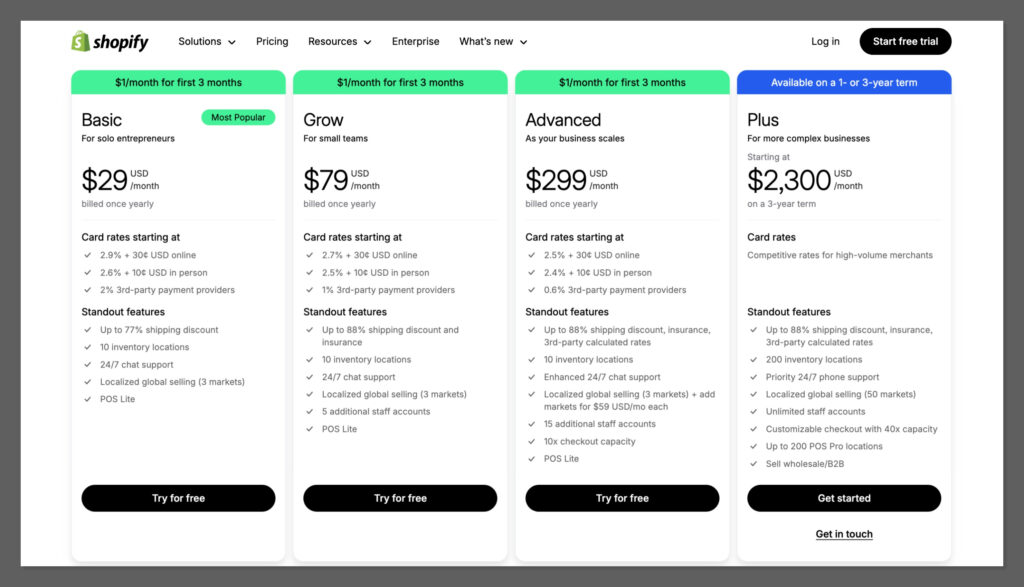
Shopify has no free plan, but often runs deals like $1/month for the first 3 months, which helps when you're starting out (see the details of the Shopify trial here).
However, transaction fees apply if you don't use Shopify Payments:
- Basic Plan: 2.9% + 30¢
- Shopify Plan: 2.6% + 30¢
- Advanced Plan: 2.4% + 30¢
That means even if you're using a third-party payment gateway like PayPal or Stripe, Shopify takes a cut — unless you stick with their built-in processor. This can add up quickly for stores with high volume.
Ecwid Pricing
| Plan | Price |
|---|---|
| Free | $0 (up to 5 products) |
| Venture | $19/month |
| Business | $39/month |
| Unlimited | $99/month |
Ecwid’s free plan is ideal for testing. It’s basic, but useful. There’s no forced upgrade unless you want more features — and there are no transaction fees regardless of plan.
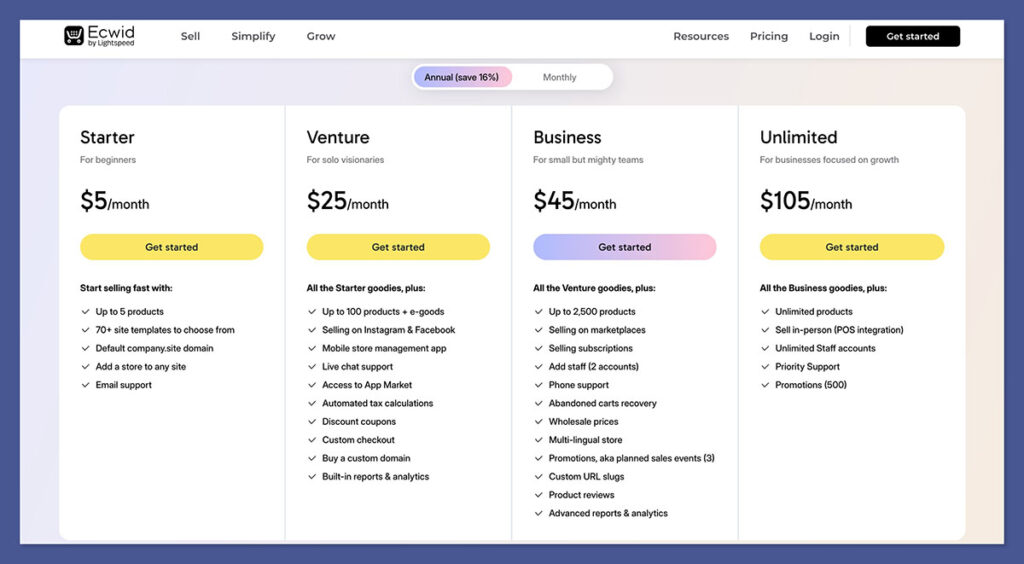
Another bonus? All paid Ecwid plans include unlimited bandwidth, automatic tax calculations, and access to features like abandoned cart emails and discount codes, which Shopify reserves for higher-tier plans.
You also get access to Ecwid's mobile app on all plans (including the free one), which is handy for managing orders on the go. And the Business plan — at just $39/month — includes tools like selling on Instagram and Facebook, which Shopify doesn’t unlock until you’re at a similar or higher tier.
Ecwid's pricing feels a lot more predictable. You know what you’re getting, and you’re not constantly being nudged into app purchases to unlock basic functionality.
Verdict:
Shopify is more expensive, especially after add-ons and payment fees.
Ecwid is the better choice if budget is a concern or you're just starting out. Its free plan is perfect for testing the waters, and even the paid plans stay affordable as your business grows.
2. Best for Selling Online: Shopify
The Winner: Shopify has more powerful sales tools.
Both Shopify and Ecwid offer the core sales features you’d expect — carts, payments, product pages, coupons — but Shopify packs in a lot more to help you actually drive growth.
Sales Features Compared
| Feature | Shopify | Ecwid |
|---|---|---|
| Product Variants | Yes | Yes |
| Inventory Management | Advanced | Basic |
| Subscriptions | Via apps | Built-in (Business plan) |
| Digital Products | Yes | Yes |
| POS Integration | Yes | Yes |
| Multichannel Selling | Facebook, Instagram, TikTok, Amazon, Walmart | Facebook, Instagram, TikTok |
Shopify’s AI-powered features like Shopify Magic and Sidekick help you generate product descriptions, automate marketing, and manage day-to-day store tasks with less effort.
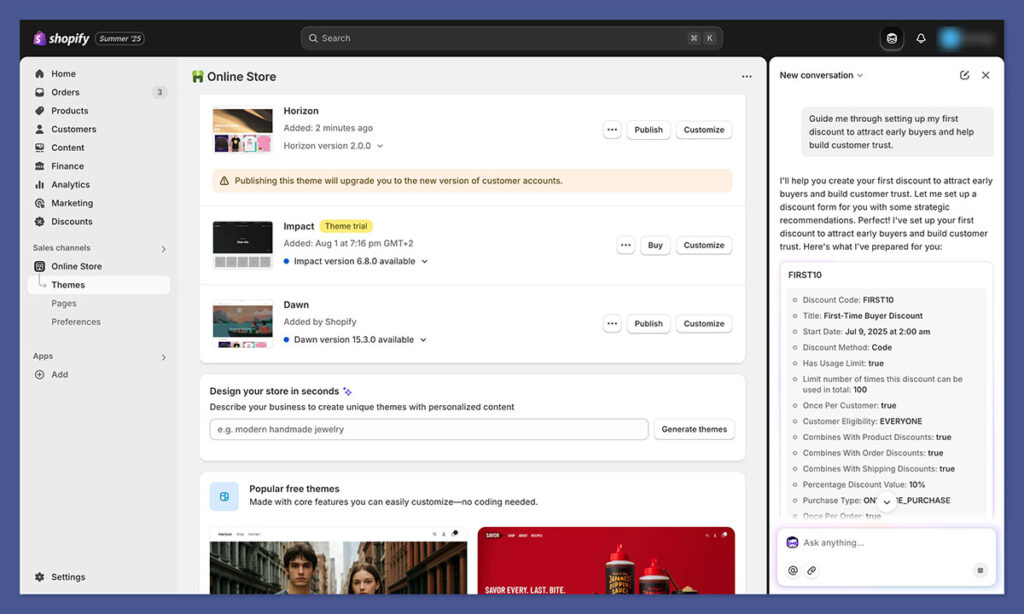
These tools can also surface recommendations based on store data, speeding up decision-making for things like inventory and promotions.
On the inventory side, Shopify supports thousands of SKUs, complex product variants, and smart stock tracking with low-stock alerts.
You can even bundle products, sell pre-orders, or create custom shipping rules using third-party apps — something Ecwid struggles with on its lower plans.
Ecwid handles the basics well. You can list physical and digital products, sync inventory across sales channels, and even sell on Facebook and Instagram.
But there are limits, especially if you're working with a large catalog or want advanced automation. Subscriptions are built into Ecwid’s Business plan, which is nice — whereas Shopify requires a third-party app like Recharge or Bold.
If you're running a store with more than a handful of SKUs, managing shipping zones, syncing inventory across platforms, or needing custom workflows, Shopify is just better built for that. The backend is smoother, faster, and more scalable.
Verdict:
- Shopify wins for serious sellers and scale.
- Ecwid is solid for side hustles and low-inventory shops, but it starts to feel limited as your product range grows.
3. Best for SEO and Marketing: Shopify
The Winner: Shopify dominates in SEO and marketing tools.
Marketing and visibility matter just as much as your product. Shopify clearly invests more in tools that help you drive traffic and convert customers.
SEO Features
| Feature | Shopify | Ecwid |
|---|---|---|
| Editable Meta Titles/URLs | Yes | Yes |
| Canonical Tags | Yes | No |
| Blogging | Yes | No (CMS-dependent) |
| Semrush Integration | Yes | No |
Shopify also includes an SEO Booster app (by Semrush), advanced 301 redirects, and auto-sitemap creation.
Ecwid handles the basics, but lacks deeper control unless you’re using WordPress or another CMS with it.
Marketing Tools
| Tool | Shopify | Ecwid |
|---|---|---|
| Email Marketing | Shopify Email (built-in) | Via Mailchimp or apps |
| Abandoned Cart Emails | Yes | Yes (Business plan+) |
| Social Selling | Yes | Yes |
| Discount Coupons | Yes | Yes |
| Blogging | Built-in | No |
Verdict:
- Shopify gives you stronger, more integrated tools to attract and retain customers.
- Ecwid falls short if you need advanced marketing and SEO control.
4. Easiest to Use: Shopify
The Winner: Shopify — now faster and easier to use, thanks to Editions Summer '25.
In past comparisons, Ecwid had the edge when it came to pure speed. You could launch a product catalog in under 10 minutes, especially if you were embedding the store into an existing website.
And for someone who just wants a simple storefront without much configuration, Ecwid still works well.

But Shopify’s latest Editions Summer '25 release has dramatically improved the user experience — especially for first-time users or store owners migrating from other platforms.
Onboarding Experience
| Feature | Shopify | Ecwid |
|---|---|---|
| Setup Time | ~20 minutes | ~10 minutes |
| Product Upload UX | Clean and structured | Simple and fast |
| Dashboard Navigation | Beginner-friendly | Lightweight and clear |
What Changed in Editions Summer '25?
With Editions Summer '25, Shopify rolled out a suite of UX improvements that genuinely simplify setup and daily workflows — narrowing, and in some cases eliminating, the usability gap with Ecwid.
Here’s what stood out in our testing:
- Smart Launch Checklist: Shopify now gives you a dynamic, personalized checklist during onboarding. It adapts based on your answers (what you're selling, where you're selling, and your goals), giving you an exact step-by-step flow.
- Visual Store Editor Improvements: The theme editor now includes real-time previews on mobile and desktop, version history with rollback, and a drag-and-drop section reordering that feels smoother than ever.
- Sidekick 2.0: Shopify’s AI assistant is no longer just helpful — it’s strategic. Sidekick now suggests actions based on performance metrics, helps you write product descriptions, and can even configure discount rules with a single prompt.
- Guided Product Setup: Product creation now includes inline tips, auto-suggestions for SEO fields, and smart categorization based on your industry.
- “Start Faster” Templates: For new users, Shopify suggests pre-configured themes with dummy content so your store doesn’t feel empty — speeding up launch and helping you visualize your setup from day one.
Compared to Ecwid’s ultra-simple interface, Shopify still has a deeper learning curve — but the new features eliminate most of the friction that once held beginners back.
Ecwid is still quicker out of the gate. But you’ll quickly run into limitations if you're looking to scale or customize deeply without touching code. Shopify’s interface — especially post-Editions Summer '25 — balances power with clarity in a way that’s hard to beat.
Verdict:
- Shopify now wins for overall ease of use, offering guided setup, AI support, and better onboarding flow than ever before.
- Ecwid is still faster for very simple stores, but can feel limited beyond the basics. Shopify gives you more control without making things complicated.
5. Best for Store Design and Templates: Shopify
The Winner: Shopify offers more variety and better design flexibility.
Shopify and Ecwid both let you create clean online stores, but Shopify’s templates are more modern, diverse, and customizable.
Themes and Customization
| Feature | Shopify | Ecwid |
|---|---|---|
| Number of Templates | 200+ | ~80 |
| Free Themes | 13 | ~10 |
| Paid Themes | $100–$350 | Limited options |
| Mobile Optimization | Yes | Yes |
| Drag-and-Drop Editor | Section-based | Basic CSS edits only |
Ecwid’s Instant Site builder is a quick way to get something live, but it’s very limited visually — you’ll need another platform (like WordPress or Wix) for advanced design.
Where Shopify really pulls ahead is with its new Horizon theme framework, launched as part of its Winter 2025 updates. Horizon themes are faster, more flexible, and come with built-in accessibility improvements.
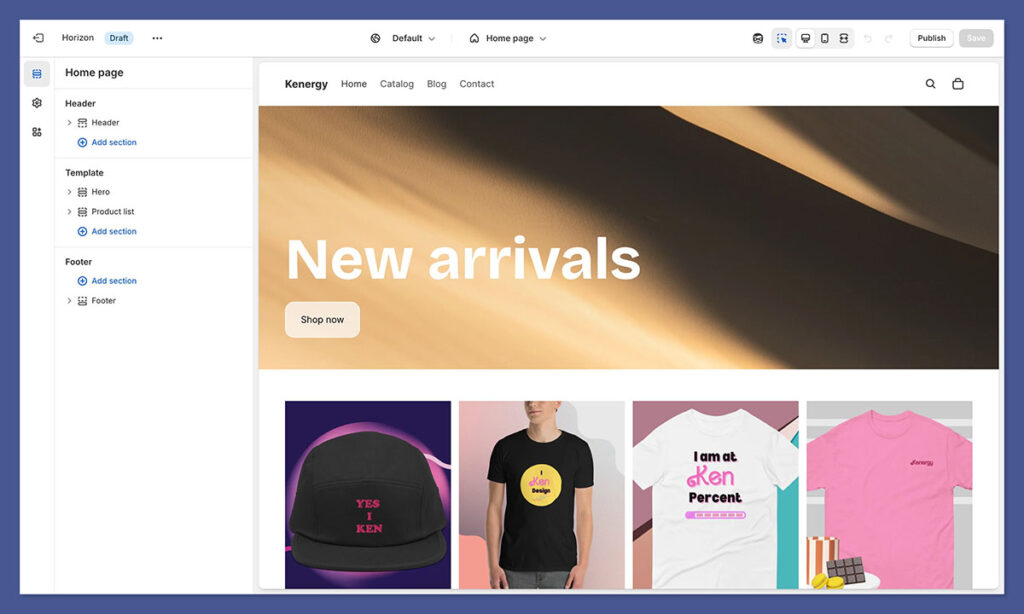
They’re also optimized for mobile-first design and load significantly faster than previous themes — ideal for boosting conversions.
Horizon themes also support modular customization without needing Liquid coding knowledge. That means you can easily change layouts, adjust product card styles, or swap entire sections without hiring a developer.
These new themes are especially useful for seasonal campaigns, pop-up stores, and limited-edition product launches — letting you refresh your brand without rebuilding your store.
In testing, I was able to set up a fully branded Shopify store using a Horizon theme in under an hour — and it looked polished straight out of the box.
Ecwid, by comparison, required me to rely on a basic layout unless I connected it to a CMS like WordPress or Webflow.
While Shopify themes (especially paid ones) can be pricey, you’re paying for flexibility and long-term scalability.
Many paid themes come with lifetime updates, mobile enhancements, and support for custom code blocks — none of which Ecwid offers natively.
Verdict:
- Shopify wins for professional, customizable designs that feel modern, fast, and polished.
- Ecwid is serviceable, but basic, and better suited to sellers who aren’t prioritizing design flexibility or brand-heavy storefronts.
6. Best for App Integrations: Shopify
The Winner: Shopify has the largest app ecosystem by far.
Shopify’s app store is huge — with over 8,000 apps for everything from subscriptions to dropshipping to AI product reviews.
Ecwid’s app market is much smaller (around 300 apps), and integrations are more limited.
App Store Breakdown
| Feature | Shopify | Ecwid |
|---|---|---|
| Number of Apps | 8,000+ | ~300 |
| Dropshipping Tools | DSers, Spocket, Printful | Printful, Wholesale2B |
| AI Tools | Shopify Magic, Sidekick | None |
| Subscription Tools | Recharge, Bold | Built-in (Business plan) |
| Reporting Tools | Advanced with apps | Basic, CSV exports |
Verdict:
- Shopify is better for scaling with apps.
- Ecwid is fine if you need fewer tools and want simplicity.
7. Best for Support: Shopify
The Winner: Shopify offers more comprehensive support.
When running an online store, support is a lifeline — especially when sales are on the line and something breaks. Shopify continues to lead here, offering 24/7 support across multiple channels, a powerful help center, and now AI-assisted troubleshooting thanks to Editions Summer '25.
By comparison, Ecwid limits key support features — particularly on the free plan. You won’t get live chat or phone access unless you're on a paid tier, and even then, response times are often slower.
Support Options
| Feature | Shopify | Ecwid |
|---|---|---|
| Live Chat | 24/7 | Paid plans only |
| Email Support | Yes | Yes |
| Phone Support | Shopify Plus only | Unlimited plan only |
| Help Center | Extensive | Moderate |
| Community Forum | Yes | Yes |
What's New with Shopify Support
Shopify added several support-focused updates in its Summer '25 release that make getting help faster, smarter, and more accessible:
- AI-Powered Help Assistant: Integrated directly into the Help Center, Shopify’s new AI assistant can now summarize solutions from docs, pull up step-by-step guidance, or escalate to human agents — all in real-time.
- Support via Sidekick: Shopify Sidekick isn’t just for store setup anymore. You can now use it to troubleshoot common problems, such as fixing checkout issues, configuring taxes, or diagnosing app conflicts.
- Search-Optimized Help Center: The Help Center now includes a smart search filter that learns from past queries and highlights the most relevant solution instantly.
- Dedicated Channels by Plan: Merchants on Shopify Plus now have a streamlined ticketing system and faster agent response windows — a major improvement over traditional support queues.
While Ecwid’s support is decent if you’re on a paid plan, it just doesn’t scale the same way Shopify’s does. The Help Center is smaller, the response times are longer, and there’s no built-in AI to walk you through fixes or suggest solutions.
Verdict:
- Shopify offers better all-round support, with 24/7 access, smarter troubleshooting tools, and a much stronger self-service ecosystem.
- Ecwid is okay if you’re tech-savvy and on a Business or Unlimited plan — but don’t expect round-the-clock help unless you pay up.
Shopify vs Ecwid: Final Verdict
| Category | Winner |
|---|---|
| Pricing | Ecwid |
| Sales Tools | Shopify |
| SEO & Marketing | Shopify |
| Ease of Use | Shopify |
| Design & Themes | Shopify |
| App Ecosystem | Shopify |
| Customer Support | Shopify |
Our Recommendation:
If you're building a full ecommerce business and want tools that grow with you — Shopify is the best choice.
If you already have a website and just want to start selling products fast — Ecwid is the smarter, leaner option.
Both platforms are solid — but they serve different goals. If you’re unsure, start with Ecwid’s free plan or Shopify’s $1/month trial and test it for yourself.



Thanks for the comparisons. I’ve used both Shopify and Ecwid and as you mentioned both have their advantages. Personally, I like having my own website to take with me and do with it as I like so Ecwid is the answer right there. Shopify is a very easy choice for those who want a quick and easy e-commerce site however.
I’m actually looking at another platform that may be the best of both worlds. Once I find out more I’ll come back and comment again.
Thanks for sharing your thoughts Robin!
Robin, have you found a better solution than Shopify and Ecwid?
Jennifer Dudley
Did you find that third option?
I’d be interested to hear what you came up with.
Cheers