

I still like Etsy, and obviously, other creators do too. Pattern by Etsy, for instance, grew 44% in the last year and a half, according to one report. It is quick, convenient, pretty affordable, and ideal if you need a fast way to find and connect with potential buyers.
Still, it is hard to see it as a long-term option for a real brand. Eventually, you want more control over your online presence and your audience, maybe a few more options for what you can sell, too.
Fourthwall is the alternative to Etsy I tend to recommend at that point, because it is just as straightforward and still affordable, but it is a lot more directed at helping businesses grow. You build a store under your own name, sell anything from custom POD products to memberships, plus you get support with tax issues.
If you are still not sure which one makes sense for you right now, here is how they stack up.
Fourthwall vs Etsy: The Quick Verdict
I would still tell new creators to try Etsy first, especially when they know they have an eye-catching product, and there is real demand out there. It is one of the easiest tools you can use if you want to get in front of buyers fast, and keep your admin costs low.
Fourthwall is the better option once you already have an audience, and you are ready to create a real brand. You build a store of your own, rather than having a page listed alongside thousands of other sellers. Plus, you can sell a range of different things: digital products, physical products, custom items, memberships, whatever you like.
What Are Fourthwall and Etsy?
Fourthwall and Etsy are not really remotely similar, beyond the fact that you can use both to sell products online.
Etsy is a marketplace, which gives sellers mini shops they can use on the platform to sell specific items, usually anything that is hand-made, or custom sourced.
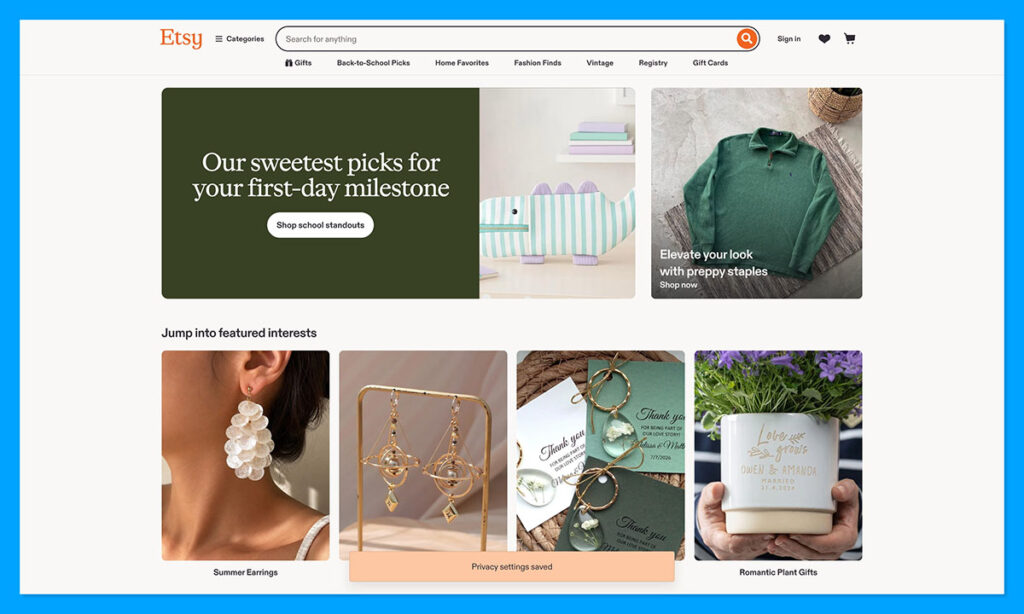
Your product appears in a space that over 86 million buyers frequent, which makes Etsy great for finding customers, but you have less control over your store and the shopping journey. You also have a lot of competition from day one.
Fourthwall is a full brand building ecosystem. You get a store with a custom domain, add your branding, choose your margins, and sell products that you can source yourself, create (including digital products), or pick from the Fourthwall POD catalog. It is free to start, and you get extra support with things like customer service (for print on demand products) and taxes, since Fourthwall acts as your Merchant of Record.

| Factor | Fourthwall | Etsy |
|---|---|---|
| Platform model | Full brand-building platform | Marketplace for creative products |
| Built-in buyer traffic | No | Yes |
| Custom domain | Yes | No |
| Store design | Completely customizable website | Some branding options inside Etsy’s fixed structure |
| Physical products | POD or your own stock | Only approved creative products |
| Digital products | Yes | Yes, within rules |
| Memberships and paid video | Yes | No |
| Customer information | Available to the seller | Owned by Etsy |
| Fulfillment | Fourthwall for POD, a fulfillment partner or the seller | Seller or specific production partners |
| Support | Customer support for POD, and Merchant of Record | You handle customer service, Etsy can act as your merchant of record |
Fourthwall vs Etsy Pricing: Fees and the True Cost
Honestly, both of these platforms are great if you have a limited budget. I do think Fourthwall is a bit easier to budget for, though. You can sign up for the free plan, and there are zero fees on selling physical products, although fees do apply for digital products or memberships.
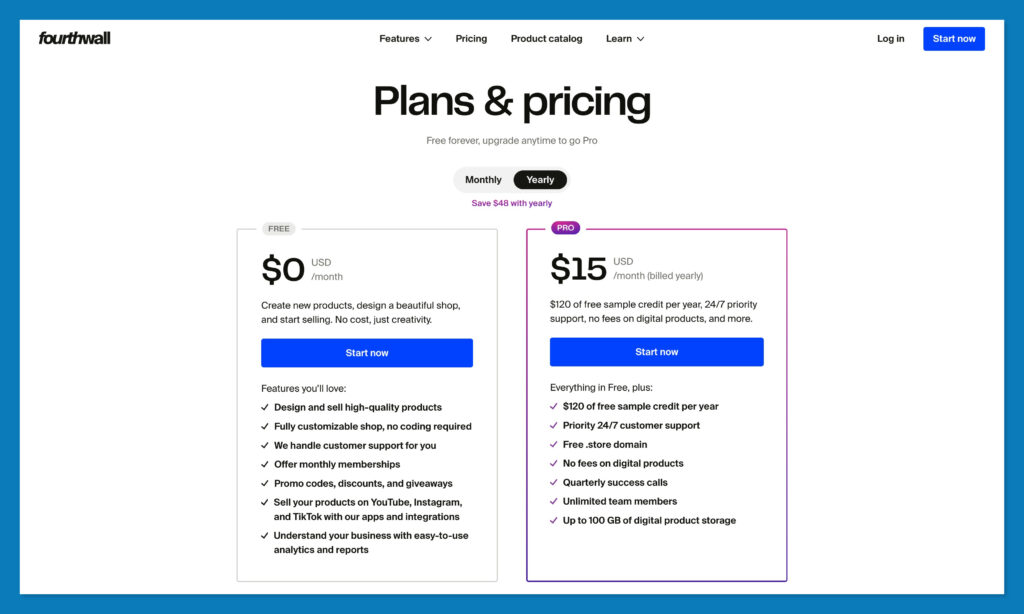
Upgrading to the Pro plan costs $19 per month, or $180 per year, which works out at $15 per month. That gives you a free .store domain, no fees on digital products, unlimited team members, more digital product storage, $10 in monthly sample credit for POD, plus priority support. Either way, you are getting a full store system, so you are not paying extra for something like Shopify.
Etsy is a bit more complicated when you get past the fact that you can sign up for free. Every product you list comes with a $0.20 listing fee, plus a 6.5% transaction fee on the final sale price (with shipping). Then there is a payment processing fee of 3% plus $0.25.
Etsy Plus, for $10 per month, is a reasonably affordable option if you are listing a lot of products on Etsy’s main marketplace, since it gives you 15 listing or renewal credits and $5 in advertising credits, but again, you are only getting a marketplace position there.
If you want the extras that Fourthwall gives you as standard, like a more custom storefront, you will need to pay more. Pattern starts at $15 per month, although it gets rid of those transaction and listing fees for you. Then there are fees for offsite ads, too.
| Cost | Fourthwall | Etsy |
|---|---|---|
| Cost to start | Free | Free to open a shop |
| Paid plan | Pro: $19/month, or $180/year ($15/month) | Etsy Plus: $10/month. Pattern: $15/month |
| Listing fee | None | $0.20 per listing |
| Transaction fee | None on physical products | 6.5% of the sale price, including shipping |
| Payment processing | Standard processing fees apply | 3% + $0.25 (US sellers) |
| Digital products | 5% on Free, 0% on Pro | Standard listing and transaction fees |
| Memberships | 5% on both plans | Not supported |
| Advertising | Optional, your own channels | Offsite Ads fee on attributed sales |
Etsy is not necessarily overpriced, especially since you are paying for access to possible shoppers, Fourthwall just gives you more value for money if you already have an audience.
Fourthwall vs Etsy: Storefronts, Discovery and Integrations
Fourthwall and Etsy operate on completely different models.
Etsy is mainly a marketplace, selling access to millions of potential shoppers. You can create a store with Pattern (although it is pretty basic), but you are mostly paying to position your products where you know customers are going to see them.
That does not mean you have absolutely no branding control. You can still add banners, arrange your products, or create shop sections and so on with the basic marketplace account. Etsy Plus even gives you collage and carousel banners, plus a mixed featured grid. Everything else still carries Etsy’s identity, so it is harder to make your brand stand out.
You also do not get full control over the customer details you collect; you are not really going to be able to ask people to sign up for a newsletter, for instance.
Fourthwall gives you a custom domain and store, with editable layouts inside a no-code site builder, so you can make the site completely your own. You can sell whatever you choose, from custom products to print-on-demand merch, memberships, or digital downloads.
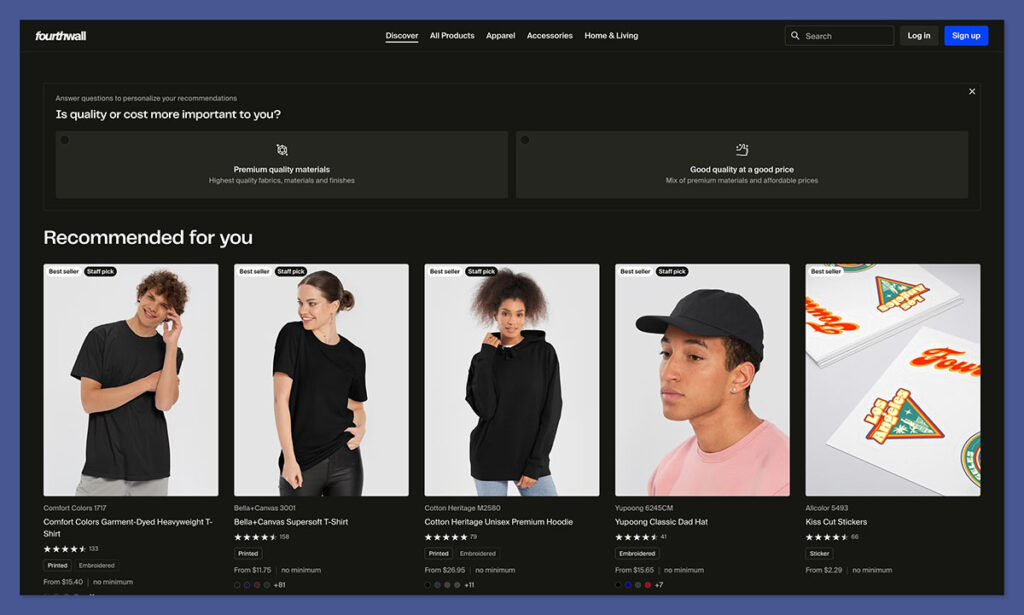
The customers you attract to your store are yours, so you can sign them up to newsletters, get them to follow you on social media, or keep them engaged with regular content.
From an integration perspective, both companies focus on what matters most to their audience. Etsy has an app marketplace to help with listing management, product partners, bookkeeping and in-person sales through Square. Fourthwall connects to things like YouTube Shopping or TikTok Shop for social selling, plus tools like Mailchimp or Klaviyo for email marketing.
The Winner: It depends on the job. Etsy is the model you want for getting products in front of strangers. Fourthwall is the one you want if you want to build a brand, and own the relationship with your customer.
Fourthwall vs Etsy: What Can You Sell?
Fourthwall definitely wins in this category, because there is far more freedom in what you can offer your customers. You might start small with a print-on-demand line taken from Fourthwall’s retail-grade catalog, which is a great way to keep initial costs and fulfillment headaches to a minimum. Then you can custom source other physical products and sell your own stock, or create digital products and memberships, without moving into a different platform.

There is even a whole system for selling video memberships, with HD content, and tools that let you track how people are interacting with whatever you sell. Plus, Fourthwall lets you accept donations from your community, too.
Etsy is much more strict about what you can list on its marketplace. Every product needs to have a “human touch”. You can sell handmade goods, original designs, vintage items (if they are over twenty years old), or craft supplies. You can also sell digital products if they fit the right category.
Print-on-demand is still an option with Etsy, but you need to ensure the design is your own, or it is provided by the customer. You also need to disclose your production partner.
The Winner: Fourthwall. For everyday sales of creative products, Etsy is still excellent. Fourthwall is just a better option when you want to experiment with new avenues for selling.
Fourthwall vs Etsy: How Much Help Do You Get?
Neither Fourthwall nor Etsy really need to help creators much with getting their stores set up, although they both have some great self-help resources, and customer support teams if you need them. It is worth noting that premium support from Fourthwall goes a lot further when you upgrade to the paid plan, it even includes success calls.
Both companies can also act as your Merchant of Record, which is genuinely very useful, since no seller (no matter how much experience they have) really wants to spend hours worrying about tax.
Fourthwall does beat Etsy in a few areas here, though. First, Fourthwall’s partners deal with dispatching catalog orders for you if you are using their print on demand service, whereas with Etsy, you have to handle the partnership yourself separately.
Fourthwall can help you with finding a supplier for custom products too, while Etsy leaves that up to you. Plus, if you use Fourthwall’s print on demand catalog, whenever customers have an issue with a product, Fourthwall’s team can handle that directly.
The Winner: Fourthwall. Its setup removes a lot more shop admin than Etsy’s does. If you want a shopfront that you do not have to spend all of your time running manually, Fourthwall is going to be the better choice.
Fourthwall vs Etsy: The Latest Updates
A few extra comments here, because both Fourthwall and Etsy have been making some valuable changes lately. Both companies now have AI assistants, though Etsy’s mainly focuses on seller support, while Fourthwall’s AI assistant can do more for you. You can ask it to create promotional campaigns, change the prices on various products, review sales, or spread a single design across a wider collection.
Fourthwall has made other small additions too, like custom gift card options that work across several products. The Throne partnership adds crowdfunding and private wish lists, then there is the Design Community, which gives you a trustworthy place to find partners for your merch.
Etsy has been working more on simplifying things and increasing its already impressive reach. The Seller app has better order filters and buyer histories now, plus you can issue refunds from messages. Listing tools can suggest better attributes and titles. There is also a Stats Assistant in testing that can answer questions about your store’s performance.
Also, Etsy has made it so that certain products can now appear inside ChatGPT, Gemini, or Copilot shopping experiences, and sellers can use AI to create message drafts, too.
The Winner: A tie, with different priorities. Etsy is developing a better marketplace experience. Fourthwall is focusing on helping you run your business better around the store.
Should You Use Fourthwall or Etsy?
Etsy is still a brilliant platform for beginners who have a great product, but not much of an audience. It is the ultimate starting place if you just need people to actually see the personalized or handmade products you have got to offer. The audience access alone is worth paying for, and the extra tools and features are really making the experience better for everyone.
Fourthwall is going to be the better choice if you already have an audience, or you know how people are going to find you. It is the brand building platform that ultimately gives you a lot more control over your online presence, your audience, plus the products you want to sell.
Honestly, some creators will end up using both. You might use Etsy to introduce your product to marketplace shoppers, while Fourthwall handles the direct sales that come from your owned channels.
When it comes down to it though, Etsy still feels like the platform you “start with”, rather than the one you stick with when you are ready to scale. Fourthwall is something that can really grow with you.
Fourthwall vs Etsy: FAQ
Is Fourthwall cheaper than Etsy?
It depends what you sell. Fourthwall has no listing fees and no transaction fees on physical products, so if you are selling merch, the running cost is usually lower. Etsy charges $0.20 per listing, 6.5% on the sale price including shipping, and 3% plus $0.25 to process the payment, and those add up on every single order. The trade-off is that Etsy’s fees buy you exposure to shoppers who are already browsing, which Fourthwall cannot give you.
Is Fourthwall actually free to use?
Yes, the free plan is a real plan, not a trial. You can build a store, sell print-on-demand products, run memberships and take donations without paying a monthly fee. There is a 5% fee on digital products and a 5% fee on memberships, and you still cover the base cost of any POD item when it sells. The Pro plan is $19 per month, or $180 per year, and it removes the digital product fee, adds a free .store domain, unlimited team members, $10 in monthly sample credit and priority support.
Does Fourthwall bring you traffic like Etsy does?
No, and this is the single biggest difference between the two. Etsy has built-in buyer traffic. Fourthwall does not. Every visitor to a Fourthwall store arrives because you sent them, whether that is from YouTube, TikTok, a newsletter or somewhere else. That is exactly why I suggest starting on Etsy if you have no audience yet, and moving to Fourthwall once you do.
Can you sell print-on-demand products on Etsy?
You can, but there are rules. The design has to be your own, or supplied by the customer, and you have to disclose your production partner. Etsy also expects every listing to have a human touch, so generic dropshipped items are not allowed. Fourthwall is far more relaxed here, since it is your own store rather than a curated marketplace.
Can you sell memberships or digital subscriptions on Etsy?
No. Etsy allows some digital downloads within its categories, but there is no membership or paid video system. Fourthwall supports recurring memberships, HD video content and digital downloads directly, which is usually the deciding factor for creators who want more than one revenue stream.
Who owns the customer data, you or the platform?
On Etsy, the buyer relationship belongs to Etsy. You cannot realistically build a mailing list from your sales or follow up with shoppers outside the platform’s messaging rules. On Fourthwall, the customers are yours, so you can send newsletters, push people towards your social channels and market to them again later. If you plan to build a brand rather than shift individual products, this matters more than the fee difference.
Do Fourthwall and Etsy handle sales tax for you?
Both can act as your Merchant of Record, which means the platform takes on responsibility for collecting and remitting sales tax on those orders. It is genuinely one of the more useful things either platform does, because tax compliance is the part of selling online that most creators would happily never think about.
Should you use Etsy and Fourthwall at the same time?
Plenty of creators do, and it is a sensible setup. Etsy works as the discovery channel that puts your product in front of strangers, while Fourthwall handles the direct sales that come from your own audience. You are paying Etsy’s fees only on the orders it actually finds for you, and keeping the better margins and the customer data on the orders you generate yourself.
Is it worth moving from Etsy to Fourthwall?
It is worth it once you have a reliable way to reach buyers without the marketplace. Be aware that you cannot take your Etsy buyers with you, since Etsy owns that relationship, and product listings need setting up again on the new store. Most creators run both for a while rather than switching overnight, then let the Fourthwall store take over as their audience grows.


Comments 0 Responses