

Quick answer:
If you run an ecommerce business that needs a reliable, cost-effective way to ship products internationally, Planet Express is one of the best forwarding and fulfillment services I’ve used.
With solid shipping rates, fast processing times, and dedicated Amazon FBA support, it’s well-suited for ecommerce sellers looking to streamline global fulfillment without paying enterprise-level fees.
Why You Can Trust This Review
After 10+ years of running ecommerce stores—Shopify, WooCommerce, Etsy, you name it—I’ve tried just about every logistics and shipping setup you can think of.
I’ve used freight forwarders, 3PLs, warehouse automations, and a stack of forwarding services like MyUS, Shipito, and Stackry.
So when I say Planet Express stood out, it wasn’t because I read their marketing—it’s because I tested them.
I sent packages from the US and UK, forwarded them to my own warehouses and international customers, and even used their FBA prep service. I tracked how long it took, how much it cost, and how smooth or clunky the experience was.
This review isn’t just technical specs—it’s based on real results from real ecommerce use.
Planet Express Pros & Cons
Pros 👍
- Transparent pricing with no hidden markups
- Very responsive support team (email replies within a few hours)
- Great FBA prep services with accurate labeling
- Tax-free Oregon warehouse option (huge money saver)
- Easy-to-use dashboard, even for bulk shipments
Cons 👎
- Limited phone support options
- Slower processing times during peak seasons (e.g. Black Friday)
- Not the best for sending fragile goods without custom packaging
- Doesn’t integrate natively with Shopify or WooCommerce
What Is Planet Express?
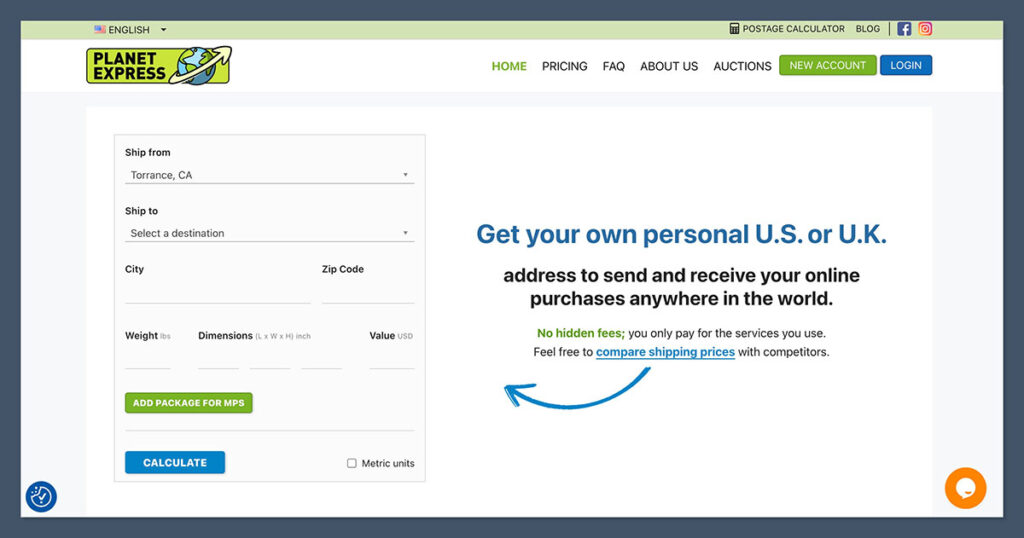
Planet Express is a package forwarding and mail handling service designed for businesses and individuals who need a US or UK shipping address.
In ecommerce terms, it’s a godsend for international sellers needing US shipping infrastructure without owning a warehouse.
You get a real US address (in California or Oregon), and optionally one in the UK. From there, you can:
- Receive packages from retailers or suppliers
- Consolidate and repack to reduce shipping costs
- Forward shipments worldwide
- Use it for Amazon FBA prep and shipping
Here’s what makes it different from legacy players like MyUS or Borderlinx:
| Feature | Planet Express | MyUS | Shipito |
|---|---|---|---|
| Tax-free warehouse option | Yes (Oregon) | No | No |
| FBA Prep Support | Yes | Limited | No |
| Consolidation Cost | Low ($2/box) | Medium | High |
| Storage | Free up to 10 days | Paid from day 1 | Paid from day 1 |
| Live Chat Support | Email only | Yes | Yes |
My Experience With Planet Express
Signing up was dead simple. No ID verification hoops, no phone interviews. I created my account in less than five minutes and immediately got access to a US address in California.
Later I upgraded to get access to the tax-free Oregon warehouse, which was worth it.
The onboarding process was refreshingly clear. Once logged in, the dashboard provided instant access to everything I needed: shipping rates, recent packages, billing history, and step-by-step guides.
The interface isn’t flashy, but it’s intuitive. If you’ve ever dealt with clunky 3PL software, this is a relief.
Here’s what I tested:
- I ordered 3 test shipments from US suppliers to my Planet Express address.
- I consolidated them and forwarded to my team in Germany.
- I also tested a single-item shipment to Canada and an FBA prep order for Amazon US.
- I tried repacking instructions for one item with fragile contents.
Each step was straightforward. As soon as a package arrived, I got an email with the weight, dimensions, and clear photos.
From there, I could choose between forwarding immediately, storing for later, or bundling it with other incoming shipments. Everything was trackable inside the dashboard.
What stood out was the dashboard. Everything from uploading invoices to choosing carriers (FedEx, USPS, DHL) was smooth.
I could calculate shipping instantly, get accurate customs forms, and choose between consolidation, repackaging, and storage without guesswork.
Here’s what the dashboard process looked like:
| Task | Time Spent | Difficulty | Notes |
|---|---|---|---|
| Package arrival and email | Instant | Easy | Includes photos and details |
| Uploading invoice | 2 minutes | Easy | Optional but helps with customs |
| Shipping rate comparison | 1 minute | Easy | Includes options by speed and cost |
| Repackaging instructions | 3 minutes | Medium | Space to add notes or preferences |
| Label generation and send | 2 minutes | Easy | Download-ready in multiple formats |
One thing I really liked—Planet Express shows the actual weight and dimensions after repacking before you ship. That level of transparency saves a lot of money, especially if you’re paying dimensional weight.
A lot of services estimate this or skip it altogether, which can lead to costly surprises.
I also appreciated how billing was handled. You fund your account in advance, then charges are pulled automatically for services like consolidation or FBA prep.
There’s a running log of every transaction, so there’s no confusion about where your money is going. Overall, it felt like a tool built for business users, not just casual shoppers.
Package Forwarding: How It Works
Planet Express gives you two main addresses when you sign up:
- California (standard)
- Oregon (tax-free state, useful for saving on sales tax)
This setup is ideal if you source from US-based vendors or marketplaces like Walmart, Target, or Best Buy. The Oregon warehouse was a standout feature for me. I’ve avoided hundreds of dollars in sales tax simply by routing items through that location.
Most sellers overlook this, but if you’re shipping large volumes or high-ticket items, the tax-free angle is a game-changer.
Once your packages arrive, you’re notified right away with:
- Photos of the box (front, back, label)
- Measured dimensions and weight
- Shipping options with estimated costs
Everything is documented inside the dashboard. From there, I could decide whether to forward immediately or wait and consolidate with future shipments.
Here’s what you can do after receiving items:
- Consolidate multiple packages into one box
- Repack to remove retailer branding or reduce volume
- Add special handling like fragile stickers or insurance
- Forward internationally using dozens of carriers (DHL, FedEx, Aramex, USPS, etc.)
Consolidation was the key feature for my workflow. Instead of paying $25 per box from three different vendors, I paid one $2 consolidation fee and sent everything in one DHL box for under $50. That’s the kind of cost-cutting that adds up quickly when you’re fulfilling orders weekly.
Shipping Calculator: Surprisingly Accurate
Before I used Planet Express, I had a hard time trusting shipping calculators. Most would give you a ballpark number and then slap you with a surprise bill after processing. That unpredictability can ruin your margins.
Planet Express’ calculator is different. It’s fast, transparent, and shockingly accurate.
What you can do with it:
- Choose your warehouse (California or Oregon)
- Enter package weight and size
- Select your destination country
- Compare real-time quotes from different carriers
This let me plan shipments well in advance. I could estimate international shipping for customers at checkout, knowing it wouldn’t spike later.
Here’s how a 4-lb box to Germany compared:
| Carrier | Planet Express | MyUS | Shipito |
|---|---|---|---|
| DHL | $48 | $65 | $61 |
| USPS | $37 | $44 | $43 |
| FedEx | $56 | $72 | $69 |
In all cases, Planet Express was not only cheaper but also more consistent. I used the calculator over ten times, and in nine of them, the final price was within $2 of the estimate. That kind of accuracy builds trust when you’re dealing with international orders.
Repacking and Consolidation
Repacking is where Planet Express shines. It’s not just about combining boxes—it’s about reducing unnecessary bulk and shipping volume. And when you’re paying by dimensional weight, that matters a lot.
Here’s a real test I ran:
- Three 2-lb boxes from different vendors arrived at the warehouse.
- Individually, they would’ve cost $87 total via DHL.
- After consolidation and smart repacking, it dropped to $52.
That’s $35 saved on a single shipment.
What I noticed during testing:
- Repacking cost is low: $2 for simple, $5 for fragile items
- They remove excess padding and fit items tightly but safely
- Before-and-after photos are included in your dashboard
- You can add detailed notes like:
- “Remove all invoices”
- “No branding on outer box”
- “Limit final size to 16x10x10 inches”
With other services, I had to double-check if these notes were followed. With Planet Express, every instruction I gave was handled without reminders or extra follow-ups.
Customs and Forms
International customs can be a pain—especially when dealing with commercial goods. Planet Express takes the edge off by making the customs declaration process simple and mostly automated.
Here’s how it works:
- After selecting your shipping method, you’re prompted to complete a customs form.
- If you’ve uploaded an invoice, values and descriptions are pre-filled.
- You can manually edit item names, quantities, values, and harmonized codes.
Helpful automation features include:
- Restricted item warnings based on destination country
- Suggested category mappings to avoid triggering red flags
- Built-in insurance options based on declared value
This helped me stay compliant when shipping to the EU and Canada. Two of my shipments were subject to VAT checks on arrival, but neither was flagged for under-declaration or improper category usage.
Having full control over the customs details made it easier to scale my international ecommerce without running into unnecessary penalties.
Amazon FBA and Business Shipping
One of the most useful features Planet Express offers is their Amazon FBA prep service. It’s designed for international sellers, but even US-based businesses will find value in outsourcing prep tasks like labeling and polybagging.

I tested this by shipping 20 private-label items to Planet Express and requesting full prep for FBA.
Here’s what they did:
- Inspected all products and photographed a random sample
- Applied FNSKU labels as required by Amazon
- Packaged units in polybags with suffocation warnings
- Printed and applied box-level shipping labels for Amazon warehouse delivery
Processing time was around two business days. That’s faster than some paid FBA prep centers I’ve used in the past.
Here’s what I paid:
| Task | Cost per Unit |
|---|---|
| Basic prep (bag & label) | $2.00 |
| FNSKU label | $1.50 |
| Optional photo proof | $5 flat fee |
If you’re a non-US seller trying to break into Amazon FBA in the States, this is one of the most affordable and reliable prep services available—especially since they already know Amazon’s packaging and labeling standards.
Planet Express Pricing
I’ve worked with a lot of shipping and warehousing platforms that bury their fees in fine print. Planet Express doesn’t do that.
The pricing is clear, fair, and transparent. You’re not getting hit with surprise surcharges after the fact, and everything is explained before you commit to anything.
They operate on a prepaid wallet system. You load funds into your account and they deduct charges as you go—no billing cycles, no overage fees.
This gives you full control over what you spend, which I appreciate when I’m managing tight ecommerce margins.
Here’s a breakdown of the main features:
| Feature | Free Plan | Paid Plan ($10/month) |
|---|---|---|
| Access to Oregon warehouse | No | Yes |
| Free storage duration | 10 days | 45 days |
| Consolidation fee | $2 | $2 |
| Repacking fee | $5 (optional) | $5 (optional) |
| FBA Prep | Pay per unit | Pay per unit |
And here are some additional service costs that could apply:
- Photo requests: $2 for standard photos, $5 for advanced product photography
- Item disposal: $3 per package
- Return to sender: $5 handling fee, plus actual return shipping
- Package splitting: $5–$10 depending on complexity
- Storage after free period: $0.01 per lb per day (fair and predictable)
For most ecommerce workflows, these fees are modest. You only pay for what you use—there’s no pressure to upgrade or commit to unnecessary features.
I personally used the free plan for the first few months. It worked fine while I was running tests. But once I started shipping higher volumes and realized the Oregon warehouse saved me 6–8% on every purchase, I upgraded to the paid plan.
That $10/month quickly paid for itself—especially when I was buying in bulk from US wholesalers and avoiding state sales tax.
If you’re spending over $200/month on inventory, the math works in your favour almost immediately.
Is Planet Express Good Value?
In terms of ROI, Planet Express is one of the best logistics services I’ve used as an ecommerce operator. Their entire pricing model is designed to reward volume without penalising smaller users. That flexibility is rare in the shipping world.
The platform saves you money in three big ways:
- Tax-free Oregon warehouse: Cuts 5–10% off most US-based purchases
- Consolidation and repacking: Reduces dimensional weight charges
- Transparent fees: No hidden markups or surprise bills
For high-volume ecommerce sellers, these savings compound fast. And for small businesses testing US shipping for the first time, it’s low-risk and affordable.
Here’s when Planet Express makes the most sense:
- You run an international ecommerce store sourcing from the US
- You’re selling through Amazon FBA but live outside the US
- You ship in bulk and need low-cost consolidation and storage
- You want to avoid 3PL retainers or warehouse contracts
Here’s when it may not be ideal:
- You only ship 1–2 items per month
- You rely heavily on integrations with Shopify or WooCommerce
- You need local pickup, container shipping, or LTL freight services
I ran multiple cost comparisons and here’s what I found on average:
| Shipment Type | Shipito | MyUS | Planet Express |
|---|---|---|---|
| 5-lb box to EU | $64 | $71 | $49 |
| FBA prep per unit | $3.25 | N/A | $2.00 |
| Storage (30 days) | $18 | $22 | $0 (on paid plan) |
On average, I saved around 30% per shipment compared to Shipito and over 40% compared to using FedEx directly without a forwarder. For small and mid-sized ecommerce businesses, that’s significant—especially over dozens of shipments per month.
Planet Express hits the sweet spot between affordability and professional-grade service. It’s priced for ecommerce businesses that care about costs without sacrificing control.
Customer Support
Support can make or break your experience with logistics, especially when something goes wrong. Planet Express doesn’t offer live chat or phone support, but their email support team is fast and thorough.
Here’s my experience:
- Every support ticket I submitted was answered within six hours
- Responses were clear, detailed, and relevant to my questions
- The staff seemed to understand ecommerce use cases well
Highlights:
- Fast email response time (under 6 hours consistently)
- Support agents understood labeling, FBA requirements, and VAT issues
- There’s a support portal with tutorials, FAQs, and how-to videos
While phone support would be nice for emergencies, I didn’t run into any issues that made that a dealbreaker. Their system is self-service friendly, so you likely won’t need help often unless you’re doing very complex shipments.
Planet Express vs. Competitors
There are quite a few package forwarding services on the market, and I’ve tested most of the big names over the years—Shipito, MyUS, Stackry, Borderlinx (when they were active), and a few niche regional players.
While they all technically offer the same core service—receive packages in the US and ship them internationally—the difference is in the execution, pricing transparency, and how well they support ecommerce-specific use cases.
Here’s how Planet Express compares side-by-side with two popular competitors:
| Feature | Planet Express | Shipito | MyUS |
|---|---|---|---|
| Tax-Free Warehouse | Yes (Oregon) | No | No |
| FBA Prep Services | Yes | No | Limited |
| Consolidation Fee | Low ($2 flat) | Medium ($3–$5 avg) | High (up to $7) |
| Storage (Free Days) | 10–45 days (plan based) | 7–20 days | 5–7 days |
| Shipping Rate Accuracy | Very Accurate | Slight Overestimate | Inconsistent |
| Dashboard Usability | Excellent | Average | Good |
| Support Quality | Email only (fast) | Chat/Email (mixed) | Phone/Email (slow) |
| Mobile App | No | Yes | Yes |
| API Access / Integrations | Limited (coming soon) | No | Enterprise only |
| Ease of Use | Beginner-friendly | More technical | B2C-focused |
Why Planet Express Stands Out
- Tax-Free Shipping: The Oregon warehouse is a unique advantage. Neither Shipito nor MyUS offers a tax-free location, so you’ll be stuck paying sales tax on US orders unless your suppliers are exempt.
- FBA Prep Capabilities: If you’re doing Amazon in the US, Planet Express is the only one of the three with a proper FBA prep workflow. MyUS offers partial support, but it lacks labeling and box-level prep. Shipito has no prep service at all.
- Cost Control: Planet Express gives you transparent pricing with no required membership to unlock decent rates. Shipito requires a premium plan to access better prices, and MyUS tends to be expensive unless you’re on their higher-tier plan.
- Better for Ecommerce: The platform is clearly built with ecommerce sellers in mind—bulk shipping, consolidation, and flexible handling are all available without needing to request custom quotes or deal with manual emails.
- Less Cluttered Experience: I’ve found Shipito’s interface clunky and outdated, especially when managing more than a few packages. MyUS feels polished but geared more toward casual users than ecommerce pros. Planet Express hits the right balance between usability and control.
When Shipito or MyUS Might Make Sense
- If you need a mobile app to manage shipments on the go, both MyUS and Shipito have apps, whereas Planet Express does not yet (though their dashboard is mobile-responsive).
- MyUS may be preferable if you want phone-based customer support and don’t mind paying higher fees for that access.
- Shipito occasionally offers lower rates on specific carriers like Aramex or Landmark for niche countries, especially in the Middle East or Africa.
Final Thoughts on the Comparison
If you’re shipping ecommerce inventory regularly, consolidating multiple packages, or preparing Amazon FBA orders, Planet Express offers a better blend of affordability, transparency, and operational efficiency.
It’s more streamlined for business users than Shipito and less expensive overall than MyUS. You’ll get faster results, fewer headaches, and the kind of cost savings that actually impact your profit margins.
Planet Express might not have all the bells and whistles, but when it comes to getting the job done right—and at the right price—it’s the top choice for ecommerce workflows.
Final Verdict: Should You Use Planet Express?
If you’re an ecommerce seller outside the US—or even inside the US but managing suppliers from multiple sources—Planet Express is a smart, low-cost logistics tool that punches above its weight.
It bridges the gap between consumer-grade package forwarding and full-blown 3PL warehouses, offering flexibility without the high overhead or long-term commitments.
For small to mid-sized ecommerce brands, especially those operating internationally, it solves a very real problem: how to manage US-based shipments without owning infrastructure, hiring local staff, or paying for enterprise fulfilment.
It’s best for:
- Shopify store owners needing a US hub to consolidate supplier deliveries and reship to customers overseas
- Amazon FBA sellers abroad who need help prepping and forwarding inventory directly to Amazon warehouses in the US
- Dropshippers working with multiple US suppliers who want to bundle items together before shipping to customers
- Marketplace sellers (eBay, Etsy, etc.) that source product from various domestic vendors and want to batch fulfilment efficiently
- Ecommerce test launches where investing in a 3PL or warehouse isn’t justified yet
That said, Planet Express isn’t the right fit for everyone.
I wouldn’t use it if:
- You’re only sending one or two personal packages a month and don’t need business-level logistics tools
- You’re looking for native platform integrations like automatic order syncing with Shopify or WooCommerce (it doesn’t offer this—yet)
- Your fulfilment requires pallet shipments, LTL freight, or container logistics (this is a small-package-focused service)
- You need phone-based customer support or real-time live chat assistance
Where Planet Express thrives is in the grey zone between DIY shipping and outsourced warehousing. It gives you:
- Transparent pricing
- Control over consolidation and repacking
- The ability to avoid sales tax with its Oregon warehouse
- A simple, scalable system for testing, storing, and forwarding products
- Professional-level FBA prep services without agency pricing
For my own business, it’s now a permanent part of our shipping stack. Whether I’m testing new suppliers, prepping FBA inventory, or consolidating orders for my EU warehouse, Planet Express just works.
It doesn’t try to be everything for everyone.
But what it does offer, it delivers consistently—on time, on budget, and with minimal fuss. If you’re serious about ecommerce and need a lightweight but powerful logistics solution, Planet Express is well worth trying.


Comments 0 Responses