

If you’re selling products online or in person, your payment processor is more than just a backend tool—it’s the core of how your business gets paid. That’s why choosing the right system matters.
In this detailed comparison, I’ll break down two popular point-of-sale (POS) and payment platforms: Payanywhere and Square.
I’ve thoroughly reviewed their features, tested both platforms, and studied real user reviews to help you decide which option fits best.
Whether you’re just getting started with ecommerce or running a growing store with both online and in-person sales, here’s what you need to know.
Payanywhere vs Square: Quick Verdict
Square – Best overall POS system for ecommerce and hybrid sellers
Payanywhere – Best for mobile, low-volume service businesses
Quick Comparison: Payanywhere vs Square
Here’s a side-by-side comparison to give you a clear picture of the two platforms:
| Feature | Square | Payanywhere |
|---|---|---|
| Best For | Ecommerce, hybrid selling | Mobile, in-person service sellers |
| Free Plan | Yes | Yes |
| Online Store | Yes (via Square Online) | No |
| Invoicing | Yes | Yes |
| Payment Links | Yes | Yes |
| Subscription Billing | Yes | No |
| Custom Pricing | Enterprise only | Yes (on request) |
| Hardware | Extensive, modern | Basic, mobile-first |
| Contract Required | No | Sometimes (for free hardware) |
| Integration Options | 300+ (Shopify, Woo, Zapier) | Limited |
| Customer Support | Weekday business hours (24/7 for Plus) | 24/7 phone support |
| Transaction Fees (In-Person) | 2.6% + $0.10 | 2.69% |
| Transaction Fees (Keyed-In) | 3.5% + $0.15 | 3.49% + $0.19 |
| Online Payment Fees | 2.9% + $0.30 | 3.49% + $0.19 (via keyed entry) |
Pricing: Nearly Identical, But Square Is More Transparent
If you’re looking at transaction fees alone, Payanywhere and Square are very similar. However, Square is more transparent, and that’s a big win for most ecommerce businesses.
Square Pricing
Square’s pricing structure is simple and predictable:
Standard Fees:
- In-person: 2.6% + $0.10
- Online: 2.9% + $0.30
- Invoices: 3.3% + $0.30
- Manual keyed-in payments: 3.5% + $0.15
Square doesn’t charge monthly fees for the basic POS or virtual terminal. You can also access Square’s online store builder for free. Paid plans for advanced features (like team permissions or restaurant layouts) start at $60/month.
Hardware costs:
- Square Reader (Magstripe): Free
- Square Reader (Contactless + Chip): $59
- Square Terminal: $299
- Square Register: $799
There are no contracts or cancellation fees.
Payanywhere Pricing
Payanywhere promotes a similar flat-rate pricing structure but tends to add complexity once you’re signed up.
Standard Fees:
- In-person: 2.69%
- Keyed-in or virtual terminal: 3.49% + $0.19
The entry-level plan has no monthly fee, but some users are shifted to custom or tiered pricing without realizing it—especially if you accept a free hardware promotion or negotiate lower rates.
Hardware costs:
- Smart Terminal: Free (with contract)
- Smart Flex Terminal: $349
- Smart POS+: $699+
Be cautious: if you cancel early after accepting free hardware, you may be charged restocking fees or early termination costs.
The Winner: Square
Although both systems are priced similarly, Square provides clearer terms, no contracts, and better pricing flexibility as you scale.
Hardware: Square Offers More Versatility

If you sell in-person—whether it’s at pop-ups, retail stores, or local markets—you’ll need hardware that matches your setup.
Here’s how they compare.
Square Hardware Options
Square’s lineup is broad, well-designed, and reliable.
- Square Reader (Magstripe): Free and ultra-portable
- Square Reader (Contactless + Chip): $59, Bluetooth-enabled
- Square Stand: $149, turns an iPad into a full POS
- Square Terminal: $299, all-in-one device
- Square Register: $799, full-featured dual-screen register
All Square hardware is fully integrated with the Square POS software and Square Online.
Payanywhere Hardware Options
Payanywhere focuses more on mobile-first and service-based businesses.
- Mobile Card Reader: Free
- Smart Terminal: Free (contract required)
- Smart Flex: $349
- Smart POS+: $699, includes barcode scanner and customer-facing screen
Payanywhere’s terminals are decent but less intuitive. They’re better suited for field services or contractors than modern retail environments.
The Winner: Square
Square offers more flexibility, better UX, and premium hardware that integrates seamlessly with ecommerce. Payanywhere is solid for field work but lacks that polished, omnichannel feel.
Ecommerce Features: Square Is Designed for Selling Online
This is where Square pulls ahead—by a long shot.
Square for Ecommerce
Square offers a full ecommerce platform through Square Online, powered by Weebly. It’s beginner-friendly and allows you to:
- Build a complete online store (free and paid themes)
- Sync inventory across online and in-person sales
- Create buy buttons and shareable payment links
- Offer local delivery and curbside pickup
- Sell on Instagram, Facebook, TikTok, and Pinterest
- Accept subscription payments or recurring invoices
It also integrates with platforms like Shopify, WooCommerce, BigCommerce, and Wix if you already have a site elsewhere.

Payanywhere for Ecommerce
Payanywhere doesn’t offer a built-in online store. Your ecommerce options are limited to:
- Sending invoices via email
- Accepting payments through a virtual terminal
- Sharing manual payment links
There are no ecommerce site integrations, subscription tools, or cart systems available.
The Winner: Square
If you plan to sell online—now or in the future—Square is far more equipped to support you.
Features and Functionality: Square wins again
Beyond ecommerce, there are plenty of other tools you’ll want from a modern POS system—like invoicing, reporting, team access, and analytics.
Here’s how the two compare:
Square POS Features
- Invoicing with scheduled reminders
- Time tracking and employee permissions
- Advanced inventory with modifiers and SKUs
- Loyalty programs (paid add-on)
- Sales reports and tax tools
- Appointments (for service-based businesses)
- Offline payments and refunds
- Over 300 third-party integrations (Zapier, Shopify, Xero, etc.)
Square also offers a powerful mobile dashboard and automatic syncing between locations, devices, and team members.
Payanywhere POS Features
- Invoicing and payment links
- Basic SKU-level inventory management
- Employee time tracking
- Tip settings and tax management
- Custom receipts and discounts
- Offline mode
There are fewer integrations, and some features (like loyalty or detailed analytics) just aren’t available or require workarounds.
The Winner: Square
Square offers more built-in functionality, plus apps and integrations to extend your setup however you need.
Customer Support and Ease of Use
Both platforms are easy to get started with, but the experience varies as your business grows.
Square Support and Experience
- Email, phone, and live chat (business hours for free plan; 24/7 for premium)
- Excellent help center with guides and tutorials
- Easy onboarding process
- Clean, modern dashboard
- Regular updates and feature releases
Square is generally user-friendly, and most users can get up and running in under an hour.
Payanywhere Support and Experience
- 24/7 phone support available on all plans
- Limited live chat or email availability
- Dated dashboard design
- Occasional technical issues reported by users
- Contracts and account holds reported in reviews
Payanywhere’s customer service is technically available 24/7, but reviews suggest slower resolution times and inconsistent support.
The Winner: Square
Square wins for a better user experience and more polished support, especially as your needs become more complex.
Best for Small Businesses and Solo Sellers: Payanywhere
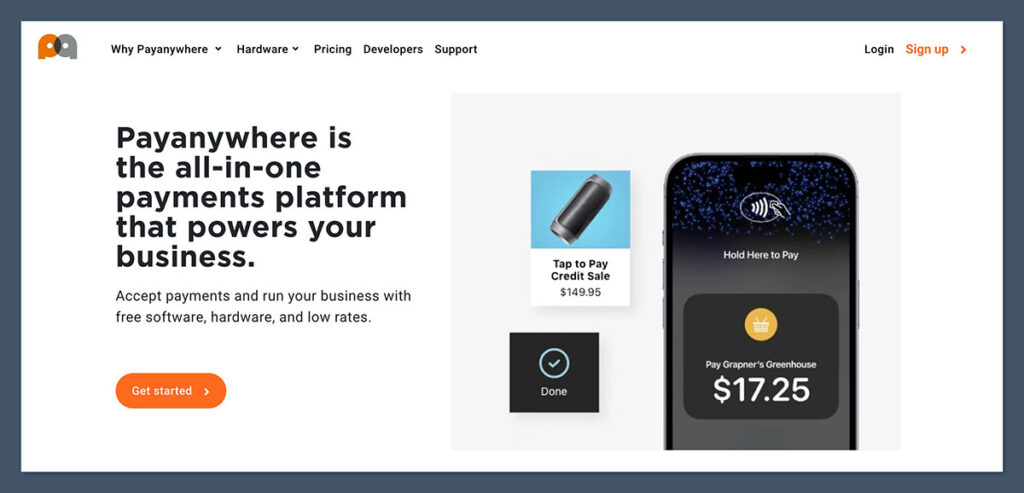
Payanywhere is a solid choice for small business owners who need a simple, mobile-friendly way to take payments without a lot of extras.
It works especially well for sellers who operate primarily in person, don’t rely on ecommerce features, and want to avoid monthly software fees.
Payanywhere works well for:
- Contractors or home service providers
- Mobile vendors with low transaction volume
- Budget-conscious businesses with basic needs
- Users who primarily accept in-person payments
These types of businesses benefit from Payanywhere’s straightforward setup and low-cost entry point.
While it lacks the deeper ecommerce and integration features of other platforms, it delivers enough functionality for day-to-day, in-person transactions without the overhead of complex systems or recurring fees.
Best for Growing Ecommerce Businesses: Square
For sellers who need a system that can handle both in-person and online transactions, Square offers a much more complete and scalable solution.
It’s designed for businesses that are growing, selling across multiple channels, or looking to streamline operations with one unified platform.
Square is better suited for:
- Online stores with occasional in-person sales
- Retail businesses needing inventory management
- Service-based businesses offering subscriptions or appointments
- Sellers using Shopify, WooCommerce, or BigCommerce integrations
- Teams needing employee tracking or sales reports
With built-in ecommerce tools, flexible hardware, and a wide range of integrations, Square makes it easy to manage sales, customers, and inventory all in one place.
It’s a better long-term fit for businesses planning to scale, expand online, or build out more advanced workflows.
Final Verdict: Square Comes Out on Top
Both Payanywhere and Square have their strengths—but Square is the clear winner for ecommerce-focused sellers or anyone looking for an integrated, all-in-one system that works online and offline.
Payanywhere may still be a viable choice if you’re running a local service business with minimal digital infrastructure, and you want to keep costs down.
But for everyone else—especially those building toward growth—Square offers far more flexibility, functionality, and future-readiness.
If I had to choose for my own ecommerce project, I’d go with Square every time.


Comments 0 Responses