

Best Overall

Printify
View Pricing Visit Printify →$0/month Free plan
Premium $24.99/month (billed yearly)
- 2,000+ products from 140+ print facilities
- Express US delivery in 2 to 3 business days
- Sells on Shopify, Etsy, eBay, Amazon, TikTok Shop and more
Best for Branding
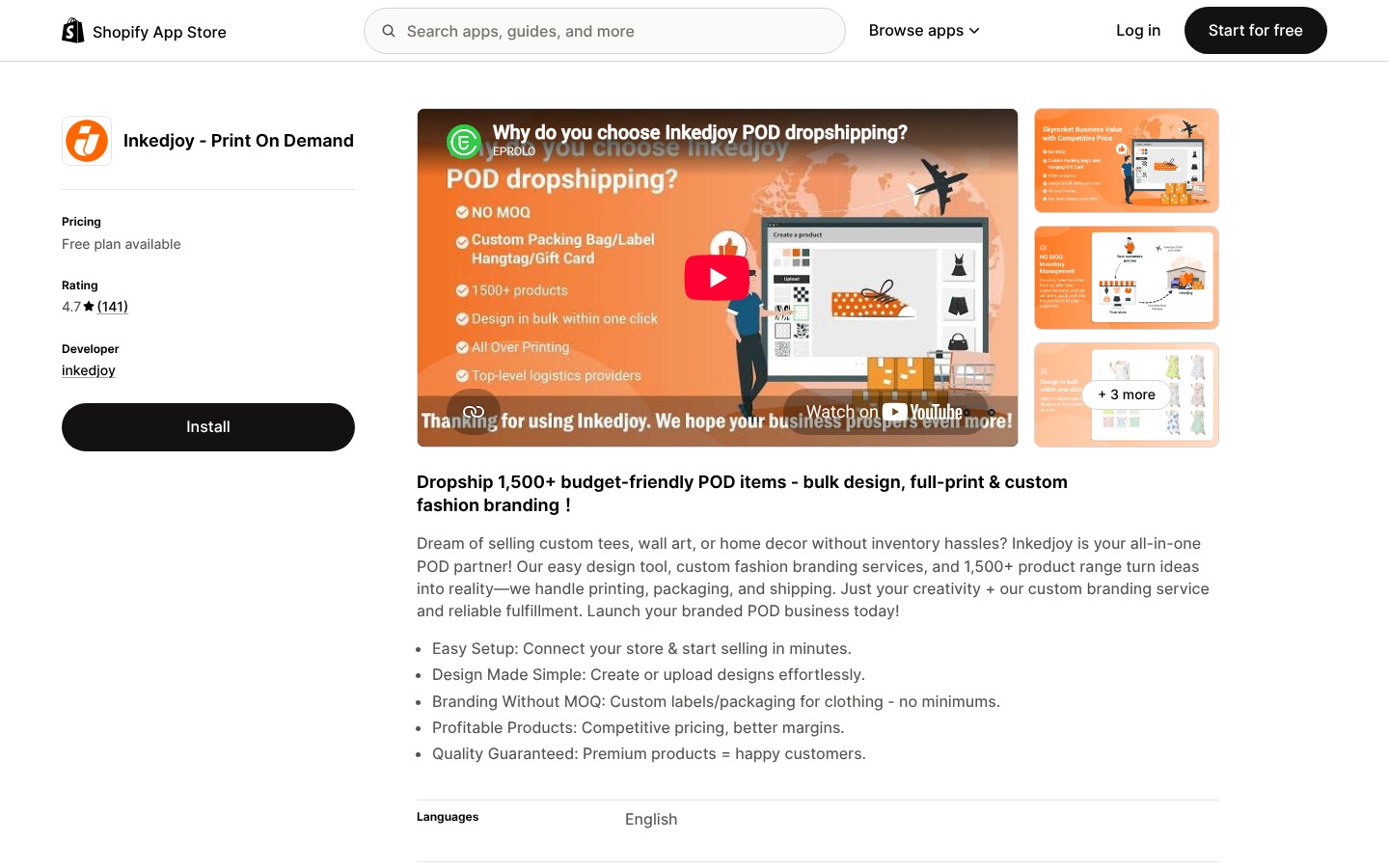
Inkedjoy
View Pricing Visit Inkedjoy →$0/month Free to install
Branding from $19.90/year
- Custom labels, hangtags and packaging
- No minimum order quantity
- Low base prices on tees, hoodies and mugs
When comparing print-on-demand platforms, Inkedjoy and Printify appear time and time again, but which came out on top in our most recent round of hands-on testing?
After putting both through their paces, I can confidently say that Printify is the better pick for most sellers, while Inkedjoy wins for small-volume clothing branding.
In this comparison, I’ll take a closer look at why, and compare the areas that matter most to your store, including pricing, products, branding, shipping, ease of use, and support.
At Ecommerce-Platforms.com, we’ve been testing and reviewing ecommerce platforms since 2012, and we constantly test them hands-on. I focused on the software you’ll use to create products, connect your store, and manage your costs.
Key Takeaways
- Both are free to start. Printify Premium costs $39/month or from $24.99/month billed yearly.
- Inkedjoy’s lower base prices come with overseas shipping costs and longer delivery windows.
- Inkedjoy branding starts at $19.90/year, with labels, hangtags, and packaging available without a minimum order.
- Printify offers 2,000+ products and broader sales-channel coverage.
- Printify provides 24/7 chat and email. Inkedjoy relies on email.
A Quick Comparison of Inkedjoy vs Printify
Printify wins overall, thanks to its product creator, provider choice, and broader integrations. Inkedjoy stands out for affordable clothing branding, particularly when you’re launching a small collection.
| Feature | Inkedjoy | Printify |
|---|---|---|
| Overall rating | 4.2/5 | 4.6/5 |
| Starting price | Free to install | Free plan |
| Paid plan | Branding Lite: $19.90/year; Pro: $99/year | Premium: $39/month or from $24.99/month billed yearly |
| Products | 1,500+ | 2,000+ |
| Sales channels | Shopify, Etsy, WooCommerce | Those channels plus eBay, Amazon US, TikTok Shop US, and more |
| Pros | Low base costs; clothing branding; no MOQ | Provider choice; broader integrations; Express delivery |
| Cons | Slower overseas shipping; basic editor | Provider quality varies; Premium is non-refundable |
| Best for | Branded apparel and personalized gifts | Multichannel sellers and US-focused stores |
What Kinds of Sellers Are Inkedjoy or Printify Best For?
The better fit depends on what you’re selling and where your customers live. A branded clothing collection has different priorities from a gift store promising quick US delivery.
Printify Is Best for…
- Multichannel sellers who want provider choice, a stronger product creator, and faster US fulfillment options.
Inkedjoy Is Best for…
- Budget-conscious apparel brands that prioritize labels and packaging over fast delivery or marketplace expansion.
1. Best for Pricing: It’s a Tie!
Inkedjoy has cheaper products, while Printify has cheaper US shipping.
Inkedjoy’s cheaper blanks don’t always mean a cheaper delivered order. Printify narrows the gap through shipping and Premium discounts, particularly when you’re selling tees to US customers.
How Much Do Inkedjoy and Printify Cost?
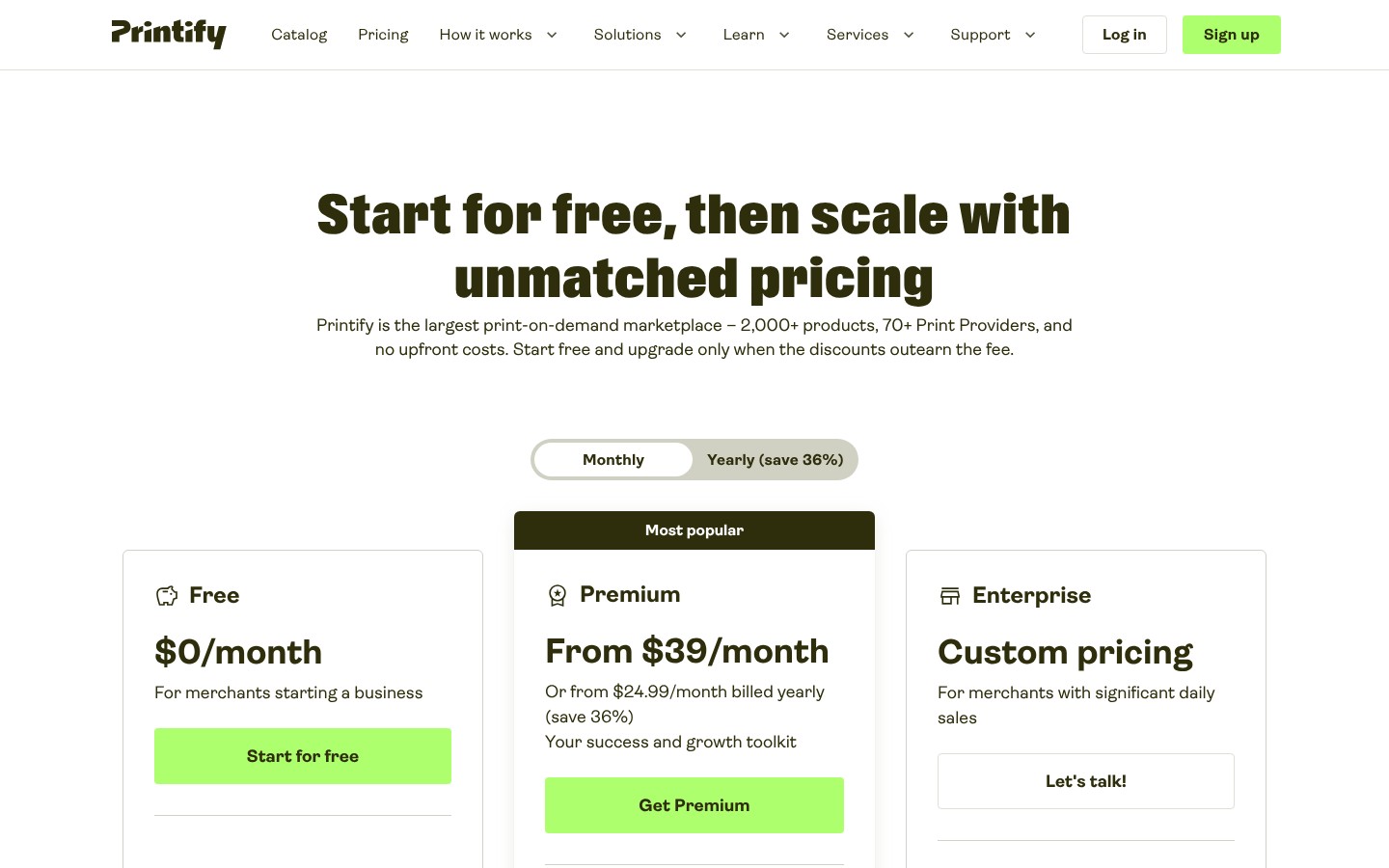
Both platforms let you start without a subscription, but their upgrades solve different problems. Inkedjoy sells branding memberships, while Printify Premium adds product discounts and more store connections.
- Inkedjoy Free: Free to install; pay product and shipping charges on orders.
- Branding Lite: $19.90/year for sellers adding clothing branding.
- Branding Pro: $99/year for additional materials and lower per-item fees.
- Printify Free: No subscription charge, suitable for testing your product range.
- Printify Premium: $39/month or from $24.99/month billed yearly, saving 36%.
- Printify Enterprise: Custom pricing for larger operations.
| Plan | Price | What you get |
|---|---|---|
| Inkedjoy Free | Free to install | Product creation and paid fulfillment |
| Branding Lite | $19.90/year | Custom label, hangtag, packing bag |
| Branding Pro | $99/year | Lite features, gift card, tape, lower material fees |
| Printify Free | Free | 5 stores, unlimited designs |
| Printify Premium | $39/month or from $24.99/month billed yearly | 10 stores, product discounts, AI Mockups |
| Printify Enterprise | Custom | A separately priced enterprise arrangement |
Printify Premium includes up to 20% off all products and up to 33% off new products. For me, the strongest reason to upgrade is repeatable order savings, not extra features your new store might not need yet.
Product and Shipping Costs Compared
Compare product cost plus shipping for the same customer destination. These US examples cover different garments, so the cotton tees and hoodies aren’t necessarily identical in fabric or construction.
| Product | Inkedjoy: base + shipping | Printify Free: base + shipping | Printify Premium: base + shipping |
|---|---|---|---|
| Cotton tee / Gildan 5000 | About $5.17 + from $6.58 | From about $8.80 + about $4 | From about $5.92 + about $4 |
| Hoodie / Gildan 18500 | From about $9.18 + about $11.50 | From about $21.58 + about $7.39 | From about $15.89 + about $7.39 |
| Mug / 11oz mug | About $1.55 + from about $8.82 | About $5.75 + about $6 | About $4.30 + about $6 |
Printify’s first-item tee shipping is about $4, compared with Inkedjoy’s shipping from $6.58. That helps Premium win this tee comparison, before you account for its subscription fee.
Inkedjoy keeps the hoodie advantage in these examples and beats Printify Free on mugs. Premium brings the mug comparison close, which is why I can’t name a universal cheapest option.
- Printify Premium is non-refundable. Check your store connection and margins before subscribing.
- Inkedjoy’s Made-in-USA Gildan 5000 costs about $14.76 and ships domestically; it’s separate from the cheaper overseas cotton tee.
The useful calculation is Premium’s expected monthly savings against its fee. Multiply each product’s discount by your expected order volume, then compare those savings with the subscription cost.
I also include branding materials and selling-channel fees before settling on a retail price. A low catalog price is appealing, but your margin depends on everything you pay to complete the sale.
2. Best for Product Range: Printify
Printify wins for catalog breadth and provider choice.
Printify gives you more room to expand beyond your first apparel collection. Inkedjoy remains a strong alternative for all-over-print clothing, home goods, and personalized gifts.
Product Catalog
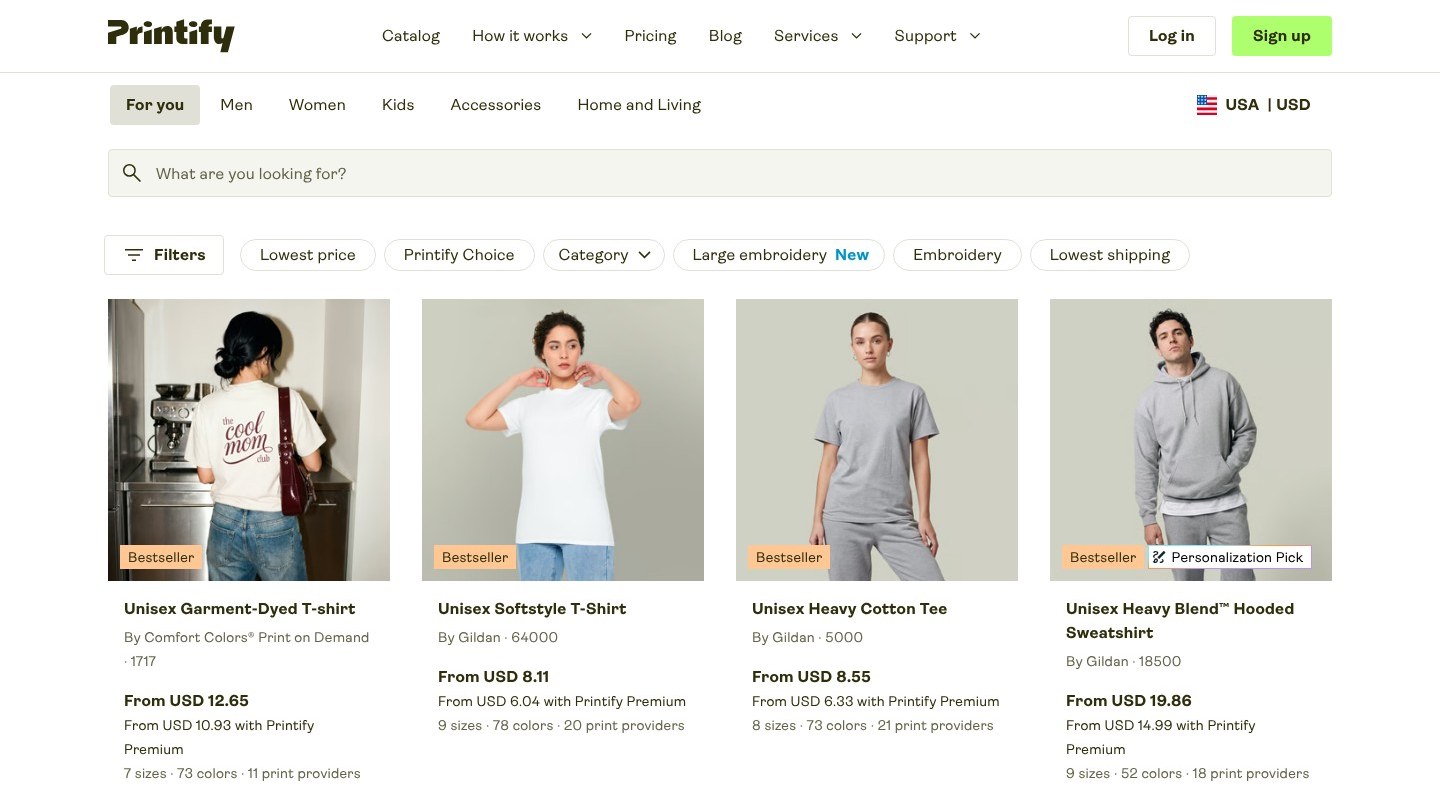
Printify offers 2,000+ products compared with Inkedjoy’s 1,500+, but provider selection was the more useful difference in my testing. You choose a print provider per product, giving you more control over how your collection is fulfilled.
When comparing Printify providers, check:
- Location: Prioritize fulfillment near your main customer market.
- Delivered cost: Compare product and shipping charges together.
- Provider ratings: Use them to build a shortlist.
- Variants: Confirm availability for the sizes and colors you intend to sell.
I like Printify’s provider-choice model for printed basics. When browsing tees, I could compare potential fulfillment partners before moving into product creation, rather than choosing purely on the garment’s appearance.
Inkedjoy’s strongest categories suit a more design-led collection:
- All-over-print apparel: For artwork that extends across the garment.
- Home goods: For carrying a design collection beyond clothing.
- Personalized gifts: For occasion-based or recipient-specific products.
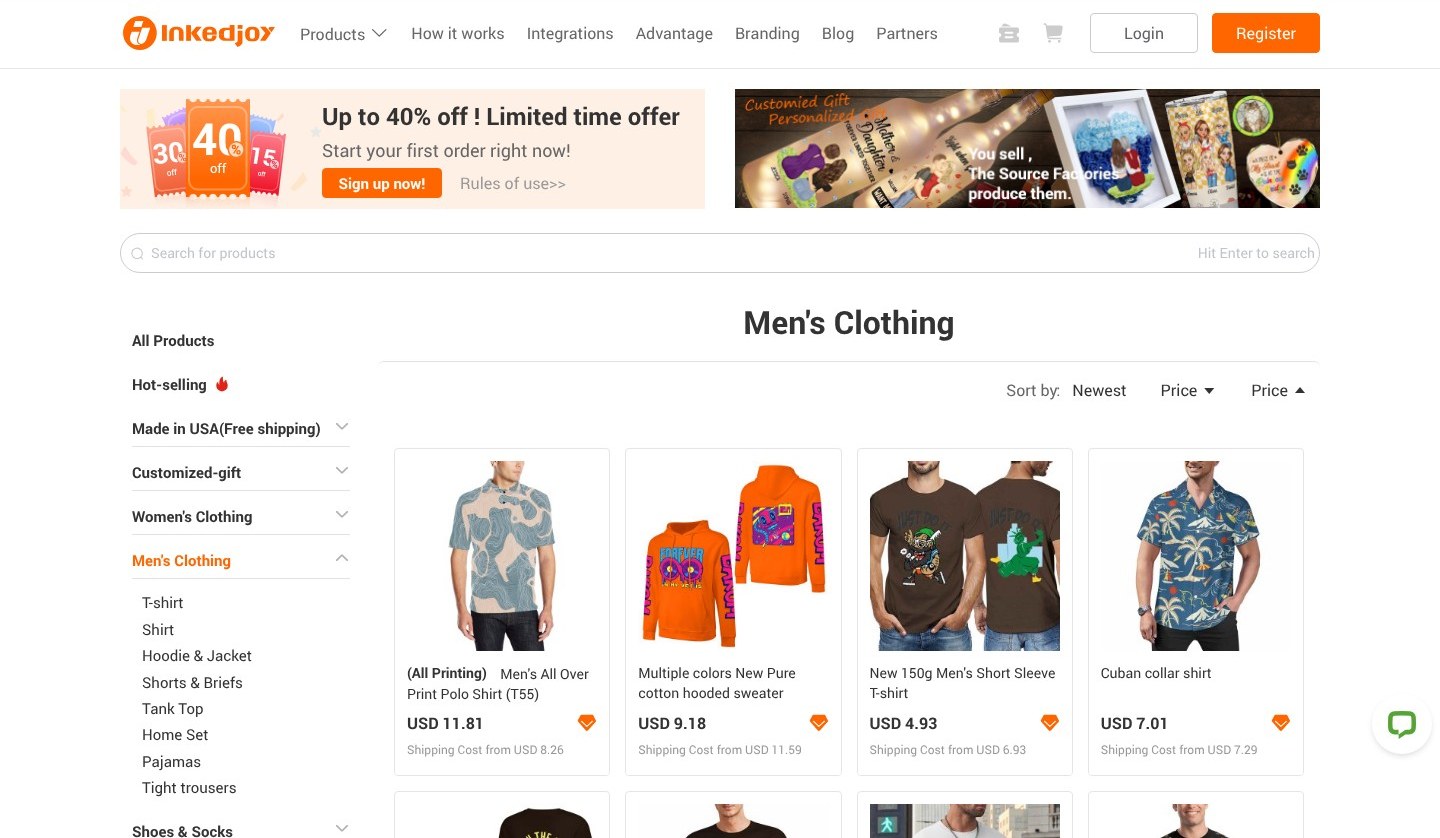
Inkedjoy is EPROLO’s print-on-demand brand, and EPROLO has been fulfilling orders since 2015. Its no-MOQ approach makes it accessible when you want to test a focused collection without buying inventory.
Print Quality and Consistency
Printify sellers report inconsistent quality between providers, so a familiar blank doesn’t guarantee an identical result. Provider choice is useful, but it also means checking the partner behind each product.
Inkedjoy users mention mockups that don’t match the printed result. That’s particularly relevant for all-over-print clothing, where a digital preview can’t tell you everything about artwork around seams and edges.
Before selling a product:
- Order the exact variant you intend to offer.
- Check print placement and fabric feel against your product description.
- Inspect seams and edges on all-over-print garments.
- Repeat the sample check after changing providers, even for the same blank.
For a printed tee collection, Printify’s flexibility outweighs the extra selection work. For a collection built around full-coverage artwork, Inkedjoy’s specialist strengths matter more than the difference in catalog size.
Printify is my pick for expansion, while Inkedjoy suits a focused apparel or gift concept. The larger catalog gives you options, but the products you actually sell still need individual attention.
3. Best for Branding: Inkedjoy
Inkedjoy wins for affordable, small-volume clothing branding.
Inkedjoy combines branded materials with no minimum order quantity for clothing branding. It stands out when labels and packaging are central to your store’s identity, rather than optional finishing touches.
Inkedjoy Branding Options
Inkedjoy’s branding entry point costs $19.90/year, compared with $39/month for Printify Premium. These aren’t equivalent subscriptions: Inkedjoy focuses on branding access, while Printify combines discounts with other account benefits.
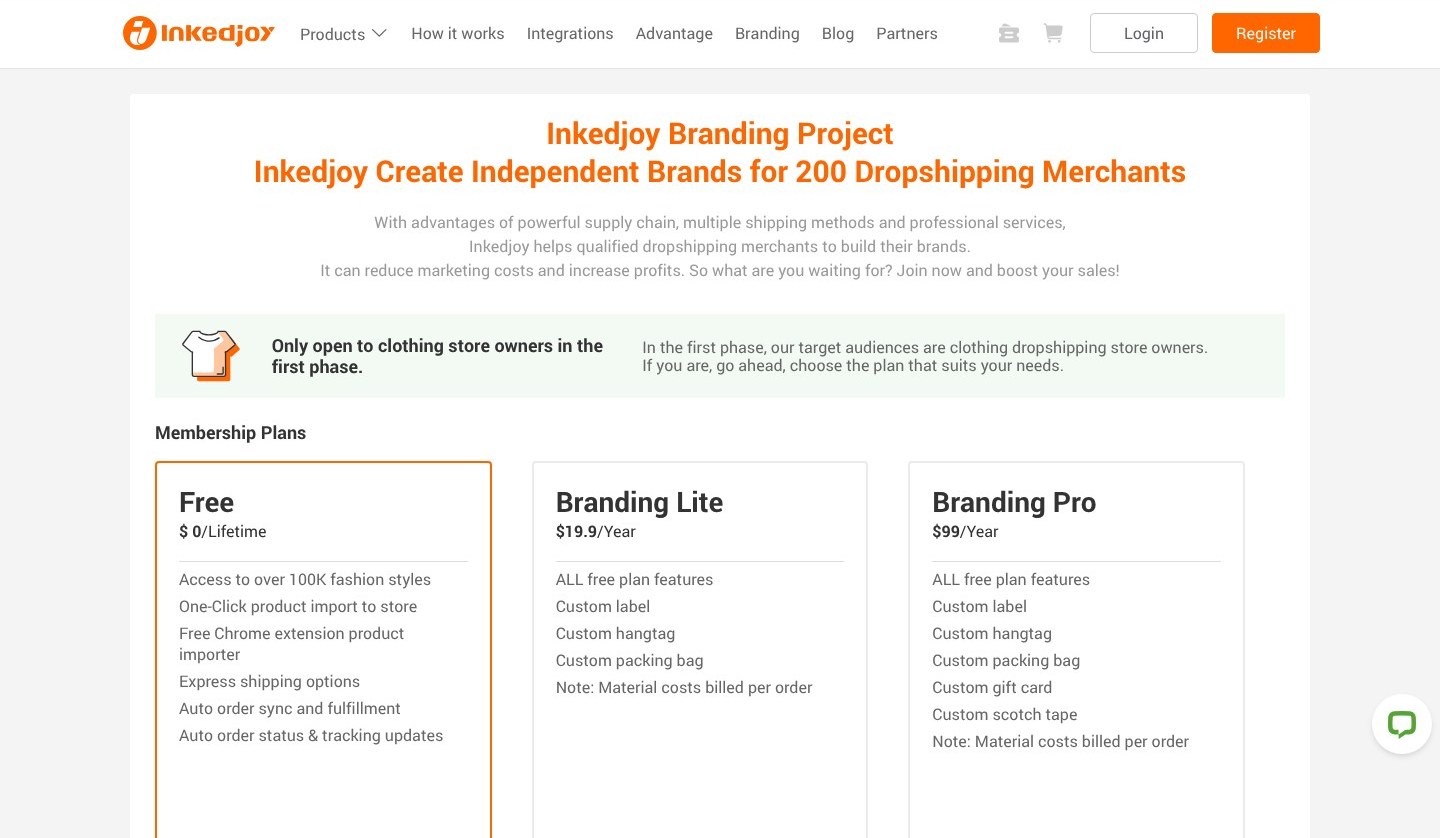
- Branding Lite: $19.90/year for custom labels, hangtags, and packing bags.
- Branding Pro: $99/year, adding gift cards and tape with lower per-item branding material fees.
Membership and materials are separate costs. I found the per-item material fees inside the app, which made it easier to see what needed adding to the product cost.
I like Lite for a new clothing brand that wants recognizable labels and packaging without committing to the larger package. Pro makes more sense when you need its extra materials or its lower material fees justify the membership difference.
No MOQ is Inkedjoy’s biggest advantage for a small apparel launch. You can build a branded presentation without buying a bulk clothing order just to get access to custom labels.
For an all-over-print hoodie collection, check compatibility with your chosen products before finalizing the packaging concept. A coordinated label and packing bag can support your brand, but the finished presentation still needs to match what you promise customers.
Printify Branding Options
Printify’s branding depends on the provider, so changing suppliers can affect your options. I found provider choice useful for costs and location, but it adds another consideration when you want consistent presentation across a collection.
Premium includes up to 33% off custom branding features. That’s a useful extra when the available options fit your store, especially if product discounts already make the subscription worthwhile.
Printify suits sellers with flexible packaging needs, particularly when the artwork is the main attraction. Inkedjoy wins this round because its branding packages make the starting decision clearer for a small clothing business.
4. Best for Shipping and Fulfillment: Printify
Printify wins for faster US delivery options.
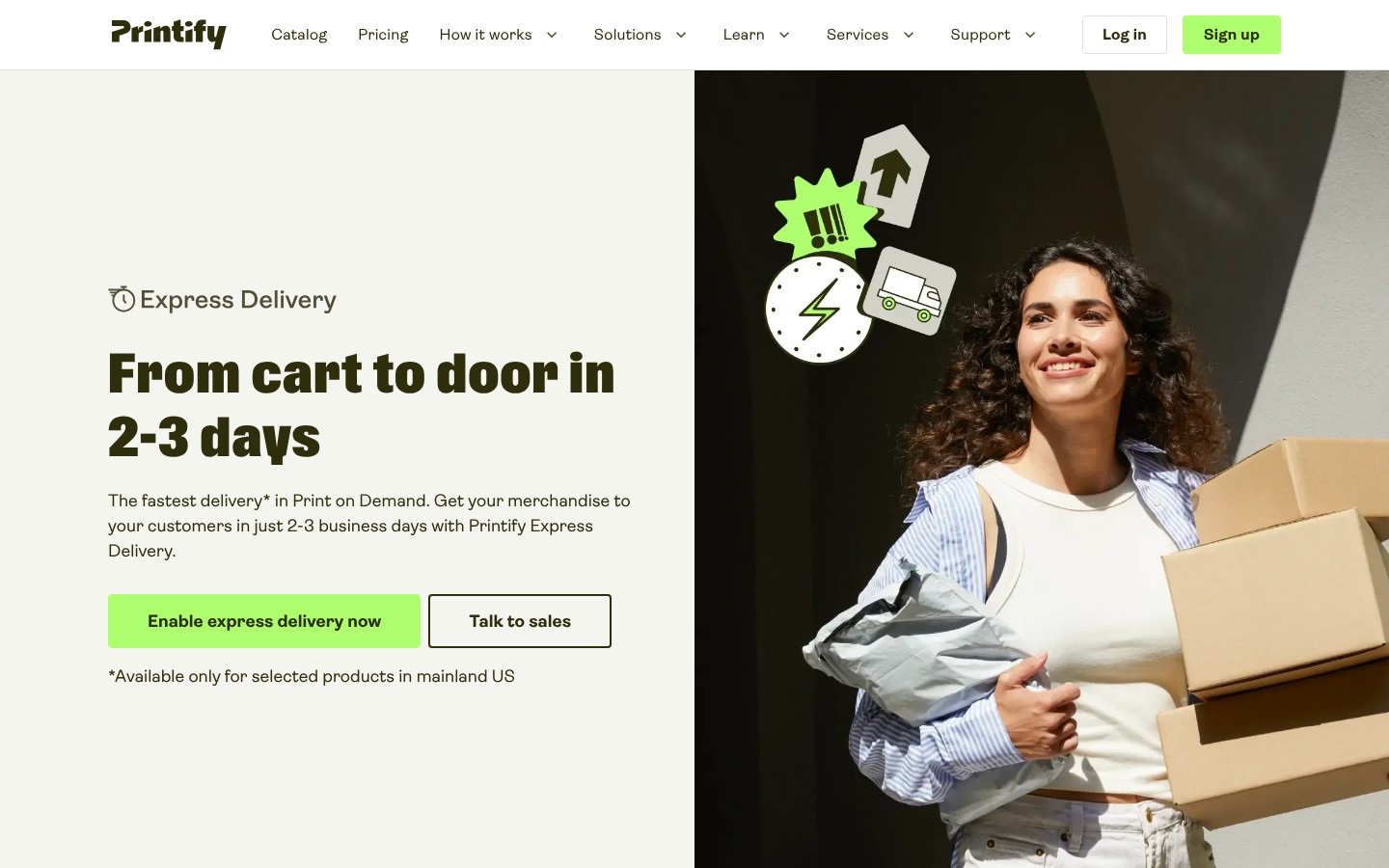
Printify Express offers 2 to 3 business days, compared with Inkedjoy US Express’s average of 7 to 12 days. That faster Printify option is limited to select products in the mainland US.
Fulfillment Network
Printify’s network includes 140+ facilities, with a provider selected for each product. I like being able to consider fulfillment location while building the catalog, rather than leaving shipping decisions until the end.
Inkedjoy has warehouses in China, the US, and Australia. That doesn’t mean everything ships domestically, so the origin of your chosen product matters more than the warehouse map.
| Shipping consideration | Inkedjoy | Printify |
|---|---|---|
| Fulfillment structure | China, US, and Australia warehouses | Print provider network with 140+ facilities |
| Faster US option | US Express averages 7 to 12 days | Express takes 2 to 3 business days for eligible products |
| Express restrictions | Check the selected product and route | Select products, mainland US |
| Express surcharge | Check the order quote | About $3.24 extra |
| Standard delivery caution | Can take several weeks | Depends on the selected provider and product |
Printify Express isn’t a storewide delivery promise. If you sell eligible tees alongside standard-shipping mugs, customers need product-specific estimates rather than one fast-arrival message across your website.
Inkedjoy users mention late shipments, which makes it less appealing for deadline-driven gifts. Its products can still suit shoppers who care more about the artwork or branded presentation than quick arrival.
Before publishing your shipping policy:
- Confirm each product’s fulfillment location and destination coverage.
- Check whether the quoted estimate includes production.
- Separate standard and Express delivery promises.
- Allow for seasonal disruption when planning occasion-based promotions.
Returns and Reprints
Printify offers a free reprint or refund for misprints and damaged items reported within 30 days of delivery. Clear photographs and order details help explain the issue when you contact support.
Inkedjoy provides a 30-day warranty, with refunds processed in 24 to 48 hours. That processing window shouldn’t be confused with a promise that every support conversation will be resolved immediately.
Your store’s returns policy still needs its own explanation. Supplier protection for a damaged item doesn’t automatically cover every reason a customer might want to return an order.
Printify is my choice when speed helps win the sale. Inkedjoy makes more sense when its products or branding give customers a reason to accept the shipping window shown for their order.
5. Easiest to Use: Printify
Printify wins for product creation and channel flexibility.
When testing the two, I found that Printify offers a more flexible product creator, whereas Inkedjoy’s editor is simpler but more basic. Printify also supports more sales channels, giving you more ways to expand beyond your first store.
My Experience Testing Printify
When testing Printify, I connected my Shopify store, picked a Gildan 5000 tee from the catalog and compared print providers side by side before uploading my artwork. The provider picker showed price, location, and rating, making those differences easy to consider together.
I then used the product creator to adjust artwork placement and review the mockups. I liked having provider selection and product design in the same setup process, even though it meant making more choices upfront.
These were the steps I followed:
- Created my account and connected Shopify.
- Selected the Gildan 5000 and compared providers.
- Uploaded my artwork in the product creator.
- Adjusted placement and reviewed the mockups.
- Set the price and published to my store.
After publishing, I checked the product page in my connected store against the setup I’d created. That final check helped me assess the full process, rather than judging the editor in isolation.
My preference was still Printify’s more flexible creator, with one caveat: users mention mockup and editor bugs, including changes not carrying through as expected. Premium’s AI Mockups also stood out as an additional presentation option, not my main reason to pay.
My Experience Testing Inkedjoy
With Inkedjoy, I installed the Shopify app and browsed the catalog with my store connected. I looked through the clothing options and checked the product and shipping details before opening the design editor.
I found the editor simpler, with fewer placement controls than Printify’s product creator. It suited straightforward artwork placement, but I had less flexibility when working on the product’s presentation.
My testing followed this sequence:
- Installed the Inkedjoy app and connected Shopify.
- Browsed products and checked shipping details.
- Added artwork in the design editor.
- Reviewed product information and pushed products to my store.
- Opened branding settings and checked material fees.
Pushing products to my store kept the process focused on the basic setup tasks. Compared with Printify, I spent less time weighing provider choices and more time assessing whether the selected product suited my design.
I also found the branding settings inside the app, alongside the per-item material fees. Seeing those charges there made the distinction between membership costs and ongoing branding costs much clearer during my test.
Sales Channels and Integrations
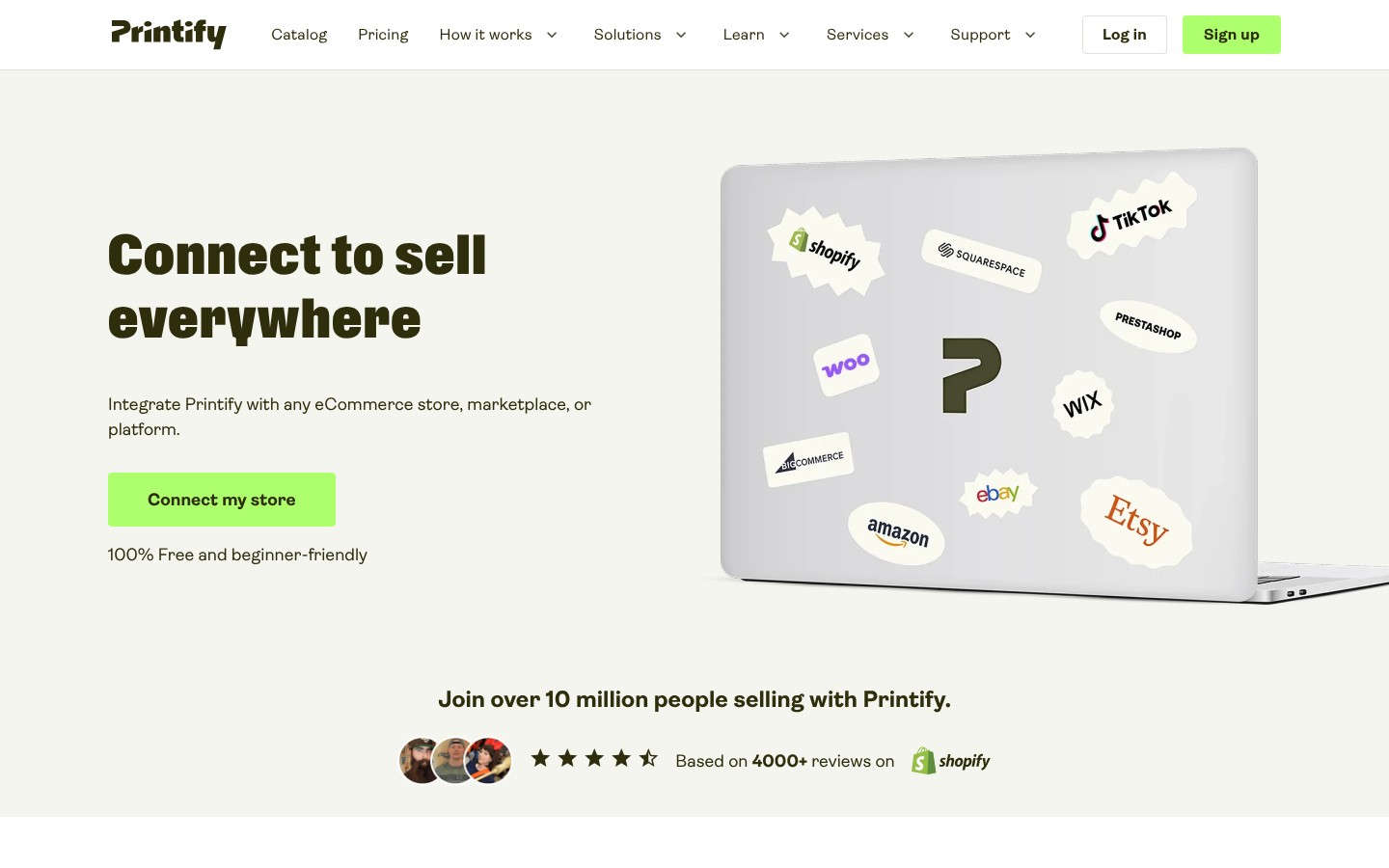
Printify gives you more expansion routes beyond Shopify and Etsy:
- Store platforms: Shopify, Wix, Squarespace, WooCommerce, BigCommerce, PrestaShop, and Big Cartel.
- Marketplaces: Etsy, eBay, and Amazon US.
- Social commerce: TikTok Shop US.
- Other routes: API and Printify Pop-Up Store.
Inkedjoy supports:
- Shopify
- Etsy
- WooCommerce
For an Etsy-only shop, Inkedjoy’s channel coverage can be enough. Printify is the stronger fit if eBay or US TikTok Shop already features in your plans, even if you aren’t ready to expand yet.
6. Best for Customer Support: Printify
Printify wins with round-the-clock live chat and email.
Both platforms hold 4.7 stars on the Shopify App Store, but Printify gives you more ways to get help. Its always-available chat is especially useful if you manage your store outside standard business hours.
Printify Support
- ✔️ 24/7 live chat and email: Contact support whenever an account or order problem arises.
- ✔️ Help Center: Find self-service guidance for setup and order questions.
- ✔️ Defect protection: Eligible misprints and damaged items qualify for a free reprint or refund.
- ❌ No phone support: Sellers who prefer calling don’t have that option.
- ❌ Refund delays: Some users describe slow refunds and repeated support exchanges.
- ❌ Provider complications: Sellers mention back-and-forth when resolving fulfillment problems.
Easy access doesn’t always mean a quick resolution. I like Printify’s contact options, but sellers’ complaints about refunds are a reminder that availability and problem-solving aren’t the same thing.
Inkedjoy Support
- ✔️ Email support: Contact the team about account and order questions.
- ✔️ Refund processing: The stated processing window is 24 to 48 hours.
- ✔️ Warranty: A 30-day warranty provides a defined protection period.
- ❌ No published live chat hours: Don’t plan around immediate chat assistance.
- ❌ Delivery complaints: Users mention late shipments that require customer follow-up.
Printify has 4,300+ Shopify App Store reviews, compared with about 140 for Inkedjoy. That gives Printify a larger pool of merchant feedback, although the shared star rating doesn’t tell you how either handles your particular problem.
Inkedjoy’s refund-processing policy is a positive, especially if you’re comfortable handling questions by email. Still, Printify wins because you have a live contact option whenever an account or order issue comes up.
With either platform, keep your customer updated while the supplier investigates. A short explanation of what you’re checking is more helpful than leaving them waiting without knowing what happens next.
How We Test Print-on-Demand Platforms
We’ve been testing and reviewing ecommerce platforms since 2012, and we constantly test them hands-on. For this comparison, I worked through store connections, catalog browsing, product creation, mockups, and branding settings.
Our testing focuses on cost, fulfillment, and everyday usability, alongside the features that help you grow:
- Pricing and product costs (25%): Compare subscriptions, product charges, and shipping together, then assess whether paid upgrades improve margins.
- Product range and quality (20%): Assess catalog suitability, provider choice, and seller feedback about consistency across products.
- Shipping and fulfillment (20%): Compare fulfillment locations, delivery options, eligibility restrictions, and remedies for damaged orders.
- Ease of use and integrations (15%): Evaluate product creation, mockup options, store connections, and the steps required to publish.
- Branding (10%): Compare available materials, membership charges, per-item costs, and minimum-order requirements for clothing brands.
- Help and support (10%): Assess contact methods, availability, self-service guidance, and recurring complaints about order resolution.
For print quality and delivery, I also weigh what sellers report after real orders, since that’s where provider differences show up.
Most importantly, I’ve tested both Inkedjoy and Printify myself, so the insights and recommendations in this comparison come from first-hand experience with both platforms.
Inkedjoy vs Printify: Our Winner
Printify is the better choice for most sellers. I found its product creator more flexible, and its provider picker gave me useful control over price and fulfillment location. Add broader sales channels and faster eligible US delivery, and it’s the platform that gives a growing store more options without requiring a subscription from the start.
Inkedjoy wins for small-volume clothing branding. Its labels, hangtags, and packaging packages make sense for a focused apparel collection where presentation matters more than marketplace expansion. The lower base prices are appealing, too, but shipping and per-item branding fees still need a place in your budget before you decide which platform leaves you with the better margin.
My recommendation is to compare the same design and customer destination on both platforms before paying for an upgrade. That gives you a clearer picture than catalog prices alone, especially when branding is involved. Start on both free plans and order a sample before listing.


Comments 0 Responses