

I’ve spent over 150 hours researching, testing, and comparing the top fulfillment and shipping platforms used by ecommerce businesses. Based on that experience, I can confidently say:
- ShipBob is the better option if you want to outsource fulfillment and scale your store.
- EasyPost is best if you’re managing your own warehouse and just need smarter shipping tools.
In this review, I’ll walk you through how these platforms compare on features, pricing, use cases, and more — so you can choose the one that fits your business.
Quick Verdict: ShipBob vs EasyPost
| Feature | Winner |
|---|---|
| Best for Fulfillment | ShipBob |
| Best for Shipping APIs | EasyPost |
| Pricing Flexibility | EasyPost |
| Ease of Use | ShipBob |
| Best for Developers | EasyPost |
| Global Warehousing | ShipBob |
If you’re a growing DTC brand with limited logistics capacity, ShipBob will handle your inventory, packing, and shipping from start to finish.
If you’re already shipping from your own location and just want better rates and shipping automation, EasyPost gives you powerful API tools to connect with 100+ carriers.
Let’s look at both platforms in more detail.
What Is ShipBob?
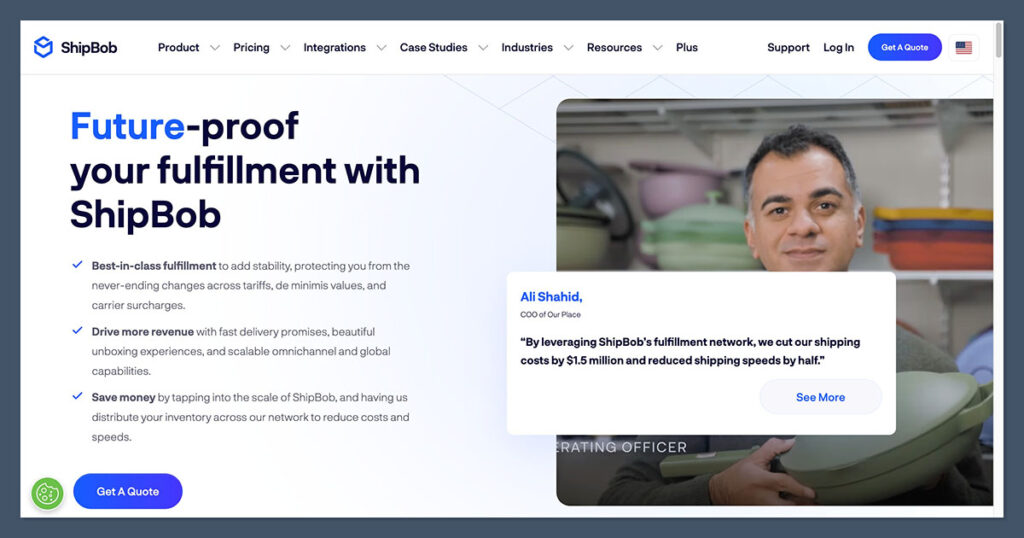
ShipBob is a third-party logistics (3PL) provider. You send your inventory to one of their fulfillment centers, and they take care of storing, picking, packing, and shipping your orders.
They integrate with your ecommerce platform, so the process is largely automated once set up.
ShipBob Key Features
- Warehousing and Fulfillment: Operates in the US, UK, Canada, EU, and Australia
- Ecommerce Integrations: Works with Shopify, BigCommerce, WooCommerce, Amazon, Walmart, and more
- Shipping Management: Automatically selects carrier and handles tracking
- Inventory Distribution: Lets you split inventory across multiple fulfillment centers
- Returns Handling: Manages customer returns and restocking
ShipBob is best for ecommerce businesses that want to completely outsource fulfillment, reduce delivery times, and focus on sales and product growth instead of logistics.
What Is EasyPost?
EasyPost is a shipping API and logistics software provider. It doesn’t handle physical fulfillment — instead, it connects you to multiple shipping carriers so you can automate label printing, rate shopping, tracking, and more.
It’s made for businesses that already handle their own picking and packing, but need better tools to manage shipping efficiently.
EasyPost Key Features
- Shipping API: Generate shipping labels, verify addresses, and track shipments automatically
- Carrier Integrations: Connects to 100+ carriers, including USPS, FedEx, UPS, DHL, and regional carriers
- Smart Rate Shopping: Automatically selects the cheapest or fastest shipping option
- Returns API: Build custom return workflows
- Developer-Friendly Tools: Well-documented APIs and SDKs for easy setup
EasyPost works best for warehouse-savvy ecommerce businesses that have logistics in-house and want more flexibility and control over their shipping operations.
ShipBob vs EasyPost: Feature Comparison
Here’s a side-by-side look at how ShipBob and EasyPost compare across key ecommerce needs:
| Feature | ShipBob | EasyPost |
|---|---|---|
| Fulfillment | ✅ Handles everything | ❌ Not available |
| Warehousing | ✅ Yes, in multiple countries | ❌ None |
| Label Generation | ✅ Built-in | ✅ API-based |
| Carrier Access | ✅ Discounted USPS, UPS, FedEx | ✅ 100+ carriers available |
| Inventory Management | ✅ Real-time inventory tracking | ❌ Not included |
| Returns Management | ✅ Managed by ShipBob | ⚠️ Requires API setup |
| API Access | ⚠️ Limited | ✅ Developer-first platform |
| Custom Shipping Rules | ⚠️ Basic options | ✅ Highly customizable via API |
| Integrations | ✅ Shopify, Amazon, etc. | ⚠️ Requires dev integration |
Fulfillment
ShipBob handles everything: receiving, storage, pick and pack, and shipping. Once you send inventory to one of their fulfillment centers, you’re largely hands-off.
EasyPost doesn’t offer fulfillment. It’s a software layer that helps you automate the shipping part — you’ll still need to manage inventory and physically ship orders yourself.
Verdict: ShipBob wins for businesses that want to outsource logistics entirely.
Warehousing
ShipBob has fulfillment centers in the US, UK, EU, Canada, and Australia. You can split inventory across locations to improve delivery times and reduce shipping zones.
EasyPost doesn’t provide warehousing. You’ll need to store and handle inventory through your own facility or a separate 3PL.
Verdict: ShipBob offers global warehousing. EasyPost doesn’t.
Label Generation
ShipBob auto-generates shipping labels as part of their fulfillment workflow. You don’t need to lift a finger.
EasyPost generates labels via API. It’s ideal for developers or teams using platforms like ShipHero or ShipStation.
Verdict: Both support label generation — ShipBob is hands-off, EasyPost is flexible and programmable.
Carrier Access
ShipBob partners with major carriers (UPS, USPS, FedEx, DHL) and offers discounted rates through volume shipping.
EasyPost integrates with over 100 carriers worldwide, including domestic and regional options. You can compare rates and services in real time.
Verdict: EasyPost wins for flexibility and carrier variety. ShipBob offers strong rates but fewer options.
Inventory Management
ShipBob includes basic inventory tracking, real-time stock updates, and tools to manage multi-location inventory.
EasyPost doesn’t manage inventory — you’ll need separate software for that.
Verdict: ShipBob provides built-in inventory features. EasyPost doesn’t offer any.
Returns Management
ShipBob manages returns from end to end — return labels, customer support, and restocking.
EasyPost lets you create return labels via its API, but building a return flow is entirely on you.
Verdict: ShipBob offers full returns handling. EasyPost supports returns but doesn’t manage them.
API Access
ShipBob has a basic API for custom workflows but most users rely on built-in integrations.
EasyPost is an API-first platform with robust documentation. It’s designed for developers who want full control.
Verdict: EasyPost is ideal for dev teams. ShipBob is better for plug-and-play users.
Custom Shipping Rules
ShipBob offers simple rules — carrier preferences, order splitting, etc. Enough for most DTC brands.
EasyPost supports highly specific logic: dynamic rate selection, fallback carriers, shipment splitting, and more — all built via API.
Verdict: EasyPost is better for advanced logistics workflows.
Integrations
ShipBob connects natively to Shopify, WooCommerce, Amazon, Walmart, and more. Setup takes minutes, and no coding is required.
EasyPost requires development resources unless you’re using a third-party system that supports it, like ShipStation.
Verdict: ShipBob wins on ease of integration. EasyPost needs more technical lift.
Pricing: Which Platform Offers Better Value?
When comparing pricing, it’s important to understand that ShipBob and EasyPost operate on completely different models.
ShipBob bundles services like warehousing, picking, packing, and shipping. EasyPost is a software provider that connects you with carriers — but doesn’t handle any physical goods.
ShipBob Pricing Breakdown
ShipBob charges for a number of services based on usage:

- Receiving Fees: $25 to $35/hour for checking in and storing your inventory
- Storage Fees: $5 to $40 per pallet/month, depending on space usage and seasonality
- Pick and Pack: Free for the first four items per order; $0.20–$0.30 for each additional item
- Shipping Fees: Varies based on order volume and zones; ShipBob uses its negotiated carrier rates
Example for 500 Orders/Month:
| Cost Category | Estimated Monthly Range |
|---|---|
| Storage | $300–$600 |
| Fulfillment Fees | $300–$500 |
| Shipping Costs | $2,000–$3,500 |
| Total | $2,600–$4,600 |
Which is Better Value?
If you’re already managing your own warehouse, packing stations, and fulfillment team, EasyPost is more affordable. You’re only paying for software and shipping.
But if you’re looking for an end-to-end logistics partner, ShipBob provides far more services in exchange for its higher cost — removing the need for physical infrastructure, staff, or packaging materials.
Ease of Use: Which Platform is More Beginner-Friendly?
One of ShipBob’s strongest selling points is how easy it is to get started.
Once you create your account and connect your ecommerce platform, ShipBob’s onboarding team will guide you through sending inventory, setting up SKUs, and configuring your shipping preferences. There’s very little manual work needed on your part.
EasyPost is much more technical by nature. You’ll need to implement the API into your system, whether it’s a custom backend, an ERP, or an app like ShipStation.
For many businesses, that means hiring a developer or relying on an IT team to get started. It’s not built for plug-and-play ease of use — it’s built for customization and control.
Verdict: ShipBob is the better option for non-technical users who want to go live quickly. EasyPost requires a more technical setup and is better suited to experienced operations teams.
Shipping Speed and Delivery Reliability
ShipBob
- Fulfills from the warehouse closest to the customer
- Offers 2-day shipping within the US and UK
- Manages delivery and tracking automatically
ShipBob’s distributed warehouse network ensures that orders are sent from the nearest location, which significantly reduces delivery times for most customers.
Their system handles the entire delivery process, from choosing the optimal carrier to sending tracking notifications, making it easy to maintain a consistent experience.
EasyPost
- Speed depends on the carrier and your fulfillment efficiency
- Lets you shop rates to find the fastest or cheapest delivery
- Offers real-time tracking via API
EasyPost gives you access to over 100 carriers, so you can prioritize either speed or cost per shipment using automated rate comparison. This flexibility is ideal for businesses with in-house fulfillment that want more control over their logistics.
Verdict: ShipBob offers more consistency with its 2-day shipping options, built-in tracking, and end-to-end delivery management.
EasyPost is more flexible and powerful for custom setups but places more responsibility on your team to ensure timely deliveries.
Integrations and Tech Stack
ShipBob
- Connects directly with Shopify, BigCommerce, WooCommerce, Amazon, Walmart, and more
- Native integrations make setup fast and non-technical
- Offers basic API access for custom workflows
ShipBob’s platform is designed to work seamlessly with popular ecommerce tools right out of the box. Most merchants can connect their store and start fulfilling orders within a day — no developer support required.
EasyPost
- Built primarily as an API-first platform
- Integrates with 100+ carriers and systems like ShipStation, ShipHero, and custom ERPs
- Requires technical setup or third-party platforms to connect with ecommerce stores
EasyPost gives developers full control over how and where it’s integrated into your tech stack.
Whether you’re connecting to a custom warehouse management system or building complex shipping logic, their API can support highly tailored logistics workflows.
However, it’s not designed for non-technical users.
Verdict: ShipBob is better suited for merchants who want fast, no-code integration with major ecommerce platforms.
EasyPost is the better option for teams with development resources looking to build a more flexible, custom shipping infrastructure.
Who Should Use ShipBob?
ShipBob is the right choice if:
- You want to outsource fulfillment completely
- You’re scaling and need a multi-warehouse solution
- You don’t have a logistics or warehouse team
- You value ease of use and speed to launch
It’s especially good for Shopify and DTC brands who want to grow without managing logistics in-house.
Who Should Use EasyPost?
EasyPost is best if:
- You have your own warehouse or in-house shipping team
- You want full control over rates, labels, and tracking
- You need flexibility across many carriers
- You have developer resources or use a platform like ShipHero or ShipStation
It’s more affordable if you’re already fulfilling orders yourself.
Case Studies and Real Examples
ShipBob:
- Touchland scaled to 3 continents using ShipBob’s global warehouses
- TB12 by Tom Brady improved delivery times by 30% after switching to ShipBob
Touchland, known for its premium hand sanitizers, relied on ShipBob’s international fulfillment network to support global demand without managing multiple logistics partners.
Their ability to centralize operations while expanding internationally made a noticeable difference in delivery times and customer satisfaction.
TB12, the wellness brand founded by Tom Brady, used ShipBob to improve shipping speed and reliability across the US. With faster delivery and better inventory control, the brand reduced customer complaints and streamlined its DTC operations.
EasyPost:
- ShipHero integrates EasyPost for rate shopping and multi-carrier labels
- American Eagle used EasyPost’s API to streamline carrier management across distribution centers
ShipHero built EasyPost directly into its warehouse software, allowing users to automate label creation and dynamically select carriers based on cost and delivery speed.
This integration gave their clients access to more competitive shipping options without manual intervention.
American Eagle implemented EasyPost’s API to consolidate carrier operations across its nationwide network of fulfillment centers.
This helped them standardize shipping processes, improve scalability, and reduce reliance on multiple shipping systems.
Final Recommendation: ShipBob vs EasyPost
| Business Scenario | Best Choice |
|---|---|
| Scaling DTC brand without warehouse | ShipBob |
| Shipping in-house and need automation | EasyPost |
| Need international warehouses | ShipBob |
| Want to plug into 100+ carriers via API | EasyPost |
| Non-technical, need quick setup | ShipBob |
| Developer team + control over logistics | EasyPost |
Both tools are solid — but they serve completely different roles.
- Choose ShipBob if you want to hand off fulfillment and grow fast without the logistics overhead.
- Choose EasyPost if you already manage fulfillment and just need smarter, faster, cheaper shipping.
Before you decide, think about how your operations are set up today and where you want to take your business in the next 6 to 12 months.
If you’re spending too much time packing boxes or managing warehouse space, ShipBob can free you up to focus on growth.
But if you already have fulfillment under control and just want to optimize shipping with better rates and automation, EasyPost gives you the flexibility to do exactly that.
Matching the right tool to your current workflow is what makes the difference.


Comments 0 Responses