

AI-referred traffic to online stores surged 4,700% last year, according to Adobe. Yet only 7% of companies have scaled AI past the experiment stage. That gap between hype and results almost always comes down to one thing: picking the right tools instead of more tools.
So I went looking for the best AI ecommerce tools that actually move revenue, not the ones with the slickest landing pages. Most “best of” lists are written by the companies selling the software. I don't sell any of these. What follows is 13 tools ranked by what they do for your store, with real pricing, the usage-based cost traps vendors gloss over, and complaints from merchants actually using them.
One thing to flag up front: a couple of these tools are about getting found now, not just running the store. AI search engines like ChatGPT and Perplexity already answer 12-18% of queries, and that changes which tools matter.
Here's the full list, ranked.
| # | Tool | Best for | Category | Starting price |
|---|---|---|---|---|
| 1 | Shopify Magic + Sidekick | Free baseline AI for Shopify stores | Platform-native | Free |
| 2 | Klaviyo | Email and SMS revenue | Marketing | Free / $20/mo |
| 3 | Gorgias | High-volume Shopify support | Customer support | $10/mo |
| 4 | Tidio + Lyro | Budget AI chat for small stores | Customer support | Free / $29/mo |
| 5 | Fin by Intercom | Highest resolution rate | Customer support | $0.99/resolution |
| 6 | Jasper AI | Brand-consistent content at scale | Content | $39/mo |
| 7 | Algolia | AI site search for big catalogs | Search | Free / $0.50 per 1K |
| 8 | Triple Whale | DTC analytics and attribution | Analytics | Free / $179/mo |
| 9 | Prediko / Cogsy | Inventory forecasting | Operations | $49/mo |
| 10 | Prisync | Competitor pricing and repricing | Pricing | $59/mo |
| 11 | Photoroom | Clean product photos at scale | Creative | $9.99/mo |
| 12 | Flair AI | Lifestyle product imagery | Creative | $10/mo |
| 13 | Ringly.io | AI voice support | Customer support | ~$0.38/call |
Key Takeaways
- The best AI tool for most stores is free. Shopify Magic and Sidekick already sit in your admin and save solo operators 5 to 10 hours a week. Turn it on before paying for anything else.
- Buy one tool, not 13. Fix your single biggest bottleneck first, prove it pays for itself, then add the next. 89% of companies using AI report positive ROI, with payback around nine months.
- Usage-based billing is where budgets break. Watch Klaviyo's total-profile billing, Gorgias's helpdesk-plus-AI double charge, and Algolia's 3.5x AI premium. Model your real volume before you commit.
- Judge support tools on resolution rate, not deflection. A deflected customer may just have given up. Fin leads on resolution (70-84% for ecommerce), while real-world automation usually lands at 26-56%, below the marketed 60%.
- Match the tool to your stage. Solo stores need free tiers and ChatGPT Plus. Paid analytics, inventory, and pricing tools only earn their place once your spend or SKU count justifies them.
- AI search is becoming table stakes. AI engines answer 12-18% of queries and AI-referred shoppers convert 31% higher, so structuring product data for AI to cite is now part of the job.
1. Shopify Magic and Sidekick: Best Free AI Built Into Your Store
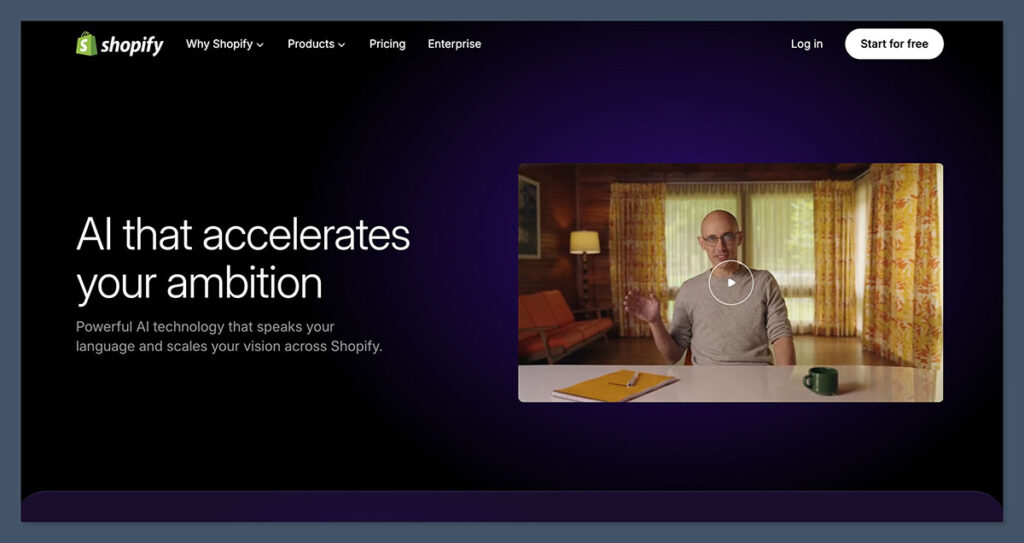
The best AI tool for most stores costs nothing and is already sitting in your admin. Before you pay for anything on this list, turn this on.
Shopify Magic and its conversational sidekick (called, well, Sidekick) are free for every Shopify subscriber. The Winter 2026 “Renaissance Edition” alone shipped more than 150 AI updates, so the gap between “free” and “good enough” has narrowed fast.
Key features
- Background removal and AI image editing for listing photos
- Automatic product tagging and SEO metadata generation
- Sidekick conversational admin (ask “show my top 10 products by revenue”)
- Sidekick Pulse, which flags anomalies against market benchmarks
- Brand Voice Cloning trained on your past posts
- Agentic Storefronts that let customers buy through ChatGPT and Perplexity
The value shows up in the numbers. One merchant, Kwame Chambers, processed 500 product descriptions in two hours that would have taken two weeks by hand, saving roughly $2,500 in copywriting. Across a typical week, Magic saves solo operators 5 to 10 hours, worth $13,000 to $26,000 a year at $50 an hour.
Pros
- Genuinely free with zero setup, API keys, or data syncing required
- Saves hours on grunt work like tagging, metadata, and background removal
- Sidekick answers basic analytics without you touching a spreadsheet
Cons
- Generic copy that leans bland and needs editing to sound like your brand
- Image artifacts make it unsafe for primary product photography
- Surface-level strategy, with Sidekick offering “generic best practices” over store-specific advice
- Locked to Shopify, so it travels nowhere if you leave
Best for: every Shopify store, as the free baseline layer under everything else. Skip the upgrade hunt if you only need hero product copy or deep analytics, since you'll want ChatGPT, Claude, or a dedicated analytics tool for those anyway.
2. Klaviyo: Best AI Email and SMS Marketing Platform
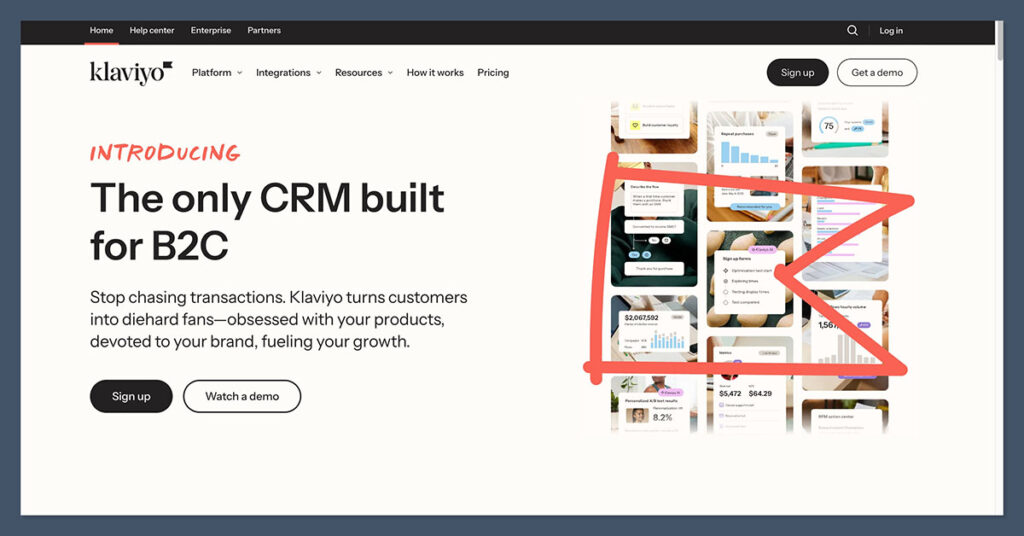
AI-assisted email campaigns generate 18 times the revenue per recipient of manual ones, and Klaviyo turns that into the closest thing to free money in ecommerce. Its abandoned-cart flows hit $3.65 per recipient versus $0.11 for a manual blast, a 33x difference. That's the upside. The catch is the bill, and I'll get to it.
What sets it apart is that the intelligence is baked into the flows, not bolted on. Predictive analytics estimate each customer's next order date, churn risk, and lifetime value, then route messages to whichever channel that person actually opens. The March 2026 Composer can spin up a full multichannel campaign from a single text prompt, and the App Embed integration tracks behavior on your Shopify store in real time. The result is less manual segmenting and more revenue per send, which is the whole point.
Key features
- Composer (launched March 2026) builds full multichannel campaigns from a single text prompt
- Predictive analytics for next order date, churn risk, and lifetime value
- Channel Affinity Routing, which lifts purchase rates up to 11x by sending to each customer's preferred channel
- Deep Shopify integration with real-time behavioral tracking via App Embed
LifeStraw saw a 111% jump in AI-driven sales after switching on Klaviyo's Customer Agent. The tooling works.
Pricing
- Free up to 250 profiles
- From $20/month, scaling with list size
- Around $150/month at 10,000 profiles
- $720/month at 50,000 profiles, up to $2,300/month at 250,000
Pros
- Best-in-class predictive data built right into your flows
- AI Composer spins up a full campaign from one prompt
- Deepest Shopify integration of any email platform tested for this list
Cons
- The billing trap: on February 18, 2025, Klaviyo switched from charging for “actively emailed” contacts to “total active profiles.” Many merchants saw 25%+ increases overnight with zero new subscribers.
- No annual discounts on self-serve plans, and no auto-downgrade when your list shrinks
- Three price hikes in four years, which long-time customers have not loved
To control the so-called “Dead Profile Tax,” set up a Sunset Flow that suppresses anyone with no opens or clicks in 180 days. That single move can cut a mature store's bill by 20 to 40%.
The verdict: Klaviyo is the default for any store serious about retention, but budget for list hygiene from day one. If you're smaller and want lighter multichannel messaging, Omnisend starts at $16/month and does most of the job.
3. Gorgias: Best AI Helpdesk for High-Volume Shopify Stores
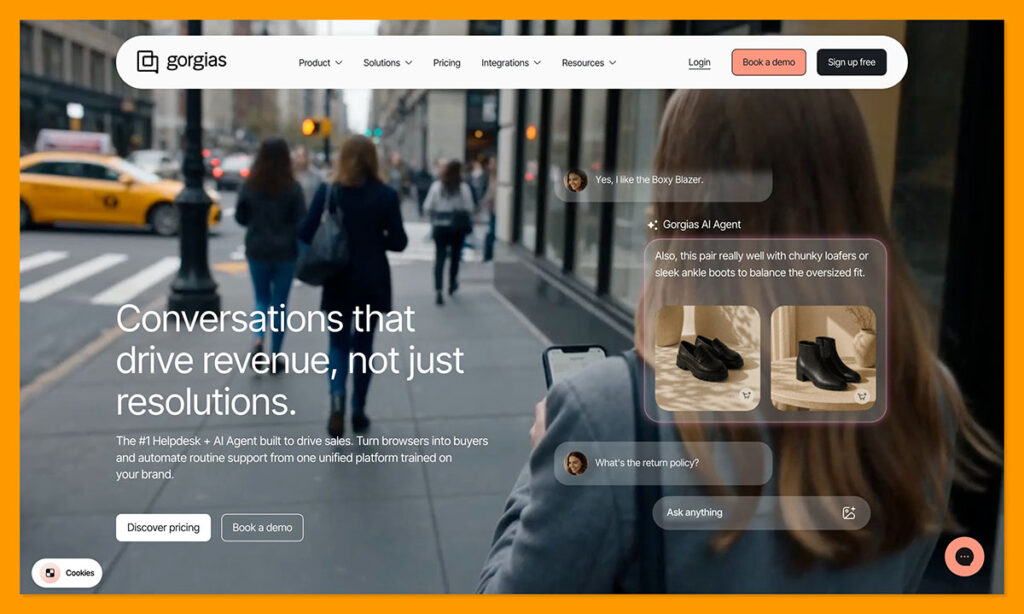
“Where is my order?” and “Where is my refund?” tickets make up roughly 60% of ecommerce support volume. They're the same questions, all day, every day. Gorgias automates them, and for a busy Shopify store that's where the savings live.
Because it's built specifically for Shopify, its AI doesn't just answer questions. It can issue refunds, update addresses, and manage subscriptions directly.
Key features
- Ticket-based pricing with unlimited agents on every plan
- Native Shopify actions (refunds, address changes, subscription edits)
- Robust macros and workflow automation for routing
Pricing
- Starter $10/month (50 tickets)
- Scaling to $750/month (5,000 tickets)
- AI Agent add-on at $0.90 to $1.00 per resolved conversation, on top of the ticket cost
Pros
- Deep Shopify integration that takes real actions, not just canned replies
- Unlimited agents on every tier thanks to ticket-based pricing
- Strong automation for complex ticket routing
Cons
- Double billing: you pay the helpdesk ticket cost and the AI fee per resolution, which surprises a lot of merchants
- Reality check on automation: case studies show real rates of 26-56%, below the marketed 60%
- Generic brand voice that can sound slightly robotic
- No AI voice channel and a 1 to 2 week setup versus Tidio's two hours
Set expectations honestly. New setups usually start around 30-40% automation and climb over two to four months as you train macros and clean up your help center.
Quick comparison: against Tidio, Gorgias costs more and takes longer to set up but actually manages orders. Against Fin, it resolves fewer tickets but lives natively in Shopify. Gorgias is the middle pick for $1M+ stores that want order management and AI in one helpdesk.
4. Tidio and Lyro: Best Budget AI Support for Smaller Stores
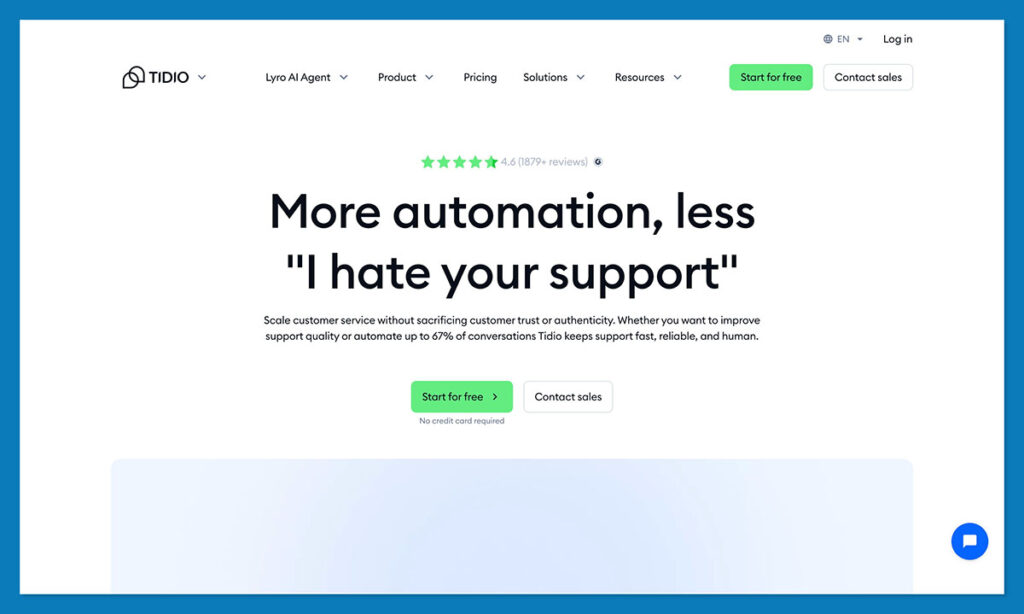
If you run a smaller store, you don't need an enterprise rollout. You need AI chat answering customers by this afternoon. Tidio's Lyro agent can be live in under two hours with no developer required, which is why it's the default entry point for stores taking their first step into AI support.
The draw is speed and simplicity. Lyro trains on your existing content (help docs, FAQs, product pages) and starts fielding repetitive questions in your brand voice, while a unified inbox pulls chat, email, Instagram, WhatsApp, and Messenger into one place so a solo operator isn't bouncing between tabs. It also leans sales-focused, nudging visitors toward a purchase rather than just closing tickets.
Key features
- Setup in under two hours
- Proactive sales engagement and product recommendations
- Customizable brand voice
- Unified inbox across chat, email, Instagram, WhatsApp, and Messenger
Pricing
- Free plan (50 AI conversations/month)
- Starter $29/month, Growth $59/month
- Lyro AI add-on at $39/month for 50 conversations
Pros
- Fastest setup in the category by a wide margin
- Sales-focused, nudging visitors toward a purchase, not just answering
- Free tier that lets you test before you commit
Cons
- No backend actions: Lyro can't process refunds or modify orders, only answer
- Basic product recommendations compared to pricier rivals
- Sneaky scaling cost: the cheap headline price climbs once you add Lyro and hit conversation limits, and past ~500 tickets/month it can rival Gorgias
One warning on AI chat: it can hallucinate product or policy facts. In fact, 56% of brands cite hallucination as their top deployment concern, and 64% of customers still want a human for emotional issues. Keep an easy handoff to a person.
Best for: stores under 500 tickets a month that want fast, affordable AI chat with a little sales nudge built in. Skip it if you need the AI to actually modify orders, or you're already past ~500 tickets a month. At that point, move up to Gorgias or Fin.
5. Fin by Intercom: Best AI Agent for Resolution Rate
Here's a number that stops most support managers: ecommerce brands running Fin hit 70 to 84% resolution rates, with a 67% average across more than 7,000 customers and a hallucination rate near 0.01%. If raw resolution is your goal, nothing else on this list touches it. The pricing model is the unusual part. You pay $0.99 per resolution, so you're only charged when Fin actually solves the problem.
Key features
- Backend actions via Data Connectors and MCP (refunds, shipping updates, multi-step workflows on live order data)
- 45+ languages
- Every channel that matters: chat, email, voice, WhatsApp, Instagram, Facebook, Slack, and SMS
Peddle, one of Fin's ecommerce customers, saved $163,000 a year and cut email response times by 67%. Resolution rate matters more than the “deflection rate” you'll see elsewhere. A deflected customer is just one who didn't reach a human, including the one who gives up and leaves with their problem unsolved. Resolution is the metric that ties to retention.
Pros
- Category-leading resolution, 70-84% for ecommerce specifically
- Pay only for results at $0.99 per resolved issue
- Takes real action on live order data across eight channels
Cons
- Pricier for low volume than Tidio or Gorgias
- Tied to Intercom, not a standalone Shopify app
- Unpredictable at scale, since per-resolution costs add up at high ticket volume
- Enterprise sales process rather than a quick self-serve signup
If you're a higher-volume store where support quality directly affects whether customers come back, start with Fin. Run it against your own ticket volume on a trial before you commit, so you can see the real per-resolution math for your store.
6. Jasper AI: Best AI Tool for Brand-Consistent Content at Scale
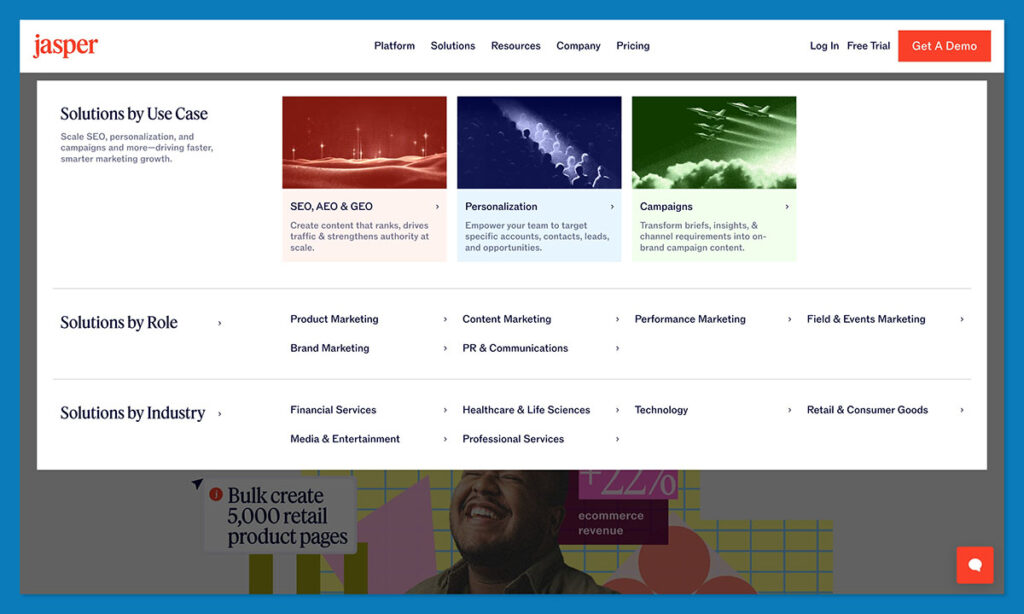
Writing 500 product descriptions by hand is impossible. Writing them with raw ChatGPT makes every single one sound identical. Jasper's Brand Voice feature is the fix, keeping a whole catalog sounding like one brand instead of a robot.
The mechanism is a Brand Voice profile trained on your existing copy, so every description, email, and ad pulls from the same tone instead of drifting into generic AI phrasing.
From there, 100+ ecommerce templates and Campaign Workflows let a team push out a coordinated launch across channels, with shared seats so everyone works from the same voice. For a catalog of hundreds of SKUs, that consistency is the feature you're really paying for.
Key features
- Brand Voice trained on your existing copy
- Campaign Workflows for multichannel launches
- 100+ ecommerce-specific templates
- Five team seats on the Pro plan
In testing, Jasper's product descriptions came out about 85% ready to publish, saving roughly 20 minutes per product. That's real time back for a content team.
Pricing
- Creator $39/month (annual) or $49 monthly
- Pro $59/month per seat
- Business custom
Pros
- Best Brand Voice feature for keeping a catalog consistent
- Fast drafts, with descriptions ~85% publish-ready
- Built for teams with shared seats and workflows
Cons
- No native Shopify or WooCommerce integration, so it's a copy-paste workflow
- API locked behind the expensive custom Business plan
- Inconsistent ad copy, with only 1 of 3 Facebook ads plug-and-play in testing
- Pricey for solos, at roughly twice the cost of ChatGPT Plus
Quick comparison: against ChatGPT Plus at $20/month, Jasper wins for teams pushing out 20+ pieces a month who need a shared Brand Voice. A solo operator gets most of the value from ChatGPT Plus with good custom instructions. And if you want copy published straight into your catalog, Shopify Magic beats Jasper on integration.
7. Algolia: Best AI Site Search for Large Catalogs
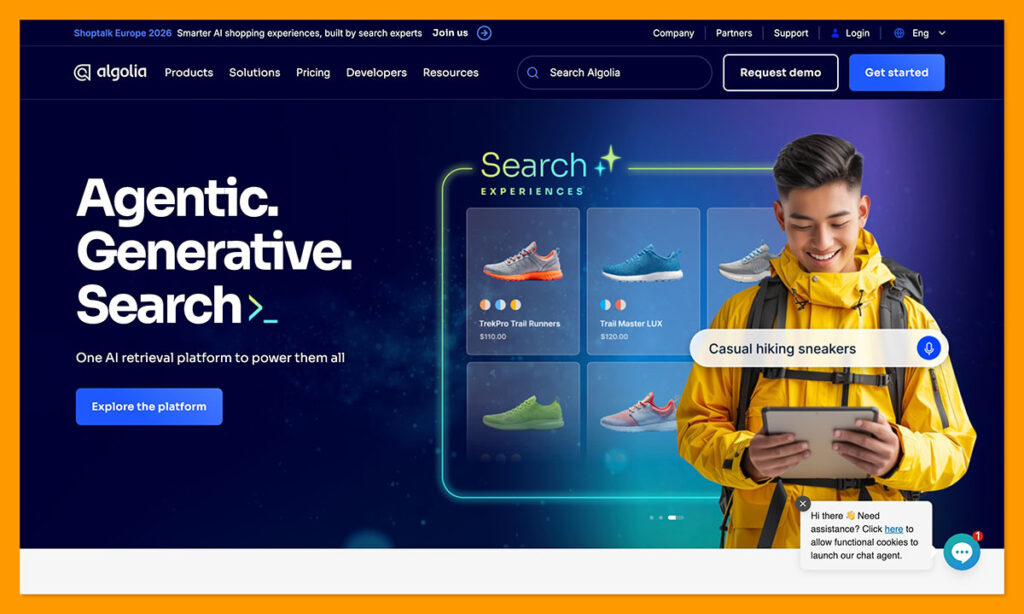
A visitor who searches your store and gets junk results is a sale you've already lost. On a big catalog full of similar products, generic search buries the thing people actually want. Algolia's NeuralSearch understands intent rather than just matching keywords.
Under the hood, NeuralSearch blends keyword and vector search, so a query like “warm jacket for hiking” surfaces the right products even when those exact words aren't in the title.
It returns results in under 100ms worldwide, layers on configurable merchandising rules to push the items you want seen, and can expose your catalog to external AI agents through an MCP server. For a large, fast-moving catalog, that's the difference between search that converts and search people abandon.

Key features
- Sub-100ms response times globally
- Semantic and NLP search on the Grow Plus tier
- AI Recommendations for cross-sell and upsell
- Configurable merchandising rules and an MCP server to expose your catalog to external AI agents
Pricing
- Free Build tier (10K requests, 1M records)
- Grow at roughly $0.50 per 1,000 requests
- Grow Plus (AI and semantic search) at $1.75 per 1,000 requests
Pros
- Fastest search response in the category, under 100ms worldwide
- True semantic search that reads intent on Grow Plus
- Free tier generous enough to prototype with
Cons
- Confusing dual-metric billing based on both requests and records
- The AI cost cliff: turning on AI features means Grow Plus at 3.5x the per-request rate. A mid-size store doing 500K searches a month jumps from about $245 to $857 for the same volume.
- Add-on creep, with Recommendations another $0.60 per 1,000 requests
- Enterprise pricing that starts around $50,000 a year on Elevate
The verdict: Algolia is worth it once your catalog tops about 1,000 SKUs and weak search is measurably hurting conversion. Stay on standard Grow until your own data proves the 3.5x AI premium pays for itself. Don't flip that switch on a hunch.
8. Triple Whale: Best AI Analytics and Attribution for DTC Brands
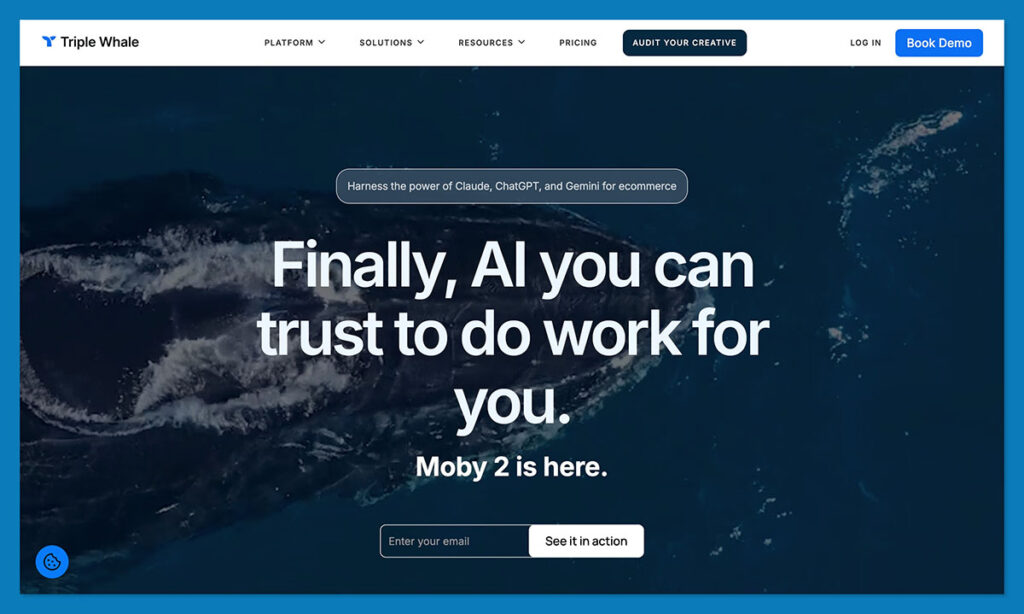
Your last sale came from Meta, Google, TikTok, or that email you sent Tuesday. Get the answer wrong and you'll pour budget into the wrong channel. Triple Whale exists to settle that argument with multichannel attribution in one dashboard.
It pulls Meta, Google, TikTok, and email into a single attribution view, then layers on Moby, an AI assistant you can ask plain-English questions like “which campaign drove the most first-time buyers last week.”
Creative Analytics surfaces which specific ad assets are pulling their weight, and the LTV, CAC, and ROAS math is built for how DTC brands actually think about spend. The pitch is one source of truth instead of five dashboards that disagree.
Key features
- Attribution across Meta, Google, TikTok, and email in one view
- Moby, an AI assistant for natural-language analytics questions
- Creative Analytics to surface your top-performing ad assets
- LTV, CAC, and ROAS math built for DTC
Pricing
- Free plan with 12-month lookback and first/last-click attribution
- Starter from $179/month (annual), Advanced $259/month
- GMV-based pricing above $5M
Pros
- One dashboard for messy multichannel attribution
- Moby AI answers questions in plain English
- Free plan that's genuinely useful for validation
Cons
- High break-even, only worth the paid tier at $15K+/month in ad spend
- Pricing climbs with revenue (GMV-linked) even if your usage is flat
- Attribution complaints, with some users reporting wrong-source credit about half the time and “failing more often since the AI era”
- Paywalled AI, since Moby, Creative Analytics, and Cohort Analysis sit behind paid tiers
If you're spending $15,000 or more a month on paid media, Triple Whale's paid tier earns its place. Below that, stay on the free plan and revisit when your spend justifies it. For true incrementality measurement, you'll still want to pair it with Northbeam.
9. Prediko and Cogsy: Best AI Inventory Forecasting Tools
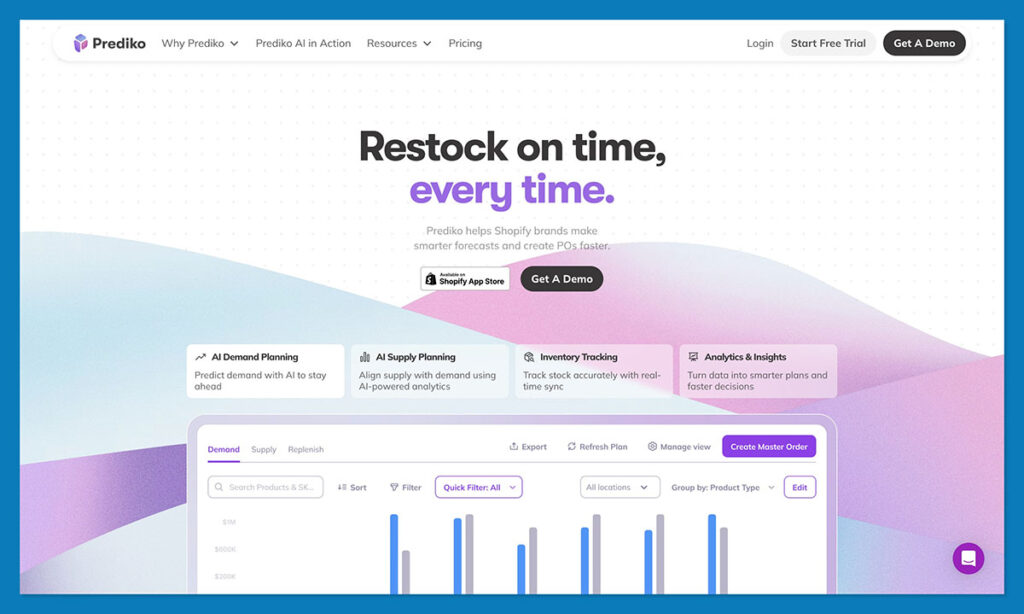
The least glamorous AI category on this list quietly protects your margin. Cogsy's surge-alert system helped one outdoor retailer absorb a 300% demand spike and save $150,000. No content generator will ever do that. AI demand forecasting prevents the two silent cash leaks every store owner knows: stockouts that lose sales, and overstock that ties up cash.
Key features
- Automated purchase order creation and reorder-point management
- Scenario planning and demand forecasting
- Cogsy: 92% forecast accuracy (needs 6+ months of data)
- Prediko: around 95% accuracy, trained on 25M+ SKUs
Caraway used Cogsy's Smart Replenishment to cut stockouts by 75%, hold a 98% inventory turnover rate, and save more than 20 hours a week. Across the board, these tools reduce holding costs 20-30% and cut forecast error 20-50% versus manual planning.
Pricing
- Prediko $49 to $199/month (revenue-based)
- Cogsy around $199/month
- Netstock (enterprise, ERP-focused) from $900/month
Pros
- Real margin protection through fewer stockouts and less dead stock
- High accuracy, 92-95% with enough history
- Automates POs, saving 20+ hours a week in documented cases
Cons
- Needs data, with 6+ months of history required for best accuracy
- Platform gaps, since Prediko leans Shopify with limited Amazon support
- Murky pricing on Cogsy, which varies across sources and caps SKU pages on the standard plan
Best for: stores past about 100 SKUs with at least six months of sales data, feeling stockout or overstock pain. Skip it if you're under 100 SKUs or less than six months old, because the forecasts won't have enough data to beat your own judgment yet.
10. Prisync: Best AI Tool for Competitor Pricing and Dynamic Repricing
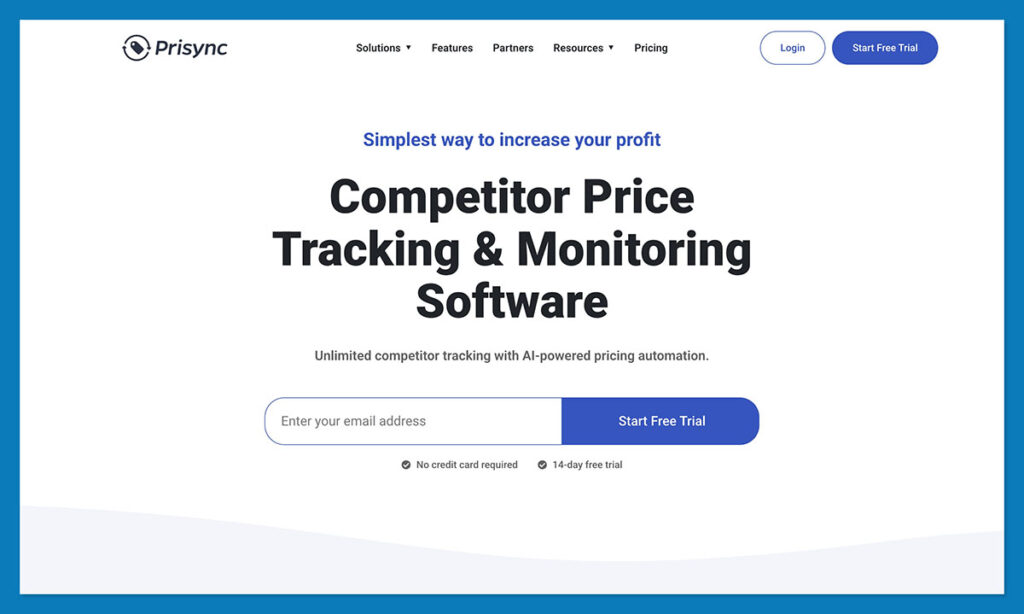
A competitor quietly drops their price and you don't notice until your sales dip a week later. If you sell products other stores also carry, Prisync catches that the same day and can reprice automatically to protect your margin.
It works by monitoring an unlimited number of competitor URLs around the clock, then applying repricing rules you set (for example, always stay $2 under a given rival, but never below your margin floor).
It flags MAP violations and competitor stock-outs, which is your cue to raise prices safely, and it plugs into Shopify, BigCommerce, Magento, and WooCommerce. The catch is product matching: the data is only as good as how cleanly your SKUs line up with theirs.
Key features
- Unlimited competitor URL monitoring
- Configurable repricing rules (for example, always $2 below competitor X unless it breaks your margin floor)
- MAP monitoring and competitor stock-out alerts
- AI product matching, plus integrations with Shopify, BigCommerce, Magento, and WooCommerce
Pricing
- Professional ~$59/month (monitoring only)
- Premium ~$159/month (adds dynamic repricing)
- Platinum ~$399/month
Pros
- Around-the-clock monitoring of unlimited competitor URLs
- Rule-based repricing that respects your margin floor
- Stock-out alerts that signal when you can safely raise prices
Cons
- Imperfect matching, which degrades data quality when SKUs don't line up cleanly
- Supply-side only, with no demand-side intelligence
- Limited for MAP-protected or high-ticket goods, and useless for unique or handmade items
The verdict: Prisync pays off best for stores with 50+ SKUs in price-volatile, competitive categories like electronics. If your products are unique, handmade, or MAP-locked, skip it. There's nothing to reprice against.
11. Photoroom: Best AI Tool for Clean Product Photos at Scale
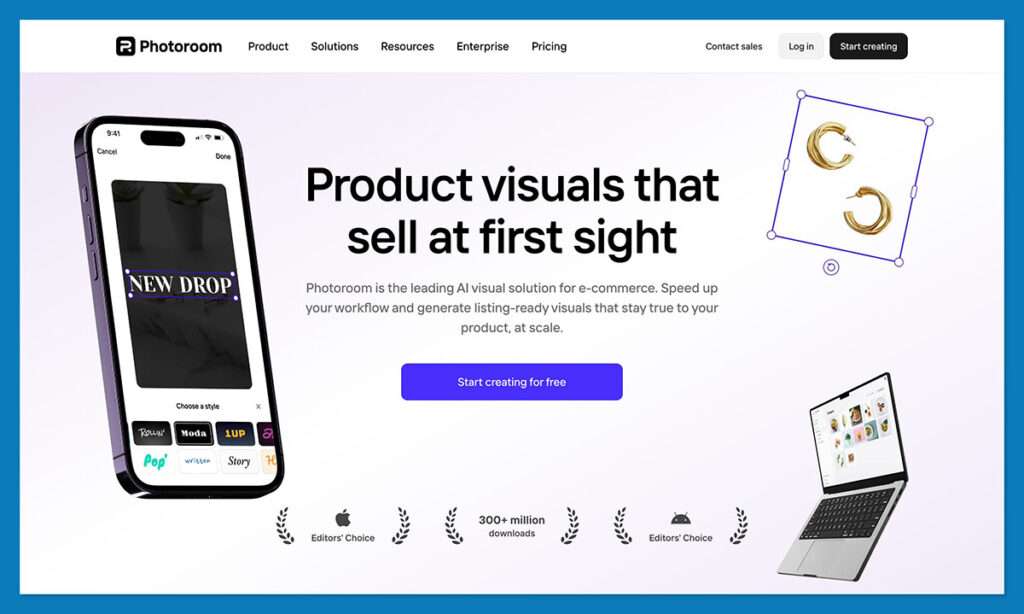
Drop in a phone photo, get a clean white-background listing image in seconds, then batch it across your whole catalog. For marketplace sellers, Photoroom is the workhorse of AI product photography, and it costs less than $10 a month.
The core engine is background removal that holds clean edges even on tricky products like hair, fur, or transparent packaging. Batch Mode runs hundreds of images at once, template-driven outputs keep listings and ads visually consistent, and the mobile app is strong enough to shoot and edit from your phone.
For a marketplace seller pushing volume, that combination of speed and price is hard to beat, as long as you remember it's a cleaner, not a scene builder.
Key features
- Best-in-class background removal with clean edges on complex products
- Batch Mode for hundreds of images at once
- Template-driven outputs for listings and ads
- A genuinely strong mobile app
Pricing
- Free (1 watermarked HD export/day)
- Pro $9.99/month (1,000 exports)
- Pro+ $24.99/month (5,000 exports)
- Enterprise $34.99/month (unlimited)
Pros
- Cleanest background removal I've seen, even on tricky products
- Batch processing built for high-volume catalogs
- Cheap and mobile-friendly, ideal for solo sellers
Cons
- Billing complaints, with merchants reporting charges after cancellation and having to “dispute with my bank”
- Support maze, described as “a chatbot maze” with no easy human escalation
- Cleaner, not creator, so backgrounds lack real lifestyle context
Quick comparison: against Flair AI next on this list, Photoroom is for clean, marketplace-ready shots at volume, while Flair is for styled lifestyle scenes. Plenty of stores run both.
12. Flair AI: Best AI Tool for Lifestyle Product Imagery
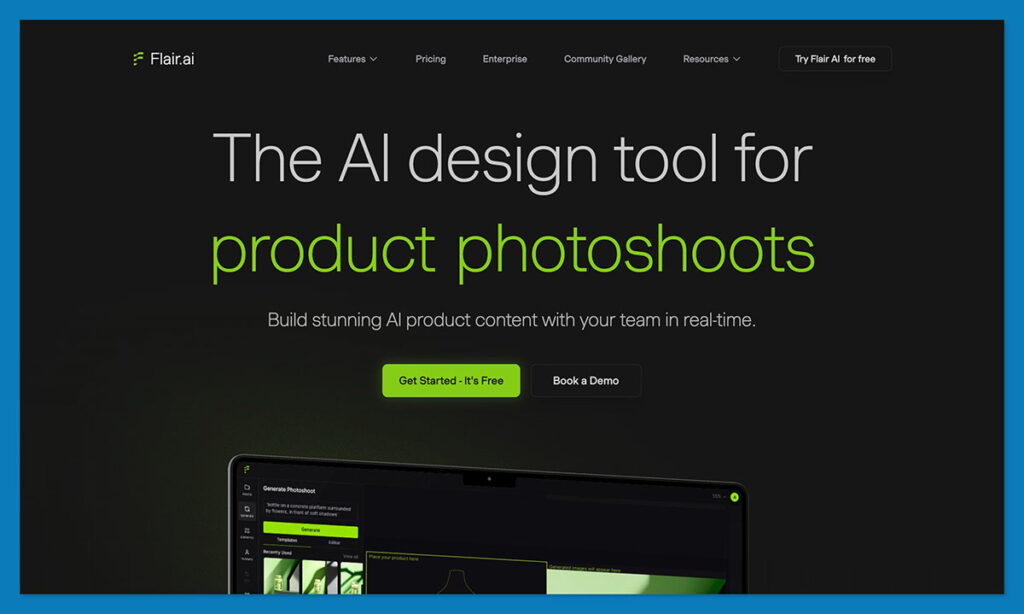
A real lifestyle photoshoot runs into the thousands, and you need fresh scenes every season. Flair AI builds the scene around your product instead, which is a lifeline for small brands with no studio budget.
The workflow is visual: drag your product onto a canvas and Flair generates a styled scene around it, complete with props, surfaces, and lighting.
It's strongest on apparel, beauty, and home goods, where an editorial-looking backdrop does real selling work that a plain white cutout can't. For a small brand that can't justify a seasonal photoshoot, it's the closest thing to a studio on a subscription, as long as you're ready to regenerate the misses.
Key features
- Drag your product onto a visual canvas and let AI generate a styled scene with props and layouts
- Strong results for apparel, beauty, and home goods
- Editorial and lifestyle output that a pure background remover can't match
Pricing
- Free trial
- Pro $10/month (250 generations)
- Premium $28/month (1,500 generations)
- Enterprise $55/month (6,000 generations)
Pros
- Real lifestyle scenes without a photographer or studio
- Affordable variety, with 250 generations for $10
- Best for visual categories like fashion, beauty, and home
Cons
- Maddeningly inconsistent, with one merchant noting “some outputs are stunning, others look like the product is floating in space, no way to control which”
- Weak on reflective surfaces like jewelry, glass, and metal, where AI photography still struggles
Best for: visual categories that need creative scene variety on a tight budget. Skip it if you sell jewelry, glassware, or metal products, because AI still botches reflections. Shoot those for real.
13. Ringly.io: Best AI Voice Support for the Overlooked Phone Channel
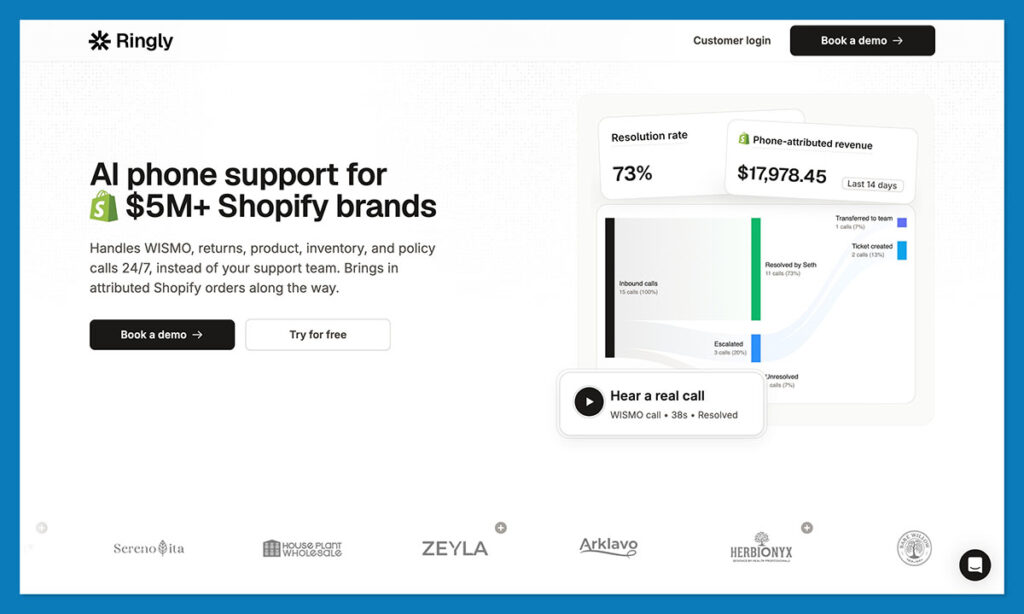
Almost every AI guide ignores the phone, yet inbound calls still cost real money and staff hours. AI voice support runs about $0.38 per call versus a $2.35 industry average, a roughly 6x cut on a channel most stores never think to automate. Ringly.io is the pick here. It handles routine inbound calls (order status, returns, product questions) so your team only takes the complex ones.
Key features
- AI phone agent purpose-built for ecommerce
- 73% resolution rate on voice specifically
- Frees humans for the calls that actually need judgment
Pros
- Cheapest per-interaction channel on this list at ~$0.38 per call
- Fills a real gap, since voice is the channel everyone else skips
- Solid voice resolution at 73%
Cons
- Newer and less proven than chat-based AI support
- Still needs humans for roughly 1 in 4 calls, so keep escalation tight
- Smaller ecosystem than the chat incumbents
The verdict: if you get steady inbound calls and they're eating staff hours, voice AI is the cheapest win on this whole list. If your customers never pick up the phone, skip it without a second thought.
The Bottom Line: Which AI Tools to Actually Buy First
Don't buy 13 tools. Buy the one that fixes your single biggest bottleneck, prove it pays for itself, then add the next. That's the principle every vendor-written guide skips, because they want you in their cart today.
The data backs the patient approach: 89% of companies using AI report positive ROI, with an average payback period of about nine months. Sequencing beats stockpiling.
A rollout order that works: Month 1, content (Shopify Magic for free, or ChatGPT Plus at $20). Month 2, email (Klaviyo, with the five core flows set up). Month 3, support (Tidio under 500 tickets, Gorgias or Fin above). After that, layer in analytics, inventory, pricing, and visuals as specific pains appear.
Here's how that maps to your store's stage:
| Store stage | Priority tools | Rough monthly cost |
|---|---|---|
| Solo / under $500K | Shopify Magic (free) + ChatGPT Plus + Klaviyo free + Tidio free | ~$20-50 |
| Growing / $500K-$1M | Add Klaviyo paid + Gorgias or Tidio paid + Photoroom | ~$150-250 |
| Scaling / $1M-$10M | Add Triple Whale ($15K+ ad spend) + Prediko/Cogsy (100+ SKUs) + Algolia or Prisync as needed | ~$300-800 |
One trend worth getting ahead of: the next frontier isn't a tool you buy, it's a shift. AI search already drives 12-18% of queries and AI-referred shoppers convert 31% higher, so structuring your product data for AI to cite (concrete specs over adjectives, real-time pricing and stock sync) is becoming table stakes. The FAQ below has a quick primer.
Your next action is simple. Find the row that matches your stage, start the one tool that targets your worst bottleneck this week, and only add the next once the first has paid for itself.
Frequently Asked Questions
Which AI ecommerce tool should I implement first?
Start with your biggest pain point. If content eats 10+ hours a week, begin with Shopify Magic (free) or ChatGPT Plus ($20/month). If support tickets are drowning you, use Tidio's free plan under 500 tickets a month or Gorgias above that. If email revenue is weak, set up Klaviyo's free tier (up to 250 profiles) with abandoned-cart and welcome flows first.
Is Shopify Magic enough, or do I need third-party AI tools?
Shopify Magic handles routine tasks well, including product tagging, SEO metadata, basic descriptions, and image background removal, saving 5 to 10 hours a week at no cost. But it produces generic content that needs editing, can't handle complex analytics, and underperforms on hero copy and strategy. Bring in ChatGPT or Claude for content that directly drives purchases.
Why did my Klaviyo bill go up without adding subscribers?
On February 18, 2025, Klaviyo changed billing from “actively emailed contacts” to “total active profile count.” Now every subscribed contact counts toward your tier, even ones you haven't emailed in months. Fix it by setting up a Sunset Flow that suppresses anyone with no opens or clicks in 180 days. This ongoing list hygiene is the only way to control the so-called Dead Profile Tax.
How accurate is the 60% AI support automation claim?
Real-world automation usually lands at 26-56%, below the marketed 60% figure. Most stores start around 30-40% and climb over two to four months as they train macros and clean up help-center content. Focus on resolution rate, how many issues are actually solved, rather than deflection rate, which only counts customers who didn't reach a human.
What is GEO and why does it matter for ecommerce?
GEO (Generative Engine Optimization) means getting your store cited by AI search engines like ChatGPT, Perplexity, and Google AI Overviews. AI search now handles 12-18% of queries, up from under 2% a year ago, and AI-referred shoppers convert 31% higher. The tactics: replace marketing adjectives with concrete specs, add Schema 2.0 structured data, and sync pricing and stock in real time so AI crawlers trust your data.
What is the best AI product photography tool on a budget?
For clean, marketplace-ready shots, Photoroom Pro at $9.99/month is the workhorse. For styled lifestyle scenes, Flair AI starts at $10/month. Pebblely's free tier works for pure budget testing. Avoid AI product photography for jewelry, glassware, or metal, since reflective surfaces still come out with flat lighting and unrealistic shadows.


Comments 0 Responses