



Shopify and Joomla are two very different tools — one is built specifically for ecommerce, the other is a flexible content management system.
But if you’re looking to build and grow an online store, which one should you choose?
After spending hours testing both platforms, digging through user reviews, and building demo stores myself, I’ve reached a clear verdict:
Shopify is the best platform for selling online — especially if you’re serious about ecommerce.
Shopify vs Joomla: Quick Verdict
Shopify – Best for ecommerce businesses that want a streamlined, scalable store with no coding needed
Joomla – Best for developers or advanced users who want full control and are comfortable managing everything manually
Shopify vs Joomla: Quick Comparison
Here’s a side-by-side look at how the two platforms stack up:
| Feature | Shopify | Joomla |
|---|---|---|
| Ecommerce tools | Built-in | Extension-based |
| Hosting & security | Included | Self-managed |
| Ease of use | Very easy | Developer-friendly |
| SEO features | Solid, plug-and-play | Customizable but manual |
| Design flexibility | Limited without code | Fully customizable |
| App/extensions ecosystem | 8,000+ apps | 6,000+ extensions (few ecommerce-focused) |
| Support | 24/7 live chat and help docs | Community forums |
| Price range | $39–$399/month | Free (but hidden costs for hosting/dev) |
Best for Pricing: Joomla (but only if you know what you’re doing)
Joomla is free. You don’t have to pay for the software itself — but that doesn’t mean it’s a low-cost option.
Shopify pricing
Shopify offers tiered monthly plans, which include hosting, SSL, and ecommerce features:
- Basic – $39/month
- Shopify – $105/month
- Advanced – $399/month
- Shopify Plus – from $2,000/month (enterprise)
You also get a 3-day free trial, then $1/month for the first 3 months on paid plans.
These costs may seem steep, but Shopify handles everything for you: server updates, payment processing, security, checkout optimization — even sales channel integrations.
Joomla pricing
Joomla itself is free. But you’ll need to pay for:
- Web hosting – around $5–$25/month
- SSL certificates – may be included with host or $10–$50/year
- Ecommerce extensions (like J2Store, HikaShop) – $50–$150/year
- Development costs – if you hire someone, $25–$100/hour
So while Joomla can be cheaper if you already have a server and technical skills, the total cost adds up quickly for beginners.
The Winner: Joomla — but only if you can handle the tech side
If you’re a developer or working with a team that manages servers and writes code, Joomla offers excellent value.
But for everyone else, Shopify’s all-in-one pricing removes guesswork, saves time, and reduces risk.
Best for Selling Online: Shopify

Shopify was built specifically for ecommerce. Joomla wasn’t. That’s the key difference.
Shopify ecommerce features
Out of the box, Shopify gives you:
- Unlimited product listings
- Inventory management
- Multiple product variants
- Automatic tax calculations
- Built-in payment gateway (Shopify Payments)
- Abandoned cart recovery
- Discount codes and gift cards
- Mobile-optimized checkout
- Multi-channel selling (Facebook, Instagram, Google, Amazon)
All of this is included — no extra setup, no plugin hunting.
Shopify’s backend is designed for sellers. From inventory to fulfillment to marketing, everything is ecommerce-focused.
Joomla ecommerce features
To turn Joomla into an online store, you need to install and configure third-party extensions like:
- VirtueMart – older, but widely used
- J2Store – turns articles into products
- HikaShop – more modern, but not free
Even with these installed, you’ll need to handle:
- Payment gateway integrations manually
- Cart and checkout flows
- Shipping setup
- Taxes and legal compliance
Each step requires extensions and manual configuration.
The Winner: Shopify
Shopify has the edge here by a mile. It’s made for ecommerce, and it works from day one.
Joomla can get you there, but only after a long setup process and lots of patching.
Best for Templates and Design: Shopify
First impressions matter. So does how easy it is to design your storefront.
Shopify templates
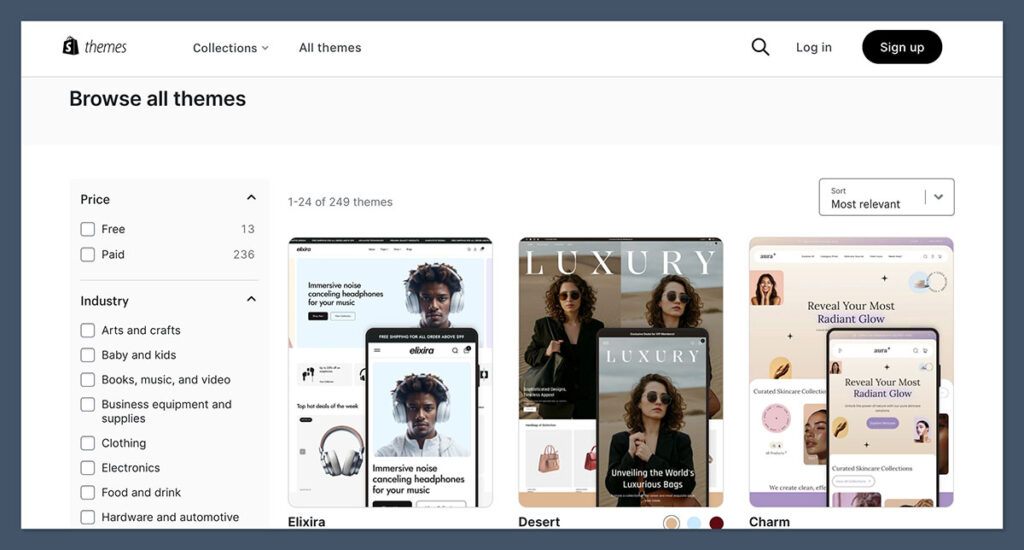
Shopify offers 190+ themes, including:
- 13 free templates
- Premium themes starting at $140 (one-time fee)
All templates are:
- Mobile-responsive
- Optimized for ecommerce
- Fully customizable via the Theme Editor
- Easy to update without coding
You can change layouts, sections, colors, and fonts — and if you want advanced customizations, Shopify uses its own templating language, Liquid.
Joomla templates
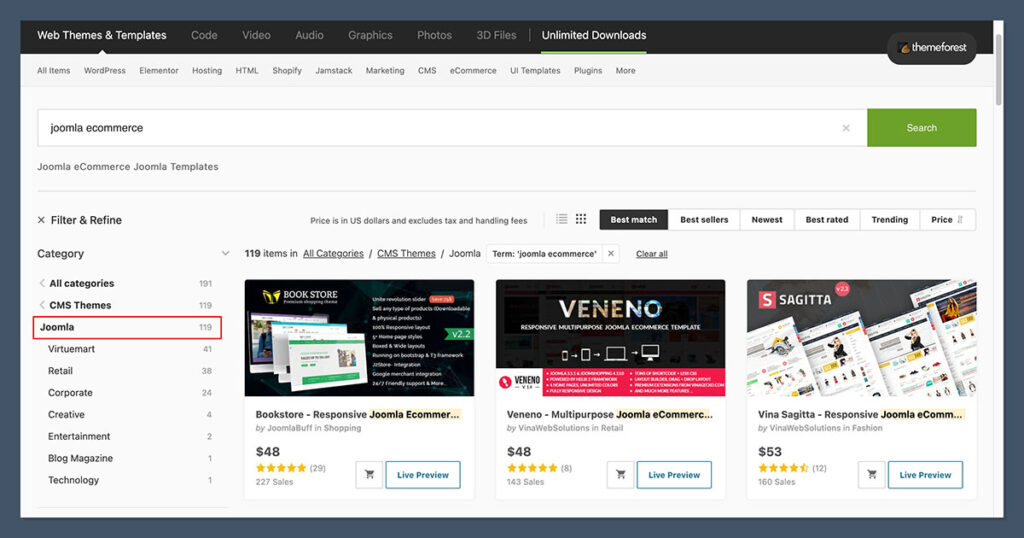
Joomla has a wide range of free and paid templates, especially via marketplaces like ThemeForest.
The catch?
- Many templates are built for blogs, portals, or business sites — not ecommerce
- Customizing templates often requires HTML/CSS
- Mobile responsiveness varies depending on the developer
To match Shopify’s design quality, you’ll need to choose a premium Joomla template and do some manual editing.
The Winner: Shopify
Shopify offers cleaner, more modern templates designed for product pages, shopping carts, and checkout. And you don’t need to touch code unless you want to.
Best for Ease of Use: Shopify
Joomla has a steeper learning curve than almost any ecommerce platform I’ve tested.
My experience with Shopify
Setting up a store took me under 30 minutes.
- I answered a few questions about my business
- Shopify automatically generated my dashboard
- I added a product, chose a theme, and customized it
- Payment options, taxes, shipping — all built in
Everything just worked. Shopify’s interface is clean, intuitive, and designed for people who just want to run a business — not manage servers.

From the dashboard to the product editor, everything feels thoughtfully laid out.
My experience with Joomla
Getting Joomla up and running involved:
- Finding a host and installing Joomla via cPanel
- Choosing an ecommerce extension and installing it
- Configuring payment and shipping manually
- Troubleshooting errors between conflicting extensions
Even for someone familiar with CMS platforms, it took several hours.
Most of the roadblocks came from plugin conflicts and outdated documentation. Even the ecommerce extensions that work well require manual tweaks, and unless you’ve set up CMS platforms before, the jargon and setup process can feel overwhelming.
Joomla assumes you’re comfortable working under the hood.
The Winner: Shopify
Shopify is beginner-friendly, with intuitive workflows, a visual editor, and a guided setup process. Joomla is powerful but requires a technical background.
Best for SEO and Performance: Tie
SEO is a big deal for ecommerce — and both platforms offer strengths here.
Shopify SEO
Out of the box, Shopify includes:
- Automatic sitemaps
- Meta titles and descriptions
- Clean URL structures
- Mobile optimization
- SSL for all pages
- Image alt text fields
With apps like Smart SEO or Plug in SEO, you can audit and optimize your content.
But there are limitations:
- Shopify forces subfolders (e.g.
/collections/,/products/) - Custom URL structures are restricted
Shopify keeps things clean and easy, but that also means sacrificing some advanced SEO flexibility. You can’t easily change the structure of core URLs, which limits control if you want a very specific SEO setup.
Joomla SEO
Joomla is more customizable, giving you:
- Fully editable URLs
- Manual control over meta tags and headings
- SEO extensions like sh404SEF
- Native multilingual support
You’ll need to optimize everything manually, but the control is unmatched.
If you’re running an international or multilingual site, Joomla has better built-in tools.
The SEO structure can be highly optimized with the right extensions, but it depends on your ability to configure them properly — and your willingness to maintain those settings long-term.
Page speed comparison
- Shopify: Hosted on fast, global CDN with built-in caching
- Joomla: Depends on your hosting and setup; can be fast with optimization
The Winner: Tie
Shopify wins for ease of use. Joomla wins for advanced control. If SEO is your top priority and you know what you’re doing, Joomla gives you more options.
Best for Apps and Features: Shopify

This is another area where Shopify dominates — not because Joomla lacks features, but because Shopify makes them accessible.
Shopify App Store
- 8,000+ apps for email marketing, SEO, analytics, upsells, reviews, shipping, CRM, and more
- One-click install
- Most are beginner-friendly
- Built-in security vetting and compatibility
Some popular apps include:
- Klaviyo (email)
- Loox (product reviews)
- ReConvert (thank-you page optimization)
- Oberlo (dropshipping, now replaced by other tools)
The app store is neatly organized, with user reviews, pricing info, and integrations clearly listed. You can install and start using most apps in minutes, which makes scaling or adding features to your store incredibly straightforward.
Joomla Extensions
Joomla has over 6,000 extensions, but:
- Only a small portion are ecommerce-focused
- Many aren’t updated regularly
- Compatibility issues are more common
Joomla has powerful add-ons — but it’s not an “install and go” environment.
You’ll often need to try multiple plugins to get one feature working the way you want.
Even then, managing conflicts or plugin updates can be a chore. While Joomla extensions can be powerful, they’re not tightly integrated or user-friendly in the way Shopify apps are.
The Winner: Shopify
Shopify’s app ecosystem is one of its biggest advantages. Everything’s vetted, secure, and built for ecommerce.
Best for Support: Shopify
Support can make or break your experience — especially when something goes wrong.
Shopify support
- 24/7 live chat
- Email and phone (for Shopify Plus)
- Extensive knowledge base
- Shopify Academy and community forums
They’ll even help with basic technical issues and store setup questions.
When I tested the live chat, I got help within minutes. The responses were clear, actionable, and specific to my questions.
Whether you’re stuck on payments or themes, you’ll find help quickly — without needing to dig through forums or send support tickets into the void.
Joomla support
- No official support team
- Community forums and volunteer help
- Documentation available (but often outdated)
- Some template and extension developers offer paid support
There’s no centralized support system. You’re either Googling for answers, relying on community threads, or paying a freelancer to troubleshoot issues.
This is fine for developers, but tough for store owners who just want problems solved fast.
The Winner: Shopify
Shopify’s support is direct, fast, and helpful. Joomla requires you to be your own support team — or hire one.
Final Verdict: Shopify is Better for Ecommerce
Both platforms have their place.
If you’re building a complex content website with some ecommerce features and you’re comfortable managing servers, Joomla offers flexibility and control.
But for 99% of people trying to sell online, Shopify is the better choice. It’s purpose-built for ecommerce, simple to use, scalable, and backed by thousands of apps and support options.
Whether you’re launching your first store or migrating from another platform, Shopify gives you the infrastructure, support, and tools to build a real business — without the technical headaches.
Shopify vs Joomla: Summary Table
| Criteria | Winner |
|---|---|
| Pricing | Joomla (if self-managed) |
| Ecommerce Features | Shopify |
| Templates & Design | Shopify |
| Ease of Use | Shopify |
| SEO | Tie |
| Apps & Extensions | Shopify |
| Support | Shopify |
| Best For Beginners | Shopify |
| Best For Developers | Joomla |
Choosing between Shopify and Joomla comes down to what kind of experience you want running your store.
Shopify handles the heavy lifting — from hosting to payments to marketing — so you can focus on your products and customers.
Joomla offers more flexibility, but with that comes more responsibility and technical setup.
If you want to launch fast, scale easily, and rely on a proven ecommerce system, Shopify is the clear choice.
But if you have the skills and resources to build something fully customized from the ground up, Joomla can deliver — it just takes a lot more work to get there.



Comments 0 Responses