

Your business name is one of the first brand decisions that sticks. It shapes how people remember you, whether they click through from a search result, and how naturally they can recommend you to someone else.
Pick too fast and you end up rebranding six months in. Overthink it and you never launch.
This guide walks through a practical, repeatable system for choosing a business name and matching URL for an online store. No fluff, no “just be creative” advice. Instead, you get naming frameworks that professional brand strategists actually use, a shortlist of tools worth trying, and a validation checklist to make sure your final pick holds up legally and commercially.
Key Takeaways
- Start with brand strategy (audience, positioning, emotion) before brainstorming names
- Use proven naming frameworks like portmanteau, compound, evocative, and lightly descriptive patterns
- Prioritize .com domains, keep them under 15 characters, and choose brandability over keyword stuffing
- Use name generators as brainstorming partners, not decision-makers
- Validate every finalist through pronunciation tests, social handle checks, reputation searches, and a basic trademark lookup
1. Start With Brand Strategy, Not Names
Most founders jump straight into brainstorming words. That usually leads to a name that sounds clever in isolation but doesn’t fit the brand once you start building around it.
Before you open a single name generator or whiteboard, get clear on four things:
- Audience. Who are you selling to? Not just demographics, but their tastes, pain points, and what they respond to. A 22-year-old buying streetwear lives in a different world than a 40-year-old shopping for minimalist homeware.
- Offer. What category are you in, and what makes you different? Eco-friendly, premium, budget, quirky, hyper-local?
- Emotion. How should people feel when they interact with your brand? Calm, playful, luxurious, rebellious? This single question eliminates more bad names than any other filter.
- Future scope. Will you stay in one narrow product type, or do you plan to expand into related categories? A name that locks you into one thing can become a liability fast.
Write your answers down. Even a quick paragraph for each one creates a filter you can hold every name candidate against later. A playful pet accessories brand and a premium organic skincare line should never end up with the same style of name, and this pre-work is what prevents that.
2. Use Proven Naming Frameworks for Ecommerce
Random brainstorming produces random results. Instead, work through naming patterns that consistently generate strong ecommerce brands. Each framework pushes your thinking in a different direction, so cycle through all four before you settle on favorites.
- Portmanteau names. Blend two words or concepts into one. Think Glossier (glossy + dossier) or Pinterest (pin + interest). Works well when you want something unique but still meaningful.
- Compound names. Combine two clear words into a single name. Think Gymshark or Mailchimp. Great for clarity and memorability, especially in consumer niches where you want instant recognition.
- Evocative names. Hint at a feeling or metaphor, not the product. Think Everlane or Allbirds. Ideal if you want emotional appeal and flexibility to expand into new categories over time.
- Lightly descriptive names. Indicate your space without being generic. Think “Summit Gear” or “Urban Brew Co.” Easy to understand at a glance while still feeling distinctive enough to own.
Whichever framework you lean toward, keep a few universal rules in mind. Aim for short and simple, ideally under 12 to 15 characters. Choose names that are easy to say and spell in your main markets. Avoid overused suffixes like “-ify” or “-ly” unless they genuinely fit your brand personality.
And before you get too attached, check how the name looks as a logo, favicon, and social profile picture. Some names that sound great fall apart visually.
Practical tip: Set a timer for 20 minutes per framework and aim for 15 to 25 raw ideas in each session. Quantity matters at this stage. You’ll filter ruthlessly later.
3. Best Practices for Choosing Your URL
A great business name with a bad URL creates unnecessary friction. This is where many founders get stuck, so think of name and domain as a pair from the start, not as separate decisions.
- Prioritize .com when possible. It still carries the most trust and is the default extension users type automatically. That said, niche extensions like .store, .shop, or country-specific domains (.es, .de, .co.uk) can work well when .com is unavailable, especially if your audience is clearly defined and regional.
- Keep it short and memorable. Aim for under 15 characters. Avoid hyphens, random numbers, and confusing letter patterns like double letters that invite misspellings. If someone hears your domain once at a dinner table, they should be able to type it correctly the next morning.
- Choose brandability over keyword stuffing. Exact-match domains like “bestcheaprunningshoesshop.com” no longer carry the SEO advantage they once did, and they look spammy to modern buyers. A strong brand name with a light, relevant keyword baked in (like SummitGear.com or PawCrafts.com) is a better balance between discoverability and trust.
- Avoid overly narrow domains if you plan to expand. “MadridBeanGrinders.com” works fine if you only ever sell coffee grinders in Madrid. The moment you want to add beans, brewers, or ship internationally, you have a branding problem. Think at least two product lines ahead before locking in a name.
It’s also worth noting that answer engines and modern search increasingly reward recognizable brands. Positive user signals like branded searches, click-through rates, and engagement matter more than ever. An ownable, memorable domain pays off beyond classic SEO.
4. Use Name Generators as Brainstorming Partners
Name and domain generators are genuinely useful ideation tools, especially early on when you are exploring different directions. Just keep the right expectations: they are starting points, not final answers. Think of them as creative sparring partners that surface combinations you might not reach on your own.
Here are three worth trying, each with a slightly different strength.
1. Shopify Business Name Generator
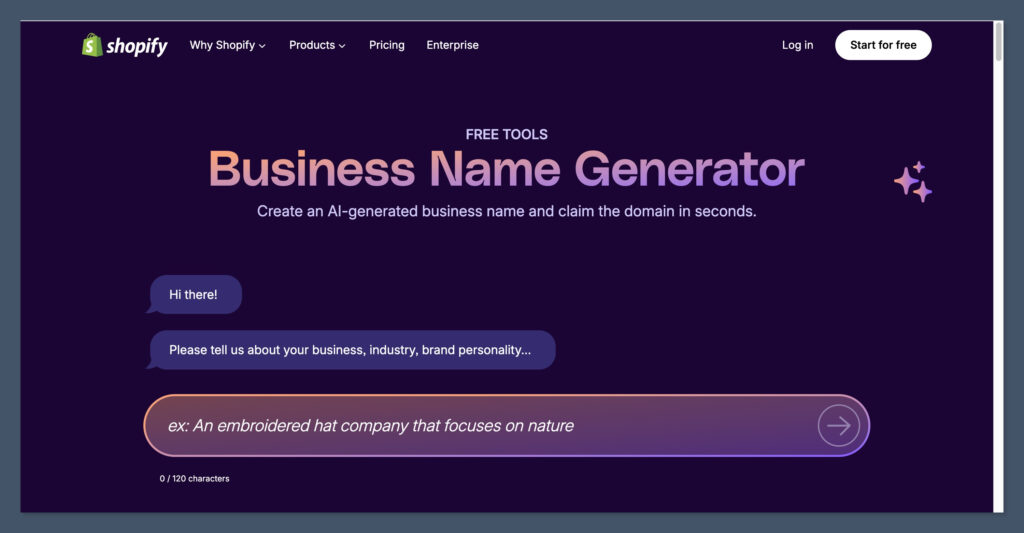
Built specifically for ecommerce, the Shopify Business Name Generator takes one or more keywords related to your niche (like “eco candles,” “streetwear,” or “pet accessories”) and produces a list of branded business name ideas with domain availability checks.
It works well as a first step because the suggestions lean toward store-friendly names rather than generic corporate ones.
Try varying your seed keywords between product terms, benefits, and mood words to see how different angles play out. For example, “cozy candles” will give you a different set of results than “handmade fragrance.”
2. Design.com Business Name Generator
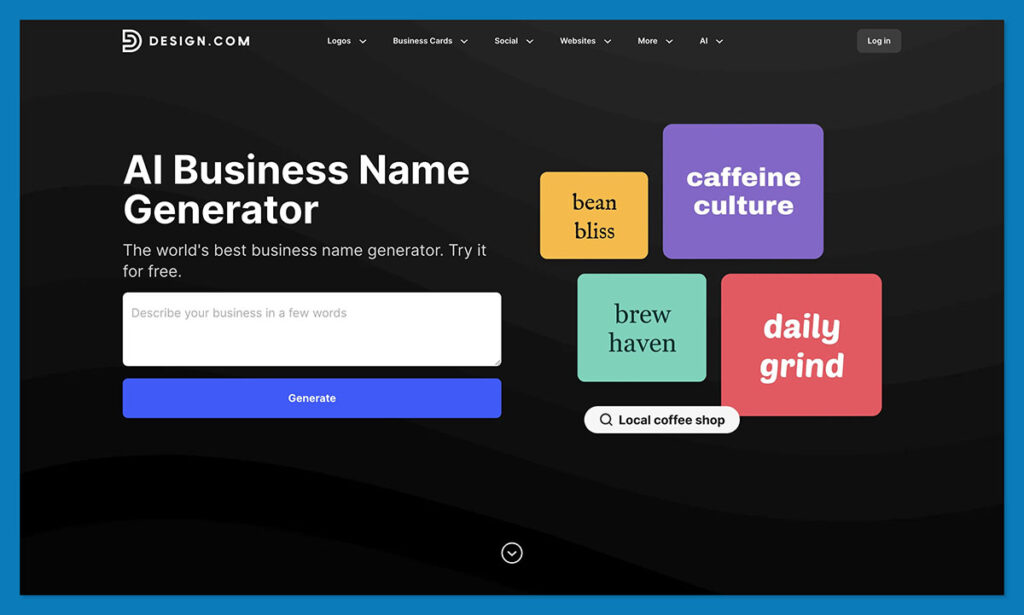
Design.com’s AI business name generator is a good step up if you want the naming process tied directly to the rest of your brand setup. You enter a short description of your business, generate name ideas, then move straight into logo previews, domain-related tools, and the wider Design.com brand toolkit.
What’s really great isn’t so much the name ideas themselves, it’s more that you can see how a name looks on a logo, a business card, or in an email signature and keep adding it to other assets without switching tools.
Plus, the AI tools include domain generation too, so you can test what a name will look like in an URL while you’re in the “startup” process. You can even see which domain names are actually available, which saves you some time.
I think this one works well for founders still doing everything at once: naming the business, testing logo directions, checking whether the name feels brandable, and trying to get something launch-ready quickly.
3. BrandCrowd Business Name Generator
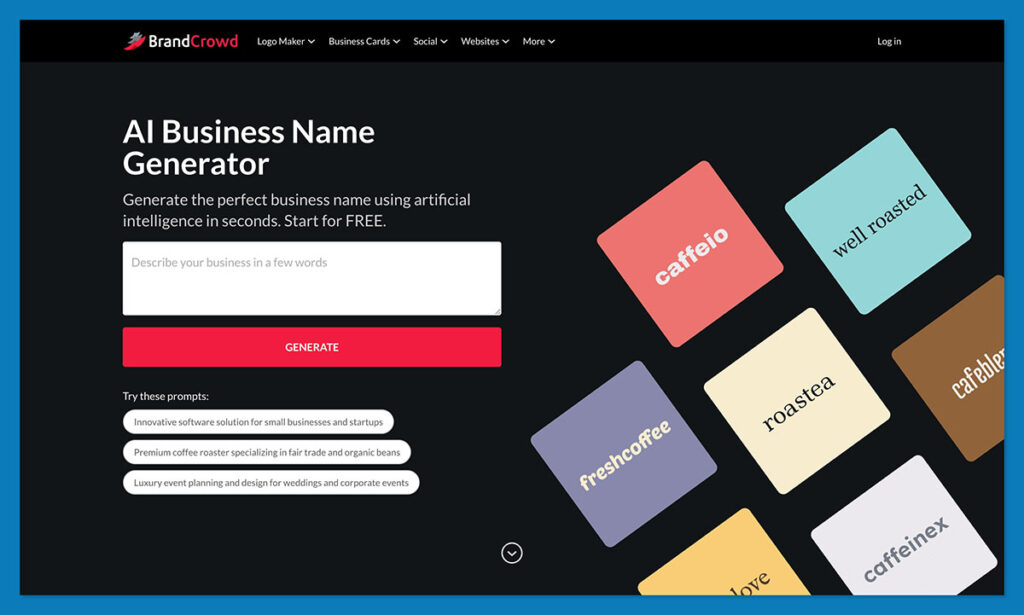
BrandCrowd’s business name generator is a bit more “hidden away”. It’s not the first tool the site is advertising, but you still get a lot of value from it. You can create hundreds of name variations in seconds based on a few keywords, and see what they’ll look like in logos or on website landing pages, just like you can with Design.com.
The tool is also built for iteration. BrandCrowd explicitly pushes you to refine the search with extra keywords or different naming styles when the first batch is weak, which is the right way to use a tool like this.

Plus, there’s the domain name generator too, which still checks availability for you. Some of the names you’ll get will seem a bit generic (that’s true for all of these tools), but at least you’ll have a strong starting point.
4. Wix Domain Name Generator
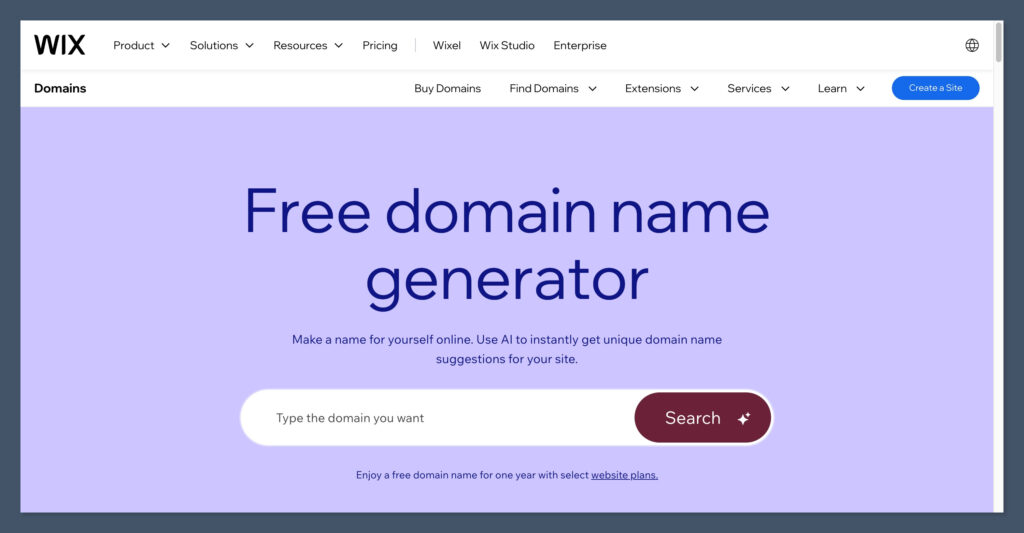
Wix’s domain generator is a good fit for founders who want an integrated website and domain setup in one place. Enter a phrase or keyword and it suggests domain ideas, including alternative extensions when your preferred .com is taken.
It pairs well with simpler store setups, especially if you are building a brochure-style site or a small catalog shop and want to go from name idea to live domain quickly without juggling multiple platforms.
5. Namr (AI-Driven Domain Generator)
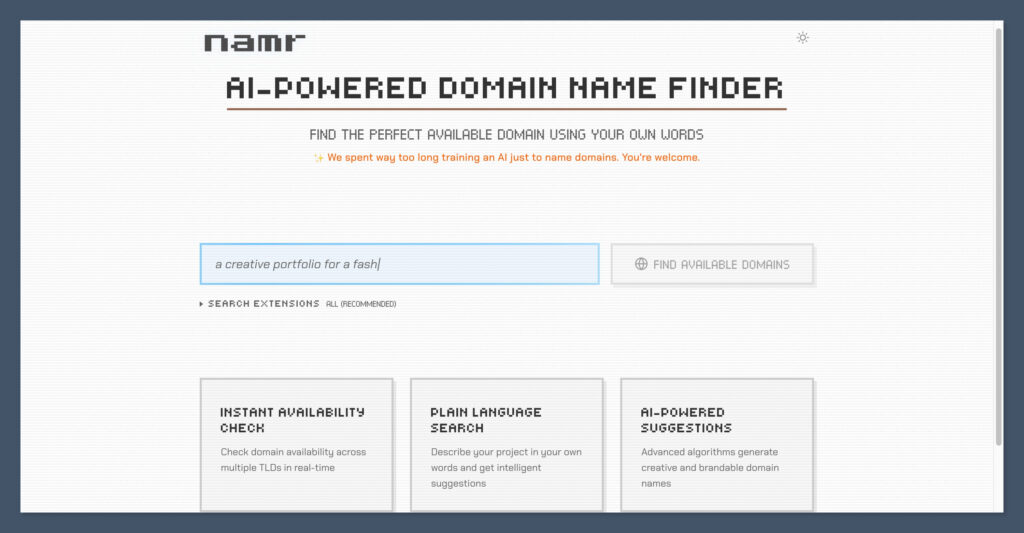
Namr takes a more creative, AI-driven approach. Instead of just recombining keywords, you describe your business, what you sell, your style, your target audience, and it generates brandable name ideas alongside available domains and different extensions.
This one is especially useful if you want less literal, more conceptual names that match a specific brand personality. It also filters out unavailable domains automatically, which saves you the disappointment of falling in love with a name that was registered in 2009.
After generating: Pick your 3 to 5 favorite names from across all three tools, then run them through the validation checklist in the next section before making a final decision. Don’t skip that step.
5. Validate Your Shortlist Before Committing
By this point you should have 3 to 5 strong name-plus-domain candidates. Now you need to pressure-test them. Skipping validation is how founders end up with a name that’s already trademarked, impossible to spell over the phone, or associated with something unfortunate on page one of Google.
| Check | What to Do | Why It Matters |
|---|---|---|
| Pronunciation and memory | Say it out loud, then ask 5 people to repeat and spell it back | If they consistently misspell or mishear it, expect that friction with every customer interaction |
| Search and reputation | Google the name alongside words like “scam,” “reviews,” and your product category | Avoid names already linked to negative press or dominated by an existing brand in your niche |
| Social handle availability | Check Instagram, TikTok, YouTube, and at least one other platform you plan to use | Consistent handles across platforms increase brand recall and make you easier to find |
| Basic trademark search | Run a preliminary search on EUIPO (EU), USPTO (US), or your local trademark office | Catches identical or highly similar names in your product class before you invest in branding |
| Visual check | Mock up the name as a simple logo, favicon, and social avatar | Some names that sound great are visually awkward at small sizes or in certain letter combinations |
For anything beyond a basic trademark check, consult a legal professional. The cost of a proper trademark clearance search is small compared to the cost of rebranding after a cease-and-desist letter.
6. The Complete Naming Workflow: 7 Steps
Here is the full process from first idea to registered domain, condensed into a clear sequence you can work through in a weekend.
- Define your brand strategy. Write down your audience, positioning, emotional tone, and future scope. This is your filter for every decision that follows.
- Brainstorm 50 to 100 raw name ideas. Cycle through all four naming frameworks: portmanteau, compound, evocative, and lightly descriptive. Quantity over quality at this stage.
- Run your best ideas through name generators. Use tools like the Shopify Business Name Generator, Wix, and Namr to expand your list and discover angles you missed.
- Shortlist 5 to 10 names. Filter by clarity, memorability, pronunciation, visual appeal, and alignment with the brand strategy you defined in step one.
- Check domain availability. Focus on short, brandable URLs. Prioritize .com but consider alternatives (.store, .shop, ccTLDs) if the fit is right for your audience.
- Validate your finalists. Run them through the pronunciation test, reputation search, social handle check, trademark lookup, and visual mock-up.
- Choose, register, and secure. Pick your winner, register the domain immediately, grab your social handles, and start building brand assets.
Don’t overthink the final call. If two names both pass validation and feel right, pick the one that is easier to say out loud and move forward. A good name executed well always beats a “perfect” name you never launch with.
Final Thoughts
Naming a business feels like it should be the fun part, and it is, but it is also one of the few early decisions that compounds over time.
A strong name makes every piece of marketing work a little harder for you. It makes word-of-mouth easier, branded searches more likely, and customer trust faster to build. A weak name does the opposite, quietly adding friction to everything you do.
The system in this guide exists to take the randomness out of the process. Start with strategy so you know what you are looking for. Use proven frameworks so you are not staring at a blank page. Let generators expand your thinking. Then validate ruthlessly before you commit.
Most importantly, don’t let naming become the thing that keeps you from launching. Set a deadline, work the process, and pick the strongest candidate that passes validation.
You can always refine your brand voice, visuals, and positioning over time. But the sooner you have a name, a domain, and a live store, the sooner you start learning what actually matters: whether customers want what you are selling.
Frequently Asked Questions
How long should a business name be?
Aim for one to three words and under 12 to 15 characters total. Shorter names are easier to remember, type, fit into logos, and use across social platforms. That said, a slightly longer name that perfectly captures your brand is better than a short one that means nothing.
Should I include a keyword in my business name?
A light, natural keyword can help with discoverability (think SummitGear or PawCrafts), but avoid forcing it. Keyword-stuffed names look spammy, date quickly, and limit your ability to expand. Brandability should always come first.
What if the .com domain I want is already taken?
Try alternative extensions like .store, .shop, or a country-specific domain if your audience is regional. You can also adjust the name slightly, for example adding “get,” “try,” or “shop” as a prefix, though simpler is always better. If the .com is parked but not in active use, some domain owners are open to negotiation.
Is it worth buying a premium domain?
It depends on your budget and how central the domain is to your brand. For most new online stores, spending hundreds on a premium domain is hard to justify when that money could go toward marketing. If you are building a brand with long-term ambitions and the right .com is available for a reasonable premium, it can be a smart investment.
Can I change my business name later?
Technically, yes. Practically, it is expensive and disruptive. You lose brand recognition, backlinks, social followers who know you by the old name, and any packaging or print materials you have produced. It is worth investing the time upfront to get it right rather than planning to “fix it later.”
How do I check if a business name is trademarked?
Start with a preliminary search on your local trademark office website. In the US, that is the USPTO’s TESS database. In the EU, use EUIPO’s eSearch. Look for identical or very similar names in your product class. For a thorough check before committing real money to branding, hire a trademark attorney.
Do business name generators create unique names?
They generate combinations that may or may not be unique in a legal sense. Generators are brainstorming tools, not legal advisors. Always run any name you like through trademark and domain availability checks independently before committing to it.


