

Following our latest research and comparison of major ecommerce platforms, including Shopify, BigCommerce, Wix, and WooCommerce, we took a fresh look at Volusion, a long-standing platform that’s still quietly serving thousands of ecommerce merchants.
But how much does Volusion actually cost?
And more importantly, is it still worth paying for in 2025 — especially when competitors are packing in more features for similar price points?
In a nutshell, Volusion pricing starts at $35 per month and ranges up to custom enterprise pricing, depending on your store’s size and sales volume.
But there are some not-so-obvious limits and extra fees that could affect how much value you’re really getting.
Here’s a full breakdown of Volusion’s pricing plans:
Volusion’s Pricing Plans
| Plan Name | Price (per month) | Sales Limit (Annual) | Bandwidth | Products Allowed | Ecommerce Tools | Support |
|---|---|---|---|---|---|---|
| Personal | $35 | $50,000 | 1 GB | 100 | Basic tools | Online chat/email |
| Professional | $79 | $100,000 | 3 GB | 5,000 | Abandoned carts, reviews | Phone/chat/email |
| Business | $299 | $400,000 | 10 GB | 15,000 | Advanced tools | Priority support |
| Prime | Custom | Custom | Custom | Unlimited | Full feature set | Dedicated manager |
Key Takeaways
- Volusion’s entry plan starts at $35/month and is limited to 100 products and 1 GB of bandwidth.
- The Professional plan ($79/month) is the best value for small businesses, unlocking key tools like abandoned cart recovery and reviews.
- Volusion caps your annual sales volume per plan — meaning you’ll need to upgrade once your revenue crosses certain thresholds.
- Bandwidth is limited on all plans except Prime, which could lead to unexpected overage charges.
- There is no free plan, and only the Prime tier offers unlimited scalability.
How Much Does Volusion Cost in 2025?
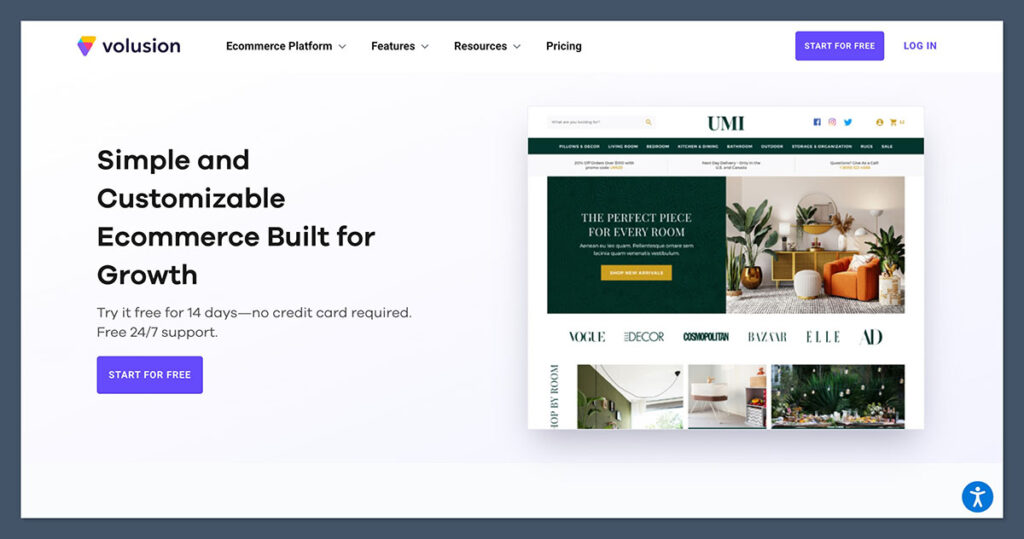
Volusion’s pricing structure is based on monthly subscriptions, bandwidth usage, and annual sales volume. Here’s a quick overview of the costs you’ll face:
| Plan | Monthly (Billed Monthly) | Monthly (Billed Annually) | Sales Limit |
|---|---|---|---|
| Personal | $35 | $31.50 | $50,000/year |
| Professional | $79 | $71.10 | $100,000/year |
| Business | $299 | $269.10 | $400,000/year |
| Prime | Custom | Custom | Custom |
While these base prices look fairly competitive, the real story lies in the limitations — especially around bandwidth and feature access.
Unlike platforms with unlimited hosting and scalable tools, Volusion’s model is structured around revenue ceilings and traffic limits.
This can create friction for businesses trying to grow organically, especially when they unexpectedly hit sales caps mid-year and are forced to upgrade to a more expensive plan just to keep operating.
Volusion Personal Plan: $35/Month – Best for Testing the Waters
The Personal plan is Volusion’s entry-level option. It’s designed for new sellers with a limited product catalog who don’t expect high volumes of traffic or revenue right away.
Features include:
- Up to 100 products
- 1 GB bandwidth per month
- Sales capped at $50,000 annually
- Basic checkout functionality
- Secure hosting and SSL certificate
- Access to Volusion’s drag-and-drop site builder
- Email and live chat support
What you don’t get:
- Abandoned cart recovery
- Ratings and reviews
- Phone support
- Export/import capabilities
- Custom shipping options
- Third-party integrations
If you’re just setting up a basic store or validating a product idea, this plan could work — but it’s missing many of the features that help drive conversions and repeat purchases.
You’ll likely need to upgrade quickly if your store starts growing.
It’s worth noting that even small stores with multiple product images or occasional traffic spikes could run into the bandwidth cap.
At just 1 GB, this limitation can force you to keep an eye on your analytics constantly — or risk unexpected overage fees.
Volusion Professional Plan: $79/Month – Best for Small Businesses
The Professional plan offers better scalability for merchants aiming to turn a side hustle into a serious business.
What’s included:
- Up to 5,000 products
- 3 GB bandwidth
- $100,000 annual sales cap
- Abandoned cart recovery
- Product ratings and reviews
- Import/export functionality
- Phone, chat, and email support
- Basic reporting tools
What stands out:
- This is the first plan that enables key ecommerce features like abandoned cart emails, which are essential for increasing your average order value and reducing drop-off at checkout.
- Ratings and reviews also become available, helping to build trust and social proof on your product pages.
If you’re selling at a steady monthly pace and marketing your store actively, this is likely the best-value Volusion plan before things get expensive.
Still, while this plan works well for businesses hitting consistent five-figure annual revenue, it doesn’t remove all limitations.
You’re still capped at $100,000 in annual sales and 3 GB bandwidth — both of which can feel tight for stores running email campaigns, SEO strategies, or paid ads that increase traffic volume.
Volusion Business Plan: $299/Month – For Scaling Stores
Volusion’s Business plan is designed for more established online retailers.
While the jump in price from the Professional plan is steep, it comes with larger limits and more advanced support.
Included features:
- 15,000 product limit
- 10 GB bandwidth
- $400,000 annual sales limit
- Advanced analytics and reporting tools
- API access and developer tools
- Dedicated onboarding support
- Priority customer service
What you gain here:
- Greater backend flexibility via the API
- Priority phone support and faster response times
- Access to strategic advice from Volusion’s team
However, this plan still imposes a bandwidth cap, and once again, if your store does well enough to hit the sales limit, you’ll need to consider the Prime plan — which has custom pricing.
For some businesses, the Business plan is a transition tier: you’re no longer just selling casually, but you might not yet be ready for enterprise-level pricing.
That said, paying nearly $300/month with limitations on bandwidth and sales volume can feel restrictive when compared to what Shopify or BigCommerce offer at the same price point.
Volusion Prime Plan: Custom Pricing – For High-Volume Stores
Volusion’s top-tier plan — Prime — is the only one without strict limits on product count, bandwidth, or sales.

It’s built for enterprise-level businesses and large online operations.
Features typically include:
- Unlimited product listings
- Unlimited bandwidth
- Custom sales volume allowance
- Dedicated account manager
- API priority access
- Enhanced security tools
- Full onboarding support
If your store is moving serious volume and needs a partner-level relationship, this plan can be customized around your operational needs.
But it comes at a premium, and at this point, most businesses explore Shopify Plus or BigCommerce Enterprise as stronger alternatives.
That said, if you’re already embedded in Volusion’s ecosystem and don’t want to migrate, Prime is your only scalable option.
It unlocks everything Volusion can offer — but by then, your costs may be better justified on a platform with faster innovation, larger dev communities, and broader third-party support.
Volusion vs. Shopify vs. BigCommerce
Here’s how Volusion’s pricing and limits compare with top ecommerce competitors:
| Platform | Starting Price | Sales Limits | Bandwidth | Blog Feature | App Store Size | Abandoned Cart |
|---|---|---|---|---|---|---|
| Volusion | $35/month | Yes | Limited | No | Limited | Only on Pro+ |
| Shopify | $39/month | No | Unlimited | Yes | 8,000+ | Yes |
| BigCommerce | $39/month | Yes | Unlimited | Yes | 1,000+ | Yes |
My thoughts:
- Volusion is cheaper upfront, but you get less flexibility and scalability in return.
- Shopify includes blogging, unlimited bandwidth, and a massive app ecosystem at every tier.
- BigCommerce has similar sales caps as Volusion, but its features and speed performance are more robust.
If blogging, mobile performance, or international selling are part of your growth plan, both Shopify and BigCommerce offer more comprehensive toolsets without requiring frequent plan upgrades or developer support for basic tasks.
Hidden Costs You Should Know About
While Volusion doesn’t charge transaction fees (unlike Shopify), there are other hidden or surprise fees you might not expect.
Bandwidth Overages
Each plan has a bandwidth cap. If you go over, you’ll be charged around $7 per GB.
Since most ecommerce sites are image-heavy, and high traffic can burn through bandwidth quickly, this is something to monitor closely.
App Integrations
Volusion’s app marketplace is smaller than Shopify or BigCommerce, and many of its third-party apps come with extra monthly costs ranging from $10 to $50/month.
Some integrations may also require developer support to install properly.
Custom Development
Customizing Volusion stores beyond the basics often means hiring a developer. Volusion offers design and dev services, but they’re expensive, ranging from $1,000 to $5,000+ depending on the project.
Even with the Professional or Business plan, you’ll still find yourself paying for features that come standard on other platforms.
For example, custom reports, automated email workflows, or cart upsell apps may require additional investment — adding to your total monthly cost of ownership.
What Do Real Users Think?
User reviews on sites like G2 and Capterra show mixed feedback about Volusion in 2025.
Common complaints:
- Dated interface
- Limited mobile optimization
- No built-in blog
- Slow support response times
- Basic SEO tools
Positive mentions:
- Easy to set up and manage
- Affordable base plans
- No transaction fees
- Works well for small catalogs
On G2, Volusion has an average rating of 3.4/5, compared to 4.5 for Shopify and 4.3 for BigCommerce.
While some users appreciate the simplicity, most experienced sellers eventually move to platforms with better scalability and support.
Several reviews also mention that Volusion feels like it’s “stuck in time.” While it performs the basics well, there’s very little innovation, and updates are infrequent.
This makes it hard to stay competitive in a fast-moving ecommerce landscape where customer experience and marketing automation are key.
Should You Use Volusion?
Volusion isn’t a bad option — but it’s very specific in who it’s right for. Based on my testing and comparisons, here’s who might benefit:
Volusion is best for:
- First-time ecommerce sellers with under 100 products
- Entrepreneurs on a strict monthly budget
- Stores selling mostly to U.S. customers (no multicurrency tools)
- Businesses that don’t need a blog or advanced content marketing
Volusion is not ideal for:
- Growing businesses aiming to scale internationally
- Brands focused on SEO and organic traffic
- Content-driven or omnichannel stores
- Users who want a robust app store or built-in automation
If you’re launching your first store and want a simplified platform with predictable pricing, Volusion can give you a low-risk way to get started.
But the second your store picks up traction — either in revenue, traffic, or product complexity — Volusion starts to feel restrictive.
The cost to upgrade, coupled with the technical limitations, often makes switching platforms a more viable move than staying and scaling within the Volusion ecosystem.
Is Volusion Worth It in 2025?
For brand-new businesses testing the ecommerce waters, Volusion can offer a lower-cost starting point.
But the limited features, bandwidth caps, and stagnant product development make it hard to recommend for serious scaling.
You may save $4/month compared to Shopify, but you give up a lot of flexibility, automation, and growth tools in the process.
My Recommendation
If you’re choosing a Volusion plan, the Professional plan at $79/month is the best overall value. It’s the first tier that unlocks revenue-driving tools like abandoned cart emails and product reviews.
But if your store grows quickly, expect to upgrade fast — or migrate to a platform with better long-term support.
Before committing, explore Volusion’s free trial to see if it meets your needs. And make sure to keep an eye on bandwidth usage and app costs — they can add up quicker than you think.


Comments 0 Responses