

I’ve had a soft spot for print on demand for years now. It’s one of the few ecommerce model that genuinely lets any creator go from “I should sell merch” to launching a real storefront without taking out a loan or stuffing hoodies under the bed.
I’ve also seen a lot of POD brands go off the rails after a few months, usually because they picked a setup that seemed cheaper and easier on the surface, but ended up dealing with a constant stream of clunky integrations, customer support issues, and quality inconsistencies.
Which brings me to today’s comparison: Fourthwall vs Printify. Both are excellent in their own way.
Printify gives you tons of product options (with very competitive prices), the freedom to choose your own supplier, a pop-up store, volume discounts and more.
Fourthwall is the “give me the whole machine” platform, storefront builder included, plus customer support handled behind your brand, plus sales tax and compliance handled for you across regions. Fourthwall also leans into creator stuff that most POD stacks ignore, memberships, thank you videos, a Discord community, and multiple print methods like DTG and their DTFx option.
Which one’s best really comes down to what you’re looking for.
The Quick Verdict
I genuinely like both platforms, just for different reasons.
If what you want is sheer product volume, we’re talking 1,000 plus items, tons of supplier options, and clean connections to whatever ecommerce platform you’re already running, Printify is hard to beat.
Fourthwall is the better option if you’re done playing supplier lottery and want guaranteed consistent quality. It’s also the better choice if you need ecommerce, POD, subscriptions, and digital products in one place, support with taxes and customer service, and fewer headaches overall.
What Are Printify and Fourthwall?
On the surface, Printify and Fourthwall seem similar. They’re both creator tools. They both handle merch. Dig a little deeper and the models split.
Printify operates as a network of third-party printers. You pick the product. You pick the supplier. You connect it to Shopify, Etsy, WooCommerce, or use their basic Pop-Up Store. Orders get routed to whichever provider you selected. What you get from Printify (by the bucket-load) is control.
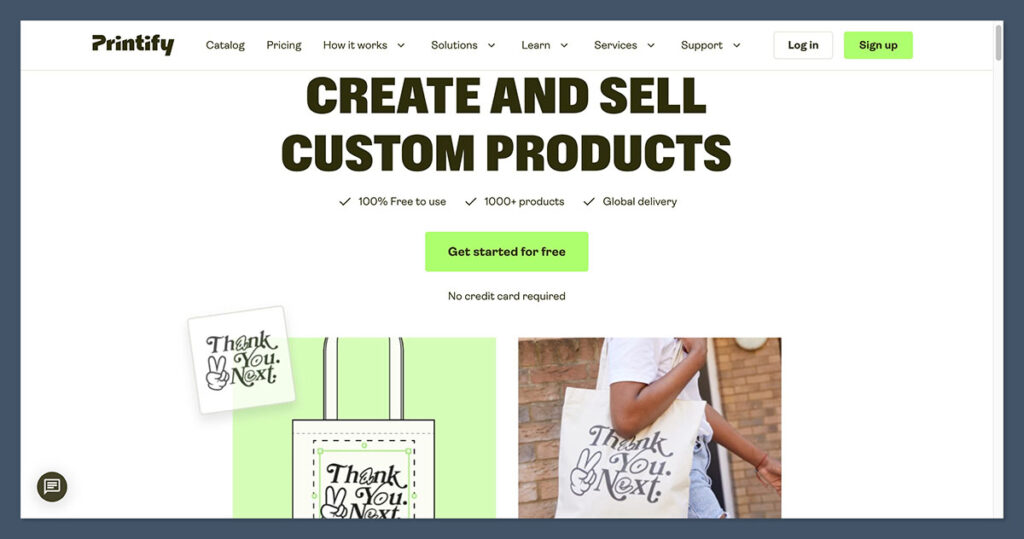
You can choose from and customize over 1,000 products, pick from multiple suppliers, mix and match price points and print methods, and choose your ideal ecommerce backbone. The downside is Printify only handles production and routing. You still need to manage the storefront, tax, customer support, and a good bit of supplier vetting yourself.
Fourthwall is different in a good way. It’s not just a fulfillment layer; it’s a complete brand platform. You get a built-in storefront with a custom domain, product creation, digital downloads, memberships, and tipping in one dashboard.

Fourthwall also acts as your Merchant of Record, which means they calculate and remit sales tax and VAT. They handle customer support for catalog orders under your brand. Plus, the system integrates directly with platforms like YouTube and Twitch.
Printify is a supplier network you plug into your stack. Fourthwall is the stack
Fourthwall vs Printify: Head to Head
| Factor | Printify | Fourthwall |
|---|---|---|
| What it is | POD marketplace connecting you to third-party suppliers | All-in-one brand platform |
| Production model | You choose from dozens of external print providers | Curated production partners with controlled standards for premium quality |
| Product range | 1,000+ products across multiple suppliers | Curated catalog + higher-end Signature options |
| Print/ Product quality | Variable depending on supplier | Consistent, and premium thanks to curated suppliers and a Signature line |
| Storefront | Requires Shopify, Etsy, etc. (Pop-Up Store is limited) | Built-in storefront with custom domain |
| True Monthly Cost | $0-$29 per month for Printify plus $39 per month for Shopify (or the cost of your ecommerce tool) | $0 until your first sale |
| Shipping speed | 7-10 days domestic, 10-30 international | 4-10 Days |
| Digital products | No | Yes |
| Memberships | No | Yes |
| Tax handling | Depends on selling platform; seller responsibility in many cases | Merchant of Record handles sales tax & VAT |
| Customer support | You handle customer-facing issues | Fourthwall handles catalog order support |
| Creator integrations | Ecommerce platform integrations | Native YouTube, Instagram, Twitch, TikTok, Discord integrations |
| Best for | Margin-focused sellers, product testers | Creators building a brand with minimal ops overhead |
Fourthwall vs Printify: The Quality Comparison
I’m starting with what I think is the most important thing separating Fourthwall and Printify: quality. I’m not saying Printify can’t produce quality products (it definitely can). The problem is that what you get depends entirely on the provider you choose.
You can choose the cheapest provider to keep your margins high and end up with lower quality. You can pick a “premium” provider, and incur higher cost, but you still might not get the quality you expect. There’s no real guarantee on anything, even though Printify does try to vet suppliers.
Vetting only does so much. Printify doesn’t manufacture in-house. It routes orders to the supplier you selected. If that supplier has capacity issues, pauses production, or changes something upstream, the experience shifts. Even reorders can feel slightly different if anything in the supply chain changes.
I’ve seen creators sell a hoodie that feels great the first month, then get messages later about thinner fabric or slightly different sizing. It’s not that Printify is “bad.” It’s that variability is built into the model. You’re working with a network, not a single controlled operation.
Fourthwall approaches this differently.
They work with a curated set of production partners and emphasize consistency over sheer volume of options. They also offer multiple print methods, including DTG and their DTFx process, which they position as a higher-finish, screen-print-style option.
Their Signature collection takes it a step further, requiring manufacturers to use Fourthwall's MAX ink settings instead of the industry norm where traditional printers cut costs by dialing back ink coverage. The catalog is smaller than Printify's, but it's tighter. Fewer variables, and more predictability.
If you’re running a high-volume testing operation, Printify’s flexibility makes sense. If you’re selling to fans who expect the same hoodie every time, consistency matters more than catalog size.
What’s Included: Fulfillment Tool vs Full Platform
Another major difference is what you actually get from each platform.
With Printify, you’re getting a production network. That’s the core product. You design something, connect it to a store, and orders are sent to the supplier you selected.
Everything else sits outside of Printify.
You’ll need a storefront platform. For most people, that’s Shopify at $39 per month minimum. You’ll need payment processing. You’ll need to configure tax collection depending on where you’re selling. If you want to sell digital downloads or memberships, that’s separate tooling. Customer support is up to you too. Printify doesn’t hide any of this, it knows it’s a fulfillment layer you plug into a stack.

Fourthwall is structured differently. The storefront is built in. You can use a custom domain. Digital products and memberships live in the same dashboard as physical merch. They act as Merchant of Record, which means they calculate and remit sales tax and VAT. They also handle customer support for catalog orders under your brand.
Printify gives you components. Fourthwall gives you a bundled system. If you enjoy assembling tools and optimizing every lever, Printify feels flexible. If you’d rather not manage the plumbing, Fourthwall’s structure makes a lot of sense.
The Integration Options
Quick note on integration options here. If you’re on Shopify or Etsy, Printify slides right in. Same with WooCommerce, Wix, and eBay. It’s built to sit behind an existing store. You deal with traffic and checkout. It deals with fulfillment.
Fourthwall doesn’t plug into ecommerce platforms because it doesn’t need to. You already get the platform and all the tools you need. What you get instead is integrations that matter for creators Links to YouTube Merch Shelf, Twitch Product Gifting, TikTok Shop, Discord role unlocks, StreamElements and Streamlabs.
That changes behavior.
If someone is watching a live stream and can gift a product directly in chat, that’s a different conversion moment than clicking a link in bio and navigating to a Shopify store. If YouTube displays your merch under your videos automatically, it reduces friction in a way traditional storefront plugins don’t.
Pricing: Where the “Cheaper” Story Gets Complicated
Most people argue that Printify is cheaper, and from one perspective, it is. It’s designed to be the budget option, letting you scroll through suppliers until you find the one that matches your budget. It also gives you a free plan with no monthly fee.

Upgrade to Premium at around $29 per month and you unlock up to 20% off product costs. If you’re pushing volume, that discount can materially change your margins. I’ve seen sellers structure entire pricing models around that 20%.
But you can’t stop at the base cost.
Most serious Printify sellers are using Shopify. That’s $39 per month minimum. Add payment processing. Add whatever tax setup tools you need. If you’re selling outside the US, things get more layered.
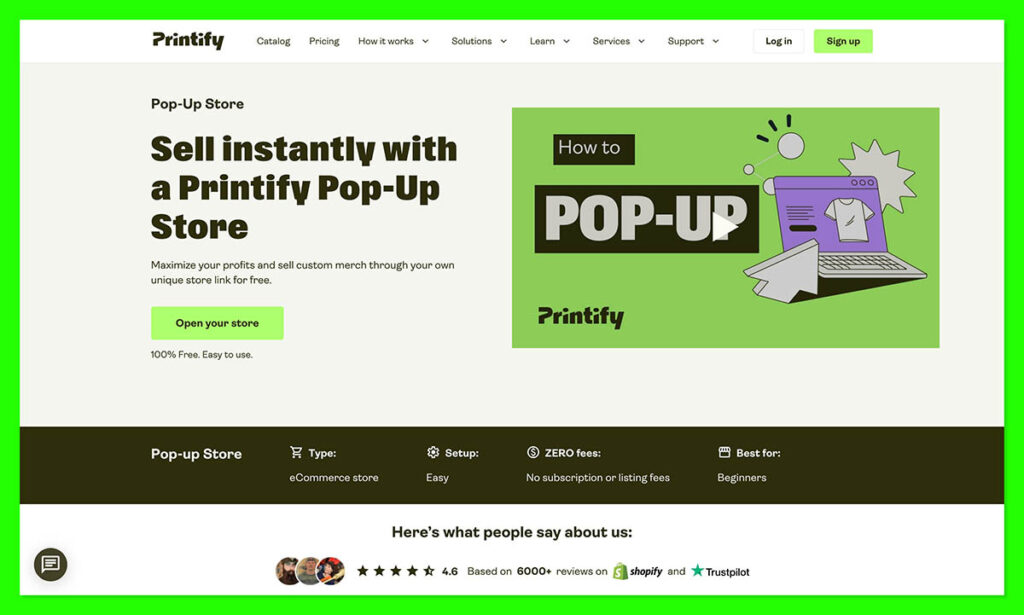
Printify’s 2025 Merchant of Record change for Pop-Up Store sellers shifted tax responsibility squarely onto the seller. If you’re selling through Shopify or another platform, tax handling depends on marketplace facilitator rules. It’s workable. It’s just not hands-off.
Then there’s the operational cost people ignore.
If you save $2–3 per shirt but spend hours handling reprints, supplier disputes, or refund emails because a provider underperformed, those savings shrink fast. One refund wipes out margin on multiple sales.
Now compare that to Fourthwall.
No monthly platform fee. Storefront included. Digital products included. Memberships included. Merchant of Record status means they calculate and remit US sales tax and international VAT/GST. Customer support for catalog orders is handled under your brand.
You still pay payment processing. You still price your products. But the stack is consolidated.
So yes, Printify often wins on base product cost. That’s its lane.
The real comparison is this: Are you optimizing for lowest unit cost or lowest total operational friction?
Shipping, Support, and What Happens When Orders Go Wrong
Let’s get into shipping. With Printify, delivery speed depends on the supplier you choose. Most US orders fall somewhere in the 7 to 15 business day window. International can stretch toward 30 days depending on the provider and destination. That’s standard for POD. The key word is variation.
You can choose a US printer for US customers and keep things relatively tight. You can prioritize a provider with stronger ratings even if it costs more. Printify gives you those options. But once the order is placed, the experience lives or dies on that specific supplier’s operations.
If something goes wrong, and it will occasionally, the email lands in your inbox. Misprint. Late package. Wrong size. Printify may approve a reprint. They may not. You’re still the one explaining it to the customer.
Fourthwall takes a different position. Shipping is generally faster for most products, since Fourthwall has chosen its suppliers carefully. For products in their catalog, they handle customer support on your behalf. Shipping questions, reprints, refunds tied to production issues, it runs through their system. From the fan’s perspective, it still feels like your store. Behind the scenes, you’re not juggling tickets.
If you’re selling 20 orders a month, managing support is fine. If you’re selling 500 after a viral video, it’s a different story.
One model assumes you’re operating like an ecommerce merchant. The other assumes you’re a creator who wants merch to work without becoming your second job.
Tax Handling: Fourthwall’s Extra Edge
I’ve met a lot of POD sellers who don’t even think about tax at first. Trust me when I say it’ll catch up with you eventually.
With Printify, tax responsibility depends on how and where you’re selling. If you’re using Shopify, Etsy, or another marketplace, the rules change based on marketplace facilitator laws. Some platforms collect and remit in certain regions. In others, it’s on you.
If you’re using the Printify Pop-up store, you are the merchant of record, which means Printify isn’t automatically collecting and remitting taxes on your behalf.
Fourthwall is unique because it acts as Merchant of Record for transactions on the platform. The team calculates, collects, and remits US sales tax and international VAT or GST where applicable. The payout you receive is after that compliance layer has been handled.
You can absolutely run a compliant store with Printify and Shopify. You’ll just need to understand your responsibilities. With Fourthwall, that responsibility isn’t on your plate.
Fourthwall vs Printify: Who Should Use Each Platform?
If you’re the kind of seller who enjoys optimizing suppliers, comparing blanks, tweaking pricing models, and squeezing margin, Printify makes sense.
You’ll appreciate being able to:
- Choose between multiple providers for the same product
- Swap suppliers if you find a cheaper option
- Run several stores under one account
- Access a catalog that goes way beyond basic tees and hoodies
If you’re experimenting with niches or running a traditional ecommerce store that just happens to use POD for fulfillment, Printify fits that model well. You’re building the stack yourself, and that control is the appeal.
If you already have an audience and your reputation matters more than shaving $2 off a shirt, Fourthwall starts to look attractive fast.
It’s a better fit if:
- You don’t want to manage suppliers
- You don’t want tax compliance on your to-do list
- You don’t want to answer fulfillment emails
- You want to sell merch, digital downloads, and memberships from one place
- You care about consistent product quality more than product volume
Fourthwall isn’t built for serious ecommerce operators who need full sourcing control or B2B customization workflows. It’s built for creators who want to launch a brand without turning into logistics managers.
If you’re testing merch for the first time and cost is everything, Printify is fine. If you’re building something your fans will reorder from for years, the margin math changes.


Comments 0 Responses