

Brevo, previously known as Sendinblue, is an all-in-one platform for email marketing, automation, CRM, and transactional messaging.
With flexible pricing and multi-channel features like SMS and WhatsApp, it’s gained popularity among ecommerce businesses looking to centralize their communication tools.
In this review, I’ll walk through Brevo’s pricing, features, automation tools, and pros and cons, all from the perspective of an ecommerce store owner or marketer.
Whether you’re sending newsletters, cart abandonment emails, or transactional receipts, this guide will help you decide if Brevo is the right fit.
| Brevo Overview | |
|---|---|
| Ideal for | Email + SMS under one roof |
| Rating | 4.2 / 5 |
| Best Suited For | – Small to medium ecommerce stores- Teams needing email, automation, and CRM features- Businesses sending both marketing and transactional emails |
| Free Plan Available | Yes |
| Paid Plans | $9 to $499+ per month |
Brevo Pros and Cons
What I Like
✔️ Free plan supports 300 emails/day and up to 100,000 contacts
✔️ Pricing scales based on email volume, not list size
✔️ Automation workflows are advanced, even on mid-tier plans
✔️ Transactional email support is built-in
✔️ Prepaid credits offer flexibility for seasonal spikes
What I Dislike
❌ Ecommerce integrations are functional but lack depth
❌ Key features like branding removal require upgrades
❌ Advanced segmentation is limited compared to Klaviyo
❌ Pricing jump from Standard to Professional is significant
Why You Can Trust This Review
This review is based on first-hand experience using Brevo for ecommerce email marketing. I’ve explored every major feature, tested automation workflows, reviewed campaign analytics, and set up transactional email via SMTP.
I’ve also compared Brevo against alternatives like Mailchimp, Klaviyo, and Omnisend to see where it truly performs, and where it falls short.
A Quick Summary of Brevo
Brevo is built to simplify how ecommerce businesses send campaigns, automate customer flows, and manage contacts. Its biggest strengths are price flexibility and multi-channel capability.
However, it may not meet the needs of high-growth ecommerce brands with complex segmentation or advanced data-driven strategies.
Here’s what you need to know at a glance:
| Feature | Included? |
|---|---|
| Email Marketing Tools | Yes |
| SMS & WhatsApp Messaging | Yes (pay-as-you-go) |
| Marketing Automation | Yes (limited on Free) |
| CRM and Sales Tools | Yes |
| Transactional Emails (SMTP/API) | Yes (all plans) |
| Advanced Segmentation | Limited |
| Ecommerce Integrations | Yes (Shopify, WooCommerce, etc.) |
| AI Features | Available on higher plans |
| Dedicated Support | Yes (Professional+) |
Brevo Pricing Plans
Brevo’s pricing is based on the number of emails you send, rather than how many contacts you store.
This makes it more affordable for businesses with large but inactive lists. All paid plans offer tiered send limits, so prices scale as you grow.
| Plan | Starting Price (USD) | Key Features |
|---|---|---|
| Free | $0/month | 300 emails/day, 1 user, limited automation |
| Starter | $9/month | No daily cap, basic email tools |
| Standard | $18/month | Automation, A/B testing, better reporting |
| Professional | $499/month | Multi-user support, advanced automation, send-time AI |
| Enterprise | Custom Pricing | SSO, SLA support, custom IPs, account manager |
Optional Add-Ons
- Remove Brevo logo (Starter plan): $9/month
- SMS and WhatsApp credits: Usage-based pricing
- Prepaid email credits: Pay-as-you-go option for high-volume spikes
- Additional users: Available on higher plans
Brevo’s Free plan is ideal for testing, especially for stores with small lists or infrequent campaigns. If you’re running ecommerce automation, the Standard plan offers the best balance between cost and features.
What It’s Like to Use Brevo
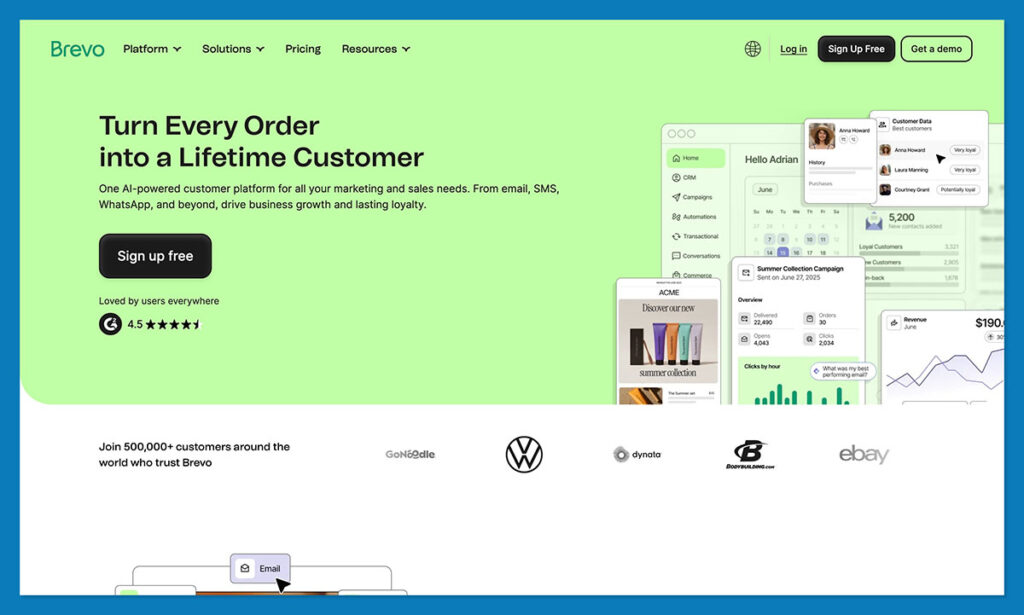
Setting up Brevo was straightforward. I signed up with an email and was immediately able to import contacts and create an email campaign.
The dashboard is clean and focuses on your primary goals: building emails, managing contacts, and setting up workflows.
Brevo’s email editor is drag-and-drop and easy to use, with a wide range of pre-built templates. There’s also a plain-text option if you want total control.
Getting Started
- No credit card needed for the Free plan
- Easy contact import (CSV or integrations)
- Pre-built automations to help you get started quickly
- Clear layout with tabs for campaigns, automation, and contacts
Brevo doesn’t overwhelm you with features at the start. You can choose to activate additional tools like CRM, SMS, or push notifications only when you need them.
Key Features for Ecommerce Stores
Brevo is designed to provide multiple marketing channels from a single dashboard. While it’s not deeply specialized in ecommerce, it does support most of the core features that online stores rely on.
Email Marketing
- Drag-and-drop builder with modern templates
- Mobile-responsive designs
- Signup forms and landing pages
- Segmentation by contact behavior
- Custom fields for personalization
Automation
- Visual workflow builder
- Pre-built ecommerce flows (e.g., abandoned cart, post-purchase)
- Trigger actions based on email behavior or ecommerce events
- Send-time optimization (Standard plan and above)
- A/B testing for subject lines and email content
Transactional Email
- Built-in SMTP relay
- API access for password resets, order confirmations, etc.
- Performance tracking for opens, bounces, and delivery rates
- Unlimited usage across all plans
Multi-Channel Messaging
- SMS and WhatsApp campaign support
- Push notifications for websites or mobile apps
- Web popups for lead generation
CRM and Contact Management
- Pipeline management for leads or sales
- Task assignment and contact notes
- Deal tracking for service-based businesses
- Contact activity logs
Brevo’s CRM is lightweight but works well for basic contact management. It’s not meant to replace full-scale CRMs like HubSpot or Salesforce.
Brevo Automation and Workflows
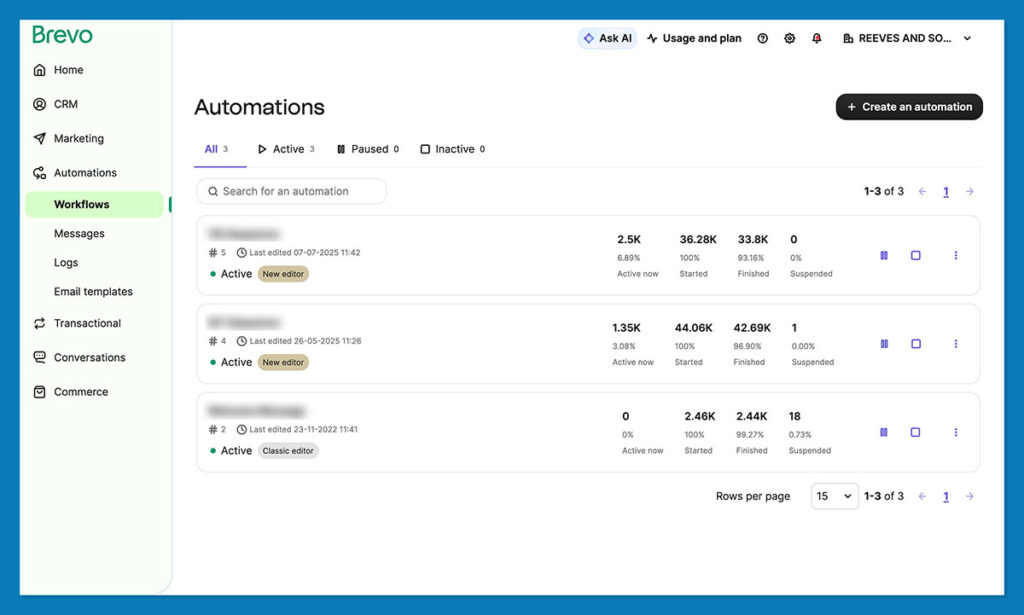
Automation is one of Brevo’s strongest features, especially considering its price point. You can trigger emails based on:
- Signup form submission
- Product purchased
- Cart abandoned
- Email clicked or opened
- Contact added to a list
The workflow builder is intuitive. Each step can include actions (like sending an email), conditions (like if someone opens it), or delays (such as wait 1 day).
Brevo includes templates for common ecommerce workflows, including:
- Welcome series
- Abandoned cart recovery
- Post-purchase review requests
- Re-engagement for inactive users
You’ll unlock the best automation features on the Standard plan or higher. This includes branching logic, A/B split testing, and send-time AI to boost performance.
Deliverability and Performance
Deliverability is a major concern for ecommerce stores. If your emails land in spam, your revenue takes a hit.
Brevo performed well in 2024 deliverability tests by third-party platforms like EmailToolTester. It maintained inbox placement rates above 89 percent, placing it ahead of platforms like Mailchimp and Constant Contact.
Transactional Deliverability
- Supports SMTP and API for fast delivery
- Real-time delivery tracking
- Bounce and spam complaint monitoring
- Option to use dedicated IPs for improved control (Professional+)
This makes Brevo a reliable option for ecommerce stores sending receipts, password resets, and shipping confirmations through one provider.
Ecommerce Integrations
Brevo integrates with most major ecommerce platforms. Here’s what’s supported:
| Platform | Integration Type |
|---|---|
| Shopify | Direct App + API |
| WooCommerce | WordPress Plugin |
| Prestashop | Native Module |
| Magento | API Integration Required |
| BigCommerce | Via Zapier or API |
What You Can Do
- Sync contacts and purchase history
- Trigger automations based on orders or carts
- Add new subscribers from store checkout
- Send transactional emails based on events
While the basics are covered, advanced features like product-level segmentation or predictive analytics are not included by default. For that, tools like Klaviyo are more capable.
Marketing and Analytics
Brevo includes built-in tools to monitor campaign performance and optimize results.
Marketing Insights
- Open and click tracking
- Bounce and unsubscribe rates
- Device and location data
- Email heatmaps
- Link performance
SEO and Landing Pages
- Create branded signup pages
- Customize URL slugs
- Track traffic via UTM codes
If you want advanced attribution tied directly to sales and product SKUs, Brevo does not offer this out of the box. You’d need to build a custom integration or consider a more ecommerce-focused provider.
Customer Support and Help Resources
Brevo offers a mix of live support and self-service documentation.
| Support Channel | Availability |
|---|---|
| Help Center | 24/7 |
| Live Chat | Paid plans only |
| Email Support | Available |
| Phone Support | Professional plan only |
| Community Forum | Limited activity |
The help documentation is thorough and includes setup guides for integrations, API calls, and marketing best practices. Live chat is responsive, though only available to paid users.
How Brevo Compares to Competitors
If you’re choosing a platform for ecommerce marketing, here’s how Brevo stacks up:
| Platform | Best For | Starting Price | Free Plan |
|---|---|---|---|
| Brevo | Affordable email + SMS + automation | $9/month | Yes |
| Klaviyo | Deep ecommerce integration + analytics | $20/month | Yes |
| Mailchimp | General marketing campaigns | $13/month | Yes |
| Omnisend | Ecommerce-focused, SMS included | $16/month | Yes |
Brevo is ideal for ecommerce stores that want flexibility without spending hundreds each month. If your business is highly data-driven or you rely on advanced segmentation, Klaviyo or Omnisend may be better suited.
Klaviyo excels in ecommerce-specific features like predictive analytics, dynamic segments, and deep integrations with platforms like Shopify. It’s best suited for data-driven brands focused on growth and revenue attribution.
Mailchimp remains popular for general email marketing, especially among creators and service-based businesses. It has a broad set of tools but can become expensive as you scale.
Omnisend is tailored to ecommerce from the start, with built-in SMS, pre-built automations, and strong cart recovery tools. It’s a great middle ground between Brevo’s affordability and Klaviyo’s depth.
Final Verdict: Is Brevo Worth It?
Brevo is a strong contender for ecommerce brands that want a single platform for marketing and transactional email. It’s affordable, easy to use, and flexible.
The pricing model based on send volume, not contacts, is particularly attractive for stores with large audiences.
It’s a great fit if you’re looking for:
- A central platform for campaigns, automations, and SMS
- Built-in transactional email without a third-party tool
- Easy automation workflows for ecommerce events
- Transparent and scalable pricing
However, it’s not ideal if you need:
- Deep product-based segmentation
- AI-powered recommendations
- Revenue attribution from emails
- Shopify Plus-level personalization
For small to mid-sized ecommerce stores, Brevo offers excellent value.
You can get started for free, explore the features, and only pay as you grow. It’s a solid choice if you’re focused on delivering consistent, multi-channel messaging without overspending.


Comments 0 Responses