

With over 150 hours researching and testing 10 of the leading print-on-demand platforms, our team has shortlisted the best options for influencers and creators looking to launch or scale a merch line in 2026.
Printful is our top recommendation for brand-first creators, offering premium quality, deep integrations, and strong branding options that keep your identity front and center.
In this guide, I’ll walk you through the key features, pricing, and trade-offs of each top-rated POD platform, so you can find the right fit for your audience and goals.
- Printful — Best for brand-first merch stores
- Printify — Best for margins and product variety
- Spring (Teespring) — Best for YouTube and social creators
- MyDesigns — Best for high-volume automation
- Merch by Amazon — Best for Amazon-centric audiences
In addition to covering the latest features and updates from each platform, I’ve recently refreshed these recommendations to reflect how influencer merch has shifted in 2026, with TikTok Shop integrations, AI search storefronts, and global fulfilment becoming key factors.
POD Platform Comparison Table
Take a look at our top POD picks side-by-side to see which best suits your merch goals:
| Platform | Best For | Starting Price | Storefront Integrations | Branding Options | Product Catalog |
|---|---|---|---|---|---|
| Printful | Brand-first merch stores | Free (Growth plan from ~$24.99/mo) | Shopify, Etsy, WooCommerce, Wix, Squarespace, BigCommerce, Amazon | Custom neck tags, inside labels, branded packaging, pack-ins | 350+ products |
| Printify | Margins and variety | Free (Premium from $29.99/mo) | Shopify, Etsy, WooCommerce, Wix, BigCommerce | Limited (provider-dependent) | 900-1,000+ products |
| Spring | YouTube and social creators | Free | YouTube merch shelf, TikTok, Instagram, native storefront | Basic | 200+ products |
| MyDesigns | High-volume automation | From $19.99/mo | Etsy, Shopify, TikTok Shop | AI-assisted mockups | Provider-dependent |
| Merch by Amazon | Amazon-centric audiences | Free (approval required) | Amazon only | Minimal | Limited apparel categories |
#1. Printful: Best for Brand-First Merch Stores
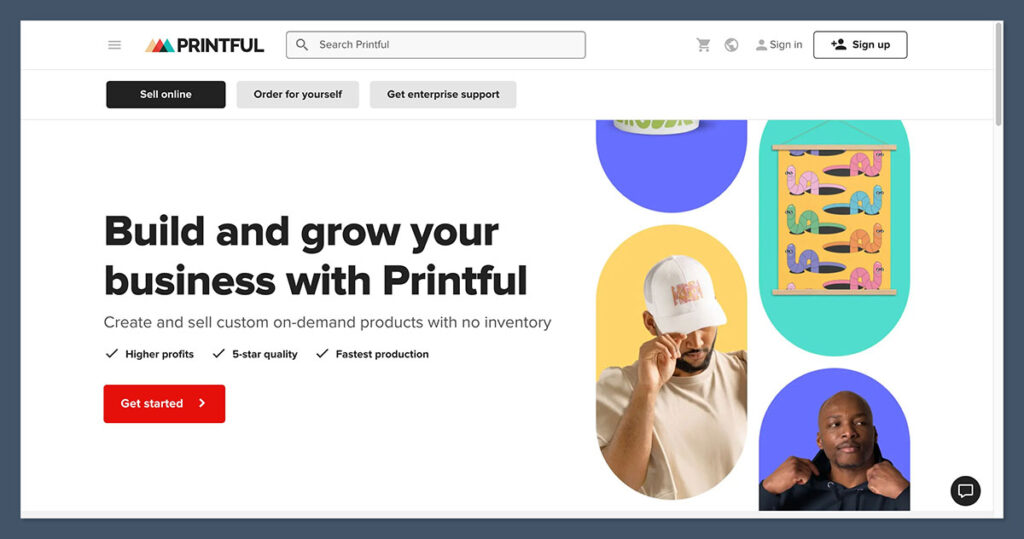
- Starting price: Free plan available (Growth plan from ~$24.99/mo)
- Best for: Creators treating merch as a serious DTC brand with quality-sensitive fans
Printful is our top recommendation for influencers who want their merch store to feel like an official brand, not just “some shirts on a marketplace.” Its strong branding options, including inside labels, custom neck tags, branded packaging, and pack-ins, keep the creator’s identity front and center rather than the fulfilment partner’s.
I tested Printful’s integration with Shopify and found the setup process smooth and well-documented. The product quality, particularly for embroidery and DTG printing, is consistently rated among the highest in the POD space. This matters when your audience associates your name with a certain standard.
Pros 👍
- Premium print and embroidery quality
- Strongest branding options (custom labels, packaging, pack-ins)
- Broadest integration set (Shopify, Etsy, WooCommerce, Squarespace, Wix, BigCommerce, Amazon)
- Global fulfilment network
- Growth plan becomes free once you hit ~$12K annual sales
Cons 👎
- Higher base prices mean slimmer margins on simple items like T-shirts
- No built-in marketplace traffic
- Shipping costs can be steep for price-sensitive audiences
- Smaller catalog than Printify
Printful’s Growth plan now includes priority processing and volume discounts, and becomes free once a store reaches approximately $12K in annual sales, which suits mid-tier influencers scaling their merch operation.
What really sets Printful apart for influencer merch is the white-label shipping experience.
When a fan receives a package, everything from the shipping label to the inside of the garment carries the creator’s brand. For influencers building a real DTC presence rather than just monetizing their audience with a quick merch drop, this level of control makes a meaningful difference.
How Much Does Printful Cost?
- Printful’s Free plan covers basic fulfilment with no monthly fee
- The Growth plan starts at approximately $24.99 per month and adds priority processing, discounts, and branding tools
- You pay per product (base price + shipping), and margins depend on your retail markup
- Higher base prices compared to competitors like Printify
Printful is suitable for:
- Creators building an official merch store on their own domain
- Influencers with quality-sensitive audiences
- Mid-tier to large creators scaling toward the Growth plan threshold
Printful isn’t suitable for:
- Price-sensitive creators who need the highest possible margins on basic items
- Creators who primarily rely on marketplace traffic rather than their own audience
- Small creators testing designs who need a massive product catalog
Why Use Printful in 2026?
In a market where fans are increasingly skeptical of generic, low-effort merch, Printful helps creators deliver a product that feels intentional. The combination of quality, branding control, and reliability makes it the right backbone for any influencer who views merch as an extension of their personal brand rather than a quick revenue add-on.
The improved mobile app in 2026 also helps creators manage orders on the go, which matters when you’re juggling content creation, community management, and merch drops at the same time.
#2. Printify: Best for Margins and Product Variety
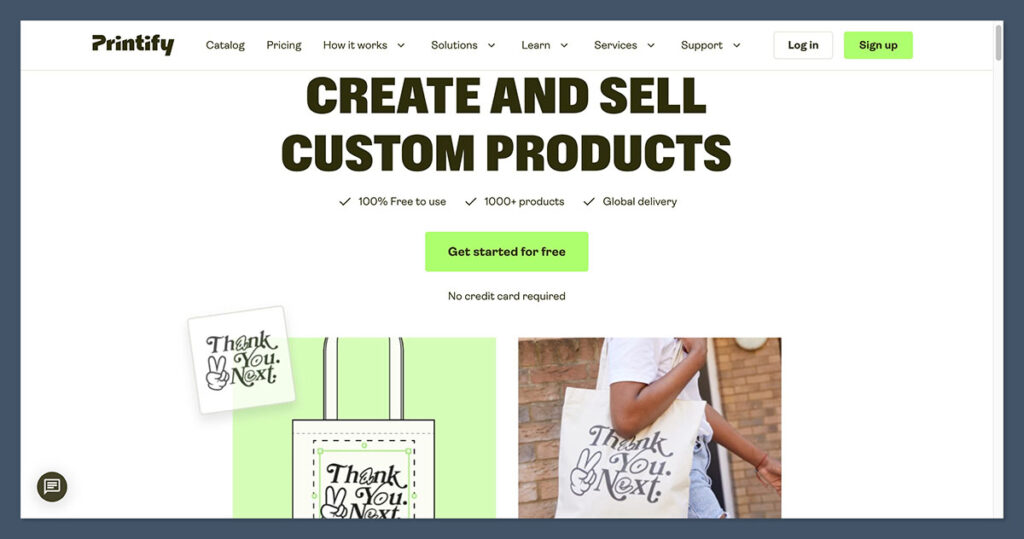
- Starting price: Free plan available (Premium from $29.99/mo)
- Best for: Price-sensitive or high-testing creators who care more about variety and margins than unified premium branding
Printify is the go-to platform for influencers who want to test a lot of designs, run frequent drops, or maximize their margins. Its print-provider marketplace model means you can choose suppliers by region, price, and rating, giving you more control over the cost and delivery time of each product.
With a catalog of 900 to 1,000+ products spanning apparel, accessories, homeware, and even niche categories like pet products and custom supplements, Printify offers significantly more variety than any other platform on this list.
Pros 👍
- Massive product catalog (900-1,000+ items)
- Print-provider marketplace lets you optimize margins per product
- Competitive base prices
- Strong Shopify, Etsy, and WooCommerce integrations
- Niche SKUs (pet products, supplements) that work well for specific communities
Cons 👎
- Product quality and shipping consistency vary by provider
- Branding options are less polished than Printful
- Requires more hands-on supplier curation
- No built-in marketplace traffic
The trade-off with Printify is clear: you get more flexibility and better pricing, but you need to invest time curating your suppliers. Unlike Printful’s uniform experience, Printify’s quality depends on which print provider you select for each product. I’d recommend ordering samples from at least two or three providers before committing to a product line.
How Much Does Printify Cost?
- Printify’s Free plan lets you create up to 5 stores with unlimited product designs
- The Premium plan at $29.99 per month gives you up to 10 stores and up to 20% discount on all products
- No transaction fees from Printify itself (marketplace fees from Etsy, Shopify, etc. still apply)
- Base product prices are generally lower than Printful, giving you more room for margin
Printify is suitable for:
- Creators who test lots of designs and run frequent drops
- Influencers with price-sensitive audiences
- Niche creators (gaming, pets, home decor, fitness) who need unusual product categories
Printify isn’t suitable for:
- Creators who want a fully branded, premium unboxing experience out of the box
- Influencers who prefer a hands-off approach to supplier management
- Small creators who only need a handful of simple products
Why Use Printify in 2026?
For influencers who treat merch as an experimentation channel, testing slogans, designs, and product types across their audience, Printify’s combination of low base prices and enormous catalog makes it the most efficient platform for iteration. The provider marketplace also means you can localize fulfilment without switching platforms, routing US orders to US-based printers and EU orders to European ones.
Printify is widely used in the Shopify ecosystem, with hundreds of thousands of merchants relying on it, which means the integration is mature and well-supported.
#3. Spring (Teespring): Best for YouTube and Social Creators
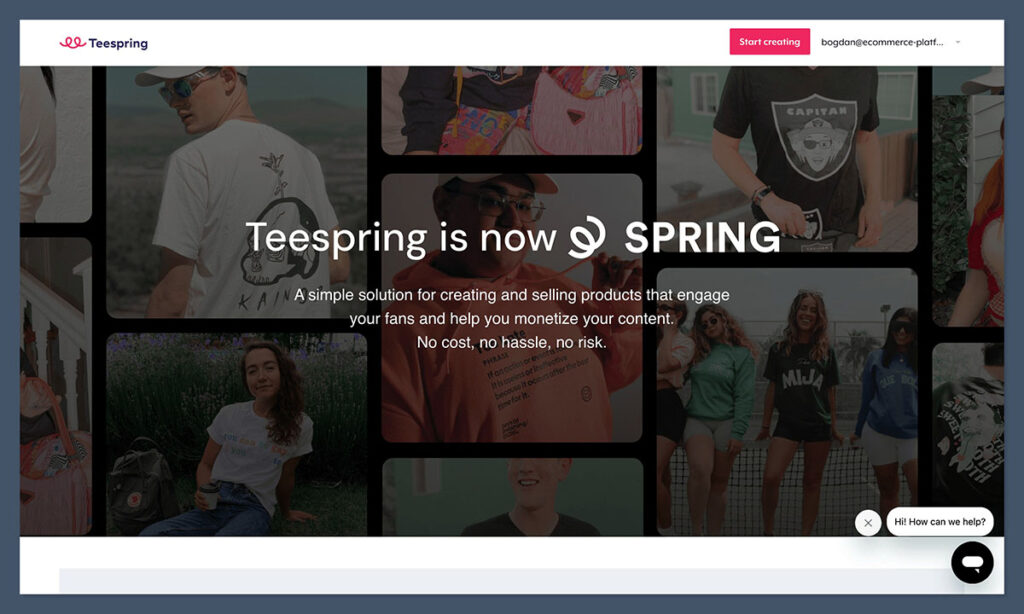
- Starting price: Free (no upfront cost)
- Best for: Beginner creators or YouTube, Twitch, and TikTok influencers wanting a fast launch
If you want to get merch in front of your audience this week without setting up a Shopify store, connecting a fulfilment partner, or paying anything upfront, Spring is the fastest path from idea to live product.
Its native integration with YouTube’s merch shelf lets creators display products directly below videos and on channel pages, which is a powerful conversion tool for creators with engaged subscriber bases.
Pros 👍
- Native YouTube merch shelf integration
- Zero upfront cost
- Creator-centric workflows designed for social-first sellers
- Frictionless setup (launch products in minutes)
- Compatible with TikTok and other social platforms
Cons 👎
- Less control over fulfilment and customer data
- Fewer advanced branding options than Printful or Printify
- Product catalog and quality are mid-tier at best
- Limited email capture and upsell capabilities
Spring’s biggest strength is also its core limitation: it’s built for speed and simplicity, not for building a stand-alone brand. You won’t get custom neck tags or branded packaging, and you have less visibility into customer data than you would with a Shopify-plus-Printful stack.
For creators who are testing whether their audience will buy merch at all, Spring removes nearly every barrier. For creators who’ve validated demand and want to level up, it works best as a secondary channel alongside a brand-owned store.
How Much Does Spring Cost?
- Spring is completely free to use with no monthly fees
- You set your own retail price above the base cost, and the difference is your profit
- No inventory risk since products are printed on demand
- Transaction and payment processing fees apply at checkout
Spring is suitable for:
- YouTube creators who want merch below their videos
- Beginner creators testing whether their audience will buy
- Social-first influencers who don’t want to manage a separate store
Spring isn’t suitable for:
- Creators who want full branding control and a premium unboxing experience
- Influencers building a long-term DTC brand with email lists and upsells
- Large-scale operations with complex inventory needs
Why Use Spring in 2026?
For YouTube creators especially, the merch shelf integration is hard to beat. It puts your products exactly where your audience already spends time, without requiring them to leave the platform. In 2026, with attention spans shorter than ever and audiences spread across multiple channels, this kind of frictionless purchasing matters. Spring also supports TikTok and Instagram integrations, making it a solid multi-channel option for social-first creators who aren’t ready to manage a full ecommerce stack.
#4. MyDesigns: Best for High-Volume Automation
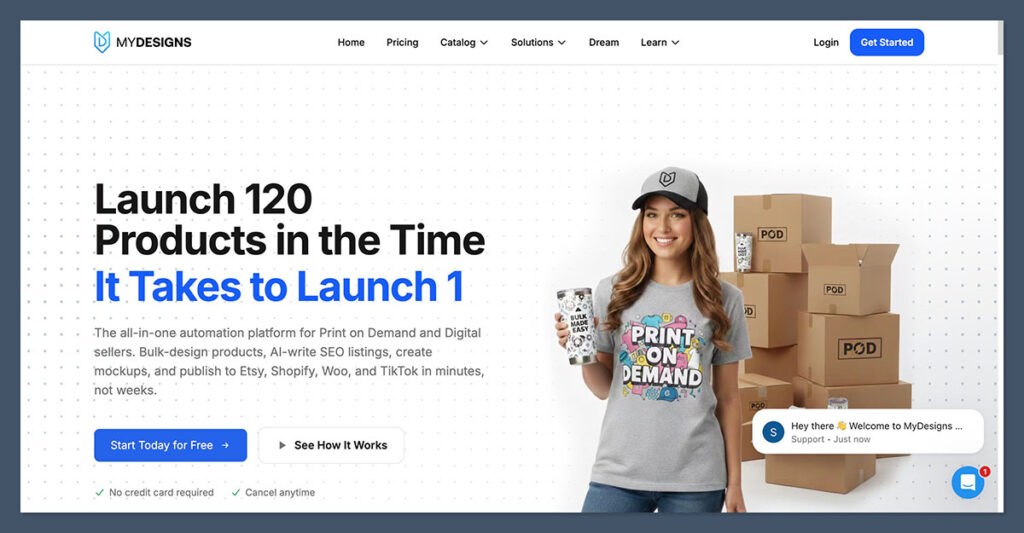
- Starting price: From $19.99 per month
- Best for: Scaled creator brands and agencies where merch is run like a serious POD operation
MyDesigns is built for a different kind of influencer merch operation: high-volume, automation-heavy, and often managed by a team or agency rather than the creator alone.
Its bulk publishing capabilities let you push up to roughly 120 products at a time, with AI-assisted design workflows and thousands of automatic mockups taking much of the manual work off your plate.
Pros 👍
- Bulk publishing (up to ~120 products at a time)
- AI-assisted design and mockup generation
- Deep Etsy-first tooling
- TikTok Shop integration
- Built for managing merch across multiple creators or brands
Cons 👎
- Steeper learning curve than plug-and-play platforms
- Overkill for a single small creator
- Requires process discipline to benefit from automation features
- Less “plug and play” than Spring or Printful
If you’re an agency managing merch for multiple creators, or you’re a creator who aggressively tests design variations, colorways, and slogans across Etsy, Shopify, and TikTok Shop, MyDesigns is purpose-built for that workflow. Its Etsy-first tooling is particularly strong, making it a good fit for creators whose audiences are comfortable buying through Etsy’s marketplace.
How Much Does MyDesigns Cost?
- Plans start at $19.99 per month
- Pricing scales with features and the number of products and integrations you use
- Product base costs depend on the fulfilment providers connected through the platform
- The cost is most justifiable at higher volumes where automation saves meaningful time
MyDesigns is suitable for:
- Agencies managing merch for multiple creators
- Creators who aggressively test variations across Etsy, Shopify, and TikTok Shop
- High-volume operations that need automation to stay efficient
MyDesigns isn’t suitable for:
- Small creators launching their first merch line
- Influencers who want a simple, hands-off setup
- Creators who only sell through a single channel
Why Use MyDesigns in 2026?
The influencer merch space is maturing. What used to be a side project for most creators is now, for some, a serious revenue line managed with the same rigor as any ecommerce operation. MyDesigns caters specifically to this evolved segment. Its bulk workflows, AI tooling, and multi-marketplace publishing make it possible to run a merch line at scale without a massive team, which is exactly what 2026 demands as creators diversify their income streams and compete for wallet share across more channels.
#5. Merch by Amazon: Best for Amazon-Centric Audiences
- Starting price: Free (approval required)
- Best for: Influencers whose audiences already shop heavily on Amazon
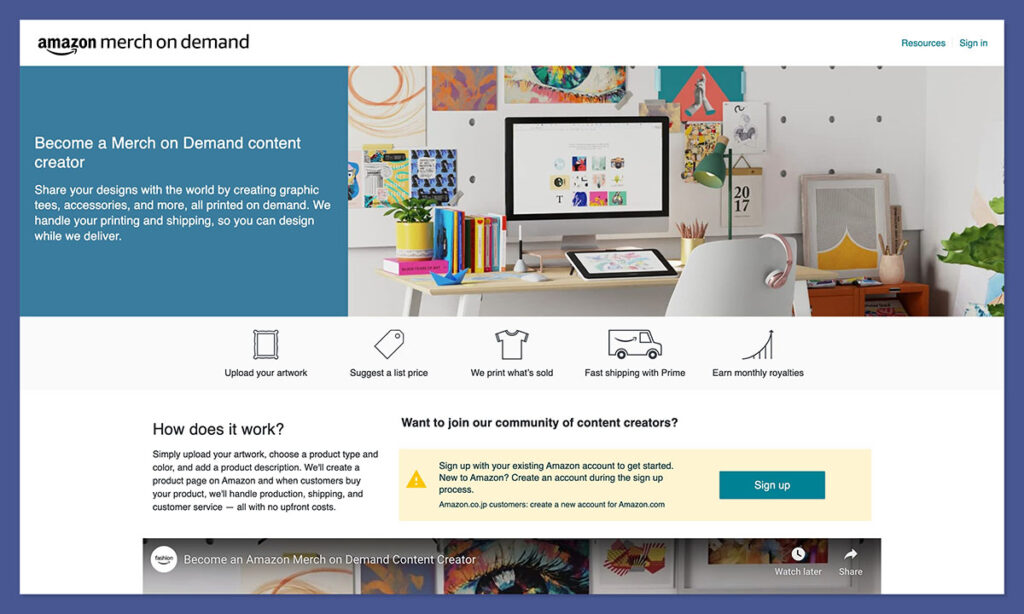
Merch by Amazon gives creators access to Amazon’s enormous organic traffic and Prime shipping network, which is a significant advantage if your audience is already buying through the platform. There’s no upfront cost, and Amazon handles production, shipping, and customer service.
Pros 👍
- Access to Amazon’s organic search traffic and Prime shipping
- No upfront cost or inventory risk
- Amazon handles fulfilment and customer service
- High trust factor for consumers already in the Amazon ecosystem
Cons 👎
- Approval required (with tier limits on new accounts)
- Very limited branding control
- Designs sit under Amazon’s UX and brand, not yours
- Crowded marketplace with heavy competition
- Limited product categories (primarily apparel)
The core trade-off with Merch by Amazon is clear: you get Amazon’s traffic and infrastructure, but you give up almost all brand identity. Your merch lives on Amazon’s marketplace under Amazon’s design language, and you have limited control over the customer relationship. For influencers who already drive significant Amazon affiliate revenue or whose audiences default to Amazon for purchases, it’s a natural fit as a secondary channel. As a primary merch strategy for building a brand, it falls short.
How Much Does Merch by Amazon Cost?
- No monthly fees or upfront costs
- Amazon pays you a royalty on each sale (typically ranging from 13% to 37% of the list price, depending on the product and price point)
- No fulfilment or shipping costs to manage
- New accounts start with tier limits (usually 10 designs), which increase as you make sales
Merch by Amazon is suitable for:
- Influencers with Amazon-heavy audiences
- Creators who want a secondary sales channel with zero management overhead
- Influencers already generating Amazon affiliate revenue
Merch by Amazon isn’t suitable for:
- Creators who want to build an independent, branded merch store
- Influencers who need control over customer data and email lists
- Creators looking for a wide product catalog beyond basic apparel
Why Use Merch by Amazon in 2026?
Amazon’s search traffic is still massive, and Prime shipping sets customer expectations that most POD fulfilment can’t match on speed alone. In 2026, with shoppers expecting two-day delivery as the baseline, having a Merch by Amazon presence gives your products a logistical edge. It works best as a supplementary channel alongside a brand-owned store, capturing the segment of your audience that defaults to Amazon for everything they buy.
Overall Winner
Printful remains the strongest option for influencers who view merch as a brand-building exercise. For creators focused on margins and experimentation, Printify is the better fit. And for beginners who just want to get started, Spring offers the lowest barrier to entry.
How Do I Choose the Right POD Platform for Merch?
Choosing the right print-on-demand platform depends on where you are in your creator journey, what your audience expects, and how much control you want over the brand experience. While we can help you compare platforms, you need to identify your priorities and figure out what trade-offs you’re willing to make.
Below, I’ve put together a checklist of key factors to consider when researching or trialing a POD platform:
Brand control and identity: Can you add custom labels, packaging, and inserts? Does the product arrive looking like it came from your brand or from a generic warehouse? White-label fulfilment (Printful, Printify) gives more control, while marketplace tools (Spring, Merch by Amazon) trade that control for convenience.
Product catalog and fit: Does the platform carry the product types your audience actually wants? Simple apparel drops work on most platforms, but niche creators (gaming, pets, home decor, fitness) may need Printify’s expanded catalog or specialized providers.
Margins vs. quality: Lower base prices (Printify, some regional providers) give you more profit per unit but introduce quality variability. Higher base prices (Printful) reduce refund risk and support premium price points when the brand is strong.
Geography and shipping: Where does your audience live? If your fanbase is concentrated in the US, a US-centric provider works fine. If you have a global following spread across Europe, North America, and Latin America, you need a platform with distributed fulfilment to reduce shipping costs and delivery times.
Tech stack and integrations: Shopify remains the primary hub for most creator merch stores, and both Printify and Printful are the best-supported apps in that ecosystem. TikTok Shop and Etsy syncing are increasingly important for influencer brands doing short-form content commerce.
Scalability: Can the platform grow with you? A creator launching their first five products has different needs than one managing 200 SKUs across three marketplaces. MyDesigns and Printify are built for scale, while Spring and Merch by Amazon are better suited as starting points or secondary channels.
How We Test POD Platforms
Our research team put 10 leading POD platforms through a structured testing process to determine our ranking and recommendations. We spent over 150 hours analyzing each platform, covering 85 areas of investigation.
We’ve focused on six core categories, each given a weighting to reflect what matters most to influencer merch sellers:
| Category | Weight | What We Assess |
|---|---|---|
| Product Quality and Fulfilment | 30% | Print quality consistency, fulfilment speed, shipping reliability, and global coverage |
| Branding and Customization | 20% | Custom labels, packaging options, white-label shipping, and brand presentation |
| Integrations and Tech Stack | 20% | Storefront compatibility (Shopify, Etsy, WooCommerce), social integrations, and API quality |
| Pricing and Margins | 15% | Base product costs, shipping prices, monthly fees, and achievable profit margins |
| Ease of Use | 10% | Onboarding experience, product creation workflow, order management, and dashboard clarity |
| Catalog and Scalability | 5% | Number of available products, niche categories, bulk tools, and multi-store support |
I also tested each platform’s product creation workflow and storefront integrations firsthand, ordering samples from each service to assess print quality and packaging. You can read my summary below:
After testing all of these platforms, I have my personal preferences, but I stand by our 2026 rankings.
Printful remains the top choice for brand-first creators because no other platform matches its combination of quality, branding tools, and integration depth. Printify offers unbeatable variety and margin potential for creators who are willing to manage suppliers.
Spring is the easiest on-ramp for social creators. MyDesigns is a genuine power tool for scaled operations. And Merch by Amazon works as a low-effort secondary channel for anyone with an Amazon-friendly audience.
Key Takeaways
- Printful is the top choice for creators who want their merch to feel like an official brand, with premium quality, custom packaging, and the broadest set of storefront integrations
- Printify offers the largest product catalog (900-1,000+ items) and a print-provider marketplace that lets you optimize margins per product, making it ideal for high-testing creators
- Spring (Teespring) remains the fastest way for YouTube and social creators to launch merch, thanks to its native merch shelf integration and zero upfront cost
- All five platforms are free to start with (no upfront inventory), but branding control, product quality, and margins vary significantly between them
- TikTok Shop and AI search integrations are increasingly important in 2026, with MyDesigns and Shopify-connected platforms leading on these fronts
Final Verdict: Which POD Platform Do I Recommend?
Our research process has identified the top five POD platforms for influencer merch, and Printful is the best option for creators who want a professional, brand-owned merch experience. Its quality, branding tools, and integration depth make it the most complete package.
That said, every platform on this list serves a different creator profile. If you’re unsure where to start, I’d recommend a practical approach: begin with a low-friction platform like Spring to validate demand with your audience, then evolve into a brand-owned stack (Shopify plus Printful or Printify) once you’ve confirmed that your fans will buy.
The biggest mistake I see influencers make with merch is over-investing in infrastructure before they’ve proven demand. Start simple, test your designs, and scale into a premium setup once the numbers justify it.
FAQ
What is the best POD site for influencer merch?
Printful is our top recommendation for influencer merch because it offers the best combination of print quality, branding control, and storefront integrations. Creators who want their merch to feel like a legitimate brand rather than a quick cash grab will benefit most from Printful’s custom labels, branded packaging, and white-label shipping.
Can I start selling merch with no upfront cost?
Yes. All five platforms on this list allow you to start selling with no upfront inventory cost, since products are only printed when a customer orders. Spring and Merch by Amazon have no monthly fees at all, while Printful and Printify offer free plans with optional paid upgrades for branding and volume features.
Which POD platform has the best margins for creators?
Printify generally offers the best margins because its print-provider marketplace model lets you shop for lower base prices across different suppliers. The trade-off is that quality and shipping consistency can vary depending on which provider you choose, so you need to test samples before committing.
Do I need a Shopify store to sell merch?
No. Platforms like Spring and Merch by Amazon provide their own storefronts or marketplace listings, so you can sell without a separate ecommerce site. However, if you want full control over your brand, customer data, and upsell flows, a Shopify store connected to Printful or Printify is the recommended setup for serious merch operations.
What is the best POD platform for TikTok creators?
For TikTok creators specifically, Spring and MyDesigns both offer TikTok Shop integrations. Spring is the easier starting point, while MyDesigns is better for high-volume creators running multiple product tests through short-form content commerce.
Can I use multiple POD platforms at the same time?
Absolutely. Many successful creator merch operations use a combination: for example, a Shopify store connected to Printful for the brand-owned experience, plus Merch by Amazon as a secondary channel for Amazon traffic, and Spring integrated with their YouTube merch shelf. The key is starting with one platform, getting it right, and then layering in additional channels as you grow.


Comments 0 Responses