

We have spent years working hands on with both of these platforms, testing them for full reviews and using them to help ecommerce sellers launch and scale print on demand stores. That experience shapes the recommendation below, so you can skip the trial and error and pick the option that actually fits how you sell.
While Printful and Sellfy both support the print on demand model, they solve different problems. Printful is a fulfillment layer: it gives you the products, printing, and global shipping you plug into an existing store or marketplace. Sellfy is an all in one ecommerce platform with print on demand built in, so your storefront, checkout, and merch live under one roof.
If you already sell somewhere (or want the widest, highest quality product range), Printful is our pick. If you need a ready made store on a tight budget, Sellfy is the more affordable all in one route. Here is how they compare in detail.
Quick verdict: Printful is our go to print on demand platform, thanks to its large product catalog, deep integrations across stores and marketplaces, and consistent quality control. If you would rather get an all in one storefront and print on demand in a single, low cost subscription, Sellfy is a solid alternative for beginners and lean creators.
| $13B+Global print on demand market size in 2026 (Grand View Research, Mordor Intelligence) | ~24%Projected annual growth rate of the POD market | $0Printful entry cost: a free plan with pay per order pricing | 0%Sellfy platform transaction fee on every plan |
Printful vs Sellfy: At a Glance
| Printful | Sellfy | |
|---|---|---|
| Best for | Sellers who already have a store or marketplace and want the widest, highest quality POD catalog | Beginners who want an all in one storefront plus POD in one subscription |
| Model | Print on demand and global fulfillment you connect to other platforms | Ecommerce platform with print on demand built in |
| Free option | Yes, free plan with pay per order pricing | No free plan, 14 day free trial |
| Starting paid price | Growth plan $24.99 per month (free once you reach $12k a year in sales) | Starter $29 per month (about $22 on annual billing) |
| Platform transaction fees | None (you pay product base cost and shipping per order) | 0% platform fee (Stripe or PayPal charge about 2.9% plus 30c per sale) |
| Own storefront | Free Quick Stores option (basic, US only); built mainly for integrations | Yes, customizable store with your own domain |
| Product range | Very large catalog across apparel, accessories, home, and more | Smaller POD range, plus digital, physical, and subscription products |
| Customization methods | DTG, DTF, embroidery, all over print, sublimation | Embroidery and digital printing |
| Support | 24/7 chat and email, plus a large self help library | Email support, priority support on higher plans |
Key Takeaways
- Printful offers a far wider print on demand catalog and more customization methods (including all over print and DTF), with tight quality control across in house fulfillment centers.
- Sellfy lets you build your own branded storefront with a custom domain, though the templates are simpler than a dedicated store builder like Shopify.
- Printful is cheaper on the surface thanks to a genuinely useful free plan, but you still pay per order, and outside its basic Quick Stores tool you need a separate store or marketplace to sell on.
- Sellfy charges 0% platform fees and bundles store, checkout, marketing, and POD into one flat subscription, which suits sellers who want everything in one place.
- Printful provides more integrations, more value added services, and a deeper library of self help resources, so it tends to win on support and flexibility.
Printful vs Sellfy: Pros and Cons
Both platforms suit growing ecommerce sellers exploring print on demand, a model that research firms now value at roughly $13 to $15 billion globally in 2026, with annual growth close to 24%. Each has clear strengths and trade offs.
Printful Pros
- Large catalog of white label products with premium and eco friendly options
- Multiple print methods: DTG, DTF, embroidery, all over print, and sublimation
- Strong design tools and a drag and drop mockup generator
- Deep integrations with Shopify, Etsy, Amazon, TikTok Shop, WooCommerce, Wix, and more
- Useful free plan and a Growth plan that becomes free at $12k a year in sales
- 24/7 support plus an extensive academy, blog, and help center
Printful Cons
- No full storefront builder; you need an existing store or marketplace
- Base product prices sit higher than some budget POD suppliers
- Costs stack up once you add branding, extra prints, and shipping
Sellfy Pros
- All in one: storefront, checkout, marketing, and POD in one subscription
- 0% platform transaction fees on every plan
- Sell digital products, subscriptions, and video content alongside merch
- Custom domain, multi language, and multi currency support
- Built in email marketing, upsells, cart recovery, and affiliate tools
- Embeddable buy buttons turn any existing site into a store
Sellfy Cons
- Smaller POD catalog and more basic design tools than Printful
- No free plan, and sales caps force an upgrade as you grow
- Store templates are simpler than a dedicated builder like Shopify
- You are responsible for VAT and GST on international sales
1. Business Model and Core Features
Although both platforms support print on demand, they approach it from opposite directions. Printful is a fulfillment engine you connect to the places you already sell. Sellfy is an ecommerce platform that happens to include print on demand.
Printful key features
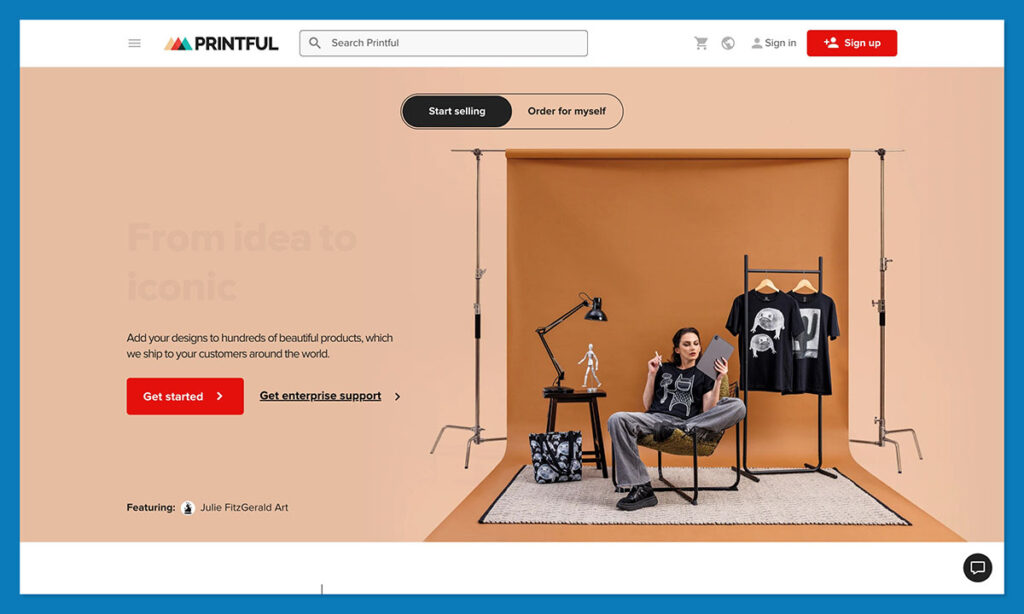
Printful is one of our favorite print on demand suppliers because of the sheer breadth and quality of its catalog. There are hundreds of customizable white label products, and a disciplined approach to production that keeps returns low.
- Large product collection: apparel, accessories, home decor, drinkware, wall art, and more, including premium and eco friendly lines and faster shipping options on select items.
- Flexible selling: Printful is built for integrations. You can connect to Shopify, Wix, Etsy, Amazon, TikTok Shop, WooCommerce, and social channels, or use the Merch Share option to collaborate. It also offers a lightweight Quick Stores option if you have no storefront yet.
- Design and mockups: a strong design maker and a drag and drop mockup generator let you preview products before printing, across print methods like DTG, DTF, embroidery, and all over print.
- Resources: a learning academy, help center, guides, and an active blog give beginners plenty to work with.
- Fulfillment and support: in house production across global fulfillment centers, a three step quality check, and a free reprint or refund policy on manufacturing errors, backed by 24/7 chat and email support.
One piece of current context worth knowing: Printful is now part of FYUL, the umbrella group formed by merging Printful, Printify, and Snow Commerce, which launched publicly in late 2025. In practice nothing changes for sellers. Printful still runs as its own independent brand with its own catalog, accounts, and pricing.
Sellfy key features
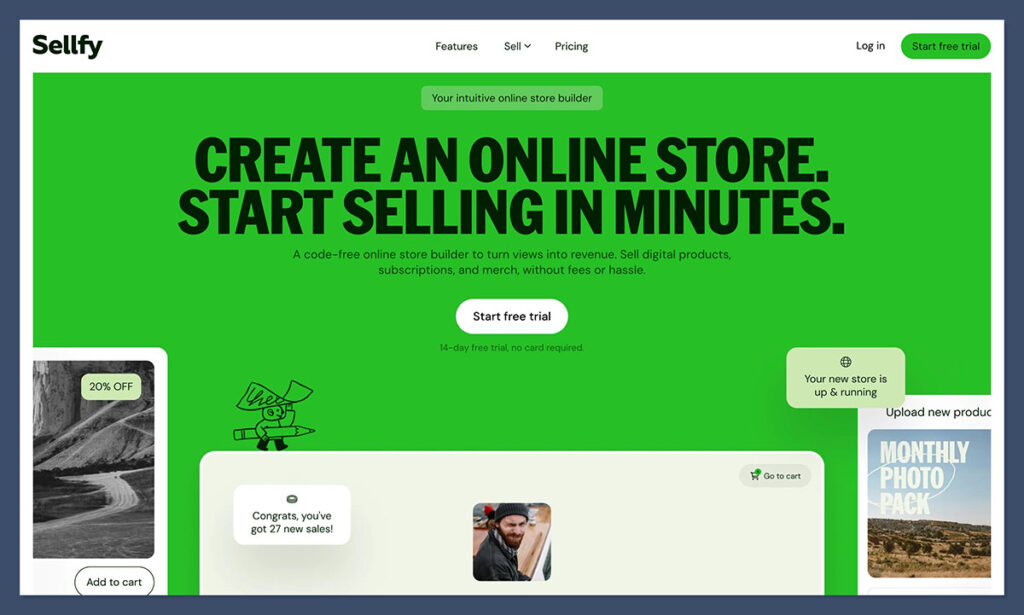
Sellfy is built for beginners who want online selling and print on demand in one place. You can sell white label merch, digital goods, physical products, subscriptions, and even video memberships through a customized storefront.
- Product options: digital products (like ebooks), print on demand merch, physical goods, subscriptions, and video on demand.
- Store builder: unlike Printful, Sellfy lets you build a branded store with your logo, colors, and layout, in multiple languages and currencies, connected to a custom domain.
- Integrated checkout: a built in cart and checkout supporting Stripe and PayPal, secured to PCI DSS standards.
- Content protection: download limits and buyer email stamping on PDF products help protect your files.
- Embedding: buy now buttons, product widgets, and full store embeds let you sell through YouTube, social media, or any existing website.
- Marketing: built in email marketing, upsells, tracking pixels, and discount codes help lift conversions.
The winner: Sellfy. On breadth of features alone, Sellfy edges ahead because it bundles a storefront, checkout, and marketing tools that Printful simply does not include. Printful is the stronger fulfillment layer, but it is only part of a full selling setup.
2. Building Your Store
This is the clearest structural difference between the two, so it earns its own section. Sellfy is a store builder first. Printful was not, but it now offers Quick Stores, a free built in storefront that closes part of the gap.
Printful Quick Stores
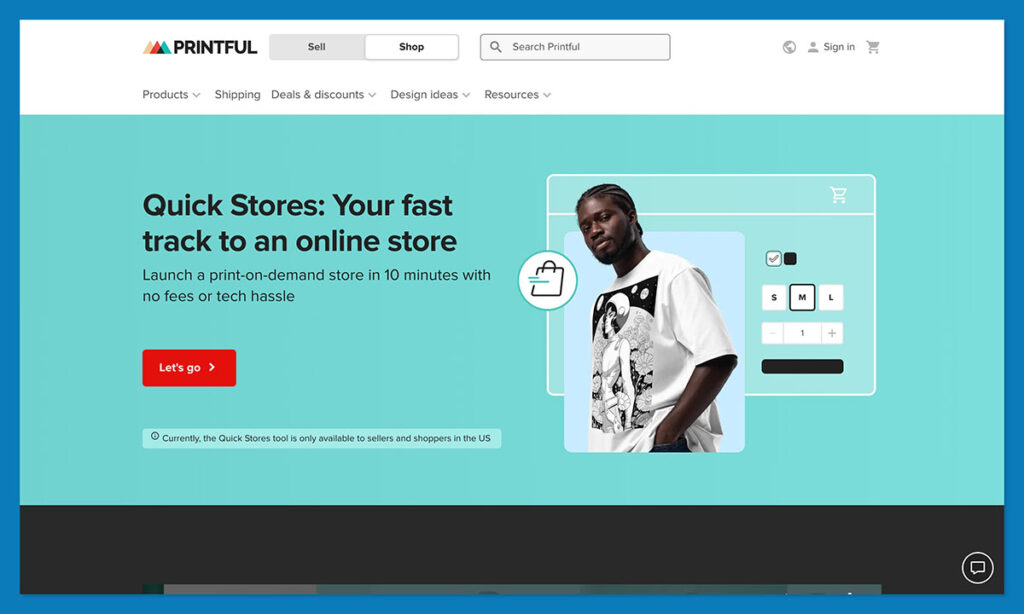
Quick Stores is Printful's free tool for launching a simple storefront in minutes, with no website building skills required. You set your store name, URL, and logo, then add products with your own titles, descriptions, and photos. Customers buy through a shareable link, pay through Stripe, and Printful prints and ships every order automatically. Payouts land in your bank account each month once you clear $25.
The catch is that Quick Stores is deliberately basic. There are no themes or design controls beyond your logo and product details, so you cannot shape the look the way a full platform allows. It is also US only for now, available to US based merchants and limited to US shipping addresses, and because it is not a marketplace, you drive all of your own traffic. We walk through the whole process in our Printful Quick Stores guide, but the short version is that it is a genuine, zero cost way to start selling, best treated as a stepping stone before a dedicated platform.
Sellfy's store builder
Sellfy is built around your storefront. You get a customizable store with your own logo, colors, and layout, connected to a custom domain and ready to sell in multiple languages and currencies. Every store is mobile optimized, and you can embed buy now buttons or the full store on any existing website. The templates are simpler than a dedicated builder like Shopify, but this is a real, branded storefront rather than a basic product list, and it works worldwide rather than in a single country.
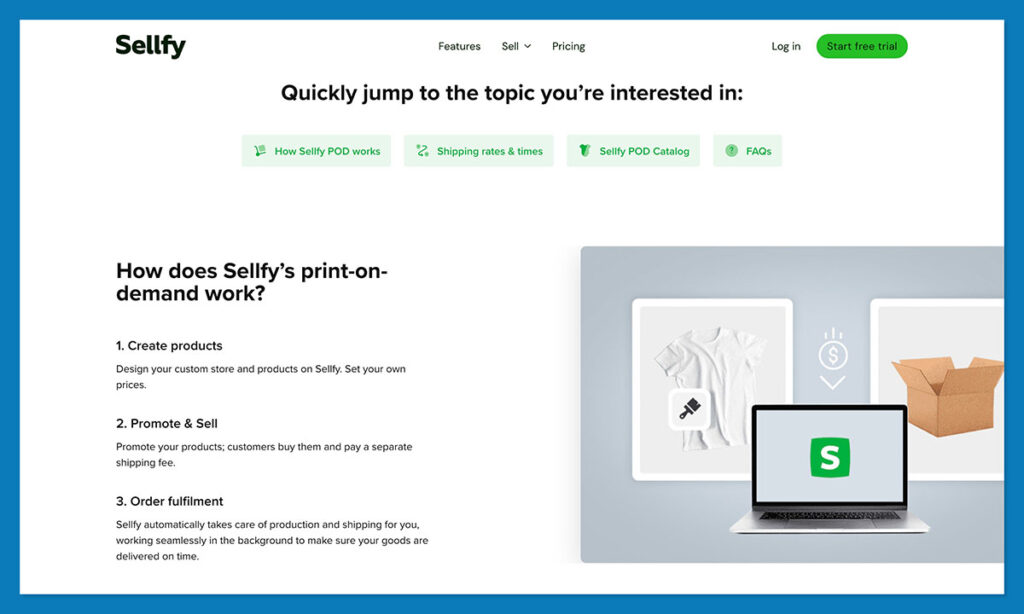
The winner: Sellfy. Printful Quick Stores is a smart free option for US sellers who just want to start, but Sellfy gives you a proper branded store with a custom domain, global reach, and far more control over how it looks.
3. Ease of Use
Both tools are beginner friendly and require no coding, and because both handle print on demand, you avoid the headaches of inventory, packing, and shipping.
With Printful, you can sign up and start designing products in minutes. The mockup generator is drag and drop, with simple controls for colors, fonts, and images, and selling is straightforward once you connect a platform like Shopify, Etsy, or Amazon. You can also use Printful's API to automate parts of your workflow.
Sellfy is just as approachable. You can spin up a storefront in minutes using templates and a simple editor, and every store is mobile optimized and ready for a custom domain out of the box. If you would rather skip store building entirely, Sellfy lets you embed products into buy now buttons and product widgets, turning any site into a store with a single snippet.
The trade off: when we built stores with Sellfy, the templates felt basic. You will not get the design depth of a dedicated builder like Shopify.
The winner: Printful. Both are easy, but Printful makes it slightly faster to design custom products and drop them into any storefront or marketplace, with more polished design tools.
4. Product Range and Quality
This is where the gap is widest. One reason we often recommend Printful to POD sellers is the size and quality of its catalog.
Printful lets you create everything from pins, patches, and hair accessories to bags, sweatpants, t shirts, wall art, laptop cases, and drinkware, with more ways to customize (all over print, embroidery, DTF, and DTG). Base prices run higher than some competitors, but the quality is consistent, and Printful's in house quality checks keep returns low.
Sellfy offers far fewer print on demand options. You will find the common categories like t shirts and sweatshirts, with more basic design tools, though you can choose embroidery or digital printing and Sellfy leans on eco friendly production. Quality can vary more, but the upside is that you can sell POD products alongside digital goods, physical items, subscriptions, and video, all from one store.
The winner: Printful. Printful offers a wider range of higher quality POD products and more print methods. Sellfy's advantage is selling merch next to digital and subscription products in a single storefront.
5. Marketing and Selling Tools
Here Sellfy has a real edge. With Printful, you sell through connected platforms, social channels, and marketplaces, but you cannot build a branded store, and marketing tools live in whatever platform you connect.
Sellfy gives you a custom storefront with a dedicated domain and checkout, plus built in marketing you do not get from Printful directly: discount codes, email marketing, tracking pixels for social ads, and upsell offers. Higher plans add cart abandonment recovery and affiliate marketing. You can also sell across channels with buy now buttons, product widgets, store embeds, and product links.
Of course, if you run Printful through a platform like Shopify, you can access similar marketing tools there, though that usually means additional subscription costs.
The winner: Sellfy. Sellfy is the only one of the two with integrated marketing tools built in. Both support omnichannel selling through embeds and integrations.
6. Customer Support
Both platforms offer support through live chat and email, and Sellfy promises priority support on its pricier plans. What separates them is self help depth.
Sellfy has a reasonable set of FAQs, guides, and help articles. Printful goes further with a dedicated learning academy, blog, news section, and extra paid services such as product photography and video. For sellers who like to solve problems on their own or level up their POD knowledge, Printful's library is the stronger resource.
The winner: Printful. Similar live support, but Printful's much larger library of guides, tutorials, and academy content gives it the edge.
7. Pricing and Plans
Printful is cheaper on the surface, but remember it has no full store builder, so factor in the cost of the platform or marketplace you sell on.
Printful pricing
If you already sell somewhere, Printful is likely the cheapest way in. The free plan covers automatic global fulfillment, the design maker, logo maker, mockup generator, white label packing slips, and 24/7 support. You still pay each product's base cost, shipping, and any extras (branding, extra prints, embroidery digitization).
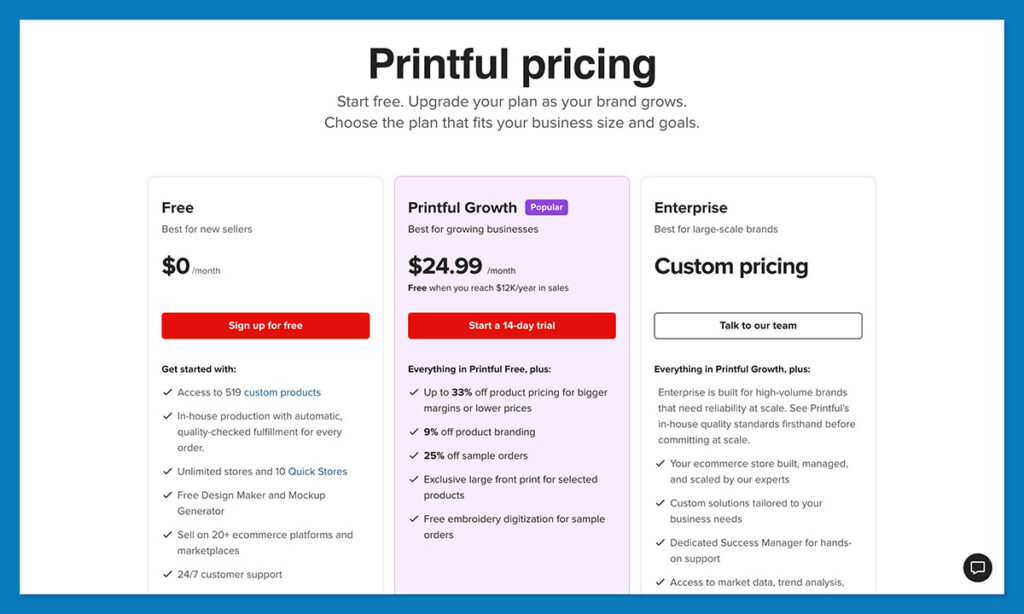
As of January 2026, Printful consolidated its paid plans. The public lineup is now Free and a single paid membership, Growth, with a volume based Business tier for high volume sellers.
| Plan | Price | What you get |
|---|---|---|
| Free | $0 | Full product catalog, integrations, automatic fulfillment, design maker, mockup generator, unlimited stores. Pay per order. |
| Growth | $24.99 per month (free once you reach $12k a year in sales) | Up to 33% off product pricing, 9% off branding, 25% off sample orders, free digitization on sample orders, large front prints on select products. |
| Business | Volume based (typically around $60k a year in sales) | Deeper discounts, priority support, and dedicated account management for higher volume sellers. Not a self serve plan. |
Sellfy pricing
Sellfy has no free plan, but you get a 14 day free trial and a 30 day money back guarantee after upgrading. There are three tiers, each capped by annual sales volume, with roughly 25% off on annual billing.
| Plan | Monthly price | Best for and highlights |
|---|---|---|
| Starter | $29 (about $22 annual) | Up to $10k a year in sales. Unlimited products, digital and subscription products, email marketing, and a custom domain. |
| Business | $79 (about $59 annual) | Up to $50k a year in sales. Adds cart abandonment, upselling, affiliate marketing, store migration, and removal of Sellfy branding. |
| Premium | $159 (about $119 annual) | Up to $200k a year in sales. Adds priority support, higher email credits, and product migration. |
Across every Sellfy plan the platform takes 0% in transaction fees. You still pay your payment processor (Stripe or PayPal) roughly 2.9% plus 30c per sale. Cross your plan's sales cap and Sellfy asks you to move up a tier.
The winner: Printful. On pure entry cost, Printful's free plan is hard to beat. Just remember to add the cost of your storefront, since Sellfy bundles that into its subscription.
Alternatives to Printful and Sellfy
If neither fits, a few alternatives are worth a look:
- Printify: like Printful, it integrates widely and offers a huge catalog through a network of third party print partners around the world. Worth noting that Printify now sits under the same FYUL parent as Printful, though the two run as separate brands with different catalogs and pricing.
- Gelato: a reliable POD supplier known for fast production and fulfillment through a large global print network, with integrations across major sales platforms.
- Fourthwall: an all in one creator storefront with built in print on demand and a merchant of record model, which means it handles sales tax, VAT, and customer support for you. It also offers native integrations with YouTube, Twitch, TikTok, and Discord, with no required monthly fee, making it a strong middle ground between Sellfy's store builder and Printful's fulfillment.
How to Choose: When to Use Each
We recommend Printful over Sellfy for most print on demand sellers. Its own Quick Stores option is basic and US only, but you can sell a large range of high quality products through nearly any channel, its design tools are stronger, and its support library is deeper. That said, if you want a simple way to start selling and do not already have a store, Sellfy is an affordable all in one option.
Choose Printful when you
- Want the widest range of unique, high quality POD products
- Prioritize product quality and strong design and mockup tools
- Need to connect with many sales channels and platforms
- Want value added services and a deep support library
- Already have a store or marketplace presence
Choose Sellfy when you
- Want to add ecommerce and POD to an existing website
- Need to build a simple storefront quickly
- Want store building, marketing, and POD in one subscription
- Are working with a limited budget
- Want to sell digital, physical, and subscription products together
How We Evaluated Printful and Sellfy
Our comparison is based on hands on use of both platforms across real store builds and product tests, weighted across the criteria below.
| Criteria | What we looked at |
|---|---|
| Product range and quality | Catalog breadth, print methods, and consistency of finished products |
| Ease of use | Setup speed, design tools, and how quickly you can start selling |
| Selling and marketing | Storefront options, integrations, and built in marketing features |
| Pricing and value | Plan costs, fees, sales caps, and total cost once extras are added |
| Support and resources | Live support channels plus depth of guides and self help content |
Final Verdict
Printful is the better choice for most print on demand sellers. Its catalog, print methods, design tools, and support library are hard to match, and the free plan makes it easy to start if you already sell somewhere. Sellfy wins for sellers who want everything (store, checkout, marketing, and merch) in one affordable subscription, especially if you are also selling digital or subscription products. In short: pick Printful for the best POD engine, and Sellfy for the simplest all in one store.
Printful vs Sellfy FAQ
Is Printful or Sellfy better?
Printful is better if you want a wider range of high quality print on demand products to sell across multiple channels. Sellfy is better if you want a simple, affordable way to build a storefront and sell merch alongside digital and subscription products.
What is the difference between Printful and Sellfy?
Printful is a print on demand supplier and fulfillment provider that plugs into your existing sales platforms. Sellfy is an all in one ecommerce platform that lets you build your own store and sell POD products alongside physical, digital, and subscription items.
Is Printful free to use?
Printful has a free plan with no monthly fee. You only pay when a customer orders, covering the product base cost and shipping. The optional Growth plan costs $24.99 a month and becomes free once you reach $12k in yearly sales.
Does Sellfy charge transaction fees?
Sellfy charges 0% in platform transaction fees on all plans. You still pay your payment processor, Stripe or PayPal, roughly 2.9% plus 30c per sale.
Can you use Sellfy with Printful?
There is no direct native integration between Printful and Sellfy. You can use Printful's open API to build workaround automations, but the two are not designed to connect out of the box.
Pricing and plan details reflect the platforms' official pages at the time of writing. Print on demand pricing changes often, so confirm current figures on each provider's site before you commit.



Comments 0 Responses