

I’ve used and reviewed both Spring (previously Teespring) and Fourthwall several times in the past, which you’d think would make this comparison a lot easier. Really, it’s still a tricky one, because the two platforms are further apart than they look.
Spring is still one of the easiest ways to sell merch if you have an existing audience. You create a simple storefront with a limited layout, choose products from Spring’s collection, customize them, then sell them straight through the platform. Spring even connects with social channels too, so it’s great if you’re monetizing a YouTube or Twitch audience.
Fourthwall is great for creators too, but it’s a much more comprehensive ecommerce solution. You can sell retail-grade print-on-demand merch through Fourthwall’s catalog, but you can also sell digital downloads, memberships, or subscriptions. You’ve even got the option to accept donations. Plus, you get a complete customizable storefront with a custom domain, Merchant of Record support, plus a really useful AI shop assistant.
Here’s how I’d choose between the two.
Fourthwall vs Spring: My Quick Verdict
Spring is excellent if all you need is a quick, hosted social store for selling print-on-demand products and digital downloads. You control the artwork and choose your retail price, Spring deals with production, payments, hosting, delivery, and buyer support.
Fourthwall is better if you want an all-in-one brand platform, where you can build a custom store, and combine print on demand with memberships, digital downloads, custom self-fulfilled products, donations, and gift cards. Fourthwall acts as your Merchant of Record, and still connects to all the social channels you need to increase your sales channels, but it gives you a lot more room to scale.
| Area | Fourthwall | Spring |
|---|---|---|
| Best fit | Creators and small brands building several income sources | Creators launching merch around social content |
| Store | Customizable branded website with a custom domain | Hosted social storefront with domain support |
| Physical products | Curated POD catalog plus self-sourced stock | POD merchandise produced and shipped by Spring |
| Digital products | Built in, with audience data kept by the seller | Built in, with Spring hosting the files |
| Memberships | Native paid tiers, posts, video, livestreams, and member perks | None |
| Integrations | YouTube, TikTok Shop, Twitch, Kit, Klaviyo, Mailchimp, Zapier, and more | YouTube, Twitch, Discord, Linktree, Store Drop, and other creator channels |
| Tax handling | Fourthwall is Merchant of Record | Spring is the Merchant of Record |
Fourthwall vs Spring Pricing: Fees, Margins, and True Cost
First, the great news is that you can use both of these platforms for free.
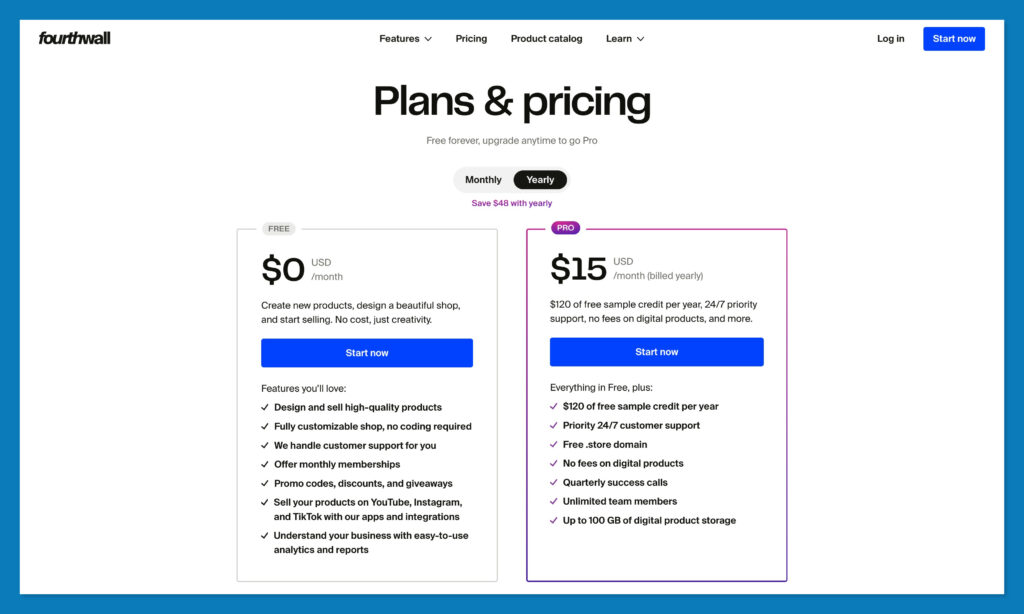
Fourthwall’s free plan gives you everything you need to get started, including a customizable store, options for selling digital or physical products, one additional team member, and up to 50 listings. You don’t pay any fees on physical product sales (except processing costs), but there’s a 5% fee on memberships and digital products.
The paid plan, for $19 per month, or $180 annual removes the digital product fee, and it gives you a 500 product limit, unlimited team members, $10 per month in sample credits, plus premium support.
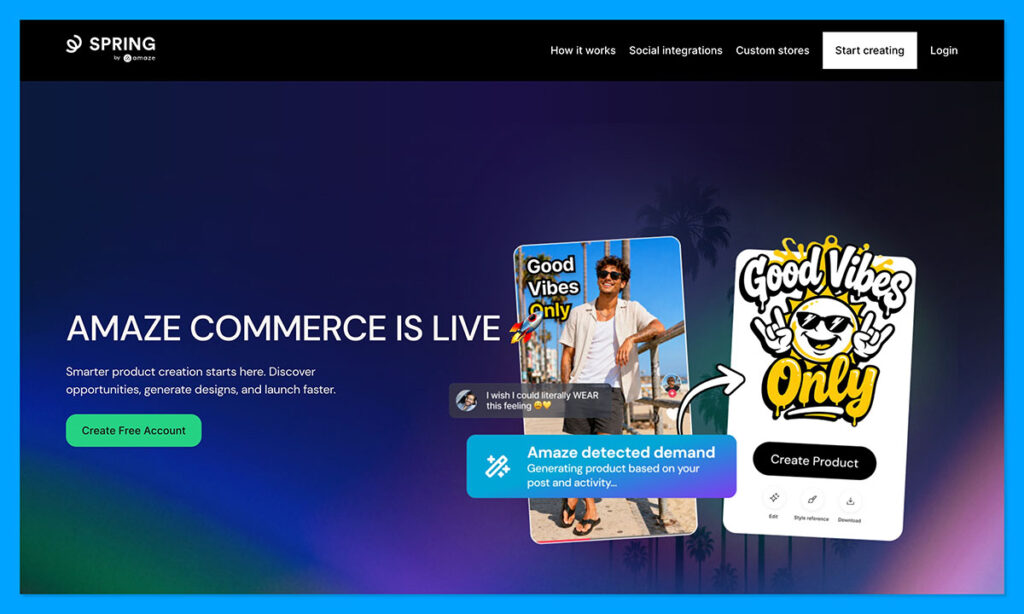
Spring only has one free plan; anyone can open a store and launch a product without paying anything. The money you make can be tricky to calculate, though. Every item has a specific base production cost set by the platform, then you set your own retail price above that base cost.
Digital products are a bit trickier too, as you’ve got a 20% charge plus $1.70 per sale on every download. So if you sell an eBook for $10, you only get $6.30.
For merch, Spring might have slightly lower base costs, but Fourthwall has higher quality. For digital downloads, or a mixed store, Fourthwall is better all around.
Fourthwall vs Spring: Store Building and Integrations
Obviously, there’s a very big gap between Fourthwall and Spring here, because Spring really doesn’t have a proper store builder. It’s great for setting up a storefront quickly. You can add your logo, colors, hero banner, social links, and featured products to a template, and you can connect a custom domain. You’re just limited in how much you can actually build out.
There aren’t really any tools for email marketing included, so you’ll need to handle that separately, and the same applies for blogging, too. On the plus side, Spring does integrate with most of the main social channels, including YouTube and Twitch.
Fourthwall, on the other hand, gives you a complete store builder and customizable checkout. You get far more control over pages, themes, layouts, domains, HTML, CSS, product collections, or anything else you might need. There’s also a Storefront API. Plus, as well as integrating with all the top social media selling channels, Fourthwall also connects with tools like Klaviyo and Mailchimp for email marketing. You can also create blogs for content marketing within your store.

There’s also a very handy Kit connection for Fourthwall now, which syncs subscribers, buyers, purchase details, and members with specific tags, so you can automatically trigger a welcome sequence or relevant offer to keep customers engaged.
Fourthwall vs Spring: What Can You Sell?
If you haven’t paid much attention to Spring since it rebranded from Teespring, it’s worth saying that you can do a lot more with the platform today than you’d think. The main focus is still on selling print-on-demand products, but you also have a Digital Launcher for selling eBooks, filters, audiobooks, or whatever else you can think of.

You can also run percentage, fixed-value, or free shipping promotions, and track the discounts inside of your listing analytics. Still, the shape of the business you can build with Spring is still very limited. You create a listing, send traffic to it, and repeat. You’re not going to have room for things like recurring memberships, self-sourced products, or donations.
Fourthwall, on the other hand, gives you all of those things. The print-on-demand catalog is curated with a quality-first approach. Everything is retail-grade; ideal for a premium audience.
Then you can source and sell your own physical products, sell digital downloads or memberships, accept donations, or bundle a few different offers together. For instance, you might sell an eBook and an audiobook at the same time. There’s even the option to sell gift cards that arrive instantly in your customer’s inbox, and never expire.
Another thing worth saying is that Eli, Fourthwall’s AI assistant, can help with expanding your collection, too. It’s there to help with catalog and price updates, as well as store tweaks, but it can also take a single design and spread it across a range of items if you want to branch out with POD.
Spring does still have a decent product mix to offer companies, but Fourthwall gives you more avenues, and more routes to turn customers into repeat visitors.
Fourthwall vs Spring: Print on Demand
I wanted to go a bit deeper into the POD aspect on both of these platforms, because there are some very important differences. As I said before, Fourthwall has a curated catalog, but it’s packed with quality, including Signature collection items, and retail-grade blanks you won’t find elsewhere. You can end up paying a little more for the base item, but it’s worth it if you can choose the right profit margin, and impress your audience.
The production choices are a little broader with Fourthwall too. You can choose from printed and embroidered apparel, screen-prints, cut-and-sew options, plus sublimation.
Spring has quite a few great print on demand product options too (about 200 different types) mostly across apparel, accessories, or home and lifestyle. Some of those products can be a little cheaper, although honestly, I found most are pretty equal between the two platforms.
For production, you’ve got mostly direct-to-garment printing and screen printing for apparel, and the material quality is decent enough, although the printing itself can be inconsistent. On the plus side, Spring does have a good option for ordering samples at base cost, so you can test the items for yourself before you let customers order them.
Shipping for both companies is decent. Fourthwall works with partners across the EU, UK, Canada, Mexico, Australia, Japan, and the US, with most deliveries taking between five to ten days. Spring has partners in the EU, US, Mexico, India, and Australia, although it’s worth saying that available products may vary depending on where you are. Production and tracking numbers are guaranteed within ten business days, then it’s another four to seven days for delivery, so customers may end up waiting a little longer.
Fourthwall vs Spring: Overall Support
Both companies give you a way to reach out through email, community channels, and help centers if you want extra help, though Fourthwall also gives you access to assistance from Eli, the 24/7 dashboard assistant. If you upgrade to the Pro tier on Fourthwall, you also get dedicated priority support, plus success calls.
Outside of that day-to-day assistance, both companies also give you help in other ways. They’re both ready to act as your Merchant of Record, so you can rely on them to handle relevant tax issues and remittance for you, rather than spending your entire week deep in spreadsheets.
As I said before, both companies also handle fulfillment for print on demand, so that’s another task off your shoulders straight away.
The two companies also give support to your customer. Spring has a “Make It Right” policy which offers a replacement or refund for damaged or defective products that customers report within 30 days. However, it doesn’t handle customer service if your customers just make a mistake with their sizing or color choice, or end up changing their mind.
Fourthwall also handles customer support for print on demand products, handling replacements or refunds for you if there’s something obviously wrong with the item. Like Spring, it won’t accept general returns when customers have made a mistake or changed their mind, since everything is made to order.
Fourthwall vs Spring: Recent Updates
Both Fourthwall and Spring have made some changes lately, which I think are worth discussing, since they show a lot about where the platforms are heading.
Spring is concentrating on improving the experience around listings, account security, checkouts, and creator support. There’s a dedicated Creator Experience team now, and the checkout can handle all kinds of payments, including crypto, PayPal, or Apple Pay.
There’s also new listing controls for bulk-editing designs, changing prices, restoring old listings, or archiving items. Plus, you get multi-factor authentication for accounts.
Fourthwall is building more machinery around repeat customers. Alongside the AI assistant addition, there’s now the Kit integration which helps with triggering follow-ups and membership campaigns. You also get custom gift cards, more granular team roles, self-fulfilment reminders, plus enhanced analytics for tracking things like Twitch gifting.
Plus, there’s a new Throne integration that helps your community support you with wish lists and fundraising. Beyond that, Fourthwall’s added a designer marketplace to help you find illustrators or partners for merch, a partnership with Karat for financial management help, as well as new items in its Signature collection.
Fourthwall or Spring: Which Platform Should You Use?
There’s nothing wrong with Spring if you’re looking for a quick way to start selling custom merch online, and you already have a social audience. It’s free to use, gives you plenty of print on demand and digital products to choose from, and it handles things like taxes and some elements of customer support for you. It just doesn’t give you a full brand you can scale.
Fourthwall is where you go when you want to build a brand you can own, and sell merchandise as just one part of the business. Once you launch you can easily scale out with downloads, paid memberships, donations, and stock you source yourself, without having to migrate to a new platform.
Ultimately, I’d choose Spring if you just want to sell a few digital products and basic merch to an existing social audience, I’d choose Fourthwall if you want a brand you can grow.


Comments 0 Responses