

Shopify and Booqable are two completely different beasts in the ecommerce space, but if you run a business that touches rentals, you've probably weighed them against each other.
We've spent over 60 hours testing both platforms, signing up for trials, building stores, and pushing them through real rental scenarios to bring you a clear recommendation.
Based on our research, the answer isn't a straight winner, it depends entirely on whether rentals are your core business or a side offering.
Shopify vs Booqable: Quick Verdict
- Shopify – Best overall for selling products online, with rentals as a secondary use case
- Booqable – Best for rental-first businesses that need date-based inventory and booking logic
- Shopify + Booqable – Best for hybrid stores that sell some products and rent others
In this comparison, I'll break down how the two platforms differ on pricing, rental features, ecommerce capabilities, ease of use, and design, plus when it makes sense to run them together as a combined stack.
Quick Comparison: Shopify vs Booqable
Here's a side-by-side overview of how the two platforms stack up:
| Feature | Shopify | Booqable |
|---|---|---|
| Primary focus | General ecommerce and omnichannel retail | Equipment and product rentals with date-based bookings |
| Rental features | Not native, requires third-party apps | Built-in rental logic, contracts, deposits |
| Starting price | $29/month (Basic, annual billing) | $29/month (Start) |
| Higher tiers | $79, $299/month, plus Shopify Plus from $2,300/month | $69 and $149/month |
| Free trial | 3 days | 14 days |
| Inventory model | SKU stock per location | Time-based availability with rental calendars |
| Checkout | High-converting ecommerce checkout | Rental-specific checkout with deposits |
| POS / in-person | Full retail POS (Lite and Pro) | Mobile rental check-in / check-out workflows |
| App ecosystem | Over 8,000 third-party apps | Smaller integration list, API on higher tiers |
| Best for | Product-led brands, DTC, omnichannel retail | Rental-first businesses or hybrid via Shopify integration |
Best for Pricing: It's Close
At the entry level, Shopify and Booqable are evenly matched. Both platforms start at $29 per month, but the comparison gets more interesting when you look at what you're actually paying for and how costs scale.
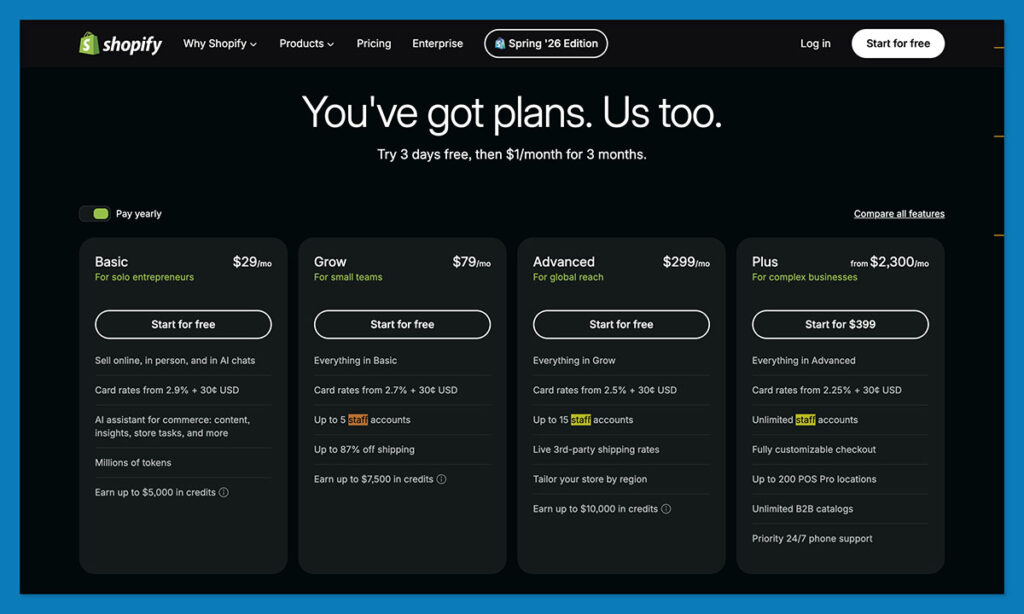
Shopify's pricing in 2026 looks like this when billed annually:
- Basic – $29 per month (or $39 monthly)
- Grow – $79 per month (or $105 monthly)
- Advanced – $299 per month (or $399 monthly)
- Shopify Plus – from $2,300 per month on a one-year term
On top of the subscription, Shopify charges payment processing fees, starting at 2.9% + 30¢ per transaction on Basic and dropping to 2.4% + 30¢ on Advanced when you use Shopify Payments. If you use a third-party gateway, Shopify also adds its own transaction fee on top.
Booqable's pricing is structured around three flat-rate tiers:
- Start – $29 per month
- Grow – $69 per month
- Scale – $149 per month
The big difference is that Booqable doesn't charge transaction fees or take commission on bookings. You pay your own payment gateway directly. Higher Booqable tiers unlock multi-location support, more users, API access, and detailed activity logs.
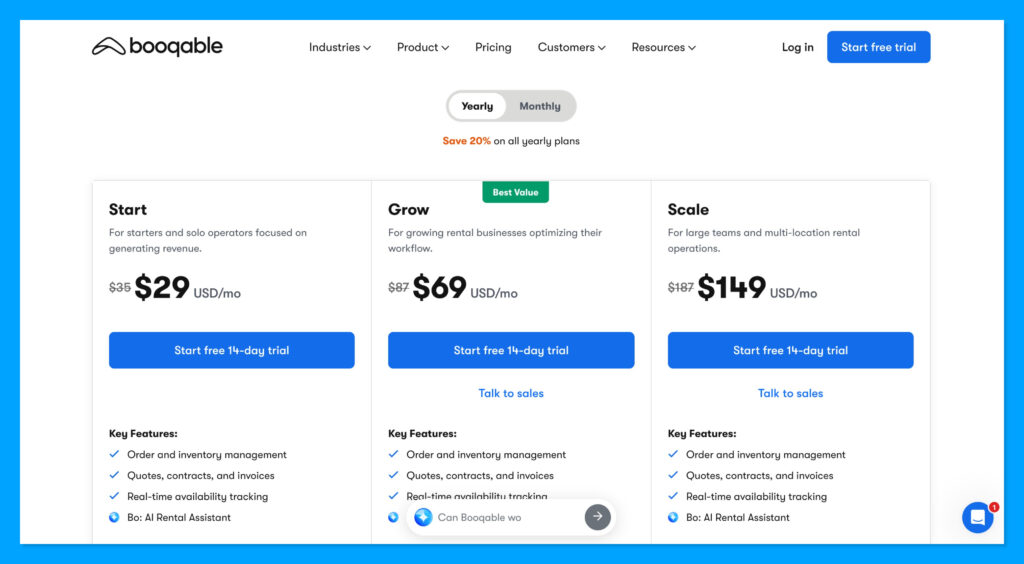
For free trials, Booqable wins. You get 14 days to test the platform versus Shopify's 3-day trial (though Shopify often runs an introductory deal at $1 per month for the first 3 months). Neither requires a credit card to sign up.
If you're running a hybrid setup with both tools, your monthly subscription cost will stack: at minimum, you're looking at $29 for Shopify Basic plus at least $69 for Booqable Grow to unlock the Shopify integration properly. That's around $100 per month before payment fees and apps.
The Winner
It's a tie on entry price, but Booqable is cheaper at scale. Both platforms start at $29 per month, but Booqable's flat-rate model with no transaction fees keeps costs predictable as your business grows. Shopify gets more expensive fast once payment fees and apps stack up.
Best for Rental Features: Booqable
This is where the two platforms genuinely diverge. Shopify's inventory system is built around SKUs, stock counts, and locations, it understands “how many do I have” but not “is this booked from Friday to Sunday.” Booqable's entire model is built around time-based availability, which is the whole point of rental software.
Rental inventory and booking logic
When I tested Booqable, every product I added could be tied to specific date and time windows, with live availability checks at checkout to prevent double bookings. The platform supports both individual tracked items (think serial-numbered cameras) and bulk stock (think 200 folding chairs), and it handles bundles intelligently, when a bundle is reserved, all the underlying components get blocked out automatically.
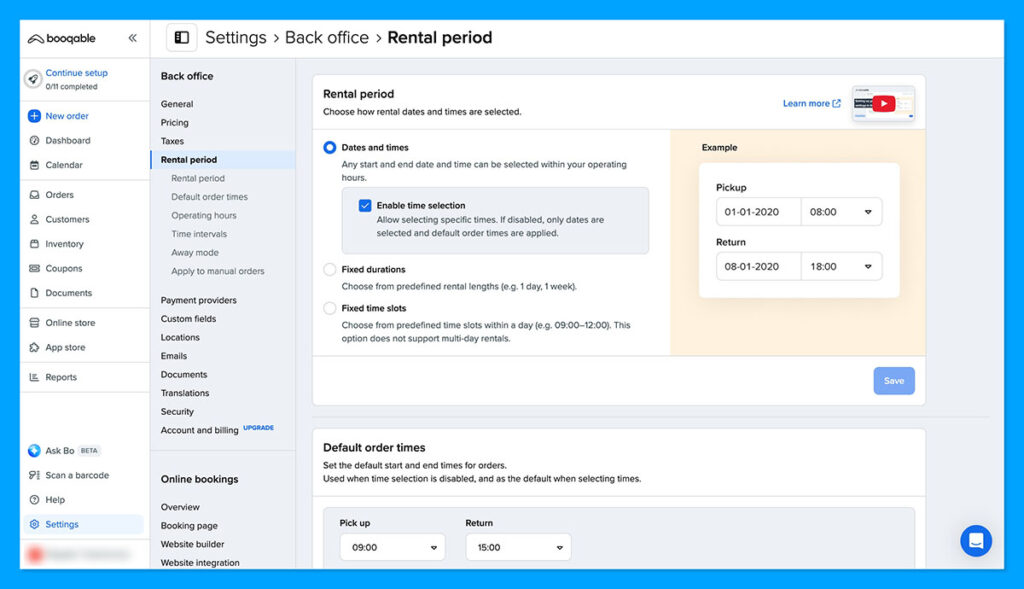
Recent Booqable updates added time selection to stock creation for more precise availability, improved how bundles behave inside orders, and added better calendar filtering.
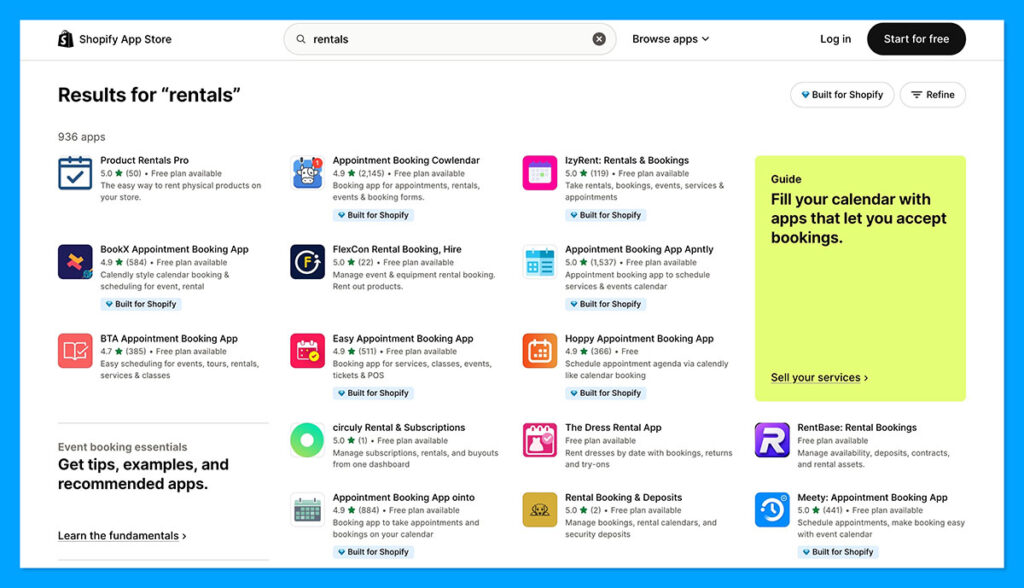
None of this is something Shopify does natively, and the rental apps available in the Shopify app store generally bolt a simplified version of this logic onto Shopify's existing stock model.
Quotes, contracts, and deposits
Booqable handles the quote-to-contract workflow that's standard in equipment rental: a customer requests a quote, you review and approve it, contracts get sent for signature, and deposits get collected separately from the final rental cost.
Shopify can do parts of this with apps, but it's not native and the experience feels stitched together compared to a system designed for it.
Check-in and check-out workflows
Booqable's mobile apps are built around the daily reality of running a rental shop, items get checked out, customers take them, items come back, you inspect them, you flag damages. Shopify POS is excellent for retail transactions but doesn't have the same workflow for items leaving and returning. If you're running a brick-and-mortar rental shop, this matters every single day.
The Winner
Booqable is purpose-built for rentals and it shows. From time-based availability to quotes, contracts, deposits, and check-in workflows, Booqable handles rental operations natively while Shopify needs third-party apps to approximate the same functionality.
Best for Selling Products: Shopify
If your business is fundamentally about selling products outright, whether that's apparel, cosmetics, electronics, or anything else with a one-time transaction, Shopify is in a different league.
The platform has spent over a decade optimizing for ecommerce, and almost every part of the buying experience reflects that.
Sales features
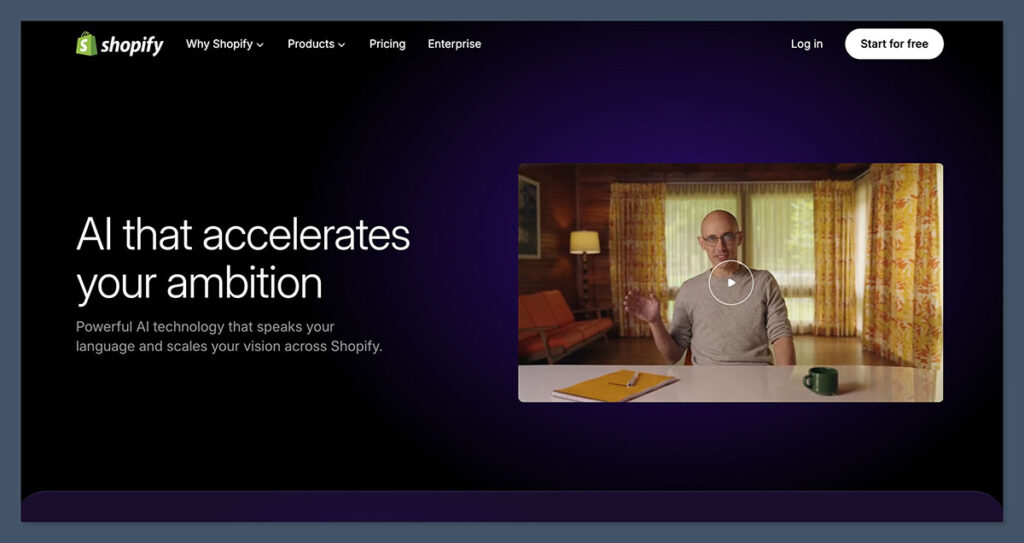
Shopify covers the full ecommerce playbook: product variants, discount codes, abandoned cart recovery, gift cards, customer accounts, multi-channel selling, and a checkout that consistently ranks among the highest-converting in the industry. The platform also includes Shopify Magic, an AI tool that generates product descriptions, blog posts, and email content from short prompts.
Booqable has a cart and checkout, but it's purpose-built for rentals, it handles deposits and date-based pricing, not promotional cross-sells or subscription upsells. If you sell items outright, Booqable's checkout will work, but it won't feel like a conversion-optimized ecommerce experience.
App market
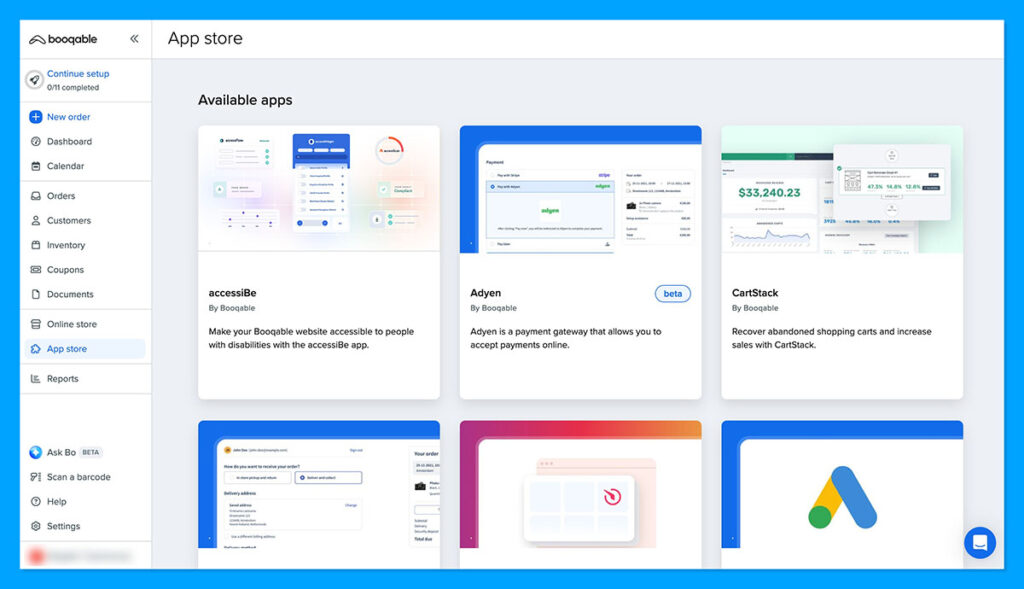
Shopify's app store has over 8,000 third-party integrations covering email marketing, subscriptions, loyalty programs, reviews, shipping, accounting, and basically anything else you can think of. Many are free or have free tiers; others are paid monthly. The breadth is genuinely one of Shopify's biggest competitive moats.

Booqable doesn't have a comparable app marketplace. It integrates with major website platforms (Shopify, WordPress, Squarespace, Wix), payment gateways, and accounting tools, and offers API access on higher tiers for custom integrations. For a focused rental business, this is usually fine. For anyone wanting a deeply customized storefront with marketing automation, loyalty, and merchandising layers, it's limiting.
Payment options
Shopify supports over 100 payment methods including PayPal, Apple Pay, Google Pay, and its own Shopify Payments gateway. Booqable integrates with Stripe, Mollie, and a handful of other gateways. Shopify's depth here matters if you sell internationally or need region-specific payment options like Klarna, iDEAL, or local wallets.
The Winner
Shopify is the clear winner for selling products outright. Its checkout, sales features, payment options, and app ecosystem are unmatched, and its tools for promoting and merchandising products are far deeper than what Booqable offers.
Best for Marketing and SEO: Shopify
Marketing is another area where Shopify's maturity shows. Building traffic and converting visitors is a different problem from managing rentals, and Shopify has invested years into both.
Marketing tools
Shopify lets you connect your store directly to social platforms like Instagram, TikTok, and Facebook, and you can sync your product catalog to marketplaces like Amazon and Etsy through the Shopify Marketplace Connect app. The built-in Shopify Email tool lets you design, send, and track campaigns from inside your admin, with the first 10,000 emails per month free on every plan.
Booqable focuses on the operational side of rentals rather than acquisition marketing. You can connect it to email marketing tools through Zapier or its API, but you won't find the kind of integrated marketing workflows Shopify has built in.
SEO
Shopify includes standard SEO features like editable meta titles, descriptions, alt text, sitemaps, and canonical tags, plus deeper tooling through apps. Its partnership with Semrush via the Ecommerce Booster app gives merchants an SEO action plan with specific recommendations.
Booqable's hosted rental sites and embeddable widgets are functional for SEO basics, but the platform isn't designed around content marketing the way Shopify is. If organic search is a major channel for you, this is a real consideration.
Internationalization
Shopify supports more than 30 languages and can automatically route customers to translated storefronts based on their browser language. Multi-currency selling is built in, and Shopify Markets adds region-specific pricing, tax, and duty handling.

Booqable supports multi-language back offices (including recent additions like Italian) and can be configured for different currencies, but its multi-region capabilities are lighter than Shopify's.
The Winner
Shopify has dramatically better tools for marketing, SEO, and international expansion. If acquiring new customers through search, social, and email is core to your strategy, Shopify gives you significantly more to work with out of the box.
Easiest to Use: Shopify (for ecommerce), Booqable (for rentals)
Ease of use depends on what you're trying to do. Shopify's setup flow is faster and more polished for general ecommerce, but Booqable feels more intuitive once you're working with date-based inventory.
When I signed up for Shopify, onboarding took less than two minutes. It asked a few questions about my business stage and what I planned to sell, then dropped me into the admin with a setup checklist. The dashboard is clean, the editor is section-based (no drag-and-drop, but easy to learn), and adding products is straightforward.
Booqable's signup is also quick, email, password, basic business details, and you're in. The dashboard is built around orders, the calendar view, and inventory status rather than catalog management.
If you've never used rental software before, there's a small learning curve when you first set up products with rental-specific pricing (per hour, per day, per week) and bundles. But once you understand the model, the interface is well-organized and gets out of your way.
Where Shopify clearly wins on usability is template editing, brand customization, and content management. Where Booqable wins is anything to do with managing live bookings, availability conflicts, and rental orders day to day.
The Winner
Depends on the job. Shopify is easier for general ecommerce setup, content editing, and brand customization. Booqable is easier for actually running a rental operation day to day. For ease of use on your specific use case, Shopify wins for selling and Booqable wins for renting.
Best Templates and Storefront Design: Shopify
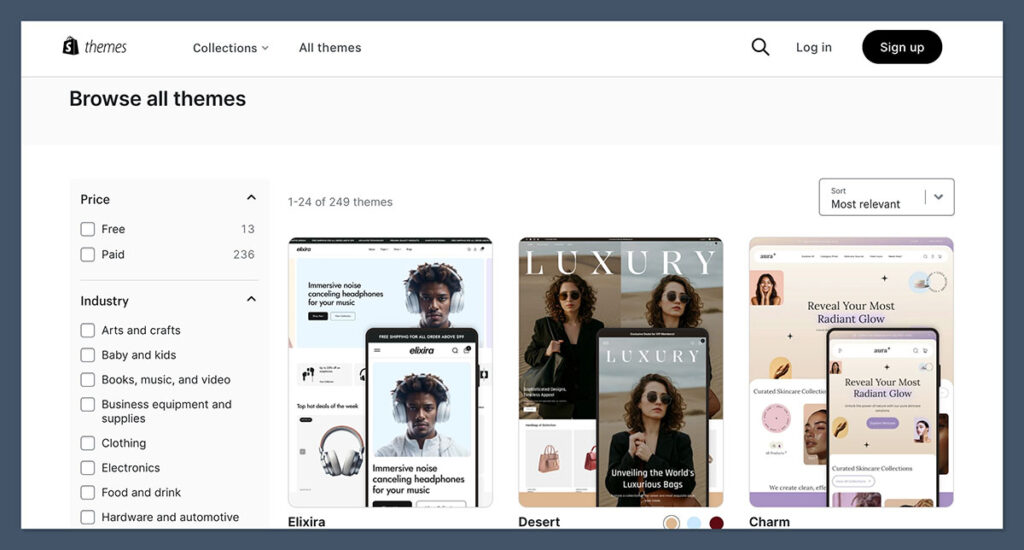
Shopify offers more than 190 templates across a wide range of industries, with 13 free options and premium themes ranging from $180 to $350 as a one-time purchase. The themes are modern, mobile-optimized, and built for conversion, with sections you can rearrange and customize without code.
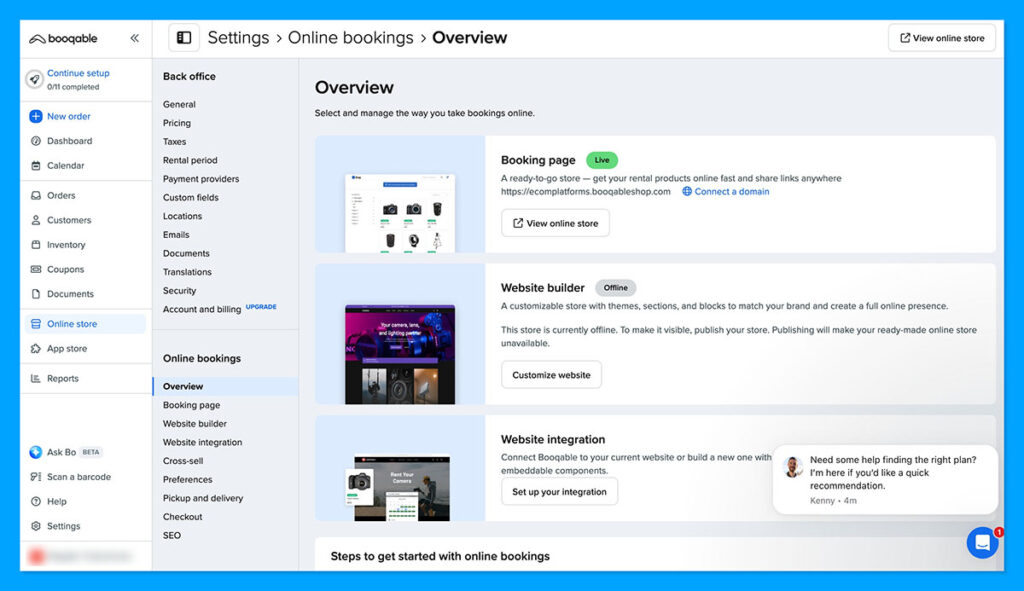
Booqable includes a rental website builder with a smaller library of templates designed specifically for rental businesses. You can also embed Booqable's booking widgets into an existing site on WordPress, Squarespace, Wix, or Shopify rather than using its native site builder.
For brand-first businesses where the storefront is part of the product, Shopify's design flexibility is hard to beat. For rental operators who care more about availability calendars and booking flows than about award-winning design, Booqable's templates are perfectly adequate.
The Winner
Shopify offers a broader range of templates and far more design flexibility. If your brand experience matters as much as your product, Shopify's design ecosystem gives you more to work with. Booqable's themes are functional but limited in comparison.
Shopify + Booqable: When to Use Both Together
One of the most useful things to know about these two platforms is that you don't actually have to choose. Booqable offers a native Shopify integration that turns Shopify into your storefront while Booqable handles rental logic, inventory, and checkout in the background. For a lot of hybrid businesses, this combined stack is the right answer.
How the integration works
Booqable's Shopify app lets you embed rental products, date pickers, and real-time availability inside Shopify product pages. Product information needs to exist in both systems, but rental pricing, availability, and inventory sync from Booqable to the embedded elements on Shopify. The rental cart and checkout can be branded and optionally hosted on your own domain so the customer experience stays seamless.
Pros of the combined stack
- ✔️ Shopify's themes, content tools, blog, and SEO capabilities
- ✔️ Booqable's rental calendar, deposits, contracts, and availability logic
- ✔️ Access to Shopify's app ecosystem for marketing, loyalty, reviews, and analytics
- ✔️ Multi-channel selling through Shopify (social, marketplaces) for non-rental products
- ✔️ Future-proofs your tech stack as your business grows
Trade-offs
- ❌ Product data lives in two systems, which means duplication and governance overhead
- ❌ Two back offices for staff to learn, Shopify for retail orders, Booqable for rentals
- ❌ Stacking two subscriptions adds up, at least $100 per month before apps and fees
- ❌ Overkill for very small, rental-only businesses that don't need Shopify's ecommerce layer
The combined stack makes the most sense when you have a hybrid business model, selling some items outright, renting others, maybe layering in memberships or subscriptions. It also makes sense if content marketing, SEO, and brand storytelling are core to your acquisition strategy and you need Shopify's content tools alongside rental-grade operations.
Shopify + Booqable is the right choice for hybrid businesses.
If you sell some products and rent others, or if you need polished marketing on top of serious rental operations, the combined stack gives you best-in-class tools on both sides at the cost of slightly more complexity.
Best for Support: Shopify
Both platforms offer reasonable support, but Shopify's scale gives it more depth across channels.
Shopify Support
- ✔️ 24/7 live chat through the Help Center, with escalation to human Support Advisors for complex issues
- ✔️ 24/7 phone support available for Shopify Plus merchants
- ✔️ Active social media support across multiple platforms
- ✔️ Extensive Help Center with guides, video tutorials, a community forum, and business courses
- ❌ Priority support is gated behind Shopify Plus
- ❌ Email support has been deprecated in favor of chat
- ❌ Limited in-product onboarding tours after initial setup
Booqable Support
- ✔️ Email and help desk support with reasonable response times
- ✔️ Live chat available during business hours
- ✔️ Knowledge base, video library, and live online training sessions
- ✔️ Smaller team but more rental-specific expertise
- ❌ No 24/7 phone support
- ❌ Smaller community and partner ecosystem than Shopify
- ❌ Implementation help for complex setups can be limited at lower tiers
The Winner
Shopify wins on support breadth and availability. Its 24/7 live chat, extensive documentation, and massive partner network are hard to match. Booqable's support is solid and rental-focused, but the resources are simply smaller in scale.
How We Tested Shopify and Booqable
We spent over 60 hours testing both platforms across seven weighted criteria to form our recommendation:
- Rental and ecommerce features – 35%: How well each platform handles its core use case
- Pricing and value – 15%: What you actually pay across tiers and at scale
- Ease of use – 15%: Onboarding, dashboard clarity, and day-to-day workflows
- Integrations and ecosystem – 10%: App stores, APIs, and third-party tool support
- Design and storefront – 10%: Template quality, customization, and brand control
- Support and resources – 10%: Channels, response times, and documentation depth
- Marketing and SEO – 5%: Tools for acquiring and retaining customers
I signed up for both platforms personally, built test stores on each, and walked through the Shopify + Booqable integration to evaluate how the combined stack performs in practice. Pricing was verified directly against current published rates in 2026.
Shopify vs Booqable: Our Final Verdict
The honest answer is that Shopify and Booqable aren't really competing for the same business. They're competing to be part of your stack, and the right choice depends on what kind of business you're running.
Choose Shopify alone if you sell products outright and rentals aren't a meaningful part of your revenue. The platform's ecommerce depth, marketing tools, and app ecosystem are genuinely best-in-class, and the rare rental need can be handled with a third-party app.
Choose Booqable alone if you run a rental-first business, equipment hire, party rentals, AV gear, photography kit, anything where availability and date-based logic are the operational core. Trying to fake this on top of Shopify will create friction every single day.
Choose Shopify + Booqable if your business is genuinely hybrid: you sell some items, you rent others, and you need both polished marketing and serious rental operations. The combined stack is more complex to maintain, but it gives you tools built for exactly what you're doing on both sides.
Both platforms offer free trials with no credit card required, so the smartest move is to test whichever path fits your business and see how it feels in practice before committing.
Shopify vs Booqable FAQ
Can Shopify handle rentals on its own?
Technically yes, through third-party apps from the Shopify App Store, but the experience is limited. Shopify's inventory model doesn't natively understand date-based availability, so rental apps work around it with varying degrees of success. For occasional or simple rentals, this can work. For a rental-first business, it almost never does.
Can Booqable replace Shopify entirely?
For pure rental businesses, yes. Booqable includes a rental-focused website builder, checkout, and order management system. You won't get Shopify's marketing depth or app ecosystem, but if your business is rental-only, you probably don't need them.
How much does it cost to run Shopify + Booqable together?
At minimum, around $100 per month, Shopify Basic at $29 plus Booqable Grow at $69 (the tier where the Shopify integration becomes more robust). Add payment processing fees on Shopify, any paid apps, and theme costs, and a realistic combined budget is closer to $150 to $250 per month for a small operation.
Does Booqable charge transaction fees on bookings?
No. Booqable doesn't take commission on bookings and doesn't add a platform transaction fee. You only pay your chosen payment gateway's standard processing rate. This is one of the bigger cost advantages over Shopify at scale.
Is Shopify or Booqable better for in-person rentals?
Booqable. Its mobile apps and in-store workflows are built around the realities of rental check-in and check-out, inspecting items, flagging damages, tracking returns. Shopify POS is excellent for retail transactions but doesn't have the same rental-specific workflows.
Which is easier to set up for a beginner?
If you're a beginner to ecommerce in general, Shopify is faster to get running, the onboarding flow and template library are more guided. If you're a beginner to rental software specifically, Booqable's learning curve is reasonable and the time you save on rental operations afterward more than pays back.


Comments 0 Responses