

I’ve tested quite a few print on demand platforms over the years, Printify, Printful, Redbubble – you name it. One thing I’ve noticed is that there’s really no “best vendor” for everyone. The right choice depends on what you’re looking for from a provider.
Both Gelato and Prodigi have earned credit for their focus on reliable, sustainable, and eco conscious POD services – so if you’re interested in sustainability, both options are great. But both of these companies also have their own unique strengths and weaknesses.
If you’re struggling to make the right decision, this behind-the-scenes comparison guide should give you the hands-on advice you need to pick the winner that’s best for your business.
Quick Verdict: Pros and Cons
If you want my opinion on which POD vendor is best overall – I’d probably pick Gelato. It’s a company I know constantly delivers top-quality products, fast production times, and an exceptional range of tools that help businesses scale (like the Personalization Studio).
Still, Prodigi has its benefits. There are no paid subscription plans (which could be a positive or a negative based on your perspective).
Companies get access to a huge product catalog, and the solution itself is very easy to use – I just think it’s less scalable than Gelato.
Gelato Pros and Cons:
Pros:
- Strong focus on sustainability and eco-friendly shipping
- Consistently strong product quality
- Exceptional paper products (and great prints)
- Strong design tools and sales solutions
- Personalization Studio for custom designs
- Integrations with most major ecommerce platforms
- Cost-effective premium plans
Cons:
- Accessing all the features can be expensive
- Not as many product options
Prodigi Pros and Cons
Pros:
- Very large product selection
- Eco-friendly focus on materials and inks
- Integrations with plenty of sales channels
- Easy-to-use and straightforward design
- White-label packaging options
- No monthly fees
- A few handy resources (like pricing sheets)
Cons:
- Not the best design tools
- Variable product quality
- Limited scalability
Gelato vs Prodigi: My In-Depth Comparison
Both Gelato and Prodigi are popular in the POD space. Both companies have embraced the era of “sustainable selling”, working with local partners on production, and opting for eco-friendly inks and materials.
They both also integrate with a few great ecommerce platforms.
Broadly, I’d probably advise anyone looking for a way to start selling quickly to consider Prodigi – but if you’re looking for real scalability and unique features, Gelato is a better choice.
Let’s break down some of the key differences between these platforms.
Product Options, Customization and Branding
Let’s start with product variety. At a glance – Prodigi does seem to have a major edge here. It advertises a catalog of over 500,000 customizable products – that’s a lot more than Gelato’s library of around 350 options.
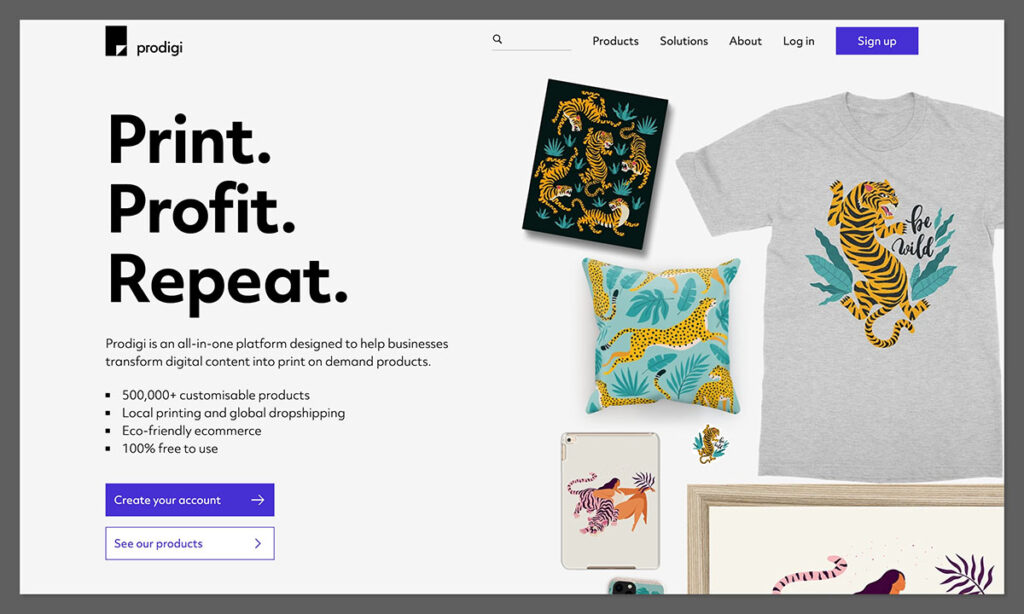
But I think Prodigi’s number is a bit inflated – as it seems like they count each “variation” of a product as a different item.
Both companies offer the same basics: T-shirts, hoodies, posters, framed prints, mugs, phone cases, and stickers. But most of Prodigi’s options are pretty generic – the same things you’ll find offered by the majority of print on demand comapnies.
Gelato has a few more “specialist” options, like premium art prints with frames, or aluminum art pieces.
Customization with Prodigi is pretty standard. You can upload designs, add text, and fine-tune your layout within the dashboard.
The mockup generator feels basic, mostly offering clean product images but not a wide array of lifestyle shots. If you’re looking for branding, you do have access to white label packaging – but there aren’t a lot of additional extras, like custom labels.
Gelato offers much better customization tools, with a premium mockup generator (on paid plans), access to a range of visual assets (like Shutterstock images and fonts) and even integrations with tools like Canva.
Plus, there’s the “Personalization Studio” – which allows customers to upload their own content onto a product. Gelato deals with all the files and production elements, so you can easily sell truly “custom” products without extra work.
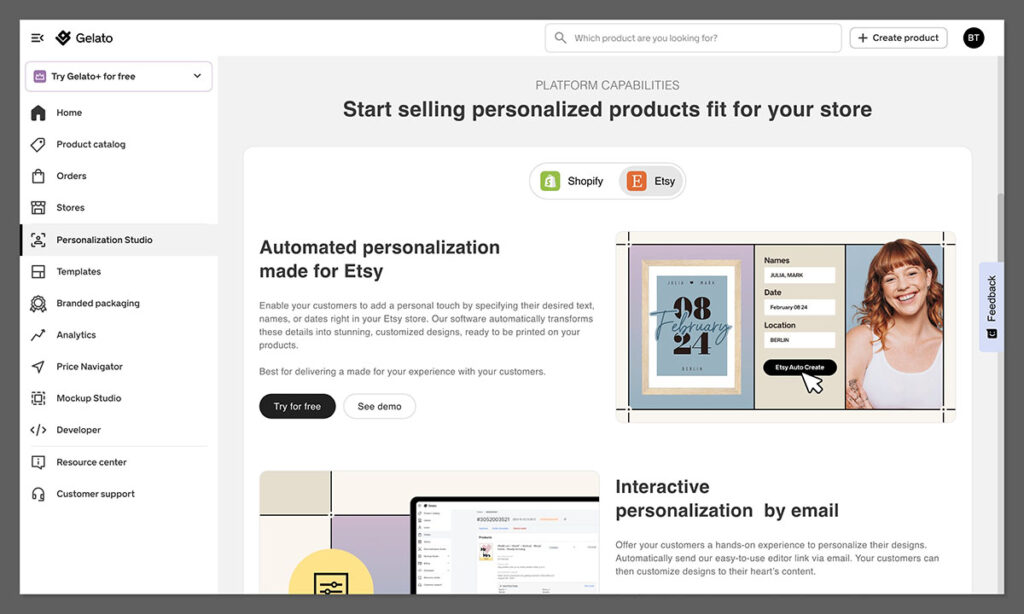
From a branding perspective, Gelato also offers custom labels and packaging inserts – but some of these options are only available to premium plan holders.
Product Quality and Profitability
One of the things I appreciate about Gelato is the consistency. Every sample I’ve ordered or seen from them has come out with vibrant colors, crisp lines, and a professional finish.
This stems, in part, from Gelato’s fairly strict quality assurance process across its production partners. If you upload a low-resolution design, Gelato will warn you before you finalize anything, helping you sidestep pixelated results or dull colors.
Despite a strong focus on quality and sustainability, the base costs for Gelato’s products can be pretty low – a standard t-shirt could cost you less from Gelato than it would from Printful or Printify – and you get extra discounts if you upgrade to a premium plan.
Plus, since you can give customers the option to personalize products, and offer express shipping options, you might be able to charge more.
Prodigi’s products are also pretty affordable – some generic options like Bella + Canvas tees do cost less than they would on other platforms. However, the quality isn’t always as consistent. Some orders arrive flawless, while others have weird coloring or off-center prints.

Prodigi doesn’t tie any features to premium plans – which could save you money in the short-term, but you don’t get anything unique, like custom branding options and personalization – so you’re opportunities to differentiate yourself from other brands are limited.
Global Fulfillment and Shipping
In terms of fulfillment, both companies cater to a global audience. Gelato has a broader local production network spanning over 30 countries, helping ensure fast deliveries to many regions.
It also prides itself on sustainability, aiming to cut down on carbon emissions by printing items as close as possible to the end customer. This sustainability factor is a key selling point if your target demographic values eco-friendly business practices.
Prodigi dispatches items from around 10 worldwide hubs. Typical production times range from one to four days, with certain products like wall art shipped out in as little as 24 to 48 hours.
That’s pretty impressive. Both companies offer Express shipping, but Prodigi provides various additional speed tiers (like overnight options) for certain regions like the US and UK.
If you’re worried about a branded unboxing experience, both partners offer white-label shipping – and they also both allow you to track orders so you can keep your customers up-to-date.
Integrations and Sales Tools
Gelato connects with popular ecommerce sites like Shopify, WooCommerce, Etsy, Wix, Squarespace, and even TikTok. Similarly, Prodigi integrates with most of these companies too – as well as a few extras like Adobe Commerce.
Both offer a similar number of sales channels – so if you’re looking for multiple ways to sell, you’re in good hands.
What I really think differentiates Gelato and Prodigi isn’t their available sales channels – but their sales tools. For instance, Gelato gives you a few basics like pricing sheets, and API documentation for automation – there’s also a handy bulk importing tool – but that’s about it.

More recently, Gelato has rolled out the CreateAI suite, now available even on the free plan. It adds speed to your workflow with tools like instant product publishing, mockup generation, and product migration support.
It’s not a massive game-changer on its own, but for anyone building out large catalogs or switching from another POD provider, it’s a real time-saver.
Gelato, on the other hand, has tools like its Price Navigator feature that assists with planning your profit margins, and a mobile app to let you manage orders on the go.
The biggest bonus is the Personalization Studio – which can plug into Etsy and Shopify stores and give customers the freedom to instantly add personal details to any product. Sure, this feature costs a little extra – but it’s worth it if you want to stand out in the POD world.
Plus, as mentioned above, Gelato’s premium plans come with extras too, like premium mockups you just won’t get from a vendor like Prodigi.
Gelato vs Prodigi: Ease of Use and Customer Support
Gelato and Prodigi are pretty much neck-and-neck from a usability perspective. Like most POD platforms, they both make it easy to set up an account and start customizing products.
I do think Gelato takes slightly longer to master if you’re taking advantage of premium tools and features – but that’s just because Prodigi lacks extra capabilities.
On the plus side, Gelato has plenty of great resources to help you, like tutorials, FAQ guides, and the Gelato Academy for tips on selling. Prodigi has some handy self-help resources too – but they’re not quite as in-depth or informative.
If you find yourself looking for extra support, Prodigi only offers direct assistance through email – and it can take a while (a few hours) to get a response. Gelato combines email support with live chat – which means you can often get answers to questions a lot faster.
Plus, if you’re on certain premium plans – you’ll get access to dedicated customer success managers, or specialist implementation support partners for custom integrations. I think that definitely gives Gelato an edge for companies that need a bit more guidance.
Gelato vs Prodigi: Pricing and Fees
I’ve already mentioned that both Gelato and Prodigi offer pretty competitive “base” prices for products, and their shipping fees are pretty similar too. The biggest difference is that while both companies offer free plans, Gelato offers premium options too.
You can only choose a free plan with Prodigi – which is fine if you want to keep monthly costs low. But Gelato’s premium plans do have a lot to offer scaling businesses.
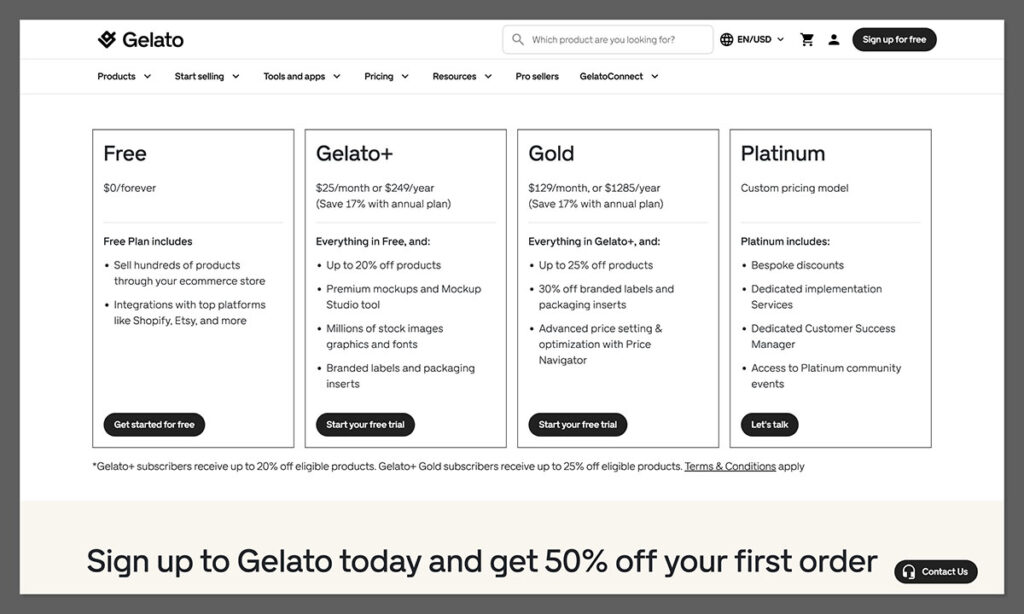
For instance:
- Gelato+ (around $25/month) grants product discounts (up to 20%), premium mockups, and Shutterstock images.
- Gold ($129/month) extends the product discount further (up to 25%) and provides tools like the Price Navigator app for advanced margin calculations.
- Platinum (custom pricing) is aimed at large-scale sellers who need deeper discounts, dedicated support, and access to community events.
These tiered plans may seem expensive on the surface, but they give you a lot of great ways to scale your business, and reduce operational costs over time.
One other thing to keep in mind is that there can be “extra fees” with Gelato. For instance, the Personalization Studio is available for free but charges a 6% transaction fee on every purchase.
You can upgrade with a “Regular” plan for $19 per month, and this cuts the fee to 4% after you sell a certain number of products.
Gelato vs Prodigi: The Verdict
If I have to choose a winner – it’s got to be Gelato. It offers a richer feature set, better options for scaling your business and increasing profits, and more consistent product quality. Gelato’s premium plans are also great for taking your business to the next level.
Prodigi does work fine if you’re on a tight budget and prefer no monthly subscription commitments – and you do get a larger catalog, and ultra-fast delivery times. But I still think Gelato will allow you to create better products at scale – much faster.
Either way, both platforms have solid reputations and track records with creators. The best choice all depends on your needs, so consider trying both if you’re not sure. After all, they both have free plans, so you can test them out for yourself.


Comments 0 Responses