

After reviewing ecommerce platforms for well over a decade, my pick for most CBD sellers is Wix: it has a guided hemp declaration route for US merchants, a real choice of approved gateways behind it, and, unlike Shopify or BigCommerce, it doesn’t charge you a platform surcharge for using one.
That said, two things override it. If you sell in person as well as online, Square Online is the cheaper answer. And if you’re based outside the United States, the guided CBD programs on Wix, Shopify, and Square mostly won’t be available to you at all, which makes WooCommerce the realistic pick.
The reason platform choice matters more here than in any other retail category is that not one major ecommerce platform will process a CBD order through its own native gateway. Shopify Payments, Squarespace Payments, Stripe, PayPal, and Wix Payments all decline hemp outright. Every platform routes you to a third party, and what each one charges you for that privilege varies by thousands of dollars a year.
In this guide, I’ll walk through the six platforms that permit CBD sales, what each actually costs once a high-risk gateway is plugged in, which products and marketing claims will get your account closed, and how the rules differ if you’re selling from the UK, the EU, or Canada rather than the US.
Key Takeaways
- No platform processes CBD natively. All six route you to a third-party high-risk gateway, so budget for elevated processing rates from day one.
- BigCommerce is no longer the fee-free option for this category. Its Open Payment Provider Fee of up to 2% applies to every CBD order, because no gateway on its exempt list accepts hemp.
- Shopify’s 0% transaction fee doesn’t apply to you either. Shopify Payments declines hemp, so CBD merchants pay the third-party gateway surcharge on every sale.
- Wix and WooCommerce add no platform-level fee at all, which makes them the cleanest options on pure transaction economics.
- Square is the only platform that is also the processor, but it prohibits hemp flower, generally prohibits vape cartridges, and bans health claims across your entire catalog.
- The US federal definition of hemp changes on November 12, 2026, shifting to a total THC standard capped at 0.4mg per container, which may affect full-spectrum formulations.
- Outside the US, the constraint is product authorization, not payments. UK and EU sellers face novel food rules; Canada routes all CBD through Cannabis Act licensing.
How We Evaluated These Platforms
- Pricing verified against live pricing pages, not archived figures. Plan names and fee structures on several of these platforms changed recently, so older guides are unreliable here.
- Hemp policies read directly from each platform’s own documentation, including help center articles and acceptable use policies, rather than from third-party summaries.
- Total cost modeled for a CBD merchant specifically, meaning every calculation assumes a third-party high-risk gateway, because no native option is available.
- Restrictions weighted as heavily as features. A prohibited product category or a banned marketing claim disqualifies a platform faster than a missing feature does.
- Regulatory position checked against primary sources, including the FSA, EFSA, and the current US statute, with pending legislation flagged where the position is still moving.
One note before the comparisons. Where you’re based changes the answer before anything else does. US sellers should start with the section directly below. If you’re selling from the UK, the EU, or Canada, skip ahead, because your first obstacle is getting the product authorized rather than getting paid for it.
United States: The Federal Hemp Rules Are Changing
If you’re selling into the US market, you need to know that the legal definition underpinning this entire industry is being rewritten. Sellers elsewhere can jump to the international section.
On November 12, 2025, Congress enacted the FY2026 agriculture appropriations package (P.L. 119-37, Division B), which amends the federal definition of hemp in 7 U.S.C. §1639o. The change swaps the old delta-9-only threshold for a total THC standard, and it caps hemp products at 0.4mg of total THC per container. It was written with a one-year runway, so it takes effect on November 12, 2026.
Two consequences matter for anyone building a store right now.
First, the change reaches further than delta-8 and THCA flower. Industry groups and trade press have flagged that plenty of full-spectrum CBD products carry more than 0.4mg of total THC per container, which means formulations that are compliant today may not be compliant afterward. If you sell full-spectrum, talk to your manufacturer about certificates of analysis and per-container totals now rather than in October.
Second, every platform policy quoted in this guide is currently written around the old 0.3% delta-9 standard. Square, Shopify, and Wix will all have to revise their acceptable use policies before the deadline, and platforms tend to tighten first and clarify later.
The timeline is also still moving. A Senate stopgap funding bill advanced 89 to 4 on August 3 would push most of the new restrictions back roughly 30 days, to December 11, 2026, but it is not law until the House passes it and the President signs it. Separate bills to delay, repeal, or replace the provision outright remain in committee with no vote scheduled. Treat November as the working deadline and watch for movement.
None of this is legal advice. If you are building a CBD business, a compliance attorney in your state is a cheaper line item than a frozen merchant account.
Selling CBD Outside the United States
Most CBD platform roundups are written for a US audience, and they quietly assume the American model: the product is broadly legal, and your hard problem is finding a processor. Outside the US, that assumption breaks.
In the UK, the EU, and Canada, the binding constraint is usually whether your product is authorized for sale at all. Payment processing is the second problem, not the first, and no ecommerce platform can solve the first one for you.
United Kingdom
The Food Standards Agency classifies ingestible CBD (oils, capsules, gummies, drinks) as a novel food, which means it requires pre-market authorization. In practice, the FSA maintains a public list of products linked to credible applications, and its guidance to local authorities is that products not on that list should be removed from sale in England and Wales.
Two nuances catch sellers out. Validation is not authorization, so appearing on the list buys you the right to keep trading while your application progresses, not a guarantee of approval. And the FSA has removed over 100 products from the list for failing to progress their applications.
Other points worth knowing: finished products should contain no more than 1mg of controlled cannabinoids per container; the FSA’s recommended daily intake for healthy adults is 10mg, which is advisory guidance rather than a legally enforced cap; and CBD flower is generally treated as illegal under the Misuse of Drugs Act, because UK law classifies the flowering parts of the plant as controlled material.
If you’re reselling rather than manufacturing, the practical question is simple: is your supplier’s product on the FSA list? If not, you have a business risk that no platform choice will fix.
European Union
The EU runs a parallel but stricter framework. Under Regulation (EU) 2015/2283, ingestible CBD has been classified as a novel food since January 2019, and as of mid-2026 no CBD product has been added to the Union list of authorized novel foods. More than 200 applications have been submitted, with roughly 17 under EFSA assessment.
There has been movement. On February 9, 2026, EFSA published a provisional safe intake level of 0.0275mg per kilogram of body weight per day, which works out to around 2mg per day for a 70kg adult, for highly purified CBD of at least 98% purity. It excludes several groups, including under-25s and pregnant women.
That figure is a scientific benchmark, not an approval. The European Commission and member states still have to vote CBD onto the Union list before it can be sold lawfully as a food or supplement at EU level.
Until then, enforcement varies country by country and ingestible CBD trades in a grey zone that is tolerated in some markets and actively enforced against in others. Cosmetics, topicals, and non-ingestible formats sit under different rules and are considerably less exposed. Note too that the EU hemp cultivation threshold moved to 0.3% THC under the Common Agricultural Policy, up from 0.2%.
Going the formal route is expensive. Industry estimates put a full novel food dossier at roughly €300,000 to €500,000 and 18 to 36 months, which puts it out of reach for most small sellers. Partnering with an authorized supplier is the realistic path.
Canada
Canada is the one most often misrepresented in guides like this one, so it’s worth being precise. CBD is legal in Canada, but it is not an open ecommerce category.
All CBD is regulated under the Cannabis Act, regardless of whether it comes from hemp or from cannabis. There is no wellness-supplement carve-out equivalent to the US model. Products must be made by Health Canada licensed producers, and retail runs through provincially authorized channels, whether that’s a government store like the OCS or SQDC, or a licensed private retailer.
Which means you cannot simply spin up a Shopify store in Canada and start selling CBD oil as a supplement. You need federal licensing and provincial retail authorization first, and you generally can’t ship across provincial borders. Health claims also require Health Canada approval.
For most readers, the honest takeaway is that Canada is a licensing project rather than a platform decision.
What This Means for Platform Choice
Two consequences for the comparisons that follow.
First, most hosted platform CBD programs are US-only. Wix’s hemp declaration flow, Shopify’s attestation, and Square’s CBD program are all built around US merchants. If you’re selling from the UK or the EU, those guided routes mostly won’t be available to you, and you’ll be arranging a high-risk merchant account independently.
Second, that tilts non-US sellers toward WooCommerce, which imposes no regional program of its own and lets you pair any gateway your acquirer approves, including options like Viva Wallet that serve parts of Europe. It’s the reason WooCommerce ranks higher for international merchants than its position in most US-written roundups suggests.
General Guidelines for Selling CBD Online
Rules and regulations vary across the globe for selling what are often called “vices” to the public. Since CBD is so closely associated with THC and marijuana, it’s regularly lumped into the same group, and traditionally been considered a “vice,” similar to alcohol or tobacco.
Payment processors have a history of avoiding these types of products for liability reasons; they’re classified as “high-risk industries.”
Enough time has passed for most ecommerce platforms, and a handful of payment processors, to build dedicated hemp programs. But high-risk classification has not gone away, and it is what drives the pricing differences you’ll see below.
Here are the guidelines and general tips to think about:
- Many countries have made CBD legal but, more often than not, it’s been heavily regulated. Therefore, you must follow all production, shipping, and sales requirements of your locale.
- Although the list may change, the guided CBD programs offered by hosted platforms are overwhelmingly built for US merchants. Canada routes CBD through Cannabis Act licensing rather than general ecommerce, and UK and EU sellers face novel food authorization rules, so check your own market before assuming a platform program applies to you.
- Even US and Canadian sellers must usually get local permits and fill out certain forms to sell CBD online.
- There’s a specific form you must complete to ship CBD through the United States Post Office. Many other carriers have similar applications.
- Find a web host/website builder that allows for CBD sales. All ecommerce platforms on this list approve of CBD sales, but many others are introducing changes to their policies as well.
- The main roadblock for CBD sales is the payment processor; without a CBD-friendly payment processor, your ecommerce platform is useless. Not one of the six platforms in this guide will process a CBD order through its own native gateway. Every single one of them routes you to a third party.
- You must find a merchant bank account that will accept payments for CBD and hemp-derived products. Without a bank account, you can’t get your money from the payment processor.
- Expect underwriting to ask for certificates of analysis (COAs), supplier contracts, product labels, and your refund policy. Have them ready before you apply.
- Avoid health claims in your product copy. Saying a product treats or relieves anxiety, inflammation, depression, or any medical condition conflicts with FDA guidance and can get your merchant account closed even when the product itself is compliant.
- Set up age verification and state-level shipping blocks at launch, not after your first compliance notice.
- Hemp-derived clothing doesn’t have the same restrictions as products you consume.
- Be aware that any payment processor, ecommerce platform, shipping courier, or banking institution could shut down your account at any time due to the highly regulated nature of CBD. Keep a backup processor approved and dormant.
What are the Best CBD Ecommerce Platforms?
Keep reading to learn all about the best CBD ecommerce platforms. We explain what makes each platform desirable for CBD merchants, and talk about the pricing and notable features from each one.
1. Wix
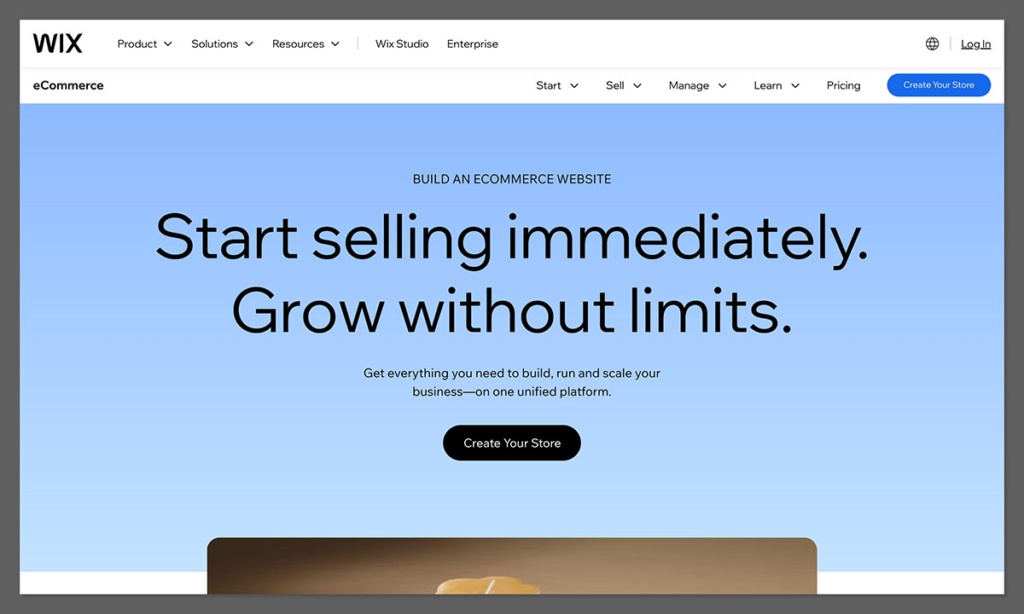
Wix continues to be one of the easiest places to launch your CBD store in 2026, but now its ease of use is just the start of its appeal. The builder is definitely simple, with hundreds of templates, and even a proper setup route for US hemp merchants. You also get AI features built into Wix Harmony that help with sorting out pages and adding products, among other things.
Plus, Wix already has built-in tools for marketing, and subscriptions, so you don’t have to worry about installing extra apps when your business starts to grow. Still, there are limits, since Wix only supports certain businesses selling CBD products in specific regions.
Why It’s Great for Selling CBD
Wix honestly makes all kinds of online selling a lot less complicated. For CBD sellers, it has a handy set-up route for US merchants. After you submit a declaration, you can connect Square, Bankful, Priority Payments, or a range of other options to suit your needs, since Wix Payments doesn’t support CBD.
The site-building side is also a lot easier lately too, although Wix has always kept things reasonably simple. Wix Harmony lets Aria (the AI assistant), build product pages, sections, or copy for you, then everything gets moved into a visual editor for you to make your final changes.
Still, it’s worth saying that AI is helpful for the initial setup stages, it’s probably not something you should trust to write health claims.
Notable Features
- Includes an easy-to-follow declaration process for US hemp and hemp-derived CBD sellers
- CBD-friendly payment connections with Square, Priority Payments, Evergreen Payments Northwest, or Bankful
- Pre-existing templates for CBD skincare, facial oils, soaps, and more
- Specific shipping-region controls for blocking certain steates
- SEO tools, email campaigns, live chat, plus abandoned cart recovery
- Wix Harmony and Aria for first-draft store content
- Dropshipping supported through Modalyst
- Content marketing enabled for blogs
Pricing:
Wix’s cheapest plan doesn’t accept payments, so you’re limited to three main plans:
- Core: $29 per month for payments, 50GB of storage, basic ecommerce tools and five collaborators
- Business: $39 per month for 100GB of storage, standard ecommerce features and ten collaborators
- Business Elite: $159 per month for advanced ecommerce, unlimited storage and 100 collaborators
Those prices are based on annual billing, paid upfront. Business is probably the best fit once the store is bringing in regular orders. Business Elite is a much more expensive at $159 per month, particularly when the CBD payment processor may already charge higher fees than a standard retail gateway.
2. Shopify
Shopify touts one of the easiest ecommerce platforms for selling CBD due to its all-in-one dashboard, integrations with a multitude of payment gateways, and its large collection of apps and themes.
You’ll also have access to various other products like its POS and fulfillment network, all from the same convenient dashboard. What you won’t get is Shopify’s own checkout, and that shapes the economics more than anything else in this section.
Why It’s Great for Selling CBD
Every plan (besides the $5 Starter plan, which is mainly for influencers) from Shopify allows for the selling of hemp-derived CBD. There are already quite a few CBD merchants on the platform for the following reasons:
First, Shopify has professional website building tools to fit the CBD industry; you can find industry-specific themes, and work with the integrated app ecosystem for custom functionality.
There’s also a collection of marketing tools for standing out in the competitive CBD world, like SEO, email marketing, and on-page promotions.
Not only does Shopify allow CBD merchants on its platform, but it connects you with CBD dropshippers for an easy supply source.
US-based merchants complete an attestation inside the Shopify admin confirming they understand and comply with applicable hemp laws. That step is quick, and it shifts the compliance burden squarely onto you.
On top of that, the shipping engine helps you set location-based rules so that you abide by CBD regulations in each state.
The Shopify Payments Catch
This is the part most roundups get wrong, so it’s worth being blunt.
Shopify’s own help documentation states that Shopify Payments does not support the sale of hemp, CBD, or THC products. The underlying reason is that Shopify Payments runs on Stripe infrastructure, and Stripe prohibits the category outright.
So the “0% transaction fees with Shopify Payments” selling point that applies to every other Shopify merchant does not apply to you. A CBD store connects a third-party gateway, and Shopify adds its third-party surcharge on top of whatever that gateway charges. That surcharge runs roughly 2% on Basic, and steps down through Grow and Advanced, in the region of 0.2% to 2.0% depending on plan.
Practically, that means the case for upgrading from Basic to Grow arrives much sooner for a CBD merchant than for a regular retailer, because you are paying the surcharge on every order from day one rather than never paying it at all.
One more operational detail worth knowing: Shopify explicitly tells merchants who already run Shopify Payments and want to add hemp products that they have two options. Switch the store’s payment settings to a third-party provider, or open a second store dedicated to hemp. If you sell CBD alongside non-CBD products, the second-store route is often the cleaner setup.
Notable Features
- Compatible with a wide range of third-party CBD payment gateways, including Authorize.Net and NMI
- In-admin hemp attestation process for US merchants
- Shipping controls to prevent shipments to states that don’t allow CBD sales
- Integrations with suppliers, fulfillment companies, and some dropshippers that provide CBD products
- Powerful point of sale tools for retail operations
- Multiple sales channels beyond the online store, like social and marketplace selling
- Abandoned cart recovery
- Marketing automation and custom segmentation
- Gift cards, discount codes, and reports
Pricing
Note that the mid-tier plan, previously just called “Shopify,” is now named Grow. Annual billing saves roughly 25% across Basic, Grow, and Advanced.
- Basic: $39 per month ($29 billed annually) for an online store, unlimited products, all sales channels, manual order creation, discount codes, a free SSL certificate, abandoned cart recovery, gift cards, basic reports, marketing automation, customer segmentation, and support for the Shopify POS.
- Grow: $105 per month ($79 billed annually) for everything in the previous plan, plus additional staff accounts and inventory locations, standard reports, ecommerce automations, and a reduced third-party gateway surcharge.
- Advanced: $399 per month ($299 billed annually) for everything in the previous plans, plus advanced reports, more staff accounts and locations, and the lowest self-serve gateway surcharge.
- Plus: from roughly $2,300 per month on a multi-year term, for high-volume operations that need checkout extensibility and B2B.
We don’t recommend trying to use the $5 Starter plan for selling CBD or hemp-derived products; it’s a checkout link rather than a full online store, so you lose the shipping controls and content pages that a compliant CBD operation actually needs.
3. Squarespace
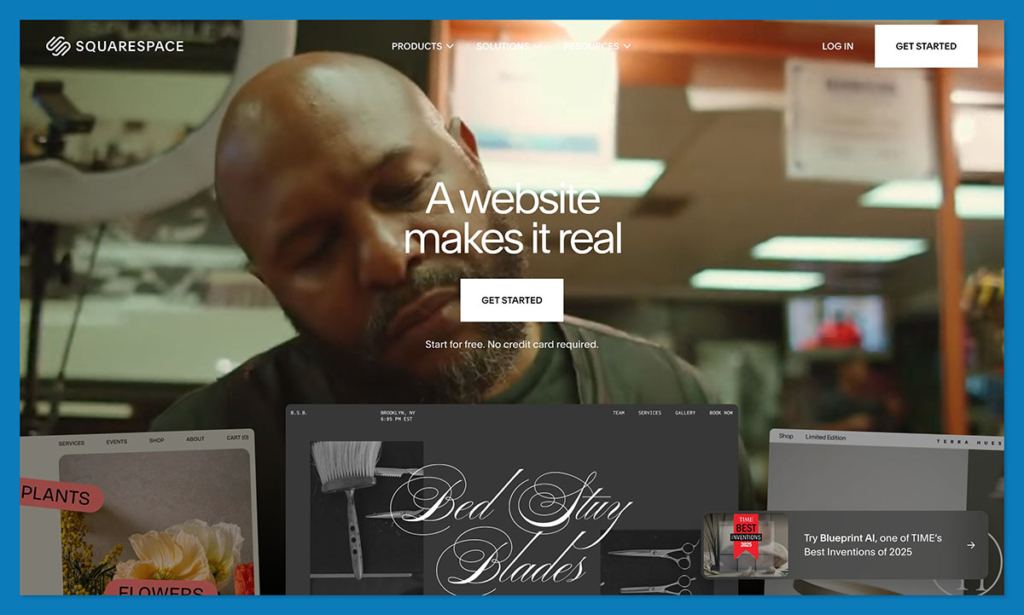
Squarespace is limited in its support for payment processors, but it’s still such a strong design platform that plenty of merchants persist with it for their CBD businesses. The complication is that Squarespace Payments, Stripe, and PayPal all decline the category, which covers every native option the platform offers.
That leaves workarounds rather than integrations. The most commonly used route in the Squarespace community is Foxy.io as a cart and checkout layer, connected to Square or another high-risk merchant account. Authorize.Net setups and external buy buttons also come up. None of these are one-click installs, and all of them mean your checkout lives partly outside Squarespace.
Contact the payment provider directly for current integration steps before you commit, because these workarounds change more often than the platform’s own features do.
Why It’s Great for Selling CBD
Squarespace is a little restrictive when it comes to payment processors, but the platform itself still permits CBD sales, and the design ceiling is higher than anything else on this list.
Overall, Squarespace leads the way in helping merchants build professional-looking sites. You can choose from stunning templates, drag and drop elements onto the page, and utilize many of the built-in marketing features to compete in the saturated CBD business.
It suits a small, tightly curated catalog with strong brand photography. It suits a 200-SKU operation with state-level shipping rules far less well.
Notable Features
- Workaround routes to CBD-friendly gateways via Foxy.io, Square, and Authorize.Net
- Built-in memberships for selling CBD subscriptions
- Course selling tools to make money on informational CBD products
- Powerful marketing tools for social, email marketing, discounts, banners, and content creation
- The best online store templates in the game, with themes that run on high-resolution images
- 0% Squarespace commerce transaction fees from the Core plan upward
- Point of sale support
- Selling products on social sites
- Merchandising
- Abandoned cart recovery and subscriptions on the higher tiers
Pricing
Squarespace replaced its old Personal, Business, Commerce Basic, and Commerce Advanced tiers with a four-plan lineup. Merchants on legacy US plans can generally stay where they are, so what you see in your own dashboard may not match the current public pricing.
- Basic: $25 per month ($16 billed annually). You can sell, but Squarespace takes a 2% commerce transaction fee on top of your processor’s cut.
- Core: $39 per month ($23 billed annually) for 0% commerce transaction fees, custom code, premium integrations, and customer accounts. Digital products still carry a 5% fee.
- Plus: $65 per month ($39 billed annually) for everything above, plus abandoned cart recovery, subscriptions, and a reduced 1% digital product fee.
- Advanced: $139 per month ($99 billed annually) for commerce APIs, advanced discounts and shipping, and no digital product fee.
For a CBD store, Core is the practical floor because the 2% Basic fee stacks on top of an already elevated high-risk processing rate. If you want abandoned cart recovery or subscription boxes, budget for Plus.
4. BigCommerce
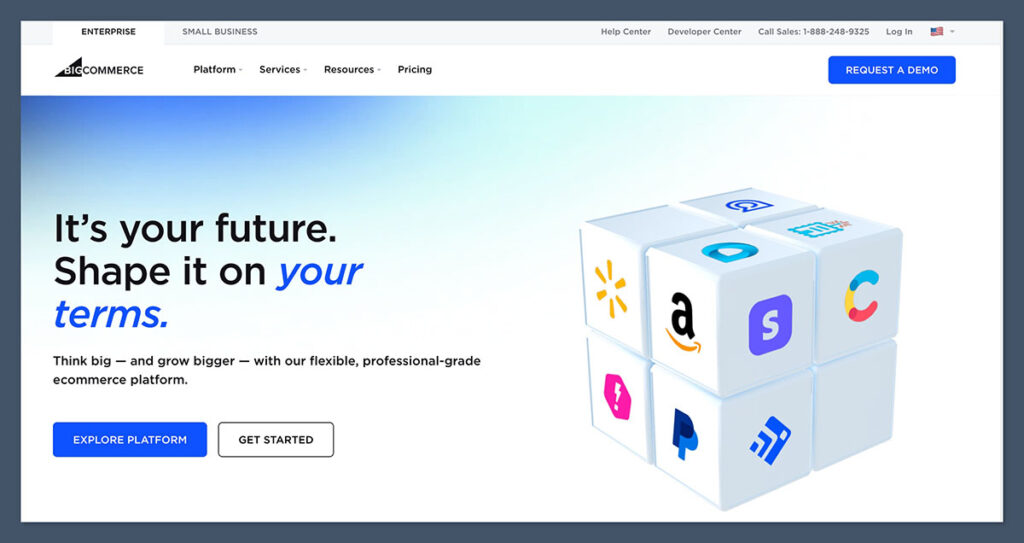
BigCommerce is known for its support of large inventory stores and partnerships with numerous payment processing companies. With powerful built-in features and an ever-expanding App Store, you have the flexibility to build your ecommerce store however you want.
It has historically been the value pick in CBD roundups, including ours, because it charged no platform-level order fee regardless of gateway. That is no longer true, and CBD merchants are the group most affected by the change.
What Changed, and Why It Hits CBD Sellers Hardest
On June 1, 2026, BigCommerce renamed its plans and restructured its fees. Standard became Core, Plus became Growth, Pro became Scale, and Enterprise became Performance.
The important part is a new Open Payment Provider Fee on all self-serve plans. BigCommerce charges this on orders processed through any gateway that isn’t on its Embedded Payment Providers list. The rate is 2.0% on Core, 1.0% on Growth, and 0.6% on Scale. Performance customers on contracted terms are exempt.
Here’s the problem for this industry. The Embedded list is built around Stripe, PayPal and Braintree, Adyen, Checkout.com, Klarna, Sezzle, Afterpay, and a handful of similar names. Not one of them accepts CBD.
Which means a CBD merchant on BigCommerce pays the Open Payment Provider Fee on effectively every order, by definition. There is no configuration that avoids it short of the Performance tier. On Core, that is 2% of gross order value handed to BigCommerce, before your high-risk processor takes its own cut.
At $100,000 in annual sales, a Growth-plan CBD store is looking at roughly $1,000 a year in Open Payment Provider Fees alone. The same store on Core would pay closer to $2,000. Worth noting too that the fee applies to offline and manual payment methods, including B2B purchase orders.
BigCommerce has publicly defended the change, arguing the fee only reaches a narrow class of providers and that it still offers more fee-free gateways than Shopify does. That argument holds for general retail. It does not hold for a category that is excluded from every embedded option.
Why It Still Works for Some CBD Sellers
BigCommerce remains one of the strongest platforms for merchants with deep catalogs, complex product data, and ERP requirements. CBD manufacturers and distributors running thousands of SKUs get more out of the box here than anywhere else on this list.
It also supports a genuinely large roster of gateways, so finding a high-risk processor that integrates is rarely the bottleneck. The bottleneck is now what BigCommerce charges you for using one.
Notable Features
- Over 65 pre-integrated payment solutions, including high-risk options
- Support for over 230 countries and 140 currencies
- Impressive marketing features like promotions, coupons, and advanced SEO
- A quick single-page checkout
- A robust theme store and App Store
- Advanced pricing lists and customer segmentation
- Inventory system and ERP integrations for CBD manufacturers
- Templates specific to retailers, manufacturers, and distributors
- Enterprise-grade security
- Extensive documentation on how to run a CBD business successfully, and follow all the rules
Pricing
- Core: $39 per month ($29 billed annually), available up to $30,000 in trailing-12-month Inclusive GMV. Open Payment Provider Fee of 2.0%. Phone support is no longer included at this tier.
- Growth: $105 per month ($79 billed annually), up to $100,000 GMV, with a 1.0% Open Payment Provider Fee and 24/7 phone support.
- Scale: $399 per month ($299 billed annually), covering up to $33,333 in monthly GMV with a 0.9% overage above that, and a 0.6% Open Payment Provider Fee.
- Performance: custom, from around $1,499 per month billed annually. The Open Payment Provider Fee does not apply under contracted terms.
Two mechanics that are easy to miss. GMV thresholds dropped sharply, from $50,000 to $30,000 on the entry plan and from $180,000 to $100,000 on the mid tier, so the same revenue now pushes you up a tier earlier than it used to. And Inclusive GMV is now calculated as gross order value minus 10%, where the old reduction was 3%. Check your dashboard if you’re near a threshold.
5. Square Online
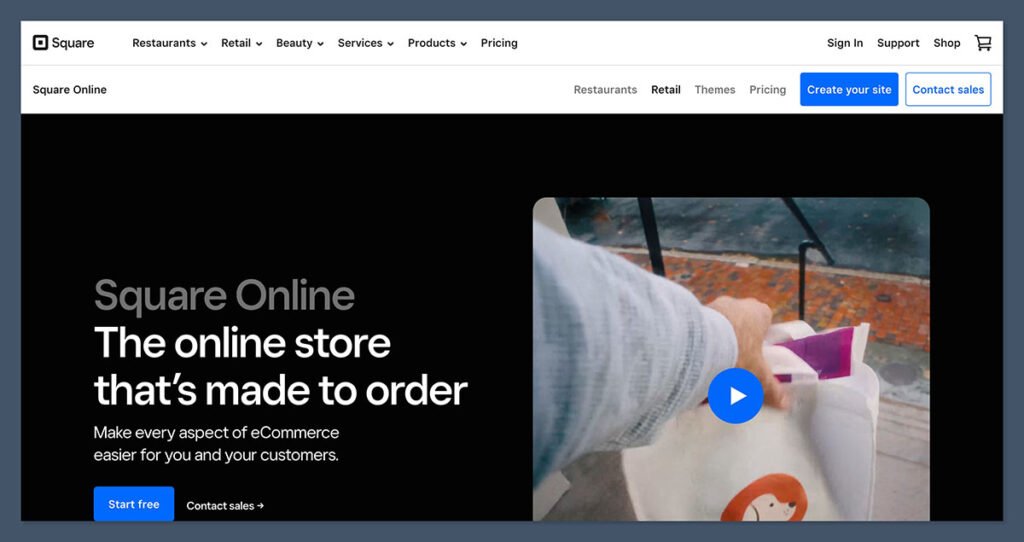
You may have noticed that Square keeps appearing as the third-party processor other platforms route you toward. So it’s reasonable to ask whether you should just run the whole store on Square.
Square Online is the only option here where the platform and the CBD-capable processor are the same company, and the site builder is free. That’s a real structural advantage. It comes with real caveats.
Why It’s Great for Selling CBD
Square runs a dedicated CBD program that lets approved sellers accept card payments for hemp-derived products across its POS, online store, virtual terminal, and invoicing tools. You apply from the Pricing and Subscriptions area of your Square dashboard, there’s no application fee, and approval usually lands within a week.
Square also confirmed in 2026 that sellers participating in its CBD program are now eligible for Square Loans, which had previously been closed to them. For a category that struggles to access conventional business credit, that’s meaningful.
And the POS remains one of the best in the business, which matters if you run a physical shop alongside the site. Square’s third-party integrations extend this with tools like PinWheel, C-Trax, and Limelight.
What Square Won’t Let You Do
Three restrictions disqualify a meaningful share of CBD businesses outright, so check these before you build anything.
- Hemp flower is prohibited, and CBD vape cartridges are generally not permitted either. If either is core to your catalog, Square is not your processor.
- No health claims. Square does not allow sellers to state that products treat or help with anxiety, inflammation, depression, PTSD, ADHD, cancer, or any other condition. Since a lot of CBD marketing is built on exactly that messaging, this often requires rewriting your entire catalog.
- CBD processing rates run above Square’s standard published rates. Square’s program pricing sits higher than its normal retail card rates, which is a slow margin drain on thin-margin products with heavy fulfillment costs.
There’s also a well-documented pattern of Square placing holds or freezes on CBD accounts, sometimes tying up substantial sums while compliance review runs. Square operates a shared-account model rather than issuing you a dedicated merchant account, which is part of why reviews can be abrupt. Keep a backup processor approved and idle so a hold doesn’t stop revenue entirely.
Notable Features
- Platform and CBD-capable processor from the same provider, with no platform surcharge layered on top
- Free ecommerce site builder with unlimited product listings
- Square Loans eligibility for CBD program participants
- Powerful POS for in-person sales, with strong card-present rates
- Payroll tools for paying employees from your operation
- Support for the selling of bookings, services, and all types of products
- Selling on Instagram and Facebook
- Text message and email marketing
- Invoices and estimates
Pricing
Square’s subscription tiers are cheap to enter and the difference between them is mostly processing rates. The figures below are Square’s standard published rates; CBD program rates sit above these, so confirm your quoted rate during onboarding.
- Free: $0 per month for a full website builder and online store, social selling, Square POS syncing, and pickup, local delivery, and shipping support. Standard rates are 3.3% + 30¢ online and 2.6% + 15¢ in person.
- Plus: $49 per month for everything above, plus advanced item settings, customer accounts, self-serve QR ordering, and expanded customization. Rates drop to 2.9% + 30¢ online and 2.5% + 15¢ in person.
- Premium: $149 per month for everything above, plus real-time shipping rates and the lowest card-present rate at 2.4% + 15¢.
The 0.4 percentage-point gap between the Free and Plus online rates is the real decision point. Below roughly $12,000 a month in online sales, the free plan is genuinely the better deal. Above it, Plus pays for itself on rate reduction alone.
6. WooCommerce
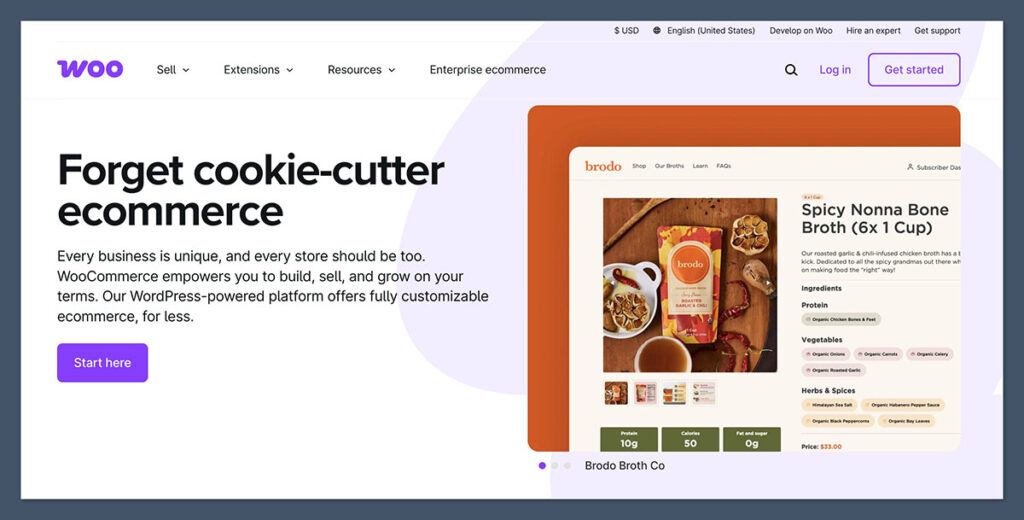
WooCommerce is the go-to ecommerce platform for merchants that want full control over their CBD operations. It’s an open-source ecommerce plugin that works on the WordPress content management system.
You must get your own hosting and add plugins and themes, but there are no limits to the amount of customization you have over your online store.
The open-source nature of WooCommerce results in lower upfront costs (the plugin is actually free), but keep in mind that no open-source ecommerce platform is truly free.
You must find your own paid hosting (in this case, a CBD-friendly host), buy a domain name, purchase a theme, and potentially acquire multiple plugins to expand your business.
Having said that, all of that is relatively easy, as long as you have at least some sort of technical experience.
Why It’s Great for Selling CBD
WooCommerce is one of the best CBD ecommerce platforms because it’s open-source. That means you have full control over the payment gateway and hosting you choose, and no company sits between you and your processor taking a percentage for the privilege.
That last point is the one that has quietly become WooCommerce’s biggest advantage in this category. Shopify surcharges third-party gateways. BigCommerce now charges an Open Payment Provider Fee. WooCommerce charges neither, because there is no platform vendor to charge you. On a high-volume CBD store, that difference compounds into real money.
There are hundreds of gateways to pick from; CBD-capable options that integrate well include NMI, Authorize.Net, Square, and Viva Wallet for parts of Europe.
In addition to that, WooCommerce is rather flexible in its design. You can always find a WooCommerce theme that’s suitable for a CBD store.
WooCommerce also offers a USPS integration (which allows for CBD shipping, subject to the required forms), along with an onslaught of third-party dropshipping plugins for finding a supplier for hemp-derived and CBD products.
Notable Features
- Self-hosted and open-source for increased control and easier cost management
- No platform-level transaction fee or gateway surcharge of any kind
- Large community for finding other businesses that sell CBD, and to locate CBD-oriented plugins and themes
- CBD sales in places like Europe, USA, and Canada, all thanks to payment processors like Viva Wallet and Square
- Age verification and geo-restriction plugins for state-level compliance
- Shipping management and labels through USPS (and other carrier options)
- Massive extension and theme store
- No-code customization, but there’s always access to site files for more complex CSS and JavaScript customizations
- Powerful marketing tools for things like Facebook Ads, Google Listings, third-party marketplaces, abandoned cart recovery, automations, and newsletters
- Coupons, rewards, and gifting
- Upsell, cross-sell, and related product listings
- Built-in SEO
- The best blogging experience out of all ecommerce platforms and website builders
Pricing
You can’t sell CBD on WordPress.com, so we’ll skip that pricing altogether.
WooCommerce on WordPress.org, however, enables the sale of CBD products. That means you don’t have to pay anything for the plugin.
However, there are expenses to consider. We won’t give you absolute pricing, but it’s important to understand that other fees will apply to run your store on WooCommerce.
Potential fees include:
- Credit card fees from a CBD-friendly provider
- Monthly hosting fees (anywhere from $3 to $50 per month) from a CBD-friendly host
- Premium WordPress themes
- WooCommerce plugins and extensions (which most stores need to expand upon the initial feature set)
- Domain name fees (often around $10 per year)
- Shipping fees
- Development costs
CBD Payment Processors: The Part That Actually Decides Everything
You can build a beautiful CBD store on any platform in this guide. You cannot take a single dollar without an approved high-risk processor behind it, and none of the native gateways will do the job.
Here are the names that come up most consistently across platform documentation and merchant communities.
| Processor or gateway | Works well with | Notes |
|---|---|---|
| Square (CBD program) | Square Online, Wix, WooCommerce, Squarespace via workaround | Fastest approval, shared-account model, no hemp flower or vapes |
| Authorize.Net | Shopify, WooCommerce, BigCommerce, Squarespace via Foxy.io | Gateway only, needs a separate CBD merchant account behind it |
| NMI | Shopify, WooCommerce, BigCommerce | Common choice for scaling hemp brands, pairs with high-risk acquirers |
| Bankful | Wix, WooCommerce | Built specifically for high-risk categories |
| Priority Payments | Wix | Listed in Wix’s hemp declaration flow |
| PaymentCloud | Shopify, WooCommerce | Dedicated merchant accounts with hands-on underwriting |
| Viva Wallet | WooCommerce | Useful route for some European markets |
Two pieces of practical advice. Get processor approval before you invest in the store build, because a rejection after launch is a much worse problem than a delayed launch. And whatever you pick, get a second processor approved and sitting dormant. Account freezes in this category are common enough that a backup is infrastructure, not paranoia.
The Real Cost of Selling CBD Online
The sticker price on a pricing page is never what a CBD merchant pays, and the gap is bigger than it is in any other retail category. Every platform on this list adds cost somewhere other than the subscription line.
- Shopify charges a third-party gateway surcharge on every order, because Shopify Payments won’t touch the category.
- BigCommerce charges an Open Payment Provider Fee of up to 2% on every order, for the same underlying reason.
- Square charges no platform surcharge but prices CBD transactions above its standard retail rates.
- Squarespace charges nothing extra from Core upward, but you’re paying in setup complexity and a checkout that lives partly outside the platform.
- Wix and WooCommerce add no platform-level fee at all, which makes them the cleanest options on pure transaction economics.
- Every option carries a high-risk processing rate above standard retail, plus permits, COAs, and compliance overhead.
Before you commit, run the arithmetic at your expected volume rather than comparing monthly plan prices. A 2% platform fee on $200,000 in annual sales is $4,000, which dwarfs the difference between any two subscription tiers in this guide.
Which Ecommerce Platform is Right for Your CBD Business?
From BigCommerce to Shopify, and Square Online to WooCommerce, the best CBD ecommerce platforms vary based on what you need for your business.
The honest summary is that there’s no single winner, because these platforms fail in different places. Squarespace has the best design tools and the worst payment setup. BigCommerce has the deepest feature set and now the highest per-order platform cost for this category. Square is the cheapest to run and the most restrictive about what you can sell and say.
One filter before the list: if you’re outside the US, the guided CBD programs on Wix, Shopify, and Square mostly won’t apply to you, which pushes WooCommerce up the ranking considerably.
Here are our final recommendations by use case:
- Wix: The best all-round starting point for most new US CBD sellers. A guided hemp declaration flow, a genuine choice of approved gateways, no platform surcharge on top of them, and strong design and marketing tools for beginners and experienced users alike.
- Square Online: Best if you sell in person as well as online, or want the lowest possible fixed cost. Platform and processor from one company, a free tier that works, and Square Loans access. Rule it out if you sell hemp flower or vapes, or if your brand messaging leans on health claims.
- WooCommerce: Best for volume. Total control of design, gateway, hosting, and compliance plugins, with no platform taking a percentage of every order. It can get clunky and it needs technical confidence, but on transaction economics nothing here beats it at scale.
- Shopify: Best for brands that need the app ecosystem, multichannel selling, and a mature POS, and that can absorb the third-party gateway surcharge on every order. Budget for a plan upgrade earlier than a non-CBD merchant would.
- BigCommerce: Best for CBD manufacturers and distributors with large catalogs, complex product data, and ERP needs. Worth the Open Payment Provider Fee only if you genuinely need that depth, and worth pricing the Performance tier if your volume justifies escaping the fee.
- Squarespace: Best for design-led brands with small, curated catalogs where the storefront is doing the selling. Accept that payments will require a workaround, and that CBD-specific documentation is thin compared to the others.
Frequently Asked Questions
Can I use Shopify Payments to sell CBD?
No. Shopify’s own documentation states that Shopify Payments does not support hemp, CBD, or THC products, because it runs on Stripe infrastructure and Stripe prohibits the category. You’ll need a compatible third-party gateway, and Shopify will apply its third-party transaction surcharge on those orders.
What’s the cheapest way to start selling CBD online?
Square Online’s free plan, if your products fit within Square’s CBD program restrictions. There’s no monthly subscription and no platform surcharge, so your only cost per order is the processing rate. WooCommerce is cheaper at higher volumes, but it carries hosting, theme, and plugin costs from day one.
Does BigCommerce still have no transaction fees?
Not for CBD sellers. Since June 2026, BigCommerce charges an Open Payment Provider Fee on orders processed through gateways outside its Embedded list, at 2.0% on Core, 1.0% on Growth, and 0.6% on Scale. Because no embedded provider accepts CBD, a hemp merchant pays that fee on essentially every order.
Will the new federal hemp law make my products illegal?
It depends on your formulation. From November 12, 2026, the federal definition shifts to a total THC standard with a cap of 0.4mg per container. Broad-spectrum and isolate products generally sit comfortably below that. Full-spectrum products with measurable THC may not. Ask your manufacturer for per-container total THC figures on current COAs, and monitor the pending bills that could delay or amend the provision.
Can my payment processor shut down my CBD store without warning?
Yes, and it happens often enough that you should plan for it. Square in particular has a documented pattern of freezing CBD accounts during compliance review. Keep a second processor approved and dormant, keep COAs and supplier documentation readily available, and respond to compliance requests immediately and in full.
Why can’t I say my CBD products help with anxiety or pain?
Claims that a product treats, cures, or relieves a medical condition conflict with FDA guidance on CBD marketing, and most processors write the same restriction into their terms. Square, for example, explicitly prohibits claims relating to anxiety, inflammation, depression, PTSD, ADHD, and cancer. Your product pages are a compliance surface, so keep the copy descriptive rather than therapeutic.
Can I sell CBD outside the United States?
In some markets, but the obstacle is usually the product rather than the platform. In the UK, ingestible CBD needs to sit on the FSA’s novel foods list. In the EU, no CBD product has yet been authorized onto the Union list, so ingestible sales remain a grey zone enforced differently by each member state. In Canada, CBD falls under the Cannabis Act and requires Health Canada licensing plus provincial retail authorization. Because most hosted platform CBD programs are US-only, WooCommerce paired with a gateway your acquirer approves is usually the most flexible route for non-US sellers.
If you have any further questions about the best CBD ecommerce platforms, share your thoughts and experiences in the comments section below.


Comments 0 Responses