

Following my in-depth 2025 review of ecommerce platforms, I revisited Big Cartel — a platform known for its creator-first approach, minimal setup, and low-cost entry point for online sellers.
Big Cartel is particularly popular among artists, makers, and small-scale businesses. But the question remains: how much does it really cost, and which plan delivers the best value?
In short, Big Cartel’s plans range from $0 to $29.99 per month, with the free plan still being one of the most generous options available for new sellers.
That said, most people will outgrow the free tier fairly quickly. Based on my experience and recent testing, here’s what each plan offers — and who it’s best suited for.
Big Cartel Plans
- Gold ($0/month) – Best for testing a small idea or running limited product drops
- Platinum ($9.99/month) – Ideal for new sellers scaling up from the free plan
- Diamond ($19.99/month) – Better for those with mid-size catalogs or growing demand
- Titanium ($29.99/month) – Designed for large stores that don’t need advanced features like apps or abandoned cart tools
Key Takeaways
- The Platinum plan at $9.99/month offers the best value for most new businesses — unlocking inventory tracking, discount codes, and a custom domain.
- The Gold plan is free forever, but only supports 5 products and has limited customization.
- No transaction fees from Big Cartel itself, but standard Stripe and PayPal fees still apply (2.9% + $0.30).
- Big Cartel lacks advanced tools like abandoned cart recovery or app integrations — this limits its ability to scale.
- All paid plans are month-to-month with no contracts or setup fees.
How Much Does Big Cartel Cost?
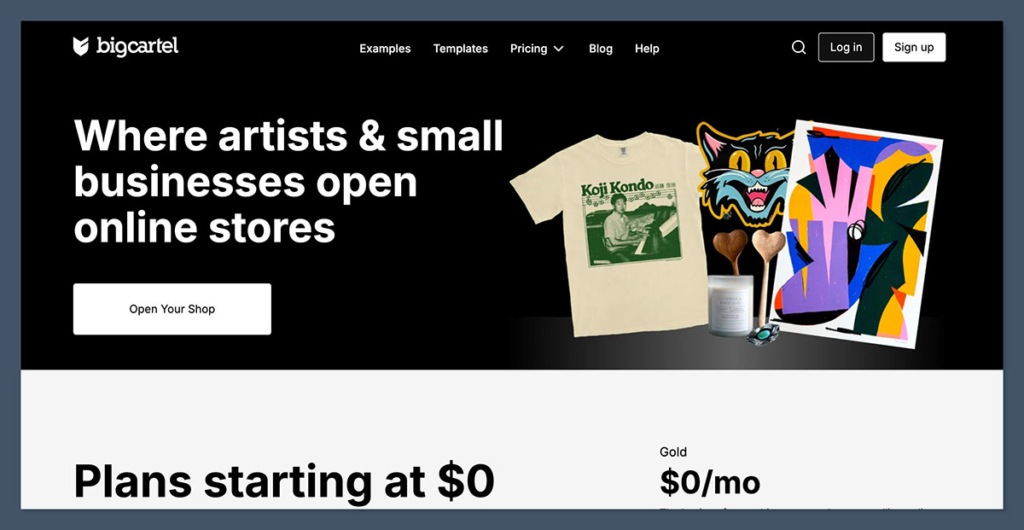
Big Cartel has four pricing tiers that cater to sellers at different stages. Here’s a quick overview of monthly costs and what’s included:
| Plan | Monthly Price | Product Limit | Inventory Tracking | Custom Domain | Discount Codes | Ideal For |
|---|---|---|---|---|---|---|
| Gold | $0 | 5 | No | No | No | Hobbyists, testing new products |
| Platinum | $9.99 | 50 | Yes | Yes | Yes | New businesses, budget stores |
| Diamond | $19.99 | 500 | Yes | Yes | Yes | Growing brands with mid-size catalogs |
| Titanium | $29.99 | 5,000 | Yes | Yes | Yes | Larger brands with basic needs |
All plans come with access to Big Cartel’s mobile app, a responsive storefront, and built-in payment options (PayPal and Stripe).
1. Gold Plan: $0 – For Testing and Hobby Use
Big Cartel’s Gold plan is completely free and doesn’t require a credit card to get started. It’s a simple way to test an idea, especially if you only have a few products to sell.
However, there are several key limitations:
Included in the Gold Plan:
- Up to 5 products
- 1 image per product
- Free Big Cartel subdomain
- Mobile-friendly themes
- Manual order management only
Missing Features:
- No inventory tracking
- No discount codes
- No access to Google Analytics
- No custom domain
- No theme code editing
When should you upgrade?
If you plan to sell more than 5 products, track inventory, or use discount codes, you’ll need to upgrade to at least the Platinum plan.
2. Platinum Plan: $9.99 – Best Value for Small Online Stores
The Platinum plan is Big Cartel’s best value offering in my opinion. It supports up to 50 products and includes the core tools most small stores need to function properly.
What You Get for $9.99/month:
- Up to 50 products
- 5 images per product
- Inventory tracking
- Custom domain support
- Discount codes and promotions
- Theme code editing
- Google Analytics integration
- Shipping settings and sales tax tools
This plan makes Big Cartel usable for real businesses. You can link your own domain, track inventory automatically, and run simple promotions — all for under $10 per month.
3. Diamond Plan: $19.99 – For Growing Brands
Once your store starts scaling up with more product SKUs or categories, the Diamond plan becomes a better fit.
Features Included:
- Up to 500 products
- Full access to design customization tools
- Google Analytics and Facebook Pixel integration
- Sales tax and shipping calculators
- Same features as Platinum, with room to scale
This plan is ideal for sellers who are still small but expanding.
You’re getting better support and more capacity without committing to a high monthly fee like you’d see with Shopify ($39/month starting).
4. Titanium Plan: $29.99 – For Larger Product Catalogs
If you’ve grown to hundreds or even thousands of SKUs, the Titanium plan will accommodate that — without switching platforms right away.
Titanium Adds:
- Up to 5,000 products
- Priority support access
- All previous features unlocked
- More flexibility for product lines and variations
Still, Big Cartel is limited in areas like app integrations, checkout optimization, and automation.
That means if you're trying to run things like upsell funnels, advanced shipping rules, or multi-channel inventory management, you'll likely hit roadblocks.
If you’ve hit this level of scale, you may want to explore Shopify or WooCommerce next. Both platforms offer significantly more flexibility, integrations with tools like Klaviyo and Zapier, and better infrastructure for running a fast-growing ecommerce brand.
Comparing Big Cartel with Shopify, Wix, and Squarespace
If you’re deciding between Big Cartel and its main competitors, here’s how they stack up:
| Platform | Starting Price | Free Plan | Product Limit | App Integrations | Abandoned Cart | Ideal For |
|---|---|---|---|---|---|---|
| Big Cartel | $0 | Yes | 5–5,000 | No | No | Artists, creators, small sellers |
| Shopify | $39/month | No | Unlimited | Yes | Yes | Fast-growing or large stores |
| Wix | $17/month | Yes | Unlimited | Limited | Yes | Visual brands, mixed content |
| Squarespace | $23/month | No | Unlimited | No | Yes (Commerce) | Designers, portfolios, ecommerce |
Shopify is a better fit if you're running a high-volume store or need access to advanced ecommerce features.
It offers powerful integrations, scalable infrastructure, and tools like abandoned cart recovery, custom checkout flows, and multi-channel selling.
The tradeoff is a higher monthly cost and steeper learning curve.
Wix combines flexibility with design freedom, making it a good option for brands that want a visual, content-rich website alongside a store.
While it’s less advanced than Shopify for ecommerce, it does include marketing tools, drag-and-drop design, and basic selling capabilities for physical and digital products.
Squarespace is ideal for creatives and small businesses who want a polished, design-forward storefront.
It doesn’t have an app marketplace or as many features for ecommerce growth, but its templates, built-in tools, and ease of use make it a strong contender for visual brands and service-based businesses.
Big Cartel, by contrast, remains the simplest and most affordable of the bunch — best suited for sellers with focused catalogs and minimal tech needs.
Are There Any Hidden Fees?
Big Cartel itself doesn’t charge extra transaction fees — that’s a major selling point. But you will still need to pay the standard payment processing fees from Stripe or PayPal.
Additional Costs to Be Aware Of:
- Payment Fees: 2.9% + $0.30 per sale
- Custom Domain: Around $12–$15/year if bought through a registrar
- External Tools: You may need tools for email marketing, inventory sync, or analytics
- No Apps: Unlike Shopify, there’s no app marketplace to add functionality
While Big Cartel keeps monthly pricing low, you’ll still want to budget for third-party tools if you need anything beyond the basics.
For example, automating emails, tracking conversions, or syncing with other platforms will usually require external services.
These extra tools aren’t expensive individually, but they can add up — especially if you're trying to scale your store or compete in more saturated markets.
Which Big Cartel Plan Should You Use?
Here’s my quick recommendation based on store type:
| Plan | Best For |
|---|---|
| Gold | Testing an idea, limited-edition drops, hobby use |
| Platinum | Small ecommerce brands with under 50 products |
| Diamond | Growing brands with multiple product categories |
| Titanium | High-SKU brands who haven’t hit Shopify-level needs yet |
If you’re unsure, start with the Gold plan to get a feel for the platform. You can upgrade later without losing any progress.
Is Big Cartel Worth It?
Big Cartel is one of the most affordable ecommerce options for creators and small businesses. If you need a simple, no-frills online store and want to avoid steep monthly fees, it’s hard to beat.
But it’s also important to recognize its limitations.
Pros 👍
- Free plan is generous
- No transaction fees from Big Cartel
- Easy to set up and manage
- Transparent pricing
- No contracts
Cons 👎
- No abandoned cart recovery
- No app store or integrations
- Limited SEO control
- Only supports PayPal and Stripe
- Scaling becomes difficult beyond a certain point
My Final Verdict on Big Cartel’s Pricing
If you’re selling handmade products, prints, merch, or niche goods and want to keep overhead low, Big Cartel makes a lot of sense — especially the Platinum plan at $9.99/month.
You won’t get advanced tools, but you’ll have everything you need to run a simple, functional store.
Once your business grows, you may eventually outgrow Big Cartel. But as a starting point for creatives and first-time sellers, it’s a solid option.
How to Save Money with Big Cartel
- Start with the free plan to test your concept
- Only upgrade when you need key features like discount codes or inventory tracking
- Use free tools like Canva for graphics and Shippo for shipping
- Buy your domain from a low-cost registrar like Namecheap
If your focus is on keeping costs low while building a lean, manageable online store, Big Cartel delivers exactly that.
It’s not built for high-growth ecommerce, but for artists, makers, and side hustlers who want to get online quickly without the monthly pressure of higher-priced platforms, it strikes the right balance between function and simplicity.
As long as you’re clear on its limitations, Big Cartel can be a dependable starting point — and a cost-effective one.



Comments 0 Responses