

Shopify and Tiendanube are two of the most widely used ecommerce platforms available to Latin American merchants, but they were built for very different jobs.
Shopify is a global platform used by millions of stores worldwide. Tiendanube (known as Nuvemshop in Brazil) was built in Latin America, for Latin America, and now powers roughly 190,000 live stores across the region.
We compared both platforms on pricing, payments, sales features, design, ease of use and support, verifying every figure against each company's official pricing pages before publishing.
Shopify is the stronger platform overall, but that verdict comes with a real caveat: if you sell almost entirely inside Latin America, Tiendanube is very likely the cheaper and more practical choice.
Shopify vs Tiendanube: Quick Verdict
- Shopify: Best overall. The deepest feature set, the biggest app ecosystem and the clearest path to scaling internationally. Best for brands that plan to grow beyond one country.
- Tiendanube: Best for selling in Latin America. A free plan in Argentina and Mexico, pricing in local currency, native local payment and shipping rails, and human support in your own language and time zone.
In this comparison, I'll walk through exactly where each platform wins, where the sticker price hides real costs, and which one fits the way you actually sell.
Quick Comparison: Shopify vs Tiendanube
| Category | Shopify | Tiendanube |
|---|---|---|
| Best for | Growing and scaling brands, international selling | Merchants selling primarily within Latin America |
| Entry price | $5/month (Starter), $39/month (Basic), $29/month billed annually | Free plan in Argentina and Mexico; paid plans from $149 MXN, $26,999 ARS, $24,900 COP or $5,999 CLP per month |
| Top standard plan | Advanced, $399/month ($299 billed annually) | Avanzado / Escala, $999 MXN or $234,999 ARS per month |
| Enterprise tier | Shopify Plus, from $2,300/month | Tiendanube Evolución (custom pricing) |
| Free plan | No | Yes, in Argentina and Mexico |
| Free trial | 3 days, then $1/month for 3 months | 7 days on paid plans |
| Native payment gateway | Shopify Payments (limited availability in Latin America) | Pago Nube (waives the per-sale platform fee) |
| Third-party gateway fee | 2% (Basic), 1% (Grow), 0.6% (Advanced) | Varies by plan and country; waived with Pago Nube |
| App store | 8,000+ apps | 100+ apps |
| Themes | 800+ themes, 13 free | 60+ free templates plus a premium design store |
| Markets served | Global | Argentina, Brazil, Mexico, Colombia, Chile |
| Support | 24/7 chat and Help Center | Chat and email on all plans, WhatsApp support on higher plans |
Key Takeaways
- Tiendanube is dramatically cheaper to start with. A free plan in Argentina and Mexico, and local-currency billing that does not move with the dollar.
- Shopify's headline price is not the full price in Latin America. Shopify Payments has limited coverage in the region, so many merchants pay Shopify's third-party gateway fee (up to 2% on Basic) on top of their processor's own fee.
- Shopify wins decisively on features. An 8,000-app ecosystem, deeper reporting, native B2B, and agentic commerce tools that Tiendanube has no direct answer to.
- Tiendanube wins on local rails. Pix, Boleto, OXXO, Mercado Pago, installments and local carriers work natively rather than through a bolt-on app.
- Tiendanube adjusts its prices quarterly in line with local inflation, so budget for the plan cost to rise over time.
- The honest split: selling regionally, Tiendanube usually costs less and fights you less. Selling internationally or scaling past seven figures, Shopify is the platform you will end up on.
1. Best for Pricing: Tiendanube
This is the clearest gap between the two platforms, and it is not close.
Shopify Pricing
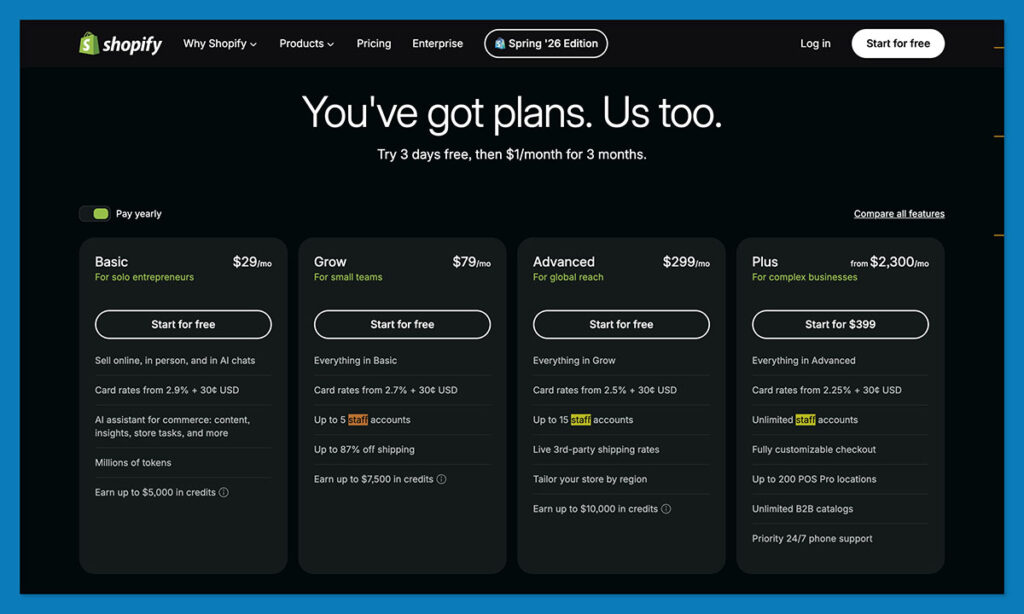
Shopify sells five tiers, priced in US dollars and billed in USD in most markets. Annual billing saves 25%, and new stores get a 3-day free trial followed by a promotional rate of $1 per month for the first three months.
| Plan | Monthly | Billed annually | Online card rate (Shopify Payments) | Third-party gateway fee |
|---|---|---|---|---|
| Starter | $5 | $5 | Varies | 5% |
| Basic | $39 | $29 | 2.9% + 30¢ | 2% |
| Grow | $105 | $79 | 2.7% + 30¢ | 1% |
| Advanced | $399 | $299 | 2.5% + 30¢ | 0.6% |
| Plus | From $2,300 | Contract terms apply | Negotiated | 0.2% |
Note: the plan formerly called “Shopify” was renamed Grow. Same price, same features, new name.
Tiendanube Pricing
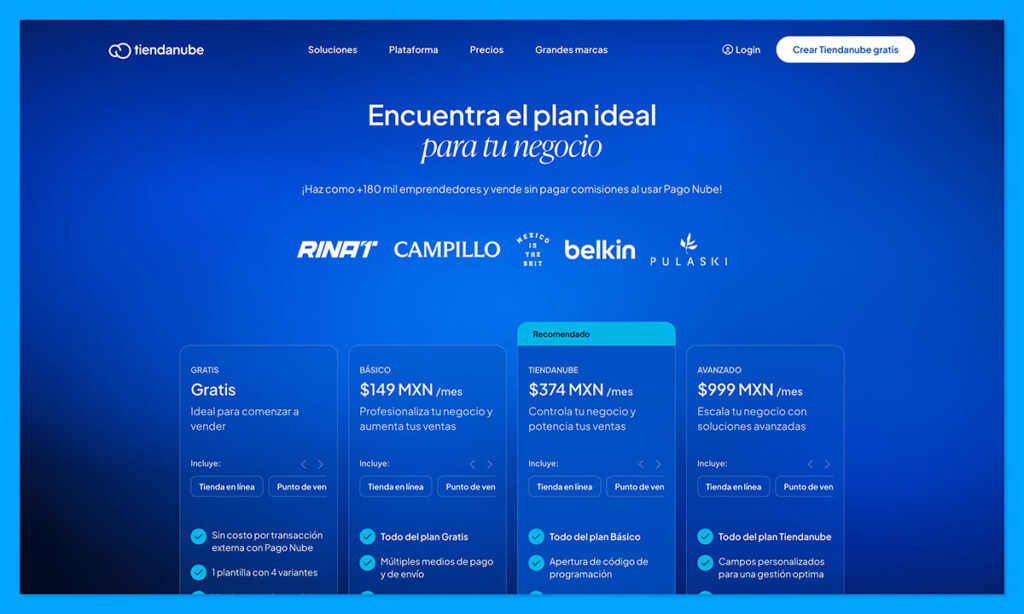
Tiendanube prices in local currency and structures its plans differently by country. Argentina and Mexico both have a genuinely free forever plan. Colombia and Chile start on paid tiers. Paid plans come with a 7-day free trial, and annual billing takes 25% off.
| Country | Free plan | Entry paid plan | Mid plan | Top standard plan |
|---|---|---|---|---|
| Mexico | Gratis, $0 MXN | Básico, $149 MXN/month | Tiendanube, $374 MXN/month | Avanzado, $999 MXN/month |
| Argentina | Inicial, $0 ARS | Esencial, $26,999 ARS/month | Impulso, $78,999 ARS/month | Escala, $234,999 ARS/month |
| Colombia | Not available | Básico, $24,900 COP/month | Tiendanube, $49,900 COP/month | Avanzado, $149,900 COP/month |
| Chile | Not available | Básico, $5,999 CLP/month | Tiendanube, $14,999 CLP/month | Avanzado, $44,999 CLP/month |
Two things matter here beyond the raw numbers.
First, local-currency billing removes exchange-rate risk, which is a real operating cost when your revenue is in pesos and your platform bill is in dollars. Second, Tiendanube applies a quarterly price adjustment tied to local inflation, so the plan you sign up for will not stay at that price indefinitely. That is an honest downside worth planning around.
The Winner
Tiendanube is far cheaper to start and to run in Latin America. A free plan in two of its largest markets, entry tiers that cost a fraction of Shopify Basic, and no dollar exposure. Shopify's $1 promo is generous, but it expires after three months and the real bill arrives in USD.
2. Best for Payments and Checkout: Tiendanube
This is the section most Shopify vs Tiendanube comparisons get wrong, and it is where the sticker price stops telling the truth.
The Shopify Payments Problem in Latin America
Shopify's entire fee structure is built on the assumption that you use Shopify Payments. Use it, and you pay only the card processing rate. Use anything else, and Shopify adds a surcharge on top: 2% on Basic, 1% on Grow, 0.6% on Advanced.
The problem is that Shopify Payments supports a limited set of countries, and its Latin American coverage is thin. Mexico is supported.
Several other major markets in the region are not, which means merchants there have to route payments through Mercado Pago, Stripe or a local gateway, and eat Shopify's surcharge on every single order. On a Basic plan doing $10,000 a month, that 2% is $200 a month on top of your processor's fees, on top of your subscription.
Always check Shopify's current supported-countries list for your market before you commit, because this single detail can change the entire cost calculation.
How Tiendanube Handles Payments
Tiendanube's native gateway is Pago Nube (Nuvem Pago in Brazil), and the incentive works in the opposite direction: using Pago Nube waives Tiendanube's per-sale platform fee entirely. Route payments elsewhere and a per-sale cost applies, but the fee is small and drops as you move up plans.

More importantly, the local payment methods that actually convert in the region are first-class citizens rather than app-store bolt-ons:
- Brazil: Pix, Boleto Bancário and credit card installments (parcelamento), which are effectively mandatory for conversion
- Mexico: OXXO cash payments, SPEI transfers and Mercado Pago
- Argentina, Chile, Colombia: Mercado Pago and local card installment plans
Shopify supports most of these methods too, but through third-party integrations that trigger the surcharge. Tiendanube treats them as the default.
The Winner
Tiendanube's payment economics are simply better in Latin America. Its native gateway rewards you for using it, local methods work out of the box, and there is no penalty structure designed around a payment product that may not even be available in your country.
3. Best for Selling Online: Shopify

Shopify has the deeper store, and it is not particularly close either.
Sales Features
Both platforms cover the fundamentals well: unlimited products, abandoned cart recovery, discount codes, product variants, inventory management, and selling through Instagram, Facebook and WhatsApp. If your requirements stop there, Tiendanube will not hold you back.
Shopify pulls ahead once your operation gets complicated. Core B2B capabilities (company profiles, price lists, net payment terms) moved out of the Plus tier and onto every standard plan, which means a wholesale operation can now run on a $399 Advanced plan instead of a $27,000-a-year enterprise contract.
Shopify also ships native A/B testing, multi-location inventory, advanced report builders and Shopify Functions for custom checkout logic.
Shopify has also moved fastest on agentic commerce, letting AI assistants like ChatGPT and Perplexity discover and transact with your catalog. Whether that channel matters to your business yet is debatable, but Tiendanube has no equivalent.
App Ecosystems
Shopify's app store carries more than 8,000 apps. Tiendanube's carries just over 100. That gap cuts both ways.
Shopify's model leans on apps for functionality that arguably should be built in, and those apps cost money. A realistic Shopify app stack adds $50 to $150 a month. Tiendanube's smaller catalog means less to research, fewer subscriptions and fewer things to break, but it also means that when you need a specific integration (a niche ERP, a particular loyalty program, a specialized subscription engine) it may simply not exist.
AI Tools
Both platforms ship AI features now. Shopify has Shopify Magic for product descriptions and image editing, plus Sidekick, an in-admin assistant that answers analytics questions and performs operational tasks. Tiendanube includes AI product description generation and photo enhancement on all paid plans, and Chat Nube, a WhatsApp-native AI assistant. Tiendanube's AI is narrower but well aimed at how LatAm merchants actually sell, which is heavily through WhatsApp.
The Winner
Shopify's feature depth is unmatched. Native B2B on standard plans, 8,000+ apps, Shopify Functions and agentic commerce give it a ceiling Tiendanube cannot currently reach.
4. Best for Marketing and SEO: Shopify
Both platforms give you the SEO basics: editable meta titles and descriptions, clean URLs, automatic sitemaps, image alt text and mobile-responsive themes. Neither will sabotage you.
Shopify goes further in three specific ways. It integrates with Semrush through the Ecommerce Booster app, which turns a site audit into an actionable optimization checklist.
Its blogging and content tooling is more capable, which matters if organic search is a serious acquisition channel for you. And Shopify Email lets you build and send campaigns natively from the admin, without a third-party ESP.
Tiendanube's answer is Marketing Nube, which handles automated emails, abandoned cart recovery and lead capture, plus native Meta Ads creation from the dashboard. It is competent and it is enough for most small stores. It is not as deep.
Where Tiendanube quietly wins is social commerce integration with WhatsApp, which in most of Latin America is not a marketing channel but the primary sales channel. Tiendanube's WhatsApp tooling, including the cloud keyboard for sharing products directly into chats, is built for how the region actually shops.
The Winner
Shopify has the stronger marketing stack overall, with better SEO tooling, native email marketing and a much larger ecosystem of marketing apps. Tiendanube's WhatsApp-first approach is the smarter play for regional sellers, but it is a narrower toolkit.

5. Easiest to Use: Tiendanube
Shopify's admin is polished, well-organized and genuinely pleasant to work in. It is also deep, and depth has a cost. There are more menus, more settings and more decisions to make before you can publish a product.
The onboarding flow asks about your business stage and channels, then hands you a checklist that runs to more than a dozen steps.
Tiendanube's admin is lighter and less intimidating. There are fewer places to get lost, the setup path is shorter, and critically for its market, the entire interface, documentation and support are natively in Spanish and Portuguese. Not translated. Native. If you or your team are not comfortable operating in English, that difference compounds every single day.
Both platforms use a section-based editor rather than free drag-and-drop. You stack blocks (image carousels, product grids, contact forms) on top of one another. It is easy to learn and constraining once you want something unusual.
Shopify's editor is more capable; Tiendanube's is quicker to master. On the higher Tiendanube plans you also get 100% flexible design access via HTML, CSS and JavaScript, which unlocks full customization for anyone who can code.
The Winner
Tiendanube is simpler to learn and natively localized. Shopify's editor is more powerful, but for a first-time merchant selling in the region, Tiendanube gets you to a live store with less friction.
6. Best Online Store Templates: Shopify
Design is a straightforward win for Shopify on volume and quality.
The Shopify Theme Store carries more than 800 free and paid themes, of which 13 are free, including Dawn, Sense, Craft and Crave.
The free themes are built and maintained by Shopify's own design team, which means they stay compatible with every platform update. Premium themes are a one-time purchase, typically $180 to $400, and the quality bar in the premium tier is high.
Tiendanube offers more than 60 free templates plus a premium design store. The free templates are clean, mobile-responsive and perfectly professional, and 60 free options genuinely beats Shopify's 13 if your budget is zero.
But the ceiling is lower. Shopify's premium theme market is a mature ecosystem with dedicated studios, sophisticated conversion-tested layouts and ongoing developer support. Tiendanube's is smaller and less specialized.
What we like about Shopify's design options
Strengths
- 800+ themes covering effectively every industry and aesthetic
- Free themes are first-party and always compatible with new features
- Mature premium market with studio-level quality and support
- Theme editor supports app blocks and dynamic sections
Drawbacks
- Only 13 free themes, and Dawn is so common that stores start to look alike
- Premium themes are an additional one-time cost of up to $400
What we like about Tiendanube's design options
Strengths
- More than 60 free templates, well ahead of Shopify's free selection
- Full HTML, CSS and JavaScript access on higher plans
- Templates are built with local shopping conventions in mind
Drawbacks
- Much smaller premium theme market with fewer specialist studios
- Advanced design flexibility is gated behind the mid and top plans
The Winner
Shopify has the better design ecosystem. Tiendanube gives you more free options, but Shopify gives you more, and better, options overall, with a premium market that Tiendanube cannot match.
7. Best for Business Support: Tiendanube
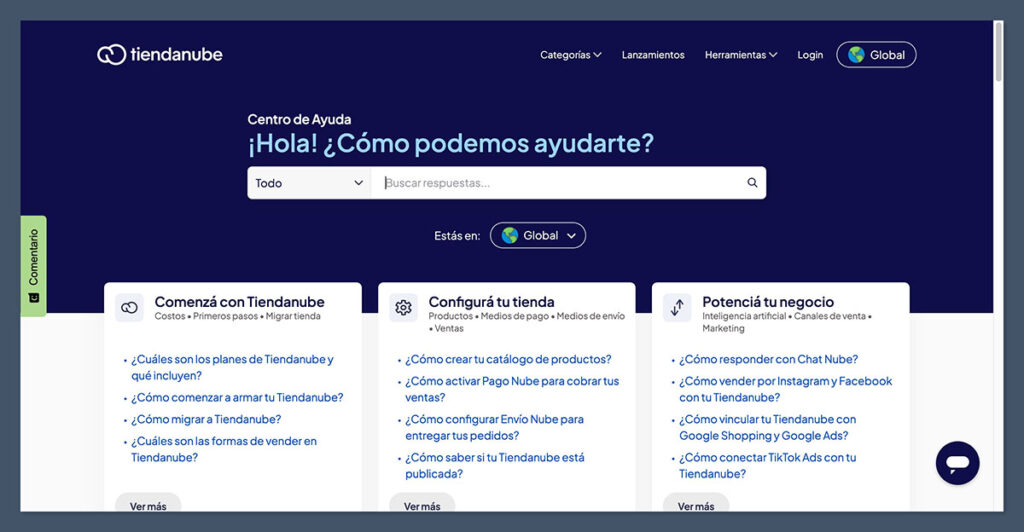
Shopify offers 24/7 support through an AI-first live chat in the Help Center, which escalates to a human Support Advisor for complex issues. Its Help Center is genuinely excellent: thorough documentation, video tutorials, an active community forum and free business courses.
The catch is that Shopify has removed email support, priority support is reserved for Plus merchants, and getting to a human can take persistence.
Tiendanube takes the opposite approach. Human support is the point.
Every paid plan includes chat and email support. Move up to the mid and top tiers and you get dedicated WhatsApp support with response-time commitments, as fast as four hours on the top Argentine plan. Support operates in your language and your time zone, and the team understands local tax, shipping and payment realities without you having to explain them.
Shopify support
- 24/7 AI-powered live chat with escalation to human advisors
- Extensive Help Center with guides, video tutorials, forum and courses
- No email support option
- Priority support is limited to Shopify Plus merchants
- Support is primarily in English, with variable quality in other languages
Tiendanube support
- Native Spanish and Portuguese support from teams in the region
- WhatsApp support on mid and top plans, with stated response times
- Chat and email available on all paid plans
- Local knowledge of tax, shipping and payment rules
- Smaller knowledge base and community than Shopify's
- No 24/7 coverage on entry plans
The Winner
Tiendanube's support is more human and more locally useful. Shopify has more documentation and round-the-clock availability, but Tiendanube gives you a real person on WhatsApp who understands your market.
8. Best for Scaling and Selling Internationally: Shopify
If your ambition extends past the region, this section decides the argument.
Shopify supports multi-currency selling, translated storefronts across 30+ languages, automatic geolocation redirects, duties and import tax calculation, and up to 50 markets on Advanced.
Its infrastructure handles flash sales and seasonal spikes at a scale Tiendanube has never had to serve. And there is a clear upgrade ladder: Basic to Grow to Advanced to Plus, with Plus supporting checkout customization, expansion stores and full B2B.
Tiendanube supports multiple languages and currencies, and its Evolución tier serves larger regional brands. But its footprint is five countries. If you want to sell into the United States, Europe or Asia, you are asking Tiendanube to do something it was not designed to do.
There is also a migration cost to consider.
Starting on Tiendanube and later moving to Shopify is a real project: product data, customer records, order history, URL structure and SEO equity all have to be carried across. If you are confident you will cross into international markets within a couple of years, starting on Shopify saves you that migration entirely.
The Winner
Shopify is built to scale globally. Tiendanube is built to scale within Latin America. If your roadmap crosses borders, Shopify is the platform you will end up on, so it is often worth starting there.
How We Compare Ecommerce Platforms
We assess ecommerce platforms across seven weighted areas, chosen for how much each one affects a merchant's ability to actually sell and grow.
Every pricing figure in this comparison was verified against the platform's official pricing pages at the time of writing, because published figures for both platforms go stale quickly.
| Criteria | Weight | What we assess |
|---|---|---|
| Sales features | 30% | Core ecommerce capability: catalog, checkout, inventory, multichannel, B2B |
| Payments and true cost | 20% | Subscription price, transaction fees, gateway surcharges and local payment method support |
| Website and SEO features | 15% | Content tools, technical SEO controls, marketing integrations |
| Help and support | 12% | Channels, response times, documentation and language coverage |
| Design functionality | 10% | Template quality and quantity, editor flexibility, code access |
| User experience | 8% | Onboarding, admin clarity, learning curve |
| Scalability | 5% | Multi-currency, multi-market, enterprise upgrade path |
Shopify vs Tiendanube: Our Verdict
Shopify is the better ecommerce platform. Tiendanube is often the better decision. Those two statements are not in conflict, and understanding why is the whole point of this comparison.
Shopify wins on raw capability: a far deeper feature set, 8,000+ apps, native B2B on standard plans, the strongest design ecosystem on the market, and an international infrastructure that Tiendanube has no answer to.
If you are building a brand that will sell across borders, or you expect to be doing serious volume within two years, start on Shopify and skip the migration you would otherwise be forced into later.
But if your customers are in São Paulo, Mexico City, Buenos Aires, Bogotá or Santiago, and they are going to stay there, Tiendanube is usually the smarter and considerably cheaper platform.
You get a free plan in two of the largest markets in the region, billing in your own currency, local payment rails that convert instead of ones that surcharge, WhatsApp-first selling tools, and support from people who speak your language and understand your tax code. Shopify's headline price does not include the 2% third-party gateway fee that many LatAm merchants cannot avoid, and that gap widens with every order.
The best way to decide is to run both. Tiendanube's free plan and Shopify's $1-per-month promotional period let you build a real store on each before you commit a peso to either.
Frequently Asked Questions
Is Tiendanube cheaper than Shopify?
Yes, substantially, for merchants in Latin America. Tiendanube offers a free forever plan in Argentina and Mexico, and its entry paid plans (from $149 MXN or $5,999 CLP per month) cost a fraction of Shopify Basic at $39 per month. Tiendanube also bills in local currency, removing exchange-rate exposure. The one caveat is that Tiendanube applies quarterly price adjustments in line with local inflation.
Can I use Shopify in Latin America?
Yes. Shopify operates globally and you can open a store from anywhere in the region. The complication is Shopify Payments, whose Latin American coverage is limited. Mexico is supported; several other major markets in the region are not. Merchants in unsupported countries must use a third-party gateway such as Mercado Pago, which triggers Shopify's additional transaction fee of up to 2% per order on the Basic plan. Check Shopify's current supported-countries list for your market before signing up.
Is Tiendanube the same as Nuvemshop?
Yes. It is the same company and the same platform. It operates as Nuvemshop in Brazil and Tiendanube in Spanish-speaking markets. The company was founded in 2011, is headquartered in São Paulo, and now powers roughly 190,000 live stores across Argentina, Brazil, Mexico, Colombia and Chile.
Does Tiendanube charge transaction fees?
Tiendanube waives its per-sale platform fee when you process payments through Pago Nube, its native gateway. If you use a different payment provider, a small per-sale fee applies, and it decreases as you move up the plan tiers. This is separate from the processing fee charged by the payment provider itself, which typically runs around 3% to 5% depending on the gateway and country.
Which platform is better for selling on WhatsApp and Instagram?
Tiendanube, for WhatsApp specifically. Both platforms integrate with Instagram and Facebook shopping, but Tiendanube is built around WhatsApp as a primary sales channel, with native tooling including Chat Nube (an AI assistant that operates through WhatsApp) and a cloud keyboard for sharing products directly into chats. In most of Latin America, WhatsApp is where the sale actually happens, and Tiendanube treats it that way.
Can I migrate from Tiendanube to Shopify later?
Yes, but treat it as a real project rather than a button click. You will need to move product data, customer records, order history and URL structure, and protect your existing SEO with proper redirects. Migration apps and specialist agencies exist for exactly this. If you already know you will need Shopify's international capabilities within a year or two, starting there avoids the cost and disruption entirely.
Which platform should a brand new store choose?
If you are selling only within Latin America and testing an idea, start on Tiendanube's free plan. There is no faster or cheaper way to get a real store live. If you already have traction, plan to sell internationally, or need features like advanced B2B, sophisticated reporting or a specific app integration, start on Shopify Basic and use the $1-per-month promotional period to build before you pay full price.


Comments 0 Responses