

Isn’t it crazy how quickly ecommerce can change? A few years ago, the only way to launch your own store was to spend insane amounts of money on suppliers, manufacturers, and warehousing companies. Now you can launch a whole fashion line without ever having to touch an item yourself.
That’s the beauty of print on demand for you, and why it’s become such a massive market (it should reach a value of about $57.49 billion by 2033).
Still, a bigger market does mean more competition, which is why choosing the right POD vendor is so important. You’re probably already familiar with a few of the names I typically recommend, like Printful, Printify, and Gelato. Today I want to talk about something slightly different.
PODpartner, one of the newer entries to the print on demand market, is quickly becoming one of the best options for fashion-focused brands out there.
Let me tell you why that is.
Quick Verdict: Should You Use PODpartner?
If you’re the kind of creator who wants to sell mugs, wall art, stickers, pet bowls, shower curtains, or any of the random add-ons you’ll see on a marketplace like Printify, PODpartner might make you feel a bit boxed in. That’s the bad news.
The catalog isn’t huge compared to what you might find on something like Printful. Mostly, you’re going to be dealing exclusively with apparel.
Sales channels are a little limited too. You do get all the big ones, like Shopify, Wix, Etsy, Ecommerce, and Squarespace, but no extras like Amazon, and no options for creating your own “pop-up” shop. But I still think the plus column for this company outshines the minus one.
PODpartner might only focus on apparel, but the products it offers are great: faded raw hem shirts, oversized, fleece-lined hoodies, super comfortable pants and tank tops.
Most of their stuff is genuinely much better than you’d get from most other POD vendors. Even customization is great, with embroidery that really feels premium, and tons of design options. Most POD platforms give you front, back, maybe a sleeve if you’re lucky. PODpartner lets you go wild, massive print areas, wide embroidery zones, and the ability to combine methods if you want something more premium.
If you want to build a fashion brand that stands out. PODpartner is a winner.
Pros 👍
- Luxurious, eco-friendly, and durable garments
- Generous design/embroidery areas
- Apparel styles that feel like they match the trends
- Simple pricing wit no monthly fees or upfront costs
- Fast production times compared to most POD vendors
- Branding extras for creators who want to look unique
Cons 👎
- Apparel only, so no mugs, posters, accessories
- Fewer integrations than big POD platforms
- No built-in AI design tools (if that matters to you)
The Core Features
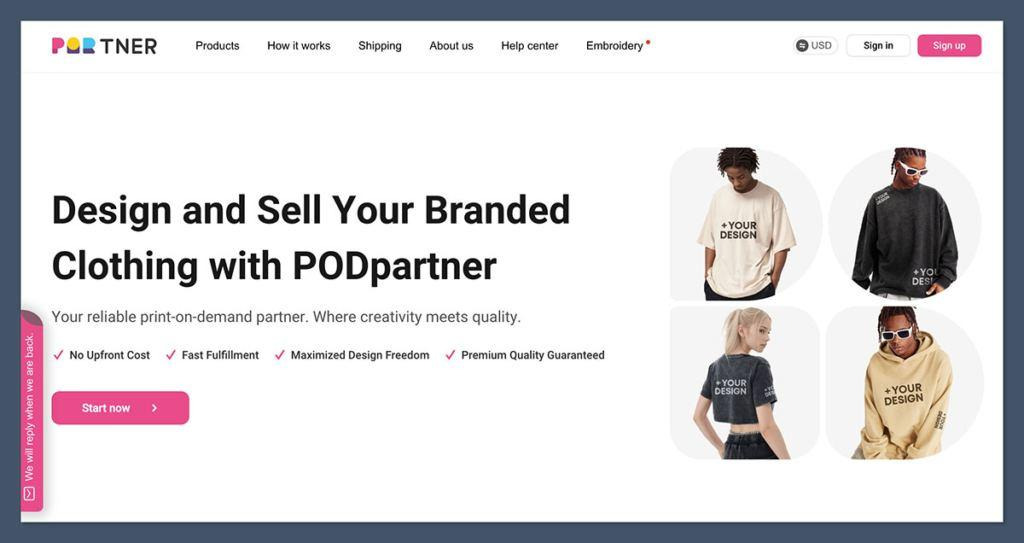
Okay, so we’ve established that PODpartner is a print on demand company focusing on fashion. They actually started off as a wholesale apparel manufacturer , then branched into custom clothing in 2019.
Unlike most POD companies that tend to offer all the same things, this one actually stands out for a few reasons. They might not give you the AI art tools, pop-up shop generators and thousand-product catalogues of other players, but they do give you:
- High quality materials and products
- Eco-friendly options
- Multiple design zones
- Fast global shipping (and express options)
- Integrations with the top ecommerce platforms
Here’s a closer look at what you can expect.
PODpartner Product Variety and Design Options

Again, PODpartner is an apparel-only setup. No mugs. No throw pillows. No framed prints of your dog’s face like you can get from something like Gelato. Still, if you’re interested in apparel anyway, PODpartner doesn’t skimp on variety. The catalog includes:
- Classic tees in different weights
- Heavyweight tees
- Oversized tees and hoodies
- Faded/pigment-dyed styles
- Fleece-lined hoodies
- Shorts, sweatpants, tanks, and a few seasonal items
It feels like PODpartner really does its research into what customers actually like these days, rather than just producing the same old “unisex tees”. You’ll find options here (like fleece-lined sweaters), that just don’t appear anywhere else.
Printing and Embroidery Freedom
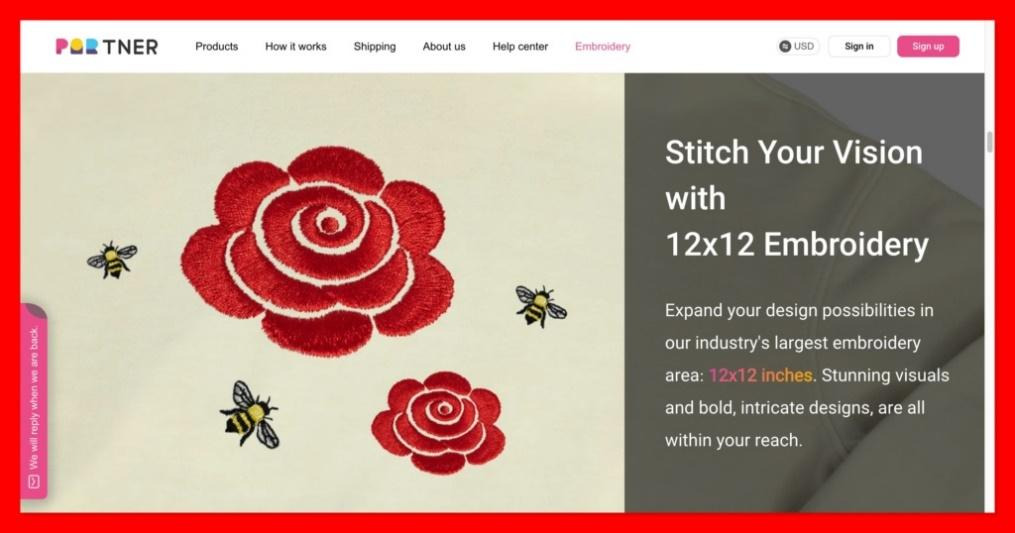
Even if the garment-focused product selection makes you feel a bit restricted, the customization options won’t. PODpartner specializes in DTG printing and embroidery – two of the most valuable options for most custom apparel merchants.
The embroidery is extra special, with up to 15 colors available, large spaces up to 12×12 inches, and endless placement options. In fact, those extra placement options are part of what makes this company so unique. There are about 18 different options to choose from on most products.
For example, on many hoodies and tees, you can:
- Print a full-width back graphic
- Add a sleeve print
- Add a chest embroidery
- Add a design on the lower front panel
- Mix printing + embroidery on the same garment
One particularly great thing to note here is that PODpartner supports direct image uploads and DST files for more detailed embroidery (other platforms ignore DST files entirely).
The Design Tools and Customization App
There’s nothing overly high-tech about PODPartner’s design tools. You don’t get any AI-powered image generators (like you do from Printify). Although you do get separate design systems for embroidery and DTG printing, with guidelines to follow.
Beyond that, PODPartner’s design tools support significantly more placement options: up to around 18 selectable zones on many garments, and offer one of the largest print areas in the industry, up to 24×24 inches. You can create oversized back graphics, wide chest layouts, sleeve prints, lower front panels, and even combine DTG and embroidery on the same piece for a premium multi-process look.
The good news is that the simplicity of these tools makes it pretty easy for anyone to get started. You just upload designs, position them, adjust the size, choose the print option you want, and take advantage of the expanded placements and DTG+embroidery combos to create more fashion-forward, high-end results.
PODpartner can create mock-ups too, so if you’re worried about showing off your products before you receive a sample or two in the post, you’re safe.
Now one thing that really does make PODpartner very different to a lot of other companies, is that it also allows your customers to create designs for themselves.
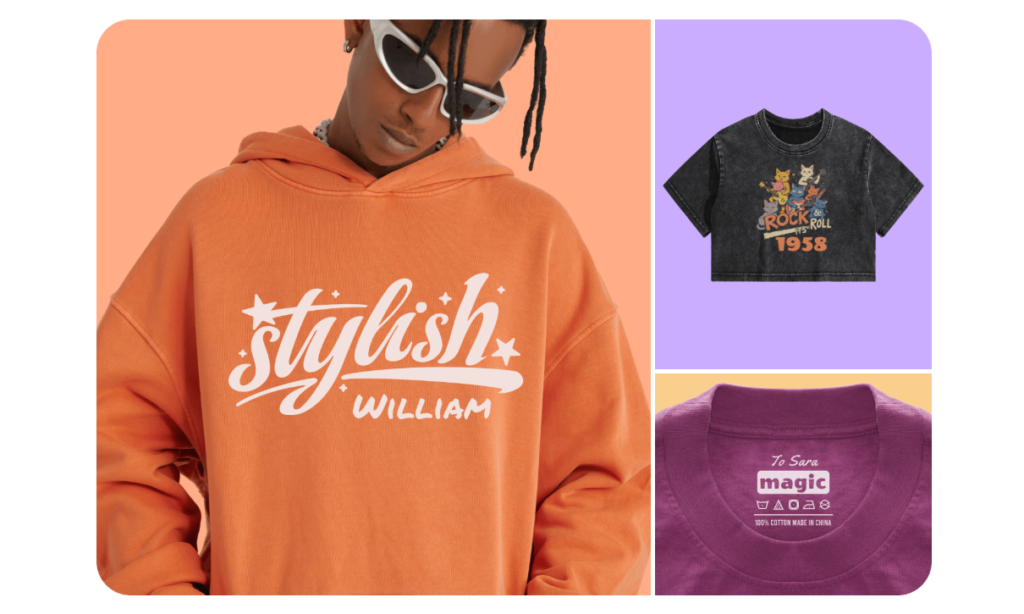
This feature is only available if you’re integrating with Shopify for now, but it’s incredibly useful. You just add a little app to your store, and customers can tweak anything you sell with their name, a special date, a quote they love, or anything else.
Gelato offers something like this too, but most of the other POD solutions I’ve worked with are still catching up. If you’re looking for a quick way to boost your potential revenue with luxury, personalized products, this is a great option.
Product Quality and Branding Options
I’ve ordered more POD samples over the years than I’d like to admit. Most of them end up in a donation pile, or in the recycling bin because they’re either scratchy, oddly shaped, washed-out after two laundry cycles, or look like they’ve been stitched by someone who doesn’t care.
PODpartner’s samples are the kind I’d actually wear.
All of their tees are 100% cotton, and you can feel the difference between the lighter and heavier options right away. The heavyweight version has that nice structure people want in modern streetwear. It’s not flimsy, doesn’t cling in weird places, and holds its shape after washing.
The prints look clean and vibrant, with solid color accuracy and no strange dots or banding. The embroidery, too, is incredible, with no loose-threads hanging off the seams or weird patches.
If you’re planning a premium-looking garment, embroidery is often what makes it feel expensive, and PODpartner’s stitching delivers that effect better than most POD vendors I’ve tested.
Another thing worth mentioning is the sustainability factor. I’m wary of vague “eco-friendly” claims from POD vendors, but PODpartner’s approach seems rooted in the fact that they manage more of their production themselves, rather than relying on a string of third-party facilities.
The garments feel durable, the inks don’t smell chemical-heavy, and the basic packaging stays minimal instead of piling on unnecessary plastic. If sustainability is something you highlight in your brand messaging, you’ll have some honest talking points to share with customers.
Branding Options: Making Your Packaging Stand Out
When it comes to branding, aside from obviously letting you add your own designs to clothing, PODpartner also lets you play with:
- Custom labels
- Neck tags
- Packaging inserts
I’ve seen POD providers that offer more options than that. You’re not getting the full “build-your-own-unboxing-experience” kit that some fulfillment partners offer, but the essentials are there, and they’re executed well.
The best part is that PODpartner produces branding materials on-demand. In other words, you’re not buying huge bundles that you have to store in a warehouse somewhere and get rid of if you suddenly find a design that works better. You can adjust designs whenever you like based on market feedback, and avoid some unnecessary extra costs.
Sales Channels and Fulfillment
Connecting POD tools to your store has become such a standard part of the process that I barely think about it anymore, until one gives me trouble. If you’ve dealt with integration loopholes before, you’ll know exactly what I mean.
I mentioned this above, but compared to a few alternatives (specifically Printful and Printify), PODpartner doesn’t give you quite as many channels to work with.
However you can connect the system to Squarespace, Etsy, Shopify, Wix, and WooCommerce stores (most of the big options). The integrations are pretty simple to setup too.
I tested the Shopify connection first. It synced quickly, and once connected, products exported from PODpartner showed up in my Shopify admin without any strange quirks. The Etsy integration behaved the same way: quick, simple, no technical headaches. Orders also synced back into PODpartner without any manual pushing.
Once everything is connected, orders flow through automatically. No CSV files, or “manual approval only” limitations, and no half-working syncs that break every other day.
The Fulfillment Options
Once an order actually moves into production, you start to see how a POD company really operates. A nice design tool or a big catalog is one thing, but if the fulfillment side is a mess, the customer complaints start pouring in quick.
PODpartner claims that almost all orders are processed within 48 hours, which is great, but it’s worth remembering that production speed isn’t the same as shipping speed. Embroidery items can take a little longer to produce too, especially if you’re customizing multiple areas on one garment.
When it’s time to handle shipping, PODpartner actually gives you more options than most. First of all, shipping is global. PODpartner works with logistics companies that already handle large volumes, so international deliveries don’t feel like a gamble. You can sell to Europe, the US, Australia, and other regions without getting buried in unpredictable shipping windows.
There are also three tiers for most customers to choose from: Standard, Fast, or Express.
Obviously, the price and speed of shipping all depends on a few things, like how many items are being ordered, and where your customers are. Still, PODpartner does have a handy rates page you can check out in advance. That’s helpful if you need to plan pricing for “free shipping” products.
PODpartner Pricing: How Much Does it All Cost?
PODpartner, like most of the POD companies I’ve reviewed, lets you start for free. They actually don’t have any premium plans at all, which could be a positive or negative thing depending on how you look at it.
You pay for the garments your customers order. That’s it. You don’t have to pay more to get access to premium features or benefits. You’re on the same footing as everyone else.
The base product costs are decent too. Lightweight tees, for instance, start at about $5.89, which is actually much cheaper than a similar shirt you could get on Printify’s premium plan ($7.70). Obviously, other extras do add up.
If you want to add multiple designs to multiple areas on a garment, you’ll pay more. If you choose embroidery over DTG, there are prices for both digitization and production. Another thing to look out for, is the multi-process fee.
If you combine DTG + embroidery on the same garment, there’s a small multi-process fee (around $2.99). Honestly, that makes sense since you’re running the product through more than one production setup. I also think that kind of thing can pay off, as it’s a great way to differentiate yourself from all the other vendors offering the same old designs.
The last thing to think about is the shipping costs. They’re pretty standard from what I’ve seen in the POD landscape lately, Standard shipping for a shirt costs about $4.96 for your first item, and $2.44 for every item after that.
Add everything up, and I think the margins here are pretty solid, even if you were going to offer free shipping. PODpartner’s catalog is built around items customers already expect to pay more for, which works in your favor.
Ease of Use and Customer Service
Some POD platforms feel like you’re signing up for a piece of enterprise software disguised as a T-shirt company. There are endless tabs, pop-ups, “get started” tutorials you can’t skip, and dashboards that take forever to get your head around. PODpartner doesn’t go down that path.
Signing up took me maybe ten seconds, and once you're inside, the dashboard feels pretty straightforward. If you’ve used Printify or Printful before, you should have no trouble.
The Design Creator tool is straightforward, especially since there are no AI features to get your head around, and you’ll start seeing mock-ups instantly. Once you create something, you just publish it to your store, add a description and price, and start selling.
The only part that threw me early on was switching between a print design and an embroidery design. Once you get used to how they handle those separately, it stops being a thing.
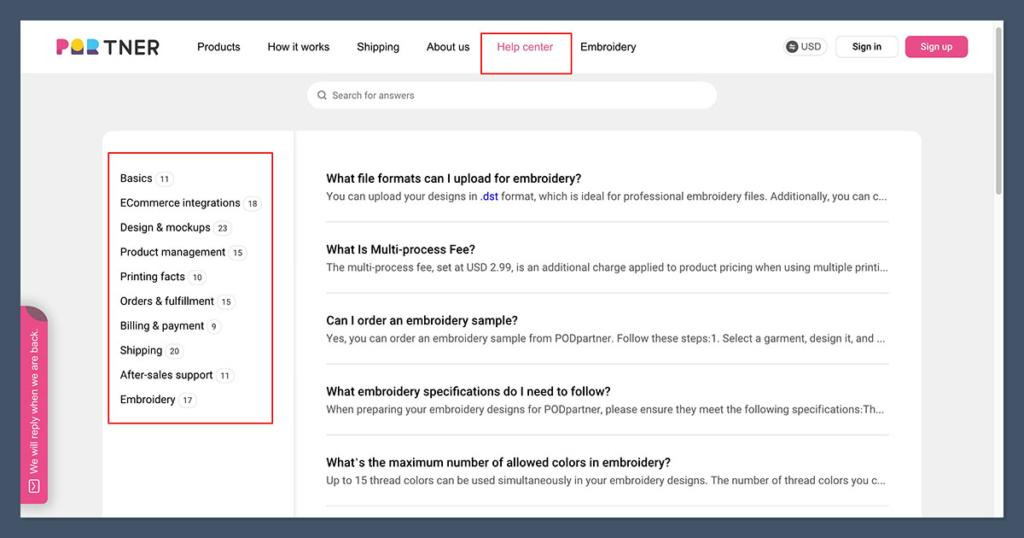
If you do find yourself in need of a little help, the help articles are straightforward. Short, visual, and not written in corporate jargon. They cover the basics: integrations, design guidelines, shipping expectations, embroidery rules. If you’re new to POD, you’ll get through them quickly.
For human assistance, there’s email, WhatsApp, and Facebook messenger. Plus, live chat is available on the website. Response times aren’t instant, especially if you’re working outside of the US, but when someone does get back to you, they’ll be clear and helpful.
If you get stuck between replies, there’s also a small but active community on their social channels, which can be useful for quick questions like “Does this fabric run large?” or “Is this item pre-shrunk?”
Verdict: Should You Use PODpartner?
No POD platform works for everyone. Each one leans toward a slightly different type of seller, and PODpartner is no exception. After spending time with it, I can safely say it’s a great option if you’re a fashion-focused creator looking to create unique products that really stand out.
It’s a fantastic option if you care about design freedom, embroidery and print quality, healthy margins, the largest print areas in the industry. Plus, it’s eco-friendly materials, express shipping options, and the customization feature that allows buyers to personalize their own garments (through Shopify) all add to its potential.
Of course, PODpartner won’t be ideal if you want fancy AI design tools, non-apparel products, or unique integrations. Overall though, I’d say it does what it aims to do well. It’s a POD collaborator for companies that want luxurious garments without restrictions.
If that appeals to you, it’s definitely worth giving PODpartner a try.



Comments 0 Responses