

Weebly vs BigCommerce: Which is best? Ultimately, it all depends on what you need from a website builder and ecommerce platform.
Based on my experience with both platforms, I’d say BigCommerce is definitely the better option for larger companies looking to scale their online presence. It offers advanced inventory management tools, state-of-the-art AI capabilities, and omnichannel selling options.
Weebly is a more user-friendly and affordable option, ideal for smaller businesses, with a decent of ecommerce tools, decent design options, and great blogging capabilities. However, it lacks the versatility of BigCommerce, which means you may need to consider migrating to a different platform when your business grows.
Here’s my complete, hands-on comparison review of both of these platforms, created to help you make the right choice for your business.
If you’re pressed for time, here’s what you need to know:
Quick Verdict
- Weebly is best for smaller businesses and beginners in search of a straightforward website builder with basic ecommerce functionality, and a few integrated marketing tools.
- BigCommerce is best for growing companies looking for advanced inventory management tools, AI capabilities, omnichannel selling, and stronger reporting options.
Weebly vs BigCommerce: Pros and Cons
Weebly Pros and Cons
Pros 👍
- Easy-to-use platform with a straightforward drag-and-drop builder
- Affordable pricing for smaller companies
- Decent range of plugins and integrations
- Built-in SEO and blogging tools
- Excellent page loading times
- No selling caps
Cons 👎
- Very few advanced features
- Poor user management
- Basic sales tools
BigCommerce Pros and Cons
Pros 👍
- Versatile and scalable platform, with excellent hosting and security
- Extensive ecommerce capabilities and omnichannel selling support
- Built-in AI solutions for content creation and website design.
- Powerful SEO and marketing tools
- Excellent user, business, inventory, product, and order management.
Cons 👎
- Selling caps on each plan
- Slightly higher learning curve
- Pricing can be expensive
Weebly vs BigCommerce: Pricing and Fees
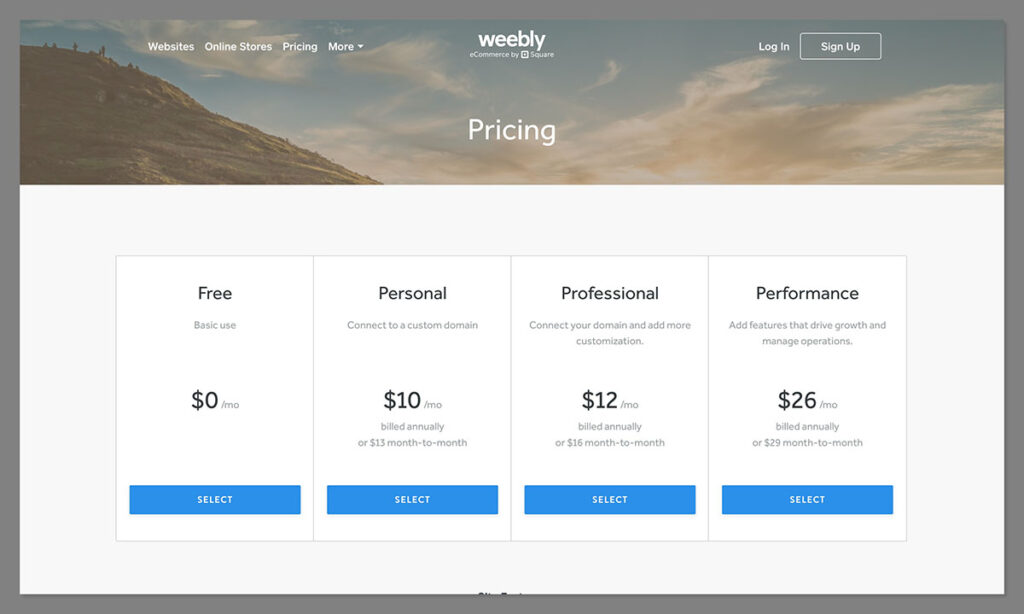
There are a few big differences between Weebly and BigCommerce, but perhaps the most significant of all is the pricing for both platforms. Weebly is well-known for offering customers a “free forever” plan, which includes access to a shopping basket, and allows you to sell unlimited items.
The paid plans from Weebly range from around $10 to $26 per month. The cheapest plan (Personal) even includes support for a custom domain, and unlimited storage, while the most expensive plan (Performance) includes abandoned cart emails and advanced ecommerce insights.
Unfortunately, BigCommerce doesn’t have a free plan, although you can trail the platform for 15 days without paying anything. After that, prices range from $39 per month (for the Standard plan), to $399 per month (for the Pro plan). There’s also an enterprise option available, with custom pricing.

Notably, BigCommerce doesn’t charge transaction fees on any plan, but it’s still a lot more expensive than Weebly overall. I’m also not particularly thrilled about the fact that each plan places limits on how much you can sell. For instance, on the Standard plan, you’ll be restricted to $50k per year.
On the plus side, you do get “more for your money”, on most BigCommerce plans, such as omnichannel and international selling tools.
Read more:
Weebly vs BigCommerce: The Core Features
Weebly and BigCommerce might both be ecommerce and website building tools, but it’s easy to see they’re clearly targeting different customer groups. BigCommerce is a much more advanced platform overall, with more powerful tools for business management. Weebly is a more basic solution, intended for solo entrepreneurs and smaller organizations.
Let’s take a closer look at how the core features of both platforms stack up, side by side.
Website Building and Design
Personally, I think BigCommerce is a slightly better platform for website design overall. Both Weebly and BigCommerce give you a couple of hundred templates to choose from, although I will note that a lot of BigCommerce’s themes seem pretty similar.
They both also focus on responsive, professional-looking templates, that can adapt to suit a range of industries.

However, BigCommerce’s themes are more fine-tuned to the needs of ecommerce store owners, whereas with Weebly, you can find themes for everything from portfolios to blog websites.

When it comes to actually customizing your themes, Weebly is a lot easier to use. The drag-and-drop website editor is very intuitive, and doesn’t require any specific coding knowledge.
I think BigCommerce’s editor has become more intuitive over the years, but it still has a steeper learning curve, even with the addition of helpful AI-powered tools.
On the plus side, though, BigCommerce gives you more freedom to make granular changes to your store’s appearance and functionality. You can dive into CSS and HTML files, create global widgets, design unique product category sections and more.
Ecommerce and Selling Features
Considering it’s affordable pricing, Weebly is pretty robust when it comes to ecommerce capabilities. Most plans include support for unlimited products, inventory management tools, automatic tax calculation, and delivery options (like in-store pickup).
However, you do need a paid plan to sell both physical and digital goods, and abandoned cart emails are reserved for the most expensive plan.
Weebly’s integrated shopping cart is excellent, and there are plenty of features that can help you improve the user experience for shoppers, like filtered search capabilities. However, you won’t be able to accept PayPal payments unless you upgrade to the “Performance” plan.
Alternatively, BigCommerce takes advantage of a partnership with PayPal which allows companies to access discount transaction rates on most plan. You can also integrate various other payment systems into your store, and access far more powerful inventory management capabilities.
BigCommerce also gives you access to marketplace and social media integrations (For omnichannel selling), and can integrate with a range of point of sale solutions from companies like Square and Clover.
Plus, you get real-time shipping quotes, product ratings and reviews, and multi-currency selling capabilities on every plan.
On top of that, BigCommerce allows you to make more granular changes to product pages, with detailed product variants, custom fields, and unique shipping and delivery rules. You can also sell physical products, digital products, and services through BigCommerce. There are even specialist plans available for B2B and wholesale companies.
Marketing Tools and Analytics
Here’s where things start to get a little tricky. I think Weebly has a slightly better blogging feature for content marketing, and it does offer some great extra tools, such as pop-up notifications, customizable Instagram feeds, and lead capture forms.
However, the platform is relatively limited from an SEO perspective – BigCommerce allows you to edit a lot more of your website with a focus on higher rankings. Both platforms also make it relatively easy to promote products and sales.
You can create vouchers and gift cards with both platforms, and showcase item reviews on product pages (although this is only available on Weebly’s most expensive plan).
Both BigCommerce and Weebly also support abandoned cart emails and basic email marketing, although I’d recommend using an integration for more advanced email drip campaigns.
The reports are definitely a lot better on BigCommerce too. You can create customized dashboards, track inventory, sales numbers, and customer preferences, and even monitor your number of new and repeat customers.
Weebly will definitely allow you to track a few important metrics, but you can’t dive as deeply into your data as you would be able to with BigCommerce.
AI Capabilities
AI has become a popular feature on most ecommerce platforms, from Wix, to Shopify. BigCommerce is rapidly emerging as a leader in the AI ecommerce space, with its “BigAI” toolkit.
This kit comes with solutions for AI content generation, predictive analytics, and personalized product recommendations. You can even add AI-powered search to your store, to help customers find the products they need faster.

Notably, BigCommerce is still in the process of unveiling its AI strategy, and is currently working with partnering companies to bring more AI integrations into the mix too.
Unfortunately, Weebly doesn’t offer any native AI capabilities as standard. You can’t even use AI to customize a template, like you can with Wix. However, you can integrate a few third-party AI-powered tools with your store, through the Weebly marketplace.
Integrations and Apps
Although I think Shopify has the best ecommerce app market available today, both Weebly and BigCommerce give you plenty of integration options to explore.

BigCommerce just slightly edges ahead of Weebly, with a wider range of apps for point of sale management, marketing, dropshipping, fulfillment, and analytics.
I also love how BigCommerce organizes its apps into “collections” such as “Shipping Essentials”, so you can find what you’re looking for pretty quickly. Plus, you can leverage open API options to create automated workflows that connect all of your different business apps.
Weebly still offers a decent number of apps within its “App Center”, but there are about 100 apps to choose from, compared to more than 850 from BigCommerce.
BigCommerce vs Weebly: Ease of Use and Customer Support
If there’s one area where Weebly definitely “steals the crown” from BigCommerce, it’s in ease-of-use. As I mentioned above, BigCommerce is a lot more intuitive these days, particularly if you’re taking advantage of the integrated AI tools, but Weebly has less of a learning curve.
If you want to dive into building your website and running your store without having to learn how to use a lot of different capabilities, Weebly is probably the better choice.
However, BigCommerce is better, in my opinion, at delivering exceptional customer support. Both platforms offer solid learning resources like tutorials, guides, and FAQs, but BigCommerce’s resources are a lot more in-depth.
There’s even a fantastic online community, and tons of videos you can watch if you need extra step-by-step guidance.
Plus, while Weebly and BigCommerce both promise 24/7 support, you’re limited to forum, chat and email support on Weebly’s free and personal plans. BigCommerce offers chat, email, and phone support on every plan.
Weebly vs BigCommerce: Final Verdict
Ultimately, choosing between Weebly and BigCommerce should be pretty simple. If you’re running a small store, and only need basic ecommerce features, but prioritize a straightforward experience, then Weebly is probably the right choice for you.
Alternatively, if you’re looking for exceptional scalability, more advanced AI and ecommerce capabilities, stronger inventory, user, and product management options, and omnichannel selling, BigCommerce is the better option.



Comments 0 Responses