

Fine Art America is a print-on-demand platform built specifically for artists, photographers, and illustrators, offering high-quality wall art, home decor, and lifestyle merchandise with one feature that sets it apart from the pack: artists set their own markups on every product.
I've spent dozens of hours testing print-on-demand platforms across the art and creator space, comparing everything from print quality to payout terms.
After working through Fine Art America's setup, product range, and artist tools, I can tell you exactly where it shines and where it falls short.
In this review, I'll break down Fine Art America's pricing, products, fulfillment, and competitive positioning so you can decide if it's the right fit for your art business.
Perché puoi fidarti di questa recensione
This review is based on hands-on platform testing, artist feedback from communities like Reddit and Facebook groups, verified buyer reviews, and current market data from third-party analytics sources. We update our print-on-demand reviews annually to reflect pricing changes, new features, and shifts in platform performance.
Recent updates to this review: Pricing verified for 2026, latest traffic and revenue data refreshed, customer support concerns documented based on recent artist reports.
Fine Art America Pros & Cons
| Ideale per | Artists and photographers selling fine art prints |
|---|---|
| Valutazione | Very Good ★★★★☆ 4.2 out of 5 |
| Ideale per | Serious photographers · Collectors-focused artists · Low-overhead testing |
| Prezzi | Free account available · Premium: $30 / year |
Pro
- Full pricing control with artist-set markups
- In-house print production
- Extremely low entry cost
Contro
- Saturated marketplace with 700,000+ artists
- 30-day delayed payouts
- Reports of arbitrary account closures
Need a quick summary of Fine Art America? Here are the best and worst features at a glance:
Cosa mi piace
- Artists set their own markups on every product, so you have full control over your profit margins instead of accepting a fixed commission
- The free Standard account lets you list up to 25 images at zero cost, making it one of the lowest-risk ways to test print-on-demand
- Fine Art America prints in-house rather than outsourcing, which translates to consistent reproduction quality praised by photographers
- The product range is genuinely deep: canvas, metal, acrylic, wood, framed prints with matting, plus apparel, mugs, phone cases, and greeting cards
- Built-in licensing program connects artists with partner retailers and brands, including opportunities to have work featured on ABC TV sets
Quello che non mi piace
- Annual revenue declined an estimated 10-20% in 2025 to around $144.8M, with analysts projecting a further 5-10% decline this year
- Payouts are released one full month after the sale to accommodate the 30-day return window, which strains cash flow for active sellers
- Multiple artists report sudden account closures without explanation, with Fine Art America citing its right to shut down accounts at its discretion
- Customer support for artists is widely described as slow and ticket-based, with resolution sometimes taking 24-72 hours
- With around 700,000 artists on the platform, organic discoverability is brutal for new sellers
My Experience With Fine Art America
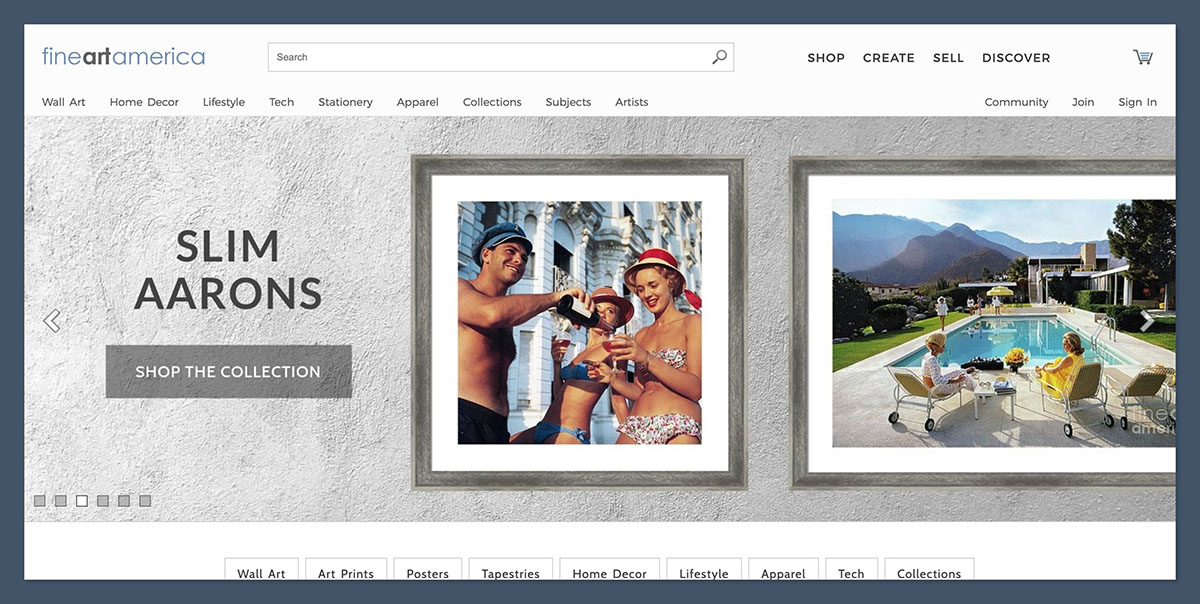
Signing up for Fine Art America is genuinely frictionless. There's no credit card requirement to open a free Standard account, just an email and basic profile information.
After registration, I landed on a personalized artist dashboard with a clear path: upload images, configure products, set markups, and publish to my storefront.
The platform asks a few onboarding questions about whether you're an artist, photographer, or illustrator, and whether you want to focus on prints, merchandise, or both. Unlike Shopify or Wix, there's no AI-driven setup wizard or theme generator.
You get a templated artist profile page (yourname.fineartamerica.com style URL), and the customization options are limited to bio, headshot, social links, and a featured image arrangement.
Note di prova dell'autore
Coming from platforms like Shopify or Squarespace, the Fine Art America back-end feels distinctly dated. The navigation is functional but cluttered, and there's a learning curve to finding settings buried under “Behind the Scenes” menus.
That said, this is a marketplace platform first and a storefront builder second, so the trade-off makes sense. You're not here to build a custom brand experience: you're here to list artwork and have someone else handle production.
How I Added Products
Uploading artwork is where Fine Art America's workflow actually feels purpose-built.
You upload a high-resolution JPEG, add a title, description, and keywords, and the system automatically generates product mockups across the full catalog: prints in multiple sizes, framed options, canvas, metal, mugs, totes, throw pillows, and more.
You can either set markups individually per image or use a default markup that applies to every product type across your portfolio. I'd recommend setting defaults first to save hours of repetitive configuration, then customizing pricing for your standout pieces.
The free Standard account caps you at 25 image uploads, which most serious artists will hit within a week. The Premium account at $30 per year removes that limit entirely and unlocks unlimited uploads.
Configuring My Storefront
Storefront customization is the weakest part of the Fine Art America experience. You don't get themes, drag-and-drop editing, or layout control. What you get is a standardized profile page where you can rearrange image collections, add a banner, and write bio copy. That's it.
If you want a real branded website, you have to upgrade to Premium, which unlocks a white-label site powered by Fine Art America's technology, plus a shopping cart widget you can embed on an external site (like a WordPress or Squarespace portfolio).
Everything you upload syncs in both directions, which is genuinely useful if you already have an artist website and just want Fine Art America to handle fulfillment.
Note di prova dell'autore
If branding and storefront design are priorities, Fine Art America isn't your platform. It's a marketplace and fulfillment engine, not a website builder. Artists who want a fully custom storefront typically pair Fine Art America with their own site (using the embed widget) or compare it against platforms like Printful or Gelato, which integrate with Shopify and let you build your own brand front-end.
How Much Does Fine Art America Cost?
Fine Art America's pricing structure is one of the simplest in the print-on-demand category. There are just two tiers, and there are no monthly subscriptions or per-product listing fees.
| Pianifica | Prezzo | Ideale per |
|---|---|---|
| Standard | Gratis | Testing the platform with up to 25 images |
| Premium | $ 30 / anno | Serious artists needing unlimited uploads and marketing tools |
The Standard plan covers everything you need to get listed: a profile page with a custom URL, access to the full product catalog, the ability to set markups, and storefront presence in the marketplace.
The catch is the 25-image cap, which is restrictive given that successful Fine Art America sellers typically maintain portfolios of 1,500+ images.
The Premium plan at $30 per year unlocks unlimited image uploads, a white-label artist website, the embeddable shopping cart widget, email marketing tools, and access to the licensing program with partner retailers.
For comparison, SmugMug charges $250 per year for a comparable creator-focused offering.
Is Fine Art America Good Value for Money?
Yes, on the entry side. There is genuinely no cheaper way to access a full print-on-demand catalog (canvas, metal, framed prints, apparel, home decor) with in-house production. The free plan alone is enough to validate whether your work sells before you commit a single dollar.
The real cost lives elsewhere: in the time you'll spend marketing your work, the relatively thin margins after Fine Art America's base prices, and the opportunity cost of building a portfolio on a platform where you don't own the customer relationship. Customer emails and data stay with Fine Art America, not with you.
Note di prova dell'autore
For most artists, I'd start with the free Standard account, upload 25 of your strongest pieces, and only upgrade to Premium once you've seen actual sales come through. The $30 annual fee is trivial, but the platform's value depends entirely on whether your specific niche has buyers actively browsing the marketplace. If you sell two prints in your first month on the free plan, upgrading is a no-brainer. If you sell zero, the Premium account won't fix that.
Prodotti e qualità di stampa
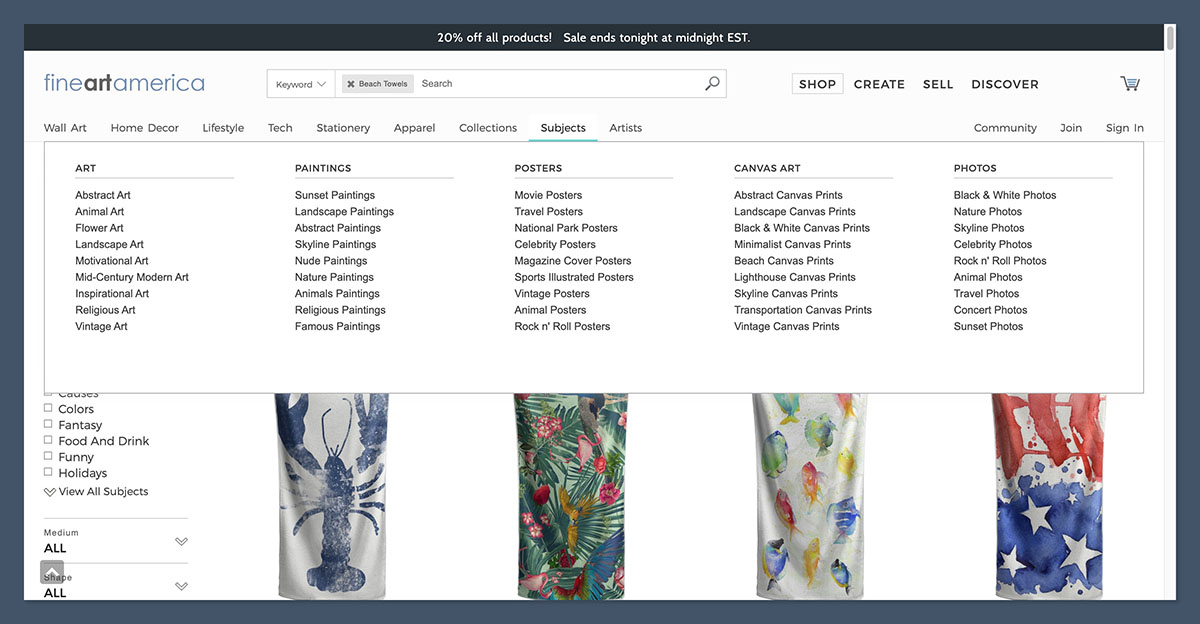
Fine Art America's product catalog is one of the deepest in the print-on-demand category, and the quality reflects the platform's positioning toward serious art buyers rather than casual merchandise shoppers.
Gamma di prodotti
The catalog spans five broad categories:
- Arte muraria: Canvas prints, metal prints, acrylic prints, wood prints, framed prints with matting, traditional paper prints, tapestries, and posters
- Home decor: Throw pillows, blankets, shower curtains, beach towels, bath mats, duvet covers, and coffee mugs
- Abbigliamento: T-shirts, sweatshirts, hoodies, and tank tops
- Tech and lifestyle accessories: Phone cases, tote bags, weekender bags, and stationery
- Biglietti d'auguri e cancelleria
One notable feature: artists can also sell original artwork alongside prints, which is unusual in the print-on-demand category. Most competing platforms only handle reproductions.
Qualità di stampa
Fine Art America operates 14-16 manufacturing facilities globally and prints in-house rather than outsourcing to third-party production partners. That matters because consistency across orders is generally better when one company controls the full production stack.
Verified Trustpilot reviews (4,651 reviews at last check) tilt heavily positive on print quality, particularly for canvas and framed prints. Photographers consistently rate Fine Art America's reproduction quality as comparable to dedicated photo labs, which is a meaningful endorsement given how exacting photographers tend to be about color accuracy.
The flip side: some artists have noted that the end-consumer pricing on premium products (large framed pieces, metal prints) runs high, which compresses how much markup you can layer on before pricing yourself out of the market.
Pricing Control and Artist Earnings
This is Fine Art America's single biggest differentiator. Unlike platforms like Society6 or Redbubble that pay artists a fixed royalty (typically 10-20%), Fine Art America lets you set your own markup on every single product.
The company collects only the base manufacturing cost, and 100% of your markup is yours.
How Markups Work
Every product in the catalog has a base price set by Fine Art America that covers manufacturing, materials, and fulfillment. You add a markup on top of that base, and the final consumer price is base + markup. When a sale happens, Fine Art America keeps the base price and pays you the full markup.
You can set markups three ways:
- Default markups that apply to every product type across all your images
- Per-image markups for specific pieces you want to price differently
- Product-specific markups for individual sizes or material types within one image
Struttura dei pagamenti
Payments are released monthly on the 15th, covering sales from the prior month. The 30-day delay exists to accommodate Fine Art America's 30-day return window, which is reasonable from a business standpoint but tough on cash flow if you're scaling fast. Payouts are sent via PayPal or check.

Suggerimento sui prezzi
Most successful Fine Art America sellers set markups in the $15-50 range for standard prints and $50-150+ for canvas, metal, and large framed pieces. Pricing too high kills conversion in the marketplace; pricing too low makes high-quality work look cheap. Test multiple price points across your portfolio before committing to a default.
Marketing and Discoverability
Fine Art America provides modest built-in marketing tools, but the platform's competitive density means most successful artists drive traffic from external sources rather than relying on internal marketplace discovery.
Built-In Marketing Features
Premium members get access to email marketing tools, promotional discount codes, and the licensing program that places artwork with partner retailers and brick-and-mortar chains like Deck the Walls. The platform also runs an active artist community with topic-based groups and contests, which can drive incremental exposure.
Fine Art America has historically ranked well in Google search results for image-based queries, which means individual artwork pages can pick up organic traffic from buyers searching for specific subjects (e.g., “abstract ocean canvas print”). Optimizing your titles, descriptions, and keywords genuinely matters here.
The Discoverability Problem
With approximately 700,000 artists on the platform, internal discovery is a long shot for new sellers. The marketplace surfaces a mix of trending artwork, recent uploads, and curated collections, but breaking through requires either a substantial portfolio (1,500+ images) or external traffic from your own social channels.
Note di prova dell'autore
Artists I've spoken with who treat Fine Art America as a primary income source uniformly report driving their own traffic via Instagram, Pinterest, and personal websites, then funneling buyers to their Fine Art America shop. Artists who upload work and wait for the marketplace to deliver sales typically see a handful of orders per year, if that. The platform handles fulfillment beautifully, but you are responsible for marketing.
Marketplace Performance and Competitive Positioning
Fine Art America is the largest dedicated fine art print marketplace, but it's been losing ground in recent years. Recent data from third-party analytics sources tells a mixed story.
Recent Performance Data
| Metrico | Valore |
|---|---|
| Annual revenue (2025) | ~$144.8M (10-20% decline year over year) |
| March 2026 online sales | $ 10.5M |
| March 2026 sessions | 3.3 milioni |
| Tasso di conversione | 2.50-3.00% |
| Valore medio dell'ordine | |
| US site rank | #5,884 |
| Projected 2026 revenue trend | 5-10% decline expected |
Traffic was actually up 27.1% month over month in December 2025, suggesting the decline is more about average order value and conversion than total visitor volume. The platform remains heavily visited, with an average session duration over 9 minutes, which indicates engaged browsing rather than bounce traffic.
How Fine Art America Compares to Competitors
| Piattaforma | Monthly Revenue (Mar 2026) | Valore medio dell'ordine | Ideale per |
|---|---|---|---|
| Belle Arti America | $ 10.5M | Fine art and photography prints | |
| Redbubble | $ 14.2M | Casual merchandise and apparel | |
| Art. com | $ 5.5M | N/A | Mainstream wall art |
| Arte Saatchi | $ 3.9M | Original art and high-end collectors | |
| Society6 | $ 2.9M | Lifestyle products and home decor |
Fine Art America sits in a useful middle position: higher average order values than Redbubble and Society6 (which means more revenue per sale), but lower than Saatchi Art (which sells original art to serious collectors). The platform's sweet spot is buyers who want quality wall art and home decor without the price tag of original work.
Rispetto alle alternative:
- Redbubble has more total traffic but lower average order values, and pays artists a fixed royalty rather than allowing custom markups
- Society6 focuses more on lifestyle and home decor than wall art, with a younger buyer demographic
- Printful and Gelato are fulfillment-only services without a marketplace, meaning you bring 100% of your own traffic but keep full control over branding
- Arte Saatchi targets original art sales at higher price points, which fits a different category of artist entirely
Customer Support and Account Issues
This is the area where Fine Art America's reputation gets uneven. Customer-facing service (for buyers) is generally reported as responsive, with a 30-day return policy and consistent order fulfillment. Artist-facing support is a different story.
Problemi segnalati
Multiple reports from artists across Reddit, Facebook groups, and review sites describe a recurring set of problems:
- Account closures without explanation: Some artists have reported sudden account terminations, with Fine Art America citing its right to shut down accounts at its discretion. There is limited recourse once a closure happens.
- Access issues blocking payouts: A smaller number of artists describe being locked out of their accounts after sales, preventing them from withdrawing earned funds.
- Image theft and IP disputes: Watermarked images have reportedly been used commercially without permission, with Fine Art America declining to take responsibility for downstream misuse by third parties.
- Slow ticket-based support: Resolution times typically run 24-72 hours via email tickets, with no live chat or phone option for artists.
It's worth noting that these reports represent a minority of artist experiences, and many sellers report years of uneventful, positive experiences. But the pattern is consistent enough across independent sources that it's worth factoring into your decision, particularly if Fine Art America would be your primary income source rather than a secondary channel.
How Does Fine Art America Compare to Competitors?
Fine Art America is the largest dedicated fine art print-on-demand marketplace, but it's not the right fit for every artist. Here's how to think about the alternatives:
- Printful is the better choice if you want to build your own branded storefront on Shopify or another platform. It's fulfillment-only with no marketplace, meaning you keep 100% of your customer relationship and brand control, but you bring all the traffic.
- Society6 and Redbubble are easier entry points for casual artists and illustrators selling pop-culture-adjacent designs on lifestyle products. They pay fixed royalties rather than letting you set markups, but the marketplace traffic is meaningful.
- Gelato is the strongest fulfillment-only competitor for wall art specifically, with global production centers that can ship locally and reduce shipping costs for international buyers.
- Arte Saatchi targets serious art collectors with original work and higher-priced limited editions, which is a different category from print-on-demand.
How We Test Print-on-Demand Platforms
La nostra metodologia di test
We evaluate print-on-demand platforms across seven weighted criteria to provide consistent, comparable reviews:
| Criterio | Peso | What we test |
|---|---|---|
| Gamma e qualità dei prodotti | 25% | Catalog depth, print fidelity, materials, and consistency |
| Artist earnings and pricing control | 20% | Commission structure, markup flexibility, base costs |
| Marketplace and discoverability | 15% | Internal traffic, SEO performance, conversion rates |
| Adempimento e spedizione | 15% | Production speed, global reach, packaging quality |
| Usabilità della piattaforma | 10% | Upload flow, dashboard design, marketing tools |
| Pricing and entry cost | 10% | Membership fees, hidden costs, value at each tier |
| Supporto e reputazione | 5% | Artist support quality, account stability, community feedback |
Fine Art America Review: Should You Sell With Fine Art America?
Fine Art America is the right platform for one specific type of artist: serious photographers, illustrators, and fine artists who want professional-grade print reproduction handled by someone else, full control over their pricing, and a low-risk way to test the print-on-demand category.
The free Standard plan alone makes Fine Art America worth a try for almost any artist. Upload 25 of your strongest pieces, set sensible markups, and see what happens over 60-90 days. If sales materialize, the $30 Premium upgrade is a trivial investment to unlock unlimited uploads.
Where Fine Art America falls short is for artists who want a branded storefront, fast payouts, responsive support, or a platform where their account is genuinely safe from arbitrary changes. If any of those matter more than print quality and pricing flexibility, look at Printful, Gelatoo costruirne uno tuo Shopify store with a print-on-demand integration.
Fine Art America's revenue decline in 2025 is a real signal worth watching, but the platform remains the largest dedicated fine art marketplace and continues to drive meaningful traffic to artist storefronts. For now, it's still a reasonable channel to add to a diversified print-on-demand strategy, particularly if you're not relying on it as your sole source of income.
Fine Art America FAQs
Is Fine Art America free to use?
Yes. Fine Art America offers a free Standard membership that lets you upload up to 25 images and list them across the full product catalog. The optional Premium membership costs $30 per year and removes the upload limit while adding marketing tools and a white-label artist website.
How much commission does Fine Art America take?
Fine Art America does not take a percentage of your markup. The company collects only the base manufacturing cost of each product, and 100% of the markup you set goes to you. Effectively, Fine Art America's “commission” is built into the base price the customer pays.
When do artists get paid on Fine Art America?
Payments are sent on the 15th of each month for sales made in the prior month, after the 30-day return window has closed. Payouts are issued via PayPal or check.
How many images do you need to be successful on Fine Art America?
Successful sellers typically maintain portfolios of 1,500 to several thousand images. The 25-image cap on the free Standard plan is mostly useful for testing whether the platform works for your style; serious sellers upgrade to Premium for unlimited uploads.
How does Fine Art America print quality compare to other platforms?
Fine Art America prints in-house across 14-16 manufacturing facilities globally rather than outsourcing to third parties. Verified buyer reviews consistently rate print quality, particularly for canvas and framed pieces, as comparable to dedicated photo labs.
Can you sell original artwork on Fine Art America?
Yes. Unlike most print-on-demand platforms, Fine Art America allows artists to list original artwork alongside print reproductions, which can be useful for selling one-of-a-kind pieces to collectors.
What products can you sell on Fine Art America?
The catalog includes canvas, metal, acrylic, wood, and traditional paper prints; framed and matted options; tapestries; throw pillows, blankets, towels, and other home decor; apparel like t-shirts and hoodies; tech accessories including phone cases and tote bags; greeting cards; and coffee mugs.
Is Fine Art America the same as Pixels.com?
Yes. Pixels.com is owned by the same company and shares the same fulfillment, accounts, and product catalog. Some artists list under the Pixels.com brand depending on their target market and audience.
Does Fine Art America offer worldwide shipping?
Yes. Fine Art America ships globally from its network of manufacturing facilities and maintains multiple country-specific domains to support international buyers.


Commenti Risposte 0