

I think that people comparing Fourthwall and Printful usually come to the debate confused. They think they’re looking at two “print on demand partners”. They’re not.
Printful is a print on demand and fulfillment service, a good one. It’s built for people who are comfortable owning the entire selling process. Store, checkout, tax rules, customer support, refunds, edge cases. If that sounds fine to you, Printful is a solid piece of infrastructure. I still recommend it in the right context.
Fourthwall starts from the opposite assumption. It assumes merch is a side effect of an audience, not a business you want to operate. So it collapses the whole thing. Storefront included. Taxes handled. Customer support handled. Merch, digital products, memberships, all living in one place without asking you to manage a dozen separate services.
That’s the big difference. Printful is for people who want to run a POD business. Fourthwall is for people who want to launch a premium brand.
Quick Verdict: Fourthwall or Printful?
Printful is popular for a reason. It’s the number one rated POD app on Shopify, with a tiny 0.24% return rate, consistent output, and fast fulfillment (usually 2-5 days). It also gives you multiple printing methods, plenty of product options, and advanced branding options.
However, it’s made for people who are fine running and managing the whole ecommerce process, from store setups, to customer support.
Fourthwall is different. It’s for people who want merch to exist and behave itself. A proper store, decent products, somewhere to sell digital downloads or memberships, and crucially, someone else dealing with tax calculations and customer emails when a package goes missing.
If you want to launch a brand without inheriting a business to run, Fourthwall fits.
If you want to run the entire business yourself, Printful does its job very well.
Fourthwall vs Printful: Side by Side
Really, this isn’t a comparison between two merch tools. It’s a choice between owning the whole selling process, or letting someone else absorb most of it so you can get back to the work that actually brought people there.
| Factor | Printful | Fourthwall |
| What it is | A print-on-demand fulfillment service | A complete creator brand platform |
| What it handles | Printing and shipping | Storefront, checkout, merch, digital products, memberships, taxes, and customer support |
| Storefront | None. You need Shopify, WooCommerce, Etsy, or similar | Built-in storefront with custom domain |
| Monthly fees | Printful: $0–$25/month Shopify: $39+/month | $0 monthly platform fee (Fourthwall Pro available at $15/month billed yearly) |
| Real monthly cost | $39–$65+ before selling anything | $0 upfront, no monthly fees |
| Who runs the store | You do | You run the brand, Fourthwall runs the operations |
| Tax handling | You’re responsible for collecting and remitting sales tax and VAT | Fourthwall is the Merchant of Record and handles all tax compliance |
| Customer support | You handle all customer-facing issues | Fourthwall handles support for products from their catalog |
| Print quality | Solid, consistent, mid-to-premium POD quality | Retail-grade quality with a curated catalog and Signature collection |
| Product range | 400+ POD products | 362+ products with a curated catalog and Signature collection |
| Digital products | Not supported | Built in |
| Memberships | Not supported | Built in |
| Creator integrations | Ecommerce platforms (Shopify, WooCommerce, Etsy) | YouTube Merch Shelf, Twitch Product Gifting, TikTok Shop, Discord roles |
| Best for | People who want to run a POD ecommerce business | Creators who want a premium brand without running ecommerce |
Fourthwall vs Printful: Pricing, and Costs
On its own, Printful. Even generous. You can sign up for free. There’s a Growth plan at $24.99 a month, but you don’t have to take it, and if you pass $12,000 in annual sales, they’ll waive it anyway. That sounds reasonable, and to be fair, it is. Printful’s per-item pricing sits in that mid-tier POD range. A Bella+Canvas tee is roughly $11.69 before shipping. That’s fine.
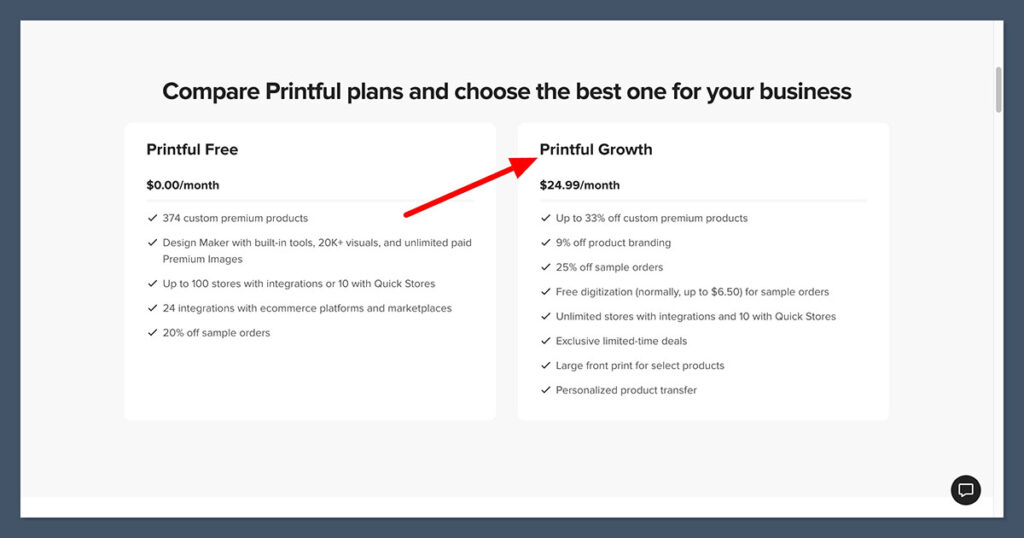
The problem is that Printful pricing never exists in isolation.
To actually sell anything, you need a storefront. For most people, that’s Shopify. Shopify Basic is $39 a month. That’s the real starting point, not zero. From there, things tend to creep. If you sell internationally, you start thinking about tax tools. If you sell enough volume, you start thinking about customer support software. If you want branding touches like custom pack-ins or labels, Printful charges extra, usually around $2.50 per item.
A realistic Printful setup looks less like “free” and more like $39 to $65 a month before you’ve sold a single item, plus time. Time setting things up, checking orders, and replying to emails when something goes wrong.
Fourthwall’s pricing is a lot more straightforward.
There’s no monthly platform fee. The storefront, checkout, and custom domain are included. Taxes are handled because Fourthwall is the Merchant of Record. Customer support for catalog products is handled. You don’t need to bolt on a tax tool.
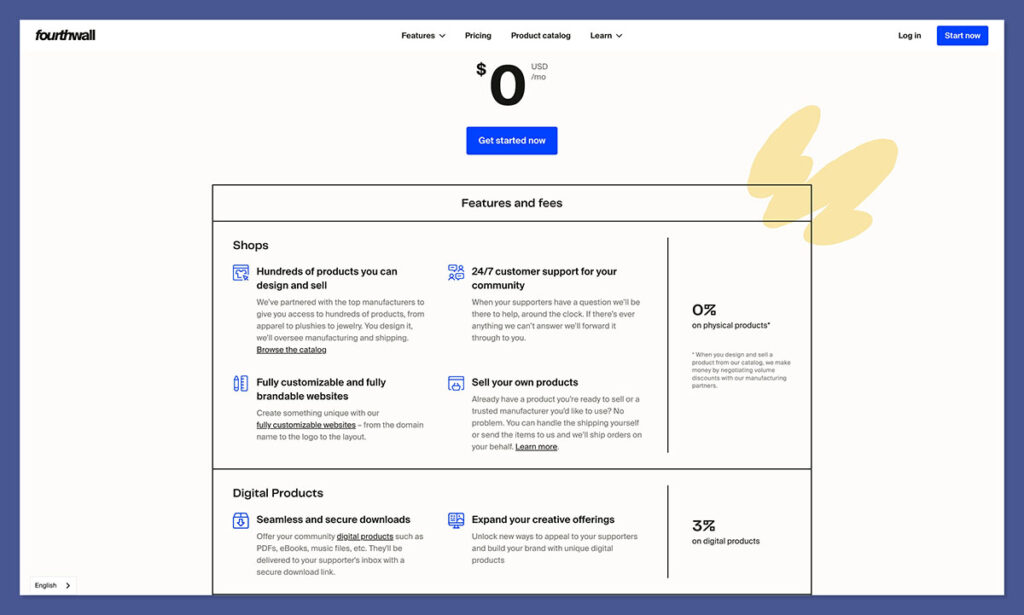
That doesn’t mean Fourthwall is always cheaper per product. Printful can sometimes win on margins, especially once volume discounts kick in. But Fourthwall removes the upfront commitment entirely. No $39 subscription ticking away while you’re figuring things out. No stack of tools you feel pressured to justify using.
Product Quality, Range, and What Your Merch Signals
Printful lands comfortably in the middle of the print-on-demand market. The output is consistently decent, which helps explain the reported 0.24 percent return rate. They handle production in-house, keep their processes tightly controlled, and tend to get orders out the door without much delay.
You also get a lot of choice. Printful’s catalog runs north of 400 products, with multiple print methods across DTG, embroidery, UV printing, and more. If you want inside labels, outside labels, custom packaging, or pack-ins, you can do that too (for a price).
Fourthwall comes at this from a different angle.
Instead of offering hundreds of SKUs, Fourthwall curates its catalog around retail-grade blanks and tighter quality control. The goal isn’t endless choice. It’s making sure the baseline product already feels like something you’d be happy putting your name on.
On top of the core catalog, Fourthwall has its Signature collection, which is where things push into genuinely premium territory. Higher-end garments with upgraded print quality and specialty items you don’t typically see on commodity POD platforms. You also get branding options without the extra fees.

Beyond that, Fourthwall doesn’t stop at “print on demand”.
You can source custom products, sell your own physical items alongside POD merch, and introduce other avenues of monetization. Creators can sell digital downloads (PDFs, bonus tracks, behind-the-scenes files and more) without an extra app. The same goes for memberships, they live in the same store as your merch, alongside donations.
If all you want is printed products, Printful’s still fine. If your income looks even slightly mixed, Fourthwall is the obvious choice.
Taxes, Compliance, and the “Merchant of Record” Problem
If you use Printful, you are the seller of record. Printful will charge you sales tax on certain orders, depending on where the product is produced and shipped. They cover their side of things in places like the US, EU, UK, Canada, and Australia. You can submit resale certificates to avoid being taxed twice. All of that is documented and above board.
What Printful doesn’t do is handle your obligations to your customers.
If someone buys from your store, you are responsible for collecting the correct sales tax or VAT from them, reporting it, and remitting it to the right authority. In the US alone, that can mean dealing with different rules across dozens of states. If you sell internationally, you’re suddenly learning acronyms like VAT and GST whether you wanted to or not.
That’s not a flaw in Printful. It’s just how fulfillment services work.
Fourthwall, on the other hand, acts as the Merchant of Record on every transaction. That means Fourthwall is legally the seller. They calculate the tax, collect it from the customer, and remit it themselves. US sales tax across states. VAT and GST internationally. All of it.
From your side, there’s nothing to configure. No thresholds to track. No “do I need to register in this country?” panic at 11pm. You get paid after the fact, cleanly.
If you want full control, Printful gives it to you, responsibility included. If you want taxes to be somebody else’s problem, Fourthwall is built around that choice.
Customer Support, Fulfillment, and Who Deals With the Mess
Printing a t-shirt is easy, keeping customers happy isn’t.
Using Printful makes one thing very clear very quickly. They’re there to print and ship. If a print comes out wrong, they’ll help you deal with it. Everything else is on you. Customers don’t talk to Printful at all. They talk to you. Every “where’s my order?”, every address typo, every refund request, every confused email about sizing. That’s your inbox.
Again, that’s the standard POD model. Plenty of store owners are fine with it. Some even prefer being close to the customer experience. The problem is that creators often wander into this setup without realizing they’ve just signed up to be first-line support.
Fourthwall takes a different stance. For products in their catalog, they handle customer support on your behalf. Shipping questions, delivery issues, returns, the whole loop. From the buyer’s point of view, it’s still your brand.
This is one of those features that sounds like a “nice” until volume ticks up. Ten orders a month, you won’t care. A hundred orders a month, you start noticing. A thousand orders around a drop, and it’s suddenly very obvious who’s absorbing that workload.
Fulfillment speed itself is roughly comparable. Printful typically turns orders around in two to five business days. Fourthwall sits in the same ballpark. The difference isn’t speed. It’s ownership of the aftermath.
Stores, Integrations, and Features Beyond Merch
One thing I always look for when testing commerce tools is where they expect sales to happen.
Printful’s answer is straightforward. Sales happen in your store. Usually Shopify. Sometimes Etsy or WooCommerce. Printful sits behind the scenes, waiting for orders to come in.
That’s fine if you already think in terms of stores, funnels, and checkout optimization. You send traffic somewhere, you hope it converts, you tweak things over time.
You can always try using a “Quick Stores” option, but for most creators, that only works for so long, there’s no real brand control, and you end up forced to use other tools for inventory management and customer service anyway.
With Fourthwall, the store is part of the product. You get a built-in storefront with a custom domain, and it’s clearly designed for people who don’t want to think for too long about page builders or themes. You’re not choosing between thirty templates or wondering which app breaks checkout this week. You set it up, it works, and you move on, until you decide to experiment with headless features (which Fourthwall also offers, by the way).
What’s more interesting is how Fourthwall ties the store into places creators already spend time. YouTube Merch Shelf support puts products directly under videos. Twitch Product Gifting lets viewers buy merch from streamers during live broadcasts. TikTok Shop integration surfaces products without pushing people through a separate store experience. Discord roles connected to purchases or memberships also make sense if that’s where your community actually lives.
Printful integrates with ecommerce platforms. Fourthwall integrates with audiences.
Beyond that, Fourthwall’s extras are more about keeping audiences engaged. You get promo codes, useful analytics, “thank you upsells” for after checkout. Printful expects you to use other tools to access things like that.
Fourthwall vs Printful: Making the Choice
By this stage, most people already have a gut feeling about which way they’re heading. They’re not looking for more information. They’re looking for a nudge to trust that instinct. So here’s how I usually frame it.
Choose Fourthwall if most of this sounds like you:
- You want merch, but you don’t want to run merch
- The idea of setting up Shopify, tax rules, and support workflows feels like unnecessary overhead
- You’d rather have fewer product choices if it means the quality baseline is solid
- You want to sell more than physical products, like downloads, memberships, and maybe the odd limited drop
- You like the idea of taxes and customer support being someone else’s responsibility
- You already have an audience somewhere, and you'd rather sell where they are than try to drive them to a separate store
Choose Printful if you’re nodding along to this instead:
- You’re comfortable running an ecommerce setup, or actively want to
- You already use Shopify (or plan to) and don’t mind paying for it
- You care about fine-tuning margins and experimenting with lots of SKUs
- Handling customer emails, refunds, and tax compliance doesn’t scare you
- You want maximum control, even if it comes with more work
If you’re torn because parts of both platforms appeal to you, that’s usually the real decision point. You need to work out what you don’t want to deal with. Printful gives you control and flexibility, but all the responsibility comes with it. Fourthwall places some limits around what you can do, but it strips out a lot of the day-to-day operational noise.
Neither choice is wrong. They just lead to very different days once orders start coming in. For most creators, I usually suggest trying Fourthwall first. You can start for free, and see what works, without spending so much time trying to cobble things together.


Comments 0 Responses