

Paddle is a top-rated billing platform built specifically for SaaS businesses, combining payments, subscriptions, tax, and compliance into one unified system.
I’ve personally tested Paddle alongside other billing platforms like Stripe, Chargebee, and Recurly, and I can confidently say Paddle is the most hands-off, globally scalable solution I’ve used to date.
In this review, I’ll walk you through Paddle’s pricing, features, strengths, weaknesses, and how it performed across our research categories, so you can decide if it’s the right choice for your SaaS business.
Why You Can Trust This Review
We’ve spent over 200 hours researching SaaS billing platforms in 2025. That includes:
- Hands-on testing of Paddle, Stripe, Chargebee, and Recurly
- Comparing dashboards, integrations, checkout experiences, and tax features
- Interviews with real founders who use Paddle daily
- Running payment simulations in multiple currencies and regions
Our rankings are always independent and based on live testing, so you get an honest picture of what Paddle can and can’t do.
Paddle at a Glance
Best for global SaaS startups and scale-ups
Excellent: 4.7 out of 5
- Great for subscription businesses
- Built-in tax handling in 200+ countries
- Ideal for teams without a full finance department
Fees: 5 percent plus 0.50 dollars per transaction
Free trial available
Paddle Pros and Cons
Pros 👍
- Merchant of Record model handles all taxes and compliance
- Built-in checkout optimized for global conversion
- Churn recovery tools and integrated dunning
- Clean, easy-to-use API and fast integration time
- Handles payments, fraud, VAT, refunds, and invoicing automatically
Cons 👎
- Flat 5 percent fee can feel steep for high-volume businesses
- Limited checkout customization options
- You’re not the legal seller—Paddle is, which some teams may not prefer
- Not built for physical product sales or marketplaces
Paddle Features Overview
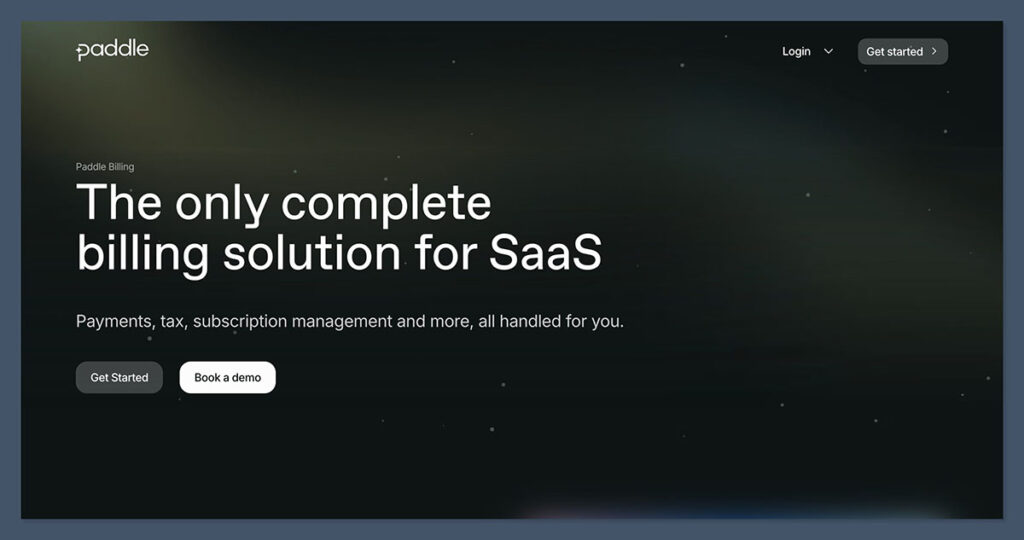
Paddle consolidates your billing stack into one tool.
| Feature Category | Included With Paddle | Notes |
|---|---|---|
| Payments and Checkout | Yes | Localized checkout, 17-plus currencies |
| Subscription Management | Yes | Trials, upgrades, prorated billing |
| Tax Compliance | Yes | VAT, GST, Sales Tax all handled |
| Invoicing and Receipts | Yes | Auto-generated and branded |
| Fraud Prevention | Yes | Built-in chargeback mitigation |
| SaaS Metrics | Yes | MRR, LTV, churn reporting |
| Customer Support | Yes | Fast, email and chat-based |
| Third-Party Integrations | Yes | Slack, ProfitWell, ChartMogul, Zapier |
This all-in-one approach simplifies operations significantly—especially for global SaaS startups.
Paddle’s Standout Feature: Merchant of Record Model
Unlike Stripe or Braintree, Paddle operates as a Merchant of Record.
That means Paddle, not your business, is the official seller of your SaaS product.
This might sound like a technical detail, but here’s what it means in practice:
You Don’t Have to:
- Register for VAT in each country
- Deal with cross-border tax filings
- Handle international fraud cases
- Worry about payment compliance like PSD2, GDPR, PCI DSS
- Manage payment disputes or chargebacks
For international SaaS businesses, this is a massive burden lifted.
Pricing: What Does Paddle Cost?
Paddle charges a flat 5 percent plus 0.50 dollars per transaction, with no monthly or setup fees.
Here’s a breakdown of how it looks at different revenue levels:
| Monthly Revenue | Paddle Fees | Effective Cost Percent |
|---|---|---|
| 500 dollars | 30 dollars | 6 percent |
| 5,000 dollars | 275 dollars | 5.5 percent |
| 20,000 dollars | 1,050 dollars | 5.25 percent |
| 100,000 dollars | 5,500 dollars | 5.5 percent |
While Stripe charges around 2.9 percent per transaction, it’s important to note that Paddle replaces a number of additional tools that SaaS businesses often need to combine, including:
- Stripe (for payment processing)
- TaxJar or Quaderno (for tax compliance and filing)
- Chargebee or Recurly (for subscription management)
- Chargeback protection and fraud tools
For many SaaS companies, these services can add up to several hundred dollars each month—not to mention the developer time and operational overhead required to maintain them.
By consolidating these functions into one platform, Paddle often presents better value overall, particularly for businesses selling globally or at scale
My Experience Setting Up Paddle
I integrated Paddle into a new SaaS project within three days.
Here’s what the process looked like:

Step 1: Onboarding
- Signed up with company info and tax ID
- Verified business details
- Added payout information with a US bank account
Step 2: Integration
- Installed Paddle’s SDK
- Used the pre-built checkout modal
- Configured webhook events for trials, payments, and refunds
Step 3: Testing and Launch
- Ran multiple test transactions in USD, EUR, and GBP
- Verified correct tax handling in the US and EU
- Went live within 72 hours
I didn’t need a dedicated developer. If you’ve ever integrated Stripe and Chargebee, you know how valuable that is.
Subscription Management: How Paddle Handles Plans and Upgrades
Paddle has a built-in subscription engine that supports:
- Free trials
- Monthly and annual billing
- Prorated upgrades and downgrades
- One-click renewals and upgrades
- Pausing, canceling, and refunding
This works out of the box without needing third-party tools.
| Functionality | Available in Paddle |
|---|---|
| Plan switching | Yes |
| Add-ons or upsells | Yes |
| Volume discounts | Yes |
| Usage-based billing | No |
If you need metered billing or complex usage-based pricing, Paddle might not be the best fit. It’s ideal for flat-rate or tiered pricing models.
Reporting and Analytics
Paddle includes real-time SaaS metrics dashboards covering:
- Monthly recurring revenue
- Churn and retention
- Upgrades and downgrades
- Refund rates
- Failed payment recovery
All data can be exported manually or via API, and you can connect to analytics platforms like ProfitWell or ChartMogul.
For most startups, this level of reporting is more than enough.
Churn Recovery and Failed Payments
Since acquiring ProfitWell, Paddle now includes built-in churn recovery tools as part of its platform.
During testing, these features stood out:
- Smart retry logic for failed card payments
- Automated email sequences to recover lost revenue
- Performance analytics that track recovery success over time
- Customizable workflows to align messaging with brand tone
According to Paddle’s own case studies, some businesses have seen failed payment recovery improve by over 25 percent within the first 60 days of using these tools.
While results vary by industry and volume, the automation and depth of insight provided are strong additions for any SaaS business focused on improving retention.
Paddle vs Stripe: Which One Is Better for SaaS?
If you're comparing Paddle and Stripe, here's a quick summary:
| Feature | Paddle | Stripe |
|---|---|---|
| Tax compliance | Fully handled | Manual setup |
| Merchant of Record | Yes | No |
| Integration time | 2–7 days | 2–4 weeks |
| Flexibility | Moderate | High |
| Per-transaction cost | 5 percent plus 0.50 dollars | 2.9 percent plus 0.30 dollars |
| Best for | Global SaaS | Custom workflows |
Choose Paddle if you want fast international scalability.
Choose Stripe if you need full control and already have a tax team.
Limitations to Be Aware Of
Every tool has its drawbacks. With Paddle, here are the main ones:
- High flat fee: Can be expensive for large-volume businesses
- Limited customization: Checkout flow is templated
- Not usage-based: No support for metered billing
- Legal setup: Paddle is listed as the seller, not your business
For most SaaS startups, these trade-offs are acceptable—but they’re worth considering based on your model.
Is Paddle Good Value for Money?
Despite its higher percentage fee, Paddle offers excellent value for the right type of business.
It replaces several tools, including your tax compliance stack, your subscription engine, and your fraud tools. That alone saves most founders hundreds each month.
In addition, the time savings, reduced stress, and legal protections make it a very appealing option for scaling internationally.
Final Verdict: Is Paddle Right for Your SaaS Business?
If you're launching or scaling a SaaS company, Paddle is one of the most efficient ways to set up billing, tax compliance, and subscription management—all in one tool.
Use Paddle if:
- You’re selling SaaS globally
- You want to avoid setting up international tax infrastructure
- You’re a lean team without a finance department
- You want a faster, simpler setup than Stripe or Chargebee
Skip Paddle if:
- You need usage-based pricing or complex billing workflows
- You want full UI customization and own every part of the checkout
- You already have in-house tax and legal resources
If simplicity, speed, and international sales are priorities, Paddle is the most complete billing solution I’ve tested this year.


currently Paddle is not good choce, they have a lot of problems, but you can’t see coz they are deleting bad reviews on trustpilot and etc…
It is kind of impossible to legally work with them from some EU countries.
They don’t let you generate the invoices on the payouts received, only providing a “reverse invoice” which in some countries is simply not a proper legal document.
Does paddle have integration with shopify? Thanks
Hi Bianca, not at the moment. Cheers.
Thanks so much for taking the time to review Paddle.com Catalin; we really appreciate it!
🙂