

Quick Verdict: If you're an entrepreneur or small online business owner looking to expand without dealing with inventory, Printful and SPOD are two solid print-on-demand options. Printful offers more customization and branding for serious brands, while SPOD is faster and more affordable — great for beginners or anyone who values speed over bells and whistles.
Entrepreneurs and small online business owners looking to launch or expand without managing inventory are turning to print-on-demand platforms. If you're aiming to make extra income without the stress of shipping or warehousing, Printful and SPOD are two top choices.
In this comparison, we’ll break down what each platform offers — from pricing to product quality — so you can decide which one fits your business best.
Printful vs SPOD: Their Pros and Cons
Before delving further into the nitty-gritty of this review, let's take a look at the pros and cons of using both Printful and SPOD:
Printful Pros and Cons
Pros 👍
- Printful ships to Europe, the US, Mexico, Australia, and other countries worldwide
- Printful’s products are fully white-labeled, so you have more control over your brand
- Printful offers a decent array of products – more than SPOD does
- There are plenty of integrations available
- It's easy to set up – you don't need any tech experience
- Printful's mockup generator is easy to use
- There's a generous maximum file upload size of 200MB
- Printful supports customized branding
- Printful works with reputable brands to ensure customers enjoy high-quality products
Cons 👎
- There aren't any built-in analytics, so you can’t track where customers come from
- Printful supports JPG and PNG, whereas SPOD supports those as well as GIF, and BMP
SPOD Pros and Cons
Pros 👍
- SPOD's products are white label
- You benefit from fast order turnaround times (48 hours)
- SPOD boasts a high rating on Shopify – 4.5 out of 5
- It's easy to install for Shopify users
- SPOD's products come with lower base prices than Printful, which means there are higher profit margins to be had
- SPOD uses good quality brands for its products
Cons 👎
- You can’t use it without a Shopify account
- There are fewer products to choose from than Printful
- SPOD only ships to the US and Europe
- There's a maximum file upload of 10MB – which is significantly less than Printiful
Printful vs SPOD: Key Feature Comparison
To make things even clearer, here’s a side-by-side table comparing the two platforms across some of the most important criteria for store owners:
| Feature | Printful | SPOD |
|---|---|---|
| Founded | 2013 | Early 2000s (by Spreadshirt) |
| Product range | 280+ items | 130+ items |
| Fulfillment time | 2–7 business days | 95% of orders ship in 48 hours |
| Branded packaging | Yes (labels, pack-ins, embroidery) | No (white-label only) |
| Shipping speed (US) | 3–4 days | 3–8 days |
| Integrations | 20+ platforms | Shopify, WooCommerce, Magento |
| Mockup generator | Advanced, includes Design Maker | Basic, with 50,000 clipart designs |
| Base pricing | Higher | Lower |
| API access | Yes (open-source) | Yes (REST API) |
| Live support | Yes (chat, email, phone) | Email + phone (no chat) |
| Print quality | High | Good, but more basic |
| Sample orders | Yes (with discount) | Yes |
Printful’s edge lies in offering a wide array of integrations, better branding options, and a polished design interface. Its support for platforms like Amazon, Etsy, Squarespace, and even Webflow means it's built to grow with your business if you plan to expand to multiple channels.
SPOD, on the other hand, is great for sellers who prioritize speed and simplicity. It’s not as expansive when it comes to third-party integrations or branding features, but it makes up for that by shipping out the majority of orders within two days.
That’s a serious benefit if fast delivery is critical to your customer experience.
What is Printful?
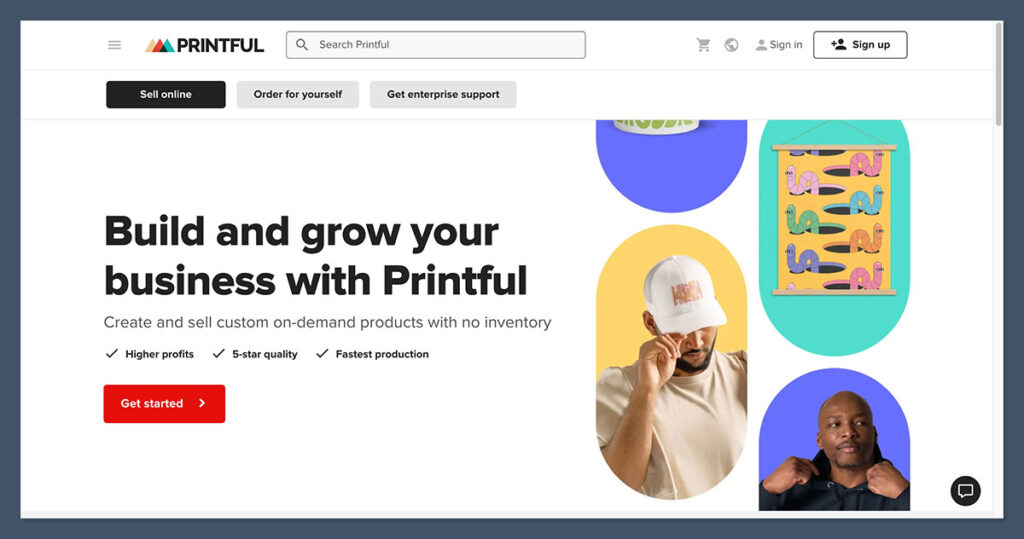
Founded in 2013, Printful is almost a decade old. It adopts the dropshipping business model, so all you need to do is sign up (for free), choose the merch you want to customize, and start designing and selling.
Printful handles order fulfillment and shipping for you, so you're entirely free to focus on marketing your online store.
As we've just hinted at, first things first, you'll need to set up a Printful account. Once you've done that, you can then integrate it with your existing ecommerce store.
Then, you can customize any of Printful’s 286 print on demand products and add them to your store to sell. We’re talking clothing for men, women, and kids, accessories, and simple home decor items such as pillowcases – to name a few!
Printful uses the following brands for its products: Alternative, American Apparel, Anvil, Bella + Canvas, Gildan, Hanes, and Next Level.
Or, if you already have lots of your own stock, Printful can warehouse and distribute your products for you. They have warehouse outlets located throughout the US, Canada, and Europe – although VAT may be added to the latter.
Suppose you’re unsure whether you want to sell Printful's products or you're keen on undertaking quality control. In that case, you can order sample products first.
Then, once you’re happy with the base product, you can use Printful’s mockup generator to bring your designs to life. Here you'll also find an inbuilt design maker where you can either upload your own design or create one using Printful.
It’s easy to use, with tons of mockups available for you to choose from and have fun with. Also included are clipart, graphics, fonts, and shapes.
👉 Read our full Printful review.
Fear not, you can preview your design before printing, so there’s always time to make adjustments.
To see our full Printful pricing review, click here.
What is SPOD?
Like Printful, SPOD is also a print-on-demand drop shipping service. It's powered by Spreadshirt and is also one of Shopify’s integrated apps.
As such, for the purposes of this SPOD review, we're focussing on the viewpoint of a Shopify user.
SPOD has been around for more than 20 years. At the time of writing, its website told us that over 50,000 items are produced daily, with 95% of these shipped out in 48 hours, and that in 2020, it shipped more than 9.8m items.
Impressive, right?
Shopify store owners can use SPOD to create a print-on-demand store and quickly sell customized products. However, it's worth noting that SPOD markets itself to beginners ranging up to medium volume merchants.
To get started, install the SPOD app to your Shopify store. After that, you can choose from 130+ products, 70+themes, and 50,000 free designs to use.
SPOD prints and dispatches your custom products directly to your customers. You just have to correctly set your shipping and billing preferences, and you're good to go!
One advantage is that SPOD ships within 48 hours from the US, which is pretty fast work! With an estimated order arrival time between three to eight days.
SPOD's product range is compiled using the following brands: American Apparel, Anvil, Bella + Canvas, Gildan, Hanes, Fruit of the Loom, and Rabbit Skins.
Printful vs SPOD: Product Quality and Customization
While both platforms offer strong foundations, the quality of the final product and how much you can customize it matters a lot — especially if you're trying to build a serious brand.
Printful
Printful is known for its consistent product quality, partly due to the premium brands it uses and partly due to its wide global fulfillment network. It provides:
- Inside and outside branding options
- Embroidery on hats, polos, and bags
- All-over sublimation printing on specific products
- Custom labels on packaging and inside garments
- A Design Maker tool that lets you create from scratch using fonts, clipart, and shapes
This setup makes Printful perfect for brand owners who want to look professional and polished out of the gate.
In addition to the built-in design tools, Printful’s mockup generator allows sellers to preview exactly how their products will look once printed.
You can choose from a wide selection of mockups to match your store’s aesthetic and ensure every listing looks professional. This is particularly useful for ecommerce store owners who want high-quality visuals without hiring a designer or investing in photography.
You can also request product samples before launching. This gives you an opportunity to see, feel, and test the product for quality. Whether it's checking embroidery detail, fabric thickness, or print durability, sampling helps reduce the risk of returns or unhappy customers once you go live.
SPOD
SPOD doesn’t offer as much branding flexibility. While it uses top-tier garment brands, it lacks the finishing touches like embroidered logos or customized packaging.
Instead, SPOD leans on simplicity. Their product designer tool is easier for beginners, with:
- Access to 50,000+ free designs
- Quick personalization tools (text overlays, clipart)
- Templates for popular items like mugs and t-shirts
SPOD is ideal for store owners who don’t need advanced branding features and just want to launch quickly. Their design interface may not offer as much polish as Printful’s, but it’s intuitive and provides more than enough to start creating custom apparel and accessories right away.
Additionally, SPOD’s customization capabilities are enhanced by the ability to support vector files, making it easier for more advanced users to upload designs created in Adobe Illustrator or similar tools.
This is particularly helpful for maintaining high resolution and sharpness, especially on larger format prints or products like posters.
SPOD’s pre-built themes also simplify the process of applying designs across different product types. You can choose from over 70 layout options, which gives you a base design style for items like mugs, shirts, and aprons.
It’s less custom, but much quicker if you're pushing a wide catalog.
Printful vs SPOD: Design Tools and Mockups
The quality of your product presentation can make or break sales, especially in saturated ecommerce categories.
Printful's Design Tools
Printful’s Mockup Generator and Design Maker provide extensive features for showcasing your designs. You can:
- Create product visuals for t-shirts, hoodies, posters, and more
- Choose between lifestyle mockups and flat lays
- Preview embroidery before placing orders
- Use built-in clipart, fonts, and templates to design without Photoshop
This makes it easy to prepare a product page that looks great on Shopify, WooCommerce, or Etsy — without needing a separate graphic designer.
One standout feature is the wide variety of image placements available for each product. You’re not limited to just the front or back of a shirt — many products allow sleeve prints, inside label designs, and even external logo placement.
These extra touches help make your products look more professional and cohesive as a collection.
Printful also enables sellers to use custom fonts and access a large font library for text-based designs. If your brand is based on typography, quotes, or slogans, this level of control is particularly useful.
SPOD's Design Experience
SPOD offers a simplified interface designed for speed and ease of use. It doesn’t have the same depth in design features, but the learning curve is gentle. You can:
- Select from 70+ design themes
- Access over 50,000 free graphics
- Upload your own artwork
- Quickly apply designs to multiple product variants
SPOD’s mockup tool allows for rapid deployment of products, especially if you’re working with high volumes or just want to test multiple design ideas quickly.
You can go from idea to product page in minutes, which is one of the platform’s biggest appeals for Shopify users.
What’s more, you’re not limited to JPEG and PNG formats. SPOD supports multiple file types including SVG and AI, which gives you the freedom to retain image quality and ensure cleaner prints — especially on larger products like posters and wall art.
If you’re targeting niche markets or running print-on-demand alongside other inventory, SPOD’s fast design-to-listing pipeline is a real time-saver.
Printful vs SPOD: Warehouse and Logistics
As you grow, the way your chosen POD partner handles logistics and inventory becomes more important.
Printful Warehousing
Printful has a global fulfillment network with facilities in:
- North Carolina and California (US)
- Toronto (Canada)
- Barcelona and Riga (Europe)
- Tijuana (Mexico)
- Tokyo (Japan)
They offer warehousing services, allowing you to store your own products and use Printful as your logistics backend. If you're a hybrid brand selling both custom-printed items and pre-manufactured stock, this is a massive advantage.
Printful’s warehousing and fulfillment service means you can send in bulk inventory, and they’ll pick, pack, and ship your non-POD products just like they do with your print-on-demand orders.
This is especially useful if you have a mix of POD and custom-manufactured items or if you're transitioning into more serious eCommerce operations. The flexibility to warehouse your own goods alongside POD items is a major edge.
It's also worth noting that VAT may be charged when warehousing in Europe, so for sellers targeting EU countries, it’s smart to review those cost implications ahead of time.
Nonetheless, Printful's multi-location setup ensures you can reach customers faster and reduce shipping costs — especially helpful for international businesses.
SPOD Fulfillment
SPOD’s operations are based in:
- Nevada and Pennsylvania (US)
- Poland (EU)
They do not offer warehousing for your personal inventory. SPOD is strictly POD, and their focus is speed. So while fulfillment is lightning-fast, it lacks the flexibility that Printful offers with storage and shipping.
SPOD’s core advantage is their ability to print and ship orders within 48 hours — with over 50,000 products shipped daily.
This quick turnaround helps reduce customer complaints and increases satisfaction, especially for sellers who offer holiday sales, flash deals, or other time-sensitive promotions. Fast fulfillment often leads to better reviews and repeat buyers.
Although you can't warehouse goods with SPOD, they still offer white-label packaging, meaning your branding doesn’t appear on any of their shipping labels or invoices.
While they currently don’t provide branded packaging, the feature is reportedly in development. If implemented, it could add a whole new layer of appeal for brands that want more control over the unboxing experience.
Printful vs SPOD: Returns and Refunds
Handling returns is part of the reality in eCommerce. So what’s the policy from each provider?
Printful
Printful offers a limited return policy focused on manufacturing issues:
- Refunds or replacements are offered if items are damaged or misprinted
- Requests must be submitted within 30 days
- Customers cannot return items just because they changed their minds
You’ll need to clearly state these terms in your own store policy to avoid disputes.
Printful also requires photo evidence when requesting replacements for faulty products. This helps protect you as a seller and ensures that only valid claims are honored.
The process is fairly streamlined through their Help Center, where you can manage issues directly from your dashboard.
They also have a detailed Returns and Exchanges knowledge base to help sellers navigate any customer complaints.
Since Printful handles fulfillment and production, the burden is shared, but the seller is still expected to manage the customer relationship. Transparent communication and accurate product descriptions go a long way in reducing refund rates.
SPOD
SPOD has a slightly more rigid approach:
- They’ll issue refunds for defective products or printing errors
- You need to report issues within 30 days
- Customers are not allowed to send returns back to SPOD directly
As a merchant, you’ll be responsible for mediating returns, so communication and transparency are key.
SPOD also requires supporting documentation, such as photos and order numbers, when you submit a return or refund request.
Their system allows you to manage this through your Shopify dashboard or directly through their Help Center, making it fairly straightforward even for new sellers.
One key difference is that SPOD does not accept returns unless there's a production issue. There’s no option for buyer remorse returns, which means you’ll need to make sure your sizing charts, product images, and descriptions are crystal clear to avoid misunderstandings.
Like Printful, you’re responsible for customer service, but SPOD does handle the backend when issues are valid.
Printful vs SPOD: Profit Margins and Pricing Strategy
Both platforms recommend adding a 30–50% markup to your base cost, but that’s not always realistic when you’re competing on price.
Here’s a quick example of how your costs and profits could look side by side:
| Product | Printful Cost | SPOD Cost | Suggested Retail | Estimated Profit |
|---|---|---|---|---|
| Men’s T-Shirt | $14.95 | $6.71 | $22.99 | $8.04 (Printful), $16.28 (SPOD) |
| Hoodie | $26.95 | $20.99 | $39.99 | $13.04 (Printful), $19.00 (SPOD) |
| Tote Bag | $14.95 | $9.91 | $21.99 | $7.04 (Printful), $12.08 (SPOD) |
As you can see, SPOD’s lower base prices allow for a larger profit margin — but remember, they don’t include the branding options that Printful does.
Printful encourages using their Profit Calculator to map out margins. For example, buying a t-shirt at $8.01 and selling 10 units at $10.41 yields about $24 in profit.
While the margins may seem slim at first glance, leveraging upsells, bundles, and higher perceived value through branded experiences can significantly boost profitability.
SPOD’s lower prices make it easier to experiment with flash sales and discounts without eating into your profits. For instance, their pricing includes the first print by default, and you can keep things simple by sticking to one design per product.
This keeps overhead costs down and simplifies your pricing strategy, especially useful for early-stage entrepreneurs.
Printful vs SPOD: Scalability and Growth Potential
Thinking long-term? It’s worth asking: which platform will support your growth at scale?
Printful Scaling Benefits
- Global distribution centers reduce international shipping times
- Deep integrations with Etsy, Amazon, Shopify, and WooCommerce
- Open-source API for creating custom tools
- Warehousing options for scaling brands with external inventory
- Easy-to-upgrade branding as your store matures
If you’re running influencer campaigns or TikTok ads and want polished packaging to impress, Printful can handle that as you scale.
Printful’s comprehensive integration ecosystem supports business owners who want to expand across multiple platforms — including niche marketplaces like Storenvy and Wish.
And if your team has development resources, the Printful API enables advanced automation such as syncing with third-party apps, adjusting pricing rules, or auto-generating listings.
Their support team and onboarding documentation also scale with you. Whether you’re selling 10 or 10,000 units, Printful has the infrastructure to support growth without compromising quality.
SPOD Scaling Benefits
- High-speed fulfillment makes it ideal for testing new products fast
- Good for limited drops, fast turnaround promos, or trending products
- Integrated primarily with Shopify, making scaling within that ecosystem simple
- Lower pricing allows you to offer discounts and still profit
SPOD is particularly useful for flash sales or time-sensitive promotions where 48-hour fulfillment can create great customer experiences.
Because SPOD focuses on efficiency and speed, it's a strong choice for dropshippers who want to test new designs quickly without long wait times or high investment.
Launching products in response to trending events, memes, or seasonal shifts becomes easier when you can have designs printed and shipped almost immediately.
And while it may not offer the same advanced features as Printful, SPOD’s REST API still provides scalability for businesses using custom platforms or inventory systems.
For high-volume Shopify sellers, it offers a stable and fast backend with fewer bells and whistles.
Printful vs SPOD: Final Thoughts
There’s no one-size-fits-all solution when it comes to choosing between Printful and SPOD. The best choice depends on your business model, experience level, and future plans.
Go with Printful if you:
- Want to build a strong brand with custom labels and packaging
- Are selling across multiple platforms (Etsy, Amazon, WooCommerce)
- Need global shipping and warehousing
- Can afford slightly higher base prices in exchange for presentation
Go with SPOD if you:
- Are new to ecommerce and want a low-risk, affordable starting point
- Only sell through Shopify
- Need super fast delivery for customer satisfaction
- Aren’t worried about branding extras
If you’re still unsure, it’s worth signing up for both platforms (they’re free) and ordering product samples. Comparing them side-by-side in your own hands will tell you everything you need to know about quality, speed, and ease of use.
Maybe you’re even considering a third option like Printify, Teelaunch, or Gooten. Each platform has its own quirks, costs, and strengths — but no matter what you choose, the key is to align your POD partner with the kind of business you want to build.



I am currently using Printful, but currently researching a platform a little more cost effective. I’m considering trying SPOD.
Hello Staci, Printful has one of the best selections of high quality products, but you can find some more alternatives to Printful here.